1765
Learning Morphosyntactic Analyzers from the Bible via Iterative
Annotation Projection across 26 Languages
Garrett Nicolai and David Yarowsky
Center for Language and Speech Processing Johns Hopkins University
[email protected] [email protected]
Abstract
A large percentage of computational tools are concentrated in a very small subset of the planet’s languages. Compounding the issue, many languages lack the high-quality linguis-tic annotation necessary for the construction of such tools with current machine learning methods. In this paper, we address both is-sues simultaneously: leveraging the high ac-curacy of English taggers and parsers, we project morphological information onto trans-lations of the Bible in 26 varied test languages. Using an iterative discovery, constraint, and training process, we build inflectional lexica in the target languages. Through a combina-tion of iteracombina-tion, ensembling, and reranking, we see double-digit relative error reductions in lemmatization and morphological analysis over a strong initial system.
1 Introduction
The computational processing of languages such as English and Arabic has undeniably benefited from the construction of annotated datasets such as treebanks and morphological databases. Unfor-tunately, the construction of even modestly-sized treebanks is very expensive, requiring hundreds of hours of expert annotation. The construction of computational tools is in turn limited by a lack of supervised training data.
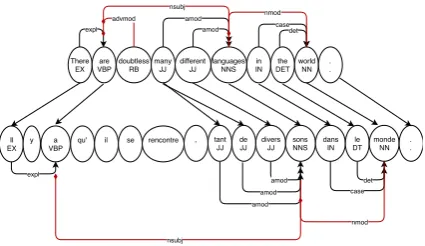
One alternative to hand-annotating low-resource languages (LRL) involves using existing tools for a high-resource language (HRL), such as English, and projecting these annotations to the LRL across a parallel corpus. Consider the example in Figure1: the English sentence is POS-tagged and dependency parsed by tools that have been trained on large amounts of high-quality data. The sentence is word-aligned to its French translation, and the POS tags and dependency relations follow the alignments to annotate the
There EX
are VBP
doubtless RB
many JJ
different JJ
languages NNS
in IN
the DET
world NN . .
expl amod amod
case det nmod
Il EX
y a VBP
qu' il se rencontre , tant JJ
de JJ
divers JJ
sons NNS
dans IN
le DT
monde NN
. .
expl
amod amod
amod
case det
nmod advmod
nsubj
[image:1.595.308.521.222.345.2]nsubj
Figure 1: Projection of POS tags and dependency parse from English to French. Black arrows demonstrate left-to-right dependency relations, while red diamonds il-lustrate right-to-left dependency relations.
French words. Note that the projection is not lossless: the aligner could not find a French translation of “doubtless”, and has thus been unable to project theRBtag or advmodrelation into French.
Parallel corpora are rare, and even when they do exist, they often only exist between specific pairs of languages. However, the documentation of a language often begins with the creation of several important documents, including a dictio-nary of key terms, and translations of religious texts. Thus, documents such as the Christian Bible are among the most translated documents in the world (Mayer and Cysouw, 2014). Furthermore, the Bible consists of short, numbered chapters and verses consisting of a small number of sentences. Although not parallel to the standard required in fields such as machine translation, the structure of the Bible means that different Bibles are approxi-mately parallel across verses.
We follow a tradition of projecting POS tags from a high-resource language onto a language with fewer available tools (Yarowsky et al.,2001;
and Botha, 2016). Our contributions, however, lie on the level of morphology and morphosyn-tax. With no further resources in the target lan-guage than a Bible translation and a dictionary, we project English POS tags, dependency relations, and semantic labels across the alignment. Lever-aging the alignment and a collaboration of anno-tations, we are able to hypothesize both a lemma and detailed morphosyntactic features for both in-flected nouns and verbs. This information can then be used to inform the construction of morphologi-cal analyzers.
We learn to identify morphosyntactic categories including plurality, temporality, and case over nouns and verbs in a test set of 26 diverse lan-guages. By leveraging annotations across a se-ries of alternative Bible translations, we are able to successfully identify lemmas and morphologi-cal features, obtaining further improvements from strategies such as ensembling and reranking.
2 Related Work
Automatic morphological induction has had nu-merous contributions over the years. Here, we list the most relevant to this work, and distinguish this work from what has come before.
The class of methods introduced byYarowsky et al.(2001) are the most similar to the work de-scribed in this paper. Also beginning with aligned Bible data, they recover verbal lemmas by lever-aging multi-lingual alignments. However, where they are only interested in recovering the lemma, we simultaneously induce detailed morphologi-cal features of the words in the target language, over a wider range of verbal and nominal mor-phology, and deploy a new set of machine learn-ing techniques to do so. Futhermore, we signif-icantly expand the languages included in our test set, from 3 to 26 typologically diverse languages, substantially increasing the range of morphosyn-tactic phenomena covered and assessed.
Similarly, Fossum and Abney(2005) and Agi´c et al.(2015) exploit the parallel nature of the Bible to project POS tags and train taggers in the tar-get languages, leveraging the signal from multiple languages to improve the tagger accuracy. We fo-cus, instead, on the induction of detailed morpho-logical categories.
Soricut and Och (2015) induce morphological transformation rules in an unsupervised manner. While this is analogous to lemmatization, part of
our motivation is to also produce detailed morpho-logical features that might be useful to train low-resource taggers, or to more richly annotate mor-phologically sparse languages such as English.
Buys and Botha(2016) train morphological tag-gers in morphologically rich languages from an English projection. However, their method is de-pendent upon an English corpus tagged with more morphologically aware tags than are typically pro-duced by an off-the-shelf English POS tagger. We instead argue that much of this information is re-coverable from syntactic and semantic parses, al-lowing us to use massively-parallel corpora such as the Bible.
Kirov et al. (2017) notes the morphological sparsity of English, and reverses our setup, pro-jecting morphologically rich tags from Czech into English. Rather than add another potentially noisy projection step (i.e., Czech to English to LRL), we instead leverage dependency and semantic parses to more richly tag English.
In the area of contraint-based discovery, our methodology most closely resembles the con-strained discovery systems ofLin et al.(2016) and particularlyUpadhyay et al.(2018). Starting from a high-quality seed, a learning algorithm gener-alizes observed patterns, iteratively increasing the seed data with confident examples, while discard-ing examples that fail to pass certain heuristics. However, unlike previous work, we assume no gold seed annotations for our system - our seed is extracted exclusively from a noisy bitext word alignment.
3 Methods
English Bibles
Project
Annotated English Bibles Annotate
LRL Bibles Aligned
Discover
Reanalyze Annotated
LRL Bibles
Constrain Inflection
Pairs
Train Constrained
Inflection Pairs English
Tools
Learn
Seq2Seq Rediscover
[image:3.595.72.283.59.215.2]Seq2Seq Model
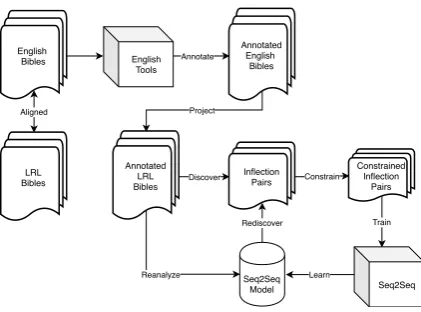
Figure 2: The discovery, constraint, and generation process. Beginning in the top-left, our method pro-ceeds towards the lower-right corner, which forms an iterative cycle that can be repeated until convergence.
3.1 Tagging and Projection
We begin with a series of 27 English Bible trans-lations, each verse-aligned to at least one Bible in a target language. Many of these Bibles are based on translations that are hundreds of years old, and preserve archaic conventions for literary reasons. Unfortunately, modern NLP tools are usually trained on modern text data, and the pres-ence of archaic linguistic forms can seriously de-grade the quality of the annotation.
Fortunately, many archaicisms in the Bible are older verbal inflections that follow a small set of consistent patterns: 2ndperson verbs end in “-est” instead of a null affix, and 3rdperson verbs end in
“-eth” instead of “s” (i.e., “seest” and “believeth”). Before tagging and parsing, we normalize these forms, as well as other common archaic forms, such as “thou”, to their modern equivalents.1
The English Bibles are then lemmatized, POS-tagged, and syntactically and semantically parsed. POS tags are directly projected between aligned words in the source and target: if a word in English aligns with multiple target words, its annotations are projected to all of them. Conversely, if many English words align to a single target word, all of the annotations are projected onto the target word (for induction, each of these tags is given equal, reduced weight).
Parses are similarly projected across the align-ment, however unlike tags, parses are tuples con-taining a head, a relation, and a modifier (or a
1Although Bibles in other languages can also be written
in older forms of the language, we leave target normalization to future work.
Vorschriften Gebote Regeln
Regel Vorschrift
Gebot
commandments commandment
Figure 3: Projecting lemmas across alignments.
Dashed lines can be eliminated with an edit-distance threshold.
predicate and its arguments, for a semantic parse). Semantic parses behave similar to POS tags, and can be projected directly onto the target words. For syntactic parses, we project the relation onto the modifier, with a back pointer to the head.
When working with a noisy alignment, such as are common in low-resource situations, it is pos-sible that either the head or the modifier will not have an aligned translation in the target. If the modifier is not aligned, then the dependency re-lation is lost, such as is the case with “doubtless” in Figure1. However, if the head is not aligned, the relation will still be projected onto the modi-fier. For our purposes, it is far more informative to know that a particular noun is a nominal subject, without knowing the verb, than to know that a verb has a subject, but not knowing what the subject is.
3.2 Lemma Discovery
Although it is straightforward to project tags across an alignment, lemmas provide a more sig-nificant challenge. In this section, we describe our method of discovering lemmas that can later be used to train lemmatizers and morphological an-alyzers.
Our lemma-induction approach is similar to that proposed by Yarowsky et al. (2001). Each En-glish word forms a set with the target words with which it is aligned. Likewise, each Englishlemma
forms a set with a group of target words. In the best case, the lemma set contains translations ob-tained from a bilingual dictionary, but if a dictio-nary is sparse, the set can be supplemented with the words aligned with the English lemma. These sets are then used to create a complete bipartite graph such that each edge corresponds with a can-didate plural-singular word pair. Pairs that fail to meet an edit-distance threshold can be discarded. An example is shown in Figure3.
[image:3.595.308.521.60.152.2]aligned to three German words. Similarly, its lemma “commandment” has been aligned to three words. Completing the graph, we establish 9 can-didate plural-singular pairs. However, some of these pairs, such as Regeln–Gebot are obviously false, and can be eliminated by an edit-distance threshold. Three pairs: Regeln–Regel, Gebote– Gebot, andVorschriften–Vorschrift, remain.
3.3 Discovery of Morphological Features
Lemmatization is itself an important application, as it can reduce data sparsity in inflectionally-rich languages. However, lemmas are only one of many available English annotations that may be able to benefit LRLs. In this section, we de-scribe our methods for leveraging English syntac-tic and semansyntac-tic parses to discover morphological features in our target languages. We consider three types of morphological information: nominal plu-rality, case, and temporality.
Our first task is to identify, for a given noun, whether it is singular or plural. This information is readily available from the English POS, and we can thus create an inflection triple for each word tagged as a noun. This triple contains the inflected form, the hypothesized lemma, and a morphologi-cal tag identifying whether the noun is singular or plural. For example, “women” would produce the triple{women, woman, PL}.
Although English does not, for the most part, decline its nouns, some case information has been translated into syntax: direct objects of verbs are in the accusative case, indirect objects are in the dative case, and nouns in prepositional phrases headed by “of” are in the genitive case. We ap-proximate case by using a set of heuristics to trans-late a syntactic and semantic parse into a nominal case. With these heuristics, we are able to con-struct 12 nominative cases. Details concerning the rules used to construct the cases can be found in the Appendix.2
Finally, we extract verbal temporality. Namely, we extract whether a verb describes an event in the past, the present, or the future. While many languages further distinguish between other tem-poral actions such as completion or habituality, we restrict our work here to a tripartite extraction, as temporality features are ready available from an English POS tagger and a syntactic parse.
2These rules are by no means complete. They merely
serve as an approximation to find some examples of the de-sired inflections.
I baptize you with water .
German Wasser
Czech vodou
Finnish vedellä
Hungarian vízbe
Russian водо́ю NOM(0.33)
ACC(0.33) DAT(0.33) INST(1)
[image:4.595.308.522.61.173.2]AT+ESS(1) IN+ALL(1) INST(1)
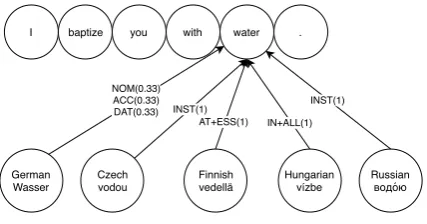
Figure 4: Forming a consensus from morphologically-informed languages.
For every verb in our English Bible, we label it as either past, present, or future, and project the label onto the target language. Present and simple past verbs can be determined directly from the POS tags, while the perfect and future tenses are informed by the syntactic parse. Past participles (i.e., VBN), governed by a form of “have” is marked as past tense. Similarly, any past participle or infinitive governed by an auxil-iary form of “will” or “shall” is marked as future tense.
Rule-based systems, however, can be brittle, so we also investigate a secondary case signal: other target languages. The Bible is not only bilingually parallel – each translation is approximately par-allel witheveryother language. Other languages than English may be better-suited to annotating the case of a target language.
Consider the example in Figure 4. A depen-dency parser might inform us that “water” is a nominal modifier of “with”, but “with” is an am-biguous preposition, corresponding to both in-strumental uses such as “He caught fish with a net”, and comitative uses “He sat down with his apostles”. We can observe which words in morphologically-rich languages have aligned to “water” in this verse. The case of these words can then be identified via a morphological dictionary.
Morphological dictionaries are expensive to construct, but exist for a small number of lan-guages; a consensus of high-resource languages can be used to inform the annotation in a low-resource one.3 In Figure4, water is identified as clearly being used in theinstrumentalcase in both Czech and Russian, and as in theessiveand alla-tivecase in Finnish and Hungarian, respectively. German has a weaker signal, with an identical
re-3If the relevant word form is not present in any of the
alization in three different cases. A simple voting scheme can annotate this use of “water” with the
instrumentalcase. This annotation is then simply another piece of information to be projected across the alignment onto the target language.
3.4 Constraint
To filter out noisy candidate pairs, we implement a series of sequential heuristics. These heuris-tics leverage the projected annotation to remove false positives while preserving as many of the true pairs as possible.
We note that in the English translations of the Bible, if a word is present in its plural form, it is also often present as a singular. Furthermore, the singular form is regularly more frequent. Our first heuristic discards any pairs for which a proposed singular form occurs less frequently in the corpus than the plural.
Secondly, we ensure that both inflected and lemma candidates have been regularly tagged as such. Polysemy, syncretism, and alignment er-rors mean that each word may have had many tags projected upon it. For example, a past tense verb may occasionally incorrectly receive a present tag – we do not want this infrequent mistake to iden-tify false morphological phenomena. We compro-mise between a desire to remove noise, while pre-serving true candidates. For each word, we cal-culate the average frequency across all of its tags. A pair is kept if the desired tag occurs more fre-quently than average.
Next, we discard any pair that demonstrates an unlikely character transformation. These trans-formations are discovered through the use of an unsupervised character aligner. The inflected forms are aligned with their discovered analysis. A pair is discarded if its normalized alignment likelihood does not fall within 2 standard devi-ations of the average likelihood. Consider the triple praised,praise,TAG. This inflection and lemma will pass an edit-distance threshold, but is much more likely to be a verbal inflection than a nominal one. The pair will be discarded if the task is plurality detection, asd→PLis an un-likely sequence. However, d→PST is very com-mon, and thus the pair would be retained for tem-porality detection.
Our preliminary nominal lemma detection is based solely on a singular/plural distinction, with no regards to case. It is possible that the
hypoth-esized lemma is a singular form other than the ci-tation form. To limit the singular forms in the dis-covered set to citation forms, we use the depen-dency parse and a target dictionary to restrict lem-mas to nominal subjects that occur in the dictio-nary.
3.5 Generation
After denoising our initial lexicon, we train mod-els that learn to transform an inflected form into a citation form.4 After training, we attempt to ana-lyze all verbs and nouns in the corpus.
We then limit the hypotheses to high-confidence analyses, and pairs for which the predicted lemma appeared in the original target Bible. This re-stricted hypothesis list is then constrained via the heuristics in Section 3.4, and new models are learned. By augmenting the training data with hy-potheses generated by the original models, we can exploit words that were in the original Bibles, but that our original induction methods missed, due to a missing alignment, a poor parse, or other noise. Development experiments demonstrated that one iteration of supplementing the training data was beneficial across our languages; subsequent iter-ations led to little further gain.
4 Experiments
In this section, we describe the data and tools that we use to label our English Bibles and generate our morphological analyses. We also outline our evaluation metrics and describe our experimental results.
Our Bible data is obtained from the cor-pus of Mayer and Cysouw (2014), which con-sists of verse-parallel Bible data across 591 lan-guages, including 27 English Bibles. The En-glish and target Bibles are aligned using the Berke-ley aligner (Liang et al., 2006), and POS tagged and syntactically parsed using the Stanford NLP toolkit (Manning et al., 2014). We semantically parse the Bibles using the Deep Semantic Role Labeler (He et al., 2017). The alignment filter is implemented using M2M aligner (Jiampojamarn et al.,2007), and our dictionaries come from Pan-Lex (Kamholz et al.,2014); statistics concerning dictionary and training sizes are contained in the appendix.
4For languages such as Arabic and Hebrew, where the
To evaluate the quality of the lexica that are pro-duced, we extract gold validation and heldout sets from UniMorph (Kirov et al., 2018). Using the URIEL typological database (Littel et al., 2016), we limit the languages to those that include af-fixing verbal and nominal inflection, and that dis-tinctly mark plurality and temporality.5 Our
eval-uation set consists of 26 languages belonging to several language families such as Semitic, Ger-manic, Italic, Slavic, Uralic, and Bantu. For each of these languages, we randomly select a valida-tion set of 5000 instances, and 1000 heldout in-stances.6 For our declension experiments, we ap-proximate case from a majority of higher-resource morphological dictionaries, as described in Sec-tion 3.3. For these experiments, the majority is obtained from the 10 largest nominal databases in our language set. Further information is included in the appendix.
4.1 Data
We consider two learning algorithms for the gen-eration phase of lexicon creation. The first is the bidirectional, hard-attentional RNN (RNN) over edit actions ofMakarov and Clematide(2018). We use 100 hidden units on the input layer, and 200 on the encoder and decoder. We train the sys-tem using the ADADELTA optimizer for a maxi-mum of 60 epochs, with 50%dropout. The second is DirecTL+ (DTL;Jiampojamarn et al.,2010), a semi-Markov model that learns transduction ac-tions over sequences of characters; an n-gram size of 9 is used, with a joint 𝑛-gram size of 3. We further ensemble the two models by adding the normalized confidence scores produced by each model (Ensemble). We also consider a simple reranking (RR) scheme where any analysis with a lemma appearing in a dictionary has its confi-dence score incremented by the score of the best original hypothesis. In this way, forms that appear in the dictionary appear at the top of the list, in the same order as they were generated by the original model.
We evaluate against two simple baselines that provide estimates of the difficulty of the task. The first baseline simply produces the inflected form
5Of our languages, six do not contain declension
infor-mation in UniMorph. For these languages, the declension models will be identical to the plurality ones.
6Several of the UniMorph corpora contain fewer than
6000 suitable inflection-lemma pairs; in these cases, the size of the validation set is adjusted accordingly.
as the lemma (Identity). The second baseline com-pares an inflected form with every citation form in a dictionary, and identifies the lemma as the cita-tion form with the lowest edit distance from the inflected form (DictED). For morphological anal-ysis, both baselines return the most common in-flectional class from the training data. All systems are evaluated on accuracy@1, accuracy@5, and accuracy@50. Accuracy@𝑛rewards a system if it returns one of the correct solutions in its first𝑛
predictions. While we focus our analysis on the accuracy@1, containing the correct solution in an
𝑛-best list can also be desirable when recall is val-ued more highly than precision.
4.2 Singularization
Morphological analysis produces a lemma and bundle of inflectional features, given an inflected wordform. In our first set of experiments, we in-vestigate a special case of analysis: singulariza-tion. By focusing on singularization, we can es-tablish which of our filtering heuristics are effec-tive in a task where we can be relaeffec-tively certain that the lemma exists somewhere in the text. In these experiments, we sequentially accumulate the heuristic filters described in Section 3.4, begin-ning with the plural-singular pairs hypothesized by our dictionary-independent lemma extraction. The average singularization accuracy over all 26 languages is detailed in Table1.
We see that DirecTL+ and the RNN behave very differently when the training data is filtered. Di-recTL+ improves marginally for each successive filter. Contrarily, the morphological filter, in par-ticular, leads to a decrease in accuracy for the RNN, while all of the filters sharply limit the num-ber of correct candidates that appear lower in the list. Some of this decrease can be attributed to smaller training data, and most of the loss is re-covered via a second iteration, which increases the size of the training data. However, we hypothe-size that the morphological filter, in particular, is too aggressive. It removes instances that contain infrequent transformations that allow the RNN to produce correct candidates further down the list.
System Projection +Lemma +Morph +Align +Dep +Dict I2 +RR
Identity 9.1 9.1 9.1 9.1 9.1 9.1 9.1 9.1
DictED N/A N/A N/A N/A N/A 31.0 31.0 31.0
DTL@1 15.2 16.8 16.9 16.7 17.8 21.3 33.0 43.1
RNN@1 17.7 17.8 16.5 17.4 18.7 22.8 30.6 36.9
Ensemble@1 17.5 19.3 18.9 18.9 20.6 25.5 36.4 43.5
DTL@5 31.6 31.9 33.1 33.0 33.8 37.1 47.3 53.3
RNN@5 40.3 33.7 30.9 32.2 31.7 37.1 46.3 52.0
Ensemble@5 43.4 40.2 39.8 40.0 40.3 45.6 57.9 61.5
DTL@50 44.9 49.7 50.4 50.8 50.8 50.6 57.8 57.8
RNN@50 63.2 52.0 49.7 51.0 50.8 54.3 60.9 60.9
Ensemble@50 63.5 58.5 57.6 58.3 58.4 60.8 70.2 71.4
Table 1: Accumulative lemmatic recall in the top-1, top-5, and top-50 hypotheses. Projection does not filter training candidates, other than by edit distance. Lemma implements the lemma heuristic, Morph the morphological one, Align the alignment one, Dep the dependency parses, Dict the dictionary, I2 applies a second iteration, and RR reranks the target hypotheses.
as null inflection: “Kochlöffel”→“Kochlöffel” (cooking spoon).
Limiting the target candidates by case has a marked impact upon the systems. By re-moving false lemmas like the German genitive “Geistes” (of the spirit), the Hungarian inessive “temploban” (in the temple), and Danish definite forms l ike “skidet” (the boat), the systems are more likely to produce the citation form: German “*Ingenieurs”→“Ingenieur” (engineer); Hungar-ian “*gõzhajóban”→“gõzhajó” (steamboat); Dan-ish “*rygradet”→“rygrad” (backbone). By remov-ing these noisy forms, we see large gains; the lem-mas returned by the Finnish, Hungarian, and Turk-ish system without noise reduction are correct less than 10%of the time, while filtering the data in-creases the accuracy to approximately 26%, 56%, and 70%, respectively.
Supplementing the system with a second iter-ation strengthens the signal of correct inflection patterns, relatively weakening the effect of noise. For example, German nouns ending in “-ung“ are very likely to pluralize with an “-en” suffix, but the projection baseline discovers no correct “-ung” pairs. However, “-en” is a common plural suffix in German, and the systems systematically strip the “-en” from “-ungen” nouns, although often lower in the hypothesis list. These correct pairs become training examples in the second iteration, outnum-bering noisy examples, and improving system ac-curacy.
If we have access to a dictionary, simply
choos-ing the schoos-ingular form closest to the inflection pro-vides a surprisingly strong baseline – indeed, our systems do not surpass this simple heuristic until we implement a second iteration. Noting that the dictionary and iteration process contribute signif-icantly more than any of the filtering heuristics, we investigate moving the dictionary earlier in the pipeline. Instead of creating a lemma list from the words aligned with the English lemma, as in Sec-tion3.2we use a list of translations of the English lemma.
By moving the dictionary to the “front-of-the-line” in such a matter, we see astounding gains, with the @1 recall of the reranked ensemble im-proving to 58.5%. In our further experiments, we thus adopt the dictionary in the lemma extraction method.
4.3 Lemmatization
System Nouns Verbs
I1 I2 +RR I1 I2 +RR
Identity 9.6 9.6 9.6 2.8 2.8 2.8
[image:8.595.71.292.63.195.2]DictED 34.8 34.8 34.8 18.6 18.6 18.6 DTL@1 44.8 48.1 59.3 46.3 49.4 50.6 RNN@1 45.7 47.6 55.7 47.6 51.5 49.5 Ens@1 51.0 51.0 57.5 51.1 52.8 53.7 DTL@5 61.0 63.8 68.9 59.6 60.9 63.6 RNN@5 55.0 55.1 61.1 58.4 60.5 62.0 Ens@5 66.6 64.8 71.1 65.0 65.9 68.7 DTL@50 71.1 74.7 74.7 68.2 70.0 70.0 RNN@50 71.2 68.9 68.8 70.6 69.2 69.2 Ens@50 78.7 77.2 78.4 74.8 75.2 75.9
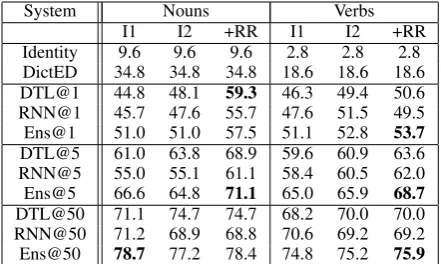
Table 2: Average Lemmatization accuracy on nouns
and verbs. I1 uses the dictionary-based lemma
ex-traction, I2 implements a second iteration, RR adds a reranker to I2.
produce the correct lemma – nouns are about 4 times as likely to observe null-inflection as verbs, and even plural nouns tend to drift significantly from their lemmas, to the point that another cita-tion form has a smaller edit-distance. However, we note little difference between nouns and verbs for any of our systems - in fact, our verbal system prior to reranking is slightly better than the nomi-nal system. Ensembling neural and traditionomi-nal sys-tems augments performance,
The ensemble makes use of complementary in-formation to improve over either the RNN or DTL, even when neither system correctly pre-dicts the lemma as its top candidate. For ex-ample, DTL predicts the lemma of the Estonian “l˜opetagem” as “*l˜opemama”, while the RNN predicts “*l˜opetamine. Both predict the correct “l˜opetama” (to finish) in 2nd place, which is ex-ploited by the ensemble system.
Re-incorporating the dictionary back in as a reranking step also provides gains, particularly to nominal lemmatization. This is even true with very small dictionaries: although the Northern-Sami and Zulu dictionaries both contain fewer than 5000 entries, North-Sami nominal lemmati-zation accuracy increase from 40 to 44 %, and Zulu from 38 to 40%.
4.4 Morphological Analysis
In our next series of experiments, we consider not only the accuracy of the lemmas produced by our systems, but of the complete morpholog-ical analyses. The task of morphologmorpholog-ical analysis subsumes lemmatization: a correct analysis must find not only the correct lemma, but also the cor-rect set of morphological features that transformed
the lemma into the inflected form. Analyzing the same systems as in Section3.2, we report the ac-curacy of complete analyses in Table3.
We note that with the exception of temporal-ity, arriving at a consensus for the morphological tag is superior to deriving it from a simple heuris-tic. While the English signal is strong enough to recover some morphological information, per-haps unsurprisingly, the signal from languages that have maintained their nominal declension is stronger. Given enough languages, the signal is strong enough to overcome idiosyncratic proper-ties of the languages individually.
The heuristics that extract case from English can be confused by complex clauses. In the sen-tence “He ordered his soldiers to remove him from his midst” the soldiers are the nominative sub-ject of the verb “remove”, but the dative obsub-ject of the verb “order”. Relying on the dependency parse alone allows dative plurals such as the Polish “˙zołnierzom” (soldiers) to enter the training data erroneously tagged as a nominative plural. The model then incorrectly tags other words ending in “-om”, a distinctly dative suffix, as nominatives. Achieving a consensus from other languages cor-rectly identifies the form as a dative, even though it is used as a subject.
4.5 Further Analysis
In the previous sections, we averaged our results over 26 languages exhibiting various morphologi-cal phenomena. In this section, we provide a more nuanced investigation of the types of languages suited to our methods.
We claim that the Bible is a suitable resource for learning the morphology of low-resource lan-guages, but due to the necessity of gold morpho-logical dictionaries, many of our evaluation lan-guages cannot be considered low-resource. How-ever, the only available resources we assume to ex-ist are a translated Bible and a bilingual dictionary. By grouping languages by the size of their dictio-naries, we can determine the impact that the size of the dictionary has on our methods, and extrap-olate how they might work in a true low-resource scenario. Table4demonstrates how the dictionary size influences two steps in our method: lemma extraction, and reranking.
lan-System Plurality Temporality Case
RB Maj I2 RR RB Maj I2 RR RB Maj I2 RR
Identity 8.9 8.9 8.9 8.9 2.0 2.0 2.0 2.0 8.7 8.7 8.7 8.7
[image:9.595.100.498.61.197.2]DictED 20.9 20.9 20.9 20.9 8.9 8.9 8.9 8.9 10.1 10.1 10.1 10.1 DTL@1 32.1 37.5 39.2 47.0 37.2 36.4 38.8 38.7 18.9 21.9 23.6 27.9 RNN@1 34.1 36.8 37.7 42.9 37.0 38.7 40.2 38.2 17.0 16.3 17.7 19.6 Ensemble@1 36.6 43.4 41.2 47.8 41.4 40.4 41.3 41.5 21.1 24.1 24.6 27.4 DTL@5 52.6 56.1 57.3 65.1 53.4 50.3 50.8 55.7 33.3 38.6 39.6 46.7 RNN@5 59.0 62.0 62.9 67.9 56.0 56.3 58.5 60.0 35.4 36.2 40.3 44.4 Ensemble@5 64.7 69.1 67.3 73.1 62.1 59.9 61.1 63.8 40.8 46.0 46.6 51.1 DTL@50 68.6 68.2 71.7 71.7 64.5 61.3 63.9 63.9 47.9 53.1 55.7 55.7 RNN@50 71.9 76.9 75.1 74.9 68.3 69.3 67.4 67.1 54.4 59.2 58.0 58.0 Ensemble@50 76.8 81.0 78.8 80.0 73.0 71.8 71.4 72.2 58.0 64.2 62.8 64.5
Table 3: Average Accuracy of morphological analysis for plurality detection, temporality detection, and case identification. RB denotes a system where case is hypothesized through rules, Maj denotes a majority consensus of other languages, I2 is a second iteration built on top of Maj, and RR applies a reranker to RR.
#Entries Nouns Nouns +RR Verbs Verbs +RR
<5K 48.7 52.1 24.1 24.4
5K-20K 38.0 41.2 35.9 38.1
20K-50K 52.5 63.4 62.3 63.0
[image:9.595.308.526.266.373.2]>50K 57.4 64.5 62.3 63.0
Table 4: Average Lemmatization accuracy@1 on nouns and verbs of the ensemble system for varying dictio-nary sizes.
guages with the smallest dictionaries perform ap-proximately as well as larger groups on nominal lemmatization, only starting to degrade after dic-tionary reranking, which is to be expected. Verbal lemmatization, on the other hand, degrades much faster as the size of the available dictionary is re-duced. However, we observe that the reranker – which is entirely dependent on the dictionary – has far less influence on verbs than nouns, even with a large dictionary. The size of the dictionary may be less of a factor than the types of morphology exhibited in the lower-resource languages.
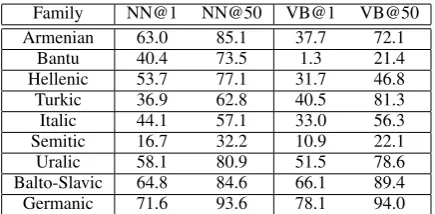
We next observe which languages are most suit-able to our methods, by separating our results by linguistic family. Table 5 reports both the accu-racy@1 and accuracy@50 for the reranked ensem-ble. Although our system can accurately lemma-tize Bantu nouns, Bantu verbs prove much more difficult. The low accuracy on Bantu verbs appears to be at least partially responsible for the low ver-bal performance of LRL in Table4.
Secondly, we note that while our system strug-gles with Semitic and Bantu language families, our methods of projection and constraint are suc-cessful on other language families, even when their morphology differs significantly from En-glish. We correctly lemmatize Uralic and
Balto-Family NN@1 NN@50 VB@1 VB@50
Armenian 63.0 85.1 37.7 72.1
Bantu 40.4 73.5 1.3 21.4
Hellenic 53.7 77.1 31.7 46.8
Turkic 36.9 62.8 40.5 81.3
Italic 44.1 57.1 33.0 56.3
Semitic 16.7 32.2 10.9 22.1
Uralic 58.1 80.9 51.5 78.6
Balto-Slavic 64.8 84.6 66.1 89.4
Germanic 71.6 93.6 78.1 94.0
Table 5: Average Lemmatization accuracy on nouns and verbs of the ensemble system for varying language Families.
Slavic languages – languages with large case in-ventories – with high accuracy. Similarly, the ver-bal signal is strong enough to train accurate lem-matizers in languages with much more complex inflectional systems than English, such as the ag-glutinative Turkic and Uralic families.
5 Conclusion
[image:9.595.72.292.268.324.2]References
Željko Agi´c, Dirk Hovy, and Anders Søgaard. 2015. If all you have is a bit of the Bible: Learning POS
tag-gers for truly low-resource languages. In
Proceed-ings of the 53rd Annual Meeting of the Association for Computational Linguistics and the 7th Interna-tional Joint Conference on Natural Language Pro-cessing (Volume 2: Short Papers), volume 2, pages 268–272.
Jan Buys and Jan A. Botha. 2016. Cross-lingual
mor-phological tagging for low-resource languages. In
Proceedings of the 54th Annual Meeting of the As-sociation for Computational Linguistics (Volume 1: Long Papers), pages 1954–1964, Berlin, Germany. Association for Computational Linguistics.
Victoria Fossum and Steven Abney. 2005. Automati-cally inducing a part-of-speech tagger by projecting from multiple source languages across aligned
cor-pora. InInternational Conference on Natural
Lan-guage Processing, pages 862–873. Springer.
Luheng He, Kenton Lee, Mike Lewis, and Luke Zettle-moyer. 2017. Deep semantic role labeling: What
works and what’s next. InProceedings of the
An-nual Meeting of the Association for Computational Linguistics.
Sittichai Jiampojamarn, Colin Cherry, and Grzegorz
Kondrak. 2010. Integrating joint n-gram features
into a discriminative training network. In
NAACL-HLT, pages 697–700, Los Angeles, CA. Association
for Computational Linguistics.
Sittichai Jiampojamarn, Grzegorz Kondrak, and Tarek
Sherif. 2007. Applying many-to-many alignments
and Hidden Markov Models to letter-to-phoneme conversion. In Human Language Technologies 2007: The Conference of the North American Chap-ter of the Association for Computational Linguistics; Proceedings of the Main Conference, pages 372– 379. Association for Computational Linguistics.
David Kamholz, Jonathan Pool, and Susan M Colow-ick. 2014. PanLex: Building a resource for
panlin-gual lexical translation. InLREC, pages 3145–3150.
Christo Kirov, Ryan Cotterell, John Sylak-Glassman, Géraldine Walther, Ekaterina Vylomova, Patrick Xia, Manaal Faruqui, Sebastian J. Mielke, Arya McCarthy, Sandra Kübler, David Yarowsky, Jason
Eisner, and Mans Hulden. 2018. UniMorph 2.0:
Universal morphology. InProceedings of the 11th Language Resources and Evaluation Conference, Miyazaki, Japan. European Language Resource As-sociation.
Christo Kirov, John Sylak-Glassman, Rebecca
Knowles, Ryan Cotterell, and Matt Post. 2017. A rich morphological tagger for English: Exploring the cross-linguistic tradeoff between morphology
and syntax. InProceedings of the 15th Conference
of the European Chapter of the Association for
Computational Linguistics: Volume 2, Short Papers, volume 2, pages 112–117.
Percy Liang, Ben Taskar, and Dan Klein. 2006.
Align-ment by agreeAlign-ment. In Proceedings of the main
conference on Human Language Technology Con-ference of the North American Chapter of the As-sociation of Computational Linguistics, pages 104– 111. Association for Computational Linguistics.
Ying Lin, Xiaoman Pan, Aliya Deri, Heng Ji, and
Kevin Knight. 2016. Leveraging entity linking
and related language projection to improve name
transliteration. In Proceedings of the Sixth Named
Entity Workshop, pages 1–10.
Patrick Littel, David R Mortensen, and Lori Levin.
2016. URIEL typological database. Pittsburgh:
CMU.
Peter Makarov and Simon Clematide. 2018.
Neu-ral transition-based string transduction for
limited-resource setting in morphology. In Proceedings of
the 27th International Conference on Computational Linguistics, pages 83–93.
Christopher D. Manning, Mihai Surdeanu, John Bauer, Jenny Finkel, Steven J. Bethard, and David
Mc-Closky. 2014. The Stanford CoreNLP natural
lan-guage processing toolkit. InAssociation for Compu-tational Linguistics (ACL) System Demonstrations, pages 55–60.
Thomas Mayer and Michael Cysouw. 2014.
Creat-ing a massively parallel Bible corpus. Oceania,
135(273):40.
Radu Soricut and Franz Och. 2015. Unsupervised
mor-phology induction using word embeddings. In
Pro-ceedings of the 2015 Conference of the North Amer-ican Chapter of the Association for Computational Linguistics: Human Language Technologies, pages 1627–1637.
Shyam Upadhyay, Jordan Kodner, and Dan Roth. 2018.
Bootstrapping transliteration with constrained dis-covery for low-resource languages. InEMNLP.