http://dx.doi.org/10.4236/ojog.2014.46042
How to cite this paper: Saleh, H.S., et al. (2014) Pull Breech out versus Push Impacted Head up in Emergency Cesarean Sec-tion: A Comparative Study. Open Journal of Obstetrics and Gynecology, 4, 260-265.
http://dx.doi.org/10.4236/ojog.2014.46042
Pull Breech out versus Push Impacted
Head up in Emergency Cesarean Section:
A Comparative Study
Hend S. Saleh, Gamal A. Kassem, Mohamed El Said Mohamed, Moustafa A. Ibrahiem,
Manal M. El Behery*
Faculty of Medicine, Zagazig University, Zagazig, Egypt Email: *[email protected]
Received 19 February 2014; revised 12 March 2014; accepted 20 March 2014
Copyright © 2014 by authors and Scientific Research Publishing Inc.
This work is licensed under the Creative Commons Attribution International License (CC BY). http://creativecommons.org/licenses/by/4.0/
Abstract
Objective: To compare maternal and fetal outcome associated with two methods Reverse breech extraction versus Head pushing to deliver the impacted fetal head in advanced labor requiring emergency Cesarean section. Method: A prospective comparative study was conducted on 80 preg- nant women at term with cephalic presentation in advanced labour, requiring emergency Cesa-rean Section. Reverse breech extraction technique (pull method) was used in 40 cases (group I) and pushing the head up through the vagina (“push” method) was tried in (group II) 40 cases. The maternal outcome was assessed by extension of the uterine Incision, bladder injury, intra and post- operative blood transfusion, Postpartum hemorrhage, wound infection and duration of hospital stay. Fetal outcome was Apgar score and admission to neonatal intensive care unit. Results: Exten-sion of the uterine inciExten-sion was significantly lower in women undergoing reverse breech extrac-tion compared to cephalic delivery (20% versus 50%; p = 0.001). The mean operative time (pull group) was lower than that in the (push group) 59.7 ± 4.2, versus 75.2 ± 6.1 p = 0.001 and blood loss was significantly lower in the (pull group) than that in the (push group) 878 ± 67 ml, versus 1321 ± 57 ml, p = 0.001. No significant difference between groups regarding maternal and neonat-al outcome. Conclusion: Reverse breech extraction (pull) is safer than pushing head up through vagina (push) for delivery of a deeply impacted fetal head in advanced labour sensitizing emer-gency Cesarean Section and is associated with the least maternal complications.
Keywords
Deeply Engaged Head; Obstructed Labor; Cesarean Section; Reverse Breech Extraction; Head Push Method
1. Introduction
Emergency Caesarean section is performed as an obstetric emergency, where intrapartum complications sudden- ly raised, and swift action is required to prevent the demises of mother, fetus or both [1]-[3]. Obstructed labor occurs when there is no progress in labor in spite of strong uterine contraction as shown by failure of cervix to dilate or failure of presenting part to descend through birth canal [4].
Although rare in developed countries, obstructed labor is still a common obstetric complication in developing countries associated with poor fetal and maternal outcome [5] [6]. One of the impasses that the obstetrician fre-quently meet is how to keep the maternal and neonatal morbidity to the least when given a select between diffi-cult vaginal instrumental delivery and caesarean section at full dilatation cervix [5].
The percentage of second stage Cesarean Section is on the rise as there is a higher incidence of failure of in-strumental delivery, and patients’ reluctance to inin-strumental delivery especially forceps as cesarean section is a safer option and strict guidelines for the length of labor [6].
Emergency cesarean section and delivery of the fetus are difficult in advanced second stage of labor as fetal head is deeply impacted in the pelvis and carriage, a higher risk of complications for both the mother and the ba- by. The difficulty in delivering the fetal head is because of lack of space between the bony pelvis, pelvic soft tis- sues and the fetal head, and in advanced labour lower segment is already thin, overstretched and edematous [7]. When excessive manipulation is done to deliver the fetal head there is a high risk of injury to uterine vessels, trauma to urinary tract and extensions of lower segment. A relatively high transverse uterine incision is often necessary to avoid incision through the vagina and avoid injury of bladder uterine. These constraints often result in incisions at the level of the fetal trunk [8]. To overcome the difficulty of delivering the fetus and reducing maternal and fetal morbidity during cesarean section, different techniques have been modified like Head push, Reverse breech extraction.
One option to deliver impacted fetal head in emergency CS is the conventional head push technique (push method) using an assistant hand in the vagina to push the head up toward the uterine incision while the operator tries to pass his/her hand below the head to dislodge the head from pelvis. Alternatively a reverse breech extrac-tion technique (pull method) is usually performed by opening the uterus soon to reach into the upper segment for a fetal leg, and by applying gentle traction on the leg until the another leg appeared. Then both legs are held to-gether and the body of fetus could be delivered (pulled) out of the uterus completely using technique similar to that for a breech delivery [9].
The purpose of this study is to compare the complications (maternal and fetal) of reverse breech extraction (Pull) technique versus Head push technique (push) in delivering the deeply wedged fetal head during emergen-cy caesarean section with active advanced labor.
2. Patients and Method
The angles of the uterine incision were clamped, and any extension was noted. An extension was defined as unintended extension of uterine incision beyond normal limits. The rest of the procedure was completed by the standard method. The blood loss was estimated by measuring blood in the suction apparatus, was repeated 24 hours after operation. Maternal outcome intraoperative in the form of complications like uterine artery injury, uterine incision extension, urinary tract Injury, intrapartum hemorrhage, and Postoperative complications like postpartum hemorrhage, Postoperative blood transfusion Infected wound, hospital stay. Fetal outcome was as-sessed in both groups and compared to each other. The institution ethical committee approved the study proto-col.
The data were processed using the Statistical Package for Social Sciences (SPSS 12). Mean and standard deviation as well as proportion were used as appropriate for describing data. Chi square test was used for qualit-ative variables and student-t test for quantitqualit-ative variables. The 95% confidence intervals CI and odds ratio OR were calculated as appropriate. A p < 0.05 was considered statistically significant.
3. Results
Eighty pregnant women with full term pregnancy in advanced labor were included in this study. All patients had emergency Cesarean section with impacted fetal head.
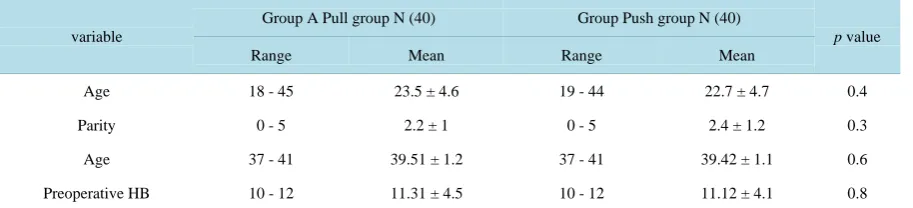
Table 1 represented the demographic data of the participants of both groups. There were no statistically sig-nificant differences between them. Table 2 represented intraoperative maternal complications. There was signif-icant difference between both groups. Extension of the uterine incision, it was signifsignif-icantly lower in group A 8 cases than in group Bin 20 cases with p value 0.001. No bladder injury happened in group A but there were 2 cases had that injury in group B. It was needed to intraoperative blood transfusion in 2 cases only of group A, but in group B, 10 cases needed to blood transfusion with p value 0.02. Operative time was significantly longer in group B in compare with time was spent in group A with p value 0.001. Blood loss was significantly more in group B than in group B with p value 0.001. No case of rupture uterus occurred in either group. Table 3
represented postoperative maternal complications. There were no significant differences between both groups except in fall in hemoglobin level, it was more in group B than in group A. Table 4 represented fetal outcome in both studied groups. No statistically significant differences between them.
4. Discussion
Cesarean sections in the second stage of labor are often associated with higher complications rate and morbidity [10]-[12]. It is still a common problem in our nation mainly in rural area to face many cases of prolonged ob-structed labor when the fetal head is deeply impacted in the pelvis after unsuccessful attempts at home delivery, whether assisted or not by unskilled midwives. Performing Cesarean Section in such situation is often difficult and problematic, because the lower uterine segment may be significantly overstretched, and the standard lower segment incision might be placed too low into the vagina with possible extension into the lower part of broad ligament, profuse bleeding from uterine vessels laceration, and potential injury of the ureter [13]. Moreover, the presence of fetal head molding and caput succedaneum could likely make the disengagement of the fetal head very difficult [14].
Delivery in this circumstance could be tried by either slipping of surgeon hand deeply into the lower uterine segment between the symphysis pubis and fetal head with gentle elevation of fetal head with the fingers and palm through the incision, with accepting the probability of lower uterine segment tears. However, if the need for assistance with a hand from below is recognized before the Cesarean is taken, the legs of the lady can be placed in a supine frog-leg or modified lithotomy position. The assistant pushing the head up from the vagina (push technique) should try to flex the fetal head. If possible, three or four fingers or a cupped hand or the palm of the hand should be used to apply force widely across the presenting part to avoid the risk of fetal skull frac-ture [10] [15].
Another alternative is reverse breech extraction technique (pull method) performed by opening the uterus high to reach into the upper segment for a fetal leg, and by applying gentle traction on the leg until another leg ap-peared. Then both legs are held together and the body of fetus could be delivered in a way similar to breech de-livery.
Table 1. The demographic characteristics of studied groups.
variable
Group A Pull group N (40) Group Push group N (40)
p value
Range Mean Range Mean
Age 18 - 45 23.5 ± 4.6 19 - 44 22.7 ± 4.7 0.4
Parity 0 - 5 2.2 ± 1 0 - 5 2.4 ± 1.2 0.3
Age 37 - 41 39.51 ± 1.2 37 - 41 39.42 ± 1.1 0.6
Preoperative HB 10 - 12 11.31 ± 4.5 10 - 12 11.12 ± 4.1 0.8
[image:4.595.89.537.240.368.2]The data are presented as mean ± SD or n (%), P value < 0.05 is significant.
Table 2. Intraoperative maternal complications.
variable Group A Pull group N (40) Group Push group N (40) P value
Extension of incision 8 (20%) 20 (50%) 0.001
Injury to urinary bladder 0 (0%) 2 (5%) 0.41
Intraoperative Blood transfusion 2 (5%) 10 (25%) 0.02
Operative time, min 59.7 ± 4.2 min 75.2 ± 6.1 min 0.001
Rupture of uterus 0 0
Mean blood loss 878 ± 674 ml 1321 ± 572 ml 0.001
The data are presented as mean ± SD or n (%), P value < 0.05 is significant.
Table 3. Postoperative maternal complications.
variable Group A Pull group N (40) Group Push group N (40) P Value
Postpartum hemorrhage 2 5 0.06
Blood transfusion 4 7 0.07
Mean fall in Hb/dl 1.25 ± 0.4 2.1 ± 25 0.003
Wound infection 1 2 0.52
Mean hospital stay 3.2 ± 1.4 3.8 ± 1.3 0.72
The data are presented as mean ± SD or n (%), P value < 0.05 is significant.
Table 4. Fetal outcome.
variable Group A Pull group N (40) Group Push group N (40)
Apgar Score 1min 12 (30%) 16 (40%) 0.280
Apgar Score 5 min 5 (12.5%) 9 (22.5%) 0.312
Admission to neonatal care unit 4 7 0.176
The data are presented as mean ± SD or n (%), P value < 0.05 is significant.
beneath the presenting part, it is advisable to sustain the elevation of the fetal head upwards until it brings the lower and flexed part of the vertex into the open incision. The delivery of the head before this point may result in laceration. Similarly, using excessive force to deliver the fetal head may result in extension of the uterine in-cision.
Also, we found that (pull) method was associated with significantly lower amount of blood loss intraoperative, besides lesser operative time compared to (push) method. These findings are analogous to the study of Baloch et al. 2008 who discussed that reverse breech extraction can be achieved if a high transverse, or J-shaped incision is made in the lower segment [16].
It is vital for the surgeon to be prepared and experienced for using various maneuvers punctually. As the oc-currence of prolonged obstructed labor in the developing nations is doubtful to be disregarded until now, training the resident doctors the simple thought of the maneuvers mandatory when met with a real situation should be addressed. In this current study, there were no significant.
No significant differences in the postoperative complications such as wound infection, hospital stay and post-partum hemorrhage was detected between both groups. This went in line with result of Kaima, et al. 2011 [17]. But, in disagreement with Fasubaa et al. 2002 who reported a higher postoperative infection rate in form of en-dometritis in the “push” method compared to reverse breech extraction. It seems logical that passage of the as-sistant’s hand (who mostly is not part of the operating team) into the vagina can never be under sterile conditions, and therefore contamination of the operating field should be anticipated [18].
Our study revealed that postpartum decrease in hemoglobin level was more in second group (push) than in (pull) group and this was explained by increase the intrapartum hemorrhage among the (push) group and so in-creased blood loss. That result was in agree with result of Thura. 2009 and Kaima, et al. 2011.
The results neonatal outcome in our study was slightly better in the pulling method group than in pushing group but with no significant difference and this agree with result of study of Thura.
5. Conclusions
Cesarean section for women with prolonged and obstructed labor when the fetal head is deeply impacted in the pelvis is linked with difficulty.
Disengagement and possible risks for maternal catastrophe are tissue injury, excessive and blood loss. Deli-very of the upper fetal pole first (reverse breech extraction) or pull method in such a position is a good-looking decision and harmless substitute to the pushing method to decrease such maternal complications.
References
[1] Betran, A.P., Merialdi, M., Lauer, J.A., et al. (2007) Rates of Cesarean Section: Analysis of Global, Regional and Na- tional Estimates. Paediatric and Perinatal Epidemiology, 21, 98-113.
[2] Brady, E., Hamilton, Joyce, A., Martin, M.P.H. and Stephanie, J., Ventura, M.A. (2012) National Vital Statistics Sys-tem. Division of Vital Statistics. Births: Preliminary Data for 2012.
[3] Cunningham, M. (2001) Gant. Caesarean Section. William’s Obstetrics. 28th Edition, 518-519.
[4] Hallak, M. (1999) Poor Progress in Labor. High Risk Pregnancy Management Options. 2nd Edition, 1113-1114.
[5] Kafali, H. (2003) Cesarean Breech Extraction for Impacted Fetal Head in Deep Pelvis after a Prolonged Obstructed La- bor: A Cesarean Technique Variation. The Internet Journal of Gynecology & Obstetric, 2, 2.
[6] Farah, Z., Seema, H. and Tamkin, K. (2013) Delivery of the Deeply Engaged Fetal Head during Cesarean Section in Advanced Labour: A Comparative Study of Head Pushing versus Reverse Breech Extraction. Current Pediatric
Re-search, 17,41-43.
[7] Blickstein, I. (2004) Difficult Delivery of the Impacted Head during Cesarean Section.
[8] Levy, R., Chernomoretz, T., Appleman, Z., Levin, D., Or, Y. and Hagay, Z.J. (2005)Head Pushing versus Reverse Breech Extraction in Case of Impacted Fetal Head during Cesarean Section. The European Journal of Obstetrics &
Gynecology and Reproductive Biology, 121, 24-26. http://dx.doi.org/10.1016/j.ejogrb.2004.09.014
[9] Robert, L.B. (2012) Difficult Fetal Extraction at Cesarean Delivery: What Should You Do? Next Time You Face This
Hazardous Scenario, Try Reverse Breech Extraction, 24, 1.
[10] Copra, S., Bagga, R., Keepanasseril, A., Jain, V., Kalara, J. and Suri, V. (2009) Disengagement of Deeply Engaged Fe- tal Head during Cesarean Section in Advanced Labor: Conventional Method versus Reverse Breech. Acta of
[11] Farah, Z., Seema, H. and Tamkin, K. (2013) Delivery of the Deeply Engaged Fetal Head during Cesarean Section in Advanced Labour: A Comparative Study of Head Pushing versus Reverse Breech Extraction. Current Pediatric
Re-search, 17,41-43.
[12] Dolea, C. and Abouzahr, C. (2003) Global Burden of Obstructed Labour in the Year 2000. Evidence and Information for Policy, World Health Organization, Geneva.
[13] Chopra, S., Bagga, R., Keepanasseril, A., Jain, V., Kalra, J. and Suri, V. (2009) Disengagement of the Deeply Engaged Fetal Head during Cesarean Section in Advanced Labor: Conventional Method versus Reverse Breech Extraction. Acta
of Scandinavian Obstetrics and Gynecology, 88, 1163-1166. http://dx.doi.org/10.1080/00016340903214932
[14] Blickstein, I. (2004) Difficult Delivery of the Impacted Fetal Head during Section: Intraoperative Disengagement Dys-tocia. Journal of Perinatal Medicine, 32, 465-469. http://dx.doi.org/10.1515/JPM.2004.152
[15] Levy, R., Chemomoretz, T., Appleman, Z., Levin, D., Or, Y. and Hagay, Z.J. (2005) Head Pushing versus Reverse Breech Extraction in Cases of Impacted Fetal Head during Cesarean Section. The European Journal of Obstetrics & Gynecolo-
gy and Reproductive Biology, 121, 24-26.
[16] Baloch, S., Khaskheli, M., Khushk, I.A. and Sheeba, A. (2008) Frequency of Second Stage Intervention and Its Out-come in Relation with Instrumental Vaginal Delivery versus Caesarean Section. Journal of Ayub Medical College
Ab-bottabad, 20, 87-90.
[17] Kaima, A.F., Abdulhakim, A.E. and Abdelrahman, H.A.-H.Reverse Breech Extraction versus Head Pushing in Cesa-rean Section for Obstructed Labor. Saudi Medical Journal, 32, 1261-1266.