Isolated Handwritten Roman Numerals Recognition
using Dynamic Programming, Naïve Bayes and Support
Vectors Machines
R. Salouan
Department of Mathematic and Informatic Polydisciplinary Faculty
Sultan Moulay Slimane University Beni Mellal, Morocco
S. Safi
Department of Mathematic and Informatic Polydisciplinary Faculty
Sultan Moulay Slimane University Beni Mellal, Morocco
B. Bouikhalene
Department of Mathematic and Informatic Polydisciplinary Faculty
Sultan Moulay Slimane University Beni Mellal, Morocco
ABSTRACT
Optical character recognition is undoubtedly considered as a one of the most active and dynamic fields of pattern recognition and artificial intelligence; it really provides in fact a solution for recognizing large volume of patterns automatically. The purpose of the present study is to compare in one hand between the performances of three novel hybrid methods used in OCR for extracting efficiently the features from characters which are the structural method called zoning combined in first time with Krawtchouk, then in second time with pseudo-Zernike invariant moments then finally combined with invariant analytical Fourier-Mellin transform in third time, and between the precision of three classifiers which the first one is a statistical that is the support vectors machine, the second is a probabilistic that is the naïve Bayes while the third forms part from optimization that is the dynamic programming on the other hand. For this purpose, we have preprocessed each numeral image by the median filter, the thresholding, the centering and the edge detection techniques. Moreover, the experiments that we have applied provided us convincing and satisfactory results.
General Terms
Zoning method, Krawtchouk invariant moment, Pseudo Zernike moment, Invariant analytical Fourier-Mellin transform, Dynamic programming, Naïve Bayes classifier, Support vectors machine.
Keywords
Isolated handwritten Roman numerals, the median filter, the thresholding, the centering and the edge detection techniques, the zoning method, the Krawtchouk invariant moment, the pseudo-Zernike invariant moment, the invariant analytical Fourier-Mellin transform, the support vectors machine, the naïve Bayes, the dynamic programming.
1.
INTRODUCTION
Character Recognition (CR) systems offer really potential advantages by providing an interface which makes the interaction between man and machine easier. Some of the powerful application fields of CR there is Optical Character Recognition (OCR) that plays an important role in many different domains as archiving documents and automatic verification of bank checks, etc. on the other hand, several studies carried for character recognition by using the zoning method [1-3] or the invariant moments [4-8] and the support vectors machines [9-12] or the naïve Bayes [13-16] or the dynamic programming [17-20].
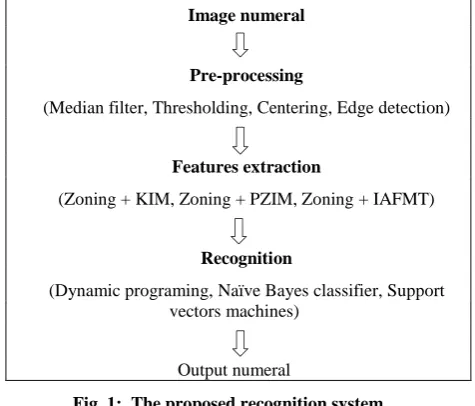
In fact, each optical character recognition system is composed from three principal phases which are the preprocessing which serves to clean the character image in order to enhance its quality, in this context we have interested in this work to the median filter, the thresholding, the centering and the edge detection techniques. The second phase is features extraction used to extract some efficient features called also primitives from the numeral image that is in principle presented in form of a matrix in order to convert this last to a vector which will allow thereafter its recognition enough easy, in this sense and for realizing this phase, we exploited the zoning method combined with in firstly with the Krawtchouk Invariant Moment (KIM)[21] then secondly with Pseudo Zernike Invariant Moment (PZIM) [22], thirdly with the Invariant Analytical Fourier-Mellin Transform (IATFM) [23].The last phase is the recognition, in this framework we have opted three classifiers which are the support vector machines, the naïve Bayes and the dynamic programming. Anyway, this paper is organized as follows: First of all the proposed system is given. In second section the pre-processing process is presented. The features extraction phase is described in third section. The fourth section explains the recognition phase. The experimental results are given in fifth section. Finally, this work is ended by a conclusion. Hence, our recognition system is presented as follow:
Image numeral
Pre-processing
(Median filter, Thresholding, Centering, Edge detection)
Features extraction
(Zoning + KIM, Zoning + PZIM, Zoning + IAFMT)
Recognition
(Dynamic programing, Naïve Bayes classifier, Support vectors machines)
[image:1.595.311.549.513.716.2]Output numeral
Fig 1: The proposed recognition system.
2.
PRE-PROCESSING
information’s which enables producing a much cleaned version of the character image so that it can be used efficiently in the features extraction phase. In this context, we have pre-processed in this study each numeral image by the median filter for filtering the image then by the thresholding
used in order to render each numeral image containing only the black (value 0) and the white (value 1) colours according a preset threshold, then by the centering employed to localized the numeral justly in the center of image, finally by the edge detection exploited for finding the edge of numeral.
Fig. 2. The different techniques ofpre-processing
3.
FEATURES EXTRACTION
Features Extraction is the technique by which certain efficient features or primitives from an image are extracted, detected and represented for further processing. In fact, the term ‘feature’ refers to similar characteristics. Therefore, the main goal of a features extraction phase is to accurately retrieve these features. In this sense many methods can be used to compute the features. In this work, we use the zoning method combined with the Krawtchouk then secondly with pseudo Zernike invariant moments, thirdly with the invariant analytical Fourier-Mellin transform.
3.1
The zoning method
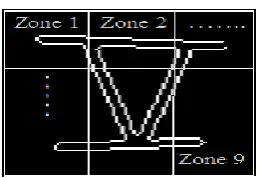
In this work we have used the zoning method that can be explained as follow:
[image:2.595.101.231.481.570.2]Given a black image that contains an numeral written in white, the zoning method consists to divide this image to a several zones then calculating in each of them the number of white pixels, all these numbers are stocked in a vector, that is to say image is converted to a vector has a number of components equal to that of zones.
Fig 3: Example of zoning method of handwritten Roman numeral V
3.2
The moments of images
In the past decades, various moment and transform functions are the descriptors which are much successfully exploited in pattern recognition field due to their abilities to extract the features of images in a efficient manner. In this sense we have used three powerful invariant descriptors.
3.3
The Krawtchouk invariant moment
3.3.1
The Krawtchouk moment
3.3.1.1
The Krawtchouk polynomial
By definition, the Krawtchouk polynomial of order n is given by:
)
1
;
,
,
(
)
,
;
(
1 0 2 , ,p
N
x
n
F
x
a
N
p
x
K
N k k p n kn
]. 1 , 0 [ ∈ , 0 , ... 2 , 1 , 0
,n N N p
x
2F1 is the hyper geometric function defined by:
!
)
(
)
(
)
(
)
;
;
,
(
0 1 2k
x
c
b
a
x
c
b
a
F
k k k k k
And is the pochhammer symbol (rising factorial) defined by: ) ( ) ( ) 1 )...( 1 ( ) ( a k a k a a a
a k
The Γ function is defined by:
0 1 )(x tx e tdt
And:
!
)
1
(
,
n
n
N
n
The set of (N+1) Krawtchouk polynomial {kn (x; p, N)} forms a complete set of discrete basis functions with the weight function:
N x N xx
p
p
N
p
x
w
(
;
,
)
(
1
)
And satisfies the orthogonally condition:
nm m n N x
N
p
n
N
p
x
K
N
p
x
K
N
p
x
w
(
;
,
)
(
;
,
)
(
;
,
)
(
;
,
)
0
, ... 2 , 1 , 0,n N
m
ρ( n; p, N) is the squared norm defined by:
n n n N n p p N p n ) ( ! ) 1 ( ) 1 ( ) , ; (
And
n mis the Kronecker symbol defined by:
10
n m
if
n m3.3.1.2
The Krawtchouk moment
The Krawtchouk moment have the interesting property of being able to efficiently extract local features of an image this moment of order (n+m) of an image f (x,y) is given by:
( ; , -1) ( ; , -1) ( , )
2 1 1 0 1 0
∑∑
K x p N K y p M f x yQ n m
N x M y nm
The NxM is the number of pixels of an image f(x,y). The set of weighted Krawtchouk polynomial K(x;p,N)
n is: ) , ; ( ) , ; ( ) , ; ( ) , ; ( N p x N p x w N p x K N p x
Kn n
3.3.2
The Krawtchouk invariant moment
The geometric moment of an image f (x,y) is given by:
1 0 1 0)
,
(
N x M y q ppq
x
y
f
x
y
M
The standard set of the geometric invariant moments that’s independent to rotation, scaling and translation is:
1 0 1 000
[(
)
cos
(
)
sin
]
N
x M
y
n
nm
M
x
x
y
y
V
) , ( ] sin ) ( cos ) [(
* yy
xx
m f x y The Krawtchouk moment invariant is:~ , , 0 0 , , ~ 2 1 jm p ij
n i m j p n i nm
nm
a
a
V
2 / 1 21, 1). ( ; , 1)]
; (
[
nm
n p N
m p M(15) pq q p j i q p j q i p j q i p ij
V
N
N
V
)
2
(
)
2
)(
(
)
(
2 12 0 0 ~
!
)
(
!
!
)
(
y
x
y
x
xy
The coefficients
a
i,n,pare determined in equation (1).3.4
The pseudo-Zernike invariant moment
3.4.1
The pseudo-Zernike moment
For an image f(x,y) the Zernike moment of order n and
repetition m is given by:
) , ( ) , (
1 1 *
0 1 0 y x V y x f n A N x M y
n m
) / arctan( *)
,
(
)
,
(
x
y
R
nmx
y
e
jm y xV
n ms s n s nm
s
m
n
s
m
n
s
n
y
x
y
x
R
0 2 2 2!
)
1
(
!
)
(
!
s
!
)
1
2
(
)
(
)
1
(
)
,
(
0
,
m
n
n
, j 1
1
,
2
2
y
x
The symbol * denotes the complex conjugate operator and t he NxM is the number of pixels of an image f(x,y).
3.4.2
The pseudo-Zernike invariants moment
The Zernike moment is invariant under rotation but sensitive to translation and scale. So normalization must be done of these moments. ) , ( ) , ( a y y a x x f y xf
Where (x,y) is the center of pattern function f(x,y)and 2 / 1 00
)
/
(
M
a
β is a predetermined value for the number of object points in pattern.
3.5
The analytic Fourier-Mellin transform
3.5.1
The analytic Fourier-Mellin transform
The standard analytical Fourier-Mellin transform (AFMT) of an function f (r, ) in polar coordinats is given by:r
dr
d
e
r
r
f
v
k
M
jv jkf
0 2 0)
,
(
2
1
)
,
(
(
k
,
v
)
Zx
,
j
1
,
0
3.5.2
The invariant analytical Fourier-Mellin
transform
The invariant analytique Fourier-Mellin transform (IAFMT) to translation, rotation and scale of an function f (r,θ) is defined by :
)
,
(
)
0
,
0
(
)
,
(
k
v
M
e
arg( (1,0))M
k
v
I
f M jk jv f f f
The AFMT can be written in a Cartesian coordinates as following: 2 2 2 2 1 0 1 0
)
(
)
)(
,
(
2
1
)
,
(
jv k M x M y kf
k
v
f
x
y
x
jy
x
y
M
The NxM is the number of pixels of an image f(x,y).
4.
RECOGNITION
4.1
Dynamic programming
The dynamic programming is a method which forms part of the problems linked to optimization and is frequently employed in order to find the shortest path (optimal path) from one point to another. In fact. The application of dynamic programming is based on the following phases:
Phase 1. Calculate the distance matrix d between the vector of test Xtest of and each one of the numeral vector X of learning base This matrix of distance d is given by the following formula:
d
(
i
,
j
)
X
test(
i
)
X
(
j
)
Where :
i
,
j
1
,
2
...
n
Phase 2. Calculate the optimal path from initial point (1,1) to a point (i , j) by the recursive formula:
) , 1 ( ) 1 , ()
1
,
1
(
min
)
,
(
)
,
(
j i S j i Sj
i
S
j
i
d
j
i
S
Where : ) , (i jS is the cumulative distance along the optimal path between initial point (1,1) and point (i , j)
) , (i j
S is evaluated on the domain
1
,
n
*
1
,
n
that is browsed column by column or row by row starting from initial point (1,1) .Phase 3. Calculate the indices of dissimilarity using the following formula :
n
n
n
S
X
X
D
(
test,
)
(
,
)
/
4.2 Naïve Bayes classifier
The naive Bayes classifier is a probabilistic classifier based on Bayes theorem :
) ( ) ( ) / ( Y P Y X P Y X
P
Where X and Y are two random variables and P(X)is the probability of C. In fact, naive name means a hypothesis says that all the attributes of the random variable are independent between them.
Then first being a set of classes
C
i,
i
1
,
2
...
N
each of them contains a set of vectors C ji
X
, j1,2...MWith
X
Ci,j
(
x
Ci,1,
x
Ci,2...
x
Ci,k)
The mathematical essperance of each attribute C s i
x
, of eachclass
C
i is given by:
M j j CxCi s M x i
1 , 1 ,
,
...
2
,
1
k
s
i
1
,
2
...
N
When its variance is given by:
M j s x j C x i C i s i C x M 1 2 , , 2 ) ( ) 1 ( 1 ,
Or use later as the parameters of the probability of an
unknown vector or vector of test
)
...
,
(
test,1 test,2 test,ktest
x
ix
ix
iX
knowingthat a class Ci,i1,2...Nis given by :
k s i s test itest
C
P
x
C
X
P
1 ) ,/
)
(
)
/
(
) ( 2 ) ( 2 1 1 2 2 , 1 , , , i x x s test k s x C P x e E s i C s i C s i C
Where E called evidence that is a scaling factor that depends only on
X
testFinally the class
X
testof is given by :)) / ( ( max arg ) ( .... 2 ,
1 N test i
i
test P X C
X Class
4.3 Support vectors machine
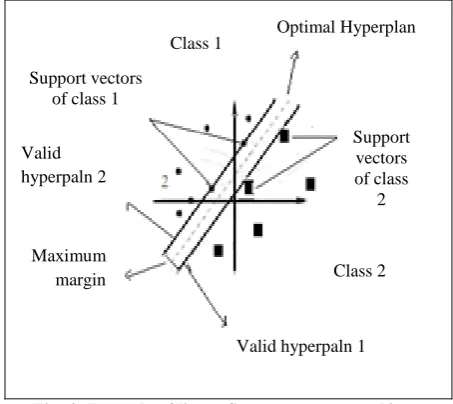
The SVM[24] is a powerful statistic tool used in many scientific fields as data mining applications such as text categorization, handwritten character recognition, image classification and bioinformatics. Support vector machines (SVM) are one of the most importont, and powerfull statistic tools used efficiently in many scientific fields as a pattern recognition, because it support high dimensional data and at the same time, providing good generalization properties. For a two-class classification problem, assume that we have a series of input vectors x i∈Rn with corresponding labels
yi∈{-1, 1} for i = 1, 2, .... N, where +1 and −1 indicate the two classes. The idea of SVM is to map the input vectors x i ∈ R
d
into a high dimensional feature spaceΦ( xi ) ∈Η,and it constructs an optimal separating hyperplane H that will maximizes the marginal distance between the hyperplane and the nearest data points of each class in the space Η.
[image:4.595.314.541.465.667.2]
Fig. 4: Example of linear Support vector machines.
The mapping Φ(⋅) is carried by a kernel function K( xi,xj) that defines an inner product in the space Η.The decision function implemented by SVM can be written as:
n i i ii
y
K
x
x
b
x
f
1 *.)
,
(
)
(
(29) (30) (28) (33) (34) (27) (26) (31) (32) Optimal Hyperplan Support vectors of class 2 Class 2Valid hyperpaln 1 Valid
hyperpaln 2
Maximum margin Support vectors
of class 1
The dual variables
iintervening in the Lagrangian is called Lagrange multipliers.To maximize
ij i j i j i j n
i i
y
y
K
x
x
D
,
1
2
(
,
)
1
)
(
Subject to
ni i i
y
10
,0
i
C
i
1
,
2
,...,
n
The parameter C which appears here is a positive constant fixed in advance; it’s called the constant of penalty.
[image:5.595.321.556.71.131.2]Some examples of kernel functions:
Table 1: Example of different kernel functions used in nonlinear SVM
Kernel linear xy
Kernel polynomial of degree n (axyb)n
Gaussian radial basis function
(GRBF) 2
2
2 y x
e
The method described above is designed for a problem of two classes only; many studies treat a generalization of the SVM to N classes. Among these studies, we have used in this work the strategy of one against all that is based to use N decision functions allowing to make a discrimination of a class bearing a label equal to 1 and containing a one vector against all other vectors included in a other class opposite that is labelled by the value -1. In the classification phase, we calculate the value image of an unknown vector X (test numeral) by all N decision functions that are obtained in the learning phase. The recognition will be attributed to the numeral that the decision function separates its class to another class containing the rest of numerals which gives the biggest value.
5.
EXPEREMENTS AND RESULTS
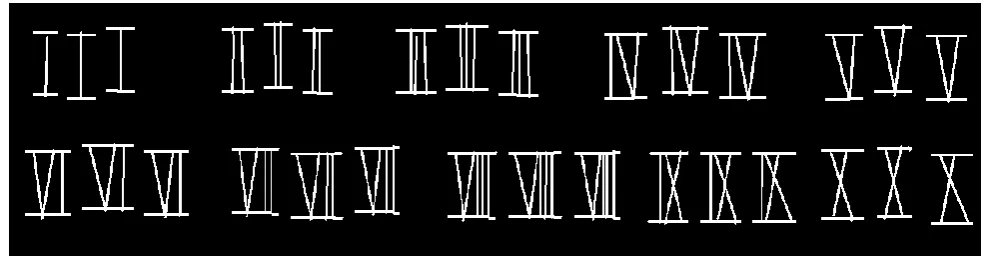
[image:5.595.57.550.323.451.2]Firstly, we present an image of some isolated handwritten Roman numerals.
Fig 5: Some isolated handwritten Roman numerals
The desired goal is to compare between the performances in terms off recognition rate (precision) and recognition time (rapidity) of:
The three hybrid methods of features extraction that are Zoning + KIM (Z+ KIM), Zoning + PZIM(Z+ PZIM), , Zoning + IAFMT (Z+ IAFMT),.
Between three different classifiers which are dynamic programming(PD), Naïve Bayes(NB), Support Vectors Machine (SVM),
Therefore in order to achieve these comparisons, we have used the following data’s:
Each numeral image has a size equal to 30x30 pixels.
The number of all images of learning and of test that we have used is equal to 3000 images.
The number of zones whose each image numeral is divided is equal to 9 zones for having consequently that each numeral is converted to a vector has 9 components noted
X
zoning The number of calculated values obtained by each descriptor is equal to 9 values to get therefore that each numeral is converted to a vector has 9 components noted
X
descriptor, therefore finally each numeral image is converted to a vector has 18 components obtained by the following relationship :
descriptor
zoning
X
X
X
The parameters KIM are equal to p=0.85, q=0.55.
The parameter of IAFMT is equal to
The kernel function chosen in the SVM is the GRBF with a standard deviation equal to
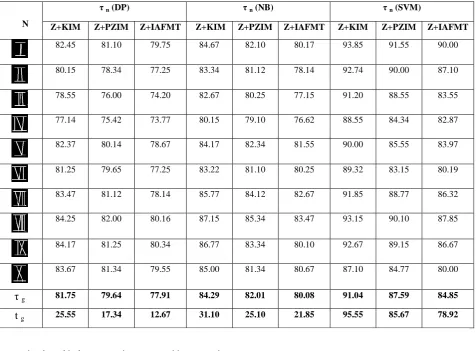
Therefore, we grouped the values that we obtained of the recognition rate τ n of each numeral (given in %) and of the global rate τ g (given in %) also the global recognition time t g (given in second) i.e. of all numerals for each hybrid method of features extraction and each classifier in the following table :
(35)
(36)
Table 2: The recognition rates and time for each hybrid method and for each classifier
N
τ n (DP) τ n (NB) τ n (SVM)
Z+KIM Z+PZIM Z+IAFMT Z+KIM Z+PZIM Z+IAFMT Z+KIM Z+PZIM Z+IAFMT
82.45 81.10 79.75 84.67 82.10 80.17 93.85 91.55 90.00
80.15 78.34 77.25 83.34 81.12 78.14 92.74 90.00 87.10
78.55 76.00 74.20 82.67 80.25 77.15 91.20 88.55 83.55
77.14 75.42 73.77 80.15 79.10 76.62 88.55 84.34 82.87
82.37 80.14 78.67 84.17 82.34 81.55 90.00 85.55 83.97
81.25 79.65 77.25 83.22 81.10 80.25 89.32 83.15 80.19
83.47 81.12 78.14 85.77 84.12 82.67 91.85 88.77 86.32
84.25 82.00 80.16 87.15 85.34 83.47 93.15 90.10 87.85
84.17 81.25 80.34 86.77 83.34 80.10 92.67 89.15 86.67
83.67 81.34 79.55 85.00 81.34 80.67 87.10 84.77 80.00
τ
g81.75 79.64 77.91 84.29 82.01 80.08 91.04 87.59 84.85
t
g25.55 17.34 12.67 31.10 25.10 21.85 95.55 85.67 78.92
[image:6.595.64.540.455.638.2]
The associated graphical representation to recognition rate τ n is :
Fig. 6: The recognition rate of each numeral for each features extraction hybrid method and for each classifier.
Interpretation:
Considering all the results that we obtained, we can to conclure that :
The numerals the most correctly recognized are : I, II,VIII, IX.
The numerals the less correctly recognized are : IV, X.
The most precise hybrid method of features extraction is zoning combined with Krawtchouk invariant moment followed then with pseudo-Zernike invariant moment then with invariant analytical Fourier-Mellin transform.
The most precise classifier is the support vectors machine then the naive Bayes then dynamic programming.
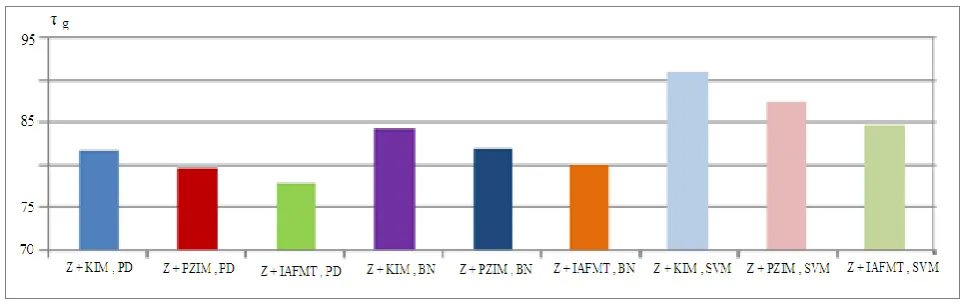
Fig. 7: The global recognition rate for each features extraction hybrid method and for each classifier.
Interpretation:
Taking into account all the results that we obtained, we can to conclure that the most precise recognition system
is that which contains a zoning method combined with Krawtchouk invariant moment as a features extraction and the support vectors machine as a classifier.
[image:7.595.61.545.73.225.2]The global time of execution is presented graphically as follow:
Fig. 7: The global time of execution for each features extraction hybrid method and for each classifier
Interpretation:
Having regard the results given in graphical representation above the most fast hybrid method is the zoning method combined with invariant analytical Fourier-Mellin transform then with pseudo-Zernike invariant moment then Krawtchouk invariant moment in one hand and the fatest classifier is dynamic programming followed by naive Bayes then finally the support vectors machine on the other hand. The most precise recognition system is that includes zoning method combined with Krawtchouk invariant moment and support vectors machine classifier but it is the slowest system,
For fixing this idea, we note:
We note the difference of precision between hm1, cl1 and hm2, cl2
2 2 1
1, , ,
,hm cl g hm cl
g
P
(38)
If ∆P>0 we will have a gain of precision, in this case ∆P is called the rate of growth of precision.
If ∆P<0 we will have a losing of precision, in this case ∆P is called the rate of decay of precision.
In a like manner, we note the difference of rapidity between hm1, cl1 and hm2 , cl2
2
2 1
1, , ,
,hm cl g hm cl
g
t
t
R
(39)
If ∆R >0 we will have a advancement of rapidity. in this case ∆R is called the rate of decay of rapidity.
hm1, cl1 ; hm2, cl2 ∆ (%) ∆ (second)
Z+KIM + SVM ; Z+PZIM + SVM 03.45 09.88
Z+KIM + SVM ; Z+IAFMT + SVM 06.19 16.63
Z+KIM + SVM ; Z+PZIM + DP 09.29 70.00
Z+KIM + SVM ; Z+ IAFMT + DP 11.40 78.21
Z+KIM + SVM ; Z+KIM + DP 13.13 82.88
Z+KIM + SVM ; Z+PZIM + NB 06.75 64.45
Z+KIM + SVM ; Z+ IAFMT + NB 09.03 70.45
Z+KIM + SVM ; Z+KIM + NB 10.96 73.70
Therefore the table above showed that for having a gain in precision means to a losing in rapidity.
6.
CONCLUSION
In this paper, we have presented both comparisonns which the first one is between the performances in terms of precision and rapidity of three hybrid methods of features extraction which are the structural method zoning combined with three statistical methods that are Krawtchouk, then with pseudo Zernike invariant moments, then with analytical invariant Fourierr-Mellin transform. While the second comparison is carried out between three classifiers that are the dynamic programming, the naive Bayes and the support vectors machines .For this purpose we have used in order to pre-process each numeral image the median filter, the thresholding, the centering and the edge detection techniques. We have concluded that the most precise but in the same time the most slow is the hybrid method zoning combined with Krawtchouk, invariant moment and the support vectors machine classifier.
Moreover, we will hope later on to introduce more other hybrid methods of features extraction and other classifiers in order to compare between their performances.
7.
ACKNOWLEDGEMENT
In conclusion we are very grateful to our professors Mister Said Safi and Mister Belaid Bouikhalene for their encouragement, their cooperation, their advices and their guidance in the realization of this work. Many thanks again to them.
8.
REFERENCES
[1] Rachid Salouan, Said Safi and Belaid. Bouikhalene, A Comparison between the Self-Organizing Maps and the Support Vector Machines for Handwritten Latin Numerals Recognition, International Journal of Innovation and Scientific Research ISSN 2351-8014 Vol. 7 No. 1 Aug. 2014, pp. 50-56© 2014 Innovative Space of Scientific Research Journals.
[2] Basappa B.Kodada and Shivakumar K.M. Unconstrained Handwritten Kannada Numeral Recognition , International Journal of Information and Electronics Engineering, Vol. 3, No. 2, March 2013.
[3] Rajashekararadhya S.V. and Vanaja Ranjan P., “Efficient zone based feature extraction algorithm for handwritten numeral recognition of four popular south Indian scripts”, Journal of Theoretical and Applied Information Technology,2005, pp 1171- 1181.
[4] Rachid Salouan, Said Safi and Belaid. Bouikhalene, A Comparative Study between the Pseudo Zernike and Krawtchouk Invariants Moments for Printed Arabic Characters Recognition, JOURNAL OF EMERGING TECHNOLOGIES IN WEB INTELLIGENCE, VOL. 6, NO. 1, FEBRUARY 2014.
[5] Rachid Salouan, Said Safi and Belaid. Bouikhalene, Printed Arabic Noisy Characters Recognition Using the Multi-layer Perceptron, International Journal of Innovation and Scientific Research ISSN 2351-8014 Vol. 9 No. 1 Sep. 2014, pp. 61-69 c 2014 Innovative Space of Scientific Research Journals.
[6] Kianoosh BAGHERI NOAPARAST* and Ali BROUMANDNIA Persian Handwritten Word Recognition Using Zernike and Fourier–Mellin Moments, SETIT 2009 5th International Conference: Sciences of Electronic,Technologies of Information and Telecommunications March 22-26, 2009 – TUNISIA [7] Shahrul Nizam Yaakob and Puteh Saad, Krawtchouk
Moment Invariant And Gaussian ARTMAP Neural Network: A Combination Techniques For Image Classification, KUKUM Engineering Research Seminar 2006.
[8] Anass El affar Khalid Ferdous, Abdeljabbar Cherkaoui Hakim El fadil, Hassan Qjidaa: Krawtchouk Moment Feature Extraction for Neural Arabic Handwritten Words Recognition, IJCSNS International Journal of Computer Science and Network Security, VOL.9No.1,January 2009.
[9] Rachid Salouan, Said Safi and Belaid. Bouikhalene, A Comparative Study Between the Hidden Markov Models and the Support Vector Machines for Noisy Printed Numerals Latin Recognition, International Journal of Innovation and Scientific Research ISSN 2351-8014 Vol. 5 No. 1 Jul. 2014, pp. 16-24 © 2014 Innovative Space of Scientific Research Journals.
[10]Rachid Salouan, Said Safi and Belaid. Bouikhalene, Printed Eastern Arabic Noisy Numerals Recognition Using Hidden Markov Model and Support Vectors Machine, International Journal of Innovation and Applied Studies ISSN 2028-9324 Vol. 9 No. 3 Nov. 2014, pp. 1032-1042 © 2014 Innovative Space of Scientific Research Journals.
[11]Gita Sinha, Dr. Jitendra kumar, Arabic numeral recognition using SVM classifier, International Journal of Emerging Research in Management &Technology ISSN: 2278-9359 (Volume-2, Issue-5), May 2013. [12]Thiago C.Mota and Antonio C.G.Thomé,
One-Against-All-Based Multiclass SVM Strategies Applied to Vehicle Plate Character Recognition, IJCNN, 2009.
[14]H.H. Avilés-Arriaga, L.E. Sucar-Succar, C.E. Mendoza-Durán, , L.A. Pineda-Cortés, A Comparison of Dynamic Naive Bayesian Classifiers and Hidden Markov Models for Gesture Recognition, Journal of Applied Research and Technology, Vol.9 No.1 April 2011.
[15]Palacios M.A., Brizuela C.A. & Sucar L.E., Evolutionary Learning of Dynamic Naive Bayesian Classifiers, Proc. 21th International FLAIRS Conference, 2008, pp. 655-659.
[16]Pradeepta K. Sarangi, P. Ahmed and Kiran K. Ravulakollu, Naïve Bayes Classifier with LU Factorization for Recognition of Handwritten Odia Numerals, Indian Journal of Science and Technology, Vol 7(1), 35–38, January 2014
[17]Mohamed Fakir , M. M. Hassani , Chuichi Sodeyama ,
ON THE RECOGNITION OF ARABIC
CHARACTERS USING HOUGH TRANSFORM
TECHNIQUE, Malaysian Journal of Computer Science, Vol. 13 No. 2, December 2000, pp. 39-47.
[18]Rachid El Ayachi, Mohamed Fakir and Belaid Bouikhalene, Recognition of Tifinaghe Characters Using Dynamic Programming & Neural Network, www. intechopen. com.
[19]H. Sakoe and S. Chiba. (1978). Dynamic Programming Algorithm Optimization for Spoken Word Recognition, IEEE Trans. Acoust., Speech and Signal Processing, Vol. ASSP-26, No.1, 1978, pp. 401-408
[20]Sylvain Chevalier, Edouard Geoffrois, and Françoise Prêteux. (2003). A 2D Dynamic Programming Approach for Markov Random Field-based Handwritten Character Recognition, Proceedings IAPR International Conference on Image and Signal Processing (ICISP' 2003), Agadir, Morocco, 2003, p. 617-630.
[21]Pew-Thian Yap, Raveendran Paramesran, Senior Member IEEE, and Seng-Huat On Image analysis by Krawtchouk moments, IEEE transactions on image processing, vol. 12, NO. 11, November 2003
[22] M.Teague.Image analysis via the general theory B of moments. Journal Optical Society of America,70:920– 930,1980.
[23]F. Ghorbel. A complete invariant description for gray-level images by the harmonic analysis approach. Pattern Recognition Letters, 15:1043{1051, October 1994. [24]V.N. Vapnik, "An overview of statistical learning