Lancaster University Management School
Working Paper
2007/011
Conceptual modelling: framework, principles, and future
research
Roger Brooks
The Department of Management Science Lancaster University Management School
Lancaster LA1 4YX UK
© Roger Brooks
All rights reserved. Short sections of text, not to exceed two paragraphs, may be quoted without explicit permission,
provided that full acknowledgement is given.
The LUMS Working Papers series can be accessed at http://www.lums.lancs.ac.uk/publications/
Conceptual modelling: framework, principles, and future research
Dr. Roger J. Brooks
Department of Management Science
Lancaster University Management School
Lancaster
LA1 4YX
Abstract
The conceptual modelling task in a simulation project is very important and yet is still
generally regarded as more of an art than a science. The meaning and nature of conceptual
modelling are discussed and a framework set out. The overall aim should be to choose the
best model for the project and conceptual modelling can be viewed as a difficult optimisation
problem that can be tackled effectively using a creative search process that develops
alternative models and predicts their performance throughout the project. An experiment
relating model characteristics to some aspects of performance is described and this type of
experiment may inform the process of predicting model performance. Based on advice from
the literature and my own previous work on conceptual modelling 17 principles of conceptual
modelling are suggested. Conceptual modelling research is still at an early stage and ideas for
future research are proposed.
Keywords: Conceptual Model, Project Outcome, Complexity, Simplification
Introduction
Of all the tasks involved in a modelling project, conceptual modelling is probably the one that
has received the least attention and consequently is the least well understood. Most other
tasks such as data analysis, model building, verification and validation, and output analysis
have a strong element of mathematics, statistics or logic. This has enabled techniques from
comparing alternative systems). The nature of conceptual modelling is quite different, so
much so that it is often described as being an art rather than a science (e.g., Shannon, 1975).
Problem formulation is somewhat similar to conceptual modelling in this respect, although
here a range of tools and approaches such as soft systems methodology may be useful (e.g.,
Checkland, 2006). Most textbooks devote only a few pages to conceptual modelling, with one
notable exception being Robinson (2004) which includes two chapters on the topic. This
paper examines the meaning and nature of conceptual modelling and suggests a framework
for the process. An experiment to investigate possible relationships between model
characteristics and performance is described. Some principles of conceptual modelling are
suggested based partly on various modelling projects I have carried out over the past 12 years.
Approaches for future research are also proposed.
Meaning of Conceptual Modelling
The term conceptual modelling itself seems to cause considerable confusion because of its
slightly different uses in different areas of science and also because there is no agreed
definition within simulation and operational research (O.R.). There is a considerable amount
of technical literature in computer science and artificial intelligence on conceptual modelling
that focuses on modelling techniques and ontologies (such as UML) for modelling thoughts,
knowledge and concepts. In the context of O.R. projects, the usage is rather broader in that it
tends to refer to the whole task (however it is carried out) of deciding what to include in the
model. Thus typical project tasks are problem formulation, conceptual modelling, model
building (coding), verification and validation, experimentation, analysis of results, and
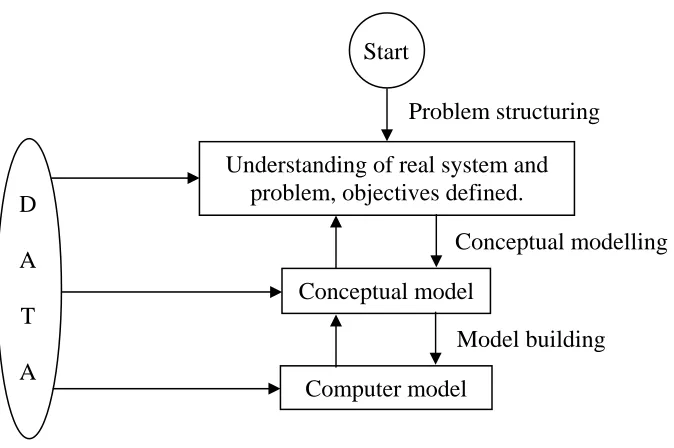
implementation of findings. Figure 1 shows these tasks (the arrows) up to the model building
stage along with their intended outcomes (the rectangles). The arrows go in both directions to
indicate returning to any previous task. Data obtained from available sources or collected as
Figure 1. The initial tasks and outcomes in a simulation project.
This paper follows the definition of Brooks and Robinson (2001) that a conceptual model
is “a software independent description of the model that is to be constructed”. The conceptual
model specifies how the virtual world being simulated should work – the entities that it
contains and all the interactions, rules, and equations that determine their behaviour. The
specification includes the type of model (e.g., whether the model state changes continuously
or discretely), and the scope or boundary of the model.
Assuming the model is intended to represent a real system then a key input into the
conceptual modelling process is the modeller’s understanding of how the real system works.
This will typically be based on observations, input from experts, and data, but will probably
also include various assumptions. The conceptual modelling process will then involve
decisions on which modelling simplifications of the real system to make (such as which
elements and processes from the real system to include). In principle the conceptual model
could therefore also be specified in a top down way by the understanding of the real system
including the assumptions made, the model boundary, and the modelling simplifications.
The definition of the conceptual model used here deliberately distinguishes the decisions
regarding model content from the technical construction of the model. There are many ways
of building the same model by using different software or different code and the conceptual
model could be built using any suitable software or programming language. In practice, the
choice of conceptual model may be affected by limitations in the available software and the
knowledge and skills of the modeller in using the software. Start
Understanding of real system and problem, objectives defined.
Conceptual model
Computer model D
A
T
A
Problem structuring
Conceptual modelling
Documentation of the conceptual model can vary considerably from none at all (where
the actual model built gives the only evidence) to detailed specifications. Possible formats for
recording aspects of the conceptual modelling information include diagrams (such as a
process diagram or activity cycle diagram), a list (such as the elements or the assumptions and
simplifications), or just a written description. A lack of documentation will tend to make
model verification and validation more difficult, and could cause problems if the model is
handed over to other users or modellers or if the modelling decisions need to be justified to
third parties.
The modelling process is, of course, not generally a simple linear process of completing
one task and then moving onto the next. Conceptual modelling may take place in several
phases and may happen in parallel with other tasks, particularly data collection and model
building. The initial conceptual model may also be reconsidered and amended at various
points during the project.
In particular, the ease of use of modern software means that sometimes the model may be
coded as it is defined so that conceptual modelling and model building take place along side
each other in an iterative manner (i.e., decide on the way part of the model should work, code
it, then move onto the next part). Therefore, in some projects the model may be constructed in
the simulation software with little or no prior planning and with no separate documentation of
the conceptual model. Even so, the decisions taken during this process regarding the content
of the model (as opposed to the specific computer code) constitute the conceptual modelling
process in such a project.
This paper concentrates on conceptual modelling in simulation, and the flexible nature of
simulation means that there can be a very wide choice of possible models. This makes
conceptual modelling a particularly difficult task in simulation. Nevertheless, many of the
issues considered here will be relevant to other types of models.
Advice on conceptual modelling
Advice given in the literature on the process of deciding what to include in the model tends to
be fairly general and brief. For example, even though Law (1991) states “I now strongly feel
that the most difficult aspect of a study is that of determining the appropriate level of model
detail”, Law and Kelton (2000) devote only two pages out of over 700 pages in their textbook
required, the advice of those who know about the real system, the model credibility required,
the data available and the budget for the study. They also suggest using sensitivity analysis
(although, in fact, this can only be done once the initial model is built), and they warn against
the temptation of including too much detail.
Pidd (1998) considers the modelling method and the experimental frame of Zeigler
(1976) as factors affecting the conceptual model. The modelling method (e.g., discrete event
or system dynamics) will certainly affect the elements and relationships in the model, but I
would consider the choice of method as one aspect of the conceptual modelling decisions
themselves in that it specifies the nature of the rules in the model. The experimental frame is
the circumstances to be investigated using the model and so is similar to advice to consider
the objectives and required outputs. In Pidd (2003), six principles of modelling in
management science are set out, several of which focus on different aspects of keeping the
model simple.
Robinson (2004) gives much more emphasis to conceptual modelling, devoting two
chapters to it. He provides a very good discussion of many of the issues including a
definition, concepts for evaluating the conceptual model, documentation and model
simplification. A framework for developing a conceptual model is also presented consisting
of a process with stages of understanding the problem, deciding on the objectives of the
project, specifying the inputs and outputs of the model, and finally determining the model
content. This is broadly similar to relating the conceptual model to the objectives and
experimental frame. However, presenting this as a step by step logical process and providing
an in-depth discussion with examples makes this a much more useful practical guide than
previous literature.
A very common piece of modelling advice is to keep the model as simple as possible,
even relating this back to Ockham’s (or Occam’s) razor from the 14th Century that can be
translated from the Latin as “entities should not be multiplied without necessity”. The other
term often used in the literature is level of detail, with complexity and level of detail
appearing to be synonymous in most cases. Various authors have set out the advantages of a
simple model compared to a complex model including being easier to understand, easier to
change and update, quicker to run and analyse, requiring less data and fewer resources, and
having a greater chance of acceptance by the client (e.g. Ward, 1989; Salt, 1993). A simple
Nevertheless, although we may have an intuitive idea of the level of detail and
complexity of a model (e.g., we may be confident in a comparative ranking of the complexity
of certain models) there appears to be no precise definition of model complexity or agreed
way of measuring it. Indeed it is quite a broad concept and narrower attributes may be more
useful. For example, Brooks and Tobias (1996) suggested size, connectedness and
calculational complexity as sub-components of complexity although, even then, there are
various ways of measuring these.
More detailed reviews of relevant literature for conceptual modelling are given in Brooks
and Tobias (1996) and Robinson (2006).
Conceptual modelling framework
In examining the nature of conceptual modelling, a good starting point is to consider what the
objective of this task should be. Conceptual modelling specifies the content of the model to be
used in the project and so it has a big impact on all the other modelling tasks and on the
success of the project as a whole. The conceptual modelling objective should therefore be to
choose the model that will result in the most successful project. This involves considering
how the model will affect the different aspects of model performance, in particular the
following eleven elements specified in Brooks and Tobias (1996):
Results
1. The extent to which the model output describes the behaviour of interest (whether it has
adequate scope and detail).
2. The accuracy of the model's results.
3. The ease with which the model and its results can be understood.
Future use of the model
4. The portability of the model and the ease with which parts of the model can be reused in
future models.
Confidence in the model (verification, validation and credibility)
5. The probability of the model containing errors.
6. The accuracy with which the model output fits the historical data.
7. The strength of the theoretical basis of the model including the quality of input data.
8. The time and cost to build the model (including data collection, verification and
validation).
9. The time and cost to run the model.
10. The time and cost to analyse the results of the model.
11. The hardware requirements of running the model.
Although the aim should be to find the best model, as a minimum, conceptual modelling
needs to find a model that is predicted to lead to a successful project outcome. Minimum
performance standards to achieve this could be identified for each of the above elements. If
all the conceptual models identified are likely to result in failure then the project as a whole
needs to be re-assessed - see Robinson and Pidd (1998) for a discussion of simulation project
success based on interviews with providers and customers, and Tilanus (1985) for survey data
of the key factors causing success or failure on O.R. projects.
Therefore conceptual modelling is essentially an optimising (or at least satisficing) task
that could be formulated in principle as:
Objective function: Maximise overall predicted project performance, P:
(
)
(
)
(
k m R u kn m R un)
f
P = 1 , , 1 ,..., , ,
where the ki(m,R,ui) for i = 1, 2,…, n are measures of each of
the n aspects of project performance.
Subject to: The resources allocated to the different project tasks are less
than or equal to the maximum available resources, A:
A r r
l
i i
c +
∑
≤=1
where rc is the resource allocated to conceptual modelling and
ri for i = 1, 2,…, l are the resources allocated to the other tasks.
Decision variables: Conceptual model chosen, m; allocation of resources to the
different tasks, R=
(
rc,r1,...,rl)
Uncontrollable variables: Other factors affecting each performance aspect, ui
There are several interactions and uncertainties that make this a very difficult problem.
The overall performance is a function f of the measures of each aspect of model performance
measures. The relative importance (and hence the weights) of these performance aspects will
differ substantially between different projects. For example, improved understanding could be
the main aim of a research project rather than making accurate predictions. A short timescale,
strict deadline and small budget would mean that the resources required are particularly
important. The measures of predicted performance of the different aspects will, to an extent,
be subjective (as discussed in Brooks and Tobias, 1996). In fact, even after the project has
been completed an objective quantitative measure of some of the aspects is probably not
possible. Therefore, in practice an overall performance assessment may just consist of
considering all the different aspects bearing in mind their relative importance for the project,
rather than combining them in any formal function.
The performance measure or assessment for each aspect depends on the conceptual
model chosen (m), but also depends on the way time and other resources are allocated (R) to
the different tasks throughout the project. Both the model chosen and the resource allocation
depend on how much resource is spent on the conceptual modelling process – for example,
spending more means that the conceptual model chosen is likely to be better, but this leaves
less for the remaining project tasks (coincidentally this type of trade-off is similar to the
“commercials” exercise used in Willemain’s (1995) experiment described later). The
performance of each aspect also depends on various other factors (represented in a combined
variable ui) such as the nature of the problem, the knowledge and skills of the modeller and
the input provided by the client. There will probably also be various trade-offs between the
allocation of resources to the other simulation tasks apart from conceptual modelling but this
is considered to be outside the scope of the conceptual modelling problem.
The further complicating factor is that there is a very wide range of alternative models
(theoretically covering all possible different types and sizes of model) and so the task is not
simply a search through a small well-defined set of alternative models. Identifying the models
is, to some extent, a creative process. The extent of the choices available will depend on the
project, in particular on the complexity of (the modeller’s perceptions of) the system and the
problem. A more complex system is likely to mean a greater choice of plausible conceptual
models as there are more combinations of factors that could be included.
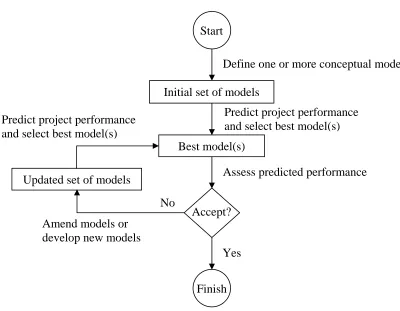
Therefore a suitable heuristic solution approach to this problem is an iterative process of
developing new models, predicting their performance and deciding whether to stop. Figure 2
shows a framework for this selection process. The assessment of the predicted performance of
will produce a successful project and also whether searching for an even better model might
be worthwhile (comparing the search time and effort with the potential improved
[image:10.595.82.482.146.457.2]performance).
Figure 2. Conceptual model selection process
Willemain (1995) is one of the very few researchers to have collected empirical evidence
of the modelling process and there is evidence from his experiment that expert modellers do
go through such a process of iteratively developing and mentally evaluating alternative
conceptual models. In Willemain’s experiment experts spoke aloud their thoughts for the first
hour of tackling an artificial problem. Tape recordings were made and transcripts produced
and analysed, which provided very valuable insights into the nature of the experts’ modelling
approaches. The transcripts were broken into “chunks” (from a phrase to a couple of
sentences) and each one categorised as one of five topics in Willemain’s stages in the
modelling process. There was a lot of switching between different modelling topics,
particularly between “structure” (conceptual modelling) and “assessment” (verification and
validation) as modellers evaluated and revised the conceptual model. Willemain comments
that even though only the initial stage of the modelling process was studied the experts did Start
Initial set of models
Best model(s)
Define one or more conceptual models
Predict project performance and select best model(s)
Assess predicted performance Updated set of models
Accept? Amend models or
develop new models
Finish Yes No
“conduct thought experiments involving the other stages as an integral part of the formulation
stage”. Therefore the experts were probably predicting the performance of the conceptual
models through these thought experiments as a basis for the choice of conceptual model. A
follow-up study was recently carried out analysing transcripts of novice modellers tackling
similar types of problems (Powell and Willemain, 2007; Willemain and Powell, 2007). One of
the important differences that Powell and Willemain identified between novices and experts
was that the novices spent much less time on “assessment” and so did not appear to evaluate
and revise the proposed models to the extent that the experts did.
Willemain (1994) also carried out a survey of the modellers who participated in his
experiment, and the findings included a strong sense of the importance of creativity in the
modelling process. The words and phrases given by the experts for important qualities of an
effective modeller included creative (2 experts), creativity (2 experts), imaginative, insightful,
inspired, willingness not to pigeon hole problems, and open-minded. There were also 7 point
Likert scale questions with a strong overall response under “the way the experts model” for
several questions including “look for analogies” rather than “start from scratch”, “start small
and add” rather than “start big and subtract”, and “always draw / doodle” rather than “never
draw / doodle”.
A key part of this solution approach for the conceptual modelling problem is to relate the
choice of model to the different performance aspects. Experts can use past experience as a
basis for predicting performance, but studies that investigate the effect of different model
attributes on performance would also provide useful information. The next section describes
such a study.
Experiment on model characteristics and performance
Amongst the 11 performance elements set out above are the time taken to build the model, the
likelihood of errors and the ease of understanding of the model and the results. These were
compared for four discrete event simulation models of production lines by analysing the
performance of the 33 students on the M. Sc. Operational Research course at the University of
Birmingham in answering questions on and in building the models. The reason for this
approach is that, in order to assess the effects of the differences between the models on these
and experience. Otherwise, if more than one model is built by the same person, building and
analysing the first model helps with the next.
As mentioned above, the complexity of a model is the most common model characteristic
related to performance in the literature, and yet it is not defined clearly. Brooks and Tobias
(1996) considered the overall complexity of a model to be a combination of its size (the
number of nodes or elements), its connectedness (the average number of connections per
element) and its calculational complexity (the complexity of the calculations making up the
connections). The aim of the experiment was to examine the effects of these characteristics
and so the models were devised to differ in these three aspects.
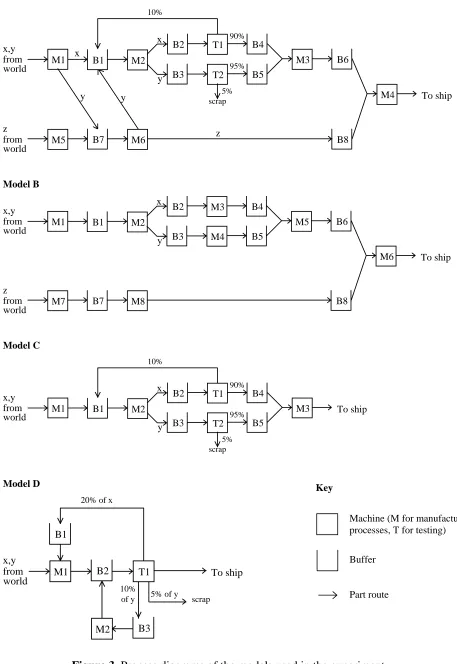
The models used are shown in Figure 3. Since they represent production lines, the natural
definition for the elements is machines and buffers with the connections being the routes
taken by the parts. Models A and B both have eight machines and eight buffers in the same
basic layout with model A having more part routes (23 compared to 19) and hence higher
connectedness. Model C has five machines and five buffers laid out in the same way as a
portion of model A and differs from A mainly in size. Model D has only three machines and
three buffers but has the most complex calculations to determine the part routes. Model D has
high connectedness and calculational complexity.
The models were assigned at random to the students. The students were quite
inexperienced modellers having received between 14 and 16 hours of tuition, mainly
consisting of hands on experience together with some formal teaching and demonstrations.
The first stage of the experiment aimed to compare how easy the models were to understand.
The students were each asked the same four written questions on aspects of the behaviour of
the particular model assigned to them, and were provided with the model description and
selected model output. The second stage focused on model building and the students were
each timed as they built their model using the WITNESS software. The number of errors in
each model was subsequently determined (the students were instructed to build the model as
Model A
B4
M1 B1 M2
B2 B3 x y x,y from world M5 T1 T2 B5 B7 90% 10% 95% 5% scrap M6 z from world M3 M4 B6 B8 To ship y y z x Model B B4 M1 B1 M2
B2 B3 x y x,y from world M7 M3 M4 B5 B7 M8 z from world M5 M6 B6 B8 To ship Model C B4 M1 B1 M2
B2 B3 x y x,y from world T1 T2 B5 90% 10% 95% 5% scrap
M3 To ship
Model D M1 x,y from world B1 T1 scrap To ship
5% of y 20% of x
B2
10% of y
[image:13.595.68.525.90.754.2]B3 M2
Figure 3. Process diagrams of the models used in the experiment.
Key
Machine (M for manufacturing processes, T for testing) Buffer
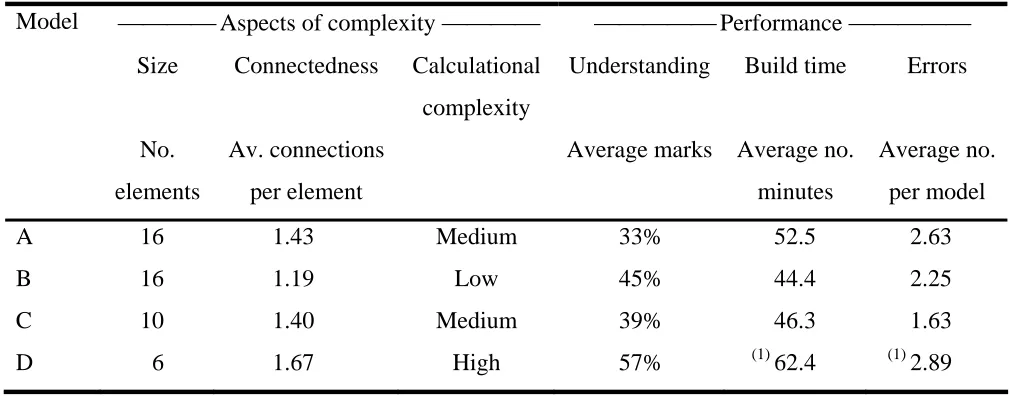
Table 1 Results from the experiment.
Model ⎯⎯⎯⎯ Aspects of complexity ⎯⎯⎯⎯ ⎯⎯⎯⎯⎯ Performance ⎯⎯⎯⎯⎯
Size Connectedness Calculational
complexity
Understanding Build time Errors
No.
elements
Av. connections
per element
Average marks Average no.
minutes
Average no.
per model
A 16 1.43 Medium 33% 52.5 2.63
B 16 1.19 Low 45% 44.4 2.25
C 10 1.40 Medium 39% 46.3 1.63
D 6 1.67 High 57% (1) 62.4 (1) 2.89
(1) Includes two students who had not quite finished within the maximum time. Six of the 26
errors on this model are omissions in these two models which are probably due to lack of
time.
Using analysis of variance (ANOVA), the differences between the models are
statistically significant at the 5% level for build time (P = 0.032), question 2 (P = 0.014) and
question 3 (P = 0.022), but not for question 1, question 4, the average mark for all questions
and the number of errors.
For build time calculational complexity appears to have the most effect with model D
taking considerably longer to build than the other models. With a package like WITNESS
which is user friendly and already contains many of the constructs required, thinking time is
the most important component of the build time and so it is the complex and less familiar
commands that are the most important. Observations also indicated that the aspects of the
model that were easy to code were completed very quickly by the students.
The questions were analysed both by comparing the marks and by considering the
reasoning process required to answer each question, which is discussed in detail in Brooks
(1996). Students were asked to give a reason for their answer and considerable importance
was given to this since the aim was to assess understanding. Both the correct answer and
correct reason were required to score 1 mark. If either the answer or reason were only
models were on questions 2 and 3. Question 2 asked “Which machine(s) is the bottleneck?”
and the average mark was much higher for the model D participants (72%) than for the other
models (19%, 31% and 25% respectively). The small size of model D made this question
easier to answer because there are fewer elements to compare to identify the bottleneck. In
fact machine M2 is rarely in operation and so this question only required comparing 2
machines. This also meant that there were more acceptable reasons for the correct answer
than for the other models. Question 3 asked “Which buffer(s) were full at some time during
the period?” and could be answered by identifying blocked machines from the output
statistics. The average marks were much higher for models B and D (81% and 72%
respectively) than for models A and C (25% and 44% respectively). Again this reflects the
question being inherently easier for models B and D since the blocked machines only sent
parts to one buffer whereas in models A and C they sent parts to several buffers. Therefore,
the difference in marks seems to be a result of lower connectedness in the critical section of
the models.
The marks were not statistically significant at the 5% level for questions 1 and 4.
Question 1 (“How many parts were sent to SHIP in the period?”) was expected to be harder
for model D since the calculation is more complex but, in fact, the average mark was similar
to that for models A and B perhaps again reflecting that the small size means that it is easier
to identify the correct part of the model to focus on. Question 4 (“Estimate the % increase in
output if [a given machine] cycle time is reduced to 10” where the given machine was chosen
not to be the bottleneck) was expected to be easier for model D but the marks were only
slightly higher than for the other models.
Overall the indication is that the difficulty in understanding is mainly affected by size
and connectedness with calculational complexity being much less important, although this of
course depends on the specific question being considered. This is probably because the fine
details can often be ignored in understanding the system with just an appreciation of which
elements influence each other being required.
Most of the model building errors for models A, B and C occurred in the input and
output rules for assembly machines, which were relatively complex commands which the
students were less familiar with. The number of errors therefore reflects the comparative
occurrence of these commands in the models, with models A and B having two assembly
machines and model C one (each error was counted separately including repeated errors).
unique to model D. Generally, the majority of errors are likely to occur in the more complex
aspects of the model, and so the number of errors is expected to be most closely related to
calculational complexity.
The sample sizes here for each model (8 or 9) are small and the results will depend to
some extent on the type of models used and the questions asked. The results can therefore
only suggest possible relationships between model attributes and performance and more work
is required to investigate this further.
Other modelling studies
One approach to studying the conceptual modelling problem is to compare alternative models
for a system and these alternative models can be developed by taking a complex model and
simplifying it in various ways. This approach was applied to models of a groundwater system,
poppy population genetics and a manufacturing system with one of the aims being to provide
insights into the choice of model (Brooks, 1996; Brooks and Tobias, 1999). This can also be a
good strategy in a modelling project, particularly where the main aim is increased
understanding as was experienced in a wheat simulation project (Brooks et al., 2001).
Techniques used in identifying good model simplifications included sensitivity analysis and
examining the detailed workings of the model and the results. This resulted in interesting
insights and in several cases a new analytical model was developed. The main simplifications
were developing a probability based model of the plant population genetics simulation, using
simplified parameter structures in the groundwater model, using aggregate variables in the
wheat model, and bottleneck analysis of the manufacturing system simulation. The result in
each case was a hierarchy of models where the simple model was easier to use and understand
but where the confidence in the simple model came from a comparison with the more detailed
model. Greater confidence in the detailed models was due to their stronger theoretical basis as
there is a direct correspondence with observed elements and known relationships. For several
of the models the output of interest was an average and this was considered to be one of the
reasons that good simplifications could be found (Brooks and Tobias, 1999). The simplified
models also generated some additional theoretical results and enabled easier experimentation.
However, simplification is time consuming (Rexstad and Innis, 1985) and risky as there is no
guarantee of success. The simplified model may also have a reduced experimental frame (i.e.,
Principles of conceptual modelling
Simulation modelling covers an extremely wide range of applications and situations and the
resulting models vary enormously in scale. Therefore, there are very unlikely to be any formal
rules that will apply in all or most situations, Nevertheless, there may be some general
principles that can act as a useful guide. The following list sets out some suggested principles,
some of which come from the literature whilst others are based on the conceptual modelling
framework and the modelling studies previously described. Many of these may be well known
to experienced modellers but hopefully will be useful for those with less experience.
1) As often mentioned in the literature, the project objectives should drive all the tasks
including conceptual modelling. Different purposes for the same system (e.g., safe
vehicle movement through a plant layout / choice of machines to improve plant
throughput) usually require quite different models.
2) The conceptual model will be based on the knowledge and belief about the real system.
Clearly better knowledge should mean a better conceptual model and so taking time to
find out about the way the system works (e.g., from those familiar with the system) will
be very beneficial (e.g., Law and Kelton, 2000).
3) The aim of conceptual modelling is to choose the model that will give the best overall
project performance. As discussed in the conceptual modelling framework section, this
requires balancing all the different aspects of performance.
4) The conceptual modelling problem can be tackled as a creative search process that
develops alternative models and predicts their performance throughout the project. This
requires thinking through all the different project tasks. From Willemain and Powell’s
work, the approach of assessing and revising proposed models in this way may be one
of the characteristics of experts that is not generally found in novices.
5) Understanding the relationships between model characteristics and performance will
help with the assessment of the models. In particular, general advice from the literature
is that a simpler model will be easier to understand, and easier and quicker to build,
verify, run and analyse but will be less accurate and have lower validity. A simpler
sometimes be exceptions to such general rules (Brooks and Tobias, 1996). Considering
the relationships between more specific model characteristics (such as size and
connectedness) and performance is likely to enhance the assessment process.
6) The model must meet certain minimum criteria for the performance aspects, otherwise
the project will not be a success. For example, it must produce the required outputs and
have sufficient validity. If there are no such models then the project is not feasible and
needs to be re-considered.
7) The needs of the client should be an integral part of the performance assessment so as to
ensure project success (Ward, 1989; Robinson and Pidd, 1998).
8) Key criteria that can provide a basis for ideas for the conceptual model are that the
inputs need to include all the options to be considered in the project and the outputs
need to show the variables that will be used to assess which option is best (Robinson,
2004). The internal content of the conceptual model then connects these inputs and
outputs (Robinson, 2004).
9) In some circumstances a model with a simpler structure may be more accurate, typically
when suitable data is not available for the more complex model. For example, arrivals
of customers at a bank would usually be modelled using a distribution from observed
arrivals. Modelling the movements of the customers around the city would be a
considerably more complex structure but good data is unlikely to be available and so it
would be much less accurate.
10) Data acts as a constraint. General advice is that the model should drive the data and
there are various ways of overcoming lack of data (e.g., Brooks and Robinson, 2001).
Nevertheless, lack of data or poor quality data will limit the accuracy of and confidence
in the model.
11) Conceptual modelling is a creative process. This is evident from Willemain’s work,
both from the nature of the transcripts of experts tackling the different problems
(Willemain, 1995) and from the emphasis given by the experts that this is a desirable
characteristic for modellers (Willemain, 1994). Having a mindset that the process has
this nature and providing an environment to stimulate creativity may therefore be
narrowing these down, and being prepared to change the conceptual model throughout
the project.
12) A top down view of the conceptual model (meaning of conceptual model section) is
conceptual model = knowledge of real system (including assumptions) + boundary +
simplifications. Producing a list of the boundary, simplifications and assumptions can
help to identify subconscious modelling decisions that may need to be challenged. This
can also be a good record of the conceptual model.
13) Simplifications can be considered to be of two types. Type 1 are those simplifications
that are apparent from a good knowledge of the real system. These simplifications can
be applied when choosing the initial conceptual model. Type 2 are those that are
derived from analysis of the model such as sensitivity analysis or detailed examination
of the model behaviour and could not be seen easily without such analysis. Type 2
simplifications can therefore only be applied after the model has been built and so
require revising the initial conceptual model.
14) The common advice of starting with the simplest model and adding detail really means
apply as many as possible of the type 1 simplifications from principle 13. In practice, it
may be difficult to define the simplest model straightaway. Instead, the easiest
candidate model to start with in the conceptual modelling search process will usually be
one where most of the model elements correspond directly to observed elements in the
real system. This will also tend to have high face validity (Law and Kelton, 2000).
Simplifications during the conceptual modelling search process could therefore start
with looking for observed elements or rules that can be combined or left out of the
initial model, before considering more advanced simplifications.
15) Initial simplifications can frequently be made by considering the scale of the
phenomena of interest. Often factors that vary on a much smaller time or spatial scale
can be averaged or aggregated, with factors that vary on a much larger scale treated as a
constant or ignored (Courtois, 1985).
16) Consider building more than one model. A hierarchy of models may be the best solution
to the choice of conceptual models. In particular, if type 2 simplifications can be applied
confidence in the model itself may not be high but comparison with the original model
(with high validity) may give sufficient confidence.
17) Documenting the conceptual model is very valuable in providing a reference for the
other project tasks (e.g., verification) and for communication with the client or other
modellers. There are various ways of documenting the conceptual model such as a
component list, process flow diagram, logic flow diagram or activity cycle diagram
(Robinson, 2004).
Future research
Research into conceptual modelling is still in its infancy hindered to date by a view that is an
art rather than a science. Common advice is to learn from experience and empirical evidence
of how experts approach conceptual modelling would provide a good foundation. Research
could include extending Willemain’s (1995) experiment by using other participants and other
problems (such as problems where simulation is the appropriate technique). Evidence could
also be obtained for real simulation projects by shadowing experts, asking experts to record
their experiences, or by conducting a survey or structured interviews. Similar data from
novice modellers would enable a comparison of modelling styles, may indicate the specific
areas in which novices lack skill or knowledge (which could be used to improve simulation
training), and may also enable some evaluation of the effectiveness of different teaching
methods. A study in this area has recently been carried out (Powell and Willemain, 2007;
Willemain and Powell, 2007). Data on real projects for an expert and several novice groups
was obtained by Wang and Brooks (2007). Experiments to investigate the relationships
between model characteristics and performance (e.g., similar to experiments described in this
paper and in Wang and Brooks, 2007) would inform the prediction of performance during
conceptual model selection. Alternative models could also be built and evaluated for specific
projects, again similar to work outlined in this paper. Looking at the applicability and benefits
of ideas from research on creativity could also be fruitful. Alternative ways of documenting
the conceptual model could be investigated and more consistent use of a particular method
would facilitate the comparison of models. If a large body of conceptual modelling research
over a range of applications could be produced then this would help to identify and evaluate
discussed in the literature (e.g., Zeigler, 1976; Innis and Rexstad, 1983; Robinson, 2004)
there is no established methodology. A first step could be developing a clearer idea as to
when simplification is likely to be beneficial.
Conclusions
Conceptual modelling is the stage in the simulation process that has received the least amount
of attention. The conceptual model is a software independent model description and the aim is
to choose the model that will give the best overall performance for the project. The
conceptual modelling task can be viewed as a difficult optimisation problem that can be
tackled effectively using a creative search process that develops alternative models and
predicts their performance throughout the project. A better understanding of how certain
model characteristics affect performance would help this process. For example, the small
scale experiment described indicates that increased size and connectedness may reduce
understanding while model building time is mainly affected by the occurrence of complex
rules. Based on the literature and my modelling experiences 17 principles of conceptual
modelling were suggested which may provide some useful guidance, particularly to
inexperienced modellers.
However, much more research is needed in this area, including research on the
relationships between model attributes and performance, on how experts and novices
approach conceptual modelling and on methodologies for model simplification. A better
understanding of conceptual modelling would be particularly valuable in training novice
modellers but may also help experts to improve their modelling skills leading to even greater
success in simulation projects.
References
Brooks R J (1996). A Framework for Choosing the Best Model in Mathematical Modelling
and Simulation. Ph. D. Thesis, University of Birmingham.
Brooks R J and Robinson S (2001). Simulation, with Inventory Control (author C. Lewis),
Operational Research Series. Palgrave: Basingstoke.
Brooks R J and Tobias A M (1996). Choosing the Best Model: Level of Detail, Complexity
Brooks R J and Tobias A M (1999). Methods and Benefits of Simplification in Simulation. In
Al-Dabass D and Cheng R (eds). Proceedings of the U.K. Simulation Society (UKSIM 99):
U.K. Simulation Society, pp. 88-92,
Brooks R J, Semenov M A and Jamieson P D (2001). Simplifying Sirius: Sensitivity Analysis
and Development of a Meta-Model for Wheat Yield Prediction. European Journal of
Agronomy 14(1): 43 - 60.
Checkland P (2006). Learning for Action: A Short Definitive Account of Soft Systems
Methodology, and Its Use Practitioners, Teachers and Students. John Wiley and Sons:
Chichester.
Courtois P-J (1985). On time and space decomposition of complex structures.
Communications of the ACM 28(6): 590-603.
Innis G S and Rexstad E (1983). Simulation model simplification techniques. Simulation
41(1): 7-15.
Law A M (1991). Simulation model's level of detail determines effectiveness. Industrial
Engineering 23(10): 16-18.
Law A M and Kelton W D (2000), Simulation Modeling and Analysis, 3rd edition. McGraw
Hill: New York.
Pidd M (1998). Computer Simulation in Management Science, 4th edition. John Wiley and
Sons: Chichester.
Pidd M (2003). Tools for Thinking, Modelling in Management Science, 2nd edition. John
Wiley and Sons: Chichester.
Powell S G and Willemain T R (2007). How novices formulate models. Part I: qualitative
insights and implications for teaching. Journal of the Operational Research Society: in press.
Rexstad E and Innis G S (1985). Model simplification - three applications. Ecological
Modelling 27(1-2): 1-13.
Robinson S (2004). Simulation: The Practice of Model Development and Use, John Wiley
Robinson S (2006). Issues in conceptual modelling for simulation: setting a research agenda.
In Garnett J et al (eds). Proceedings of the 2006 Operational Research Society Simulation
Workshop (SW06): O. R. Society, pp. 165-174.
Robinson S and Pidd M (1998). Provider and customer expectations of successful simulation
projects, Journal of the Operational Research Society 49: 200-209.
Salt J D (1993). Keynote address: simulation should be easy and fun!. In Evans G W et al
(eds). Proceedings of the 1993 Winter Simulation Conference: IEEE, New York, pp. 1-5.
Shannon R E (1975). Systems Simulation: The Art and Science, John Wiley: New York.
Tilanus C B (1985). Failures and successes of quantitative methods in management. European
Journal of. Operational Research 19: 170-175.
Wang W and Brooks R J (2007). Improving the understanding of conceptual modelling.
Submitted to Journal of Simulation.
Ward S C (1989). Arguments for constructively simple models. Journal of Operational
Research Society 40(2): 141-153.
Willemain T R (1994). Insights on modeling from a dozen experts. Operations Research
42(2): 213-222.
Willemain T R (1995). Model formulation: what experts think about and when. Operations
Research 43(6): 916-932.
Willemain T R and Powell S G (2007). How novices formulate models. Part II: a quantitative
description of behaviour. Journal of the Operational Research Society: in press.