Avoiding Key Off-Set attack in a Pairing-Free
Certificateless Key Agreement Protocol based on ECC
Hassan M. Elkamchouchi
Elec. Eng. Dept, Fac. of Eng, Alexandria Univ.
Alexandria Egypt
Eman F. Abou Elkheir
Elec. Eng. Dept, Fac. of Eng, Kafr Elsheikh Univ.
Kafr Elsheikh Egypt
Yasmine Abouelseoud
Eng. Math. Dept, Fac. of Eng, Alexandria Univ.
Alexandria Egypt
ABSTRACT
A key establishment protocol allows entities to establish a common secret key to ensure secure communications over an insecure public network. This paper proposes two new two-party key agreement protocols. Both protocols do not involve bilinear pairings. The first protocol is a certificate-based key agreement protocol that is more efficient than [1] due to its dependence on the elliptic curve discrete logarithm problem and the second is an extension to a certificateless key agreement protocol. Both protocols depend on the use of an authentication message to check that the shared session key is equal for both entities before using it. This authentication message prevents the key off-set attack that is valid for the Haiyan-Sun protocol [2]. The security analysis of the second protocol is discussed. The proposed certificateless key agreement protocol is compared with other protocols in literature [2,3,4] and it requires minimal computational cost. Moreover, this protocol is implemented using the Mathematica (7) program.
General Terms
Security, CryptographyKeywords
Key Agreement (KA) protocol, Elliptic Curve Discrete Logarithm Problem, ID-Based cryptography, Key Off-Set Attack, Certificateless cryptosystems.
1.
INTRODUCTION
Public key cryptography has become the traditional way to realize network and information security. The problem of certificate management in a traditional public key infrastructure arises from needing a trusted certification authority to issue a certificate binding the identity and the public key of an entity. Shamir proposed a new public key paradigm called identity-based public key cryptography [5] to overcome this problem. However, identity-based public key cryptography requires a trusted key generation center (KGC) to generate a private key for each entity. So, we are confronted with the key escrow problem. Fortunately, the two problems in traditional public key infrastructure and identity-based public key cryptography can be prohibited by introducing certificateless public key cryptography [6], which can be conceived as an intermediate structure between traditional public key infrastructure and identity-based cryptography. The first certificateless two-party authenticated key agreement protocol appears in the seminal paper by Al-Riyami and Paterson (2003) [6].
Some early certificateless key exchange protocols (2005 till 2010) [7-13] have been proposed with heuristic security analysis. These protocols involve bilinear pairings and the pairing is regarded as a computationally expensive operation. The relative computation cost of a pairing is approximately
twenty times higher than that of the scalar multiplication over elliptic curve group [14]. Therefore, the certificateless key agreement protocols without bilinear pairings would be more appealing in terms of efficiency. Recently, several certificateless key exchange protocols without pairing have been proposed in (2009 till 2011) [15-18]. However, Yang et al. [17] (2011) pointed out that both of Geng et al.’s protocol [15] (2009) and Hou et al.’s protocol [16] (2009) are not secure. They proposed an improved certificateless key agreement protocol. He et al. [18] (2011) also proposed a certificateless key agreement protocol without pairing. In (2011 and 2012), Debiao [4,3] proposed two certificateless key agreement protocols without pairings. In 2013, Haiyan-Sun [2] proposed another two-party key agreement protocol without pairings.
In this paper, the weakness of Haiyan-Sun protocol, which is its susceptibility to the key off-set attack is demonstrate. Also, two new key agreement protocols are proposed; the first is a two-party certificate-based key agreement protocol and the second is a certificateless two-party key agreement protocol. Both protocols are based on elliptic curve cryptography.
The rest of this paper is organized as follows. Section two presents the preliminaries. In section three, the security properties of a two-party key agreement protocol are provided. Section four introduces an overview of Haiyan-Sun protocol. Section five presents the first of the proposed protocols followed by the proposed certificateless key agreement protocol in section six. Section seven covers the security analysis and a comparative study of the proposed certificateless protocol followed by the implementation in section eight. Finally, section nine concludes the paper.
2.
PRELIMINARIES
2.1
Notations
In this subsection, the notations used in this paper are introduced.
n ,
p :two large prime numbers
p
F :a finite field
p
F /
E : an elliptic curve defined on Fp
G : the cyclic additive group composed of the points on E/Fp
P : a generator of G ( .)
H1 : a secure one-way hash function, where
* n *
1:{0,1} G Z
H
( .)
H2 : a secure one-way hash function, where
* n *
2 :{0,1} G Z
H
) P , s
( pub : the KGC’s private/public key pair, where P
. s Ppub
) P , x
( i i : the user i ’s secret value/public key pair, where P
. x Pi i )
R , r
( i i : a random point generated by KGC, where P
. r Ri i )
R , s
( i i : the user i ’s partial private key, where n
mod s . h r
si i i , hi H1(IDi,Pi,Ri) )
P , R
( i i : the user i ’s public key pair )
T , a
( A : the user A’s ephemeral private/public key pair, where TAa.P
) T , b
( B : the user B’s ephemeral private/public key pair, where TB b.P
2.2
Background of Elliptic Curve Groups
Let the symbol E/Fpdenote an elliptic curveE
over a primefinite field Fp, defined by an equation (2,3) b
ax x
y2 3 , a,bFp (1)
and with the discriminate
0 b 27 a
4 3 2
(2)
The points on E/Fptogether with an extra point
O
called the point at infinity form a group} { } { ) , ( , , : ) ,
{(x y x y F E x y G O
G p (3)
G is a cyclic additive group in the point addition "" defined as follows: Let P,QG, l be the line containing
P and Q (tangent line to E/Fpif PQ), then Ris the third point of intersection of l with E/Fp. Let l' be the
line connecting R and O. Then P""Q is the point such that
l
'
intersects E/Fp at R and O. Scalar multiplicationover E/Fpcan be computed as follows: tPPP...P(ttimes) (4).
Let the order of G be n . The following problems are commonly used in the security analysis of many cryptographic protocols [4,19].
2.2.1
Computational Diffie-Hellman (CDH)
problem
Given a generator Pof G and (aP,bP) for unknown
* n RZ
b ,
a , the solution of the CDH problem is to compute abP. For convenience, we define the function cdh as
abP bP aP
cdh( , ) .
2.2.2
Decisional Diffie-Hellman (DDH) problem
Given a generator Pof G and (aP,bP,cP) for unknown
* n RZ
c , b ,
a , the solution of the DDH problem is to decide whether the equation abPcP holds.
2.2.3
Gap Diffie-Hellman (GDH) problem
Given a generator Pof G and (aP,bP) for unknown
* n RZ
b ,
a ,and an oracle Oddhp, the task of GDH problem is
to compute abP , where Oddhpis a decision oracle that on
input (aP,bP,cP), answers 1 if cdh(aP,bP)cP ; and answers 0, otherwise.
The GDH assumption states that the probability of any polynomial-time algorithm to solve the GDH problem is negligible.
3.
SECURITY PROPERTIES FOR
TWO-PARTY AUTHENTICATED KEY
AGREEMENT PROTOCOLS
The following security properties are commonly required for two-party authenticated key agreement protocols[19, 20]:
3.1
Known Key Security (KKS)
Each run of a key agreement protocol between two parties A and B should produce a unique session key. A protocol should not become insecure if the adversary has learned some of the previous session keys.
3.2
The Key off-set attack (KOA)
An adversary can off-set the agreed session key by an exponent
, which is unknown to both A and B3.3
Resistance to Disclosure of Ephemeral
Secrets (DES)
The protocol should be resistant to the disclosure of ephemeral secrets. The disclosure of an ephemeral secret should not compromise the security of other sessions.
3.4
Partial (or Weak) Forward Secrecy
(WFS)
An attacker who knows the private keys of all parties, but is not actively involved in choosing ephemeral keys during the sessions of interest, should not be able to determine previously established session keys.
3.5
Resistance to Key-Compromise
Impersonation (KCI) Attacks
If the private key of a user A is compromised, the attacker should not be able to impersonate another user B to A.
3.6
No key control (NKC)
Both participants A and B have an input into the session key neither participant can force the full session key to be a preselected value.
3.7
Resistance to Unknown Key-Share
(UKS) Attacks
It should be impossible to coerce A into thinking it is sharing a key with B, when it is actually sharing a key with another (honest) user C (and C correctly thinks the key is shared with A).
4.
OVERVIEW ON HAIYAN SUN[1]
PROTOCOL
4.1
Set up
This algorithm takes a security parameter k as an input and returns the system parameters and the master secret key. Given k, the KGC does the following steps.
1) The security center chooses a k-bit prime p and determines the tuple {Fp,E/Fp,G,P} as defined in Section 2.1.
3) KGC chooses two cryptographic secure hash functions
* q *
1:{0,1} G Z
H and
k 10
2 *
2:{0,1} G {0,1}
H
4) KGC publishes the system-wide parameters (params) and keeps the master key s secret.
} H , H , P , P , G , F / E , F {
params p p pub 1 2
4.2
Partial –Private –Key –Extract
This algorithm takes a master key, a user's identifier, system parameters as inputs, and returns the user's ID-based private key. The KGC does the following steps.
1) KGC chooses a random number riZ*n, computes P
. r
Ri i and hi H1(IDi,Ri).
2) KGC computes sirihi.s and sends {si,Ri} to the rs through a secret channel.
The user's partial private key is si, the user checks his secret key validation by testing the equation si.PRihi.Ppub .
The private key is valid if the equation holds.
4.3
Set- Secret- Value
The user with IDi picks randomly xiZ*n, computes P
. x
Pi i and sets xi as his secret value.
4.4
Set-Public-Key
The user with identity IDi has the public key as Pi xi.P,
i
P the public key
4.5
Key Agreement
Suppose that A and B want to establish a session key, they perform the following steps:
1) A chooses a random number aZ*q and computes P
. a
TA , then sends (TA,RA,IDA) to the entity B. 2) After B receives (TA,RA,IDA), B chooses a random
number bZ*n and computes TBb.P, then sends )
ID , R , T
( B B B to the entity A. Then, B computes
pub A A A R h .P
PK . The session key is computed as
) Z || Z || Z || Z ||
Z || Z || P || P || T || T || ID || ID ( H K
6 5 4 3
2 1 B A B A B A 2
where, Z1(sBxB)(PKAPA), ) P 2 PK )( x 2 s (
Z2 B B A A ,
) T PK )( b s (
Z3 B A A , Z4(sBb)(PKATA) , Z5(bxB)(PATA) and
) T P 3 )( x 3 b (
Z6 B A A
3) Upon receiving (TB,RB,IDB), A computes
pub B B B R h .P
PK and its session key
) Z || Z || Z || Z ||
Z || Z || P || P || T || T || ID || ID ( H K
6 5 4 3
2 1 B A B A B A 2
where, Z1(sAxA)(PKBPB), ) P 2 PK )( x 2 s (
Z2 A A B B ,
) T PK )( a s (
Z3 A B B , Z4(sAa)(PKBTB)
, Z5(axA)(PBTB) and ) T P 3 )( x 3 a (
Z6 A B B .
Both entities A and B are supposed to compute the same session key.
4.6
Weakness on Haiyan Sun[2] Protocol
The key off-set attack (KOA) is defined by Blake-Wilson [21] as follows: an adversary can off-set the agreed session key by an exponent
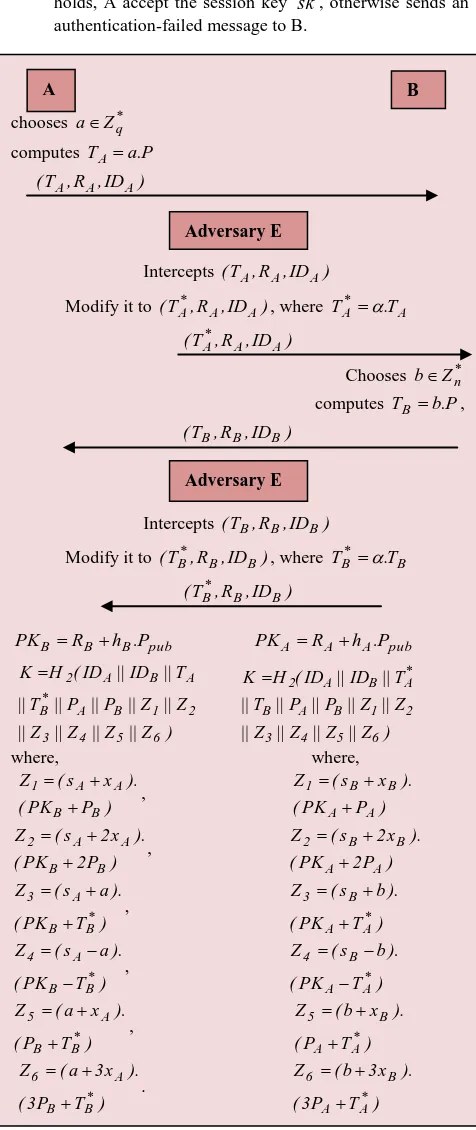
, which is unknown to both A and B. All the key agreement protocols [2, 3, 4, 19] without key confirmation are vulnerable to this attack. From the attack, the adversary does not gain any knowledge about the agreed session key, but two entities generate a wrong session key. This is a violation of the key integrity property which indicates that any accepted session key should depend only on inputs from the protocol participants. Now, in Figure 1, how this attack works in Haiyan Sun’s protocol is demonstrated.5.
THE PROPOSED ELLIPTIC CURVE
KEY AGREEMENT PROTOCOL
The proposed protocol consists of three phases: the registration phase, the transfer phase and the key generation phase. The proposed protocol is described in Figure 2.
5.1
The Registration Phase
The security center chooses a k -bit prime p and determines the tuple {Fp,E/Fp,P} as defined in Section 2.1(notations) then publishes this tuple
Each entity A, B choose his /her secret key and compute the corresponding public keys as follow:
For entity A, A chooses xA[p1]where xAis the secret key and computes the public key PAxA.P For entity B, B chooses xB[p1]where xBis the
secret key and computes the public key PBxB.P
5.2
The Transfer Phase
The entity A chooses a random number a[p1]and computes TAa.Pthen sends TA to the entity B The entity B chooses a random number b[p1]and
computes TBb.Pthen sends TB to the entity A.
Upon receiving TB, entity A computes the session key as follows: K1ABa.TBxA.PB and K2ABa.TB.Then A computes the secret session key
) K || K || T || T ( H
sk 1 A B 1AB 2AB , the authentication message AMAsk H1(TA||TB||sk) and sends
) AM , T
( A Ask to B
Upon receiving TA, entity B computes the session key as follows: KBA1 b.TAxB.PA and KBA2 b.TA then computes the secret session key
) K || K || T || T ( H
sk 1 A B 1BA BA2 , the authentication message AMBsk H1(TA||TB||sk) and sends
) AM , T
Upon receiving the entity A(TB,AMBsk): A checks the validation of the shared secret key. If AMAsk AMBsk holds, A accept the session key sk, otherwise sends an authentication-failed message to B.
Fig 1: Key off-set attack in Haiyan Sun[1] Protocol
P . x . x P . b . a P . x T . a
K1AB B A B A B and
1 AB A B A B A 1
BA b.T x .P b.a.P x .x .P K
K . Also
P . a . b K P . b . a T . a
K2AB B BA2 , therefore the secret
session key is equal.
) K || K || T || T ( Hash ) K || K || T || T ( Hash sk 2 BA 1 BA B A 2 AB 1 AB B A
Also, AMAsk AMBsk as both entities share the same secret key.
Fig 2: The proposed key agreement Protocol
6.
THE PROPOSED CERTIFICATELESS
KEY AGREEMENT PROTOCOL
In this section, the above proposed key agreement protocol is extended to be an identity based key agreement protocol. The proposed identity based protocol consists of six polynomial time algorithms. They are described as follows. The proposed protocol described in figure 3.
6.1
Set up
This algorithm takes a security parameter k as an input and returns the system parameters and the master secrete key. Given k KGC does the following steps.
1) The security center chooses a k -bit prime p and determines the tuple {Fp,E/Fp,G,P} as defined in Section 2.1(notations)
2) KGC chooses the master secret key sZ*n and computes the master public key Ppubs.P
3) KGC chooses two cryptographic secure hash functions
* n *
1:{0,1} G Z
H and H2:{0,1}*GZn* 4) KGC publishes as system parameters and keeps the
master key s secret.
} H , H , P , P , G , F / E , F {
params p p pub 1 2
6.2
Set- Secret- Value
The user with IDi picks randomly xiZ*n, computes P
. x
Pi i and sets xi as his secrete value.
chooses a[p1] chooses b[p1] computes TAa.P computes TB b.P
A T B T B A B 1
AB a.T x .P
K
K1BAb.TAxB.PA
B 2 AB a.T
K KBA2 b.TA
) K || K || T || T ( H sk 2 AB 1 AB B A 1 ) K || K || T || T ( H sk 2 BA 1 BA B A 1 ) sk || T || T ( H
AMAsk 1 A B
) sk || T || T ( H
AMBsk 1 A B
) AM , T
( A Ask
) AM , T
( B Bsk
If AMAsk AMBsk holds If AMAsk AMBsk holds A accept B accept
A B
chooses aZ*q
computes TAa.P (TA,RA,IDA)
Intercepts (TA,RA,IDA)
Modify it to (TA*,RA,IDA), where TA* .TA ) ID , R , T
( *A A A
Chooses bZ*n computes TBb.P,
) ID , R , T
( B B B
Intercepts (TB,RB,IDB)
Modify it to (TB*,RB,IDB), where TB* .TB ) ID , R , T
( B* B B
pub B B B R h .P
PK PKARAhA.Ppub
) Z || Z || Z || Z || Z || Z || P || P || T || T || ID || ID ( H K 6 5 4 3 2 1 B A * B A B A 2 ) Z || Z || Z || Z || Z || Z || P || P || T || T || ID || ID ( H K 6 5 4 3 2 1 B A B * A B A 2
where, where,
) P PK ( ). x s ( Z B B A A 1 , ) P PK ( ). x s ( Z A A B B 1 ) P 2 PK ( ). x 2 s ( Z B B A A 2 , ) P 2 PK ( ). x 2 s ( Z A A B B 2 ) T PK ( ). a s ( Z * B B A 3 , ) T PK ( ). b s ( Z * A A B 3 ) T PK ( ). a s ( Z * B B A 4 , ) T PK ( ). b s ( Z * A A B 4 ) T P ( ). x a ( Z * B B A 5 , ) T P ( ). x b ( Z * A A B 5 ) T P 3 ( ). x 3 a ( Z * B B A 6 . ) T P 3 ( ). x 3 b ( Z * A A B 6
A B
Adversary E
[image:4.595.309.541.154.415.2]Fig 3: The proposed certificateless KA Protocol
6.3
Partial –Private –Key –Extract
This algorithms takes master key , a user's identifier, system parameters as inputs , and returns the user's ID-based private key. KGC does the following steps.
1) KGC chooses a random number
r
i
Z
*n, computes P. r
Ri i and hiH1(IDi,Ri,Pi).
2) KGC computes sirihi.s and sends {si,Ri} to the users through secrete channel.
The user's partial private key is si, the user checks his secret key validation by testing the equation si.PRihi.Ppub . The private key is valid if the equation holds.
6.4
Set-Private-Key
The user with identity IDi has the secrete key pair )
s , x (
ski i i
6.5
Set-Public-Key
The user with identity IDi has the public key pair )
R , P ( pki i i
6.6
Key -Agreement
Let an entity A with identity IDA has the private key )
s , x (
skA A A and public key pkA(PA,RA) and an entity B has the private key skB(xB,sB) and the public key pkB(PB,RB) wants to establish a session key , then they can do the following:
1) A choose a random number aZ*n and computes P
. a
TA , then sends M1(TA,IDA) to the entity B
2) After B receives M1, B choose a random number
* n
Z
b and computes TBb.P, then sends )
ID , T (
M2 B B to the entity B
3) A computes
B A pub B B B 1 B B A 1 AB P . x ) P ). R || P || ID ( H R T ).( s a ( K
and KAB2 a.TB then
) K || K || T || T || ID || ID ( H
skAB 2 A B A B 1AB 2AB , the
authentication message AMAsk H1(TA||TB||skAB) and sends M3(IDA,TA,RA,AMAsk) to B
4) B computes
A B pub A A A 1 A A B 1 BA P . x ) P ). R || P || ID ( H R T ).( s b ( K
and KBA2 b.TA then
) K || K || T || T || ID || ID ( H
skBA 2 A B A B BA1 2BA , the
authentication message AMBskH1(TA||TB||skBA) and sends M4(IDB,RB,TB,AMBsk) to A. B checks the validation of the shared secret key. If
Bsk Ask AM
AM holds, B accept the session key skBA , otherwise sends an authentication-failed message to A. The shared secret keys agree because
B A pub B B B 1 B B A 1 AB P . x ) P ). R || P || ID ( H R T ).( s a ( K B A B B B 1 B A 1 AB P . x ) P . s ). R || P || ID ( H P . r P . b ).( s a ( K B A B B B 1 B A 1
AB (a s ).(b r H (ID ||P ||R ).s).P x .P
K
P . x . x P ). s b ).( s a (
K1AB A B A B
1 BA B A B A 1
AB ( (a s ).(b s ) x .x ).P K
K where
A B A A A 1 A B 1 BA P . x ) P . s ). R || P || ID ( H P . r P . a ).( s b ( K P . x . x P ). s ). R || P || ID ( H r a ).( s b ( K A B A A A 1 A B 1 BA 1 AB A B A B 1
BA ( (b s ).(a s ) x .x ).P K
K
And KAB2 a.TB a.b.PKBA2 b.TAb.a.P The agreed session key can be computed as
) K || K || T || T || ID || ID ( H sk ) K || K || T || T || ID || ID ( H sk 2 BA 1 BA B A B A 2 BA 2 AB 1 AB B A B A 2 AB
7.
SECURITY ANALYSIS
7.1
Known Key Security (KKS)
In the proposed protocol both entities A and B computes the
session key as follow:
) K || K || T || T || ID || ID ( H
skAB 2 A B A B 1AB 2AB security of which is depends on the secrecy of
P . x . x P ). s b ).( s a ( P . x ) P ). R || P || ID ( H R T ).( s a ( K B A B A B A pub B B B 1 B B A 1 AB
However, if an attacker knows the session ephemeral secrets a and b , he cannot computes the session key skAB He can chooses a[p1] chooses b[p1]
computes TAa.P computes TBb.P )
ID , T (
M1 A A
) ID , T (
M2 B B
B A pub B B B 1 B B A 1 AB P . x ) P . ) R || P || ID ( H R T ).( s a ( K
A B pub A A A 1 A A B 1 BA P . x ) P . ) R || P || ID ( H R T ).( s b ( K B 2 AB a.T
K KBA2 b.TA
) K || K || T || T || ID || ID ( H sk 2 AB 1 AB B A B A 2 AB ) K || K || T || T || ID || ID ( H sk 2 BA 1 BA B A B A 2 BA ) sk || T || T ( H AM AB B A 1 Ask ) sk || T || T ( H AM BA B A 1 Bsk ) AM , R , T , ID (
M3 A A A Ask
) AM , T , R , ID (
M4 B B B Bsk
If AMAsk AMBsk holds If AMAsk AMBsk holds A accept B accept
generate the session key if he knows xA.xB.P, sA.sB.P, P
. s .
a B and b.sA.P but this is impossible due to difficulties of solving the CDHP problem. Therefore, the proposed protocol is strong against Known Key Security attack.
7.2
Key off-set attack (KOA)
In the proposed protocol, after sending the user A the message M1(TA,IDA) to B. An attacker E modifies it to
) ID , T (
M1 *A A where TA* .TA. The user B receives T*A
and computes:
A B
pub A A A 1 A * A B *
1 BA
P . x
) P ). R || P || ID ( H R T ).( s b ( K
,
* A * 2 BA b.T
K ,sk*BAH2(IDA||IDB||TA*||TB||KBA1*||K2BA*). Then computes authentication message
) sk || T || T ( H
AM*sk 1 *A B *BA ,
) AM , R , T , ID (
M*4 B B B *sk and sends M*4 to A. Again, An attacker E modifies it to TB* where TB* .TB but does not change the AM*skH1(TA*||TB||sk*BA) because he has no ability to compute it without B’s secret key. Now the user A computes
B A
pub B B B 1 B * B A *
1 AB
P . x
) P ). R || P || ID ( H R T ).( s a ( K
and
the session key:K2AB* a.TB*, )
K || K || T || T || ID || ID ( H
sk*AB* 2 A B A B* AB1* AB2* , )
sk || T || T ( H
AM*sk* 1 A B* *AB* which does not equal )
sk || T || T ( H
AM*sk 1 A* B *BA and therefore, user A rejects the session key agreement and sends an authentication-failed message to B. Thus, the key off-set attack is not possible against the proposed protocol.
7.3
Resistance to Disclosure of Ephemeral
Secrets (DES)
If any session key is exposed to an attacker it does not mean that other session keys are also exposed. In the proposed protocol, the agreed session key sk depends on two random ephemeral secrets a,b and these are generated in each session. The only way to derive a and b is from TAand TB but due to the difficulties of ECDLP problem , it is impossible. So driving one session key does not allow the attacker to gain the knowledge about other session keys.
7.4
Perfect Forward Secrecy(WPFS)
If the attacker compromise the secret keys of
A
andB
, he cannot recover any past session keys. The attackerE
may compute the session key sk if he knowsP ). x . x ) s b ).( s a ( (
K1AB A B A B . Suppose an attacker compromise xA and xB, he may compute xA.xB.P, but not
P . x .
a.b.xA B as a and b are unknown to
E
.He can try to derive a and b from TA and TB, but this is impossible due to difficulties of solving the CDHP problem. Moreover,E
tries to derive a.xB.Pfrom (TA,PB)(a.P,xBP) and P
. x
b. A from (TB,PA)(b.P,xA.P) directly and then P
. x .
a.b.xA B from them. However, these are also not
possible due to hardness of CDHP problem. Thus, the perfect forward security and PKG forward security are preserved in the proposed protocol.
7.5
Resistance to Key-Compromise
Impersonation (KCI) Attacks
Suppose that A's secret key xA is disclosed by an attacker, and then he tries to impersonate
B
toA
to obtain the resulting session key. The attacker intercepts the A's message M1(TA,IDA)and then computes TBb'.P ( b' is selected by the attacker) but he cannot computesP ). x . x ) s a ).( s b ( (
K1BA B A B A , because with known
A
T , random number b and A's secret key, he cannot computes K1BA without the knowledge of a,sA,sB,xB. Thus, generating a session key by an attacker is impossible and the proposed protocol is strong against the key-compromise impersonation attacks
7.6
No key control (NKC)
In the proposed protocol, both participants A and B have an input into the session key neither participant can force the full session key to be a preselected value. The session key in our protocol is determined jointly by both participants A and B.
Thus skAB H2(IDA||IDB||TA||TB||KAB1 ||KAB2 ) depends on TA ,TB, RB, Ppub and PB where
B A
pub B B B 1 B B A 1
AB
P . x
) P ). R || P || ID ( H R T ).( s a ( K
,
B 2 AB a.T
K and these are generated by A and B respectively. No way for any user to control the session key only by himself.
7.7
Resistance to Unknown Key-Share
(UKS) Attacks
Following the proposed protocol, the session key is generated not only using KAB, also the identities
B A,ID
ID of the participants and other session dependent tokens TA and TB. The proposed protocol is secure against unknown key-share attack.
7.8
The Comparative Study
The proposed identity based key agreement protocol is compared with the protocols by Debiao He [4] (2011) , Debiao He [3] (2012) and Haiyan Sun [2] (2013) from the computational cost , number of exchanged messages and the key offset attack where TEC-mult is the time required for
executing multiplication operation on elliptic curve E, TEC-add
is the time required for executing addition operation on elliptic curve E and Th is the time required for executing one
Table.1. the proposed protocol is compared with the protocols in [2, 4 ,3]
The protocol
Computational cost
Key off-set attack
(KOA)
No of exchanged
messages Debiao He
[4] (2011)
5TEC-mult + 4T
EC-add +2Th
No 2
Debiao He [3] (2012)
5TEC-mult + 3T
EC-add +2Th
No 2
Haiyan Sun [2] (2013)
10TEC-mult + 7T
EC-add +1Th
No 2
The proposed
protocol
5TEC-mult + 3T
EC-add +2Th
Yes 4
8.
IMPLEMENTATION
8.1
Domain Parameter Specification
In this section, the elliptic curve and the domain parameters proposed are specified in the following way.
The elliptic curve equation specified in section 2.2. where the parameters
p : is the prime specifying the base field. b
,
a : are the coefficients of the equation b
ax x
y2 3 defining the elliptic curve. )
y , x (
G : is the base point, i.e., a point in E of prime order, with x and y being its x- and y-coordinates, respectively.
q : is the prime order of the group generated by G.
8.2
Sample Run and its Results
8.2.1
Parameters
p 76884956397045344220809746629001649093037950 200943055203735601445031516197751
a 56698187605326110043627228396178346077120614 539475214109386828188763884139993
b 17577232497321838841075697789794520262950426 058923084567046852300633325438902
x 63243729749562333355292243550312970334778175 571054726587095381623627144114786
y 38218615093753523893122277964030810387585405 539772602581557831887485717997975
q 76884956397045344220809746629001649092737531 784414529538755519063063536359079
s 53145625260008940986066055669109078527114602 034138260649790296341236527899616
pub
P {7739552726222612815050026272965492129582592 38484808867339922169776988198408,
65530321311658607517084723974213331739070203 81956762080138611198361845088069}
8.2.2
Set- Secret- Value
A
ID 71687682297330968505367935422899969320414662 101541886965266449198989192834904
B
ID 71987535192538800477616344379393279498811277 820641396100499030343301187801069
A
x 36970917057604995392163116089274538973784638 899374105544422616072686917434464
B
x 67388075705982992220549471663190937701872496 524845891485128629547185746636907
A
P {7722331765656151675963766905894768609675094 184151969406165403177166454051199
,4495759660172938421442437952749463662005401 4645374456997318769737528198317509}
B
P {7877034842700288155439664896882850632711435 866587094426483917070356571715558,
52217726305833992167110353980070706594254804 748676939014424841041113837483648}
8.2.3
Partial –Private –Key –Extract
A
R {314169454325786797840651879609148627570600 77944048741799900358541013723057886, 7633185294375774407847793039974595878796447 3887676236075106521110575452102413}
B
R {321174742753041001090213921502670566773986 21356810027529292510481770196804628, 3899576261769988143665210733325964437978675 7451105133811925831417942621327436}
A
h 374982247
B
h 353954023
A
s 2372853270574853210884637784154362490573544 3530640418618326059738268806026376
B
s 7192801064002881170796124948987168075691402 2056843876726996635965024213329524
8.2.4
Key –Agreement
For entity A
A
T {7230817669096889475837353000808181994279 628910856346151533017806348669598413, 39574847083995390826591958791953613060955 771369431781142502617203129241099995}
1 AB
K {3662124632149932211220405868461415045259 6080628660128787671850125780705606675,2467 92905808135544097355807167814679435311767 54326088277500428152230081364796}
2 AB
K {4328321497048380559974549459573231114299 2355003145102061119456591261706306951, 34250812356769795848839860278670170691043 127398187645252784441297390811232556}
AB
sk 1074612477
AB
AM 525601355 For entity B
B
T {4256490918640759351857357489711663350951 9805440194728252475938500328559159536, 50686570996408811739553512801295382759631 783451684054328040272365406949972510}
1 BA
K {3662124632149932211220405868461415045259 6080628660128787671850125780705606675, 24679290580813554409735580716781467943531 176754326088277500428152230081364796}
2 BA
K {4328321497048380559974549459573231114299 2355003145102061119456591261706306951 ,34250812356769795848839860278670170691043 127398187645252784441297390811232556}
BA
BA
AM 525601355
It obvious from the Implementation that both entities share the same session key
9.
CONCLUSION
In this paper, a security flaw of Haiyan Sun's protocol has been identified and then a modification has been proposed to design a new paring-free key agreement protocol based on elliptic curve cryptography. A certificateless key agreement protocol without bilinear pairings is proposed which is an extension to the first proposed one. The security analysis of the proposed paring free this key agreement protocol has been discussed. It is found that the proposed protocol achieves all security requirements and avoids the key-off set attack. The performance of the proposed protocol is compared with other protocols and it is found that the proposed protocol is requires computations with improved security properties. The proposed protocol has been implemented using the Mathematica(7) program.
10.
REFERENCES
[1] F. Ahmed and Dalia Elkamchouchi ," A New Efficient Protocol For Authenticated Key Agreement", International Journal of Computer and Communication Engineering, Vol. 2, No. 4, July 2013.
[2] H. Sun, Q. Wen, H. Zang and Z. Jin, " A Strongly Secure Pairing –Free Certificateless Authenticated Key Agreement Protocol For Low –Power Devices", ISSN 1392-124X, ISSN 2335-884X (online) Information Technology and control , 2013,Vol.42 ,No. 2.
[3] D. He , S. Padhye and J. Chen," An Efficient Certificateless Two-Party Authenticated Key Agreement Protocol", Computers & Mathematics with Applications , Volume 64, Issue 6, September 2012, Pages 1914–1926
[4] D. He, and Y. Chen, " An Efficient Certificateless Authenticated Key Agreement Protocol Without Bilinear Pairings", Mathematical and Computer Modelling, 54 (11-12), 3143-3152, 2011
[5] A. Shamir, "Identity-Based Cryptosystems And Signature Protocols", Proc. CRYPTO1984, LNCS, vol.196, 1984, pp.47–53.
[6] S. Al-Riyami, and K.G. Paterson, "Certificateless Public Key Cryptography", Proceedings of ASIACRYPT 2003, LNCS 2894, Springer-Verlag, 2003, pp. 452–473.
[7] Z. Shao," Efficient Authenticated Key Agreement Protocol Using Self-Certified Public Keys From Pairings", Wuhan University Journal of Natural Sciences, 10(1):267-270, 2005.
[8] S. Wang, Z. Cao, and X. Dong, "Certificateless Authenticated Key Agreement Based On The MTI/C0 Protocol", Journal of Information and Computational Science 3 (2006) 575–581.
[9] Y. Shi, and J. Li, " Two-Party Authenticated Key Agreement In Certificateless Public Key Cryptography", Wuhan University Journal of Natural Sciences 12 (1) (2007) 71–74.
[10] T. Mandt, and C. Tan, " Certificateless Authenticated Two-Party Key Agreement Protocols", in the Proceedings of the ASIAN 2006, LNCS, vol. 4435, Springer-Verlag, 2008, pp. 37–44.
[11] C. Swanson, "Security In Key Agreement: Two-Party Certificateless Schemes", Master Thesis, University of Waterloo, 2008.
[12] G. Lippold, C. Boyd, and J. Nieto, "Strongly Secure Certificateless Key Agreement", In Pairing 2009, pages 206-230.
[13] L. Zhang, F. Zhang, Q. Wua, and J. Domingo-Ferrer, "Simulatable Certificateless Two-Party Authenticated Key Agreement Protocol", Information Sciences 180 (2010) 1020–1030. 16
[14] L. Chen, Z. Cheng, and N.P. Smart, "Identity-Based Key Agreement Protocols From Pairings", Int. J. Inf. Secur., 6(2007) pp.213–241.
[15] M. Geng and F. Zhang, "Provably Secure Certificateless Two-Party Authenticated Key Agreement Protocol Without Pairing", In International Conference on Computational Intelligence and Security, pages 208-212, 2009.
[16] M. Hou and Q. Xu," A Two-Party Certificateless Authenticated Key Agreement Protocol Without Pairing", In 2nd IEEE International Conference on Computer Science and Information Technology, pages 412-416, 2009.
[17] G. Yang, and C. Tan," Strongly Secure Certificateless Key Exchange Without Pairing", In the 6th ACM Symposium on Information, Computer and Communications Security, 71-79, 2011.
[18] D. He, J. Chen, and J. Hu," A Pairing-Free Certificateless Authenticated Key Agreement Protocol", International Journal of Communication Systems, DOI: 10.1002/dac.1265, 2011.
[19] Y. Kim , Y. Kim , Y. Choe and H. Chol O, " An Efficient Bilinear Pairing-Free Certificateless Two-Party Authenticated Key Agreement Protocol In The Eck Model", KISU‐MATH‐2013‐E‐R‐016: Version 4 [20] S. H. Islama and G. P. Biswas, " An Improved
Pairing-Free Identity-Based Authenticated Key Agreement Protocol Based On ECC", International Conference on Communication Technology and System Design 2011.