Moving Target Travelling Salesman Problem using
Genetic Algorithm
Nitin S. Choubey
Professor & Head,
Department of Computer Engineering SVKM’s NMIMS, Shirpur, Dhule, Maharashtra, India
ABSTRACT
In this paper, the Moving Target Travelling Salesman Problem (MTTSP) is described. In MTTSP, several sites are required to be visited which are moving with constant velocity in different directions. The distance of the sites from origin, velocity and the angle of movement are known in advance. The goal is to find the fastest tour starting and ending at the origin which intercepts all the sites. The method implemented using genetic algorithm approach on the various data sets and the results are compared with greedy approach.
General Terms
Algorithm, complexity,
Keywords
Genetic Algorithm, Evolutionary Computation, Travelling Salesman Problem, Moving Target Travelling salesman problem, intercept, greedy method.
1.
INTRODUCTION
The traveling salesman problem (TSP) was originated by the studies of two mathematicians Sir William Rowam Hamilton from Ireland and Thomas Penyngton Kirkman from Briton in the 18th century. The general form of the TSP is believed to be studied further Kalr Menger in Vienna and promoted by Hassler, Whitney & Merrill at Princeton[2]. A detailed description about the connection between Menger & Whitney, and the development of the TSP can be found in Schrijver, 2005[3].
Given a set of cities and the cost of travel (or distance) between each possible pairs, the objective of the TSP is to find the best possible way of visiting all the cities and returning to the starting point that minimize the travel cost (or travel distance)[1]. Given n is the number of cities to be visited, the total number of possible routes covering all cities can be given as a set of feasible solutions of the TSP and is given as (n-1)!/2 [4]. In the classical TSP, the sites to be visited are stationary[10]. Motivated by practical application, Helvig et al.[4] introduced a time dependent generalization of TSP, referred as Moving Target TSP, where a pursuer must intercept in minimum time a set of targets which move with constant velocities (e.g., when a supply ship resupplies patrolling boats or when an aircraft must intercept a number of mobile ground units). Helvig et. al.[4] defined the Moving-Target travelling salesperson problem (MTTSP) as
“Given a set S = {s1, … sn} of targets, each si moving at
constant velocity vi from an initial position pi, and given a
pursuer starting at the origin and having maximum speed v>|vi|, find the fastest tour starting (and ending) at the origin,
which intercepts all targets.”
[image:1.595.340.519.219.404.2]An instance of MTTSP with four targets to be visited is shown in the fig 1. The start and end position of the pursuer is shown by flag. Helvig et. Al. has shown that the problem is NP-Hard. Several variants of MTTSP are given in [5][6].
Fig 1 : MTTSP instance with four targets[4]
Jindal et al.[9][16] attempted to solve an variant of MTTSP, with resupply when all the target are moving away from the origin, by using greedy methodology, where authors sorted the target in the order of di/vi to get the sequence of the sites
to be visited, where di is the distance of the i th
target from origin and vi is the velocity of ith target. The assumption made
in this paper is that, although the target are either moving away from the original position of the pursuer or moving towards pursuer, they are also moving with some angle “” with respect to the origin[13][14][15]. It is assumed that the angle of movement also plays important role in determining the sequence to be visited for the optimal elapsed time. The MTTSP problem is addressed in this paper with the help of Genetic Algorithm. The solution generated with the help of Genetic algorithm is compared with that of generated with the help of greedy approach. Section 2 of the paper gives details of the suggested approach and the greedy method. Section 3 compares the result followed by concluding remarks in section 4.
2.
METHODOLOGY ADOPTED
The suggested approach is divided in to two sub-section namely The generation of the sequence and calculation of Total Elapsed Time (TET) the simulation of the sequence to get total elapsed time for the sequence.
2.1
Generation of sequence
The suggested model uses genetic algorithm for generating the sequence. The answer generated with genetic algorithm is compared with that of greedy method. The methods are discussed in the following subsections.
2.1.1
Genetic Algorithm methodology
The Simple Genetic Algorithm (SGA) is adopted for generating the optimal sequence. A Simple Genetic Algorithm is given in fig. 2.
1. Create initial random population.
2. Calculate fitness of the individuals in the population. 3. Repeat following steps until termination criteria is reached.
a. Select best fit from the current population and generate offspring.
b. Evaluate fitness of each offspring.
c. Replace weak individuals from the population with newly generated ones.
Fig 2 : Simple Genetic Algorithm
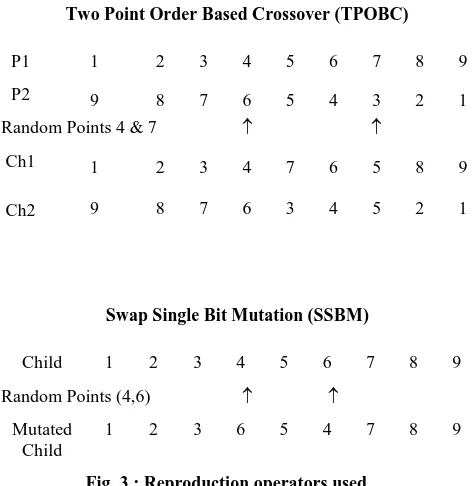
The GA produces successive generations of individuals by computing their “fitness” at each step and selecting the best of them, when the termination condition arises. Tournament selection method is used for selection of parent where two parents are chosen randomly and the best amongst them get a chance to be in the mating pool [12]. The termination criteria of user specified maximum number of generations is used. Two point order based crossover and swap single bit mutation is used for reproduction process. The sequence of the targets to be visited by the pursuer is used as chromosome. The working of the crossover and mutation operators is shown in Fig 3. Order based crossover is used to preserve the target in the chromosomes. The TET is used as fitness value for the chromosome sequence.
2.1.2
Greedy Method
The sequence of the sites to be visited is decided based on the ratio of di/vi and are scheduled in ascending and descending
order of the ratio di/vi.
Two Point Order Based Crossover (TPOBC)
P1 1 2 3 4 5 6 7 8 9
P2 9 8 7 6 5 4 3 2 1
Random Points 4 & 7
Ch1 1 2 3 4 7 6 5 8 9
Ch2 9 8 7 6 3 4 5 2 1
Swap Single Bit Mutation (SSBM)
Child 1 2 3 4 5 6 7 8 9
Random Points (4,6)
Mutated Child
[image:2.595.315.551.78.321.2]1 2 3 6 5 4 7 8 9
Fig. 3 : Reproduction operators used
2.2
Calculation of Total Elapsed Time
The TET is measure by adding the time required to visit each targets by the pursuer in the provided sequence. The process is shown in figure 4.
1. Initialize the TET to zero, and target to visit as si with
i=1.
2. Calculate the time required to visit the target si from
origin of the pursuer, say ti. Update TET to TET+ ti, & i
to i+1.
3. Calculate the time required to visit the target si from the
place of the visit target si-1 by the pursuer, say ti.
4. Update TET to TET+ ti, & i to i+1.
5. Repeat Steps 3 & 4 for all the targets in sequence. Fig 4 : Calculation of TET
3.
Experimental Setup and Result Analysis
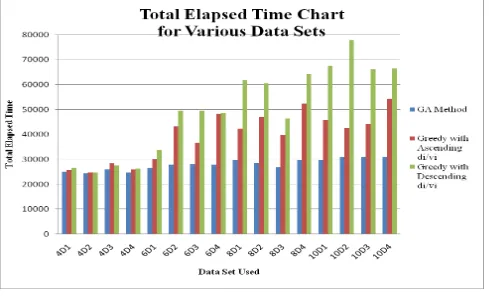
movement while deciding the sequence of the targets to be visited, where as in GA methods the final time taken by the pursuer is considered as a fitness function. It shows that there is need to incorporate the direction of targets movement apart from merely its direction and velocity only.
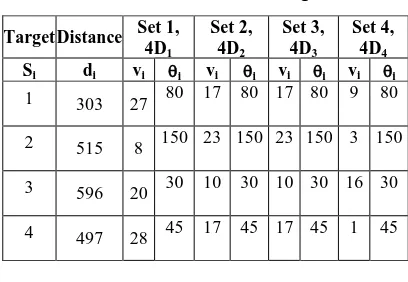
Table 1. Data Sets for Four targets
Target Distance Set 1, 4D1 Set 2, 4D2 Set 3, 4D3 Set 4, 4D4
Si di vi i vi i vi i vi i
1 303 27 80 17 80 17 80 9 80 2 515 8 150 23 150 23 150 3 150 3 596 20 30 10 30 10 30 16 30 4 497 28 45 17 45 17 45 1 45
Table 2. Data Sets for Six targets
Target Distance Set 1, 6D1 Set 2, 6D2 Set 3, 6D3 Set 4, 6D4
Si di vi i vi i vi i vi i
[image:3.595.327.530.81.350.2]1 303 2 80 6 80 26 80 27 80 2 515 25 150 22 150 12 150 7 150 3 596 14 30 25 30 23 30 19 30 4 497 29 45 6 45 6 45 20 45 5 527 22 60 4 60 5 60 27 60 6 289 36 294 3 197 26 307 17 267
Table 3. Data Sets for Eight targets
Target Distance Set 1, 8D1 Set 2, 8D2 Set 3, 8D3 Set 4, 8D4
Si di vi i vi i vi i vi i
1 303 16 80 4 80 8 80 14 80 2 515 26 150 3 150 17 150 28 150 3 596 27 30 4 30 9 30 17 30 4 497 1 45 11 45 7 45 22 45 5 527 23 60 29 60 3 60 18 60 6 326 37 296 15 85 39 30 19 122 7 419 26 136 30 168 4 32 23 14 8 281 10 104 13 334 7 42 17 28
Table 4. Data Sets for Ten targets
Target Distance Set 1, 10D1 Set 2, 10D2 Set 3, 10D3 Set 4, 10D4
Si di vi i vi i vi i vi i
1 303 15 80 3 80 1 80 20 80 2 515 3 150 26 150 5 150 19 150 3 596 10 30 28 30 14 30 26 30 4 497 11 45 16 45 3 45 18 45 5 527 13 60 10 60 26 60 5 60 6 425 36 227 18 278 1 240 12 128 7 288 30 283 26 356 39 15 23 313 8 311 3 37 20 309 29 284 22 15 9 203 36 179 28 281 25 171 33 11 10 462 16 86 4 15 15 145 30 95
Table 5. Results for set with four targets
Data Sets
GA Method Greedy Method
Di/vi, Ascending Di/vi, Descending Solution TET Solution TET Solution TET 4D1 1-2-3-4 24911 2-3-4-1 25821 1-4-3-2 26534
4D2 1-4-2-3 24453 3-4-2-1 24860 1-2-4-3 24621
4D3 1-4-2-3 26056 4-2-3-1 28349 1-3-2-4 27651
4D4 1-2-3-4 24713 1-3-2-4 25824 4-2-3-1 26293
Table 6. Results for set with Six targets
Data Sets
GA Method Greedy Method
Di/vi, Ascending Di/vi, Descending Solution TET Solution TET Solution TET
6D1
6-1-2-4-3-5 26458
6-4-2-5-3-1 30035
1-3-5-2-4-6 33685 6D2
6-5-3-4-2-1 27945
2-3-1-4-6-5 43354
5-6-4-1-3-2 49389 6D3
6-5-3-2-4-1 28024
1-6-3-2-4-5 36692
5-4-2-3-6-1 49461 6D4
6-1-2-5-3-4 27919
1-5-4-6-3-2 48437
2-3-6-4-5-1 48527
Table 7. Results for set with eight targets
Data Sets
GA Method Greedy Method
Di/vi, Ascending Di/vi, Descending Solution TET Solution TET Solution TET
8D1
6-5-3-2-4-7-1-8 29789
6-7-1-2-3-5-8-4 42326
4-8-5-3-2-1-7-6 61764 8D2
8-7-4-3-5-2-6-1 28526
7-5-6-8-4-1-3-2 47136
2-3-1-4-8-6-5-7 60615 8D3
8-6-5-3-2-4-7-1 26880
6-2-8-1-3-4-7-5 39875
5-7-4-3-1-8-2-6 46494 8D4
8-6-5-3-4-2-7-1 29726
7-2-6-1-4-8-5-3 52419
[image:3.595.64.268.139.280.2] [image:3.595.65.269.496.718.2]
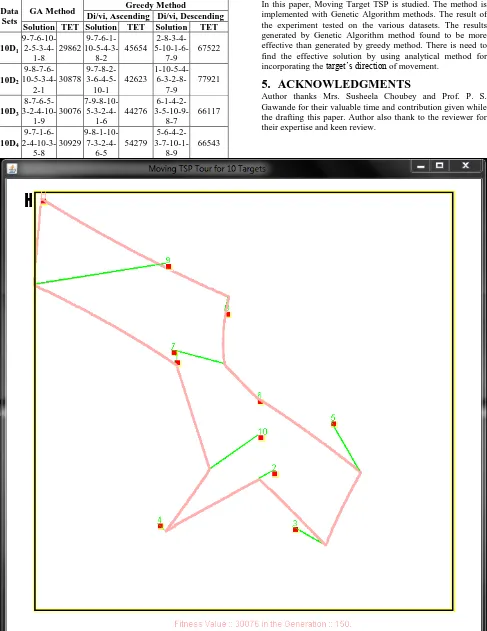
Table 8. Results for set with ten targets
Data Sets
GA Method Greedy Method
Di/vi, Ascending Di/vi, Descending Solution TET Solution TET Solution TET
10D1
9-7-6-10-
2-5-3-4-1-8
29862 9-7-6-1-
10-5-4-3-8-2
45654
2-8-3-4-
5-10-1-6-7-9
67522
10D2
9-8-7-6-
10-5-3-4-2-1
30878 9-7-8-2- 3-6-4-5-10-1
42623
1-10-5-4-
6-3-2-8-7-9
77921
10D3
8-7-6-5-
3-2-4-10-1-9
30076
7-9-8-10-
5-3-2-4-1-6
44276
6-1-4-2-
3-5-10-9-8-7
66117
10D4
9-7-1-6-
2-4-10-3-5-8
30929
9-8-1-10-
7-3-2-4-6-5
54279
5-6-4-2-
3-7-10-1-8-9
66543
4.
CONCLUSION
In this paper, Moving Target TSP is studied. The method is implemented with Genetic Algorithm methods. The result of the experiment tested on the various datasets. The results generated by Genetic Algorithm method found to be more effective than generated by greedy method. There is need to find the effective solution by using analytical method for incorporating the target’s direction of movement.
5.
ACKNOWLEDGMENTS
Author thanks Mrs. Susheela Choubey and Prof. P. S. Gawande for their valuable time and contribution given while the drafting this paper. Author also thank to the reviewer for their expertise and keen review.
Fig 6 : Comparison chart
6.
REFERENCES
[1] Horowitz E., Sahani S, and Rajasekaran S, 2007. Fundamentals of Computer Algorithm, University Press. [2] Rajesh Matai, Surya Singh and Murari Lal Mittal (2010).
Traveling Salesman Problem: an Overview of Applications, Formulations, and Solution Approaches, Traveling Salesman Problem, Theory and Applications, Prof. Donald Davendra (Ed.), ISBN: 978-953-307-426-9,
InTech, Available from:
http://www.intechopen.com/books/traveling-salesman-
problem-theory-and-applications/traveling-salesmanproblem an-overview-of-applications-formulations-and-solution-approaches.
[3] Schrijver, A., 2005. On the History of Combinatorial Optimization (Till 1960). In K. Aardal, G. L. Nemhauser, & R. Weismantel (Eds.), Handbooks in operations research and management science, 12, Amsterdam: Elsevier.
[4] Helvig C. S., Gabriel Robins, and Alex Zelikovsky, 2003. The Moving-target travelling salseman problem, Journal of Algorithms 49 (2003), 153-174.
[5] Helvig C. S. Gabriel Robins, and Alex Zelikovsky, C. H. Helvig, G. Robins, and A. Zelikovsky. “Moving Target TSP and Related Problems”, G. Bilardi et Al. (Eds.): ESA’98, LNCS 1461, pp 435-1998.
[6] D. P. Guy, Evolutionary Computing as a Tool for Grammar Development, CNTS – Language Technology Group, UIA – University of Antwerp, Antwerp – Belgium, GECCO 2003 LNCS 2723, Springer-Verlag, Berlin, Heidelberg, 2003, pp. 549–560.
[7] J. H. Holland, Adoption in Natural and Artificial System, University of Michigan Press, Ann Arbor, MI, 1975.
[8] D. E. Goldberg, Genetic Algorithms in Search, Optimizations and Machine Learn-ing, Addison-Wesley, 1989.
[9] Jindal Pawan, Amit Kumar, and Shishir Kumar, 2011, “Dynamic Version of Travelling Salseperson Problem”, International Journal of Computer Applications (0975 – 8887), Volume 19– No.1, April 2011.
[10]Choubey Nitin S., 2012, “Solving TSP using DARO”, International Journal of Computer Applications (0975-8887), Volume 58-No.9, November 2012.
[11]Potvin J. Y., 1996, “Geneti Algorithms for the Travelling Salseman Problem”, Annals of Operation Research, 339-370, 1996.
[12]Sivanandam, Deepa, 2008, “Introduction to Genetic Algorithm”, Springer, 2008.
[13]Bartley Cristopher, 2004, “Closed Form Guidance Laws for Intercepting Moving Targets” Master’s thesis, Rice University, Houstons, Texas, April 2004.
[14]Gabrial Jacob Diaz, Flip Phillips and Brett R. Fajen, 2009, “Intercepting Moving Targets: a Little Foresight Helps a Lot” Springer-Verlag 2009.
[15]Jason R. Looker, 2008, “Minimum Paths to Interception of a Moving Targets when Constrained by Turning Radius”, DSTO Defence Science and Technology Organisation, Australia, December 2008.
![Fig 1 : MTTSP instance with four targets[4]](https://thumb-us.123doks.com/thumbv2/123dok_us/8074738.780628/1.595.340.519.219.404/fig-mttsp-instance-targets.webp)