
http://dx.doi.org/10.4236/wjet.2015.33C026
A New Robust Color Image Watermarking
Scheme Based on 3D-DCT
Xiangguang Xiong
School of Mathematics and Computer Science, Guizhou Normal University, Guiyang, China Email: [email protected]
Received 7 September 2015; accepted 16 October 2015; published 23 October 2015
Abstract
In this paper, for color image copyright protection application, a new and blind color image wa-termarking algorithm based on quantitation method in three dimensional discrete cosine trans-form (3D-DCT) is proposed. Firstly, the original RGB color image is divided into non-overlapping blocks sized 8 × 8 × 3, and then performs 3D-DCT transform on each block. Secondly, embed a bit watermarking signal into each block’s 3D-DCT direct-current (DC) coefficient by quantization method. The results show that the proposed scheme has very good imperceptibility and robust-ness against the common image processing attacks. Compared with similar algorithm, the pro-posed scheme has better robustness performance for most attacks.
Keywords
Color Image Watermarking, Three Dimensional Discrete Cosine Transform (3D-DCT), Quantitative Method, Robustness
1. Introduction
With the development of multimedia technology, computer technology and network technology, the digital mul-timedia can be completely reconstructed without any distortion. However, many new issues have emerged, such as the security of computer network transmission and the copyright protection of digital products [1]. For copy-right protection application of digital multimedia, copycopy-right owner generally embeds a watermarking signal (may be a number, a text or an image) into original digital multimedia to verify its copyright.
per-formed by DCT [4]-[10]. And then embed the watermarking signal into corresponding transform domain coeffi-cients by proposed embedding rule.
In this paper, a new and blind robust RGB color image watermarking scheme based on 3D-DCT transform is proposed. Firstly, the original RGB color image is divided into non-overlapping blocks sized 8 × 8 × 3, and then performs 3D-DCT transform on each block. Secondly, embed a bit watermarking signal into each block’s 3D-DCT direct-current (DC) coefficient by quantization method. The proposed scheme can not only achieve good imperceptibility but also against the common image processing attacks, such as adding noise, filtering, cropping, JPEG compression, scaling and rotating. Compared with similar watermarking algorithm, it has a bet-ter robustness performance for most attacks.
The rest of the paper is organized as follows. Section 2 briefly defines 3D-DCT transform and its inverse transform. Section 3 proposes detailed watermarking embedding and extraction procedures. The corresponding experimental results are given in Section 4. Finally, the conclusions are drawn in Section 5.
2. 3D-DCT Transform
For a given 3D volume data sized n n nx, y, z, the 3D-DCT transform is defined as follows.
1
1 1
0 0 0
(2 1) (2 1) (2 1)
( , , ) ( ) ( ) ( )[ ( , , ) ]
2 2 2
y
x n z
n n
x y z x y z
x a y b z c
F a b c C a C b C c f x y z
n n n
π
π
π
−
− −
= = =
+ + +
=
∑ ∑ ∑
(1)where ( ) 1 / , 0
, 0 2 / x x n a C a a n = = ≠ ,
1 / , 0
( ) , 0 2 / y y n b C b b n = = ≠ ,
1 / , 0 ( ) , 0 2 / z z n c C c c n = = ≠
, f x y z( , , ) is the pixel value
at position ( , , )x y z , and F a b c( , , ) is 3D-DCT transform coefficient. The inverse 3D-DCT transform is de-fined as below.
1
1 1
0 0 0
(2 1) (2 1) (2 1)
( , , ) [ ( ) ( ) ( ) ( , , ) ]
2 2 2
y
x n z
n n
a b c x y z
x a y b z c
f x y z C a C b C c F a b c
n n n
π
π
π
−
− −
= = =
+ + +
=
∑ ∑ ∑
(2)3. Proposed Scheme
For the proposed scheme, it consists of two phases: watermarking embedding procedure and extraction proce-dure.
3.1. Watermarking Embedding Procedure
The proposed watermarking embedding procedure is showed in Figure 1. The detailed steps are described as follows.
Figure 1. Flow diagram of watermarking embedding procedure. Binary image 3D-DCT transform
Embedding watermarking
Inverse 3D-DCT transform Arnold scrambling
Original RGB color image
Step 1. According to selected iteration times n, encrypt binary watermarking image with Arnold transform to obtain an encrypted watermarking image.
Step 2. For a given color image, it is divided into blocks sized 8 × 8 × 3. Step 3. For each image block, 3D-DCT transform is performed on it.
Step 4. Suppose the watermarking embedding strength is Q. Modify the DC coefficient to embed watermark-ing signal. The watermarkwatermark-ing embeddwatermark-ing rule is defined as bellow.
' / 2 mod( 0.75 , ) , 1
/ 2 mod( 0.75 , ) , 0
DC Q DC Q Q if w
DC
DC Q DC Q Q if w
+ − + =
= + − − =
(3)
Step 5. Perform inverse 3D-DCT transform on new DC coefficient and other coefficients to obtain an em-bedded image block. When all blocks are emem-bedded, the final watermarked image is obtained.
3.2. Watermarking Extraction Procedure
The watermarking extraction procedure is just the inverse procedure of the watermarking embedding procedure. The extraction procedure of the watermarking is blind, which does not need the original cover image. The wa-termarking extraction procedure is showed in Figure 2. The watermarking extraction steps can be described as below.
Step 1. For a given watermarked color image, it is divided into blocks sized 8 × 8 × 3. Step 2. For each image block, 3D-DCT transform is performed on it.
Step 3. The binary watermarking bits can be extracted as follows.
' 1, mod( , ) / 2
0 ,
if DC Q Q
w
else
≥
=
(4)
Step 4. According to selected iteration times n during watermarking embedding procedure, decrypt the ex-tracted binary watermarking signal using inverse Arnold transform to obtain final exex-tracted watermarking im-age.
4. Experimental Results
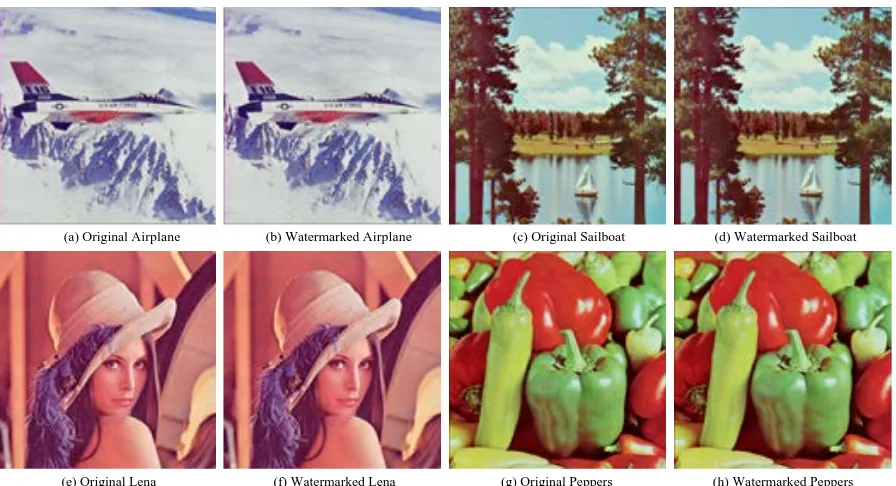
To test the robustness of proposed scheme, the original watermarking signal is a binary image sized 64 × 64 and is showed in Figure 3. The original cover images are four RGB true color image sized 512 × 512 × 3, namely Airplane, Sailboat, Peppers and Lena, as shown in Figure 4. The threshold Q of the proposed scheme defined in Section III is 60.
4.1. Imperceptibility Test
The Peak Signal to Noise Ratio (PSNR) is used to evaluate the distortion between the cover image x and the watermarked image x′, which is defined as below.
Figure 2. Flow diagram of watermarking extraction procedure.
RGB watermarked color image
3D-DCT transform
Extraction watermarking
Figure 3. Original binary watermarking image.
Figure 4. Original images and watermarked images.
2
10 255
10 log ( )
PSNR
MSE
= × (5)
The mean square error (MSE) between x and x′ is defined as blew.
2
, ,
1 1 1
( )
M M
i j i j i j
MSE x x
M M = =
′
= × −
×
∑∑
(6)where M is width of original cover image.
The average PSNR between the original RGB image and its watermarked image are shown in Table 1. From Table 1, it can be seen that the proposed scheme and the algorithm in [3] have good visual quality of water-marked image. The average PSNR for proposed scheme are about 45.85 dB.
4.2. Robustness Test
The Normalized Cross-Correlation (NC) is used to measure the similarity between the original binary water-marking signal w and the extracted binary watermarking signal w′, which is defined as follows.
, ,
1 1 1
( )
N N
i j i j i j
NC w w
N N = =
′
= × ⊕
×
∑∑
(7)where N is width of binary watermarking signal, ⊕ symbol represents XOR operation.
To verify the robustness of the proposed scheme, the watermarked image is first attacked by common image processing. And then the embedded watermarking signal is extracted from attacked watermarked image. The results for watermarked Lena color image are shown in Figure 5 (The results of other images are similar with Lena image). It can be easily seen that the extracted watermarking images can be discriminated by human visual
(a) Original Airplane (b) Watermarked Airplane
(g) Original Peppers (h) Watermarked Peppers (c) Original Sailboat (d) Watermarked Sailboat
system. These results show that the proposed scheme can achieve excellent robustness against common image processing attacks.
4.3. Performance Comparison
[image:5.595.225.403.233.344.2]To test the superiority of the proposed scheme, we compared the proposed scheme with similar algorithm based on 3D-DCT in [3]. Under the same conditions, the results between PSNR and NC are shown in Table 2. From Table 2, it can be easily seen that the proposed scheme and the algorithm in [3] have almost same PSNR values after various attack, but the proposed scheme has better robustness performance.
Figure 6 gives the results between the proposed scheme and the algorithm in [3] on Lena image. From Figure 6, it can be easily seen that compared with the algorithm in [3], the proposed scheme has better robustness against most common image processing attacks.
[image:5.595.88.543.410.475.2]Figure 5. Extracted watermarking image. Various attacks have been utilized independently to each component each time for Lena image. (a) Crop (1/4); (b) JPEG compression (Q = 80); (c) median filter (3 × 3); (d) rotate (10˚); (e) scale (0.5); (f) salt & peppers noise (0.001); (g) speckle noise (0.001); (h) wiener filter (3 × 3).
Table 1. PSNR comparisons between the proposed scheme and the algorithm in [3].
Test image Proposed scheme [3]
Airplane 45.8905 45.4424
Lena 45.8888 45.4374
Peppers 45.9074 45.5219
[image:5.595.87.538.504.720.2]Sailboat 45.7450 45.4507
Table 2. PSNR and NC comparisons between the proposed scheme and the algorithm in [3].
Attack type Intensity Proposed scheme [3]
PSNR NC PSNR NC
Compression
JPEG compression (Q = 60) 32.4461 0.8564 32.4273 0.9004
JPEG compression (Q = 70) 32.9402 0.9163 32.9126 0.9126
JPEG compression (Q = 80) 33.6178 0.9844 33.5874 0.9102
Noise Speckle noise 35.2496 0.9878 35.1973 0.9138
Salt & pepper noise 35.0859 0.9709 34.7111 0.9817
Filtering
Median filtering (3 × 3) 33.9339 0.9194 33.9918 0.9133
Median filtering (5 × 5) 30.6079 0.8027 30.6583 0.7869
Wiener filtering (3 × 3) 35.7532 0.9732 35.8472 0.9282
Wiener filtering (5 × 5) 33.5019 0.7832 33.5941 0.7798
Rotating 5 degree 20.0438 0.9407 20.0449 0.8953
10 degree 17.5140 0.9390 17.5147 0.8857
Rescaling Scale (0.5) 33.1163 0.9846 33.1603 0.9404
Scale (2) 41.1787 1.0000 41.1122 0.9412
Cropping Cropping (1/16) 18.4751 0.9895 18.4741 0.9661
Cropping (1/4) 12.1114 0.9563 12.1112 0.8599
(a) (b) (c)
(f) (e)
(d)
[image:6.595.86.536.79.415.2]
Figure 6. Performance comparison between the proposed scheme and the algorithm in [3].
5. Conclusion
In this paper, a new and blind color image watermarking scheme based on quantization modulation in 3D-DCT domain is proposed. The proposed scheme embeds only a bit into each block’s 3D-DCT DC coefficient by quantization rule. Experimental results show that the proposed scheme has good imperceptibility and robustness against common image processing attacks. The comparison results between the proposed scheme and the algo-rithm in [3] show that the proposed scheme has better performance for most attacks.
Acknowledgements
This work was funded by the Joint Foundation of Department of Science and Technology of Guizhou Province and Guizhou Normal University (Qian-Ke-He LH Zi [2014] 7041).
References
[1] Barni, M., Bartolini, F. and Piva, A. (2002) Multichannel Watermarking of Color Images. IEEE Transactions on Cir-cuits and Systems for Video Technology, 12, 142-156. http://dx.doi.org/10.1109/76.993436
[2] Fu, Y. and Wang, H. (2009) Secure Spread Image Watermarking Scheme in 3D-DCT Domain. Proceedings of 2nd In-ternational Congress on Image and Signal Processing, 1-4. http://dx.doi.org/10.1109/cisp.2009.5303499
[3] Fu, Y. (2009) Robust Image Watermarking Scheme Based on 3D-DCT. Proceedings of Sixth International Conference on Fuzzy Systems and Knowledge Discovery, 5, 437-441. http://dx.doi.org/10.1109/fskd.2009.19
[4] Feng, S., Lin, D., Shie, S.C. and Guo, J.Y. (2010) Improving the Robustness of DCT Based Image Watermarking against JPEG Compression. Computer Standards & Interface, 32, 54-60. http://dx.doi.org/10.1016/j.csi.2009.06.004 [5] Xie, B. (2011) A Blind Watermarking Algorithm Based on Color Space Conversion in DCT Domain. Proceedings of
http://dx.doi.org/10.1109/iccase.2011.5997612
[6] Zhong, Q.C. and Zhu, Q.X. (2009) A DCT Domain Color Watermarking Scheme Based on Chaos and Multilayer Ar-nold Transformation. Proceedings of International Conference on Networking and Digital Society, 209-212.
[7] Zhang, T. and Du, Y. (2009) A Digital Watermarking Algorithm for Color Images Based on DCT. Proceedings of In-ternational Conference on Information Engineering and Computer Science, 1-4.
http://dx.doi.org/10.1109/iciecs.2009.5364628
[8] Ahmidi, N. and Safabakhsh, R. (2004) A Novel DCT-Based Approach for Secure Color Image Watermarking. Pro-ceedings of International Conference on Information Technology: Coding and Computing, 2, 709-713.
http://dx.doi.org/10.1109/itcc.2004.1286738
[9] Zhou, Y. and Liu, J. (2009) Blind Watermarking Algorithm Based on DCT for Color Images. Proceedings of 2nd In-ternational Congress on Image and Signal Processing, 1-3. http://dx.doi.org/10.1109/cisp.2009.5303681
![Table 2. PSNR and NC comparisons between the proposed scheme and the algorithm in [3]](https://thumb-us.123doks.com/thumbv2/123dok_us/8058312.775729/5.595.87.538.504.720/table-psnr-nc-comparisons-proposed-scheme-algorithm.webp)
![Figure 6. Performance comparison between the proposed scheme and the algorithm in [3]](https://thumb-us.123doks.com/thumbv2/123dok_us/8058312.775729/6.595.86.536.79.415/figure-performance-comparison-proposed-scheme-algorithm.webp)
