Object Recognition: Performance evaluation using SIFT
and SURF
Ritu Rani
M.Tech Scholar Deenbandhu Chhotu Ram
University of Science and Technology,Murthal
Surender Kumar Grewal
Associate Professor Deenbandhu Chhotu Ram
University of Science and Technology,Murthal
Kuldeep Panwar
Assistant Professor HMR Institute of Technology and Management, Hamidpur
New Delhi
ABSTRACT
Object Recognition has become one of the most attractive areas of research for most of the scientists over the past few decades. Object recognition has extensive applications in numerous areas of interest. In this paper, the importance of object recognition in different applications has been highlighted. The very famous and impressive technique by David Lowe which is Scale Invariant Feature Transform (SIFT) has been implemented for object recognition and an attempt has been done to compare the results obtained from it with the another very important technique called Speeded-Up Robust Feature Transform (SURF) to conclude with certain interesting results.
KEYWORDS:
Object recognition, features, applications,SIFT, SURF
1.
INTRODUCTION
Object Recognition is one of the core areas of research in computer vision. A lot of work and interest is been shown in this field since it has proved to be very useful for a number of applications whether face recognition [1], iris or fingerprint recognition, augmented reality and Robotic manipulations, military, medical diagnosis, vehicle counting, surveillance and last but not the least for security purposes[2].
Object recognition is basically concerned with the recognition of 3 dimensional objects from image data. It also involves the approximation of the positions and orientations of the recognized objects in the 3D world. Research process is in this field is going on since few decades and noteworthy progress has been done in this direction during all this time [3]. Basic Object recognition systems [4] involve extraction of features and then matching of these features with the features calculated and stored in the database. Features are basically the ‗keypoints‘ which can uniquely define the whole object i.e. the features should be able to give the most of the information about the object/data. Features can be patches, edges, corners. When all images are similar in nature (same
Thus, in this paper an introduction to two very effective techniques has been given
Scale Invariant Feature Transform
Speeded-Up Robust Feature Transform
Here is a brief about the organization of this paper. The section 2 will talk about the David Lowe‘s Scale Invariant Feature Transform Technique and the section 3 will talk about the Herbert Bay‘s Speeded-Up Robust Feature Transform. In section 4 a brief review about the implementation and the data analysis of these techniques on certain images taken using Samsung Galaxy note-2, 8 MPixel camera is given. In section 5 a glimpse of certain interesting results and conclusion has been given.
2. SCALE INVARIANT FEATURE
TRANSFORM
David Lowe in 1991 [6] gave this Scale Invariant Feature Transform (SIFT) wherein he implemented this technique for object recognition. SIFT has now been successfully implemented in number of other applications [7] as well such as fingerprint recognition [8], face recognition [9] [10], ear recognition [11], real-time hand gesture recognition [12], iris recognition [13]. SIFT provides us with features which are robust to illumination changes, scaling, orientation, occlusion etc.
SIFT [14] is quite an involved algorithm and thus it can be broken down into steps as follows:
Constructing a scale space
LoG Approximation
Finding keypoints
Get rid of bad key points
Assigning an orientation to the keypoints
Generate SIFT features
3.
SPEEDED-UP
ROBUST
TRANSFORM
SURF [15] is also popularly known as approximate SIFT. It uses integral images and efficient scale space construction for the efficient generation of keypoints and descriptors. SURF basically involves two stages
Keypoint detection
Keypoint description
In the first stage, instead of using Difference of Gaussian like in SIFT, integral images are used which allow the fast computation of approximate Laplacian of Gaussian(LoG) images using a box filter. The computational cost of applying the box filter is independent of the size of the filter because of the integral image representation. Determinants of the Hessian matrix are then used to detect the keypoints. In order to be
invariant to rotation, it calculates the Haar-wavelet responses in x and y direction.
4.
IMPLEMENTATION
AND
DATA
ANALYSIS
The algorithm has been implemented for the MATLAB environment. A small database of certain images has been created using SAMSUNG GALAXY NOTE-2 Camera with 8.0 MP resolution. All the images correspond to daylight scenes. The original images were resized to a lower resolution of approximately 457x630 pixels so that the algorithms chosen can process them more efficiently. The experiments are performed on Intel Core i-3 3210, 2.3 GHz processor and 4 GB RAM with windows 7 as an operating system. Features are detected in both images using SIFT and SURF algorithm.
4.1 FEATURE DETECTION USING SIFT
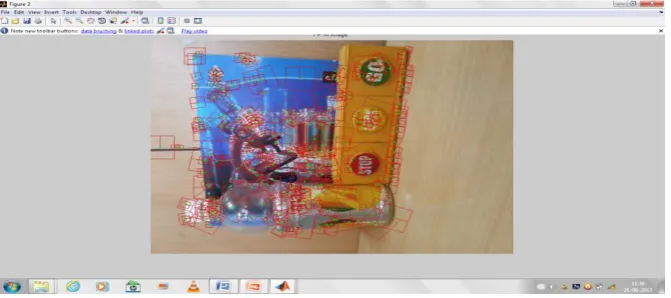
The features of the image are extracted using Scale InvariantFeature Transform.
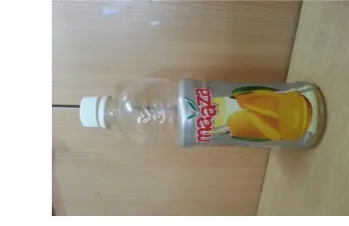
[image:2.595.132.468.501.650.2]Given below is the input image taken from the database.
Figure 1. The features of the database image are extracted using SIFT
4.2 FEATURE DETECTION USING SURF
Given below are the input images taken from the database. [image:3.595.101.444.145.292.2]Features are extracted from the input image using the Speeded- Up Feature Transform.
[image:3.595.99.440.356.508.2]Figure 3. The features of the database image are extracted using SURF
Figure 4. The input image is given and the features are extracted using SURF
4.3
FEATURE MATCHING USING SIFT
[image:3.595.127.472.599.748.2]4.4 FEATURE MATCHING USING SURF
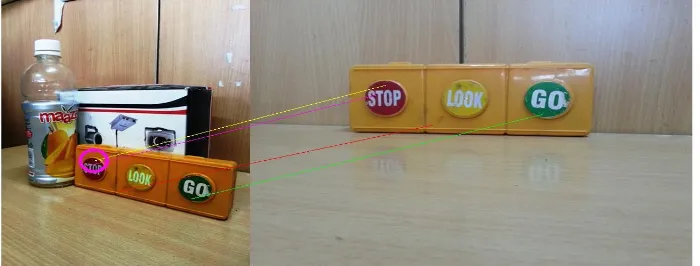
Figure 6. The register in the input image is been matched with the register in the database image and it is been recognized using SURF.
5.
RESULTS AND CONCLUSION
SIFT and SURF has been implemented on the images and the results below can show that these techniques SIFT and SURF both can recognize objects under various constraints.
5.1 RESULTS OBTAINED WITH SIFT
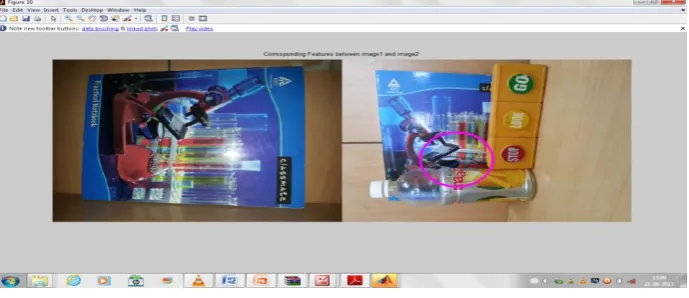
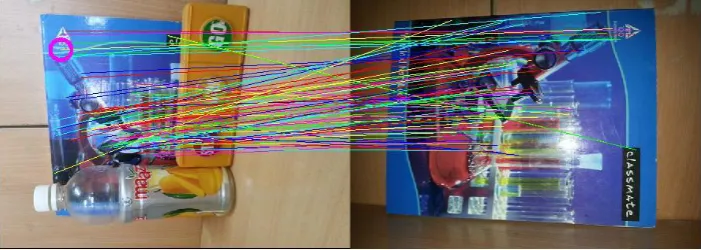
Figure 8. The yellow box is detected in the input image with different scaling and orientation and illumination too using SIFT
[image:5.595.128.470.346.456.2]Figure 9.The box is detected in the input image even after different illumination, orientation using SIFT (IMAGE 1)
Figure 11. The register is been detected even after occlusion using SIFT (IMAGE II)
6.
RESULTS OBTAINED WITH SURF
[image:6.595.82.432.378.511.2]Figure 13. The white box is been matched and detected even under occlusion and different orientation using SURF
Figure 14. The register is been matched and detected even under occlusion and different illumination using SURF (IMAGE II)
7.
COMPARISON BETWEEN SIFT
AND SURF
SIFT and SURF has been implemented on the given images in the database. These two techniques are compared mainly on two parameters
Number of features
Execution time/run time
Figure 15 : Given below are the few images from database named 1,2,3,4 respectively
[image:7.595.286.461.574.687.2]
[image:8.595.85.432.71.202.2]
Image 3 Image 4
Table 1 Table showing the number of features using SIFT and SURF
NUMBER OF FEATURES
S.No. IMAGE SIFT FEATURES SURF FEATURES
1 1 890 750
2 2 870 770
3 3 900 740
4 4 865 755
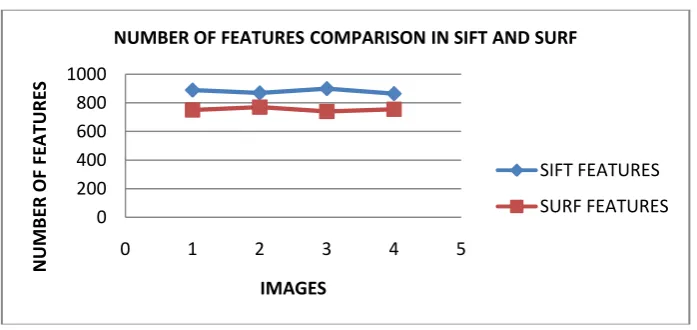
The given table gives the number of features detected using SIFT and SURF implemented on four images 1,2,3,4 taken from the database. From the table it can seen that the number of features extracted from SIFT is more than the features
[image:8.595.50.466.231.298.2]extracted from the SURF. The table below gives the execution time or the run time required for execution using SIFT and SURF. From the table it can seen that the execution time or the run time required in the SURF is less than the SIFT. Table 2. Table showing the time taken for execution in SIFT and SURF
TIME TAKEN FOR EXECUTION (SEC)
S.No. IMAGE SIFT SURF
1 IMAGE I 45.291518 6.622343
2 IMAGE II 96.850186 12.055012
The images in figure 9 and figure 12 are named as Image I. The images in figure 11 and figure 14 are named as Image II. The SIFT and SURF has been applied on Image I and Image
II and the time taken for execution has been noted for both these.
[image:8.595.125.474.563.728.2]Let‘s plot two graphs also to show this comparison between these two algorithms.
Figure 16. Graph comparing the number of features detected using SIFT and SURF
1000
Figure 17. Graph comparing the time constraint in both SIFT and SURF
8
.CONCLUSION
Thus, from both the graphs and the table we can conclude that the numbers of features detected using SIFT is more than that of SURF. But the execution time for SURF is less than the SIFT.
9. REFERENCES
[1] Rajeshwar Dass, Ritu Rani, Dharmender Kumar, ―Face Recognition Techniques: A Review‖, International Journal of Engineering Research and Development‖ Volume 4, Issue 7 (November 2012), PP. 70-78
[2] Ritu Rani, Surender Kumar Grewal, ―A Comprehensive Survey of Object Recognition Techniques‖, in National Conference on Contemporary Techniques and Technologies in Electronics Engineering at D.C.R.U.S.T Murthal, on March 14th, 2013.
[3] J.Ponce, M. Hebert, C. Schmid, and A. Zisserman, editors. ―Toward Category-level Object Recognition‖, Springer-Verlag, Volume 4, 2007.
[4] S. Dickinson,in: E. Lepore and Z. Pylyshyn , ―What is Cognitive Science?‖, Basil Blackwell publishers, 1999, PP 172—207.
[5] Harris, C. and Stephens, ― A combined corner. and edge detector‖, In Fourth Alvey Vision Conference, Manchester, UK, PP. 148-151,1988.
[6] Lowe, David G. (1999). "Object recognition from local scale-invariant features". Proceedings of the International Conference on Computer Vision. PP. 1150–1157, 1999.
[7] Ritu Rani, Surender Kumar Grewal, Indiwar, ―Implementation of SIFT in various applications‖, International Journal of Engineering Research and Development‖, Volume 7, Issue 4 ,PP. 59-64, 2013. [8] Unsang Park, Sharath Pankanti, A. K. Jain, ―Fingerprint
Verification Using SIFT Features‖, SPIE Defense and Security Symposium, Orlando, Florida, 2008.
[9] Mohamed Aly, ―Face Recognition using SIFT Features‖, Technical report, Caltech, California Institute of Technology USA, 2006.
[10] Geng C., Jiang X., ―SIFT Features for Face Recognition‖, IEEE Conference CSIT, PP 598–602, 2009.
[11] Hunny Mehrotra, Phalguni Gupta, and Jamuna Kanta Singh, Dakshina Ranjan Kisku, ― SIFT-based Ear Recognition by Fusion of Detected Keypoints from Color Similarity Slice Regions‖2009.
[12] Nasser Dardas , ―Real-time Hand Gesture Detection and Recognition for Human Computer Interaction‖ Technical Report, University of Ottawa, 2012.
[13] Fernando Alonso-Fernandez, Pedro Tome-Gonzalez, Virginia Ruiz-Albacete, Javier Ortega-Garcia, ―Iris Recognition Based on SIFT Features‖,Biometric Recognition Group- AVTS, 2009.
[14] Lowe, ―Object recognition from local scale-invariant features‖, The proceedings of the seventh IEEE International Conference on Computer Vision, PP 1150-1157, 1999.
[15] Herbert Bay, Andreas Ess, Tinne Tuytelaars, Luc Van Gool "SURF: Speeded Up Robust Features", Computer Vision and Image Understanding (CVIU), Vol. 110, No. 3, PP. 346--359, 2008.
0 50 100 150
0 0.5 1 1.5 2 2.5
TIME TAK EN IN SE C IMAGES
COMPARISON OF TIME TAKEN BETWEEN SIFT AND SURF
SIFT