Communication Dissertations
Department of Communication
5-9-2016
Bodies That Scatter: Sound, Cinema, Figure, Form
Justin Horton
Follow this and additional works at:
https://scholarworks.gsu.edu/communication_diss
This Dissertation is brought to you for free and open access by the Department of Communication at ScholarWorks @ Georgia State University. It has been accepted for inclusion in Communication Dissertations by an authorized administrator of ScholarWorks @ Georgia State University. For more information, please [email protected].
Recommended Citation
by
JUSTIN HORTON
Under the Direction of Jennifer M. Barker
ABSTRACT
This dissertation argues for an understanding of “form” in two senses: as both the plasticity of the
cinematic medium and the contour of the human body. Form is most often understood in relation to
visible traits such as line, shape, or figure; whereas sound is described as being without form, as any
number of sonorous metaphors attests (sound as aqueous, as “disembodied,” as invisible or
indeterminate). Cinema, therefore, constituted as it is by sound and image, exhibits a tension between
form and formlessness that manifests itself in contemporary films such as Her, Ratcatcher, Morvern
Callar, We Need to Talk About Kevin, The Tree of Life, and Upstream Color at the level of the human
body: corporeal boundaries blur as characters incorporate into new configurations. I conclude that we
must reckon with the image in terms of sound, for thinking sonically allows us to see form—bodily and
study takes an interdisciplinary approach that draws on theories of sound and image hailing from outside
film studies proper, such as Nietzsche’s theorization of Greek tragedy, Jean-Luc Nancy’s ethics of
listening, Deleuze’s exegesis on painter Francis Bacon, Nicole Brenez’s “figural” method of film
criticism, and Karen Barad’s “agential realism.” I unite these ideas and others and bring them to bear on
cinema, showing in the process what an attentiveness to sound has to offer not only film studies but also
the humanities writ large.
INDEX WORDS: Cinema, Film, Sound, Affect, Body, Form, Deleuze, Nietzsche, Brenez,
Nancy, Barad,
Her
,
Ratcatcher
,
Morvern Callar
,
We Need to Talk About
Kevin
,
The Tree of Life
,
Upstream Color
, Ramsay, Malick, Carruth,
Entanglement, Autosopic phenomena, Heautoscopy
by
JUSTIN HORTON
A Dissertation Submitted in Partial Fulfillment of the Requirements for the Degree of
Doctor of Philosophy
in the College of Arts and Sciences
Georgia State University
Copyright by
Justin Horton
by
JUSTIN HORTON
Committee Chair:
Jennifer M. Barker
Committee: Patricia Pisters
Angelo Restivo
Greg M. Smith
Electronic Version Approved:
Office of Graduate Studies
College of Arts and Sciences
Georgia State University
DEDICATION
ACKNOWLEDGEMENTS
As a child, my father obligingly took me to the movies almost every weekend, and though it
vexed him so, I insisted that we remain seated through the end credits. “If you enjoyed the movie,” I
would tell him, “you owe it to the people who made it to at least read their names.” The same holds true
here: each of the individuals listed below has had a hand, directly and indirectly, in the completion of the
dissertation before you.
Foremost, I would like to thank my extraordinarily patient advisor Jennifer M. Barker for
shepherding this project through the various incarnations and transformations it underwent. From the
inchoate “brain dump” draft of the prospectus to the wildly different final product here, she has graciously
provided feedback, fielded frantic emails, and given much-needed pep talks. It is no exaggeration at all to
say that I could not have done this without her. I am also indebted to Angelo Restivo for encouraging me
very early on in my master’s studies to pursue film sound and rigorous theory; without that foundation,
this project would not have been possible. Indeed, I see the document before you as the culmination of
lines of inquiry that began with him nearly a decade ago. Special thanks are in order to Greg M. Smith for
his continued support, helpful counsel, and willingness to let me take unconventional paths in my
research. I’d also like to extend my gratitude to my outside reader Patricia Pisters, whose work provided a
model for dealing with some tricky methodological challenges. The final product is no doubt better
because of her participation.
I must also thank several other faculty and staff at Georgia State University. Librarian
extraordinaire Nedda Ahmed, M. Lane Bruner, Tonia Edwards, Ted Friedman, Alessandra Raengo, James
Roberts, Niklas Volmer, and Carol Winkler have all provided valuable assistance, advice, and friendship
along the way. My special thanks go out to former chair of the department David Cheshier for his
unflagging support over the years as well as to Ben Miller, director of the 2CI New Media Initiative.
This project has profited greatly from conversations with current and former students at Georgia
State University as I was feeling my way through my initial ideas: my erstwhile officemates Drew Ayers,
Adam Cottrell, and Eiland Glover. I am also grateful for the shoptalk and commiseration I’ve enjoyed
over the years with Laurel Ahnert, Andrew Barnes, Nicki Barnes, Cindy Berger, Maria Boyd, Lauren
Cramer, Charles Fox, Noel Kirkpatrick, Jennifer Olive, Ian Peters, Karen Petruska, Munib Rezaie, and
Steve Stuglin. To my far-flung colleagues on Twitter who are too numerous to mention here: thank you
for your camaraderie and good humor. I am also quite fortunate to have been surrounded by a number of
friends from outside the academy who kept me (more or less) sane during this process.
Finally, my immense gratitude goes out to my immediate and extended family who have had to
endure me as I endured the slog that is graduate school: my wife Kristin, and my children Connor and
Whit; my parents, Phyllis and Sidney Horton; my brother Sid Horton, my nephew Evans, my in-laws Sue
and Jerry Fitts, Cheryl Fitts, and Shane Fitts; Kerri and Justin Cason; and my two more-or-less silent
partners: the late, great Oscar de la Horton and Theodore Horton.
TABLE OF CONTENTS
ACKNOWLEDGEMENTS ... v
LIST OF FIGURES ... ix
PREFACE ... 1
1 / A CINEMA OF MIXED BODIES ... 7
The Discriminating Eye ... 10
Sound: Propagation and Sensation ... 14
De- and Reformation ... 20
Her
as Tuning Fork ... 27
Inside-Out ... 31
Mixed Bodies ... 36
2 / (TRANS)FIGURATION ... 41
Sound and Image in Nietzsche ... 44
Music and Form ... 48
Two Varieties of Repetition: The Myth of Echo and Narcissus ... 53
Sound and the Liquid Metaphor ... 56
On Some “Motifs” in Lynne Ramsay ... 69
Formal Echoes ... 85
3 / STRUCTURES OF REFERRAL ... 86
Dismantling the Self ... 91
The Body, Doubled ... 96
“Magic Mirror”:
Enter the Void
... 104
Ecstatic Perception:
The Tree of Life
... 111
Sound at the Limits ... 118
The Voiceover as
Renvoi
... 120
4 / DISTANT PASSIONS ... 127
An Anti-expository Film ... 130
Entangled States ... 133
Trans-species Intersubjective Loops ... 139
Affective Antennae ... 143
“A Weird Flowing Sound” ... 149
To Learn Better to Listen ... 162
CONCLUSION ... 164
LIST OF FIGURES
Figure 1 – Linear Perspective, from Alberti’s
Della pittura e della statua
(1804) ... 11
Figure 2 -
Head VI
(Francis Bacon, 1949) ... 21
Figure 3 - Shot: Theodore ... 31
Figure 4 - Reverse Shot: Samantha? ... 31
Figure 5 - Chladni patterns. Photographs by Chris Smith. ... 64
Figure 6 - Sine Wave. Image by C. J. Cowie ... 65
Figure 7 - The curtain-wrapped boy in
Ratcatcher
... 70
Figure 8 -
The Ambassadors
(Hans Holbein the Younger, 1533) ... 74
Figure 9 - Margaret Anne (L) and James in
Ratcatcher
... 77
Figure 10 - Morvern (L) and Lanna in
Morvern Callar
... 77
Figure 11 - Under water, Eva morphs... ... 79
Figure 12 - ... into Kevin ... 79
Figure 13 - James appears on both sides of a lateral track (R to L); this structure is reversed with
Morvern ... 80
Figure 14 - Cymatic figures grow more complex as pitch rises. (Hans Jenny,
Cymatics
, 85) ... 84
Figure 15 -
Black Swan
(Aronofsky, 2010) ... 87
Figure 16 – The Phenomenology of Autosocopia. From Blanke and Mohr, 187. ... 98
Figure 17 -
The Schoolmaster
(René Magritte, 1954) ... 107
Figure 18 - Behind-the-back shot from
Enter the Void
... 108
Figure 19 - Two Jacks, one shot ... 123
Figure 20 - TOP: Jack's brother in blue (L), brown (R); Mrs. O'Brien in green (L), blue (R) ... 124
Figure 22 - Oscar dotted with motion capture sensors in
Holy Motors
... 129
Figure 23 - CU of hand in
The Tree of Life
... 145
Figure 24 - The Sampler's hand in
Upstream Color
... 145
Figure 25 - The Sampler communes with a pig ... 146
Figure 26 - The Sampler “eavesdrops” on a window shopper ... 146
Figure 27 - Kris recognizes The Sampler's compositions ... 151
Figure 28 - The Sampler (foreground) watches Kris (L) and Jeff ... 152
Figure 29 - The Sampler studies Kris' face ... 152
Figure 30 - Kris returns his gaze ... 153
Figure 31 - Kris walks across the office towards The Sampler, partially visible on the right .... 154
Figure 32 - In a graphical match, Kris continues her movement, only now on the farm ... 154
Figure 33 - Kris takes aim The Sampler ... 155
Figure 34 - Diagram of Cycles and Connections in
Upstream Color
... 157
Figure 35 - Kris warmly embraces a pig on the farm ... 158
Figure 36 - An inter-affective Map ... 160
Figure 37 - The Visual Microphone Methodology (Davis,
et al
., n.p.) ... 165
Figure 38 - The Visual Microphone Apparatus (Davis,
et al
., n.p.) ... 165
Figure 39 - Theodore Listens to Samantha ... 168
Figure 40 - Morvern Communing with the Dead Via Earbuds ... 168
Figure 41 - Jack with a aluminum can telephone ... 169
PREFACE
“One cannot step twice into the same river, nor can one grasp any mortal substance in a stable condition, [for] it scatters again and gathers; it forms and dissolves, and approaches and departs.”1—Heraclitus
In a recent book, film scholar Robert Spadoni draws our attention to what he describes as an
“overlapping timeline” in film history wherein synchronous sound emerged almost in tandem with the
rise of the horror film in Hollywood. For Spadoni, this is hardly a coincidence. The transition to sound
was an awkward one, and as his archival research reveals, audiences of the time found the voices in the
early talkies to be novel, yes, but also “mechanical,” “queer,” or “unnatural.” A host of factors
contributed to these reactions, from the limitations of the technology to actors’ adoption of the slow,
mannered articulation of the stage to the sheer foreignness of synchronized dialogue. Sync sound,
therefore, did not provide an instant gain in filmic realism as one might assume; instead, early audiences
largely found the practice alienating, for it conjured up the “uncanniness” at the heart of cinematic
representation: that that which we see on screen is at once real and not real, animate and inanimate. Prior
to synchronization, these same audiences had become accustomed to the entrenched norms of silent film
aesthetics and thus had learned to overlook the pre-talkie cinema’s artificiality. But when suddenly faced
with the combination of a polished image and unrefined sound, that repressed knowledge of the medium’s
constructed nature came flooding back to the fore of their minds. Spadoni makes the case that while most
Hollywood practitioners sought to ward off these uncanny sensations in viewers, directors such as Tod
Browning and James Whale strived to harness and exploit the unheimlich in films such as Dracula (1931)
and Frankenstein (1931), respectively, by putting to use the estranging effects of sync sound to arouse
dread in their audiences.2
What follows is not a study of the horror film, nor does it contribute to the important work being
done on transition-era Hollywood. It does however draw a key lesson from this moment in both the
genre’s and the medium’s history: that the advent of synchronous sound inaugurated a problem for the
cinema with regard to the body. At stake in the talkie was not merely a greater degree of verisimilitude
but also, more fundamentally, the integrity of the human body onscreen. As Mary Ann Doane has argued,
sound is the lynchpin of the cinematic illusion in that it creates an “imaginary harmony” between the
body onscreen and the voice one hears from the loudspeaker as well as “an elaborate imbrication” of
diegetic space and the space of the theater.3 Yet at the same time, sound also “carries with it the potential
risk of exposing the material heterogeneity of the medium.” One false step or technical error with the
sound track can irrevocably destroy the impression of an “organic unity” between the onscreen body and
the voice that accompanies it, which in turn destroys the coherence of the film’s entire spectacle.4 From
the outset of synchronization, then, sound assured the cohesion of the visible body even as it threatened to
rip it apart. We see this most saliently in Singin’ in the Rain (Kelly and Donen, 1952), a film set against
the backdrop of the coming of sound in Hollywood, when the sound track falls out of sync with the image
during a packed screening, eliciting riotous laughter from crowd. What was deployed to frightening effect
in Dracula is here staged for comic impact.5
Yet, Doane’s claim—as well as the gag in Kelly and Donen’s musical—rests on the assumption
that, unlike the “fantasmatic” or “heterogeneous” bodies of the cinema, real, material bodies are entirely
“unified” and cannot be torn asunder.6 This is to say, Doane understands the human body as a discrete
entity that moves about a world occupied by other entities likewise discrete, and what divides us from
them are material boundaries—skin, edges, lines. Science tells a different story, however. In a passage
that I will take up in greater detail later in the dissertation, physicist and philosopher Karen Barad writes :
3 “Just as the voice must be anchored by a given body, the body must be anchored in a given space. The fantasmatic visual space which the film constructs is supplemented by techniques designed to spatialize the voice, to localize it, [and] give it depth.” Mary Ann Doane, “The Voice in the Cinema: The Articulation of Body and Space,” Yale French Studies 60 (1980): 35–40.
4 Doane, “The Voice in the Cinema,” 35.
5 Thomas Elsaesser and Malte Hagener, Film Theory: An Introduction through the Senses (New York: Routledge, 2010): 132–136.
[T]he outside boundary of a body may seem evident, indeed incontrovertible. A coffee mug ends at its outside surface just as surely as people end at their skins. On the face of it, reliance of visual clues seems to constitute a solid empirical approach, but are faces and solids really what they seem? In fact, an abundance of empirical evidence from a range of different disciplines […] suggests that visual clues may be misleading. […] It has become increasingly clear that the seemingly evidentiary nature of bodily boundaries, including their seeming virtual self-evidence, is a result of the repetition of (culturally and historically) specific bodily performance.7
Looking with one’s naked eye, the world is a place of clear-cut lines and divisions, but at a
particle level, these boundaries do not prevail. The lines that we see all around us, physicist Richard P.
Feynman claims, are “not something definite. It is not, believe it or not, that every object has a line
around it! There is no such line. It is only in our psychological makeup that there is a line.”8
But if bodies and objects are not demarcated by definite lines, then, from the standpoint of the
human, can there be a hard-and-fast barrier between my body and that of another? In other words, does
the subject-object divide obtain in a world in which form is not fixed and matter is not captive to a state of
boundedness? Might not we say that physics has revealed our presumption of discrete bodies and subjects
to be, like the cinema, a mere illusion of organic unity, for even though we as humans are not fixed and
bounded, we tend to experience ourselves as such. But deeper down, at an invisible and imperceptible
level, our bodies, or better, the particles that compose it, disperse. They are thrown out in all directions, at
which point they congeal into new, if temporary, formations. The feeling of coherence we have of a self
housed in a body is in fact a much more tenuous configuration that we might imagine. Bodies are not
stable, fixed things. In the words of Heraclitus that appear in the epigraph above, bodies scatter, they
form and dissolve and form again.9
7 Karen Barad, Meeting the Universe Halfway: Quantum Physics and the Entanglement of Matter and Meaning (Durham, NC: Duke University Press, 2007): 155.
8 Richard P. Feynman, Robert B. Leighton, and Matthew Sands, The Feynman Lectures on Physics, vol. 1 (Reading, MA: Addison-Wesley, 1964), qtd. in Barad, Meeting the Universe Halfway, 155. I’ve removed Barad’s italics, which were not present in the original text.
Doane suggests that classical film practice has “a stake in perpetuating the image of unity and
identity” of the body “and in staving off the fear of fragmentation” so as to hide the traces of its own
discursive construction.10 This to me seems undeniable. Yet, in certain films, the appearance of unity of
bodily and cinematic form breaks down. This is most obvious in movies that self-reflexively gesture
toward their own making in an effort to demystify the cinema (think: Jean-Luc Godard or
Structural/Materialist filmmakers like Michael Snow or Ernie Gehr). What I have in mind in this study,
however, are more or less conventional narrative films in the art house vein that are not overtly political
in nature but that nevertheless reveal something about the material body that tends to escape our grasp. In
the films considered herein, whether explicitly or implicitly, bodies are revealed to be porous, protean, or
dispersive, and they tend to enter into highly unusual amalgamations with other bodies.
In what follows, I seek to understand “form”—bodily and cinematic—in terms of a relationship
between image and sound, visibility and invisibility. Form, of course, is most often defined according to
visible attributes such as contour, shape, figure, or schema, whereas sound, because it is invisible, is said
to be indeterminate, amorphous, or ephemeral. I therefore argue that cinema, constituted as it is by sound
and image, exhibits a tension between form and formlessness—and this tension manifests itself at the
level of the human body in a number of contemporary films that I shall take up in this dissertation, among
them Her (Jonze, 2013), the work of Lynne Ramsay (Ratcatcher [1999], Morvern Callar [2002], and We
Need to Talk About Kevin [2011]), The Tree of Life (Malick, 2011), and Upstream Color (Carruth, 2013).
In these examples, boundaries are shown to be permeable as bodies enter into affective configurations that
would seem to defy our experiential understanding of how the world operates.
Let me be clear, though, that the task of this dissertation is not simply to illustrate principles from
physics at work in an assortment of films. Rather, in the pages that follow I move freely between what
Deleuze and Guattari describe as the three great, interrelated domains of creativity: art, philosophy, and
science.11 In this first domain, I will have occasion to discuss, in addition to cinema, theater, poetry,
performance art, mythology, and music. Likewise, with critical theory and philosophy, I draw from the
likes of Nietzsche, Deleuze, Guattari, Merleau-Ponty, Jean-Luc Nancy, Jane Bennett, the aforementioned
Barad, and many others. Finally, along with quantum physics I also turn to neuroscience, most notably in
Chapter 3. Let me assure the reader, though, that in spite of the study’s own heterogeneity, my principal
focus is always ultimately the cinema and how it renders aesthetically changes to the body both subtle and
overt.
As the opening discussion of the voice in early horror cinema suggests, sound plays an important
role in my argument. More often than not, in the films considered herein the sound track signals the
impending reorganization of the body. In her book Dreams of Difference, Songs of the Same, Amy
Herzog coins the term “the musical moment” to describe instances in which “music, typically a pop song,
inverts the image–sound hierarchy to occupy a dominant position in the filmic work.”12 As she explains,
sound is typically thought of as subservient to the image, as playing an unobtrusive accompanying role.
What Herzog identifies instead are moments when sound, in the form of music, takes the lead and the
image, if only briefly, dutifully tags along. Though I am quite convinced by her argument, I would like to
offer that music is but one of the ways in which sound can seize the reins of a film. In the movies I
analyze in this study, the conspicuous use of dialogue, noise, or even silence disrupts the customary
sound–image hierarchy just as frequently as does music. I therefore call these moments not “musical” but
“soundful”–a descriptor I’ve borrowed from Douglas Kahn.13 Soundful moments are significant for me
not only because they announce a shift in the formal logic of the film but also because they at times
appear to participate in or be the primary driver of bodily redistributions. It is therefore helpful here to
recall the special kinship between sound and affect in various theorizations of embodiment. For instance,
11 Gilles Deleuze and Félix Guattari, What Is Philosophy?, trans. by Hugh Tomlinson and Graham Burchell (New York: Columbia University Press, 1994).
12 Amy Herzog, Dreams of Difference, Songs of the Same: The Musical Moment in Film (Minneapolis: University of Minnesota Press, 2010): 7.
in something of an aural analog to his notion of the photograph’s “punctum,” Roland Barthes describes
the “grain” of the voice as a bodily remainder that exceeds signification and that arouses both his ear and
his body.14 Along similar lines, Deleuze seems incapable of describing bodily sensation without recourse
to acoustical terms such as “vibration” and “resonance” (see Chapter 1), just as Nietzshce thinks bodily
arousal almost exclusively with respect to music (see Chapter 2).15 Even when sound is not their explicit
focus, these thinkers nevertheless gravitate towards a sonic vocabulary to describe that which one feels be
cannot see.
Thus, in this study, sound is both a catalyst of and a signpost to bodily scattering. It is not only
the object of analysis but also, to intentionally mix a metaphor, a conceptual lens through which we might
reckon with the question of form, matter, and aesthetics. This is the task to which I turn in the chapters
ahead.
14 Roland Barthes, Camera Lucida: Reflections of Photography, trans. by Richard Howard (New York: Hill and Wang, 1981); Roland Barthes, “The Grain of the Voice,” in Image, Music, Text, translated by Stephen Heath. London: Fontana Press, 1977): 179–189.
1 / A CINEMA OF MIXED BODIES
We know how to “read” a fade to black. Between scenes, it serves as punctuation that marks the
passage from one space or time to another; and at the end of a film, it provides a moment for reflection
before the credits roll, a convention that in turn assures us that for all intents and purposes the movie is
over and that there will be no subsequent fade-in.
Neither of these is the case, however, in one highly unusual scene in Spike Jonze’s 2013 film Her
wherein the screen goes black and stays that way for more than a minute of screen time. Here’s the set-up:
recently estranged from his wife and lonely, Theodore (Joaquin Phoenix) finds himself smitten by
Samantha, his computer’s artificially intelligent operating system. She has no avatar or visual
representation, but she does have a voice (that of Scarlett Johansson), which Theodore hears via an ear
bud. Their relationship bourgeons and Samantha quickly graduates from personal assistant to confidante
to girlfriend. The film leaves us to wonder, though, if she has indeed developed the capacity for genuine,
human-like emotion or if she, in her programmed aim to please, is merely playing dutifully to his type.
Initially, Samantha’s lack of body is of no matter to Theodore, who is charmed by her wit and sensitivity
nonetheless. For a time, all is well in the courtship—that is until it reaches the stage at which, under
“normal” circumstances, it would be consummated.
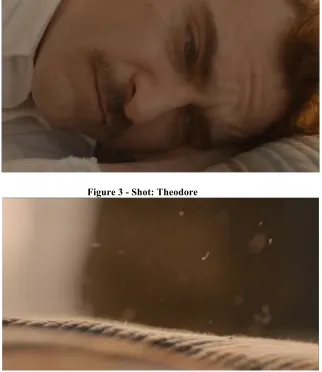
As the scene in question opens, we see Theodore lying in bed, wishing aloud to the necessarily
unseen Samantha that he might one day encounter her in the flesh, that he might feel her in his arms
rather than simply hear her in his ear. At her request, he describes how he would touch her if such an act
were possible: “I’d take your head into my hands,” “I’d rub your cheek,” “I’d kiss your mouth.” And as
the conversation escalates and steers into more erotic terrain, the image fades out, leaving us with only
their voices and the accompanying nondiegetic score.
During this blackout, Samantha’s replies are marked by a shift in verbal tense, away from
Theodore’s conditional (“I would”) and toward the active (“I am”). That is to say, Theodore describes
what he, as the toucher, might touch, whereas Samantha, in a breathy register suggestive of both arousal
Samantha speaks as if she were materializing right before our ears, if not our eyes. The voices then
alternate panting before merging into one sustained groan of pleasure, an aural crescendo that suggests a
mutual sexual climax.
Shortly thereafter, the image returns, but not to where it left off, with Theodore alone in bed. In
its place is the Los Angeles skyline, and over it, we once again hear their voices. “I was just somewhere
else with you,” he says. “Just lost. It was just you and me.” And in a line that perhaps retrospectively
“explains” the previous blackout and that this dissertation will have occasion to dwell on, Samantha
replies, “I know. Everything else just disappeared.”
What are we to make of this extended and conspicuous absence of the image? In a certain sense,
the fade-to-black is necessary, for it sidesteps that which it quite literally cannot show: a carnal encounter
between the fleshy Theodore and immaterial Samantha. In removing the image track, the film underscores
or “amplifies” the voice, with the sound of Samantha’s moans, following Linda Williams, serving as an
“aural fetish of the female pleasure we cannot see.”1 But why also shroud Theodore in black leader,
especially when earlier in the film he was fully visible during a phone sex session gone comically awry?
The extended blackout thus deviates not only from the fade-to-black’s conventional deployment but also
the movie’s previously established formal strategies.
The cinema, it has been said countless times, is fundamentally, ontologically, a visual medium. It
existed, the thinking goes, in the form of the silent film prior to the advent of synchronized sound.
Therefore, the cinema doesn’t need sound in order to be cinema.2 Extending this logic, what would a film
11 Linda Williams, Hard Core: Power, Pleasure, and the “Frenzy of the Visible” (Berkeley, CA: University of California Press, 1999): 123.
2 Rick Altman argues that this is fallacious logic that ignores instances wherein sound accompanies a black screen, a common occurrence in the musical interludes in Vitaphone films, for instance. While this is certainly true, each of Altman’s examples of cinematic sound sans image are musical in character. Her therefore remains anomalistic in that voices, even as they turn into a-signifying moans, are rendered without the image of the body from which they emit, a situation that will be discussed in greater detail later. Rick Altman, “Four and a Half Film Fallacies,” in
without an image be? A radio play? Sound art? Certainly not a movie at all, some would say.3 Perhaps
this is why the scene in question from Her registers so forcefully: if only for a minute, it is an imageless
movie, briefly withdrawing that which would seem to ground it ontologically.
This moment is not merely a deviation from cinematic convention, however. In retracting the
image, the film inverts the bias towards sight over the other sense modalities—not only in film but also in
much of western thought generally. The question, then, is what transpires in this scene as sound takes the
lead in the image’s momentary absence? What happens to Theodore and Samantha when, as she reckons
in her coital afterglow, everything else disappeared? Sans image, this scene becomes especially soundful.
We are left with no choice be to concentrate on the dialogue and linger on the characters’ words. More
importantly, though, the blackout in Her marks a rupture that signals an impending bodily reorganization.
This highly unusual scene reveals—even as it would ostensibly seem to cloak—a fluid exchange between
the two characters, a simultaneous scattering and enmeshment of bodies at a particle level.
But we’ve gotten ahead of ourselves, I’m afraid. It is my contention in this dissertation that we
might productively think of the relationship of the body to the self and the self to the other, and indeed, of
the self to the world at large, as bound up in a movement between aural and visual logics, a movement
that is manifested, as it were, in the cinema as changes in state and alterations of form. And “form” as I
deploy it means at one and the same time physical form—shape, contour, outline, figure—and aesthetic
form—the arrangement of aspects of a work of art (e.g., line, color, texture) as well as its “medial
incarnation,” to borrow a phrase from André Gaudreault and Phillipe Marion.4 Throughout the study, I
pose a series of questions about physical, bodily form and seek to answer them in aesthetic terms, and
vice-versa.
3 Derek Jarman’s Blue, which runs 76 minutes with a rich audio track accompanying a solid blue background, might well be the cinema’s closest thing to an “imageless” film. Indeed, when it premiered, it was simultaneously
broadcast on BBC radio, and the audio track later was released on CD. As Steven Dillon suggests, “Blue might best be thought of as a species of radio, where we would read the film into a tradition of radio plays by Samuel Beckett and Harold Pinter.” Steven Dillon, Derek Jarman and the Lyric Film: The Mirror and the Sea (Austin, TX: University of Texas Press, 2004): 227.
4 André Gaudreault and Phillipe Marion, “Transécriture and Narrative Mediatics: The Stakes of Intermediality,” in A
The ways in which I think about the relationship between image and sound, however, differ in
significant ways from how it has most traditionally been understood within film studies. Thus, in order to
proceed with our analysis of Her and with the study at large, we must briefly review (and rehearse) how
sound and image each came to be one another’s dialectical other in philosophy. It begins in ancient
Greece (a site to which we shall return in Chapter Two) with a hierarchical classification of the human
senses.
The Discriminating Eye
We may trace the visual bias as far back as classical Greek philosophy, which privileged sight, as
the “distance sense” par excellence, over and above the other faculties. For the Greeks, sight was
associated with simultaneity, for the human eye is “capable of surveying a wide visual field” in one
glance, one instant.5 As it was theorized, vision provides a level of “mastery” not available to the more
proximal, and therefore lesser, senses. What such an account takes for granted, though, is that the viewer
is to a greater or lesser extent at a remove from that which she views, and it treats vision as if it “freezes”
the scene before the viewer in order to survey the scene in detail, much as one hits the pause button on a
DVD player. The notion of sight as a “distance sense” is hence predicated upon an abstraction of the
viewer from the field and the time of the viewed.
This detachment of the viewer and the “taming” of the temporal by giving the spatial pride of
place were fundamental to the development sometime around 300 BCE of Euclidean geometry, which
represented the world in planar fashion and as governed by logically derived axioms. And geometry of
course was a precondition for the development of Renaissance or “linear” perspective in the 17th century.
In order to render the three-dimensional world onto a two-dimensional canvas, Renaissance painters
relied on a geometric system in which parallel lines converged at a single vanishing point at the horizon.
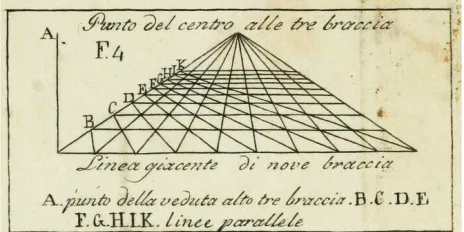
(SEE FIG. 1) The result was a rational, mathematical representation of space, but one organized around
an implied point of view outside of that space. That is, if the vanishing point is thought of as the apex of a
pyramid that extends to the horizon, then a second imagined pyramid—a mirror of the first—must extend
to the eye of the beholder. And where the bases of these two pyramids meet is a frame, a window onto the
world. But certainly this arrangement of the viewer and the viewed is not without ideological
consequence. As art historial John Berger puts it, “Perspective makes the single eye the centre of the
visible world,” and this world would seem to be “arranged for the spectator as the universe was once
[image:24.612.191.423.250.366.2]arranged for God.”6
Figure 1 – Linear Perspective, from Alberti’s Della pittura e della statua (1804)
These metaphysical implications of linear perspective, Martin Jay asserts, bring “ocularcentrism”
full circle—from philosophy to mathematics to art and back again to philosophy. Renaissance perspective
embodies a disembodied Cartesian metaphysics: an entire (representational) world of objects, obeying the
laws of physics and geometry, laid out for a rational observer—a subject—who is entirely abstracted from
that world. The ideal observer postulated by Descartes, who notoriously claimed that his goal was “to be a
spectator rather than an actor,”7 finds its apotheosis in linear perspective. Consequently, vision was
inseparably braided with Cartesian reason and calcified at the top of the sensual hierarchy.
By the mid 20th century, though, vision came under attack widely—aesthetically, with the rise of
Modernism, which frequently broke with the perspectival tradition; and theoretically, most notably with
the French poststructuralists’ polyvalent anti-ocularcentric response. Jay claims these thinkers set about
6 John Berger, Ways of Seeing (New York: Penguin Books, 1997): 16.
unsettling the hegemonic privileging of vision in various ways, some via an outright rejection of the eye
(Georges Bataille’s fixation of blindness, for example), while others sought to redeem sight by
challenging its Cartesian disembodiedness, as with Maurice Merleau-Ponty’s alignment late in his life of
vision with touch or with Jacques Lacan’s situating of the gaze as external to the seeing subject. Still
others began to valorize senses aside from vision. Walter Ong, for instance, looked nostalgically back to a
time prior to written language in holding up orality over visuality,8 and Luce Irigaray turned to the
sexually-differentiated body and to air, fluids, and “baser” senses such as olfaction and touch in an effort
to escape from the patriarchal gaze as both a social reality and as a theoretical construct.9 These critiques
have been successful to varying degrees in uncovering the ideological underpinnings of a visualist
paradigm, but less so in toppling sight from its privileged perch.
But need it be toppled? The anti-ocular response is today most often regarded as something of an
over-correction that repeats the same mistake of Descartes and others by giving primacy to one sense
modality over and above the others. Steven Connor, who labels himself a “cultural phenomenologist,”
notes the irony of attempting to overcome the hegemony of vision by separating sight from the other
senses when “scopophobia [itself] derives from what is in fact a distinctive feature of vision, namely its
tendency to isolate and distinguish its objects.” To differentiate the senses according to the properties of
each needlessly partitions what is in fact a sensorial whole: no sense modality operates in a vacuum.
Argues Connor: “To understand the workings of any of the senses it is necessary to remain aware of the
fertility of the relations between them.”10
8 Walter Ong, Orality and Literacy (London: Routledge, 1982) and The Presence of the Word: Some Prolegomena
for Cultural and Religious History (Cambridge, MA: Yale University Press, 1976). Derrida would later argue that the fixation on voice as the guarantor of “pure presence” evinces the “phonocentrism” at the core of Western philosophy. Jacques Derrdia, Of Grammatology, trans. by Gayatri Chakravorty Spivak (Baltimore, MD: Johns Hopkins University Press, 1974). For a thorough critique of Ong, see Jonathan Sterne, “The Theology of Sound: A Critique of Orality,” in The Canadian Journal of Communication, no. 36 (2011): 207–225.
9 I take up Irigaray in greater detail in Chapter 2. See Luce Irigaray, “The ‘Mechanics’ of Fluids,” in This Sex Which
is Not One, trans. by Catherine Porter (Ithaca, NY: Cornell University Press, 1985): 106–118; Luce Irigaray, “The Age of the Breath,” in Luce Irigaray: Key Writings (New York: Continuum, 2004): 165–170.
Eminent Sound Studies scholar Jonathan Sterne wonders along similar lines whether there is
much to be gained in the seeing-hearing comparison. He contends that scholarly discussions of the nature
of these two modalities tend to resort to a familiar sets of phenomenological comparisons—for instance,
that vision is outwardly directed whereas sound comes to the subject, that hearing is based in contact with
the outside world while vision demands abstraction and distance, and so on—in order to make sweeping
ontological claims about perception. The “audiovisual litany,” as Sterne calls it, presumes static,
unchanging, or “pure” sensory experiences and thus fails to account for the specific historical
circumstances that structure them.11 How can we properly attend to sight and hearing without also
attending to overdetermining factors like technological mediation (e.g., eyeglasses, acoustic architecture)
and cultural customs (e.g., noise ordinances) that influence our sense of these senses?
Veit Erlmann likewise complicates the matter in concluding that the division between hearing and
seeing and their respective associations with physical sensation and mental abstraction are all too tidy. He
argues instead that the two senses are deeply imbricated, and not simply at the phenomenal level, à la
Connor, but also philosophically, for “[t]he acoustic and physiological phenomenon of resonance […]
played a constitutive role in the history of [both] modern aurality and rationality.”12 Hearing is therefore
not the province of some bygone, pre-Enlightenment era, but a crucial component of modern subjectivity.
The highly nuanced historical accounts of Sterne and Erlmann demonstrate the folly of trying to
derive an ontology of sound from a phenomenology of hearing. But let us not be too quick to dismiss
such attempts out of hand, for even if they are prone to essentialism, they nevertheless testify to the place
sound has come to occupy in the philosophical imagination as an alternative ground from which to
proceed with new ways of thinking that are distinct from the predominant visual orientation. Indeed, my
aim in this project is to trace how seeing and hearing and image and sound have been theorized at various
historical junctures and in sundry disciplines in an effort to bridge these discourses. This of course
11 Jonathan Sterne, The Audible Past: Cultural Origins of Sound Reproduction (Durham, NC: Duke University Press, 2003): 14–19.
requires a delicate balancing act that considers sound and image not in opposition to one another but as
complements. My emphasis on sound is thus not a rejection of visuality so much as a counterbalance to
its hegemonic privilege, and to bring the scale in line requires us to move through some broad yet
interrelated theoretical terrain, from film studies, art history, sound studies, visual culture, and affect
theory to neuroscience, quantum physics, new materialism and post- (or non-)humanism. By the same
token, the objects considered herein are likewise diverse, encompassing cinema, music, theatre, painting,
and performance art. With that said, my disciplinary “home base” is in film studies, and the insights from
these allied fields will more often than not be brought to bear on cinema in this study.
Why film? Movies, at least the vast majority of them from the 1930s onward, consist of and in
images and sounds. They therefore bring these two realms, modes, and epistemologies together. Now, the
sound-image dyad that I focus in both philosophy and in the formal elements of cinema should not be
seen as an effort to home in on the distance senses to the exclusion of the proximate modalities of smell,
taste, or touch—far from it, in fact. The senses, as Connor indicates, do not operate in isolation—even in
the case of film, which is limited to two sensory “channels.” We do not “receive” movies at the level of
the eye and the ear alone; instead, the entire body factors into the equation, as Jennifer M. Barker, Laura
U. Marks, Vivian Sobchack and others have compellingly demonstrated.13
But the present study is not one on embodied film spectatorship proper either, though it freely
mines that terrain for insight. In the pages that follow, the reader will see that I am keenly interested in the
body, especially as it relates to sound. But in this dissertation, I treat sound not merely as some immaterial
yet perceivable “data” but also as a material force unto itself.
Sound: Propagation and Sensation
Sound is difficult thing with which to grapple if for no other reason than the fact that it’s not a
thing at all. Even describing sounds proves particularly problematic. If you were to place a can of soup in
13 Jennifer M. Barker, The Tactile Eye: Touch and the Cinematic Experience (Berkeley, CA: University of California Press, 2009); Laura U. Marks, The Skin of the Film: Intercultural Cinema, Embodiment, and the Senses
the hands of a blindfolded person, she would be able to relate its characteristics to you with relative ease:
it’s cylindrical, made of metal, with thick ridges along the side, possibly cool or warm to the touch. You
could do the same experiment with its contents: How does the soup taste? What are its component
flavors? Its consistency? These are attributes of a physical entity that exist entirely independently of the
perceiving subject.
This is not the case, however, with sound. As Sterne provocatively puts it, “sound is a product of
the human senses and not a thing in the world apart from humans.”14 The world is a vibrating place, and
sound is merely the audible subset of all of these pulses, “a little piece of the vibrating world.”15
Certainly, this is why most ontologies of sound are drawn from phenomenologies thereof—how else is
one to account for it?—, and also why so often these ontologies implicitly posit a transcendental subject.
This is why Sterne’s historical project begins outside the subject: “if sound in itself is a variable and not a
constant,” he says, “then the history of sound is of necessity an externalist […] endeavor.”16
Here, I want to embrace the notion of exteriority while nevertheless taking a slightly different
tack. For the most part, I am less interested in the subjective, interior experience of hearing (from within)
than I am with sound’s vibratory propagation (from without)—that is, with its quiverous movement that
comes into being prior to its audibility.17 Let’s turn our attention outward then, away from how we hear
sounds and instead towards how sounds make themselves heard: how they come to us, pass us by, rattle
14 Sterne is here making a point about the necessary anthropocentrism of any working definition of sound. Invoking the famous thought experiment about whether a tree falling in the woods makes a sound if a person is not there to hear it, Sterne is quick to acknowledge that a squirrel would likely answer differently. Sterne, The Audible Past, 11, emphasis mine.
15 Ibid., 11. 16 Ibid., 13.
17 An exception: sounds that are the productions of one’s own body, which are only audible insofar as they are externalized. This would be the case most obviously with speech but also when the inner workings of the body announce themselves, as with the sometimes audible rumbling of one’s tummy, “conducted” through the organs, flesh, and skin. Another more curious example would be tinnitus (“ringing in the ear”). For an intriguing account of his own suffering with this condition, see Steven Connor, “Auscultations,” (paper presented at the University of Iowa Sound Research Seminar, Iowa City, Iowa, January 29, 2010). http://www.stevenconnor.com/auscultations/. Oliver Sacks considers tinnitus alongside the hallucinatory hearing of music “inside one’s own head.” Oliver Sacks,
the body, palpate the room. This move should not be taken as merely swapping out phenomenology for
physics, though. What I’m after here is more along the lines of Steve Goodman’s Spinozan call for “an
ontology of vibrational force,” which “delves below a philosophy of sound and the physics of acoustics
towards the basic processes of entities affecting other entities.”18
Thought of in this way, as affective vibration, sound becomes not simply something that is
“there” for perceptual apprehension, but an invisible figure of interaction and relationality, one that
extends beyond the human realm in ways that will become clearer in the dissertation’s latter half. In the
meantime, I want to briefly sketch some philosophical consequences of thinking of sound not so much as
something out there in the world for me to apprehend but as something external to me that acts upon me.
Four characteristics suggest themselves. First, sounds are not simply heard but materially felt,
because sound, in its essence, is a disturbance. The musician drags her bow across the cello’s strings,
causing them to vibrate. This vibration in turn generates a force that ripples outward in a wave, agitating
the air surrounding it. But it is not a sound per se until it is audible, when the wave causes one’s cochlea,
the coil-shaped bony labyrinth of the inner ear, to resonate at the same amplitude and frequency, thus
activating the nerve impulses that travel to the brain.19 Yet the tactility of sound does not register solely in
the ear, nor for that matter is its movement exclusively atmospheric. Let’s stick with our example of the
cello: anyone who has heard the instrument in a concert hall can attest to its power to stir the body, and
not simply in the sense of an emotional arousal, though it certainly is effective in that regard.20 Some of
the cello’s vibrations might traverse the walls and floor before finding its way up one’s legs and into the
rib cage. In short, this sound vibrates the eardrum, yes, but also one’s entire body. Thus, though hearing is
18 Steve Goodman, Sonic Warfare: Sound, Affect, and the Ecology of Fear (Cambridge, MA: The MIT Press, 2010): 81.
19 C. Daniel Geisler, From Sound to Synapse: Physiology of the Mammalian Ear (New York: Oxford University Press, 1998): 55–69.
often thought of alongside sight as a “distance sense,” when we take account of the body’s (and not
simply the ear’s) role in the reception of sound, it becomes apparent that hearing is a distance sense in
name only.
Secondly, and relatedly, sounds are mobile and invasive. One directs his vision, turning his head,
his eyes, his attention outward, while sounds traverse space. They come to us but does not necessarily
terminate with us; they pass us by with indifference. Moreover, we can’t easily “turn off” sounds. Loud
noises, for instance, can rouse one from a deep sleep in a way that a partner switching on a nightstand
lamp cannot. Likewise, we can turn away from an unpleasant happening or avert our eyes, but we don’t
possess, as Steven Connor calls them, “earlids.”21 There is no escaping sound, for, as we’ve seen, these
vibrations may move through physical barriers such as walls, windows, or bodies. Writes Hans Jonas,
“Sound, itself a dynamic fact, intrudes upon a passive subject.”22And passivity, as we shall see
momentarily, will be of central importance moving forward.
Now, because sound is invasive and does not heed material boundaries, it throws the very notion
of a concrete delineation between inside and outside into question. This is as much a result of its incessant
motion as it is vibratory properties, which brings us to our third point: sounds are temporal and
ephemeral. We might describe the cellist’s drawing of the bow across the strings as the “birth” of a
particular sound, and just as it is born, so too will it die. In psychoacoustical terms, loaded as they are
with both tactile and bodily imagery, the vibration that initiates a sound is called its “attack.” Once it
reaches its peak amplitude, the sound carries on even after its originating event stops—this is called the
“sustain.” Afterwards begins its “decay.”23 Again, sounds are events, and as such, they are finite. They
have a lifespan. This is partly why music is frequently contrasted with sculpture or painting as a temporal
21 Steven Connor, Dumbstruck: A Cultural History of Ventriloquism (New York: Oxford University Press, 2000), 16–17.
22 Hans Jonas, “The Nobility of Sight: A Study in the Phenomenology of the Senses,” in The Phenomenon of Life:
Toward a Philosophic Biology (Evanston, IL: Northwestern University Press, 2001): 139.
rather than a static art. It comes into being in time, always changing, never resting. The striking of a note
is a singular event; no two performances of it are ever precisely the same, for the variables are prodigious:
the size and shape of the room, its appointments and tapestries, the precise tuning of the instrument, the
force with which the keys are struck or the strings plucked or the pressure applied to the mouthpiece.
There is thus something elegiac about the way sound is often described: like humans, sounds are
in a constant state of animation until the point at which they die. Even then, just because a vibration
ceases to fall within the audible spectrum of human hearing does not mean that the vibration itself has
ceased, for it may still be unfolding in space, and non-human species might well perceive it long after a
human of “normal” hearing no longer can.
Musician turned theorist of film sound Michel Chion writes, “[s]ound unscrolls itself, manifests
itself within time, and is a living process, energy in action.”24 Process, of course, stands at odds with the
fixity supposedly furnished by sight, and this difference is not without philosophical significance. For
instance, it should come as no surprise that the Greeks, who held sight in such high esteem, would favor a
space-based orientation over a temporal one. The assumption that time and space are both infinitely
divisible, however, left them ill-equipped to address the problem of motion—hence the paradox of Zeno’s
arrow. Hans Jonas contrasts this visual, spatial orientation with a aural, temporal one: “According to the
nature of sound as such it can ‘give’ only dynamic and never static reality….“[T]he sense of hearing is
[therefore]… related to event and not to existence, to becoming and not to being.”25
Jean-Luc Nancy points to precisely this same quality in a recent treatise:
If, from Kant to Heidegger, the major concern of philosophy has been found in the appearance or manifestation of being, in a “phenomenology,” the ultimate truth of the phenomenon (as
something that appears as precisely distinct from everything that has already appeared and, consequently, too, as something that disappears), should truth “itself,” as transitivity and incessant transition of continual coming and going, be listened to rather than seen?26
24 Michel Chion, quoted in Frances Dyson, Sounding New Media: Immersion and Embodiment in the Arts and
Culture (Berkeley: University of California Press, 2009): 10.
25 Hans Jonas, “The Nobility of Sight,” 137, 139.
Jonas and Nancy explicitly contrast an ontology of being, which they align with vision, with one
of becoming, which is embodied, as it were, by sound. If Cartesian metaphysics is defined by fixity,
atemporal stasis, and disincarnated vision, then a sound-oriented ontology would thus be one of flux,
duration, and spatial embeddedness—even ecological, one might say. The uniting of sound with
becoming is apposite, for both are characterized by an unfolding in time. But let’s not be satisfied with the
earlier example of the single cello and the single note, for the realm of sound is far more multiplicitous
than that, and as such, it has wide-reaching philosophical ramifications, as will soon be apparent.
Thus, to our final point: sounds are combinatory. Jean-Luc Nancy draws a number of distinctions
between seeing and listening, but one will be of particular importance going forward. He writes: “the
visual is tendentially mimetic, and the sonorous tendentially methexic (that is, having to do with
participation, sharing, and contagion.)”27 Nancy is here drawing on Plato’s distinction made between the
imitative arts and activities that involve group participation. According to The Oxford English Dictionary,
in the Greek, “participation” derives from part (a portion) and capare (to seize or to take). It thus
corresponds to the English verb “to partake.” So, in addition to the connotation of communal involvement
is an implicit relation between part and whole. Partake: to lay hold of something, to take a part; but also
to disassemble, to take apart. In contrast to the abstraction of Cartesian vision, Nancy’s characterization
of sound is remarkably tactile, for, according to him, methexis operates via “contagion,” which in the
Latin translates directly as “touch.”
Steven Connor discusses sound in terms similar to Nancy, but he goes ever further. “Sound,” he
stresses, possesses the “power to take substance to its limit” and thus “must be understood as primarily
experienced … not in the modality of ostension, or exhibition, but in the modality of what might be called
the mutative commixture of substances.”28 He argues that sight is characterized by “combination and
27 Ibid.
correlation, distinction and differentiation. What sight does not permit is commixture. When sounds come
together, by contrast, they change and are changed; they enter into each other. Edges dissolve.” What’s
key here is that Connor is not referring simply to sounds blending together as with harmonious musical
notes or when a plethora of sounds merge into indecipherable noise but of matter. For Connor, sound
activates a “mixing and reciprocal mutation of bodies and substances. [It] is the realm of
metamorphosis.”29 Bodies indeed.
De- and Reformation
Perhaps at no other place in Gilles Deleuze’s oeuvre is the body more at the fore than in his
monograph on the Irish painter Francis Bacon. There, Deleuze reasons that the distorted and often
gruesome bodies on offer in Bacon’s work are not in and of themselves horrific, for the horror, or better,
that which is prompting the horror, lies beyond the confines of the canvas and therefore goes unseen.
What we are left with inside the frame, Deleuze argues, is pure sensation. According to him, Bacon’s
paintings depict not a story so much as a body, a “figure,” in the midst of a three-stage process of
undoing. First, Bacon “extracts” his subjects, often frozen in the midst of a scream, from the narrative or
figurative content of the painting by isolating them, encircling them, or cordoning them off within one
panel of a triptych. The cause is thus divorced from the effect. Second, the subject of the painting, wrested
from the represented space, is in one way or another “deformed”—smeared, smudged, or impossibly
contorted. What we see are bodies in the process of being deformed by the forces of sensation. (As
Deleuze vividly describes it, Bacon’s paintings sometimes present us with heads in the throes of shaking
off their own faces.) The final stage of Bacon’s un-doing of the body? “Dissipation”: the figure “dissolves
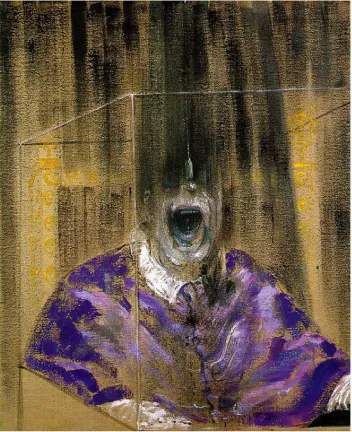
into the material structure” or “melts into the molecular texture” of the painting.30 What remains are only
the faintest impressions of the subject, as in Bacon’s Head VI (1949), wherein the background and
foreground are collapsed and the body appears to integrate into the wall behind him, as if the room itself
29 Ibid.
were swallowing him up. (SEE FIG. 2)
But what does all of this—Bacon, painting, Deleuze—have to do with sound? The answer lies in
the way in which Deleuze deploys a consistently sonic vocabulary to reckon with Bacon’s visual art.
Sensation, he says, is a “wave” that operates via “vibration” and varies according to its own “amplitude”;
the coexistence of all three of these aspects—isolation, deformation, dissipation—at once results in what
Deleuze terms a “rhythm,” which he distinguishes from another concept of musical and temporal
derivation, “meter.” Perhaps most crucially, when two forces are coupled, they “resonate,” that is, they
mutually vibrate. Deleuze, channeling Paul Klee, argues that the aim of painting is “to render visible
forces that are not themselves visible,”31 and sound, as invisible yet palpable flux, grounds his conceptual
[image:34.612.219.395.326.542.2]language.
Figure 2 - Head VI (Francis Bacon, 1949)
Deleuze admires Bacon’s work for the extent to which it makes manifest the forces of sensation
that otherwise remain invisible. But to better grapple with the properly sonic aspects of Delezue’s
understanding of force, I want to turn to a sound-oriented example: Alvin Lucier’s experimental music
composition, I Am Sitting in a Room, which was first recorded in 1969 and which Lucier has performed
numerous times since.32 What’s most striking (for my purposes at least) about the piece is that we can
map it onto Deleuze’s tripartite structure of sensation despite the shift to an altogether different medium.
Deleuze’s concept, as I see it, is therefore fundamentally aural in character.
As the performance opens, Lucier reads aloud a short text (a few words of which he stutters) in
which he describes what the nature of his experiment is and his reasons for undertaking it. Lucier explains
that he is recording his speech, and that he will play this recording back into the room, subsequently
recording that recording’s playback. Over and over for some 45 minutes, he repeats this process, nesting
the original utterance ever deeper into a chain of recordings. As time passes, his voice begins to distort,
sounding at first robotic and hollow before finally ceasing to sound anything like a voice at all. We are
left with nothing but seemingly ambient, somewhat menacing, somehow beautiful noise. Based on this
description alone, one might think the gradual loss of Lucier’s voice is the result of the degradation
inherent in tape recording, for with analog media, every succeeding copy of a “master” results in an
additional level of “noise,” and, given enough iterations, the hissy noise of the system will eventually
overtake the primary signal. (Listeners of heavily-traded bootleg tapes of concert performances are no
doubt familiar with this sort of additive deterioration).
But Lucier has something more intriguing in mind, as he makes clear in his monologue, which I
quote in its entirety:
I am sitting in a room, different from the one you are in now. I am recording the sound of my speaking voice and I am going to play it back into the room again and again until the resonant frequencies of the room reinforce themselves so that any semblance of my speech, with perhaps the exception of rhythm, is destroyed. What you will hear, then, are the natural resonant
frequencies of the room articulated by speech. I regard this activity not so much as a
demonstration of a physical fact, but more as a way to smooth out any irregularities my speech might have.33
Lucier insists that his intent with this experiment is to eliminate his stutter (result) more so than to
32 Lucier is a key figure in Earth Sound, Earth Signal, the most recent book by historian and theorist Douglas Kahn, who studied under Lucier. Specifically, Kahn addresses Lucier’s practices of using electromagnetic brainwaves to create musical compositions. Douglas Kahn, Earth Sound, Earth Signal: Energies and Earth Magnitude in the Arts
(Berkeley, CA: University of California Press, 2013).
demonstrate acoustic phenomena at work (cause); nevertheless, the former is a function of the latter, and
as such, I want to draw our attention to the physics of this all. Every material object possesses a natural
resonant frequency such that if a neighboring object were to vibrate at a frequency that matches its own,
the two objects would begin to vibrate in tandem, thus reinforcing and prolonging one another. This is
why one’s singing tends to sound better in the shower than in more open environments: the mutual
vibrations of the close quarters richen the tones. In the case of I Am Sitting in a Room, certain frequencies
within Lucier’s speech correspond to the room’s natural resonant frequencies, and this, in turn, makes the
room itself simultaneously, yet inaudibly, vibrate. Each subsequent playback and re-recording, however,
serves to amplify the room’s tremor, gradually bringing to the fore the room’s normally inaudible
pulsations, so much so that we arrive at a point in which what we hear is the room’s vibrations, its sound,
superseding Lucier’s. In short, Lucier succeeds in “smoothing out” his stammer only by putting his
speech, and indeed himself, under erasure.
In this way, I Am Sitting in a Room aligns with the processes of sensation Deleuze elaborates in
his discussion of Francis Bacon. Lucier, in setting up the initial recording, begins by isolating his voice,
and then, through a patient manipulation of acoustic resonance, deforms it, which results in its ultimate
dissipation or scattering. In this regard, Lucier’s piece serves to illustrate by aural means Deleuze’s
understanding of what happens to the subjects of Bacon’s paintings: caught in the spasm of sensation—of
agony, pleasure, jouissance, affect—the figures go about “dissolv[ing] into the material structure” of the
world, of “melt[ing] into a molecular texture.”34
The notion of the molecular is an idea developed across of number of Deleuze’s works, both
alone and with Félix Guattari. Making its first appearance in The Logic of Sense in 1969, the concept
becomes more prominent in the co-authored works Anti-Oedipus (1972) and A Thousand Plateaus (1980)
before taking on a pronounced aesthetic bent in the solo-authored Francis Bacon (1981) and Cinema 1
(1982) and Cinema 2 (1985). In the first of the Cinema books, Deleuze ties human perception to molarity: