Validation and Effectiveness of Modules in Personality
Development and Public Relations
Rowena de los Reyes Laroza, Ed. D
University of Rizal System, Morong, Rizal, Philippines
Abstract- The study aimed to determine the validity and effectiveness of the developed modules in the subject Social Orientation(Soc. Or.) or Personality Development and Public Relations (PDPR). This study was conducted at the University of Rizal System-Morong Campus during the First Semester of School Year 2009-2010 with 15 PDPR professors and 30 second year students of Bachelor of Technology major in Hotel and Restaurant Management as the respondent-evaluators in the study. Descriptive-experimental method of research using the questionnaire-checklist and test results in gathering data was used in the conduct of the study. The PDPR professors validated the modules based on the following criteria: objectives, subject matter, organization and presentation, language and style and usefulness of the module. Pretest-post test design was used to determine the performance of the control and experimental group in which the students were equated and divided into two groups. Mean, standard deviation and rank distribution were used as statistical tools in treating the data. T-test was utilized to test the significant difference between the mean performance of the control and experimental group as revealed by the post test results. It was found out that the modules in PDPR were very much valid as an instructional material. This is shown in the high performance of the experimental group as revealed in their pretest and post test results. The modules in PDPR were perceived to be very much effective by students and professors.
Index Terms- Hotel and Restaurant Management, Instructional Materials, Modules, Personality Development and Public Relations
I. INTRODUCTION
ocial Orientation (Soc. Or.) or Personality Development and Public Relations (PDPR) subject plays a great role for Hotel and Restaurant Management students. Knowledge, skills and values on the physical, intellectual, social, emotional and moral aspects of personality as well as social graces and manners in the business world will be gained by the students before the semester ends. Most of the teachers nowadays teaching the subject PDPR use the available textbooks as their references in teaching and very few support their teaching with other instructional materials in a form of module, work text, workbook and the like. In the usual classroom situation, the teacher tries to teach and evaluate the students in a conventional way by using a book with the same lesson at the same time. On the other hand, with the use of modules, the students learn in a self-paced mode and evaluate his
self evaluation until he gained mastery of the lesson. The competing epistemologies which are struggling to shape the formal undergraduate curriculum of the 21st century include the deconstruction of the subject, as reflected in, for example, the modularization of the curriculum; the cross-curricular ‘key ‘ skills movement ; and the learning through experience movement among others[ Bridge,2000].[1]
Section 3, Chapter 3 of the Education Act of 1982 expressed the following aim which is to develop curricular designs, prepare instructional materials, prepare and evaluate programs to upgrade the quality of teaching [2]. Similarly, Presidential Decree No.6-A, Section 5 states,” One of the educational objectives is to design, utilize and improve instructional technology and develop or produce textbooks and other instructional materials leading to quality education.” [3] A well-developed instructional material will greatly contribute to the performance of the students and would also make learning easier and permanent ( Abarro,2004[4] Aparejo, 2004[5] Bautista [6] and Marino,2004 [7]). The use of work text has a significant effect on the performance of the students and that instructors find it useful if paired with the traditional lecture method ( Maranan [8] and Tonido 2005 [9]). Similarly, the developed work text, modules and laboratory manual in Sciences and Mathematics subjects are very useful in enhancing the learning of the students as evaluated by students and instructors ( Constantino2010, [10]Cruz 2006, [11] Jimenez 2008[12] and Robles 2004 [13]).
The study was anchored on Bruner’s Instruction Theory. According to this theory, instruction must have as its object to help the learner to be a self-sufficient problem-solver [14]. The Theory of Bruner is related to the present study because through the use of modules, the students become independent in evaluating their own learning.
II. OBJECTIVES
The main purpose of this study is to validate and test the effectiveness of the developed modules in the subject Personality Development and Public Relations during the School Year 2009-2010 in the University of Rizal System, Morong , Rizal, Philippines.
Specifically, it aimed to:
1. Determine the validity of the developed modules as evaluated by professors in terms of the following criteria; 1.1 objectives;
1.2 subject matter;
1.3 organization and presentation;
2. Determine the performance of the control and experimental group as revealed by the pretest and post test with respect to the following learning areas;
2.1 Aspects of Personality;
2.2 Self-Appraisal, Self Improvement and Philosophy of life;
2.3 The Better You; 2.4 The New You;
2.5 You and Your Clothing; 2.6 Social Graces;
2.7 Emotions, Conflict and Adjustment.
3. Identify the significant difference between the mean performance of the control and experimental group as revealed by the post test results.
4. Identify the significant difference on the effectiveness of the developed modules in Personality Development and Public Relations as revealed by the pretest and post test scores of the experimental group.
III. METHODOLOGY
The study utilized the descriptive research design using questionnaire checklist which was distributed to the respondents. Descriptive method according to Aguinaldo “is design to gather information about present and existing conditions. It determines and reports the way things are [15].” This design is very appropriate in determining the validity of the modules that were
evaluated by PDPR professors. Experimental method of research was also used in this study. Experimental method according to Aguinaldo is “the procedure which involves a situation in which a certain phenomena may be controlled… It describes and analyzes variables in carefully controlled conditions as a basis for interfering or concluding. It consists of manipulating an experimental variable under highly controlled condition to determine how and why a particular event occurs [15].”
Pretest-post test group designs were used as instruments in the study. The study made use of a 70 item multiple choice of test in PDPR to find out the accomplishment of the two groups of student respondents. The pretest and the post test scores of the two groups were evaluated and analyzed and were used as the bases to test the effectiveness of the modules in the subject Personality Development and Public Relations (PDPR). The subjects were divided into control and experimental groups using the simple random sampling procedure. Each group has fifteen (15) student-subjects who formed part of the study and were equated based on their grades. A questionnaire –checklist was also used as instrument in the gathering of the data. The questionnaire-checklist was adapted from the questionnaire of Laurice A. Cruz in his study, “The Effectiveness of Environmental Science Teaching Modules on the Performance of College Students” [11]. The criteria included in the questionnaire- checklist are objectives, subject matter, organization and presentation, language and style and usefulness.
The instrument used a five- point scale to interpret the gathered data as shown below:
Verbal Interpretation
Scale Range Objectives Subject Matter
Organization & Presentation
Language &
Style Usefulness
5
4.20-5.00
Very Strongly Agree
Very Highly Sufficient
Very Much Effective
Very Highly
Effective Very Useful
4
3.40-4.19
Strongly Agree
Highly
Sufficient Much Effective
Highly
Effective Useful
3
2.60-3.39 Agree Sufficient
Moderately
Effective Effective
Moderately Useful
2
1.80-2.59
Slightly Agree
Slightly
Sufficient Less Effective
Slightly
Effective Slightly Useful
1
1.00-1.79 Disagree
Not
Sufficient Least Effective Not Effective Not Useful
Mean and rank were used to determine the validity of the modules as evaluated by professors. Mean and standard deviation were utilized to determine the performance of the control and experimental group as revealed by the pretest and post test, and the significant difference on the effectiveness of the developed modules in PDPR as revealed by the pretest and post test scores of the experimental group. T-test was used to determine the significant difference, between the mean performance of the control and experimental group as revealed by the post test results.
IV. RESULTSANDDISCUSSIONS
Validity of the Modules as Evaluated by Professors in Terms of Objectives, Subject Matter, Organization and Presentation, Language Style and Usefulness .
Table1. Computed Weighted Mean on the Validity of the Modules with Respect to Objectives
A. Objectives Professors
Weighted
Mean Rank Verbal Interpretation
1. The general objectives include the development of
logical judgmental behaviors. 4.78 1.5 Very Strongly Agree
2. The specific objectives are clearly stated. 4.78 1.5 Very Strongly Agree
3. The specific objectives are measurable and attainable. 4.59 4 Very Strongly Agree
4. The objectives guide the students to have a full grasp
of the concepts to be discussed in each of the module. 4.64 3 Very Strongly Agree 5. The learning objectives are aligned with the mission,
vision, goal, and objectives of the University. 4.53 5 Very Strongly Agree
Average Weighted Mean 4.66 Very Strongly Agree
The table shows in terms of objectives as perceived by professor respondents item 1 “The general objectives include the development of logical judgmental behaviors” and item 2 “The specific objectives are clearly stated” both ranked first with 4.78 weighted mean. Last in rank is item 5 “The learning objectives are aligned with the mission, vision, goal, and objectives of the university” with 4.53 weighted mean. All the findings are verbally interpreted as “Very Strongly Agree” with an average weighted mean of 4.66. The findings describe that the respondents very strongly agreed on the “Objectives” of the
developed modules. This implies that the objectives are clearly stated, are of greatest assistance to the students to have a full understanding of the concepts to be discussed, accessible and achievable. As revealed by Cruz (2006) the instructors “very strongly agree” that the objectives include the enhancement of good critical behaviors and are clearly stated [12].
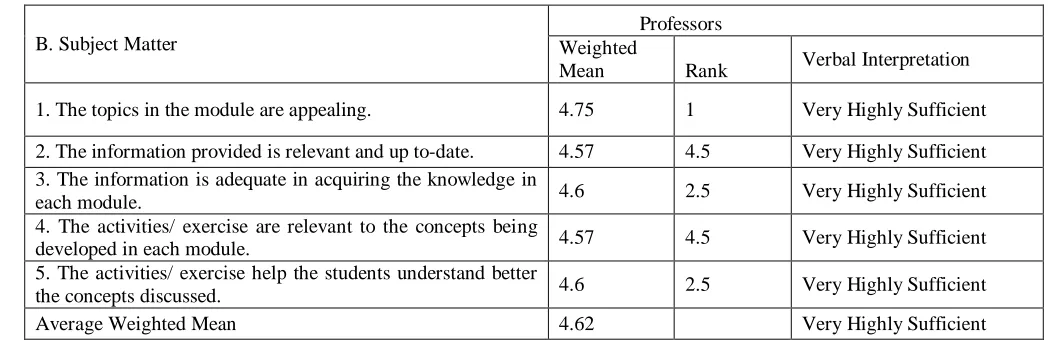
Table 2 presents the computed weighted mean on the validity of the modules as evaluated by the instructors with respect to the subject matter.
[image:3.612.39.563.428.601.2]
Table 2. Computed Weighted Mean on the Validity of the Modules with Respect to Subject Matter
B. Subject Matter
Professors Weighted
Mean Rank Verbal Interpretation
1. The topics in the module are appealing. 4.75 1 Very Highly Sufficient
2. The information provided is relevant and up to-date. 4.57 4.5 Very Highly Sufficient 3. The information is adequate in acquiring the knowledge in
each module. 4.6 2.5 Very Highly Sufficient
4. The activities/ exercise are relevant to the concepts being
developed in each module. 4.57 4.5 Very Highly Sufficient
5. The activities/ exercise help the students understand better
the concepts discussed. 4.6 2.5 Very Highly Sufficient
Average Weighted Mean 4.62 Very Highly Sufficient
The table reveals that the average weighted mean for Subject Matter is 4.62 and is verbally interpreted as “Very Highly Sufficient”. Item 1, “The topics in the module are appealing” got the highest rank with a weighted mean of 4.75. On the other hand, item 2 “The information provided is relevant and up to- date” and item 4, “The activities/ exercises are relevant to the concept being developed in each module” both rank last with a weighted mean of 4.57 all verbally interpreted as “Very Highly
of the end users-the students. This implies that the topics presented are attractive to the interest of the learners, information is adequate and enhance by the activities/ exercises incorporated in each module. As Marino (2004) stressed out, a well- developed instructional material will greatly contribute to the performance of the students. The use of instructional material would also make learning easier and permanent [7].
Table 3. Computed Weighted Mean on the Validity of the Modules with Respect to Organization and Presentation
C. Organization and Presentation Professors
Weighted Mean Rank Verbal Interpretation
1. The presentation of topics is sequential. 4.60 2.5 Very Much Effective
2. The discussion of topics is clear and well
presented in a logical and orderly sequence. 4.68 1 Very Much Effective
3. The variety of activities is sufficient enough to
realize the objectives. 4.53 4 Very Much Effective
4. The illustrations, examples, figures, and exercises
are instruments to attain the learning process. 4.28 5 Very Much Effective
5. Instruments for assessment of the targeted
objectives are included. 4.60 2.5 Very Much Effective
Average Weighted Mean 4.54 Very Much Effective
The table depicts that the average weighted mean for organization and presentation is 4.54 and is verbally interpreted as “Very Much Effective”. Item 2 “The discussion of topics is clear and well presented in a logical and orderly sequence” is ranked first with a weighted mean of 4.68 while item 4 “The illustrations, examples, figures and exercises are instruments to attain the learning process” is ranked last with a rating of 4.28 and all are verbally interpreted as “Very Much Effective” It could be deduced from the results that the respondents perceived the organization and presentation of the modules to be very
effective as an instructional material. This implies that the topics presented are in order, evaluation instrument is incorporated based on the objectives set as well as provision for illustrations, example, figures and exercises that enhance the learning process. As pointed by Constantino (2010) more exercises focus on the objectives should be added [10].
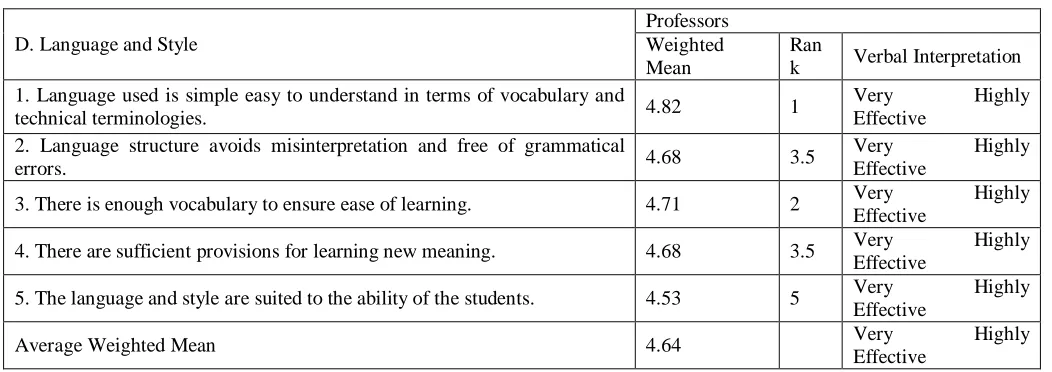
Table 4 depicts the computed weighted mean on the validity of the modules as evaluated by the professors with respect to the language and style.
Table 4. Computed Weighted Mean on the Validity of the Modules with Respect to Language and Style
D. Language and Style
Professors Weighted Mean
Ran
k Verbal Interpretation 1. Language used is simple easy to understand in terms of vocabulary and
technical terminologies. 4.82 1
Very Highly Effective
2. Language structure avoids misinterpretation and free of grammatical
errors. 4.68 3.5
Very Highly Effective
3. There is enough vocabulary to ensure ease of learning. 4.71 2 Very Highly
Effective
4. There are sufficient provisions for learning new meaning. 4.68 3.5 Very Highly
Effective
5. The language and style are suited to the ability of the students. 4.53 5 Very Highly
Effective
Average Weighted Mean 4.64 Very Highly
Effective
The table reveals that the average weighted mean for “Language and Style” is very 4.82 and is verbally interpreted as “Very Highly Effective”. Item 1 “Language used is simple, easy to understand in terms of vocabulary and technical terminologies” is ranked first with a rating of 4.82 while item 5 “The language and style are suited to the ability of the students” is ranked last with a rating of 4.53 and all are verbally interpreted as “Very Highly Effective” This means that the professors agreed that the language and style of the developed modules are enough to be understood by the learners, inclusion for learning new
meaning is evident and carefully chosen vocabulary facilitate learning. The findings imply that the modules contain contents that would improve the performance in the subject Personality Development and Public Relations. According to Abarro (2004) the language used should be easily understood by the learners. A well- written module should be clear, simple and orderly in order to make learning easy [4].
[image:4.612.45.571.394.580.2]Table 5. Computed Weighted Mean on the Validity of the Modules with Respect to Usefulness
E. Usefulness
Professors
Weighted Mean Ran k
Verbal Interpretation 1. The modules enable the students to analyze and apply information/
theories in real life situations. 4.74 1.5 Very Useful
2. The modules are engaging, beneficial to students learning and supportive
of higher level thinking skills. 4.67 4 Very Useful
3. Students can learn, understand and answer the guide questions thoroughly
by reviewing examples and illustrations, which are provided per topic. 4.74 1.5 Very Useful 4. The modules can make the students learn and understand the subject
matter by reviewing the illustrations and examples at his pace. 4.59 5 Very Useful 5. The modules have well- defined accommodations to support a diversity of
learners. 4.70 3 Very Useful
Average Weighted Mean 4.69 Very Useful
The data revealed that the average weighted mean on the “Usefulness” is 4.69 and is verbally interpreted as “Very Useful”. Item 1 “The modules enable the students to analyze and apply information/ theories in real life situations” and item 3 “Students can learn, understand and answer the guide questions thoroughly by reviewing examples and illustrations which are provided per topic” are ranked first with a rating of 4.74 while item 4 “The modules can make the students learn and understand the subject matter by reviewing the illustrations and examples at his pace” is ranked last with a rating of 4.59 and all are verbally interpreted as “Very Useful”. This means that the information/
theories in the modules help the students to actualize it in real life situations and the inclusion of guide questions or study helps are very useful per topic. The findings imply that the respondents considered the modules as very useful instructional material in imparting knowledge to students. As posited by Constantino (2010) the work text is very useful in enhancing the learning of the students [10].
Table 6 reveals the composite table on the validity of the modules as evaluated by the professor- respondents in terms objectives, subject matter, organization and presentation, language and style and usefulness.
Table 6. Composite Table on the Average Weighted Mean on the Validity of Modules as Evaluated by Professors with Respect to Objectives, Subject Matter, Organization and Presentation, Language and Style and Usefulness
Criteria Average Weighted
Mean Rank Verbally Interpretation
1. Objectives 4.66 2 Very Strongly Agree
2. Subject Matter 4.62 4 Very Highly Sufficient
3. Organization and Presentations 4.54 5 Very Much Effective
4. Language and Style 4.64 3 Very Highly Effective
5. Usefulness 4.69 1 Very Useful
Grand Mean 4.63 Very Much Valid
Based on the professor’s results of evaluation, generally, they perceived the modules as a “Very Much Valid” instructional material with an average weighted mean of 4.63. This means that generally, the modules are very good support learning materials to instruction as shown in the high results of evaluation of the respondents. The result implies that according to the professor- respondents the modules in Personality Development and Public Relations are very much effective and useful in facilitating the learning abilities of the students. This implication is supported by
Cruz (2006) when he found out that the module in Environmental Science is very useful as evaluated by the instructors [11].
The Performance of the Control and Experimental Group as Revealed by the Pretest and Posttest
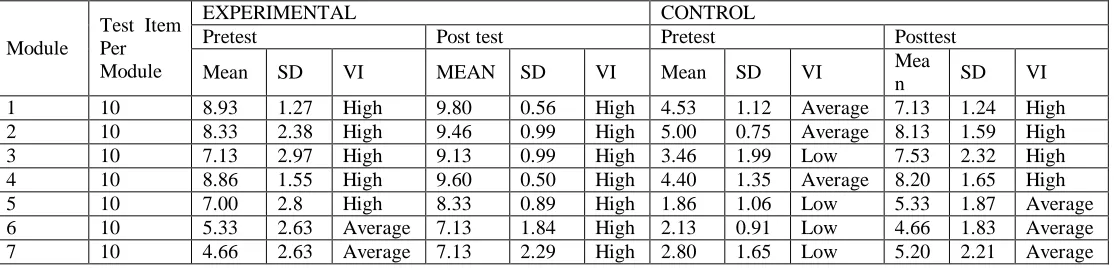
Table 7 presents the mean performance and standard deviation of the control and experimental group in the pretest and post test of the modules in Personality Development and Public Relations.
[image:5.612.42.569.432.531.2]Table7. Mean Performance and Standard Deviation of the Control and Experimental Groups in the different modules in Personality Development and Public Relations as Revealed by the Pretest and Post test Scores
Module
Test Item Per Module
EXPERIMENTAL CONTROL
Pretest Post test Pretest Posttest
Mean SD VI MEAN SD VI Mean SD VI Mea
n SD VI
1 10 8.93 1.27 High 9.80 0.56 High 4.53 1.12 Average 7.13 1.24 High
2 10 8.33 2.38 High 9.46 0.99 High 5.00 0.75 Average 8.13 1.59 High
3 10 7.13 2.97 High 9.13 0.99 High 3.46 1.99 Low 7.53 2.32 High
4 10 8.86 1.55 High 9.60 0.50 High 4.40 1.35 Average 8.20 1.65 High
5 10 7.00 2.8 High 8.33 0.89 High 1.86 1.06 Low 5.33 1.87 Average
6 10 5.33 2.63 Average 7.13 1.84 High 2.13 0.91 Low 4.66 1.83 Average
7 10 4.66 2.63 Average 7.13 2.29 High 2.80 1.65 Low 5.20 2.21 Average
The data shows the number of test items for each developed module. Module1 to 7 have 10 test items. From the table it can also be seen that the post test scores of the control group for each module are7.13, 8.13, 7.53, 8.20, 5.33, 4.66 and 5.20 with standard deviations of 1.24, 1.59, 2.32, 1.65, 1.87, 1.83 and 2.21 respectively. On the other hand, the post test scores of the experimental group for each module are 9.80, 9.46, 9.13, 9.60, 8.33, 7.13 and 7.13 with standard deviations of .56, .99, .99, .50, .89, 1.84 and 2.29 respectively. The obtained mean and standard deviation of both groups shows that the experimental group performed much better than the control group in all the modules. It may be due to the reason that the experimental group used the modules and was able to internalize additional knowledge from it.
According to Bautista (2004) utilizing modules in teaching the subject produces better performance among students. Furthermore, instructional materials facilitate learning and understanding among students. Additional devices could also add to the capacity of the students to understand and comprehend [6].
The Significant Difference on the Mean Performance of the Control and Experimental Group
as Revealed by the Post test Results
[image:6.612.30.587.92.226.2]Table 8 shows the computed t-value the significant difference in the performance of the control and experimental group as revealed by their post test scores.
Table 8. Computed t-value on the Performance of the Control and Experimental Group as Revealed by their Post test Scores
Topics Mean Standard
Deviation t D f
P-value
Mean Difference
H O
Verbal Interpretatio n
Module1 Experimental Control
9.80 7.13
.56 1.24
7.55
9 28 .000 2.66 R S
Module2 Experimental Control
9.46 8.13
.99 1.59
2.74
7 28 .010 1.33 R S
Module3 Experimental Control
9.13 7.53
.99 2.32
2.45
1 28 .021 1.66 R S
Module4 Experimental Control
9.60 8.20
.50 1.65
3.13
0 28 .004 1.40 R S
Module5 Experimental Control
8.33 5.33
.89 1.87
5.58
2 28 .000 3.00 R S
Module6 Experimental Control
7.13 4.66
1.84 1.83
3.66
6 28 .001 2.46 R S
Module7 Experimental Control
7.13 5.20
2.29 2.21
2.35
0 28 .026 1.93 R S
The data shows mean difference of 2.66 for module 1, 1.33 for module 2, 1.66 for module 3, 1.40 for module 4, 3.00 for module 5, 2.46 for module 6 and 1.93 for module 7. The table also reveals that all the computed t-values for all the modules are higher than the tabular t- values at 0.05 level of significance. Based from the findings, it can be concluded that there is a significant difference between the post test scores of the control and experimental for modules1 to 7. With regard to the performance of experimental and control groups in the post test, the data reveal that the experimental group performed much better than the control group hence significant. This may be due to the reason that the level of retention tend to be high when the learners able to see the information than merely discussing the lesson the traditional way. The use of instructional materials like modules facilitate the teaching- learning process more
effectively. As stressed out by Cruz (2006) based on his findings, the experimental group performed a little better than the control group. This may be due to the fact that the students tend to remember information better when they are able to see it. Stimulations using instructional materials are very important in making learning permanent [11].
The Significant Difference on the Effectiveness of the Developed Modules in Personality Development and Public Relations as Revealed by the Pretest and Post Test Scores of the Experimental Group.
[image:7.612.47.570.275.535.2]Table 9 presents the computed t-value on the significant difference in the performance of the experimental groups as revealed by its pretest and post test scores.
Table 9. Computed t-value on the Performance of the Control and Experimental Group as revealed by the Pretest and Post test Scores
Topics Mean SD t D f P-value HO VI
Module 1 Pretest Post test
8.93 9.80
1.27 1.56
-2.476 14 .027 R S
Module 2 Pretest Post test
8.33 9.47
2.38 .99
-2.828 14
.013 R S
Module 3 Pretest Post test
7.13 9.13
2.97 .99
-2.432 14
.029 R S
Module 4 Pretest Post test
8.86 9.20
1.55 .50
-2.048 14
.060 A NS
Module 5 Pretest Post test
7.00 8.33
2.80 .89
-1.958 14
.070 A NS
Module 6 Pretest Post test
5.33 7.13
2.63 1.84
-2.267 14
.040 R S
Module 7 Pretest Post test
4.66 7.13
2.63 2.29
-5.069 14
.000 R S
The table 9 reveals that the computed t-value of the experimental group for module 1 is -2.476, module 2 is -2.828, module 3 is -2.432, module 6 is -2.267 and module 7 is -5.069 with a p-value of .027, .013, .029, .040 and .000 verbally interpreted as significant respectively. The data shows that there is a significant difference on the performance of experimental group as revealed by the pretest and post test scores in the modules stated above. On the other hand, the table also reveals that the computed t-value of the experimental group for module 4 is -2.048 and for module 5 is -1.958 with a p-value of .060 and .070 verbally interpreted as not significant respectively. The data shows that there is no significant difference on the performance of experimental group as revealed by the pretest and post tests scores in modules 4 and 5. It can be gleaned from the majority of
concepts included therein. Study helps or supplementary questions included in the discussion served as a challenge for the students to acquire more knowledge and insights. As pointed out by Aparejo (2004), a module should be presented in a manner that is relevant to the concept being developed. The activities should connect old and new learning to ensure the ease of learning. The way a module is presented greatly affects the performance of a student [5].
V. CONCLUSIONS
Development and Public Relations. Majority of the modules in Personality Development and Public Relations were very effective in helping students learn as shown by the pretest and post test scores of the experimental group.
VI. RECOMMENDATIONS
From the summary of findings and conclusion drawn, the following are hereby recommended. Both the professors and students can use the developed modules in Personality Development and Public Relations to facilitate the teaching-learning process more effectively. Review and enrichment of the modules should be done continuously to match the needs and abilities of the students.
REFERENCES
[1] Bridge, D. “Back to the Future: The Higher Education Curriculum in the 21st Century”, Cambridge Journal of Education, Vol. 30. No.1, 2000.
[2] Education Act of 1982.Retrieved from
http//www.lawphil.net/statutes/presdecs/bp1982.
[3] Presidential Decree No.6-A. Retrieved from http//www.lawphil.net/statutes/presdecs/pd 1972.
[4] Abarro, J.O.” Development and Validation of a Work Text in Principles and Methods of Teaching”, Doctorate Dissertation: URS Pililla, 2004. [5] Aparejo,E. “Effectiveness of Modules in Selected Topics in Algebra for
College Students”, Master’s Thesis; EARIST,2004.
[6] Bautista, F.V. “Development, Validation and Effectiveness of Modules in Principle of Guidance and Counselling”,URS Morong,2004.
[7] Marino, W.P.” Development, Validation and Effectiveness of Plane Trigonometry Work Text for the First Year College Students”, Master’s Thesis, URS-Antipolo, 2005.
[8] Maranan, E.B. “The Effectiveness of Work Text in Physics”, Master’s Thesis: URS-Antipolo, 2004.
[9] Tonido,A.R. “ Acceptability and Effectiveness of the Developed Training Package in AC Industrial Control” Master’s Thesis: URS Morong ,2005. [10] Constantino, B.G. “Development and Validation of Work Text in Calculus
I. Unpublished Research,2010.
[11] Cruz,L.A. “ The Effectiveness of Environmental Science Teaching Modules on the Performance of College Students”,Master,s Thesis URS Morong,2006.
[12] Jimenez,M.S. “Development and Validation of Laboratory Manual in General Chemistry”Master’s Thesis:URS-Morong, 2008. [13] Robles,F.SD. “Effectiveness of Modules in Chemistry”,Doctorate
Dissertation: URS Morong,2004.
[14] Bruner, J. “Theory of Learning” Bigge, 1980: p.401
[15] Aguinaldo M. M.”Simplified Approach to Thesis Writing”, 2002.
AUTHOR
Rowena DR. Laroza, Ed.D.is a Professor III in the University