ISSN 2250-3153
An Empirical Study on the Structure Optimization
of Teachers in Guizhou University, China
Yang Zhong Fei1* , Foong Chee Haur2 and S.M. Ferdous Azam3
Management and Science University, Seksyen 13, 40100, Shah Alam, Selangor, Malaysia
* E-mail of the corresponding author:[email protected]
DOI: 10.29322/IJSRP.9.07.2019.p9181 http://dx.doi.org/10.29322/IJSRP.9.07.2019.p9181
Abstract- Establishing a well-structured faculty is not only the focus of the construction of college faculty, but also the only way
for the survival and development of universities. The core of the construction of faculty is the professional qualification structure
and academic structure.This paper makes a statistical analysis of the changes in the professional qualification structure and
academic structure of teachers in Guizhou University in the past three years, and finds out some problems in the construction of
the school's teaching staff, and puts forward corresponding countermeasures.The research in this paper was developed based on
quantitative research methods, through a measurement model, and tried to gain further understanding.Thereafter, the main data
required is collected according to the survey strategy by providing self-administered questionnaires and interviews.Full-time
teachers who teach at Guizhou University in China were selected as the sampling framework for this study.The survey results
show a positive correlation between the professional qualification structure and the team structure.In addition, there is a
significant relationship between the academic structure and the team structure; and the positive relationship between the team
structure and the optimization of the faculty.The study shows that the policy has a positive impact on optimizing the teaching
staff.The research results analyze the current situation of the construction of the teaching staff, policy optimization, and the
average score of the sustainable development of the teaching staff with different professional qualification structures and different
academic qualifications.This study is limited to Guizhou University. It can bring some enlightenment to other universities in
Guizhou Province when choosing the structure adjustment mechanism of teachers. It provides countermeasures for the adjustment
of the teaching staff structure in other universities in Guizhou Province, and provides relevant higher education for the Chinese
Ministry of Education and the government. Educational policy provides a theoretical reference.This research can serve as a guide
for other factors in future research that will influence the development of the university's faculty.
ISSN 2250-3153
I. INTRODUCTION
Founded in 1902, Guizhou University is located in Guiyang, Guizhou Province, China.First-class disciplineThe construction of
colleges and universities is a national key university jointly established by the Ministry of Education of China and the Guizhou
Provincial People's Government, and the best key comprehensive university in Guizhou Province. It is a high-level university with
key construction in the western region.In October 1950, it was named Guizhou University.In August 1997, it merged with
Guizhou Agricultural College and other institutions.In August 2004, it merged with Guizhou University of Technology.In
December 2012, the Ministry of Education and the People's Government of Guizhou Province jointly established universities.In
April 2016, it was listed as a national “one province, one school” to support the construction of universities.In November 2017, it
was awarded the title of the first Chinese Civilization Campus.
The university has a wide range of subjects, including literature, history, philosophy, science, engineering, agronomy, medicine,
economics, management, law, education, and art.There are 40 colleges and 33,064 full-time undergraduate students.
Teachers are the main body of the university. Whether the professional qualification structure and academic structure of the
teaching staff are reasonable, directly affects the overall quality of the teaching staff, affects the development of the university,
and how to establish a well-structured teaching staff, which is the reform and development of higher education institutions.
Fundamental plan.This paper analyzes and analyzes the professional qualification structure and academic structure of the
three-year faculty of Guizhou University, finds out some problems existing in the construction of the faculty of the school, and proposes
corresponding optimization measures, which is extremely high for the future construction of the university faculty. The reference
value will lead the construction of the optimization faculty of other universities in Guizhou, which has important reference
significance for other universities in China and abroad.
II. STATISTICAL ANALYSIS OF TEACHER TEAM STRUCTURE
Establishing a well-structured faculty is not only the focus of the construction of university faculty, but also the only way for the
survival and development of the university.And the core of the faculty construction is the professional qualification structure and
academic structure.Table 1 shows the statistical results of the professional qualification structure and academic structure of
teachers in Guizhou University in the past three years.The statistical analysis of the structure of teachers and the changing trends
can provide a scientific basis for the development of other universities in Guizhou Province and the future development of the
[image:2.595.35.563.652.757.2]university and the construction of the teaching staff.
Table 1 Statistical Table of Faculty Structure (Guizhou University, 2011.6)
Category item 2016.6-2017.6 2017.6-2018.6 2018.6-2019.6
Number of
people Proportion (%)
Number of
people proportion(%)
Number of
people Proportion (%)
Total
number of
ISSN 2250-3153
teachers
Professional
qualificatio
n structure
advanced 1198 47.67 1611 63.38 1593 63.14
Intermediate and
below 1315 52.33 1231 36.62 930 36.86
Academic
structure
Doctor 286 11.38 902 31.74 1006 39.88
master's degree 1230 48.95 876 30.82 1284 50.89
Bachelor 997 39.67 1064 37.44 233 9.23
As can be seen from Table 1, there are 2,523 full-time teachers in the school.Among them, 1593 teachers with advanced
vocational qualifications accounted for 63.14% of the total number of teachers; 930 teachers with intermediate and lower
vocational qualifications, accounting for 36.86%.From 2016 to 2019, the absolute number of teachers with intermediate
professional qualifications in the faculty increased in 2017, but the proportion of teachers with advanced professional
qualifications declined in 2018. Teachers with intermediate and lower vocational qualifications The ratio is rising.This is mainly
due to the employment of a large number of young teachers.This trend of change may continue to develop in the next few years
and should be given sufficient attention.
Among the full-time teachers of the school, there are 1006 doctoral students, accounting for 39.88% of the total number of
teachers; 1284 with master's degrees, accounting for 50.89% of the total number of teachers.There are 233 bachelor's degrees,
accounting for 9.23% of the total number of teachers.Relatively speaking, the proportion of teachers with master's degrees is
large.From 2016 to 2019, the academic level of the faculty is gradually increasing. The number of teachers with master's degree or
above is increasing year by year, and the proportion of teachers with bachelor's degrees is gradually narrowing.The Ministry of
Education of the People's Republic of China clearly stipulates that the proportion of doctors in key universities should be greater
than or equal to 50% in the evaluation index system of the new national undergraduate colleges. The school should increase the
proportion of doctors in full-time teachers from 39.88% in a short period of time. One percentage point, to meet the evaluation
criteria of the Ministry of Education of the People's Republic of China, on the one hand, to train young teachers with master's
degrees, and to ensure that the proportion of teachers with doctoral degrees in new teachers every year is more than 50%.
The academic structure mainly determines the academic foundation of the teaching staff. The professional qualification structure
mainly determines the academic strength of the team. This paper mainly studies how to optimize the teacher's professional
qualification structure and how to optimize the teacher's academic degree structure.At present, China's higher education is in the
stage of major reform, great development, and great improvement. It is in the key link from scale expansion to quality
improvement. Structural adjustment will inevitably become the core of higher education reform, and the best Guizhou University
ISSN 2250-3153
thesis, it can bring some enlightenment to other universities in Guizhou Province when choosing the structure adjustment
measures of teachers. It provides countermeasures for the adjustment of the structure of teachers in other universities in Guizhou
Province, and formulates relevant higher education policies for the Chinese Ministry of Education and the government. Provide a
theoretical reference.
III. LITERATURE REVIEW
The main theoretical basis of this thesis includes structural function theory, system optimization theory and mutual benefit
symbiosis theory.
A. Structural Function Theory (American sociologist T. Parsons, R. Merton, 1950)
It is mainly about the relationship between the constitutional state of things and the overall functional state of things.Later,
scholars extended and supplemented the theories of T.Parsons and R.Merton. The main points are as follows.
Structure is the basic way of existence of things.The history of human science has been proven that everything has a certain
structure, certain things and certain structures coexist, and everything is formed, expressed and integrated as a whole by a given
structure. There are no unstructured things, no structure without things.Whether it is a macroscopic cosmic star, a mesoscopically
visible object, or a microscopic science, the smallest particle ever discovered - quark, whether it is the universe in the natural
world, the human organization of the social world, or the language and thinking of the spiritual world, One is not the existence of
structure.The structure is omnipresent and inseparable from things.From a dynamic perspective, structural changes will inevitably
lead to changes in things, and the development of things depends on structural optimization.
Structural analysis is the fundamental way to understand things.Structural analysis is the basic method for human beings to
understand the world. It is inherently consistent with analytical synthesis.To obtain a comprehensive understanding of things,
human beings cannot only examine the superficial phenomena of things and must go deep inside the things.The most common
way to analyze things inside is to split the things into multiple parts, and then carefully examine the characteristics of each part,
the relationship between each part, and the way each part constitutes the whole thing. Finally, based on the comprehensive
understanding of these parts, An intrinsic, essential understanding of the whole thing.
There is a high degree of correlation between structure and function.The theory of structural function considers that the structure
and function of things are closely related. A certain structure corresponds to a certain function. Under the same conditions, the
structure determines the function.At the same time, there are four relationships between structure and function: to-one,
one-to-many, many-one-to-many, and many-to-one.The connection between structure and function is complex, and often has many forms
such as isomorphism, heterogeneous isomorphism, and isomorphism.First of all, the university teacher team is a structured
system. The structure of teachers in different universities (or university systems) or the same university (or university system) in
different periods is often different, even huge.Secondly, structural analysis is the most fundamental way to understand things. We
know the team of college teachers and cannot do without the in-depth analysis of their structure.Thirdly, the structure and function
of college teachers are highly correlated, the structure determines the function, the different combinations and different
connections of the members of the university teachers, the members will have different characteristics of mutual birth, mutual
gram, phase checks, phase transformation, and phase neutrality. Therefore, the university teachers team has the functions and
functions of different natures and sizes.It can be seen that the theory of structural function not only lays down and enhances the
significance of this research in theory, but also provides methodological guidance for the study, especially the discussion of
ISSN 2250-3153
B.System Optimization Theory (Wei Hongsen、Zeng Guoping ,1995)
It is mainly an important branch of general system science. It is the crystallization of system theory and evolutionary
cross-infiltration. It focuses on exploring and revealing the general laws of system change and development.The main points are as
follows:
Any system is a system that continues to evolve.The system is composed of elements, the constant changes in the nature of the
elements themselves, and the constant changes in the relationship between the elements, causing constant changes in the structure,
functions, and features of the system.According to the dialectical materialism, any system has an objective existence.Things are in
constant change, movement is eternal and absolute, and rest is temporary and relative, and everything must go through the process
of creation, development, and extinction.Therefore, any system is a constantly changing system that may be positive, may be
negative, or may behave in another form of stagnation.Among them, the forward evolution system is what we call the optimized
system.
System optimization is a performance state in system evolution.The system will show different states in the long-term evolution,
with optimization and non-optimization. The optimized system is in the positive evolution, the interaction between the elements is
good, the part and the whole are coordinated, the energy and potential are huge, the function and The system in the extended state.
System structure optimization is the basis and performance of system optimization.The realization of system optimization is
reflected by the improvement of system organization, structure and function. The optimization of structure is the important aspect
and key link, that is, system optimization must include the structural optimization of the system. At the same time, system
structure optimization is the overall optimization of the system. condition.A distinctive feature of the system is its
constitutiveness, that is, any system is composed of elements, and a certain structure is formed between the elements.Therefore,
system optimization is inseparable from the optimization of the structure. It is precisely because of the continuous positive
adjustment of the structure that the system is continuously optimized. It is unthinkable that a structural imbalance is the overall
optimization system.At the same time, structural optimization is the specific performance of system optimization. In a big sense,
system optimization refers to the optimization of system structure.
C. Mutual Benefit Symbiosis Theory (Dale. S. Weis, 1879)
First appeared in the field of biology, proposed by the protozoologist Dale. S. Weis.Later, scholars extended and supplemented the
theory of Dale. S. Weis. The main points are as follows.
Mutually beneficial symbiosis is the basic way of individual existence.Mutually beneficial symbiosis is a common phenomenon in
the biological world and human society, and is the basic way for individual survival and development.Such mutually beneficial
commensal individuals can be similar, categorical, or heterogeneous.In social organizations, only individuals can coordinate, help
each other, and benefit each other, and individuals can be fully developed, and the functional role of the organization can be
expanded and enhanced.In a real market economy society, everyone can only make a profit by contributing to others, and only
through mutual benefit can promote market prosperity, wealth growth, and social progress. The market mechanism is a typical
mutual benefit. Symbiotic mechanism.
Mutual benefit and symbiosis are important rules for group survival.Individuals in a group do not mutually benefit each other, and
ISSN 2250-3153
mutual benefit and symbiosis is the individual's life from the individual point of view. It is the whole life from the group or the
system. Because the individual and the group are interdependent, the individual's life supports the group or system, and the group
or system is the individual. Students provide space and opportunities.
Mutually beneficial symbiosis is the exchange of information, complementing each other's strengths, complementing each other's
strengths, and achieving win-win development.The premise of mutual benefit is that you have nothing to do with me, you are
open, connected, and interact with each other. The key is to exchange with each other. The purpose is to be symbiotic, that is, to
develop together.Therefore, mutual benefit and symbiosis is the exchange of information or energy, complementing each other's
strengths, complementing each other's strengths, and achieving win-win development.
Mutually beneficial symbiosis and structural optimization are inherently consistent.The theory of mutual benefit and symbiosis
focuses on the basic characteristics of structural optimization from the interconnection and complementary relationship between
elements.The mutual symbiosis between individuals within the system is conditional, and the effect of mutual benefit and
symbiosis is limited by the relationship between system elements and system elements, that is, the overall structure of the
system.If the individual functions of the system are similar, then only the functions will be accumulated and the mutual symbiosis
will not be generated. If there is too much or too much between the individuals in the system, there will be too little or too much
and too little. Then, there will be no mutually beneficial symbiosis or mutual benefit symbiosis effect; if the individuals in the
system are loosely isolated, mutually closed, the connection mode is single or the connection relationship is broken, then the
mutual symbiosis effect is also difficult to produce.The above series of "if" are related to the structural problems of the system
itself.Therefore, there is internal consistency between mutual benefit and structural optimization, structural optimization promotes
mutual benefit and symbiosis, and mutual benefit and symbiosis reflect structural optimization.From the mutual benefit symbiosis
between the individual systems, the optimization of the system structure can be judged to some extent.
D. Theoretical review
Improve the proportion of high-level talents.Chen Yongmei (2018) believes that teachers' academic qualifications and
professional qualifications are important indicators of teachers' quality.The degree of education reflects the extent to which
teachers receive formal education. Professional qualifications reflect the academic and working abilities of teachers.Therefore, in
line with the principle of “based on training and active introduction”, we should introduce young and highly educated talents in
various preferential conditions, and actively introduce high-quality and highly qualified professionals with high academic
qualifications. Improve the professional qualification structure and academic structure of the faculty.Zhang Xiaoxu (2014)
believes that the implementation of young and middle-aged teacher training programs, strengthen continuing education, improve
the academic level, form a complete talent training chain, optimize the teacher's knowledge structure, improve the overall quality
of the teaching staff, and enable a group of young and promising rising stars to grow rapidly. Get up and gradually take up the
heavy responsibility of discipline construction.Zhang Yingqiang & Jiang Hualin. (2014) believes that the construction of the
echelon of disciplines will enable the formation of a reasonable echelon in all disciplines of the school, and improve the imbalance
between the academic qualifications, professional qualifications, age, and academic boundaries of echelon members in different
disciplines. The overall structure of the school's faculty has become more rational and strives for all-round development.
Improve and perfect the professional training system with advanced professional qualifications and high education.Yao Xu(2016)
believes that the overall professional qualification level of university teachers is low. The construction of teachers in provincial
universities needs to develop a long-term teacher construction plan and broaden the channels for introducing high vocational
ISSN 2250-3153
qualification training mechanism and establish a practical evaluation system; Liu Jun (2014), to study the construction of
provincial-level university teachers, to run schools for colleges, rationally plan and train senior professionals, people-oriented, and
respect teachers.Strengthen the centripetal force, train teachers, increase training, expand training channels, deepen the reform of
personnel distribution system, establish an effective performance management mechanism for teachers, and rely on the
government's public resources to ensure the development and construction of teaching staff; Gao Jiaqi (2013) believes that it
should be from the government, universities Starting from the three middle aspects of teachers, we are looking for effective ways
to improve the level of college lecturers.It is pointed out that the government should lead talent training with the scientific
development concept.With the direction of the construction of teachers, universities should give full play to the construction of
teachers.The role of teachers should start from their own, improve the quality of teaching and research, and cooperate with the
construction of teachers.
The policy affects the structure of the faculty.Han Fubin (2016) proposed that China's provincial universities should establish a
policy system for teacher recruitment, talent introduction and senior professional qualifications, formulate or revise relevant
policies, and optimize the structure of the teaching staff; Wang Yiding & Wang Weiying (2015) believe that the university's
faculty construction It has a great relationship with the transformation and development of local undergraduate colleges. It not
only requires the efforts of the university itself, but also the support of the government and the society. The university needs to
reform its personnel management system and teacher training system. The government must be qualified for talents and schools.
Cooperate and other aspects to give strong support to jointly create a faculty with new characteristics in line with the requirements
of the university, in order to cultivate high-level professional and technical personnel; Jin Quan (2009) believes that policy is the
primary factor affecting the construction of university faculty, and promotes the development of higher education The foundation
and long-term impact.To improve the existing university teacher policy work, we should start from four aspects: accurately
constructing policy issues, improving the policy-making participant mechanism, coordinating the relationship between policies,
and improving the importance of policy implementation.
Optimize the research of the faculty team.Yan Xiaolei & Wang Zhifei (2017) analyzed the dilemma and connotation of the
construction of the teaching staff of provincial universities, and proposed to optimize the teaching staff through innovative
methods based on criteria such as thinking renewal, connotation construction, collaborative cooperation, and teacher performance
appraisal. The demand for rapid development; Zhong Binglin & Wang Xinfeng (2016) believe that science draws on international
experience, localization practice, teacher selection, hiring and dismissal related systems, etc., and puts forward suggestions for
Chinese university optimizable faculty; Liu Xiaoge (2013 Considering the new situation of China's higher education transition
from elite to mass, it is proposed to ensure the stable and sustainable development of higher education. The key is the performance
appraisal and promotion mechanism of the teaching staff of colleges and universities.
IV. RESEARCH METHOD
This study believes that the structure of the teaching staff of Guizhou University has achieved initial results after many years of
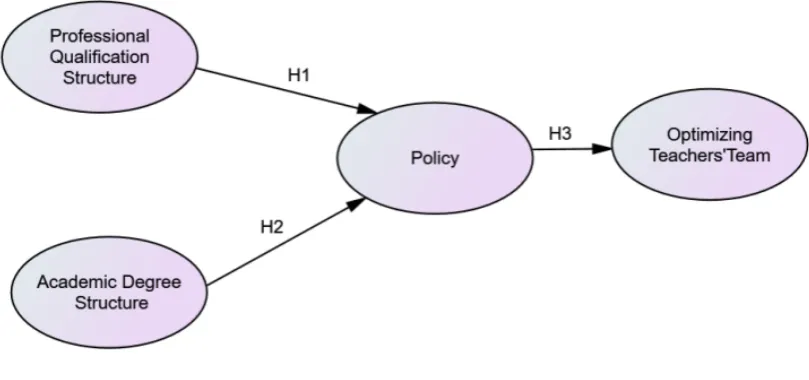
adjustment, but there are still many problems.This paper proposes the following three research hypotheses.Figure 1 shows the
ISSN 2250-3153
Figure 1: Conceptual framework
Hypothesis 1 (H1): The professional qualification structure has a significant positive impact on the policies of Guizhou
University.
Hypothesis 2 (H2): The degree structure has a significant positive impact on the policies of Guizhou University.
Hypothesis 3 (H3): The policy has a significant positive effect on optimizing the faculty.
This thesis takes the teachers of Guizhou University as a sample. This study uses a combination of questionnaires and interviews
to investigate the professional qualification structure and academic degree structure of the teachers in Guizhou University.254
individual questionnaires were distributed, 250 valid questionnaires were returned, and the effective questionnaire recovery rate
was 98.4%.The demographic characteristics of the respondents were descriptively analyzed using spss 21.0 and the reliability of
the study variables was analyzed.Use amos version 21.0 to test the hypothesis of this research development.
Data analysis and discovery
Based on the respondents' responses to the items in the questionnaire, Table 1 provides an average score for four areas:
professional qualification structure, degree structure, policy optimization, and optimization of the faculty.The scores in the
intervals [0-4], [4-4.5] and [4.5-5] indicate that the degree of recognition has low, medium and high levels, respectively.The
current situation of the construction of the faculty team is mainly reflected in two aspects: the professional qualification structure
ISSN 2250-3153
Table 1: Levels of Instructor Team Indicators
Mean standard deviation Level
Professional qualification
structure
4.549982 0.262639 high
Degree structure 4.387926 0.256662 medium
policy 4.587976 0.137224 high
Optimize the faculty 4.560306 0.471331 high
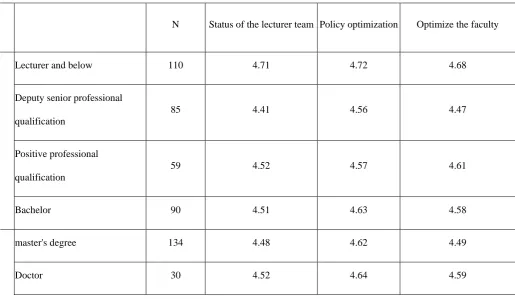
Table 2 shows the survey status of the faculty team, policy optimization, and the average score of the faculty team structure
[image:9.595.35.551.422.721.2]optimization with different professional qualifications and different levels of education.
Table 2: Average scores of respondents with different professional qualifications and different levels of education
N Status of the lecturer team Policy optimization Optimize the faculty
Lecturer and below 110 4.71 4.72 4.68
Deputy senior professional
qualification
85 4.41 4.56 4.47
Positive professional
qualification
59 4.52 4.57 4.61
Bachelor 90 4.51 4.63 4.58
master's degree 134 4.48 4.62 4.49
Doctor 30 4.52 4.64 4.59
ISSN 2250-3153
the information gathered from a particular set of data. However, before proceeding with EFA, two tests, namely,
Kaiser-Meyer-Olkin (KMO) and Bartlett’s Test of Sphericity, should be verified for checking the factorability of data (Pallant, 2007).
Tabachnick et al. (2001) have indicated that the value of the first test (KMO) ranges from 0 to 1, and for an appropriate analysis it
is essential to have at least a value of 0.6, and for the latter (Bartlett’s Test of Sphericity) it is essential to attain a significant
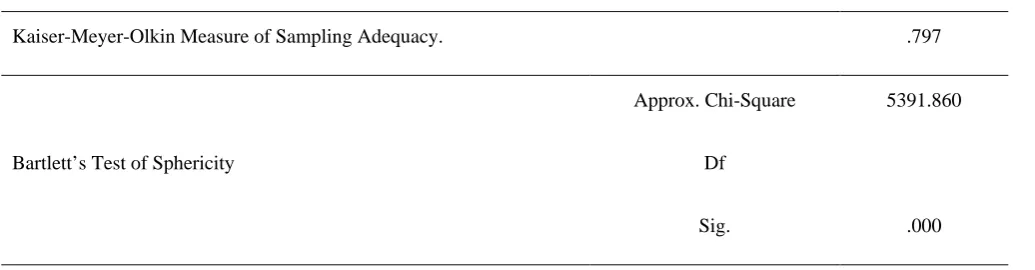
p-value (p < .05). After running both of these several tests through SPSS, it was observed that the results of both fell within the
acceptable range, indicating that the researcher can run EFA. The outcomes of the tests are shown below in Table 4. From EFA,
certain items have been derived, and all the items are considered to be significant as they managed to load with a value higher than
0.50, and any loading above this value is considered to be practically significant by Hair et al. (2009). It shows that the total
variance accounted for approximately 72.824% per cent, which is highly adequate. A higher variance is explained when eight
components are retained. Cronbach’s alpha has also been calculated for all the items of the four variables. It can be seen in Table
4, all items under each of the variables are reliable as they all have surpassed the minimum value of .60 suggested by Hair, Black,
[image:10.595.45.563.407.542.2]Babin, and Anderson (2010).
Table 3: Kaiser-Meyer-Olkin (KMO) & Bartlett’s test
Kaiser-Meyer-Olkin Measure of Sampling Adequacy. .797
Bartlett’s Test of Sphericity
Approx. Chi-Square 5391.860
Df
Sig. .000
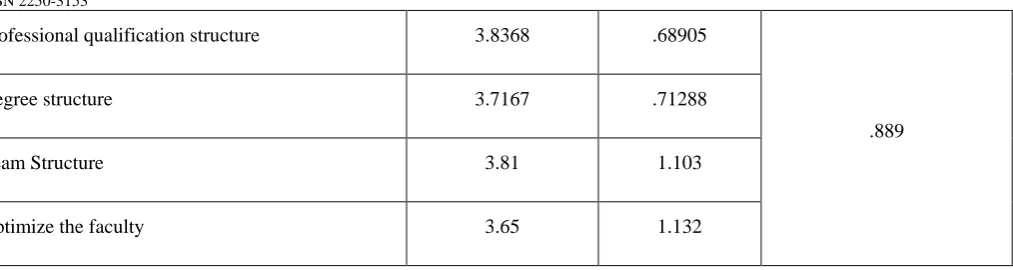
Descriptive statistics help to interpret data consequentially by summarizing the data set of the population or sample (Malhotra,
2011). To achieve the basic features of the data set, the following methods of descriptive statistics have been applied to the data of
this study.
Table 4: Descriptive Statistics and Reliability Measures
ISSN 2250-3153
Professional qualification structure 3.8368 .68905
.889
Degree structure 3.7167 .71288
Team Structure 3.81 1.103
Optimize the faculty 3.65 1.132
As can be seen from Table 4 above, the occupational structure, degree structure, team structure, optimization of the faculty, Team
Structure and norms and values have mean scores 3.84, 3.72, 3.81 and 3.65.As respective of the values drops below 4.0, a
corresponding value equivalent to agree on the five-point Likert scale, the concluding remark is that there is is need for some
consideration to increase satisfaction on these cultural factors. The standard deviation of the first six constructs indicates that the
responses on average were the same deviation of the first six constructs indicating that the responses on average were a small
below 1 point away from the mean. It reflects the fact that the mean of the sample more accurately portrays the mean of the actual
population. All of the constructs used in the study are reflective.
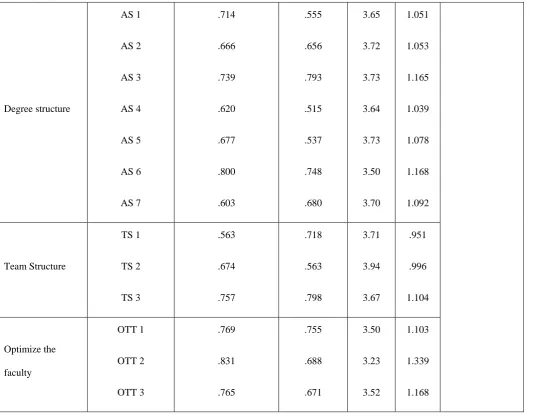
In an attempt to calculate measurement errors, each of the latent constructs was measured by multiple observed items (See Table
[image:11.595.46.553.56.191.2]5).
Table 5: Results of Reliability and Validity
Key Factors
(Constructs)
Sub-Factors (Item) Communalities
Factor
Loadings
Mean S.D Cronbach’s α
Professional
qualification
structure
PQS1
PQS2
PQS3
PQS4
.723
.739
.687
.623
.779
.763
.767
..514
3.39
3.56
3.67
3.93
1.059
1.270
1.180
.984
ISSN 2250-3153 Degree structure AS 1 AS 2 AS 3 AS 4 AS 5 AS 6 AS 7 .714 .666 .739 .620 .677 .800 .603 .555 .656 .793 .515 .537 .748 .680 3.65 3.72 3.73 3.64 3.73 3.50 3.70 1.051 1.053 1.165 1.039 1.078 1.168 1.092 Team Structure TS 1 TS 2 TS 3 .563 .674 .757 .718 .563 .798 3.71 3.94 3.67 .951 .996 1.104 Optimize the faculty OTT 1 OTT 2 OTT 3 .769 .831 .765 .755 .688 .671 3.50 3.23 3.52 1.103 1.339 1.168
This study adopted a two-step technique of model through SME analysis recommended by Anderson and Gerbing, (1988). In this
technique, data was analyzed initially through factor analysis, which provides an assessment of measurement reliability,
convergent and discriminant validity. Then, the structural equation model was conducted to test the model fit and to understand
the hypothesized relationships. Before the model test, the correlation matrix for all constructs of the proposed model was
[image:12.595.32.569.59.479.2]examined. The results of and correlations among the variables are shown in Table 6.
Table 6: Summary of Correlations among Constructs
ISSN 2250-3153
Professional
qualification
structure
Academic
structure
Team Structure Optimize the faculty
Professional qualification
structure
Academic structure
Team structure
Optimize the faculty
1
.692**
.680**
.474**
.621**
1
.626**
.577**
.735**
1
.305**
.525**
1
.664**
** Correlation is significant at the 0.01 level (2-tailed)
The correlations indicate indicated that the scales are empirically distinct from each other. The correlation matrix indicates that are
positive correlations among all of the study variables. Pearson Correlations co-efficient is 0.689 between professional
qualification structure and academic structure, which indicates a positive moderately high linear relationship and this relationship
exists at the significant level of 0.01. The correlations co-efficient between professional qualification structure and team structure,
, team Structural and academic structure, as well as team structure, are 0.790, 0.636 and 0.745 respectively which indicate there is
that moderate relationship among them. These relationships are also significant at 0.01 level. Relationships between other
constructs are also significant at 0.01 level.
Assessing Reliability and Validity
The estimates of structural relationships can be biased unless the measurement instrument is reliable and valid. Therefore,
reliability and validity should be measured to make this study authentic. Reliability of each construct has been assessed through a
degree of internal consistency. This analysis was conducted before other analyses. For data to be considered reliable, the value of
its Cronbach’s alpha should be >0.7 (Nunnally, 1978). The reliability analysis of this paper sample produced a Cronbach’s alpha
of 0.903 (Table 5), meaning that all items used in the questionnaire were reliable.
Next, the construct validity was calculated by the factor analysis. Where the Principle Component Analysis with Varimax rotation
ISSN 2250-3153
is assumed that variables are loaded onto factors. Convergent validity means that the variables within a single factor are highly
correlated. This is evident by the factor loadings in Table 5.
Communality means the extent to which an item correlates with all other items that indicate higher communalities are better. If
communalities for a particular variable is low (between 0 - .4), then that variable may struggle to lead significantly on any factor.
So, the values of communalities are more than 0.5 estimates that all items have a pretty good quality of influence in all.
Discriminant validity refers to the extent to which factors are distinct and uncorrelated. To meet the discriminant validity, the
variable should relate more strongly to their factor than to another factor. Two primary methods help to determine discriminant
validity. The first method is to examine the rotated component matrix. Variables should load significantly only on one factor. The
rest of the items were, and the discriminant validity is assumed.
Another method for validity testing is to examine the factor correlation matrix and correlations between the key strategic factors
which should not exceed 0.8 (Kenneth, 1988). Thus, in this method, Table 6 presented that all of the correlation values between
factors are below 0.8, which provide support to the discriminant validity. Overall, according to the evidence of reliability,
convergent validity and discriminant validity, the measurement model was believed to be appropriate.
Hypothesis Testing
After the model was found to be acceptable by examining the model fit indices, the proposed hypotheses were tested using
Structural Equation Modeling (SEM) technique with Maximum Likelihood Estimation. Within the overall model, the estimates of
the structural coefficients provide the basis for testing the proposed hypotheses. Hypotheses are tested by examining the
significance level, direction and magnitude of the standardized estimates of paths that link independent variables with the
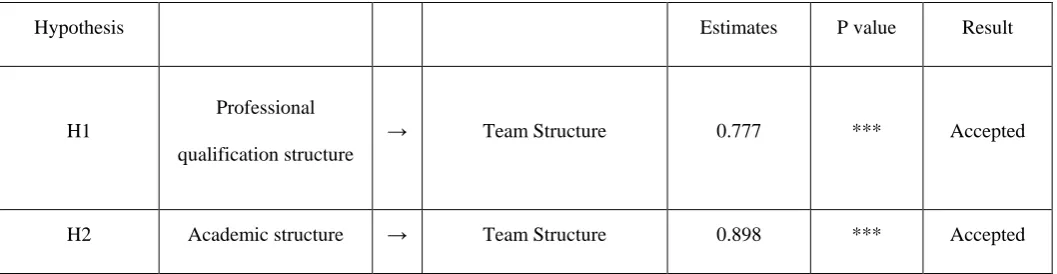
[image:14.595.31.560.618.755.2]dependent variable. The summarized results are presented in Table 7.
Table 7: Results of Path Analysis
Hypothesis Estimates P value Result
H1
Professional
qualification structure
→ Team Structure 0.777 *** Accepted
ISSN 2250-3153
H3 Team Structure → Optimize the faculty 0.714 *** Accepted
Source: AMOS output by analyzing primary data
The result shows that the estimated value for the qualification structure in the prediction of Team Structure is 0.777 and p-value is
less than 0.01. This indicates a positive relationship found between the professional qualification structure and Team Structure.
The p-value is .000, Which means this relationship is significant at a level of .01 (Table 7). The result presents that, the estimated
value for one of cultural factor which is educational structure and Team Structure is 0.898 and p-value is less than 0.01. There is a
significant relationship found between the structure and the Team Structure. The p-value is .000, which means this relationship is
significant at a level of .01 (Table 7). The result shows that the estimated value for Team Structure in the The meaning of the
optimization faculty is .714 and p-value is less than .01. This means there is a positive relationship found between Team Structure
and optimization faculty. The p-value is .000, which means this relationship is significant at a Level of .01 (Table 7). TheThe
hypothesized relationships between exogenous and endogenous variables are significant at .01 level. The directional relationships
between them are statistically established (Table 7). So, H1, H2, and H3 hypotheses are accepted at .01 levels. All hypotheses are
established through this study .
Therefore, H1, H2, H3 are accepted at a significance level of p > 0.000 of 0.5.The study shows that this policy (POL) has a
positive impact on the optimization of the faculty (OTT).
V. DISCUSSION AND CONCLUSION
By referring to the professional qualification structure, degree structure and policy optimization revealed in the current research,
and optimizing the relationship between the faculty, it can be concluded that the faculty structure of Guizhou University needs to
be further optimized.To optimize the structure of the teaching staff of Guizhou University, it is necessary to prescribe the right
medicine and choose effective measures.The level of faculty construction not only requires Guizhou University to introduce
policies that are conducive to the construction of faculty, but also requires the government to give policy support to the faculty of
the university.
Improve the professional qualification review system and optimize the professional qualification structure.There are many factors
that affect the irrational structure of the professional qualifications of college teachers. The unreasonable vocational qualification
review system is an important aspect, so this situation should be changed as soon as possible.First of all, to change the previous
ISSN 2250-3153
change the method of assessing the professional qualifications of the scientific research and the scientific research.Therefore, in
the process of teacher professional qualification assessment, the ability and contribution of teachers should be evaluated mainly
from the aspect of teaching, that is, the standard of vocational qualifications should be based on teaching, taking into account
scientific research and social services.Again, emphasis on teacher business training, skills training and business assistance.The
promotion of professional qualifications is based on ability. Without the promotion of ability, there is no promotion of
professional qualifications.
Improve academic standards, strengthen academic qualifications, and optimize academic structure.First of all, moderately improve
the academic qualifications for the qualifications of college teachers. By adjusting or formulating relevant policies, it is stipulated
that in the future, hiring teachers must first have a master's degree or above, and gradually improve the overall level of the
teaching staff by improving the qualifications of professional qualifications.Secondly, university administrators should vigorously
tap potential resources, scientifically allocate existing resources, and should be inclined to the construction of teachers in the use
of funds. Attract and recruit more doctoral students by improving the treatment of teachers, changing management methods, and
creating a good atmosphere. Health.Once again, increase the academic qualifications of in-service teachers.At present, the
proportion of teachers with only master's degree or below is still relatively large. To optimize the academic qualification structure
of the teaching staff, in addition to vigorously recruiting highly educated teachers, another way out is to select or encourage
teachers to pursue doctoral degrees and gradually increase teachers. The proportion of highly educated teachers in the team.
The government has appropriately raised the relevant policies for professional qualifications and higher education standards, and
strictly established the minimum academic qualifications for the promotion of professional qualifications for professors and
deputy teachers.The government adjusts the administrative orientation of over-administration, transforms micro-management into
macro-management, actively guides and urges colleges and universities to adjust the structure of teachers' teams independently
from the macro level; the university adjusts the administrative orientation of over-administration, respects the academic
development rules and academic professional characteristics, and adopts science. Reasonable measures to optimize the structure
of the teaching staff.Second, the government and universities should adjust the development orientation of higher education with
emphasis on scale expansion and light structure adjustment.The government scientifically formulates macroeconomic policies to
guide colleges and universities to attach importance to and adjust the structure of the teaching staff. By tapping potential resources
and integrating existing forces, universities adjust the matching relationship of elements, promote academic exchanges among
teachers, and optimize the structure of teachers.Strengthen the rational regulation and control of the government, and guide the
university to adjust and optimize the structure of the teaching staff through scientifically formulating and strictly implementing
ISSN 2250-3153
exchange and cooperate, and provided more opportunities for teachers to study abroad, visits, and academic cooperation.The
university itself increased special funds and vigorously introduced various high-level talents that are conducive to adjusting the
structure of the original teachers.In short, sufficient school funding is an important basis for optimizing the structure of local
undergraduate college teachers.
REFERENCE
[1] Nunnally, J.C., (1978). Psychometric Theory, McGraw-Hill, New York, NY.
[2] Anderson, J. C., & Gerbing, D. W. (1982). Some methods for specifying measurement models to obtain one-dimensional construct measurement. Journal of Marketing Research, 19, 453-390
[3] Steiger, J.H. (1990). Structural model evaluation and modification, Multivariate Behavioral Research, 25, 214-12.
[4] Oliver, R. L., 1993. Cognitive, Affective, and Attribute Bases of the Satisfaction Response. Journal of Consumer Research, Volume 20, pp. 418-430. [5] Anderson, E. (1996), “Customer satisfaction and price tolerance”, Marketing Letters, 7(3), 265-274
[6] McDonald, R.P. and Ho, M.-H.R. (2002). Principles and Practice in Reporting Statistical Equation Analyses, Psychological Methods, 7 (1), 64-82. [7] ]Miles, J. and Shevlin, M. (2007). A time and a place for incremental fit indices, Personality and Individual Differences, 42 (5), 869-74. [8] Malhotra, N. K. (2011), Basic marketing research, Pearson Higher Ed.
[9] Tabachnick, B.G. and Fidell, L.S. (2007), Using Multivariate Statistics (5th Ed.). New York: Allyn and Bacon.
[10] Jinquan(2009), Research on the policy factors of the construction of teaching staff in higher vocational colleges. Science and Education Wenhui, (36), 7-8. [11] Chen Jie (2011), Research on talent introduction mechanism based on the optimization of college teachers' structure, Journal of Changchun Education
Institute, (29), 85-86
[12] Zhang Jinwei. (2013). The German vocational education has implications for the construction of higher vocational education teachers in China (Doctoral dissertation).
[13] Li Jieling. (2014) An Empirical Study on the Structure Optimization of Local College Teachers' Teams 1,Theory and Practice of Contemporary Education, (6), 104
[14] Zhang Xiaoxu. (2014). Research on the construction and optimization of local college teachers. Journal of National Academy of Education Administration, 4, 38-42.
[15] Zhang Yingqiang, & Jiang Hualin. (2014). Reflections on Some Issues Concerning the Transformation and Development of Local Undergraduate Universities. Modern University Education, 6(1), 8.
[16] Hou Changlin, Luo Jing, Ye Dan, (2015). The choice of new undergraduate colleges from the perspective of applied universities [j]. Educational Research, (4): 61-69.
[17] &Wang Weiying(2015). Research on the construction of "double-skilled" faculty in the University of Applied Technology. Education and Vocation, (29), 63-65.
[18] Hou Changlin, Luo Jing, & Ye Dan. (2015). The choice of new undergraduate colleges and universities under the perspective of applied universities [j]. Educational Research, (4): 61-69.
[19] Han Fubin. (2016). Discussion on the construction of teachers in the transformation of local undergraduate colleges.Vocational education forum,(2),61-62 [20] Zhong Binglin, & Wang Xinfeng. (2016). Analysis of Some Hot Issues in the Transformation of Local General Undergraduate Colleges in China.
Educational Research, 37(4), 4-11.
[21] Yao Xu. (2016). Research on the construction of faculty in new undergraduate colleges under the background of transformation. Education Exploration, (5), 80-82.
[22] Gao Xuechun,Hou Changlin.Study on the discipline construction strategy of teaching service universities under the perspective of swot analysis method[J].Chinese Adult Education,2016(22):7-11.
[23] Luo Wen-wen ZhaO Bao-yun(2017),Research on Construction of Teaching Staff in the Process of Local Universities' Transformation to Applied Technology Universities,jiaoyu jiaoxue luntan,(10),22-24.
[24] Yan Xiaolei, Wang Zhifei (2017). Research on the feasibility of the construction of the teaching staff of the Open University [j], Tianjin TV University Journal, 21(4): 1-3
[25] Ge Linbo(2017),Journal of Beijing Institute of Graphic Communication,On Transformation of Teaching Faculty in Application- oriented University —— Based on Newly-built Provincial University,(5),87-89.
[26] QIU Hui(2018).On Construction of Teacher Staff in Local Universities in Transitional Duration.Heilongjiang Higher Education Research,(2),104-106. [27] Jing Hongwen, Wang Yingchao, Wei Liyuan (2018), Exploration and Practice of the Construction of Teaching Staff in Colleges and Universities from an
International Perspective, Coal Higher Education, (36), 49-53.
[28] Du Fangfang, Xu Chao, Song Bingbin (2018), Reflections on the Construction of Teaching Staff in Colleges and Universities in Jiangxi Province, Rural and Economic Science and Technology, (29), 284-286.
AUTHORS
ISSN 2250-3153
E-mail:[email protected]
Second Author –Dr Foong Chee Haur,He has earned a PhD Degree from Management and Science University Malaysia (MSU). His Doctoral research was related to marketing , advertising practice and Malaysian online business. Also, he has published numerous articles in international refereed journals in the area of marketing, online businesses and management etc. Moreover, he
has several years of teaching experience in various subjects related to marketing, international business, management, organisational behaviour. He also has extensive experience with the corporate environment and consulting practice.
E-mail:[email protected]
Third Author –Dr S.M. Ferdous Azam,He has earned a PhD Degree from International Islamic University Malaysia (IIUM), who is currently working in Management and Science University (MSU) Malaysia. His Doctoral research was related to financial
economics, management practice and Malaysian small and medium enterprises (SMEs). Also, he has presented his research works in many international conferences, as well as published numerous articles in international refereed journals in the area of finance,
economics, marketing, businesses and management, small and medium enterprises, e-commerce, education etc. Moreover, he has several years of teaching experience in various subjects related to the finance, economics, management and research methodology in three different universities.
E-mail:Dr. S. M . Ferdous Azam