Effects of Women Involvement in Decision Making On
the Performance of County: A Case Study of Kiambu
County
Isaac Gitangu Kamau*, Dr. Kepha Andrew Ombui**
*
Msc. Student: Department of Entrepreneurship, Technology, Leadership and Management; Jomo Kenyatta University of Science and Technology: Nairobi, Kenya.
**
Adjunct Lecturer: Department of Entrepreneurship, Technology, Leadership and Management; Jomo Kenyatta University of Science and Technology: Nairobi, Kenya.
Abstract- The main aim of the study was to establish the effects of women involvement in decision making on the performance of county: a case of Kiambu county. The study was guided by three specific objectives which included to identify vocational training opportunities for women that will enable them to attain leadership positions, to identify knowledge gaps in women to enable them participate in running the affairs of Kiambu county and to enact relevant policies that would accelerate implementation of agreed global and regional committees of Gender Equality and Women Empowerment (GEWE) in Kiambu county. The study sought to bridge the existing knowledge gap on the effects of women involvement in decision making on the performance of county. Simple random sampling technique was used whereby subjects were selected from the population. Out of a total population of 50,000, a sample size of 400 respondents was selected for the purpose of the study. Questionnaires were used to collect primary data while the secondary data was collected through review of published documents and text books. The presentation of data was through pie charts. The findings from the study indicate that level of education, position in management, advocacy for women leaders, current leadership and marginalization of women leaders affects the participation of women in leadership affairs of their county.
Index Terms- Women leadership, marginalization, women empowerment
I. INTRODUCTION
omen play a major role in the social economic stability of the society. Socially women play reproductive roles and they are also care givers for the members of the society homeless, disabled and disadvantaged. Economically they take care of family and country assets and they form a majority of the labor supply in firms and small businesses. However women are not significantly noted in the decision making on the matters of development of the country. Like for example in Kiambu county has only two members of parliament out of twelve. In the view of very many people that I researched from the two honorable members in the two constituencies are doing exemporally well in carrying on development agenda than their male counterpart e.g.
they are very keen in the way they implement national agenda on social, political and economic development.
For example there has been a lot of improvement of maternity facilities in the two constituencies and other health facilities. There is free access to maternity health care in the two constituencies. In the issuance of bursary funds, we have noted a great increase in the two areas than those headed by men. In conclusion, if how women access decision making in development there is high likely hood for sustainable development. All barriers must be broken to allow women to be involved in the decision making.
Statement of the problem
The need for proposed study, on the influence/effects of women involves in the performance of county is very crucial study. This gives the data in how well women are getting involved in the performance of developing the economy of Kiambu county. Women are highly skilled and experienced people in many fields. They are highly aggressive and therefore they are supposed to be equipped through trainings so that they can be able to make good decisions during the strategic formulation in capacity building. The removal of traditional exercise of official authority by women in an organizational structure (Green 1993; Wolfe 2003) second is its message of social change and social renewal, important elements of which are directed towards male behavior that may be damaging women (Brusco, 1993; Gill, 1990; Mashalls, 1993).
In terms of personal development of individuals, it’s important for the governments in county to come up with policies that elevate the position of women in seeking political power, participation in leadership decision making and involvement in development initiatives. In Africa as a continent, Malawi has had a female president; Joyce Banda; in Liberia Her Excellency Helen Johnson in whose tenure a lot of development has been experienced in the two countries. In Kenya for example, two major universities in our country Jomo Kenyatta University of Agriculture and Technology (JKUAT) and Kenyatta University have recently reported very high levels of development in technology and academic having being led by the female Vice Chancellors.
Objectives of the study
The general objective of the study was to establish the effects of women involvement in decision making on the performance of county governments. A case of Kiambu county.
Specific Objectives
i. To identify vocational training opportunities for women that will enable them to attain leadership positions in Kiambu county.
ii. To identify knowledge gaps in women to enable them participate in running the affairs of Kiambu county. iii. To enact relevant policies that would accelerate
implementation of agreed global and regional committees to spearhead Gender Equality and Women Empowerment (GEWE) in Kiambu county.
Research Questions
i. Which training opportunities are required to empower women in leadership activities in Kiambu county? ii. What knowledge or skills gaps exist that prevent women
from participating in leadership activities in Kiambu county?
iii. Which policies that require to be enacted to empower women to leadership positions in Kiambu county?
II. RESEARCH METHODOLOGY
This was a descriptive study which focused on use of focused group discussions, interviews and questionnaires. According to Kothari (2004), a population is a well-defined set of people, service, elements, events and group of things or households that are being investigated. The target population in this study is the members of the public residing in Kiambu county, estimated at 50,000. A sample of 400 was selected.
Respondents were both men and women in leadership and normal civilians.
The study used primary data which was collected from respondents via structured and unstructured questionnaire. The questionnaire was dropped and picked from the respondents. A total of 400 questionnaires were randomly issued whereby 320 questionnaires were filled and returned. Collected data was edited for completeness and consistency and later analyzed using Statistical Package for Social Sciences (SPSS). The data was presented using descriptive statistics i.e. percentages, pie charts and tables.
III. RESEARCH FINDINGS AND DISCUSSION
The study sought to establish the effects of effects of women involvement in decision making on the performance of county a case study of Kiambu county. Descriptive and inferential statistics such as Pearson correlation and Multiple Regression computations have been used to interpret and present the findings of the study. The questionnaires were edited and cleaned for completeness and consistency. They were keyed into the SPSS for analysis and findings were presented in tables and graphs
Response rate
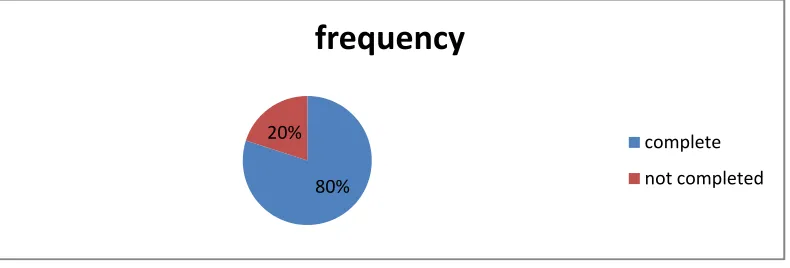
[image:2.612.111.506.465.599.2]The study targeted about 400 men and women in the county government of Kiambu county. A total of 320 questionnaires were completed and returned representing a response rate of 80% as shown in the pie chart below. Both Mugenda and Mugenda (2003) and Bailey (2000), acertain that a 50% response rate is adequate, 60% is good, while above 70% is very good. This implies that based on this assertion, the response rate in our case is therefore very good. This therefore provides adequate data for conclusive analysis.
Figure 1: Response Rate
Demographic Information
From the study findings, 35% of the respondents were comprised of males while 65% comprised of females. Since the study concerned women, more women wanted to participate in the study.
Age of Respondent
The study established that respondents were between the ages of 30-40 year (49%) while the least percentage was of those of above 55 years (6%) as shown in figure 2 below.
80% 20%
frequency
Figure 2: Age of respondents
Level of Education
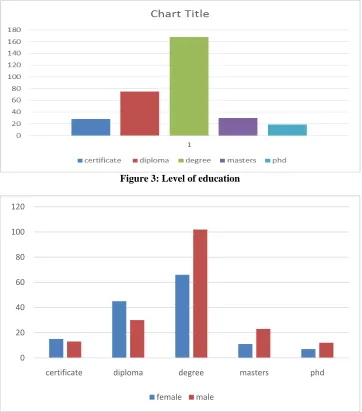
[image:3.612.126.488.299.711.2]The target population comprised of people in different responsibilities and qualifications. As shown in figure 3 below.
Figure 3: Level of education
Figure 4: Highest of education by gender
14%
49% 31%
6%
20-30 years 30-40 years 40-50 years 55 years+
0 20 40 60 80 100 120
certificate diploma degree masters phd
From the above figures, most of the respondents have attained some degree program of which the number of males who have degrees is higher than the number of women. It is important to note that most of the females have only done certificate (53%) and diploma (60%) whereas most men have done degrees (60%), masters (76%) and PhD (63%). This indicates that educating the girl child has not been put into practice in the county
Current Designation
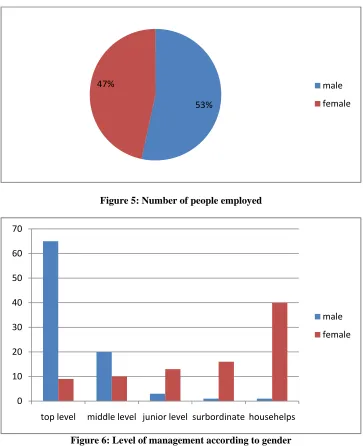
[image:4.612.125.488.189.635.2]The study also sought to know where the respondents worked i.e. if they were employed or not and at which leve1 i.e. top level management, middle level, junior level, subordinates house helps/wives, houseboys. From the illustration in figure 7 it is clear that a higher percentage of males are employed (53%) as compared to the number of female (47%). Also it is important to note that a greater number of the males employed are in top level management and most of the females wok as housewives (figure 6). This clearly shows that most of the firms do not employ women may be due to the level of education they have acquired as seen in figure 5 below.
Figure 5: Number of people employed
Figure 6: Level of management according to gender
Marginalization of Women
The study sought to enquire from the respondents if they thought that women in the county were marginalized. As per findings below, most respondents strongly agreed that women were marginalized in the county.
53%
47% male
female
0 10 20 30 40 50 60 70
top level middle level junior level surbordinate househelps
Figure 7: Women marginalization in the county
Factors that have led to marginalization
The study also sought to know what factors have led to the level of marginalization
Figure 8: Factors that have led to women marginalization in the county
We realized that women are marginalized greatly due to cultural norm of the society, followed by the domination of men in leadership then the responsibility women play in the society and the level of education and finally fear. This indicates that the county still follow traditional norms and culture that women are not supposed to be in leadership, their work is to take care of the family,
Women Leadership
The study also sought to know if the respondents would be comfortable with a woman in leadership in the country, county or any other recognizable area. As illustrated in the chart below, many respondents would be comfortable with a woman in leadership. This shows that given the chance, a woman can gain popularity as a leader.
YES NO
Series1 287 33
0 50 100 150 200 250 300 350
Ax
is
T
itl
e
0 10 20 30 40 50 60 70
[image:5.612.98.517.338.581.2]Figure 9: Woman leadership
Effectiveness of a woman's leadership
[image:6.612.123.492.55.257.2]In addition, the study wanted to know from the respondents if a woman leader can be effective where they were to say yes or no.
Figure 10: Effectiveness of a woman's leadership
Many responded (75%) believed that given the chance woman’s leadership can be more effective than the current men's leadership.
Changes in women leadership
The respondents were also requires to state if they thought a woman can bring about many changes and if they can make good leaders. They were to respond if they agreed or not agreed. 66% of the respondents believed that a woman leader would bring about great changes in the county and that it would be good to have a leader who is a woman in the county. This is clearly illustrated in the figure below (figure 11).
54% 26%
14% 6%
stongly agree agree disagree
strongly disagree
75% 25%
Figure 11: Changes in woman leadership
Advocacy for a Woman Leader
[image:7.612.92.521.59.251.2]The study also wanted to know if the respondents would advocate for a woman leader in the county. As illustrated in the figure below 82% of the respondents would advocate for women leadership in the county. This shows that the respondents are confident in the leadership of a woman.
Figure 12: Advocacy for a woman leader
Woman Senator, Governor in the county
The study wanted to enquire if they would elect a woman to be a senator or a governor in the county during an election. stongly agree
66% agree
15% disagree
12%
strongly disagree 7%
82% 18%
Figure 13: electing a woman leader
85% of the respondents would elect a woman as a governor or senator. One of the respondent even said that the current leadership composed of men has not done much in the county and would like to give woman a chance to lead to the county since being a mother she would be "the mother of the county".
Own Leadership as a Woman
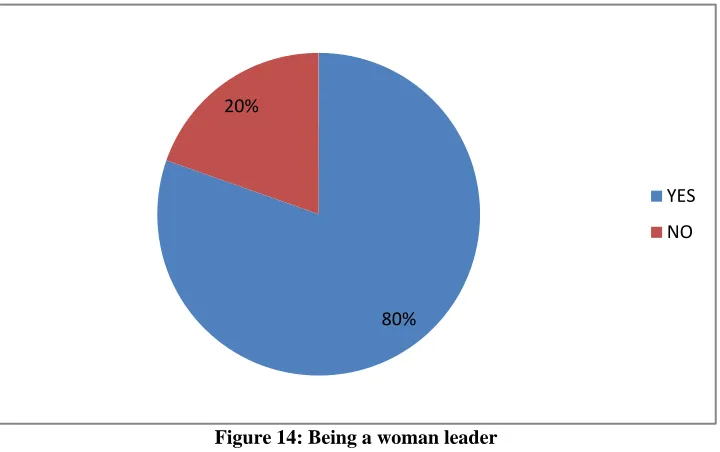
The study sought to know if the respondents would want to be leaders as women or for the males they would want their wives, mothers or sisters to be leaders in the county. 80% of the respondents would want to be leaders as women and men would like for their wives, mothers and sisters to be leaders. The 20% said that due to the current politicians who are being assassinated, they wouldn't want to be leaders, they actually stated that they would leave it to men since men are capable of instilling fear. This showed that some fear leadership because of the safety of their lives.
Figure 14: Being a woman leader
Current Leadership in the County
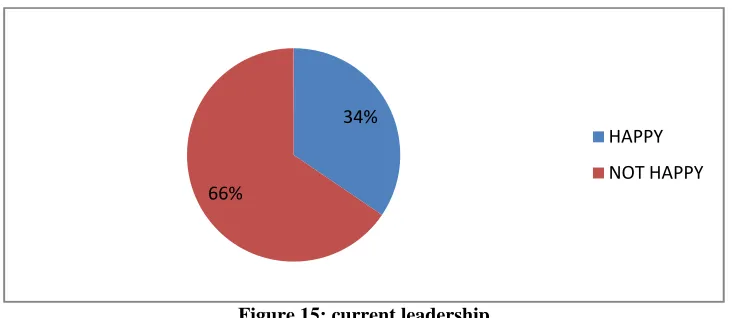
The study also sought to know if the respondents were happy with the current leadership of the county being dominated by men. They were to say if they are happy or not. As shown in the figure below, 66% of the respondents were not happy with the current leadership. Some even indicated that they would not vote for the leaders again come the next election. They said that they would like a change in leadership and that this change would be brought about by a woman becoming a leader.
85% 15%
YES NO
80% 20%
[image:8.612.128.488.422.648.2]Figure 15: current leadership
In conclusion, it is evident that many of the respondents are confident with women's leadership and they would elect a woman leader. However since many of the women have a low level of education they may not get the chance to venture into leadership. Also many of them fear to be in leadership as earlier explained
IV. CONCLUSION AND RECOMMENDATIONS
The study examined how the county felt of the current leadership being dominated by men and how they think the county would be if it was led by a woman leader. It also analysed why women are marginalised in the county and the factors that have led to this marginalisation and if they would advocate for women leadership in the county and the country as a whole. This study gave a very clear and elaborate summary concerning the issues surrounding women leadership in the county. Majority of the responses were obtained from the female respondents. From the study 35% of the respondents were comprised of male respondents while 65% comprised of female respondents. Since the study concerned women, more women wanted to participate in the study.
A great percentage of respondents were between the ages of 30-40 year (49%) while the least percentage was of those of above 55 years (6%). The target population comprised of people in different responsibilities and qualification. The difference might contribute to differences in the responses given by the respondents. Most of the people of gone through the degree program of which the number of males who have done degree is higher than the number of women. It is important to note that most of the females have only done certificate (53%) and diploma (60%) whereas most men have done degrees (60%), masters (76%) and PhD (63%). This indicates that educating the girl child has not been put into practice in the county. A higher percentage of males are employed (53%) as compared to the number of female (47%). Also it is important to note that a greater number of the males employed are in top level management and most of the female’s wok as housewives. This clearly shows that most of the firms do not employ women may be due to the level of education they have acquired.
In the county the respondents strongly agreed that women are marginalized. We realized that women are marginalized greatly due to cultural norm of the society, followed by the
play in the society and the level of education and finally fear. This indicates that the county still follow traditional norms and culture that women are not supposed to be in leadership, their work is to take care of the family. Many respondents would be comfortable with a woman in leadership. This shows that given the chance a woman can gain popularity as a leader. Many responded (75%) believed that given the chance woman’s leadership can be more effective than the current men's leadership. 66% of the respondents believed that a woman leader would bring about great changes in the county and that it would be good to have a leader who is a woman in the county. 82% of the respondents would advocate for women leadership in the county. This shows that the respondents are confident in the leadership of a woman. 85% of the respondents would elect a woman as a governor or senator. One of the respondent even said that the current leadership composed of men has not done much in the county and would like to give woman a chance to lead to the county since being a mother she would be "the mother of the county". 80% of the respondents would want to be leaders as women and men would like for their wives, mothers and sisters to be leaders. The 20% said that due to the current politicians who are being assassinated, they wouldn't want to be leaders; they actually stated that they would leave it to men since men are capable of instilling fear. This showed that some fear leadership because of the safety of their lives. 66% of the respondents were not happy with the current leadership. Some even indicated that they would not vote for the leaders again come the next election. They said that they would like a change in leadership and that this change would be brought about by a woman becoming a leader.
V. CONCLUSION
Women participation in development contributes more to the socio-economic and political life of not only their own but also their families, neighbors, community and the society as a whole. Development, both in urban and rural areas of the country provide sufficient space for the empowerment of women are comparatively in better position in matters like group quality, bank-linkage scheme and Income generating activities. The wise exploitation and utilization of the opportunities provided by county enabled them to become empowered women to a great extent. However, beyond the so called women empowerment, 34%
66%
there are some bitter experiences which prompt the members to think more and give a new dimension for women empowerment. Any attempt to improve the status of women should start with ‘empowerment’. Empowerment implies the creation of an enabling environment where individuals can fully use their capabilities to take charge of their lives. The purpose of empowerment is to free someone from rigorous control and to give them freedom to take responsibilities for their own ideas and actions and to release the hidden resources which would otherwise remain inaccessible. Women empowerment process is one in which women find time and space of their own and begin to re-examine their lives critically and collectively. It enables women to look at old problems in new ways, analyze their environment and situation, recognize their strength and potentials, alter their self-image, access new kinds of information and knowledge, acquire new skills and initiate action aimed at gaining greater control over resources of various forms. When women are empowered, a society with stability is assured. The Kenyan experience of women’s influence on the content and implementation of a constitutional reform process shows how such moments of formal legal change are a unique window of opportunity in this regard. Of course, what how that influence takes place varies in terms of women’s access to such processes (formal or informal), and the specific trajectories and experiences of advocacy, networking and lobbying and social mobilization. Whether women have a formal seat at the table, in terms of direct access to constituent assemblies, or whether they engage through other forums and arenas or networks where decisions are being made and agreements negotiated, there is no doubt that constitutional reform processes constitute an important site for shaping institutional change and contesting gender norms.
Law is a political instrument, and a powerful site for political contestation that can contribute to transformative change. It is notable, therefore, that it has not been a prominent feature of the development agenda. Moreover, to the extent that legal and constitutional change has been supported, there is often an assumption that it is a technical process. What this study shows, as does a growing body of work on the politics of legal change, is that we need to ‘depoliticize’ our understanding of legal change. The technical is political, and in practice this is often undervalued. Normative content matters. This is made evident precisely because it inspires so much political resistance. This is true of constitutional reform which after all, it defines the formal rules of political, social and economic engagement. In addition to supporting struggles over normative content for the women’s rights and gender equality agenda, it is important to invest in the institutional and organizational capabilities of the relevant mechanisms of oversight and implementation. The watchdog functions of these bodies can under certain political, organizational and capabilities-based conditions contribute to activating the accountability functions that can help protect or advance normative gains. Thus, there has been a tendency to trivialize legal change, especially where politics and decision-making normally takes place through informal channels, institutions and relationships. Yet legal and constitutional change processes are politically charged precisely because they can activate changes in incentive structures and
idealize the transformative potential of legal and constitutional change for at least two important reasons.
First, formal written norms co-exist everywhere with informal norms, relationships and practices. Exchanges of power and resources happen at the intersection between the formal and the informal. Women activists (as with all political brokers) are effective precisely when and because they are able to navigate formal and informal institutions, practices and relationships, through politically savvy engagement that straddles these different sites of exchange and decision-making. There is a need for more research on what this looks like, drawing on an emerging body of work in feminist institutional analysis. The challenges with such research, as demonstrated in this study, are that, by their very nature, informal processes are not documented and some incidents are so nuanced that the actors may not have total clarity on what finally worked best.
Second, in contexts such as Kenya, where legal pluralism is an important feature of the political and social landscape, there is all the more need to temper our enthusiasm for how much formal change can translate into meaningfully transforming the multiple levels of norms, belief systems and practices. At the same time, it is crucial that constitutional reform – as a window of opportunity – be seen as one milestone in a longer process of political and institutional change. At one level, it helps sediment longer-standing efforts (such as the earlier legal and legislative gains by Kenyan gender activists) and thus is the outcome of a longer-term process of political mobilization and institutional change efforts by women’s movements. At the same time, to the extent that it advances, it can galvanize new momentum in contesting and challenging the terms of the political settlement in the degree to which it leads to a new set of rules on politics and development.
In this regard, the transformative impact and sustainability of constitutional reforms are - like all progressive agendas – inevitably hostage to wider political economy conditions. Resistance and backlash take many forms. Typically, elite actors will aim to subvert or ignore rule changes that undermine their interests. Progressive gender gains will also be hostage to the
real nature of the ruling elite bargain. Of interest in the Kenyan context is that the political settlement is relatively ‘unsettled’. This in itself creates opportunities for change and contestation that women’s groups and political activists have used effectively Waylen (2014) and Mackay and Waylen (2009) are examples of important new scholarship generating analytical and theoretical insights on how institutional and political change happens, drawing on feminist theory and a gendered analysis of institutional development to create new space and political openings for women’s rights and access to political and economic power.
constitutional commissions and independent bodies cannot be of the same gender has ensured the presence of women in the growing body of checks and balances and accountability measure and bodies tasked with guarding the normative content of the Constitution. In the courts, for instance, this is important as it could enhance the prospects for jurisprudence that protects newly expanded women’s rights.
Fourth, important normative gains on women’s rights also constitute an important achievement. Institutional change of the scale advanced by the Kenyan constitutional reform process in support of gender equality and women’s rights would not have been possible without the presence of a mature, if diverse, women’s social movement and feminist political activists, who effectively navigated formal politics, social mobilization and the range of national and sub national informal forums of political bargaining, advocacy and awareness-raising. Finally, it is important to recognize the value of the technical knowledge and expertise of women activists in a range of specialist organizations and think tanks, and the support and presence of feminist academics across a range of disciplines. This contributed to the development of a Kenyan feminist agenda – notwithstanding the fact of important cleavages and divisions among women relating to class, regional, ethnicity-based and religious identities and political and ideological preferences and allegiances.
VI. RECOMMENDATIONS
Continue to invest in women’s movements. This includes organizational and logistical support to facilitate cross-country networking, consolidation of experience, knowledge and lessons learned, and providing opportunities for the development of political apprenticeship acquired in different spaces of social mobilization and political activism. Areas of support involve working across diverse issue and sectoral domains, at the national and sub-national levels to facilitate space for women’s participation, voice and the development of different associative capabilities and political skills in order to consolidate gains achieved and remain active in pushing the boundaries for change across different women’s rights and gender equality issues (on reproductive health, access to land, legal expertise on law reform and rights protection). Support can also aim to facilitate creative exchange between older women’s movements and younger generations of feminist activism in to allow for knowledge transfer and exposure to historical trajectories of political contestation, experiences of backlash and lessons on political strategy – including in support of activism in formal political life and political party engagement.
Support accountability, oversight and constitutional implementation mechanisms, and women’s engagement with these. This includes support to implementation of constitutional oversight mechanisms and to strategic litigation strategies that can activate judicial review and oversight. This means first working with public and state bodies, and engaging with reform champions inside these accountability mechanisms (such as High Court judges as well as magistrates and kadhis who work on frontline issues of access to justice). Second, it includes supporting social movements and organizations with legal
to protect newly constituted rights for women. Third is investing in oversight mechanisms relating to application of the quota, but also to implementation of subsequent legislation, such as the 2011 Political Parties Act. This can contribute to strengthening practices on ‘following the money’ and ensuring the IEBC fulfills its oversight mandate on political party and electoral practice in relation to women’s access to political participation. Invest in political and technical capabilities to advance on legal change to align with the 2010 Constitution. This includes engaging with hard issues like violence against women and women’s access to land rights and property. Change in these areas can be transformational – and thus also susceptible to resistance and backlash. Women activists in Kenya are aware of the merits of ongoing iterative and progressive gains in formal legal change and of the need to pursue and oversee implementation. Where social norms are ‘sticky’, this involves multi-level, multi-pronged support strategies to connect the national and the local/county levels, across a wide range of stakeholders. Social norms are a formidable barrier to progress on legal change. Addressing these includes engaging with national level political actors and local power brokers, custodians of customary norms and gatekeepers of power structures. It also includes working to broker engagement with community elders, religious leaders. Deep knowledge of and sensitivity to legal pluralism and how it is manifested in different parts of the country should underpin engagement on support to awareness-raising and sensitization.
Invest in national capacity for knowledge production. The most valuable sources of evidence to inform policy and practice are national-level research. Support can be directed to local think tanks or knowledge-producing organizations working on gender equality and women’s rights, or on concrete thematic and sectorial issues that this research has found to be relevant to supporting women’s voice and leadership. This includes research on reproductive health needs (thus medical and other sciences), on women and girls’ access to education, on violence against women and access to justice and on women’s access to economic assets. Investing in women’s research capabilities is an underdeveloped and underappreciated form of international support, but the dividends can be far-reaching in terms of providing context-specific evidence to inform policy and programming to contribute to women’s technical knowledge, and thus to enhance the prospects for locally owned, locally relevant and locally driven agendas. This includes investing also in deeper comparative analysis of sub regional experiences of how to support implementation of the Constitution (Ohman & Lintari, 2015).
Invest in higher education for women, to support the development of technical skills and expertise required at different stages of policy and legal change and implementation, as well as recourse to different oversight, accountability and legal redress mechanisms.
women’s movement, it is necessary to provide incentives and support to rural women to access higher education across a range of disciplines, include law, public administration, economics and medicine. Women are increasingly reaching parity levels in primary and secondary education, but higher education remains elusive for women and girls (Mulongo, 2013).
Invest in flexible support and programming structures that can adapt to emerging political opportunitiesas these arise. This can allow for responsive support to changing conditions. Some opportunities structures in institutional and political reform can be planned for, such as the process of devolution. But even here there are many unknowns with regard to what this will involve in practice and the nature of the obstacles and problems that will be encountered. Moreover, sub national variation in Kenya is important. The experience of gender norms in Garissa, for instance, is quite different to that in Nairobi. Maximize the fact that women’s empowerment is a powerful agenda driven and owned by Kenyan women and gender activists. Drawing on locally owned knowledge and strategy to identify entry points and modes of engagement to shape programming choices will contribute to more effective support and to minimizing the risk of doing harm (including in terms of contributing to patrimonialism). Invest in brokering networks and strategic alliances, including through creatively navigating informal norms and institutions in political and social space.
VII. SUGGESTIONS FOR FURTHER RESEARCH
Arising from this study, additional research needs to be carried out. This research only conducted the study in one county hence is not integrated to all the 47 counties in Kenya. Secondly it only considered one method of data collection hence another method of collecting data can be used to enhance completeness. The study also did not consider other countries in east Africa which could be facing the same problems in women leadership as the County Government of Kiambu does. Further research is therefore necessary for more analysis.
REFERENCES
[1] AWC Feature Service (2002) A Journey of courage: Kenya women’s experiences of the 2002 General Elections.”AWC Features, Nairobi [2] Beaman, L., Duflo, E., Pande, Y. and Topalova, P. (2006) ‘Women
Politicians, Gender Bias and Policy-Making in Rural India’. Background Paper for the State.
[3] Bell, K. L., Allen, J. P., Hauser, S. T., & O’Connor, T. G. (1996), Family
factors and young adult transitions: Educational attainment and
occupational prestige. In J.A.
[4] Beijing Declaration and Platform for Action (BPA). 4th World Conference
on Women. 15th Sept. 1995
[5] Botha, M. (2007). Design and implementation of capacity development
strategies: A South African case study.
www.fao.org/docrep/009/90415e/Ao415E09htm.
[6] Coleman, M. (2000), The female secondary head teacher in England and
Wales: leadership and management styles. Educational Research.
Vol. 42.No. 1.13-27.
[7] Council, R.W (1995), Masculinities: St Leonards: Allen & Unwin. [8] Cornwall, A. and Goetz, A. M. (2005)‘Democratizing Democracy: Feminist
Perspectives’. Democratization 12(5): 783-800
[10] Hefferan, C. (2008). http://www.wia.usda.gov/Hefferan Speech.pdf [11] Higgs, P. (2006). In defense of local knowledge: A theoretical reflection. [12] Indilinga: African Journal of Indigenous Knowledge Systems. Vol.
5,(1)1-11
[13] Jansen, J. D. (2007). On second thoughts Pretori:.Actua Press
[14] Kanjeere, M.M. (2011). Challenges faced by women leaders as school principals in rural areas. Limpopo
[15] Lehuba, W.( 2007). Media is a threat to democracy. Star Newspaper Ed. 1 (7/09/2007)
[16] Life of Institutions’. Public Administration 91(3): 599-615.Childs, S. and Krook, M. L. (2008) ‘Critical Mass Theory and Women’s Political
Representation’. Political Studies 56: 725-736.
[17] Lynne De Ver, H. (2009) ‘Conceptions of Leadership'. Background Paper 4. Birmingham: Developmental Leadership Programme
[18] Mbigi, L and Maree, J. (1995). Ubuntu the Spirit of African Transformation
Management: Randburg. Knowledge Resources (PTY) LTD New York, 28
February (UN Headquarters)
[19] Republic of Kenya, (2007). The Gender Policy in Education: Nairobi. [20] Republic of Kenya, (2010). The Constitution of Kenya: Nairobi,
Government Printers
[21] Songca, R. (2006). Transdisciplinarity: The dawn of an emerging approach to acquiring Knowledge. International Journal of African Renaissance
Studies Multi-, Inter- and Transdisciplinarity. Vol. 1(2), 221-232
[22] Teffo, L. J. ( 2006). African Humanism in a globalizing world In Teffo L, J and Cloete, N Indigenization in aglobalizing world An African Perspective Sovenga University of Limpopo Press
[23] United Nations. (1979)“Internationally: Convention on the Elimination of all Discrimination Against Women adopted by the United Nations General Assembly.”
[24] United Nations. (1995) “Beijing Platform for Action.” United Nations [25] United Nations . Division for the Advancement of Women. (1997) “Women
and Decision Making in Women 2000.”United Nations United
[26] United Nations (1948) “Universal Declaration of Human Rights.” United Nations
[27] Versfeld, R. (2005). Teaching Controversial Issues Claremont New Africa Books (Pty) Ltd
[28] World’s Children 2007. New York: UNICEF.Chappell, L. and Waylen, G. (2013) ‘Gender and the Hidden
[29] Zeleza, P.T. (2006). The disciplinary, interdisciplinary and global dimensions of African Studies. Women Organizational Management in
Zimbabwe; Theory and Practice, University of Fort of Hare, Ph.D. Thesis.
[30] Zikhali,W (2007): InternationalJournal of African Renaissance Studies Multi-, Inter- and Trandisciplinarity Vol. 1,(1) 195-220.
AUTHORS
First Author: Isaac Gitangu Kamau is a successful
businessman with interests in forex trading and real estate development. He is pursuing an Executive Master of Science degree in Governance and Leadership at Jomo Kenyatta University of Agriculture & Technology (JKUAT): Nairobi, Kenya. He is passionate in serving his community as an elected representative. Email: [email protected]
Second Author: Dr. Kepha Andrew Ombui is an adjunct