0095-1137/04/$08.00⫹0 DOI: 10.1128/JCM.42.4.1734–1738.2004
Copyright © 2004, American Society for Microbiology. All Rights Reserved.
Development of a Multiplex PCR Technique for Detection and
Epidemiological Typing of
Salmonella
in Human
Clinical Samples
Juan Alvarez,
1Mertxe Sota,
2Ana Bele´n Vivanco,
1Ildefonso Perales,
3Ramo´n Cisterna,
1,2Aitor Rementeria,
1and Javier Garaizar
1*
Department of Immunology, Microbiology, and Parasitology, University of the Basque Country, Vitoria-Gasteiz,1 Clinical Microbiology Service, Basurto Hospital,2and Public Health Laboratory, Basque Government
Health Department,3Bilbao, Spain
Received 29 September 2003/Returned for modification 14 November 2003/Accepted 9 January 2004
We have developed a multiplex PCR assay forSalmonelladetection and epidemiological typing. Six sets of primers were designed to detect the major Salmonella serotypes and phage types in Spain. An internal amplification control was designed in order to detect PCR inhibition. The different amplification profiles obtained allowed us to detectSalmonellabacteria and to distinguish the clinically prevalentSalmonella enterica
serotypes Enteritidis, Typhimurium and subspecies I serotype 4,5,12:i:ⴚ. Using this method, we could detect a specific band for DT104 and U302 phage types inSalmonella serotype Typhimurium. Salmonella enterica
serotype Hadar and other C2 serogroup strains showed two specific band profiles. In the validation stage, the assay was reproducible for all serotypes studied, apart from some C2 serogroup strains. When the technique was applied to clinical stool specimens, the prevalent serotypes Enteritidis and Typhimurium were detected with a sensitivity of 93%, specificity of 100%, and efficiency of 98%. Also, a low PCR inhibition rate (8%) was obtained. The overall agreement of the multiplex PCR with conventional culture-based techniques was 95% for
Salmonellatyping using Cohen’s kappa index.
Salmonella entericais one of the major bacterial agents that cause foodborne infections in humans all over the world (4). In Spain, the most important serotypes causing disease are Sal-monella enterica serotypes Enteritidis, Typhimurium, Hadar, and subsp. I serotype 4,5,12:i:⫺ (18). TraditionalSalmonella
detection methods are based on cultures using selective media and characterization of suspicious colonies by biochemical and serological tests. These methods are generally time-consuming. Therefore, a rapid method is necessary for identification of
Salmonellaserotypes from clinical specimens. There are sev-eral PCR assays to detect Salmonella bacteria in feces, but diagnostic PCR is limited by the presence of inhibiting sub-stances in complex biological samples (7, 11). These subsub-stances can interfere with cell lysis or inactivate the DNA polymerase, and DNA extraction procedures are usually necessary to re-move them (2). The utility of multiplex PCR as a tool for pathogen detection in clinical and environmental samples is well documented (10, 15, 19).
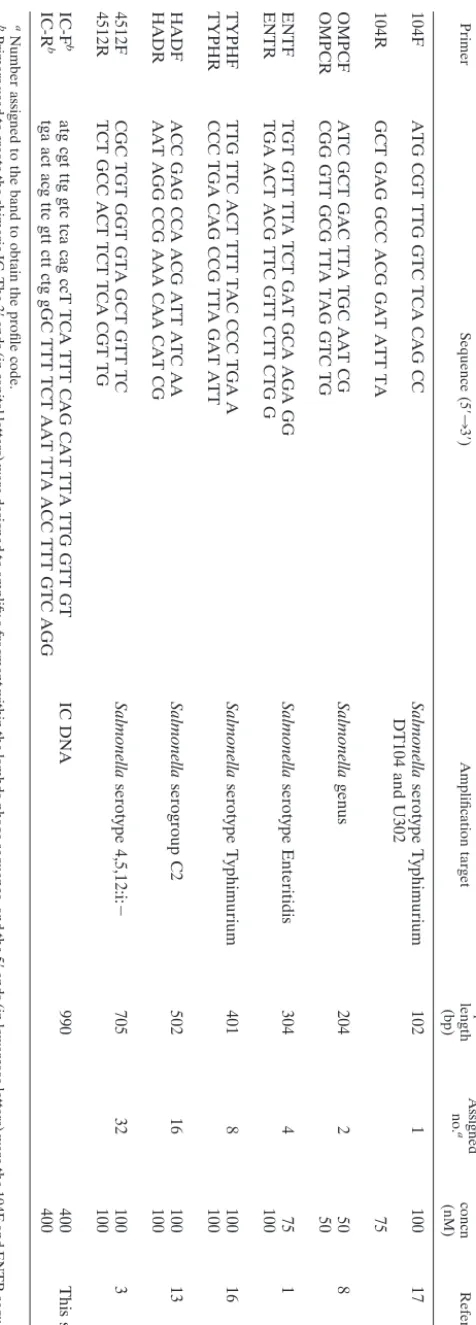
The aim of this study was to develop a multiplex PCR assay able to detect Salmonella and simultaneously detect the five most important serotypes and phage types in Spain. This tech-nique should be able to avoid the effect of the PCR inhibitors in clinical samples and had to be reliable, simple, and accurate. We designed new PCR primers using previously described genetic targets (Table 1) and the Jellyfish primer design soft-ware (BioWare Corp., Edmonton, Alberta, Canada). The
primer set (synthesized by Invitrogen, Paisley, United King-dom) was chosen to amplify products with lengths similar to those of the 100-bp ladder (Amersham Biosciences, Piscat-away, N.J.) bands. A total of six different sequences were amplified in each reaction mixture: aSalmonellagenus-specific sequence (204 bp), a serotype Enteritidis-specific sequence (304 bp), a serotype Typhimurium-specific sequence (401 bp), a sequence specific for serotype Typhimurium DT104 and U302 (102 bp), aSalmonellaC2 serogroup-specific sequence (502 bp), and a sequence specific for serotype 4,5,12:i:⫺(705 bp).
An artificially created chimeric DNA was used as an internal control (IC) in every reaction mixture. This IC was used to detect inhibition in the PCR due to the presence of inhibitory substances in the clinical samples. The IC was designed ac-cording to a strategy previously described (6) slightly modified to obtain a 990-bp fragment and consisted of a fragment (948 bp) of a region of the lambda phage flanked by two of the primers used in the multiplex PCR (104F and ENTR).
Every amplification profile was coded with a number ob-tained by the addition of the values corresponding to each amplified band (Table 1). The template DNA for multiplex PCR was prepared as previously described (12). All the PCRs were performed in a final volume of 25l in a Robocycler 96 Grad (Stratagene, La Jolla, Calif.). The optimized PCR mix-ture consisted of 1.5 mM MgCl2, 200M each of the four
deoxynucleoside triphosphates (Amersham Biosciences), 1 U ofTaqpolymerase (Amersham Biosciences), and 60 pmol of IC DNA per sample. Primer sequences and concentrations are given in Table 1. The PCR protocol consisted of the following steps: (i) an initial denaturation step of 2 min at 95°C; (ii) 30 cycles, with 1 cycle consisting of 1 min at 95°C, 1 min at 57°C,
* Corresponding author. Mailing address: Department of Immunol-ogy, MicrobiolImmunol-ogy, and ParasitolImmunol-ogy, F. Pharmacy, University of the Basque Country, Paseo de la Universidad 7, 01006 Vitoria-Gasteiz, Spain. Phone: 34 945 013912. Fax: 34 945 013014. E-mail: oipgacaj @vc.ehu.es.
1734
on May 15, 2020 by guest
http://jcm.asm.org/
TABLE 1. Primer sequences and sizes of PCR-ampli fied targets Primer Sequence (5 ⬘ 3 3 ⬘ ) Ampli fication target Amplicon length (bp) Assigned no. a Primer concn (nM) Reference 104F ATG CGT TTG GTC TCA CAG CC Salmonella serotype Typhimurium DT104 and U302 102 1 100 17 104R GCT GAG GCC ACG GAT ATT TA 75 OMPCF ATC GCT GAC TTA TGC AAT CG Salmonella genus 204 2 50 8 OMPCR CGG GTT GCG TTA TAG GTC TG 50 ENTF TGT GTT TTA TCT GAT GCA AGA GG Salmonella serotype Enteritidis 304 4 75 1 ENTR TGA ACT ACG TTC GTT CTT CTG G 100 TYPHF TTG TTC ACT TTT TAC CCC TGA A Salmonella serotype Typhimurium 401 8 100 16 TYPHR CCC TGA CAG CCG TTA GAT ATT 100 HADF ACC GAG CCA ACG ATT ATC AA Salmonella serogroup C2 502 16 100 13 HADR AAT AGG CCG AAA CAA CAT CG 100 4512F CGC TGT GGT GTA GCT GTT TC Salmonella serotype 4,5,12:i: ⫺ 705 32 100 3 4512R TCT GCC ACT TCT TCA CGT TG 100 IC-F b atg cgt ttg gtc tca cag ccT TCA TTT CAG CAT TTA TTG GTT GT IC DNA 990 400 This study IC-R b tga act acg ttc gtt ctt ctg gGC TTT TCT AAT TTA ACC TTT GTC AGG 400 a Number assigned to the band to obtain the pro file code. b Primers used to create the chimeric IC. The 3 ⬘ ends (in capital letters) were designed to amplify a fragment within the lambda phage sequence, and the 5 ⬘ ends (in lowercase letters) were the 104F and ENTR sequences.
on May 15, 2020 by guest
http://jcm.asm.org/
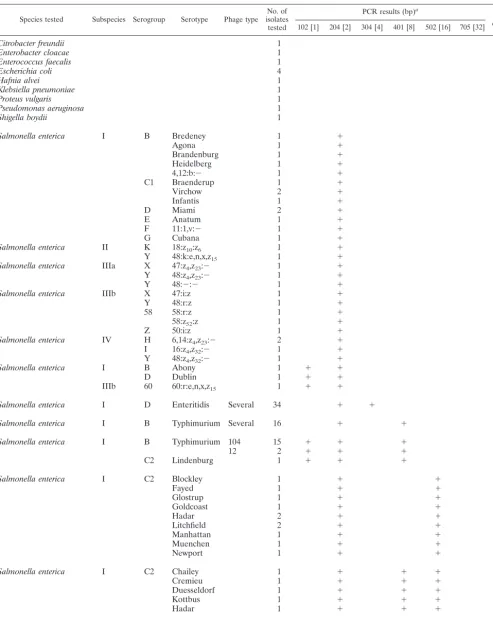
[image:2.603.173.411.66.729.2]TABLE 2. Strains tested and multiplex PCR results obtained in the optimization and validation experiments
Species tested Subspecies Serogroup Serotype Phage type isolatesNo. of tested
PCR results (bp)a
Type codeb
102 [1] 204 [2] 304 [4] 401 [8] 502 [16] 705 [32]
Citrobacter freundii 1 0
Enterobacter cloacae 1 0
Enterococcus faecalis 1 0
Escherichia coli 4 0
Hafnia alvei 1 0
Klebsiella pneumoniae 1 0
Proteus vulgaris 1 0
Pseudomonas aeruginosa 1 0
Shigella boydii 1 0
Salmonella enterica I B Bredeney 1 ⫹ 2
Agona 1 ⫹ 2
Brandenburg 1 ⫹ 2
Heidelberg 1 ⫹ 2
4,12:b:⫺ 1 ⫹ 2
C1 Braenderup 1 ⫹ 2
Virchow 2 ⫹ 2
Infantis 1 ⫹ 2
D Miami 2 ⫹ 2
E Anatum 1 ⫹ 2
F 11:1,v:⫺ 1 ⫹ 2
G Cubana 1 ⫹ 2
Salmonella enterica II K 18:z10:z6 1 ⫹ 2
Y 48:k:e,n,x,z15 1 ⫹ 2
Salmonella enterica IIIa X 47:z4,z23:⫺ 1 ⫹ 2
Y 48:z4,z23:⫺ 1 ⫹ 2
Y 48:⫺:⫺ 1 ⫹ 2
Salmonella enterica IIIb X 47:i:z 1 ⫹ 2
Y 48:r:z 1 ⫹ 2
58 58:r:z 1 ⫹ 2
58:z52:z 1 ⫹ 2
Z 50:i:z 1 ⫹ 2
Salmonella enterica IV H 6,14:z4,z23:⫺ 2 ⫹ 2
I 16:z4,z32:⫺ 1 ⫹ 2
Y 48:z4,z32:⫺ 1 ⫹ 2
Salmonella enterica I B Abony 1 ⫹ ⫹ 3
D Dublin 1 ⫹ ⫹ 3
IIIb 60 60:r:e,n,x,z15 1 ⫹ ⫹ 3
Salmonella enterica I D Enteritidis Several 34 ⫹ ⫹ 6
Salmonella enterica I B Typhimurium Several 16 ⫹ ⫹ 10
Salmonella enterica I B Typhimurium 104 15 ⫹ ⫹ ⫹ 11
12 2 ⫹ ⫹ ⫹ 11
C2 Lindenburg 1 ⫹ ⫹ ⫹ 11
Salmonella enterica I C2 Blockley 1 ⫹ ⫹ 18
Fayed 1 ⫹ ⫹ 18
Glostrup 1 ⫹ ⫹ 18
Goldcoast 1 ⫹ ⫹ 18
Hadar 2 ⫹ ⫹ 18
Litchfield 2 ⫹ ⫹ 18
Manhattan 1 ⫹ ⫹ 18
Muenchen 1 ⫹ ⫹ 18
Newport 1 ⫹ ⫹ 18
Salmonella enterica I C2 Chailey 1 ⫹ ⫹ ⫹ 26
Cremieu 1 ⫹ ⫹ ⫹ 26
Duesseldorf 1 ⫹ ⫹ ⫹ 26
Kottbus 1 ⫹ ⫹ ⫹ 26
Hadar 1 ⫹ ⫹ ⫹ 26
Salmonella enterica I B 4,5,12:i:⫺ U302 10 ⫹ ⫹ ⫹ ⫹ 43
aThe PCR result, the presence (⫹) of 102-, 204-, 304-, 401-, 502-, and 705-bp bands, which were assigned numbers 1, 2, 4, 8, 16, and 32 (shown in brackets),
respectively, is shown for the strains tested.
bThe type code is obtained by adding all the assigned numbers to the positive amplicons. Each code is specific for a particular band pattern.
on May 15, 2020 by guest
http://jcm.asm.org/
and 2 min at 72°C; and (iii) a final elongation step of 5 min at 72°C. The PCR products were electrophoresed in 2.5% (wt/ vol) D-1 agarose (Pronadisa, Madrid, Spain), stained with 2g of ethidium bromide (Sigma-Aldrich, Madrid, Spain) per ml, and photographed under UV light. In each PCR run, a non-template control was included to detect possible external DNA contamination.
A total of 138 microbial strains isolated from veterinary, environmental, food, and clinical sources from Spain, Den-mark, and England were used for selectivity determination. These strains were well characterized in terms of genus, spe-cies, serotype, and phage type (Table 2). Figure 1 shows the amplification profiles and codes obtained in the technique val-idation stage. The detection limits of this multiplex PCR were 6,500 CFU of Salmonella serotype Typhimurium LT2 strain and 1 ng of DNA. In our validation study, all the tested Sal-monellastrains showed at least the 200-bp band (code ofⱖ2) (Table 2), while none of the non-Salmonella strains showed this band (code of 0). The inclusivity and exclusivity were 100% (14), and the overall agreement (5) forSalmonellabacteria was therefore complete.
Analyzing the PCR profiles for epidemiological purposes, all the serotype Enteritidis strains showed the amplification pro-file code 6. The serotype Typhimurium strains showed the amplification profile code 10 or 11 (if DT104). The serogroup C2 strains showed profile code 18 or 26, depending on the
presence of a band of 401 bp, which was not completely re-producible in some strains. Fortunately, all these strains also presented the serogroup C2-specific band. The serotype 4,5,12: i:⫺ strains showed profile code 43. A serotype Lindenberg strain showed profile code 11. Serotype Lindenberg has the same antigenic formula as serotype Typhimurium, except it has C2 serogroup O antigens. Two serotype Typhimurium DT12 strains also presented profile code 11. In a previous pulsed-field gel electrophoresis typing study (9), the pulsed-pulsed-field gel electrophoresis profile of one of these isolates was identical to the profile of DT104 strains with three restriction enzymes. Also, a DT104 strain showed profile code 10. In the same study (9), the band pattern of this strain was different from the prevalent pattern of the DT104 isolates. Assay reproducibility was measured using independent strains replicated during the validation period of the technique and reached 91.5%. A 400-bp band was not always found for the Salmonella sero-group C2 strains.
Salmonelladetection by both conventional culture and mul-tiplex PCR methods was then performed on 120 consecutive human stool samples obtained at the Basurto Hospital, Bilbao, Spain. A swab soaked with human stool was used to inoculate selenite-cystine broth and allowed to grow overnight at 37°C for Salmonelladetection by both techniques. In the conven-tional culture technique, XLD, MacConkey, and Hektoen agars were inoculated with the incubated broth. Suspicious
Salmonella colonies were confirmed with triple sugar iron (TSI) agar, API 20E strips (BioMe`rieux, Marcy l’Etoile, France), and serotyped according to the Kauffman-White scheme. ForSalmonelladetection by multiplex PCR, 100l of the incubated broth was diluted in 10 ml of fresh broth and incubated for 4 h at 37°C. The broth was then centrifuged at 4°C at 3,000⫻g, and the pellet was washed with phosphate-buffered saline. The cells were centrifuged again and resus-pended in 200l of water. The bacterial DNA was extracted by boiling as described previously (12). A 5-l aliquot of the supernatant was used as template DNA in the multiplex PCR described above. In addition, a final concentration of 10% (wt/vol) polyethylene glycol (Sigma-Aldrich) was used as a PCR facilitator in the reaction mixture. One hundred seven of the samples gave coincident results by both techniques (Table 3). The multiplex PCR results for two samples were considered false-negative results, and one sample was detected as belong-ing to theSalmonellagenus instead of serotype Enteritidis. In 10 samples (8%), PCR inhibition occurred, including one
[image:4.603.45.282.67.216.2]se-FIG. 1. Multiplex PCR amplification profiles. All the different mul-tiplex PCR amplification profiles found in this study are shown. The type code is shown above the lanes. The M lanes contain the 100-bp molecular size ladder marker.
TABLE 3. Comparison of results obtained analyzing human stool samples by multiplex PCR and by culture and serotyping
Result by culture and serotyping
No. of samples in the following category by Multiplex-PCR
Inhibitiona Negative Type
code 2b code 6Type code 10Type code 11Type Total
Negative 9 81 90
Salmonellaserotype Enteritidis 1 2c 1d 22 26
Salmonellaserotype Typhimurium 2 2 4
Total 10 83 1 22 2 2 120
aInhibition of multiplex PCR.
bThe type code is obtained by adding all the assigned numbers to the positive amplicons. Each code is specific for a particular band pattern. cFalse-negative data in multiplex PCR.
dMistaken result in multiplex PCR.
on May 15, 2020 by guest
http://jcm.asm.org/
[image:4.603.44.541.603.693.2]rotype Enteritidis strain that was isolated by culture. The sen-sitivity value of the technique was 93%, the specificity was 100%, and the efficiency was 98%. Cohen’s kappa index was 0.95, which indicates high agreement between the two tech-niques.
In this article, we have described a multiplex PCR-based diagnosis method for Salmonellathat is simple, inexpensive, and sensitive and enables the quick and precise detection of the most prevalent serotypes ofSalmonellain human clinical samples. Although our results are preliminary, this PCR assay would offer an effective alternative to traditional typing meth-ods for the identification and differentiation of the most clin-ically relevantSalmonellatypes.
This work was supported in part by Basque Government grant PI 1998/52,“Subvencio´n general a Grupos de Investigacio´n” UPV/EHU (2002-2005). Juan Alvarez and Ana Bele´n Vivanco were supported with a “Beca de Formacio´n de Personal Investigador” from the Basque Government and a “Beca de Investigacio´n Predoctoral” from the Uni-versity of the Basque Country, respectively.
REFERENCES
1. Agron, P. G., R. L. Walker, H. Kinde, S. J. Sawyer, D. C. Hayes, J. Wollard, and G. L. Andersen.2001. Identification by subtractive hybridization of sequences specific forSalmonella entericaserotype Enteritidis. Appl. Envi-ron. Microbiol.67:4984–4991.
2. Al-Soud, W. A., and P. Radstrom.2000. Effects of amplification facilitators on diagnostic PCR in the presence of blood, feces, and meat. J. Clin. Mi-crobiol.38:4463–4470.
3. Garaizar, J., S. Porwollik, A. Echeita, A. Rementeria, S. Herrera, R. M. Wong, J. Frye, M. A. Usera, and M. McClelland.2002. DNA microarray-based typing of an atypical monophasicSalmonella entericaserotype. J. Clin. Microbiol.40:2074–2078.
4. Herikstad, H., Y. Motarjemi, and R. V. Tauxe.2002.Salmonellasurveillance: a global survey of public health serotyping. Epidemiol. Infect.129:1–8. 5. Hong, Y., M. E. Berrang, T. Liu, C. L. Hofacre, S. Sanchez, L. Wang, and
J. J. Maurer.2003. Rapid detection ofCampylobacter coli,C.jejuni, and
Salmonella entericaon poultry carcasses by using PCR-enzyme-linked
im-munosorbent assay. Appl. Environ. Microbiol.69:3492–3499.
6. Hoorfar, J., P. Ahrens, and P. Ra˚sdstro¨m.2000. Automated 5⬘nuclease assay for identification ofSalmonella enterica. J. Clin. Microbiol.38:3429– 3435.
7. Kongmuang, U., J. M. C. Luk, and A. A. Lindberg.1994. Comparison of three stool-processing methods for detection ofSalmonellaserogroups B, C2, and D by PCR. J. Clin. Microbiol.32:3072–3074.
8. Kwang, J., E. T. Littledike, and J. E. Keen.1996. Use of the polymerase chain reaction forSalmonelladetection. Lett. Appl. Microbiol.22:46–51. 9. Laconcha, I.2001. Evaluacio´n de marcadores moleculares en la tipificacio´n
deSalmonellaspp. Creacio´n de un sistema de librerías informatizado para la
vigilancia epidemiolo´gica. Doctoral thesis. University of the Basque Country, Vitoria-Gasteiz, Spain.
10. Lee, C. Y., G. Panicker, and A. K. Bej.2003. Detection of pathogenic bacteria in shellfish using multiplex PCR followed by CovaLink NH microwell plate sandwich hybridization. J. Microbiol. Methods53:199–209.
11. Lin, J. S., and H. Y. Tsen.1999. Development and use of polymerase chain reaction for the detection ofSalmonellaTyphimurium in stool and food samples. J. Food Prot.62:1103–1110.
12. Lo´pez-Molina, N., I. Laconcha, A. Rementeria, A. Audicana, I. Perales, and J. Garaizar.1998. Typing ofSalmonella enteritidisof different phage types of PCR fingerprinting. J. Appl. Microbiol.84:877–882.
13. Luk, J. M., U. Kongmuang, P. R. Reeves, and A. A. Lindberg.1993. Selective amplification of abequose and paratose synthase genes (rfb) by polymerase chain reaction for identification ofSalmonellamajor serogroups (A, B, C2, and D). J. Clin. Microbiol.31:2118–2123.
14. Malorny, B., J. Hoorfar, C. Bunge, and R. Helmuth.2003. Multicenter validation of the analytical accuracy ofSalmonellaPCR: towards an inter-national standard. Appl. Environ. Microbiol.69:290–296.
15. Mason, W. J., J. S. Blevins, K. Beenken, N. Wibowo, N. Ojha, and M. S. Smeltzer.2001. Multiplex PCR protocol for the diagnosis of staphylococcal infection. J. Clin. Microbiol.39:3332–3338.
16. Olsen, J. E., S. Aabo, O. F. Rasmussen, and L. Rossen.1995. Oligonucleo-tide probes specific for the genusSalmonellaand forSalm.typhimurium. Lett. Appl. Microbiol.20:160–163.
17. Pritchett, L. C., M. E. Konkel, J. M. Gay, and T. E. Besser.2000. Identifi-cation of DT104 and U302 phage types amongSalmonella entericaserotype Typhimurium isolates by PCR. J. Clin. Microbiol.38:3484–3488. 18. Usera, M. A., A. Aladuen˜a, R. Díaz, M. de la Fuente, R. Gutie´rrez, P. Cerda´n,
M. Arroyo, R. Gonza´lez, and A. Echeita.2001. Ana´lisis de las cepas de
Salmonellaspp. aisladas de muestras clínicas de origen humano en Espan˜a
en el an˜o 2000 (I). Bol. Epidemiol. Sem.9:221–224.
19. Wang, G., C. G. Clark, and F. G. Rodgers.2002. Detection inEscherichia coli
of the genes encoding the major virulence factors, the genes defining the O157:H7 serotype, and components of the type 2 Shiga toxin family by multiplex PCR. J. Clin. Microbiol.40:3613–3619.