0095-1137/07/$08.00
⫹
0
doi:10.1128/JCM.01076-07
Copyright © 2007, American Society for Microbiology. All Rights Reserved.
Identification of Less-Common
Streptococcus pneumoniae
Serotypes by
a Multiplex PCR-Based Reverse Line Blot Hybridization Assay
䌤
Fei Zhou,
1Fanrong Kong,
1Zhongsheng Tong,
1,2and Gwendolyn L. Gilbert
1*
Centre for Infectious Diseases and Microbiology (CIDM), Institute of Clinical Pathology and Medical Research (ICPMR),
Westmead, New South Wales, Australia,
1and Research Laboratory for Infectious Skin Diseases, Department of
Dermatology, Wuhan First Hospital, Wuhan 430022, People’s Republic of China
2Received 26 May 2007/Accepted 29 July 2007
We developed a multiplex PCR-based reverse line blot (mPCR/RLB) assay to identify 50 uncommon
pneumococcal serotypes. In combination with a previously described mPCR/RLB assay (3), all 90
pneumo-coccal serotypes can be identified individually (32 serotypes) or, because of predictable cross-reactions, to
within small groups of two to five related serotypes (58 serotypes), which can be distinguished using
serotype-specific antisera.
Recently, we described a multiplex PCR-based reverse line
blot (mPCR/RLB) hybridization assay to identify 40
Strepto-coccus pneumoniae
serotypes, including the 23 represented in
the polysaccharide vaccine and 17 others that show
reproduc-ible cross-reactions (3). In this study, we designed one pair of
specific primers and one probe for each of the remaining 50
serotypes to allow provisional identification of all 90 known
serotypes by mPCR/RLB (5). The primer and probe sequences
were based on recently published full
cps
gene cluster
se-quences of all 90 pneumococcal serotypes (1) and on other
sequences available in GenBank (4, 7).
Twenty sets of serotype-specific primer pairs and probes
were designed; the remaining 30 serotypes shared identical or
very similar
wzy
sequences with one or two others in the same
or closely related serogroups, as follows: 7B/7C/40, 10F/10C,
11B/11C, 15F/15A, 19B/19C, 24F/24A/24B, 25F/25A/38, 28F/
28A, 32F/32A, 33B/33D, 35F/47F, 35A/35C/42, and 41F/41A.
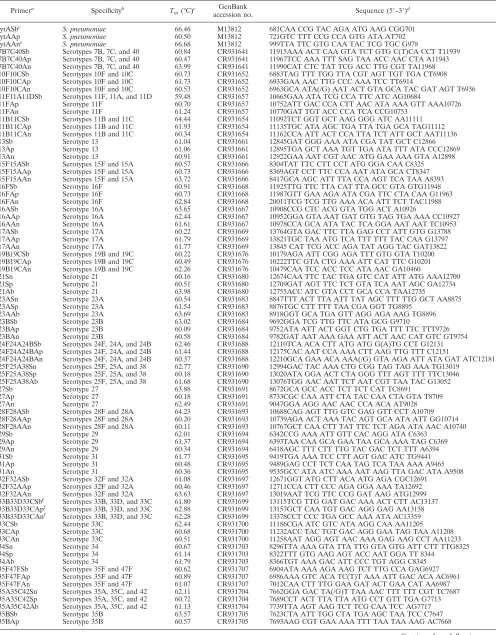
The primers and probes used in this assay are shown in Table 1.
Probes and primers were designed with similar physical
characteristics to allow simultaneous amplification and
hybrid-ization in a multiplex reaction (5) and were synthesized by
Sigma-Aldrich (Sydney, Australia). Primers were biotinylated
at the 5
⬘
end, and probes had a 5
⬘
amine group (5). DNA
extraction (6) and RLB hybridization were performed as
pre-viously described (5).
mPCR was performed according to the QIAGEN Hotstar
Taq
polymerase kit instructions (5) under the following
condi-tions: 95°C for 15 min; 35 cycles of 94°C for 30 s, 55°C for 30 s,
and 72°C for 1 min; 72°C for 10 min; and a hold at 22°C. The
34-primer-pair mPCR mixture was prepared to contain the
following: 2
l template DNA, 0.075
l of each forward (100
pmol
l
⫺1) and reverse (100 pmol
l
⫺1) primer, 2.4
l
de-oxynucleoside triphosphates (2.5 mM of each dede-oxynucleoside
triphosphate), 3
l 10
⫻
PCR buffer, 4.2
l 25 mM MgCl
2(final
concentration, 5 mM), 0.2
l QIAGEN Hotstar
Taq
polymer-ase (5 units
l
⫺1), and water to 30
l.
Preliminary testing of reference strains of all 90 serotypes
(Statens Serum Institut, Copenhagen, Denmark) showed that
all 50 target serotypes (and none of the other 40) were
ampli-fied and hybridized by the mPCR/RLB system; 20 serotypes
reacted only with the corresponding primers and probe, and 30
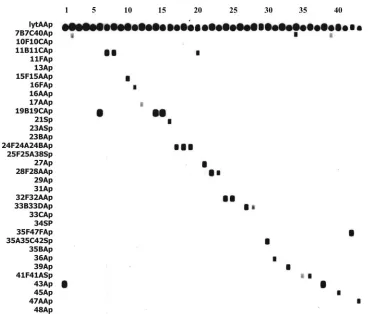
exhibited the predicted cross-reactions (Table 1; Fig. 1).
The method was further evaluated using 173 previously
stud-ied (4, 7) clinical isolates from China, Australia, and Canada,
which included one to four isolates of all pneumococcal
sero-types except for 10C, 11F, 23B, 25A, and 33D (for which
clinical isolates were not available). They were tested by
mPCR/RLB without knowledge of the serotype. Sixty-eight
isolates belonging to 1 of 40 serotypes identified by our original
mPCR/RLB assay were not amplified. One nonserotypable
isolate was also not amplified by either the previous (3) or new
mPCR, although it was confirmed to be
S. pneumoniae
by
species-specific PCR and phenotypic characteristics. This
re-sult suggests that this isolate either contains a significant
cps
deletion or mutation (8) or belongs to a novel serotype (10).
Forty-four isolates were identified as being of individual
serotypes corresponding with those identified by conventional
serotyping, and 59 were identified as being one of a group of
two or three related serotypes which, with one exception,
in-cluded the serotype identified by conventional serotyping
(Ta-ble 2).
The exception was an isolate from China, which was
identi-fied as serotype 33B/33D by mPCR/RLB and as serotype 33C
by conventional serotyping. Both methods were repeated and
the initial (discrepant) results confirmed. Single PCR was
pos-itive with 33B/33D-specific and negative with 33C-specific
primers. Sequencing of a portion of
wzy
of this isolate showed
that it was different from that of any known serotype (1, 7) but
more closely related to that of 33C than to that of 33B/33D.
Although the discrepancy between molecular and
immunolog-ical serotype identifications remained unresolved, our results
suggest that
wzy
is not the only determinant of antigenic
spec-ificity (3). Further investigation of this isolate is in progress.
Finally, the mPCR/RLB assay was used to test 152 clinical
* Corresponding author. Mailing address: Centre for Infectious
Dis-eases and Microbiology (CIDM), Institute of Clinical Pathology and
Medical Research (ICPMR), Westmead Hospital, Darcy Road,
West-mead, New South Wales, 2145 Australia. Phone: (612) 9845 6255. Fax:
(612) 9893 8659. E-mail: [email protected].
䌤
Published ahead of print on 8 August 2007.
3411
on May 16, 2020 by guest
http://jcm.asm.org/
TABLE 1. Oligonucleotide primers and probes for mPCR/RLB assay used in this study
Primera Specificityb T
m(°C)c
GenBank
accession no. Sequence (5⬘–3⬘)
d
lytASbe S. pneumoniae 66.46 M13812 681CAA CCG TAC AGA ATG AAG CGG701
lytAAp S. pneumoniae 60.50 M13812 721GTC TTT CCG CCA GTG ATA AT702
lytAAne S. pneumoniae 66.68 M13812 999TTA TTC GTG CAA TAC TCG TGC G978
7B7C40Sb Serotypes 7B, 7C, and 40 60.84 CR931641 11915AAA ACT CAA GTA TCT GTG C(T)CA CCT T11939
7B7C40Ap Serotypes 7B, 7C, and 40 60.47 CR931641 11967TCC AAA TTT SAG TAA ACC AAC CTA A11943
7B7C40An Serotypes 7B, 7C, and 40 63.99 CR931641 11990CAT CTC TAT TCG ACC TTG CGT TA11968
10F10CSb Serotypes 10F and 10C 60.73 CR931652 6883TAG TTT TGG TTA CGT AGT TGT TGA CT6908
10F10CAp Serotypes 10F and 10C 61.73 CR931652 6933GAA AAC TTG CCC AAA TCC TT6914
10F10CAn Serotypes 10F and 10C 60.53 CR931652 6963GCA ATA(/G) AAT ACT GTA GCA TAC GAT AGT T6936
11F11A11DSb Serotypes 11F, 11A, and 11D 59.48 CR931657 10665GAA ATA TCG CCA TTC ATC AG10684
11FAp Serotype 11F 60.70 CR931657 10752ATT GAC CCA CTT AAC ATA AAA GTT AAA10726
11FAn Serotype 11F 61.24 CR931657 10770GAT TGT ACC CCA TCA CCG10753
11B11CSb Serotypes 11B and 11C 64.44 CR931654 11092TCT GGT GCT AAG GGG ATC AA11111
11B11CAp Serotypes 11B and 11C 61.93 CR931654 11135TGC ATA AGC TGA TTA TGA GCA TAG11112
11B11CAn Serotypes 11B and 11C 60.34 CR931654 11162CCA ATT ACT CCA TTA TCT ATT GCT AAT11136
13Sb Serotype 13 61.04 CR931661 12845GAT GGG AAA ATA CGA TAT GCT C12866
13Ap Serotype 13 61.06 CR931661 12895TGA GCT AAA TGT TGA ATA TTT ATA CCC12869
13An Serotype 13 60.91 CR931661 12922GAA AAT CGT AAC ATG GAA AAA GTA A12898
15F15ASb Serotypes 15F and 15A 60.57 CR931666 8304TAT TTC CTT CCT ATG GGA CAA C8325
15F15AAp Serotypes 15F and 15A 60.73 CR931666 8369AGT CCT TTC CCA AAT ATA GCA CT8347
15F15AAn Serotypes 15F and 15A 63.72 CR931666 8417GCA AGC ATT TTA CCA AGT TCA TAA A8393
16FSb Serotype 16F 60.91 CR931668 11925TTG TTC TTA CAT TTA GCC GTA GTG11948
16FAp Serotype 16F 60.73 CR931668 11987GTT GAA AGA ATA CGA TTC CTA CAA G11963
16FAn Serotype 16F 62.84 CR931668 20011TCG TCG TTG AAA ACA ATT TCT TAC11988
16ASb Serotype 16A 63.65 CR931667 10908CCG CTC ACG GTA TGG ACT A10926
16AAp Serotype 16A 62.44 CR931667 10952GGA GTA AAT GAT GTG TAG TGA AAA CC10927
16AAn Serotype 16A 61.61 CR931667 10978CCA GCA ATA TAC TCA GGA AAT AAT TC10953
17ASb Serotype 17A 60.22 CR931669 13764GTA GAC TTC TTA GAG CCT ATT GTG G13788
17AAp Serotype 17A 61.79 CR931669 13821TGC TAA ATG TCA TTT TTT TAC CAA G13797
17AAn Serotype 17A 61.77 CR931669 13845 CAT TCG ACC AGA TAT AGG TAC GAT13822
19B19CSb Serotypes 19B and 19C 60.22 CR931676 10179AGA ATT CGG AGA TTT GTG GTA T10200
19B19CAp Serotypes 19B and 19C 60.49 CR931676 10222TTC GTA CTG AAA ATT CAT TTC G10201
19B19CAn Serotypes 19B and 19C 62.26 CR931676 10479CAA TCC ACC TCC ATA AAC GA10460
21Sn Serotype 21 60.16 CR931680 12674CAA TTC TAC TGA GTC CAT ATT ATG AAA12700
21Sp Serotype 21 60.51 CR931680 12709GAT AGT TTC TCT GTA TCA AAT AGC GA12734
21Ab Serotype 21 63.98 CR931680 12755ACC ATC GTA CCT GCA CCA TAA12735
23ASn Serotype 23A 60.54 CR931683 8847TTT ACT TTA ATT TAT AGC TTT TTG GCT AA8875
23ASp Serotype 23A 61.54 CR931683 8876TGC CTT TTT TAA CGA GGT TG8895
23AAb Serotype 23A 63.69 CR931683 8918GGT GCA TGA GTT AGG AGA AAG TG8896
23BSb Serotype 23B 63.02 CR931684 9692GGA TCG TTG TTC ATA GCG G9710
23BAp Serotype 23B 60.09 CR931684 9752ATA ATT ACT GGT CTG TGA TTT TTC TTT9726
23BAn Serotype 23B 60.58 CR931684 9782GAT AAT AAA GAA ATT ACT AAC CAT GTC GT9754
24F24A24BSb Serotypes 24F, 24A, and 24B 62.46 CR931688 12110TCA ACA CTT ATG ATG G(A)TG CCT G12131
24F24A24BAp Serotypes 24F, 24A, and 24B 61.44 CR931688 12175CAC AAT CCA AAA CTT AAG TTG TTT C12151
24F24A24BAn Serotypes 24F, 24A, and 24B 60.37 CR931688 12210GCA GAA ACA AAA(/G) GTA AGA ATT ATA GAT ATC12181
25F25A38Sn Serotypes 25F, 25A, and 38 62.77 CR931690 12994GAC TAC AAA CTG CGG TAG TAG AAA TG13019
25F25A38Sp Serotypes 25F, 25A, and 38 60.18 CR931690 13020ATA GGA ACT CTA GGG TTT AGT TTT TTC13046
25F25A38Ab Serotypes 25F, 25A, and 38 61.68 CR931690 13076TGG AAC AAT TCT AAT CGT TAA TAC G13052
27Sb Serotype 27 63.88 CR931691 8672GCA GCC ACC TCT TCT CAT TC8691
27Ap Serotype 27 60.18 CR931691 8733CGC CAA ATT CTA TAC CAA CTA GTA T8709
27An Serotype 27 62.49 CR931691 9047GGA AGG AAC AAC CCA ACA AT9028
28F28ASb Serotypes 28F and 28A 64.23 CR931693 10688CAG AGT TTG GTC GAG GTT CCT A10709
28F28AAp Serotypes 28F and 28A 60.20 CR931693 10739AGA ACT AAA TAC AGT GCA ATA ATT GG10714
28F28AAn Serotypes 28F and 28A 60.11 CR931693 10767GCT CAA CTT TAT TTC TCT AGA ATA AAC A10740
29Sb Serotype 29 62.01 CR931694 6342CCG AAA ATT GTT CAC AGG ATA C6363
29Ap Serotype 29 61.37 CR931694 6393TAA CAA GCA GAA TAA GCA AAA TAG C6369
29An Serotype 29 60.34 CR931694 6418AGC TTT CTT TTG TAC GAC TCT TTT A6394
31Sb Serotype 31 61.77 CR931695 9419TGA AAA TCC CTT AGT GAC ATC TG9441
31Ap Serotype 31 60.48 CR931695 9489GAG CCT TCT CAA TAG TCA TAA AAA A9465
31An Serotype 31 60.36 CR931695 9535GCC ATA ATC AAA AAT AAG TTA GAC ATA A9508
32F32ASb Serotypes 32F and 32A 61.08 CR931697 12671GGT ATG CTT ACA ATG AGA CGC12691
32F32AAp Serotypes 32F and 32A 60.46 CR931697 12711CCA CTT CCC AGA GGA AAA TA12692
32F32AAn Serotypes 32F and 32A 63.63 CR931697 13019AAT TCG TTC CCG GAT AAG ATG12999
33B33D33CSbf
Serotypes 33B, 33D, and 33C 61.80 CR931699 13115TCG TTG GAT GAC AAA ACT CTT AC13137
33B33D33CApf Serotypes 33B, 33D, and 33C 62.88 CR931699 13157GCT CAA TGT GAC AGG GAG AA13138
33B33D33CAnf Serotypes 33B, 33D, and 33C 62.28 CR931699 13378CCT CCC TGA GCC AAA ATA AC13359
33CSb Serotype 33C 62.44 CR931700 11186CGA ATC GTC ATA AGG CAA AA11205
33CAp Serotype 33C 60.68 CR931700 11232ACC TAC TGT GAC AGG GAA TAG TAA A11208
33CAn Serotype 33C 60.51 CR931700 11258AAT AGG AGT AAC AAA GAG AAG CCT AA11233
34Sn Serotype 34 60.67 CR931703 8296TTA AAA GTA TTA TTG GTA GTG ATT CTT TTG8325
34Sp Serotype 34 61.14 CR931703 8322TTT GTG AAG AGT ACC AAT GGA TT 8344
34Ab Serotype 34 61.79 CR931703 8366TGT AAA GAC ATT CCC TGT AGG C8345
35F47FSb Serotypes 35F and 47F 60.62 CR931707 6904ATA AAA AGA AAG TCT TTG CCA GAG6927
35F47FAp Serotypes 35F and 47F 60.89 CR931707 6986AAA GTC ACA TC(T)T AAA ATT GAC ACA AC6961
35F47FAn Serotypes 35F and 47F 61.07 CR931707 7012CAA CTT TTG GAA GAT ACT GAA CAT AA6987
35A35C42Sn Serotypes 35A, 35C, and 42 62.11 CR931704 7662GGA GAC TA(/G)T TAA AAC TTT TTT CGT TC7687
35A35C42Sp Serotypes 35A, 35C, and 42 60.72 CR931704 7689CCT ACT TTA TTA ATG CCT GTT TGA G7713
35A35C42Ab Serotypes 35A, 35C, and 42 61.13 CR931704 7739TTA AGT AAG TCT TCG CAA TCC AG7717
35BSb Serotype 35B 63.57 CR931705 7623CTA ATT TGG CTA TGA AGC TAA TCC C7647
35BAp Serotype 35B 60.57 CR931705 7693AAG CGT GAA AAA TTT TAA TAA AAG AC7668
Continued on following page
on May 16, 2020 by guest
http://jcm.asm.org/
FIG. 1. mPCR/RLB results for a representative sample of 43 clinical isolates (see Table 1 for descriptions and specificities of the probes listed
on the left). Conventional serotype-mPCR/RLB results for the isolates shown, from left to right, are 43, 7B, 9A,* 9L,* 9V,* 19B, 11B, 11C, 12A,*
15F, 16F, 17A, 18F,* 19B, 19C, 21, 24F, 24A, 24B, 11B, 27, 28F, 28A, 32F, 32A, 33A,* 33B, 33B, 33F,* 35C, 36, 37,* 39, 40, 41F, 41A, 44,* 43,
7B, 45, 46,* 47F, and 47A. Isolates marked with asterisks belong to one of 40 serotypes identified by our original mPCR/RLB assay (3) and were
not amplified in this assay.
TABLE 1—
Continued
Primera Specificityb T
m(°C)c
GenBank
accession no. Sequence (5⬘–3⬘)
d
35BAn Serotype 35B 60.29 CR931705 7722TAA CTT AAA TAG GCA TTA ACA AAA TAG GT7694
36Sb Serotype 36 60.58 CR931708 13687CAA TTT CCC CTT ATT CTG TAG TTC13710
36Ap Serotype 36 60.38 CR931708 13739AGA TAA ATA CAT CAT TAT TGA CGA ACA13713
36An Serotype 36 63.39 CR931708 13763TGG AGA TCC CCA AGA GAA AAT A13742
39Sb Serotype 39 63.67 CR931711 11410ATT GGT TTG GGA ACT TGA TGT C11431
39Ap Serotype 39 62.70 CR931711 11464TAA TAA CCA TAC TCT TCC GTC GG11442
39An Serotype 39 62.76 CR931711 11490GCA ATA AGG CAA ATA AGG GAT AAT TA11465
41F41ASn Serotypes 41F and 41A 60.08 CR931714 11239TGA CAC TAT TTA TAA TTG CTT TAT CCT T11266
41F41ASp Serotypes 41F and 41A 60.11 CR931714 11272GGG TGC AAG GTG ATT ATG TAT11292
41F41AAb Serotypes 41F and 41A 63.37 CR931714 11348TAG CGA GAA ACT ATC TGC ATC TTG11325
43Sb Serotype 43 60.10 CR931716 10493AGA TCA AAT GGT GGT ATT AGG AA10515
43Ap Serotype 43 61.11 CR931716 10538TCG GGT GTA CAA ATC CTA AAC TA10516
43An Serotype 43 60.19 CR931716 10564GGA ATA GAT CAT TAA CCC TAA TGA AT10539
45Sb Serotype 45 64.85 CR931718 13236TAT GCA GGA AAT ATC CGA GAA GG13258
45Ap Serotype 45 64.64 CR931718 13296CAG CAT ATC TTG CAC GAT AAT GAA13273
45An Serotype 45 64.31 CR931718 13618CCG TGA AAC AGA AAC GCT ATG13598
47ASb Serotype 47A 63.03 CR931720 10554TAT TTG CCA TAA CGG ACT CTA GAA C10578
47AAp Serotype 47A 59.71 CR931720 10659TTT TTA ACA ACC TTG TAT AGA ATA CCT C10632
47AAn Serotype 47A 60.23 CR931720 10710GCT AAA ATA ATA AAT AGC GAA CTT ACT ACA10681
48Sb Serotype 48 63.24 CR931722 12838GCA TTT GGA GTT ATT GCC CTA C12859
48Ap Serotype 48 60.13 CR931722 12884CCT ATA AAC ACA CTC AAA ACT AGC A12860
48An Serotype 48 61.76 CR931722 12927CGA CGG AAT CAA TAT AAA TAA GTG ATA12901
a
S, sense; A, antisense; b, biotin-labeled primer (primers were biotin labeled at the 5⬘end); p, probe (probes were 5⬘ end labeled with a C-6 amine); n,
non-biotin-labeled primer.
b
Based on published sequence data for the wholecpsgene cluster, it was not possible to design primers/probes that could distinguish some individual serotypes from
one to three closely related ones, usually (but not always) belonging to the same serogroup.
c
Tm, melting temperature. Values were provided by the primer synthesizer (Sigma-Aldrich).
d
Numbers represent the base positions at which primer/probe sequences start and finish (starting at position 1 of the corresponding GenBank sequence).
e
One pair of previously published primers (11) were used as species-specific primers.
f
Some 33C strains may have positive results with the primers/probe (see the text for further explanation).
on May 16, 2020 by guest
http://jcm.asm.org/
isolates collected during 2000–2007 at the Centre for
Infec-tious Diseases and Microbiology and selected as belonging to
one of the 50 uncommon serotypes identified by the new
mPCR/RLB system.
Thirteen isolates were not initially amplified by mPCR. Of
these, 11 were successfully identified after modification of the
DNA extraction method (5) by adding 2
l of proteinase K (20
mg/ml; Sigma, Australia) to tubes before heating them at
100°C for 10 min. Two isolates that still were not amplified had
been identified, using antisera, as serotypes 11F and 16A.
Con-ventional serotyping was repeated and showed that they
be-longed to serotypes 11A and 18C, respectively (not
repre-sented in the current mPCR/RLB system). Two isolates,
previously identified as serotypes 35A and 29, were identified
by mPCR/RLB as 35F and 35B, respectively. Retesting with
antisera confirmed the mPCR/RLB results.
Seventy-three isolates were identified by mPCR/RLB as
sin-gle serotypes corresponding with those of conventional
sero-typing; 75 isolates gave positive results with probes
cross-re-acting with two or three related serotypes, which included the
serotypes identified by conventional serotyping. The mPCR/
RLB-predicted serotypes for these 152 isolates are shown in
Table 3.
Because serotype-specific targets within
cps
gene clusters are
not always available, this mPCR/RLB assay is less
discrimina-tory—although more objective and reproducible—than
con-ventional serotyping (2, 4). In combination with our previous
mPCR/RLB assay (3), it can identify 32 serotypes precisely and
58 as belonging to one of two to five related serotypes. This is
the first report of a practical molecular assay that can predict
all 90 serotypes without sequencing. Potentially, it can be used
to identify multiple serotypes directly in clinical (including
culture-negative) specimens. It could be adapted to other
plat-forms, such as “liquid” molecular beacons (9) and solid
mi-croarrays (12).
For routine serotyping of pure pneumococcal cultures, our
first mPCR/RLB assay (identification of 40 serotypes) would
be used initially to identify the most prevalent serotypes
TABLE 2. mPCR/RLB and serotype identification results for 173
previously studied isolates from China, Australia, and Canada
Serotype(s) No. of
isolates mPCR/RLB result
Forty serotypes represented in
previously described mPCR/
RLB assay (3)
68
Negative
7B
2
7B/7C/40
7C
2
7B/7C/40
40
1
7B/7C/40
10F
2
10F/10C
10C
0
11B
3
11B/11C
11C
2
11B/11C
11F
0
13
4
13
15F
3
15F/15A
15A
3
15F/15A
16F
3
16F
16A
1
16A
17A
2
17A
19B
2
19B/19C
19C
3
19B/19C
21
3
21
23A
3
23A
23B
0
24F
3
24F/24A/24B
24A
1
24F/24A/24B
24B
1
24F/24A/24B
25F
2
25F/25A/38
25A
0
38
4
25F/25A/38
27
4
27
28F
4
28F/28A
28A
3
28F/28A
29
1
29
31
4
31
32F
1
32F/32A
32A
2
32F/32A
33B
3
33B/33D
33D
0
33C
a1
33B/33D
34
4
34
35F
3
35F/47F
47F
1
35F/47F
35A
1
35A/35C/42
35C
3
35A/35C/42
42
1
35A/35C/42
35B
3
35B
36
3
36
39
2
39
41F
2
41F/41A
41A
1
41F/41A
43
2
43
45
1
45
47A
1
47A
48
3
48
Nonserotypable
b1
Negative
a
One isolate from China, which was identified as 33B/33D by single PCR and mPCR/RLB, was shown to be 33C by using serotype-specific antiserum.
b
This isolate was amplified and hybridized byS. pneumoniae-specific primers
[image:4.585.301.542.97.291.2]and probes (targetinglytA) and had optochin susceptibility and bile solubility.
TABLE 3. mPCR/RLB and conventional serotyping results for 152
clinical isolates from Centre for Infectious Diseases
and Microbiology
Serotype No. of isolates mPCR/RLB result
7C
9
7B/7C/40
10F
1
10F/10C
11F
1
Negative (11A)
a13
4
13
15A
5
15F/15A
16F
41
16F
16A
1
Negative (18C)
a21
2
21
24F
1
24F/24A/24B
25A
2
25F/25A/38
38
24
25F/25A/38
28F
1
28F/28A
28A
1
28F/28A
31
3
31
34
4
34
35F
b30
35F/47F
35C
1
35A/35C/42
35B
c20
35B
36
1
36
a
Serotypes in parentheses are corrected serotypes after retesting by conven-tional serotyping; these serotypes are not included in the new mPCR/RLB assay.
b
One isolate initially identified as serotype 35A was found to be 35F upon being retested.
c
One isolate initially identified as serotype 29 was found to be 35B upon being retested.
on May 16, 2020 by guest
http://jcm.asm.org/
(
⬎
95% of invasive isolates, based on unpublished data from
the NSW Pneumococcal Reference Laboratory) (3). The
cur-rent assay would then be needed, infrequently, to identify the
small proportion of isolates belonging to less-common
sero-types.
Fanrong Kong and Fei Zhou had similar contributions to the work
and should be seen as co-first authors.
We thank Mitchell Brown and Shahin Oftadeh for conventional
serotyping and for selecting appropriate clinical isolates.
This study was funded, in part, by National Health and Medical
Research Council project grant 358351 (to G. L. Gilbert).
REFERENCES
1.Bentley, S. D., D. M. Aanensen, A. Mavroidi, D. Saunders, E. Rabbinowitsch, M. Collins, K. Donohoe, D. Harris, L. Murphy, M. A. Quail, G. Samuel, I. C. Skovsted, M. S. Kaltoft, B. Barrell, P. R. Reeves, J. Parkhill, and B. G. Spratt.2006. Genetic analysis of the capsular biosynthetic locus from all 90
pneumococcal serotypes. PLoS Genet.2:e31.
2.Henrichsen, J. 1995. Six newly recognized types of Streptococcus pneu-moniae. J. Clin. Microbiol.33:2759–2762.
3.Kong, F., M. Brown, A. Sabananthan, X. Zeng, and G. L. Gilbert.2006. Multiplex PCR-based reverse line blot hybridization assay to identify 23
Streptococcus pneumoniaepolysaccharide vaccine serotypes. J. Clin.
Micro-biol.44:1887–1891.
4.Kong, F., and G. L. Gilbert.2003. UsingcpsA-cpsBsequence polymorphisms
and serotype-/group-specific PCR to predict 51Streptococcus pneumoniae
capsular serotypes. J. Med. Microbiol.52:1047–1058.
5.Kong, F., and G. L. Gilbert.2006. Multiplex PCR-based reverse line blot hybridization assay (mPCR/RLB)—a practical epidemiological and
diagnos-tic tool. Nat. Protoc.1:2668–2680.
6.Kong, F., S. Gowan, D. Martin, G. James, and G. L. Gilbert.2002. Serotype identification of group B streptococci by PCR and sequencing. J. Clin.
Microbiol.40:216–226.
7.Kong, F., W. Wang, J. Tao, L. Wang, Q. Wang, A. Sabananthan, and G. L. Gilbert.2005. A molecular-capsular-type prediction system for 90 Strepto-coccus pneumoniaeserotypes using partialcpsA-cpsBsequencing andwzy- or
wzx-specific PCR. J. Med. Microbiol.54:351–356.
8.Llull, D., P. Veiga, J. Tremblay, and S. Kulakauskas.2005.
Immobilization-based isolation of capsule-negative mutants ofStreptococcus pneumoniae.
Microbiology151:1911–1917.
9.Marras, S. A., S. Tyagi, and F. R. Kramer.2006. Real-time assays with molecular beacons and other fluorescent nucleic acid hybridization probes.
Clin. Chim. Acta363:48–60.
10.Park, I., D. G. Pritchard, R. Cartee, A. Brandao, M. C. Brandileone, and M. H. Nahm.2007. Discovery of a new capsular serotype (6C) within
sero-group 6 ofStreptococcus pneumoniae. J. Clin. Microbiol.45:1225–1233.
11.Suzuki, N., M. Yuyama, S. Maeda, H. Ogawa, K. Mashiko, and Y. Kiyoura.
2006. Genotypic identification of presumptiveStreptococcus pneumoniaeby
PCR using four genes highly specific for S. pneumoniae. J. Med. Microbiol.
55:709–714.
12.Wen, L., Q. Wang, Y. Li, F. Kong, G. L. Gilbert, B. Cao, L. Wang, and L. Feng.2006. Use of a serotype-specific DNA microarray for identification of
group B streptococcus (Streptococcus agalactiae). J. Clin. Microbiol.44:1447–
1452.