Group Magic Labeling of Multiple Cycles
K.Kavitha
Research scholar, Bharathiar University, Coimbatore. Assistant Professor, Bharathi Women’s College,
Chennai, India.
K.Thirusangu
Associate Professor, S.I.V.E.T. College,
Chennai, India.
ABSTRACT
Let G = (V, E) be a connected simple graph. For any non-trivial additive abelian group A , let A* = A − {0}. A function f: E (G) → A* is called a labeling of G. Any such labeling induces a map f + : V (G) → A, defined by f+(v) = ∑ f(uv), where the sum is over all uv E(G). If there exist a labeling f whose induced map on V (G) is a constant map, we say that f is an A-magic labeling of G and that G is an A-magic graph. In this paper we obtained the group magic labeling of cycles with a common vertex, a chain of three cycles and even number of times even cycles in a chain.
Key words
A-magic labeling, Group magic, cycles with a common vertex, chain of cycles.
1.
INTRODUCTION
Labeling of graphs is a special area in Graph Theory. A detailed study has been done in [1]. Originally Sedlacek has defined magic graph as a graph whose edges are labeled with distinct non- negative integers such that the sum of the labels of the edges incident to a particular vertex is the same for all vertices. If those labels are from a non trivial additive abelian group A, then graph is said to be Group magic graph or A-magic. A-magic graph is introduced by J sedlacek. Recently A- magic graphs are studied and investigated in the literature [2,3,4,5,6].
An A-magic graph G is said to be Zk -magic graph if we
choose the group A as Zk- the group of integers mod k. These
Zk- magic graphs are referred as k - magic graphs. Baskar
Babujee, L.Shobana [7] have shown few graphs like cycle graphs, complete, bistar, ladder, etc. are Z3 –magic. A detail
study about zero-sum magic graphs and their null sets was done by Ebrahim salehi in [8].
It was proved in [9] that wheels, fans, cycles with a Pk chord,
books are group magic. In [10] it was proved that wheels can be labeled with at most n distinct labels, where n is the number of vertices. In [11] the graph B(n1, n2, …, nk), the k
copies of Cnj with a common edge or path is labeled. In [12] a
biregular graph is defined and group magic labeling of few biregular graphs have been dealt with. In [13] the group magic labeling of two or more cycles with a common vertex is derived. As an extension of this result in this paper the group magic labeling of a chain of three cycles and even number of times even cycles in a chain are considered.
2.
DEFINITIONS
2.1 Let G = (V, E) be a connected simple graph. For any non-trivial additive abelian group A, let A* = A − {0}. A function f: E (G) → A* is called a labeling of G. Any such labeling induces a map f +: V (G) → A, defined by f+(v) =∑uvE(G)f(u,v) If there exists a labeling f which
induces a constant label c on V (G), we say that f isan A-magic labeling and that G is an A-magic graph with index c.
2.2 A A-magic graph G is said to be Zk -magic graph if we
choose the group A as Zk- the group of integers mod k.
These Zk- magic graphs are referred as k - magic graphs.
2.3 A graph G = (V; E) is called fully magic if it is A-magic for every abelian group A. For example, every regular graph is fully magic.
2.4 A graph G = (V,E) is called non-magic if for every abelian group A; the graph is not A-magic.
The most obvious class of non-magic graphs is Pn (n ≥
3); the path of order n. As a result, any graph with a pendant path of length n ≥ 3 would be non-magic [7].
2.5 A k-magic graph G is said to be k-zero-sum (or just zero sum) if there is a magic labeling of G in Zk that induces a
vertex labeling with sum zero.
2.6 BV (n1,n2,…nk) denotes the graph with k cycles Cj (j
3)of size nj in which all Cj ′s (j=1,2,…k) have a common
vertex.
2.7 The chain of cycles C(n1,n2,…nk) denotes the graph of k
cycles C1,C2,…Ck of sizes n1,n2,…nk such that for
i=1,2,..k-1, Ci and Ci+1 have a common vertex.
3.
OBSERVATION [1]
By labeling the edges of even cycle as α, the vertex sum is 2α or if their edges are labeled as α1 &α2 alternatively then the
vertex sum is α1+α2. But the edges of odd cycles can only be
labeled as α with the index sum 2α.
4.
MAIN RESULTS
4.1 Theorem
The graph of two cycles C1 and C2 with a common vertex is
group magic when both cycles are either odd or even.
Proof:
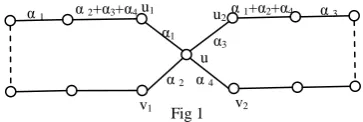
G is the graph of 2 cycles C1 and C2 with a common vertex.
Let u be the common vertex. The vertices which are adjacent with u of the two cycles C1 and C2 be u1, v1 and u2, v2
respectively. If the edges uu1, uv1, uu2, and uv2 are labeled as
α1, α2, α3 &α4, the α΄s are chosen from A* such that the edge
labels are nonzero, then the vertex sum at u is α1+α2+α3+α4.
To get this vertex sum at each of the other vertices we have to label the edges of cycle C1 as α2+α3+α4 and α1 alternatively
from the edge which is adjacent with uu1. Similarly the edges
of the cycle C2 are labeled as α1+α2+α4 and α3 alternatively
from the edge which is adjacent with uu2. This labeling gives
the vertex sum as α1+α2+α3+α4 at all vertices except at v1 and
Case 1:
Both C1 and C2 are odd cycles.If C1 and C2 are odd cycles the edge which is adjacent with
uv1 gets the label as α 2+α3+α4 and the edge which is incident
with uv2 gets the label as α1+α2+α4. So at v1 and v2 the magic
condition requires
α2+α3+α4 +α2 = α1+α2+α3+α4
α1+α2+α4 +α4 = α1+α2+α3+α4
Hence α1 =α2, and α3 =α4.
Thus when the cycles C1 and C2 are odd, the edges incident
with u of Ci (i=1,2) are labeled as αi (i=1,2) the remaining
edges of C1 are labeled as α1+2α2 and α1 alternatively while
those of C2 labeled as 2α1+α2 and α2 alternatively. This
labeling gives the vertex sum 2(α1+α2).
Case 2:
Both C1 and C2 are evenIf C1 and C2 are even cycles the edge which is adjacent with
uv1 gets the label as α1 and the edge which is adjacent with
uv2 gets the label as α3. So at v1 and v2 the magic condition
requires
α1+α2 = α1+α2+α3+α4
α3+α4 = α1+α2+α3+α4
Hence α1+α2 =0, and α3 +α4 = 0
This leads to the vertex sum as zero.
Hence when the cycles C1 and C2 are even, by the above
discussion G is zero sum magic.
Case 3:
Either C1 or C2 is oddSuppose C1 is odd and C2 is even, the edge which is adjacent
with uv1 gets the label as α2+α3+α4 and the edge which is
adjacent with uv2 gets the label as α3.
So at v1 and v2 the magic condition requires
α2+α3+α4 +α2 = α1+α2+α3+α4
α3+α4 = α1+α2+α3+α4
Hence α1=α2, and α1+α2 =0.
Which in turn α1 = 0 which is impossible. □
This result can be extended to BV (n1,n2,…nk).
4.2 Theorem
BV (n1,n2,…nk) for k
3 is group magic.Proof :
Denote the common vertex in BV (n1,n2,…nk) as u and the
vertices of Cj which are adjacent to u as uj and vj for every j =
1,2,…k.
Case 1:
Among Cj ′s (j=1,2,…k) at least two are even cycles.For our convenience let us take C1, C2, … ,Cs are the odd cycles
and the remaining k-s cycles are even. In each Cj , label the
edges uuj and uvj as α2j-1 and α2j . At u the vertex sum is
. Choose α΄s from A* such that the edge labels are nonzero.
In C1 the remaining edges are labeled - α1 and α1
alternatively from the edge which is incident with u1. At v1 the
magic condition requires
- α1+α2 = . That is α1=α2
Similarly we can do for the cycles Cj for j=2,…,s.
we have α2j-1 = α2j for j=2,…s .
In each Cj for j = s+1,s+2,…k, the remaining edges are labeled
- α2j-1 and α2j-1 alternatively from the edge which is
incident with uj. At vj the magic condition requires
α2j-1+α2j = .
That is = 0 for each j = s+1,s+2,…k
These k-s equations can be written as,
2 + = 0 (1)
Taking M = -2
Equation (1) gives
= M
From these k-s equations we get α2j-1+α2j =α2i-1+α2i for every i
and j = s+1,s+2,…k.
Substituting in (1) we get for each j = s+1,s+2,…k
2 + (k-s-1)( α2j-1+α2j ) = 0
That is α2j-1+α2j = M (2)
Provided k-s ≠1, that is BV (n1,n2,…nk) contains at least two
even cycles.
Thus choosing αj for j = s+1,s+2,…k in such a way that it
satisfies (2) will give the group magic labeling with the vertex sum
= -M + (k-s) (α2j-1+α2j )
= -M + M
= M (3)
If all the cycles are even then M takes the value zero. So BV(n1,n2,…nk) is zero sum magic when all n΄s are even.
Case 2:
Among Cj ′s (j=1,2,…k) only one Cj is even cycle.Let Ck be the even cycle. Label the edges uuj and uvj as αj
(j=1,2,…k-1) and the remaining edges of those Cj ′s are
labeled T-αj and αj alternatively, where T is the vertex sum.
Label the edges uuk and uvk as αk andαk′. Here the vertex sum
is
T = 2 +αk+αk′
Since Ck is even cycle, the remaining edges of Ck are labeled
as T-αk andαk alternatively from the edge which is incident
with uk. At vk the magic condition requires
α2
α1
α 2
u2
α 1
α 1
α1+2α2 2α1+α2
v1 v2
α 1
α1+2α2
Fig 2 u u1
α1+2α2
α3
u α1
α 2
v2
α 1
α 4
Fig 1 v1
α 3
u2
u1
[image:2.595.75.257.77.138.2]αk+αk′ = 2 +αk+αk′
Shows =0 (4)
Thus choosing αj for j = 1,2,…k-1 in such a way that it
satisfies (4) will give the group magic labeling with the vertex sum T = αk+αk′ . Here k>2. If k=2 the condition (4) shows α1=
0 which is impossible. This one is derived in case 3 of theorem 4.1.
Case 3:
All Cj′s (j=1,2,…k) are odd.Label the edges uuj and uvj as αj (j=1,2,…k) and the
remaining edges of Cj are labeled alternatively as 2 - αj
and αj. This labeling induces a vertex sum 2 . □
4.3 Illustrations
For case 1
Consider k=4 and s=2 and choose the edge labels α1=α2=1, α3
=α4 = 2, then M = -2(1+2) = -6 and k-s-1 = 1
Now choose α5, α6, α7, and α8 such that
α5+α6 = -6 and α7+α8 = -6, here the vertex sum is -6.
For case 2
Let k = 4 and s = 1
4.4 Corollary
BV (n1, n2,…nk) for k
3 is h - magic for h > k where k is themaximum of all edge labels.
4.5 Theorem
The chain of three cycles C(n1,n2,n3) is group magic.
Proof:
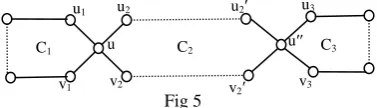
Consider 3 cycles C1, C2, and C3. Let u′ be the vertex common
to C1 and C2 and the vertex common to C2 and C3 be u′′. Let
the vertices adjacent to u′ in C1 be u1, v1, those in C2 be u2, v2
and the vertices adjacent to u′′ in C2 be u2′′, v2′, those in C3 be
u3, v3.
We label the edges u′u1, u′v1, u′u2 and u′v2 as α1, α2, α3, and α4
respectively. Choose α΄s from A* such that the edge labels are nonzero.
To get the vertex sum as α1+α2+α3+α4 at the vertices of C1 we
label the other edges of C1 as α2+α3+α4 and α1 alternatively
from the edge which is adjacent with u′u1.
Result:1
If C1 is odd cycle the edge incident with v1 will receive the
label as α2+α3+α4. To satisfy the magic condition at v1 we
require
α2+α3+α4+α2 = α1+α2+α3+α4.
Hence α2 = α1. Here the vertex sum is 2α1+α3+α4.
Result : 2
If C1 is even, the edge incident with v1 will receive the label
as α1.
The magic condition requires
α1+α2 = α1+α2+α3+α4.
Hence α3+α4 = 0
This shows the edges u′u2 and u′v2 in C2 receives labels α3 and
-α3. Here the vertex sum is α1+α2.
The above discussed results also hold for the cycle C3. In C2
there are 2 paths joining u′ and u′′. Let them be P and Q. Now we see the labeling of G in the following cases.
Case 1:
C2 even C1 and C3 are oddBy the result (1) the edges u′′u3 and u′′v3 in C3 receives the
same label α1.
To get the vertex sum at the vertices of C2 as 2α1+α3+α4, along
P the edges of C2 can be labeled as 2α1+α4 and α3 alternatively
from the edge which is incident with u2 and along Q the edges
of C2 labeled as 2α1+α3 and α4 alternatively from the edge
which is incident with v2.
As C2 is even, both P and Q contain either odd or even
number of edges. If both P and Q contain odd number of edges, along P, u2′u′′ and along Q, v2′u′′ gets the label as α3
and α4. The remaining edges in C3 receive α1+α3+α4 and α1
alternatively. This labeling gives the vertex sum 2α1+α3+α4.
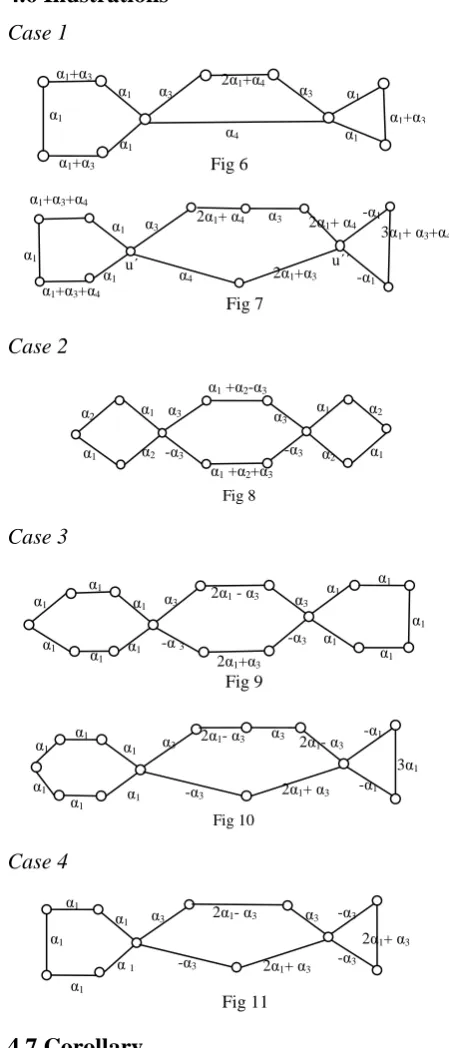
As P and Q are the paths joining u′ and u′′ and since G is a simple graph both P and Q cannot contain exactly one edge. So C2 must contain more than four edges. Refer figure 6.
If both P and Q contain even number of edges, along P, u2′u′′
and along Q, v2′u′′ gets the label as 2α1+α4 and 2α1+α3.
To attain the magic condition at u′′, the edges of C3 which are
incident with u′′ must take the label as – α1 and -α1. The
remaining edges in C3 receive 3α1+α3+α4 and -α1 alternatively.
In this case also the vertex sum is 2α1+α3+α4. Referfigure 7.
Case 2 :
All C1,C2 and C3 are even.From result (2) α4 = -α3 . If both P and Q contain odd number
of edges, along P, u2′u′′ and along Q, v2′u′′ gets the label as α3
and -α3. Here α3 should be chosen in such a way that α3 ≠
u2
u1
v1 v2
u2′
v2′
u3
v3
u C u′′
2
C1 C3
Fig 5
1 1 8
2
2
-3 -3 4
5 5
4
1 2
12
-3 7 7
2
Fig 4 1 1 2
2 3 -9
-9 -7
-8 -10
-10
3 4
4
[image:3.595.342.531.350.404.2]α1+α2. The edges of C1 and C3 receive the labels α1 and α2
alternatively. Here the vertex sum is α1+α2. Refer figure 8.
If both P and Q contain even number of edges, along P, u2′u′′
and along Q, v2′u′′ gets the label as α1+α2-α3 and α1+α2+α3.
Since C3 is even from result (2) we have
α1+α2-α3 = -(α1+α2+α3).
This shows α1+α2 = 0. In this case the graph is zero sum
magic.
Case 3:
C2 even and either C1 or C3 is odd.Suppose C1 is even from the result (2) α4 = -α3. If both P and
Q contain odd number of edges, along P, u2′u′′ and along Q,
v2′u′′ gets the label as α3 and -α3. To attain the magic condition
at u′′, the edges of C3 which are incident with u′′ must take the
label as α1 and α2. Since C3 is odd by the result (1) we have
α2 = α1. Hence the edges of C2 along P receive labels 2α1-α3
and α3 alternatively from the edge which is incident with u2
and those along Q receives 2α1+α3 and -α3 alternatively from
the edge which is incident with v2. Here α3 should be chosen
in such a way that α3 ≠ 2α1. The remaining edges in C3 receive
α1. This labeling gives the vertex sum 2α1. Refer figure 9.
If both P and Q contain even number of edges, discussing as before in this case also the vertex sum is 2α1. Refer figure 10.
Case 4:
All C1, C2 and C3 are odd.By the result (1) the edges in C1 which are incident with u′
receives the same label α1. Since C2 is odd either P or Q
contains odd number of edges. Suppose P contain odd number of edges, the edge in P which is incident with u′′ receives α3.
The edge in Qwhich is incident with u′′ receives 2α1+α3. The
magic condition at u′′ requires the labels of edges of C3
incident with u′′ as α4 and –α3. Since C3 is odd from result (1)
we have α4 = -α3. In this case the vertex sum is 2α1 and α3
should be chosen in such a way that α3 ≠ 2α1. Suppose Q
contain odd number of edges, same result derived from the similar argument. Refer figure 11.
Case 5:
C2 is odd and both C1 and C3 are evenSince C1 is even, from the result (2) α4 = -α3. If P contains odd
number of edges, the edge in P which is incident with u′′ receives α3. The edge in Qwhich is incident with u′′ receives
α1+α2+α3. Since C3 is even from result (2) we have
α1+α2+α3=-α3.
Shows α3 = -(α1+α2)/2.
Hence choosing α3 as -(α1+α2)/2 the labeling is possible and it
gives the vertex sum α1+α2. Suppose Qcontain odd number of
edges, same result derived from the similar argument.
Case 6:
C1, C2 are odd and C3 evenBy the result (1) the edges in C1 which are incident with u′
receives the same label α1. If Pcontains odd number of edges,
the edge in Pwhich is incident with u′′ receives α3. The edge
in Qwhich is incident with u′′ receives 2α1+α3. Since C3 is
even from result (2) we have
2α1+α3 = -α3.
And therefore α3 = -α1.
Hence choosing α3 as -α1 labeling is possible and it gives the
vertex sum α1+α4. □
4.6 Illustrations
Case 1
Case 2
Case 3
Case 4
4.7 Corollary
G is h - magic for h > k where k is the maximum of all edge labels.
4.8 Theorem
The chain of cycles C(n1,n2,…nk) is zero sum magic when k
and all Cj’s are even.
Proof:
The case k = 2 is in the case- 2 of theorem 4.1.
For i=1,2,…,k-1, let ui be the vertex common to Ci and C(i+1)
and let Pi and Qi are the paths joining ui and u(i+1).
Consider C (n1, n2,…nk) for k=4. The labeling of the graph is
discussed as in theorem 4.5. From result (2) of theorem-4.5 the edges of C1which are incident with u1 gets the labels α1
α3
α1
α 1 -α3
-α3
-α3
α1
α1
2α1+ α3
2α1+ α3
α3
Fig 11
α1
2α1- α3
α3
α1
α1 -α3
-α1
-α1
2α1+ α3
2α1- α3 2α 1- α3
Fig 10 α1
α1
α1
α1
3α1
α3
α1
α1
α1
-α 3
α1
α1
α1
α1
α1
α3
-α3
α3
2α1 - α3
2α1+α3
α1
α1
α1
Fig 9
α2
α1
α2 -α3
α1
α1
α2
α1
α2
-α3
α3
α1 +α2+α3
α1 +α2-α3
α3
Fig 8 α3
u΄ α1
α1 α4
u΄΄ -α1
-α1
2α1+α3
2α1+ α4 2α1+ α4
Fig 7
α1
α3
α1+α3+α4
α3
α1
α1
α4
α1
α1
α3
α1+α3
+α4
α1+α3
+α4
α1+α3
+α4
Fig 6
2α1+α4
α1
3α1+ α3+α4
[image:4.595.312.537.82.607.2]and α2 and the edges of P1 and Q1 which are incident with u1
gets labels α3 and -α3.Since all cycles are even, for i=1,2 and 3
both Pi and Qi contains either even or odd number of edges.
Consider both Pi and Qi contains even number of edges. In C2
if the edge of P1 and Q1 gets the label α3 and -α3 then the edge
of P1 and Q1 which is incident with u2 gets the label α1+α2-α3
and α1+α2+α3. To get the vertex sum at u2 as α1+α2, the edges
of C3 incident with u2 gets -α1 and -α2. The edges of C3 which
are incident with u3 receive the label 2α1+α2 and α1+2α2. As
C4 is even from result (2), 2α1+α2+α1+2α2=0. This proves the
vertex sum as zero.
Consider both Pi and Qi contains odd number of edges. In C2
if the edge of P1 and Q1 gets the label α3 and - α3 then the edge
of P1 and Q1 which is incident with u2 also gets the label α3
and -α3 respectively. To get the vertex sum at u2 as α1+α2, the
edges of C3 incident with u2 gets α1 and α2. The edges of C3
which are incident with u3 receive the label α1 and α2. As C4 is
even from result (2), α1+α2=0. This proves the vertex sum as
zero.
Suppose both P1 and Q1 contains even number of edges and
both P2 and Q2 contains odd number of edges. Discussing the
edge labels as above the edge of P1 and Q1 which is incident
with u2 gets the label α1+α2-α3 and α1+α2+α3. To get the
vertex sum at u2 as α1+α2, the edges of C3 incident with u2
gets -α1 and -α2. The edges of C3 which are incident with u3
receive the label -α1 and -α2.
Similarly we can prove for any even number k, the labeling of the graph C(n1,n2,…nk) as discussed in the above two cases
will give the vertex sum as zero. □
4.9 Theorem
Let C (n1,n2,…nk) be a chain of k cycles Cj with k is odd and
all Cj’s are even. For i = 1,2,…k-2, let Pi’s and Qi’s are the
paths in the cycle C(i+1) connecting the vertices ui and u(i+1)
where the vertex ui is common to Ci and C(i+1) and the vertex
u(i+1) is common to C(i+1) and C(i+2). If P’s and Q’s contains
odd number of edges then C (n1,n2,…nk) is group magic and if
P’s and Q’s contains even number of edges then C(n1,n2,…nk)
is zero sum magic.
Proof:
As the end cycle C1 is even by result (1) of theorem 4.5 the
edges of C1which are incident with u1 gets the labels α1 and α2
and the edges of P1 and Q1 which are incident with u1 gets
labels α3 and -α3. Since all cycles are even, for i=1, 2,..., k-2,
both Pi and Qi contains either even or odd number of edges.
Consider all Pi’s and Qi’s contains odd number of edges. The
edges of P1 and Q1 incident with u2 get the labels α3 and -α3
and the edges of P2 and Q2 incident with u2 gets the labels α1
and α2. Since P2 and Q2 contains odd number of edges, the
edges of P2 and Q2 incident with u3 get the labels α1 and α2
and the edges of P3 and Q3 incident with u3 gets the labels α3
and -α3. Continuing in the same way it can be observed that
the edges of Pk-1 and Qk-1 incident with uk-1 gets the labelsα3
and -α3 and the edges of Ck incident with u(k-1) gets the labels
α1 and α2 since k is odd. Thus at all vertices the vertex sum is
α1+α2.
Consider all Pi’s and Qi’s contains even number of edges. The
edges of P1 and Q1 incident with u2 get the labels α1+α2-α3 and
α1+α2+α3 and the edges of P2 and Q2 incident with u2 gets the
labels -α1 and -α2. Since P2 and Q2 contains even number of
edges, the edges of P2 and Q2 incident with u3 get the labels
2α1+α2 and α1+2α2 and the edges of P3 and Q3 incident with u3
gets the labels -2α1 and -2α2. Continuing in the same way it
can be observed that the edges of Pk-1 and Qk-1 incident with
uk-1 gets the labels (k-2)α1+α2 and α1+(k-2)α2 since k is odd.
Since Ck is even from result (2) of theorem 4.5, we have
(k-2)α1+α2+α1+(k-2)α2=0.
This shows the vertex sum α1+α2 is zero. □
5. CONCLUSION AND FUTURE WORK
In theorems 4.1 and 4.2 it was derived that in group magic labeling of BV (n1, n2,…nk) the vertex sum contains as many
distinct labels as many odd cycles. The vertex sum is zero when all cycles are even. The chain of cycles C(n1,n2,…nk) is
group magic when there are odd number of cycles in C(n1,n2,…nk) also the path connecting the common vertices
have odd number of edges. The chain of cycles C(n1,n2,…nk)
is zero sum magic when there are even number of even cycles in C(n1,n2,…nk) and also in the case that there are odd number
of cycles in C(n1,n2,…nk) and the path connecting the
common vertices have even number of edges. We further work to derive the group magic labeling to the chain of cycles C(n1,n2,…nk) in the remaining cases.
6. REFERENCES
[1] Joseph A. Gallian, A Dynamic Survey of Graph Labeling, Fourteenth edition, November 17, 2011.
[2] E.Salehi, P.Bennett, “Integer-Magic Spectra of Caterpillars”, J. Combin. Math. Combin. Comput., 61 (2007), 65-71.
[3] C. Shiu, Richard M.Low, “Group magicness of complete n- partite graphs”
[4] Baskar Babujee, L.Shobana, “On Z3- magic graphs”,
Proceedings of the International Conference on mathematics and computer science,131-136.
[5] Ebrahim salehi ,“Zero-sum magic graphs and their null sets”, ARS combinatorial 82(2007),41-53
[6] E. Salehi, “Integer-Magic Spectra of Cycle Related Graphs”, Iranian J. Math. Sci Inform., 2 (2006), 53-63.
[7] K.Kavitha , R.Sattanathan, “Group magicness of some special graphs”, Proceedings of the International Conference on Mathematical Methods and Computation,24-25 July,2009.pp.152-157.
[8] K.Kavitha , R.Sattanathan, “Construction of group magic labeling of multiple copies of cycles with different sizes”, International Journal of Algorithms, Computing And Mathematics, Vol 3,No.2,May 2010,1-9
[9] K.Kavitha , R.Sattanathan, “Group magic labeling in biregular graphs” IJAM, Volume 23 No. 6,2010 ISSN 1311-1728,1103-1116
[10] K.Kavitha, K.Thirusangu, “Group magic labeling of two or more cycles with a common vertex” International conference on Bioinformatics, Computational biology 23-25 July,2012 (yet to be published).