© 2017, IRJET | Impact Factor value: 5.181 | ISO 9001:2008 Certified Journal | Page 3351
STUDIES ON STRENGTH AND DURABILITY PROPERTIES OF POLYMER
MODIFIED MORTARS AS A REPAIR MATERIAL
Eldho Peter
1, Sooraj V.S
21M.Tech Student, Dept. of Civil Engineering, Sree Narayana Gurukulam College of Engineering, Ernakulam, Kerala,
India
2Assistant Professor, Dept. of Civil Engineering, Sree Narayana Gurukulam College of Engineering, Ernakulam,
Kerala, India
---***---Abstract -Civil infrastructure around the world is in a
state of utter disrepair and significant efforts are needed on the part of all stakeholders to render our failing infrastructure back to a serviceable and safe state. Since Concrete is a major construction material, the economic aspects and long term serviceability should be major concern while choosing demolition, rebuilding or renovation. Concrete repairing mainly includes removing structurally unsound concrete and replacing it with repair or overlay materials. This chapter presents the results of the compressive strength and durability studies conducted on the polymer modified repairing mortars like Styrene Butadiene Rubber(SBR) modified mortar, Acrylic modified mortar over conventional cement mortar. The type of various polymer modified repair materials were studied on the basis of their compressive strength and durability properties. The effect of acid conditioning and alternative temperature cycles on compressive strength and weight loss of repair materials were studied.Key Words: Compressive Strength, Temperature
Cycles, Acid Attack, Styrene Butadiene Rubber, Acrylic Modified Mortar, Polymer Modified Mortar
1.INTRODUCTION
The degree of success of repair material in concrete depends mainly on the correct choice and the method of application of repair materials. Addition of polymer in cement and aggregate act as an polymer modified mortar which has very effective results as compared to that of the conventional mortar [1].The addition of polymer improves workability, flexural strength tensile strength [2].Polymer forms a layer on the cement and aggregate paste which results in the less permeability of concrete. [3].Polymer forms a skin or crust in the surface if it is in contact with air for long time which causes rapid hydration of the moisture
from the surface and it will result in tearing of the surface [3]. One of the key properties of repair materials is its durability. Durable repair can be defined as the repair which renders capability of a repaired structure and its components to maintain the serviceability over the designed period of time in a specified environment. In tropical climates there will climatic changes will occur and it affect negatively to concrete structures. The thought of alternate thermal cycles effect comes under this scenario. Durability is a major concern for concrete structures exposed to aggressive environments like acid exposure and alternate thermal cycles[4]. This is particularly relevant in cases where design is controlled by durability requirements of reinforced concrete members. Polymer modification of cement mortar enhances some properties of conventional cement mortars. Repair materials were treated under acid and thermal cycles .The durability against external acid attack is evaluated as per ASTM C 267-01, which is the standard test method for the chemical resistance of mortars, grouts and polymer concrete, was the basis for this test procedure.
2. EXPERIMENTAL INVESTIGATION 2.1 General
The following test methods were conducted in laboratory on specimens as per the standard procedures given in IS Codes to assess
Compressive Strength
© 2017, IRJET | Impact Factor value: 5.181 | ISO 9001:2008 Certified Journal | Page 3352
2.2 Materials Used
Ordinary Portland Cement conforming to Indian standards (IS 1489-1991), Fine aggregate of Zone I grading as per Indian standards (IS 383). The Repair material used was commercially available SBR latex and Acrylic Latex (40% solids) of a reputed manufacturing company. 98.08% Concentrated sulphuric acid were used as acid in this study.
2.3Mix Proportion of Repair Mortar
Cement mortar cubes were made with the following mixes. (1)Cement mortar of mix proportion 1:3 with a water to cement ratio by weight (w/c ratio) of 0.50.(2) Cement mortar of mix proportion 1:3 with SBR added at the rate of 20 % of the weight of cement at w/c ratio of 0.30.(3) Cement mortar of mix proportion 1:3 with Acrylic Polymer latex added at the rate of 20 % of the weight of cement at w/c ratio of 0.30 . The 1:3 cement–sand mortar is selected as per the minimum ratio in which repair works were done. It is observed that minimum w/c ratio required for the cement mortar workable is 0.5. Mix proportion of polymer modified repair materials were done as per manufacturer’s recommendations.
2.3 Specifications of Specimen
The dimensions of mortar cubes were 70.6 mm x 70.6 mm sides of cross-section area 50 cm2. All the
parameters were kept same for all the specimens for the purpose of comparing the effect of modification of cement mortar by polymer latex under compression.12 samples were casted for each repair material. Nomenclature of specimens were given as CM01 (Cement Mortar specimen of samples 01), SBR01 (SBR Modified Mortar specimen of sample 01), ACR01 (SBR Modified Mortar specimen of sample 01).
2.3 Preparation of test specimen
The quantity of materials already calculated were taken and mixed dry with trowel for one minute and then add calculated quantity of water as per the specified w/c ratio. In unmodified cement mortar
the materials used werecement and fine aggregates, In case of polymer modified mortars corresponding polymer latex of specified quantity were added as cement modifier and then mixed the materials until the mixture was of uniform colour. Then placed it in the standard cube mould and prodded with the rod. The mortar in the mould was prodded 20 times in about 8 seconds to ensure the elimination of entrained air. Then placed the cube moulds in room temperature of 27oC for 24 hours. Then demoulded
the specimens and immediately submerged in clear water for 28 days of curing. Total 12 specimens were casted for each repair material and after curing specimens were divided in to three specimens for each exposure conditions. The exposure conditions were:- 1) Specimens under normal conditions of 28 days and 56 days. 2) Specimens dried under 20 thermal cycles (one thermal cycle constitute 8 hours of oven dry at 70oC and 16 hours of room
temperature 3) Specimens were immersed in acid for 7 days after 28 daysof normal curing.
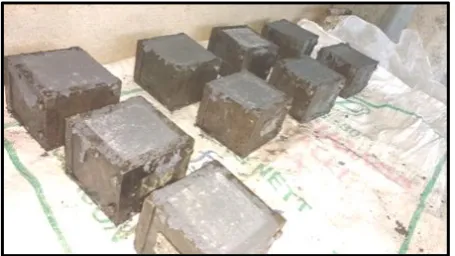
Fig-1: Casted mortar specimens.
[image:2.595.308.536.422.550.2] [image:2.595.307.516.590.717.2]© 2017, IRJET | Impact Factor value: 5.181 | ISO 9001:2008 Certified Journal | Page 3353
Fig-3: Specimens in acid Fig-4:Specimens in oven 2.4 Test set up
After a curing period of 28 days, all the specimens were tested in the compression testing machine of 1000kN capacity.Range selected is 0kN-500kN.Testing procedure for all the specimens were same. The load was applied at a uniform rate 350kg/cm2/minute till the specimens reached the
value of its maximum load .Maximum load of the all the specimens were determined. The test set up is shown in Fig -5. A front view of mortar cube specimens under loading is shown in Fig -6.
Fig -5: Test set-up Fig -6:Mortar Cubes under loading
3. RESULTS AND DISCUSSION
3.1 Compressive Strength of Repair Mortars
The control specimen under normal condition shows an average compressive strength of 30.26 N/mm2
and 31.6 N/mm2 at 28 days and 56 days respectively
due to compression of concrete. While testing SBR modified mortars,it shows an average compressive strength of 31.4 N/mm2 and 33.06 N/mm2 and in
case of Acrylic modified mortars it shows 31.33 N/ mm2 and 32.26 N/ mm2 at 28 days and 56 days
respectively. After thermal cycles, the values of repair material’s compressive strength shows increasing. CM specimens shows an average compressive strength of 34.4 N/mm2 and SBR
modified specimens and Acrylic modified specimens 37.34 N/mm2 and 35.24 N/mm2 respectively.
M.Sautaraja et.al [6] observed that the presence of three dimensional polymer latex influenced in increasing the compressive strength. The strength of polymerconcrete increased with dry curing than wet curing [6].
Afteracid immersion of 7 days, the compressive strength values of repair material’s shows decreasing. CM specimens shows an average compressive strength of 17.2 N/mm2 while SBR
modified specimens and Acrylic modified specimens shows 18.53 N/mm2 and 17.67 N/mm2 respectively.
Chart -1: Compressive Strength of Repair materials
© 2017, IRJET | Impact Factor value: 5.181 | ISO 9001:2008 Certified Journal | Page 3354
Chart-3: Compressive Strength of Repair materials after acid immersion.
The effect of acid attack shows the compressive strength of repair materials were affected due to leaching process. While all the specimens were given similar duration of acid attack. The % of decrease in compressive strength with compare to unmodified cement mortar were SBR modified mortar(7.75%) andAcrylic modified repair material (2.71%) .
3.2 1 Weight Loss of Repair Mortars Due To Acid Attack
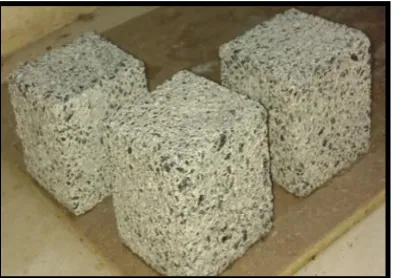
Fig -4: Cube Specimens after 7 days acid immersion
Fig -5: SBR cube specimens after acid attack
It is observed that for CM specimens, after 7 day of acid immersion, the surface of cubes were completely peeled off and white patches were seen on the surface. But in case of SBR and ACR specimens surface was seen partially peeled off. The rate of degradation was less in polymer modified mortars (SBR>Acrylic) than unmodified cement mortar Moreover, among three repair mortars, SBR modified mortars and Acrylic modified mortars shows comparatively lesser % of degradation than cement mortar
.
But polymer modified mortars have not resist acids of high pH. Earlier studies shows it is good in alkaline medium[5].Chart-3: Percentage of Weight Loss in Repair materials after acid immersion.
It can be seen that the specimens of polymer modified mortars shows improvement in strength and durability properties with compare to conventional cement mortar under various environmental conditions.
4. CONCLUSIONS
Following conclusions are drawn based on the results obtained from experiment.
i. Polymer modified mortar cubes shows improvement in compressive strength of SBR and Acrylic 4.64 % and 2.11% higher than control cement mortar at 56 days of curing. ii. For long term durability, it is recommandable
to use polymer modified mortars in areas which exposed to weather.
[image:4.595.314.546.314.433.2] [image:4.595.40.238.429.568.2]© 2017, IRJET | Impact Factor value: 5.181 | ISO 9001:2008 Certified Journal | Page 3355 in strength and durability properties than
both Acrylic modified mortar and cement mortar.
iv. For polymer modified mortars, the rate of degradation is less compared with cement mortar.
REFERENCES
1. Abdulkader Ismail A.Al-Hadithi and Ghassan S. Jameel Al-Kubaysi (2013), “Improving The Mechanical Properties Of Steel Fiber Concrete Using Acrylic Polymer”, The Iraqi Journal Of Mechanical And Material Engineering,(D),4,1-15.
2. S.B.Singh, Pankaj Munjal and NikeshThammishetti, (2015),“Role of water/cement ratio on strength development of cement mortar”,Journal of Building Engineering,4,94–100.
3. Moetaz M. El-Hawary, Ali Abdul-Jaleel and Thamer AI Yaqoub(2004 ),“Corrosion And Durability Of Polymer Modified Concrete”, 29th Conference on Our World in Concrete & Structures”, Singapore.
4. R.Radhakrishnan, Syam prakash. V,C.K.Prasad Verma Thampan, (2012), “Performance Of Styrene Butadiene Rubber As A Concrete Repairs Material In tropical Climate”, International Journal of Advancement In Research And Technology, 6, ,pp1-5.
5. Joao Feiteira and Maria S. Ribeiro,(2013), “Polymer Action On Alkali–Silica Reaction In Cement Mortar”, Cement and Concrete Research ,44,97–105.