http://dx.doi.org/10.4236/ajor.2015.51002
JIT Mixed-Model Sequencing Rules: Is There
a Best One?
Patrick R. McMullen
School of Business, Wake Forest University, Winston-Salem, North Carolina, USA
Email:
[email protected]
Received 3
November 2014; revised 29
November 2014; accepted 10
December 2014
Copyright © 2015 by author and Scientific Research Publishing Inc.
This work is licensed under the Creative Commons Attribution International License (CC BY).
http://creativecommons.org/licenses/by/4.0/
Abstract
This research effort compares four sequencing rules intended to smooth production scheduling
for mixed-model production systems in a Just-in-Time/Lean manufacturing environment (“JIT”
hereafter). Each rule intends to schedule mixed-model production in such a way that
manufactur-ing flexibility is optimized in terms of system utilization, units completed, average process
in-ventory, average queue length, and average waiting time. A simulation experiment, where the
various sequencing rules are tested against each other in terms of the above production measures,
shows that three of the sequencing rules essentially offer the same performance, whereas one of
them shows more variation.
Keywords
JIT/Lean Manufacturing, Scheduling, Sequencing, Enumeration, Simulation
1. Introduction
In a JIT/Lean manufacturing environment, it is important to schedule production in such a way that units are
manufactured in direct proportion to their demand. Otherwise, in-process inventories accumulate, throughput
time increases, schedule compliance suffers, all resulting in sub-optimal performance
[1]
. Consider the simple
example where four units of Item A are demanded, two units of Item B are demanded and one unit of Item C is
demanded. One possible schedule is as follows: AAAABBC. While changeovers are minimized, units are not
sequenced proportional to demand. The following schedule would be better in terms of “smoothing out”
produc-tion in terms of demand: ABACABA
[2]
.
This paper explores four of the more common sequencing rules, uses them to sequence mixed-model
produc-tion schedules, simulates producproduc-tion schedules under various condiproduc-tions, and analyzes the performance of the
various rules.
2. Sequencing Rules
Four sequencing rules are investigated for this research effort. Prior to presenting the individual rules, a few
definitions are needed.
Symbol Definition
i Index for all items
n Number of all items
(
i=1, 2,,n)
k Index for each unique item
i
d Demand for unique item i
(
k=1, 2,,di)
D Total number of items (or total demand)
i
∆ Average gap between units of each unique item
i k
∆ Actual gap between positions k + 1 and k for item i
ik
x The number of units of i produced through the kth sequence position
As an example for the sequence: ABACABA, we have
∆
ikvalues of (2, 2, 2, 1) for
i
=
1
(Item A), (4, 3)
for
i
=
2
(Item B), and (7) for
i
=
3
(Item C). When we calculate these
∆
ikvalues, we assume that the
se-quence cycles over and over. For the
∆
ivalues, we simply use
D d
i( )
∀
i
, yielding values of
(
7 4 , 7 2 , 7 1
)
for this particular problem.
2.1. Minimize Maximum Response Gap (MRG)
The first objective function to be studied is the minimization of the maximum response time for a sequence
[3]
.
Mathematically, this is as follows:
(
)
min : max max
ik ii k
∆ − ∆
(1)
For our example problem, this objective function value would be as follows:
(
)
(
)
(
)
(
)
max max 2 7 4 , 2 7 4 , 2 7 4 , 1 7 4 , max 4 7 2 , 3 7 2 , max 7 7 1
−
−
−
−
−
−
−
,
which reduces to:
max 0.75, 0.50, 0.0
(
)
=
0.75
.
2.2. Minimize Average Gap Length (AGL)
The next objective to be studied is the minimization of the average distance between the actual gap and the
av-erage gap
[4] [5]
. Mathematically, this is as follows:
1 1
min :
i
d n
i k i i k
D
= =
∆ − ∆
∑∑
(2)
The example problem above, the objective function value would be as follows:
2 7 4
2 7 4
2 7 4
1 7 4
4 7 2
3 7 2
7 7 1
7
−
+ −
+ −
+ −
+ −
+ −
+ −
, resulting in a value of 0.3571.
2.3. Minimize Gap Variation (VAR)
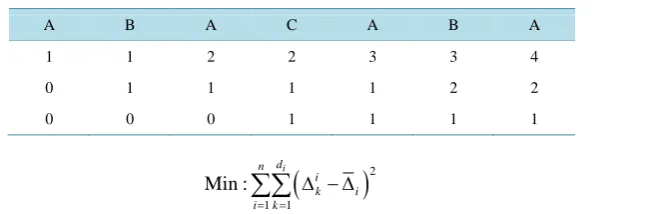
A B A C A B A
1 1 2 2 3 3 4
0 1 1 1 1 2 2
0 0 0 1 1 1 1
(
)
21 1
Min :
i
d n
i k i i= k=
∆ − ∆
∑∑
(3)
Using the example problem above, the objective function value would be:
(
) (
2) (
2) (
2) (
2) (
2) (
2)
22 7 3
−
+ −
2 7 3
+ −
2 7 3
+ −
1 7 3
+ −
4 7 2
+ −
3 7 2
+ −
7 7 1
. This calculation results in a
value of 1.25.
2.4. Minimize Usage Rate (USAGE)
The final objective function to be explored is the minimization of the usage rate—keeping as constant as
possi-ble in assigning units for sequencing
[7]
. Mathematically, this is as follows:
2
1 1
Min :
i
d D
i ik k i
d
x
k
D
= =
−
∑∑
(4)
For the example problem, the objective function value is 1.7143, when using
x
ikvalues reflecting the
se-quence:
A B A C A B A
1 1 2 2 3 3 4
0 1 1 1 1 2 2
0 0 0 1 1 1 1
3. Experimentation
To determine which of the sequencing rules is most effective in terms of the JIT/Lean objectives mentioned
pre-viously, experimentation is conducted. Several problem sets are simulated according to their best sequence in
terms of the objectives described above, simulation is performed, data is collected from the simulation, and
analysis is made in an attempt to differentiate performance among the four presented objectives
[8]
.
3.1. Problem Sets
Eight problem sets are used for experimentation, starting with a small problem and having the problems grow
large to the point where finding the optimal sequencing (via complete enumeration) in terms of the objective
function values becomes computationally intractable.
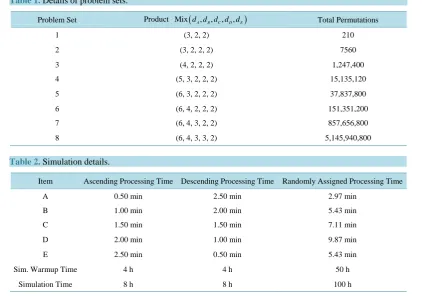
Table 1
shows the product mix details of the eight
prob-lem sets used, and the number of total permutations required for compute enumeration.
Complete enumeration is used for each problem set so that the optimal values for each objective function
shown above are obtained. It is intended to show each objective function in its “best possible light”.
[image:3.595.167.500.81.188.2]For each unique item, a processing time for the single-stage simulation has been assigned. In actuality, three
different processing time templates have been assigned to each unique item: ascending processing times,
de-scending processing times, and randomly assigned processing times on the uniformly-distributed interval (2, 10).
Table 2
summarizes the processing times for each of the three variants, along with simulation settings.
3.2. Simulation Outputs
Several output measures are used to determine the performance of the sequencing rules. They are as follows:
•
Utilization―the average amount of time the system is busy.
•
Units completed―the average number of units completed by the system.
Table 1.
Details of problem sets.
Problem Set Product Mix(
d d d dA, B, C, D,dE)
Total Permutations1 (3, 2, 2) 210
2 (3, 2, 2, 2) 7560
3 (4, 2, 2, 2) 1,247,400
4 (5, 3, 2, 2, 2) 15,135,120
5 (6, 3, 2, 2, 2) 37,837,800
6 (6, 4, 2, 2, 2) 151,351,200
7 (6, 4, 3, 2, 2) 857,656,800
8 (6, 4, 3, 3, 2) 5,145,940,800
Table 2.
Simulation details.
Item Ascending Processing Time Descending Processing Time Randomly Assigned Processing TimeA 0.50 min 2.50 min 2.97 min
B 1.00 min 2.00 min 5.43 min
C 1.50 min 1.50 min 7.11 min
D 2.00 min 1.00 min 9.87 min
E 2.50 min 0.50 min 5.43 min
Sim. Warmup Time 4 h 4 h 50 h
Simulation Time 8 h 8 h 100 h
•
Average Queue Length
―average number of units waiting to be processed.
•
Average Waiting Time
―average amount of time a unit spends waiting to be processed.
These performance measures are actual outputs from the simulation.
3.3. Design of Experiment
The general research question pursued is to determine whether or not the sequencing rules have an effect on the
simulation performance measures. This question can be adequately addressed via Single-Factor ANOVA, with
the sequencing rule as the experimental factor (of which there are four levels), and the simulation-based
per-formance measure as the response variable.
Because there are eight different production models, three different processing time templates, and five
dif-ferent simulation-based performance measures, there are (8) (3) (5) = 120 difdif-ferent analyses to perform. Each of
the (120) analyses utilize (25) simulation replications.
4. Experimental Results
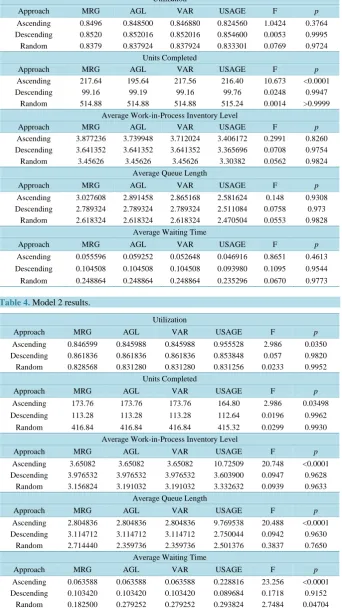
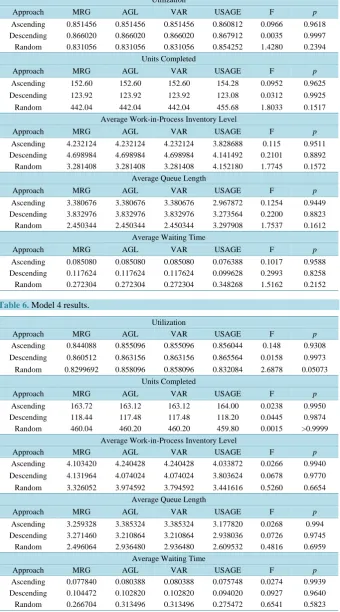
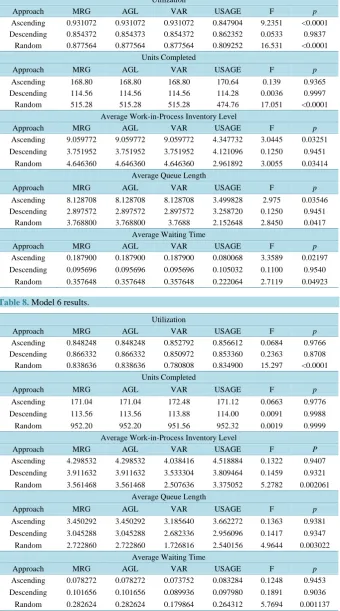
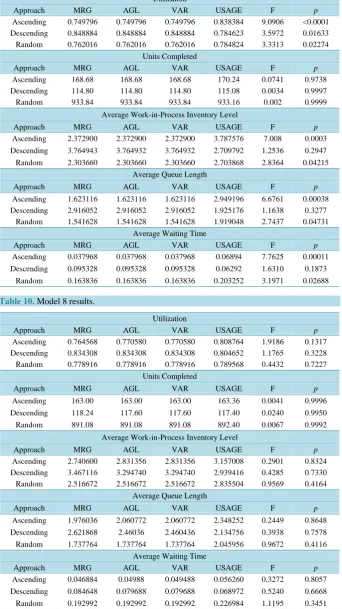
Tables 3-10
show the results of the experiments for each unique analysis, specifically including the mean for
each factor level, along with the F-statistics and associated p-value for each experiment. These tables show that
the sequencing rule has an effect on the performance measure of interest (26) times of the (120) experiments
conducted, using an
α
=
0.05
level of significance. Of these (26) times, USAGE is a superior performer
com-pared to the other three (8) times, and is an inferior performer comcom-pared to the other three (17) times. There is
one other occasion where the sequencing rule has an effect on a performance measure of interest, but the
differ-ence is not due to USAGE.
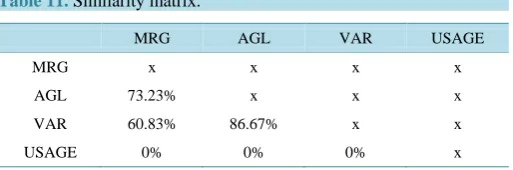
Table 11
shows the similarity between all four of the sequencing objectives, based upon the sequences
ob-tained via complete enumeration of all possible sequences for all (120) problems.
Table 3.
Model 1 results.
UtilizationApproach MRG AGL VAR USAGE F p
Ascending 0.8496 0.848500 0.846880 0.824560 1.0424 0.3764 Descending 0.8520 0.852016 0.852016 0.854600 0.0053 0.9995 Random 0.8379 0.837924 0.837924 0.833301 0.0769 0.9724
Units Completed
Approach MRG AGL VAR USAGE F p
Ascending 217.64 195.64 217.56 216.40 10.673 <0.0001 Descending 99.16 99.19 99.16 99.76 0.0248 0.9947
Random 514.88 514.88 514.88 515.24 0.0014 >0.9999 Average Work-in-Process Inventory Level
Approach MRG AGL VAR USAGE F p
Ascending 3.877236 3.739948 3.712024 3.406172 0.2991 0.8260 Descending 3.641352 3.641352 3.641352 3.365696 0.0708 0.9754 Random 3.45626 3.45626 3.45626 3.30382 0.0562 0.9824
Average Queue Length
Approach MRG AGL VAR USAGE F p
Ascending 3.027608 2.891458 2.865168 2.581624 0.148 0.9308 Descending 2.789324 2.789324 2.789324 2.511084 0.0758 0.973
Random 2.618324 2.618324 2.618324 2.470504 0.0553 0.9828 Average Waiting Time
Approach MRG AGL VAR USAGE F p
Ascending 0.055596 0.059252 0.052648 0.046916 0.8651 0.4613 Descending 0.104508 0.104508 0.104508 0.093980 0.1095 0.9544 Random 0.248864 0.248864 0.248864 0.235296 0.0670 0.9773
Table 4.
Model 2 results.
UtilizationApproach MRG AGL VAR USAGE F p
Ascending 0.846599 0.845988 0.845988 0.955528 2.986 0.0350 Descending 0.861836 0.861836 0.861836 0.853848 0.057 0.9820 Random 0.828568 0.831280 0.831280 0.831256 0.0233 0.9952
Units Completed
Approach MRG AGL VAR USAGE F p
Ascending 173.76 173.76 173.76 164.80 2.986 0.03498 Descending 113.28 113.28 113.28 112.64 0.0196 0.9962
Random 416.84 416.84 416.84 415.32 0.0299 0.9930 Average Work-in-Process Inventory Level
Approach MRG AGL VAR USAGE F p
Ascending 3.65082 3.65082 3.65082 10.72509 20.748 <0.0001 Descending 3.976532 3.976532 3.976532 3.603900 0.0947 0.9628
Random 3.156824 3.191032 3.191032 3.332632 0.0939 0.9633 Average Queue Length
Approach MRG AGL VAR USAGE F p
Ascending 2.804836 2.804836 2.804836 9.769538 20.488 <0.0001 Descending 3.114712 3.114712 3.114712 2.750044 0.0942 0.9630
Random 2.714440 2.359736 2.359736 2.501376 0.3837 0.7650 Average Waiting Time
Approach MRG AGL VAR USAGE F p
Ascending 0.063588 0.063588 0.063588 0.228816 23.256 <0.0001 Descending 0.103420 0.103420 0.103420 0.089684 0.1718 0.9152
Table 5.
Model 3 results.
UtilizationApproach MRG AGL VAR USAGE F p
Ascending 0.851456 0.851456 0.851456 0.860812 0.0966 0.9618 Descending 0.866020 0.866020 0.866020 0.867912 0.0035 0.9997 Random 0.831056 0.831056 0.831056 0.854252 1.4280 0.2394
Units Completed
Approach MRG AGL VAR USAGE F p
Ascending 152.60 152.60 152.60 154.28 0.0952 0.9625 Descending 123.92 123.92 123.92 123.08 0.0312 0.9925 Random 442.04 442.04 442.04 455.68 1.8033 0.1517
Average Work-in-Process Inventory Level
Approach MRG AGL VAR USAGE F p
Ascending 4.232124 4.232124 4.232124 3.828688 0.115 0.9511 Descending 4.698984 4.698984 4.698984 4.141492 0.2101 0.8892 Random 3.281408 3.281408 3.281408 4.152180 1.7745 0.1572
Average Queue Length
Approach MRG AGL VAR USAGE F p
Ascending 3.380676 3.380676 3.380676 2.967872 0.1254 0.9449 Descending 3.832976 3.832976 3.832976 3.273564 0.2200 0.8823 Random 2.450344 2.450344 2.450344 3.297908 1.7537 0.1612
Average Waiting Time
Approach MRG AGL VAR USAGE F p
Ascending 0.085080 0.085080 0.085080 0.076388 0.1017 0.9588 Descending 0.117624 0.117624 0.117624 0.099628 0.2993 0.8258 Random 0.272304 0.272304 0.272304 0.348268 1.5162 0.2152
Table 6.
Model 4 results.
UtilizationApproach MRG AGL VAR USAGE F p
Ascending 0.844088 0.855096 0.855096 0.856044 0.148 0.9308 Descending 0.860512 0.863156 0.863156 0.865564 0.0158 0.9973 Random 0.8299692 0.858096 0.858096 0.832084 2.6878 0.05073
Units Completed
Approach MRG AGL VAR USAGE F p
Ascending 163.72 163.12 163.12 164.00 0.0238 0.9950 Descending 118.44 117.48 117.48 118.20 0.0445 0.9874 Random 460.04 460.20 460.20 459.80 0.0015 >0.9999
Average Work-in-Process Inventory Level
Approach MRG AGL VAR USAGE F p
Ascending 4.103420 4.240428 4.240428 4.033872 0.0266 0.9940 Descending 4.131964 4.074024 4.074024 3.803624 0.0678 0.9770 Random 3.326052 3.974592 3.794592 3.441616 0.5260 0.6654
Average Queue Length
Approach MRG AGL VAR USAGE F p
Ascending 3.259328 3.385324 3.385324 3.177820 0.0268 0.994 Descending 3.271460 3.210864 3.210864 2.938036 0.0726 0.9745
Random 2.496064 2.936480 2.936480 2.609532 0.4816 0.6959 Average Waiting Time
Approach MRG AGL VAR USAGE F p
Table 7.
Model 5 results.
UtilizationApproach MRG AGL VAR USAGE F p
Ascending 0.931072 0.931072 0.931072 0.847904 9.2351 <0.0001 Descending 0.854372 0.854373 0.854372 0.862352 0.0533 0.9837
Random 0.877564 0.877564 0.877564 0.809252 16.531 <0.0001 Units Completed
Approach MRG AGL VAR USAGE F p
Ascending 168.80 168.80 168.80 170.64 0.139 0.9365 Descending 114.56 114.56 114.56 114.28 0.0036 0.9997 Random 515.28 515.28 515.28 474.76 17.051 <0.0001
Average Work-in-Process Inventory Level
Approach MRG AGL VAR USAGE F p
Ascending 9.059772 9.059772 9.059772 4.347732 3.0445 0.03251 Descending 3.751952 3.751952 3.751952 4.121096 0.1250 0.9451
Random 4.646360 4.646360 4.646360 2.961892 3.0055 0.03414 Average Queue Length
Approach MRG AGL VAR USAGE F p
Ascending 8.128708 8.128708 8.128708 3.499828 2.975 0.03546 Descending 2.897572 2.897572 2.897572 3.258720 0.1250 0.9451
Random 3.768800 3.768800 3.7688 2.152648 2.8450 0.0417 Average Waiting Time
Approach MRG AGL VAR USAGE F p
Ascending 0.187900 0.187900 0.187900 0.080068 3.3589 0.02197 Descending 0.095696 0.095696 0.095696 0.105032 0.1100 0.9540
Random 0.357648 0.357648 0.357648 0.222064 2.7119 0.04923
Table 8.
Model 6 results.
UtilizationApproach MRG AGL VAR USAGE F p
Ascending 0.848248 0.848248 0.852792 0.856612 0.0684 0.9766 Descending 0.866332 0.866332 0.850972 0.853360 0.2363 0.8708 Random 0.838636 0.838636 0.780808 0.834900 15.297 <0.0001
Units Completed
Approach MRG AGL VAR USAGE F p
Ascending 171.04 171.04 172.48 171.12 0.0663 0.9776 Descending 113.56 113.56 113.88 114.00 0.0091 0.9988 Random 952.20 952.20 951.56 952.32 0.0019 0.9999
Average Work-in-Process Inventory Level
Approach MRG AGL VAR USAGE F P
Ascending 4.298532 4.298532 4.038416 4.518884 0.1322 0.9407 Descending 3.911632 3.911632 3.533304 3.809464 0.1459 0.9321 Random 3.561468 3.561468 2.507636 3.375052 5.2782 0.002061
Average Queue Length
Approach MRG AGL VAR USAGE F p
Ascending 3.450292 3.450292 3.185640 3.662272 0.1363 0.9381 Descending 3.045288 3.045288 2.682336 2.956096 0.1417 0.9347 Random 2.722860 2.722860 1.726816 2.540156 4.9644 0.003022
Average Waiting Time
Approach MRG AGL VAR USAGE F p
Table 9.
Model 7 results.
UtilizationApproach MRG AGL VAR USAGE F p
Ascending 0.749796 0.749796 0.749796 0.838384 9.0906 <0.0001 Descending 0.848884 0.848884 0.848884 0.784623 3.5972 0.01633 Random 0.762016 0.762016 0.762016 0.784824 3.3313 0.02274
Units Completed
Approach MRG AGL VAR USAGE F p
Ascending 168.68 168.68 168.68 170.24 0.0741 0.9738 Descending 114.80 114.80 114.80 115.08 0.0034 0.9997 Random 933.84 933.84 933.84 933.16 0.002 0.9999
Average Work-in-Process Inventory Level
Approach MRG AGL VAR USAGE F p
Ascending 2.372900 2.372900 2.372900 3.787576 7.008 0.0003 Descending 3.764943 3.764932 3.764932 2.709792 1.2536 0.2947 Random 2.303660 2.303660 2.303660 2.703868 2.8364 0.04215
Average Queue Length
Approach MRG AGL VAR USAGE F p
Ascending 1.623116 1.623116 1.623116 2.949196 6.6761 0.00038 Descending 2.916052 2.916052 2.916052 1.925176 1.1638 0.3277
Random 1.541628 1.541628 1.541628 1.919048 2.7437 0.04731 Average Waiting Time
Approach MRG AGL VAR USAGE F p
Ascending 0.037968 0.037968 0.037968 0.06894 7.7625 0.00011 Descending 0.095328 0.095328 0.095328 0.06292 1.6310 0.1873
Random 0.163836 0.163836 0.163836 0.203252 3.1971 0.02688
Table 10.
Model 8 results.
UtilizationApproach MRG AGL VAR USAGE F p
Ascending 0.764568 0.770580 0.770580 0.808764 1.9186 0.1317 Descending 0.834308 0.834308 0.834308 0.804652 1.1765 0.3228 Random 0.778916 0.778916 0.778916 0.789568 0.4432 0.7227
Units Completed
Approach MRG AGL VAR USAGE F p
Ascending 163.00 163.00 163.00 163.36 0.0041 0.9996 Descending 118.24 117.60 117.60 117.40 0.0240 0.9950 Random 891.08 891.08 891.08 892.40 0.0067 0.9992
Average Work-in-Process Inventory Level
Approach MRG AGL VAR USAGE F p
Ascending 2.740600 2.831356 2.831356 3.157008 0.2901 0.8324 Descending 3.467116 3.294740 3.294740 2.939416 0.4285 0.7330 Random 2.516672 2.516672 2.516672 2.835504 0.9569 0.4164
Average Queue Length
Approach MRG AGL VAR USAGE F p
Ascending 1.976036 2.060772 2.060772 2.348252 0.2449 0.8648 Descending 2.621868 2.46036 2.460436 2.134756 0.3938 0.7578 Random 1.737764 1.737764 1.737764 2.045956 0.9672 0.4116
Average Waiting Time
Approach MRG AGL VAR USAGE F p
Table 11.
Similarity matrix.
MRG AGL VAR USAGE
MRG x x x x
AGL 73.23% x x x
VAR 60.83% 86.67% x x
USAGE 0% 0% 0% x