© 2017, IRJET | Impact Factor value: 5.181 | ISO 9001:2008 Certified Journal
| Page 630
Effect of residual modes on dynamically condensed spacecraft
structure
Sandeep P R
1, Dr. H G Hanumantharaju
2, Muralidhar K V
31
Department of Mechanical Engineering, University Visvesvaraya College of Engineering, Bengaluru, Karnataka,
India
2
Assitant Professor, Department of Mechanical Engineering, University Visvesvaraya College of Engineering,
Bengaluru, Karnataka, India
2
Divisional Head, Structural Analysis Division, ISRO Satellite Centre, Bengaluru, Karnataka, India
---***---Abstract
-
In the present work, an attempt has been made to study the impact of residual modes on fundamental frequencies of condensed spacecraft structure. Finite element model of a spacecraft bus consists of many degrees of freedom, and it is a tedious task to determine the modal frequencies at each and every node. The spacecraft bus is modeled in Msc Patran and it is made up of laminate composites. As a part of dynamic analysis, condensing the spacecraft structure is an essential step where the condensed element behaves like the complete structure in dynamic environment. While condensing the structure, higher frequency modes will be lost which directly affects the dynamic solution. As a necessary step of retaining the lost data, modal augmentation techniques will be employed. In this work, residual modes are retained to trace their impact on data recovery.Key Words
:
Craig Bampton method, Dynamic condensation, Modal augmentation techniques, Residual modes, Normal mode analysis, Honeycomb structure1. INTRODUCTION
Design and analysis of structures for space missions are too sensitive as space is very much intolerant to minute discrepancies. The structural design is a formidable challenge to design community due to contradictory requirements of low mass and high reliability. These challenges can be met by using sandwich honeycomb structures, stiffened structures etc. Thus these advancements in space missions have lead manufacturing industry to develop advanced composites which are most promising and suitable for industry. The dynamic environment of spacecraft is generally used to describe the level of the excitation on the spacecraft itself and the auxiliary equipment [1]. Therefore, the dynamic environment of spacecraft is a criterion for the structural dynamic design as well as the ground verification test, the reliability assessment of the spacecraft themselves and the auxiliary equipment. However, two major problems are suffered in the prediction process: one is the high time consumption for solving the high-dimensional dynamic equations due to the huge amount of degrees of freedom; the other is the structural dynamic models of different
© 2017, IRJET | Impact Factor value: 5.181 | ISO 9001:2008 Certified Journal
| Page 631
2. METHODOLOGY
Geometrical modeling of the structure would be according to the spacecraft standards preferred in the previous spacecraft structural systems. The model of spacecraft structure consists of cylinder, shear webs, top deck, bottom deck, east deck, west deck, north deck, south deck, interface ring and subsystems. Hybrid meshing (fine mesh) is the meshing methodology followed to mesh the structure. A rigid body is linked to the mid node of the outer edge of interface ring from all the bottom edge nodes of interface ring as shown in the fig. Modeling tank 1 and tank 2 simulations would be a necessary step to represent the fuel and oxidizer tank carriers. As a necessary step of testing the accuracy and compatibility of the model, structure will be examined for duplicate elements, duplicate nodes and free edges [9]. The materials used in modeling are carbon fiber reinforced polymer (CFRP), glass fiber reinforced polymer (GFRP), low density aluminum as a core material [10]. Laminate type of composites is used and the core of the composite is honeycomb structure. The first step in structural analysis (dynamic) of spacecraft bus is to find the normal modes of the structure. Determining the normal modes of any structure is an important and first step of performing dynamic analysis as a reason being to assess the dynamic interaction between a component and its supporting structure [11]. In this work, Msc Patran and Msc Nastran are used as the modeling and analysis tools. SOL 101 represents normal mode analysis in Msc Patran. As a part of condensing the structure to a superelement, AUTOSPC =1, EXTSEOUT (ASMBULK EXTID=100 DMIGPCH) cards are inserted in bulk data section of a Nastran input file [12].
2.1 Craig-Bampton Method
Rubin S. et.al [13] represented the improved methods of component mode synthesis which is most commonly used in every domain of dynamic analysis. As a first step of condensing, the matrices are partitioned as per the general convention. K and M are the stiffness and mass matrices of the structure. The Craig-Bampton transformation matrix of the structure helps to transform the structure into mathematical form and is computing using eq.1. The reduced stiffness and mass matrices are determined using eq.2 and eq.3.
K = M = Where,
KAA – Retained degrees of freedom MAA - Retained degrees of freedom
KDD – Omitted degrees of freedom MDD - Omitted degrees of freedom
The Craig – Bampton transformation matrix is, Ts = 1)
Where = -1* )-1* ) 2)
– Mass normalized matrix I – Identity matrix
Kr = [Ts]’ [K] [Ts] 3) Mr = [Ts]’ [M] [Ts] 4)
2.2 Residual modes
The residual flexibility vector of
i are static solutions tounit loading at the force input point and improve the accuracy of static contribution in the mode displacement method (MDM). R.R Craig [14] et.al considered residual attachment modes in substructure coupling as a part of dynamic analysis and highlighted the enhancement of accuracy. It is an efficient method since the data recovery procedure is equivalent to the MDM once a few static problems are solved. Rose et.al [15] proposed a method to find the static part of the dynamic loads as given below. Residual vectors are computed in Msc Nastran by inserting RESVEC=YES command in case control section [16].
The residual flexibility vector of
i given in the eq.6 arestatic solutions to unit loading at the force input point and improve the accuracy of static contribution in the mode displacement method (MDM). R.R Craig [14] et.al considered residual attachment modes in substructure coupling as a part of dynamic analysis and highlighted the enhancement of accuracy. It is an efficient method since the data recovery procedure is equivalent to the MDM once a few static problems are solved. Rose et.al [15] proposed a method to find the static part of the dynamic loads as given below. Residual vectors are computed in Msc Nastran by inserting RESVEC=YES command in case control section.
[F] = [{F1},{F2},…….] is written as
K
x
res
F
5)The vector
x
res will be made orthogonal with respect tothe modal base
.The new modal base
consists of
,
x
res
6)
K
ˆ
M
ˆ
7)
With
K
ˆ
TK
8)
M
ˆ
TM
9) The solution of the Eigen value problem of Eq will result in the original modes, plus new (high-frequency) pseudo modes. The new modal base becomes,
x
10)The physical displacement vector {x (t)} is expressed as follows
© 2017, IRJET | Impact Factor value: 5.181 | ISO 9001:2008 Certified Journal
| Page 632
K
ˆ
,M
ˆ
- structural matrices in modal coordinates.xres – Displacement vector based on residual load vector.
- New modal base3. RESULTS AND DISCUSSION
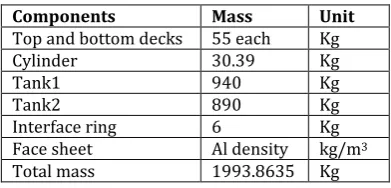
[image:3.595.325.542.134.217.2]The modeled structure of a spacecraft bus is as shown in the figure 1. The finite element data of the model is given in the table 1. The cylinder layup was bounded by east deck, north deck, south deck, west deck, top deck and bottom deck and linked through shear panels. The bottom deck of the structure was linked to the interface ring, through which the satellite gets separated from its lower stage. The subsystems are attached to the east and west decks of the spacecraft. The model consists of RBE, BAR2, QUAD4 and TRIA3 elements. The properties of the composites used in modeling are given in table 2.
Fig -1: Spacecraft structural system
Fig -2: Interface ring with rigid link.
2.1 Finite element data
Table -1: Shows the finite element data of the model
Types of elements Number of elements
Bar elements (Bar2) 180 Shell elements (QUAD4) 70038 Bush elements (CBUSH) 8 Triangular elements (TRIA3) 458 Rigid body elements (RBE2) 33 Total number of elements in
the finite element model 70717
Table -2: Shows the properties of aluminium honeycomb core of the model
Property Value Unit
Young’s Modulus 1.00E+4 N/m2
In plane Shear Modulus 1.00E+4 N/m2
Poisson’s ratio 0.3 ---
Mass Density 72 kg/m3
Shear modulus G 13 3.7E+8 N/m2
[image:3.595.336.532.263.357.2]Shear modulus G 23 3.7E+8 N/m2
Table -3: Shows the mass of individual components of the spacecraft structural system
Components Mass Unit
Top and bottom decks 55 each Kg
Cylinder 30.39 Kg
Tank1 940 Kg
Tank2 890 Kg
Interface ring 6 Kg
Face sheet Al density kg/m3
Total mass 1993.8635 Kg
3.1 Normal modes of the structure
The normal mode analysis in Msc Nastran will be done without inserting residual vector card. Residual vector card is inserted in case control section to compute the residual modes in f06 file (Output file of Msc Nastran). The structure is further condensed as per the preliminary objective of the work. Craig-Bampton method (CMS method) is used as the dynamic condensation technique. Residual vectors of condensed model are computed. This work is restricted to 10 modes. The table below shows the modal frequencies of the complete model and the condensed model.
Table -3: Shows the fundamental frequencies of the complete model and super element including residual
frequencies
Sl
No Frequency complete model in Hz of the Frequency condensed model in Hz of the
1 21.53488 21.53488
2 21.60565 21.60565
3 22.88971 22.88971
4 23.79123 23.79123
5 32.76614 32.76614
6 33.08495 33.08495
7 33.66083 33.66083
8 34.06837 34.06837
9 65.82056 65.82056
10 66.49674 66.49674
11 77.06128 77.06128
12 82.22667 82.22690
13 93.47472 93.47480
14 102.058 102.0580
15 160.1069 160.1070
[image:3.595.90.227.326.459.2]© 2017, IRJET | Impact Factor value: 5.181 | ISO 9001:2008 Certified Journal
| Page 633
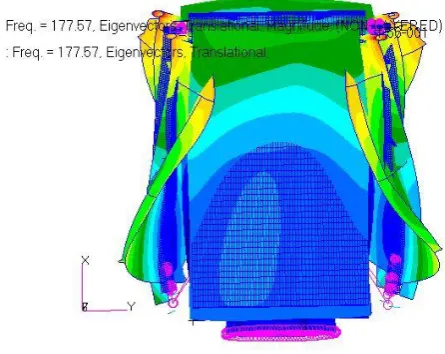
The modal frequencies given in the table 3 are obtained from the f06 file of the Nastran output. During the truncation of modes, higher frequency modes will be lost and thus it affects the dynamic solution directly. In order to retain the impact of lost modes, the residual modes are computed which enhances the solution. The structural system is condensed to a superelement. Further, residual modes are involved in the dynamic analysis. The residual frequencies obtained for a complete structure and a superelement are almost same. This means, Craig-Bampton method is an efficient method for dynamic condensation of spacecraft structural system and involving the residual frequencies in the analysis spectrum improves the solution. The figures shown below are the structural deformations for mode 1 (without residual vectors) and mode 16 (with residual vectors). The structural deformation shown in fig 4 is obtained at 177.57 Hz which is a residual modal frequency computed in Msc Nastran.
Fig -3: Deformed structure at 21.535 Hz
Fig -4: Deformed structure at 177.57 Hz
4. CONCLUSIONS
Dynamic condensation is the most effective method of condensing a spacecraft structure into a superelement. Component mode synthesis (Craig-Bampton method) is adapted in the present case as a dynamic condensation technique. As a step of enhancing the accuracy of dynamic solution, modal augmentation methods are preferred in which residual modes are adapted in this case. The residual vectors play an important role in improving the data lost during the structural condensation. The residual vectors computed for a superelement are almost same as that of the complete model, which means, the mathematical behavior of a superelement is much similar to that of the complete model.
ACKNOWLEDGEMENT
The first author would like to express deep sense of gratitude to Mr. P JAYASIMHA, Section Head, Structural Design, ISRO Satellite Centre, Bengaluru, who helped me to do this precious work.
REFERENCES
[1] H. Himeblau, D. L. kern, A. G. Piersol, “Dynamic Environmental Criteria”, NASA-HDBK-7005. March 2001.
[2] Crisfield, M.A, “Finite Elements and Solution Procedures for Structural Analysis, Vol. 1 Linear Analysis”, Pineridge Press, ISBN 0-906674-53-0, 1986.
[3] G. Masson, N. Bouhaddi, S. Cogan, F. Laurant, “Component Modes Synthesis Method Adapted to Optimization of Structural Dynamic Behavior”, 21st IMAC Conference and Exposition 2003 (IMAC XXI): A Conference and Exposition on Structural Dynamics, Kissimme, Florida, 2003, February 3-6.
[4] W. C. Hurty, “Dynamic Analysis of Structural Systems Using Component Modes”, AIAA Journal, Vol. 3, No. 4, pp. 678-685, 1965.
[5] R. R. Craig, M. C. C. Bampton, “Coupling of Substructures for Dynamic Analysis”, AIAA Journal, Vol. 6, No. 7, pp. 1313-1319, 1968.
[6] R. MacNeal, “A Hybrid Method of Component Mode Synthesis, Computers and Structures”, Vol. 1, No. 4, pp. 581-601, 1971.
[image:4.595.44.273.324.475.2] [image:4.595.42.265.524.701.2]© 2017, IRJET | Impact Factor value: 5.181 | ISO 9001:2008 Certified Journal
| Page 634
[8] W. A. Benfield, R. F. Hrurda, “Vibration Analysis of Structures by Component Mode Substitution”, AIAA Journal, Vol. 9, No. 7, pp. 1255-1261, 1971.
[9] Jacob J Wijker, “Mechanical vibrations in spacecraft design”, ISBN 978-3-642-07354-0
[10] Jacob J Wijker, “Spacecraft Structures”, Springer, ISBN 978-3-540-75552-4.
[11] Dynamic analysis guide, Msc Nastran 2012.
[12] Quick reference guide, Msc Nastran 2012.
[13] S. Rubin, “Improved component-mode representation for structural dynamic analysis”, Amer. Inst. Aero. Astro. J. 13 (8) 995–1006, 1975.
[14] R.R. Craig, C.J. Chang, “On the use of attachment modes in substructure coupling for dynamics analysis”, Proceedings of the 18th Structures, Structural Dynamics and Material Conference, AIAA/ASME, San Diego, AIAA 77-405,
pp. 89–99, 1977
[15] Rose, “Using residual vectors in Msc Nastran Dynamic analysis to improve accuracy”, Msc World user’s conference, 1991.
BIOGRAPHIES
Sandeep P R is a Post Graduate student in University Visvesvaraya College of Engineering, Bengaluru, Karnataka, India. Previously he authored three journals on composite material analysis and design.
Dr. H G Hanumantharaju is an Assistant Professor working in University Visvesvaraya College of Engineering, Bengaluru, Karnataka, India. He authored many journals in bio material design and analysis.