© 2018, IRJET | Impact Factor value: 6.171 | ISO 9001:2008 Certified Journal | Page 2047
Evaluation of the effectiveness of flexible PVC plastic material on
unsaturated soils
Mihretab Madamo
1, Bhavita S. Dave
21MTech. Student, Civil Engineering Department, Parul university, Gujarat, India
2Asst. prof., Civil engineering department, Parul university, Gujarat, India
---***---Abstract
-
Soils consist of individual particles that can slideand roll relative to one another. Shear strength of a soil is equal to the maximum value of shear stress that can be mobilized within a soil mass without failure taking place. The shear strength of a soil is a function of the stresses applied to it as well as the manner in which these stresses are applied. A knowledge of shear strength of soils is necessary to determine the bearing capacity of foundations, the lateral pressure exerted on retaining walls, and the stability of slopes. This paper deals on comparison of the effectiveness of flexible PVC plastic granules on two different types of soils. The main factors considered is variation of moisture content and percentage of blended materials. Whereas, the objective research is comparing and contrasting shear strength results on 0%,2%and 5% of flexible PVC plastic granules. Flexible PVC plastic material used in the form of granules with various percentages like 0%,2% and 5% of mass of soil. Also, the strength parameters cohesion(C), angle of internal friction (Φ) and optimum moisture content (OMC)& maximum dry density (MDD) evaluated by various moisture contents. Basically, soil sample collected for the tests are low cohesion-friction soil (MI) and high cohesive soils (CH) soils.
Key Words: Plastic Reinforcement, Unsaturated Soils, Shear Strength, Flexible PVC plastic granules, Optimum Moisture Content.
1. Introduction
Today, geosynthetic reinforced soil structures are widely used to support bridge abutments and to form approach roads. The use of geosynthetic reinforced soil structures is growing due to technical and economical advantages (Nouri et al., 2008). A variety of research efforts have been made to study reinforced soil walls and slopes in the last three decades. They mainly include: studies of full-scale structures (Wichter et al., 1986; Thamm et al., 1990; Gourc et al., 1995; Haza et al., 2000; Bathurst et al., 2003; Bergado and Teerawattanasuk, 2008; Yoo and Kim, 2008); the use of small scale models tested at normal gravity (Lee et al., 1973; Leshchinsky and Lambert, 1991; Lee and Manjunath, 2000; Yoo, 2001; Vafaeian and Abbaszadeh, 2006; El Sawwaf, 2007a,b); the use of small-scale models tested at high gravities (Porbaha and Goodings, 1994, 1996; Zornberg et al., 1998; Nova-Roessig and Sitar, 2006; Mahajan, 2007; Viswanadham and Mahajan, 2007; Chen et al., 2007; Viswanadham and Ko ¨nig, 2009); and numerical simulation (Blatz and Bathurst, 2003; Faheem et al., 2006; Won and
Kim, 2007; Bergado and Teerawattanasuk, 2008; Yoo and Kim, 2008). The results of these investigations have provided important insight regarding collapse mechanisms for reinforced slopes, walls and embankments. The shear resistance of soil is a result of friction and interlocking of particles, and possibly cementation or bonding at particle contacts. Due to interlocking, particulate material may expand or contract in volume as it is subject to shear strains. If soil expands its volume, the density of particles will decrease and the strength will decrease; in this case, the peak strength would be followed by a reduction of shear stress. The stress-strain relationship levels off when the material stops expanding or contracting, and when inter particle bonds are broken. The theoretical state at which the shear stress and density remain constant while the shear strain increases may be called the critical state, steady state, or residual strength.
1.1 Shear Strength
The shear resistance of soil is the result of friction and the interlocking of particles and possibly cementation or bonding at the particle contacts. The shear strength parameters of soils are defined as cohesion and the friction angle. The shear strength of soil depends on the effective stress, drainage conditions, density of the particles, rate of strain, and direction of the strain. Thus, the shearing strength is affected by the consistency of the materials, mineralogy, grain size distribution, shape of the particles, initial void ratio and features such as layers, joints, fissures and cementation. The shear strength parameters of a granular soil are directly correlated to the maximum particle size, the coefficient of uniformity, the density, the applied normal stress, and the gravel and fines content of the sample. It can be said that the shear strength parameters are a result of the frictional forces of the particles, as they slide and interlock during shearing. Soil containing particles with high angularity tend to resist displacement and hence possess higher shearing strength compared to those with less angular particles.
© 2018, IRJET | Impact Factor value: 6.171 | ISO 9001:2008 Certified Journal | Page 2048
heterogeneous nature of the soil, the water table location, the drainage facility, the type and nature of construction, the stress history, time, chemical action, or environmental conditions
1.2 Materials
A) PVC Plastics
PVC is extensively used for municipal water supply/sewage pipes, spouts, profiles, etc., since its mechanical properties such as tensile strength and tensile modulus are better than those of other general-purpose olefin plastics, and these products are robust and durable. When plasticisers are added, PVC shows rubber-like elasticity with high tensile strength and fatigue strength, and can be used for industrial hoses, gaskets, automobile parts, and electric cable covering. Comprising a wide range of materials and applications, including pipes, footwear and floor coverings, PVC plastic is used globally for its versatility, stability and good chemical and physical properties. Flexible PVC plastic compounds are used in communication wire coating, electrical wire jackets and coating, bumpers, wheels, outdoor furniture, medical tubing and meat wrap. Rigid PVC is used for water distribution pimping, chemical pumps and tanks, bathtubs, appliances, decorative trim and profiles, medical apparatus and house siding. PVC plastic is available as a cream-colored solid, white powder or thick white liquid (when diluted in water). It is combustible, stable and has a tensile strength of 6500 pounds per square inch or 44,816 kilopascals, melts at 176 degrees Fahrenheit and can withstand temperatures between -13 and +158 degrees Fahrenheit. PVC plastic has a specific gravity of 1.34. (The specific gravity of a substance is its density compared with the density of water.) It is mechanically stable and exhibits a minimum or low change in mechanical strength or molecular structure. However, constant exposure to an exterior force can deform its structure.
B) Soil Samples
From the basic properties of soil obtained values from laboratory test liquid limit (LL)=38.5 and plastic index (PI)=12.79 the graph plot below A-line and the liquid limit is lied between 35%-50%, so that the soil categorized under inorganic silt of medium plasticity(MI). shown in Table-1. An expansive soil has a large clay content. When dry, it has distinct shrinkage cracks. The soil becomes sticky when wet. Generally, the soil classified as CL, CI or CH are expansive soils. The soils classified as ML, MI or MH may also be expansive. Even the soil classified as SC may be expansive in some cases.
From the basic properties of soil obtained values from laboratory liquid limit (LL)=53 and plastic index (PI)=21.86 the graph plot above A-line and the liquid limit is exceeding 50%, so that the soil categorized under inorganic clay of high plasticity (CH). Tabulated below in table-2.
Table -1: Basic properties of the cohesive- friction or MI soil
Basic properties of soil Values
Natural water content(w) in % 19.85
Specific gravity(Gs) 2.32
Free swell in % 45
MDD(gm/cm3) 1.72
OMC in % 19.5
Liquid limit (LL) in % 38.5
Plastic limit (PL) in % 25.71
Plasticity index (PI) in % 12.79
Table -2: Basic properties of the cohesive or CH soil
Basic properties of soil Values
Natural water content(w) in % 28.12
Specific gravity(Gs) 2.45
Free swell in % 80
MDD(gm/cm3) 1.576
OMC in % 21.02
Liquid limit (LL) in % 53
Plastic limit (PL) in % 31.14
Plasticity index (PI) in % 21.86
2. Objective of the research
The main goal of this research is to compare the effectiveness of flexible PVC plastic granules on two different types of unsaturated soils. That means on cohesive highly compressive (CH) soil and cohesive-friction inorganic silt of medium plasticity(MI)soil. The factors considered is to find out the shear strength parameters on a various moisture content and amount of flexible PVC plastic materials.
3. Methodology
In order to put subsequent discussions into proper perspective, it is convenient to list the various kinds of apparatus that have been used to measure the shearing strength. In this research the equipment used for determination of shearing strength parameters are box shear test and untrained un consolidating triaxial test.
© 2018, IRJET | Impact Factor value: 6.171 | ISO 9001:2008 Certified Journal | Page 2049
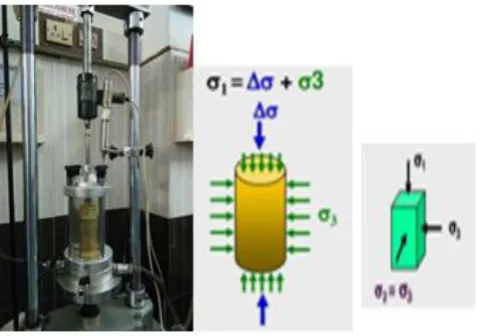
Fig -1: Triaxial apparatus and loading conditions
During shear, the major principal stress, σ1 is equal to the applied axial stress (Δσ=p/A) plus the chamber pressure, σ3. The applied axial stress, σ1- σ3 is termed the principal stress difference or sometimes called deviator stress. The intermediate principal stress σ2 and the minor principal stress σ3 are identical in the test, and are equal to the confining or chamber pressure.
3. Observation, Results and Discussions
In this part laboratory test results are presented and their analysis is briefly discussed. The relevant engineering property of the soil is evaluated both for cohesive, and cohesive- friction soils with and without PVC plastic granules. The tests include Atterberg limits, free swell, compaction, direct shear test and UU triaxial tests. All the tests were conducted on C and C-Φ soil mixed with different percentages of PVC plastic granules and at various moisture content.
[image:3.595.44.284.85.253.2]Table -3: Comparison of angle of internal friction for virgin C and C-Φ soils
[image:3.595.311.555.306.436.2]Table -4: Comparison of angle of internal friction for C and C-Φ soils with 2% of PVC plastic granules
Table -5: Comparison of angle of internal friction for C and C-Φ soils with 5% of PVC plastic granules
The charts below shows that the comparison of cohesion (C) values at 0%,2%&5% of flexible PVC plastic granules for inorganic silt of medium plasticity(MI) soil.
© 2018, IRJET | Impact Factor value: 6.171 | ISO 9001:2008 Certified Journal | Page 2050 Chart -2: Comparison of angle of internal friction
values for MI soil.
The above charts provide that the effects of flexible PVC plastic granules at different moisture contents up to OMC. Angle of internal friction at 0% and 2% of PVC plastic granules blended MI soil the line graph gradually elevates, on the other hand 5% of PVC plastic the graph rapidly rises. (chart-2) The cohesion of virgin MI soil rapid increase in cohesion some amount of moisture and then suddenly decreases. Whereas MI soil with 2% of PVC plastic granules has a slight increase in cohesion. Then MI soil with 5% of PVC plastic granules a gradual increase is shown in the cohesion as increase in water content. (chart-1)
Chart -3: Comparison of cohesion values for CH soil
Chart -4: Comparison of angle of internal friction values for CH soil.
The graph above(chart-3) shows Cohesion(C) values for CH with and without PVC plastic granules on different moisture contents. For CH soil which does not have PVC plastic granules, the graph shows a rapid rise and fall in cohesion values as amount of water increases. Whereas CH soil with 2% of PVC plastic granules shows a gradual rise and fall in cohesion values as amount of water increases. There is a gradual increase and a rapid fall in cohesion values as amount of water increase in CH soil with 5% PVC plastic granules. Chart-4 shows angle of internal friction for CH soil with and with out PVC plastic granules at various moisture content. The test showed a decrease of angle of internal friction for CH virgin soil as amount of water taken in increases. For CH soil with 2% of PVC granules angle of internal friction gradually increases as amount of water taken in increases. There is a rapid increase in angle of internal friction for CH soil with 5% of PVC granules as amount of water taken in increases.
Conclusion
© 2018, IRJET | Impact Factor value: 6.171 | ISO 9001:2008 Certified Journal | Page 2051
internal friction gradually increases as amount of water taken in increases. There is a rapid increase in angle of internal friction for CH soil with 5% of PVC granules as amount of water taken in increases.
From the comparison of all the results shows that PVC plastic granules are more effective in CH soil by increasing internal angle of friction and decreasing cohesion both by increasing amount of plastic granules and water content up to MOC.
REFERENCES
[1] V.N.S. Murthy, Principles of Soil Mechanics and
Foundation Engineering, UBS Publishers’
Distributors Ltd., New Delhi, 2002.
[2] Karsten, T.K., Gau, C. and Tiedemann, J., 2006, Shear
strength parameters from direct shear tests - influencing factors and their significance., IAEG2006 Paper number 484, The Geological Society of London, 1-12.
[3] P. P. Raj, Soil Mechanics and Foundation
Engineering, Dorling Kindersley (India) Pvt. Ltd., New Delhi, 2012
[4] S.R. Kaniraj, Design Aids in Soil Mechanics and
Foundation Engineering, McGraw Hill Education (India) Private Limited, New Delhi, 1988. [9] Jain, V.K., Dixit, M. and Chitra, R., 2015, Correlation of plasticity index and compression index of soil., IJIET., 5(3), June, 263-270.
[5] S.J. Poulos, Liquefaction Related Phenomena; In:
Advanced Dam Engineering for Design Construction and Rehabilitation Van Nostrand Reinhold (ed.) Jansen R. B., pp. 292–320, 1989.
[6] Yagiz, S., 2001, Brief note on the influence of shape
and percentage of gravel on the shear strength of sand and gravel mixture., Bull. Eng. Geol. Environ., 60(4), 321-323.
[7] G. Ranjan and A.S.R. Rao, Basic and Applied Soil
Mechanics, New Age International (P) Ltd., Publishers, New Delhi, 1991
[8] A. Rajabian a, B.V.S. Viswanadham b, H. Ghiassian a,
H. Salehzadeha, Centrifuge model studies on anchored geosynthetic slopes for coastal shore protection. Geotextiles and Geomembranes ;34 (2012) ,144-157
[9] A.N. Sommers, B.V.S. Viswanadham, “Centrifuge
model tests on the behaviour of strip footing on geotextile-reinforced slopes”
[10] Bernardo Caicedoa, and Luc Thorel Centrifuge
modelling of unsaturated soils. Journal of Geo- Engineering Sciences; 2 (2014) ,83–103
[11] Datye,K.R(1988) Natural materials for soil
reinforcement, International Geotechnical
symposium on theory and practice of earth reinforcement,
[12] Laskar, A. and Pal, S.K., 2012, Geotechnical
characteristics of two different soils and their mixture and relationships between parameters., EJGE, 17, 2821-2832.
[13] Liping Wang, Ga Zhang*, Jian-Min Zhang “Centrifuge
model tests of geotextile-reinforced soil embankments during an earthquake” 10 December 2010.
[14] McCartney JS, Zornberg JG. Centrifuge Permeameter
for Unsat urated Soils II: Measurement of the Hydraulic Characteristics of an Unsaturated Clay. J Geotech Geoenviron Eng. 2010;136(8):1064-1076.
[15] R. H. Burgess, Ed., Macmillan, Manufacture and
processing of PVC, New York, 1982
[16] Rajesh, S., Viswanadham, B.V.S., 2009. Evaluation of
geogrid as a reinforcement layer in clay based engineered barriers. Applied Clay Science 46 (2),153-165
[17] Rocscience, 2005. Slide Ver. 5.0-2D Limit
Equilibrium Slope Stability Analysis. Rocscience, Inc., Toronto, Canada.
[18] Schaefer, V.R., 1997. Ground improvement, ground
reinforcement, ground treatment: developments 1987-1994. ASCE Geotechnical Special Publication 69, 603
BIOGRAPHIES