© 2017, IRJET | Impact Factor value: 5.181 | ISO 9001:2008 Certified Journal | Page 1904
Experimental study and CFD analysis of Thermal performance
improvement of car radiator by MgO/water nanofluid.
Mr. Sumit G. Wani.
1, Prof. Ravi H.C.
21PG student, Dr. D.Y.Patil School of Engineering Academy, Ambi, Pune 2Assistant Professor, Dept. of Mechanical Engineering,Dr. D.Y.Patil School of
Engineering Academy, Ambi, Pune, Maharashtra, India
---***---Abstract -
The objective of this study is to improve thethermal performance of car radiator (cross flow) heat exchanger by a new coolant MgO/water nanofluid. Traditional method of cooling system of engine heat involves the use water or EG but we are now using the latest and most promising coolants (nanofluids) which are used commonly everywhere for heat transfer applications. The experimentation include the study of heat transfer characteristics density, thermal conductivity, dynamic viscosity, specific heat capacity. The observations were recorded to maintain flow between (5-9 lpm) and average heat transfer enhancement found in the range of (40-70%) for different volume fractions. The experimental results were validated by CFD simulations to check the temperature distributions across the radiator.
Key Words: Radiator, nanofluid, MgO particles, thermal
conductivity, heat transfer rate
1. INTRODUCTION
In this research paper our main focus is to improve thermal performance of automobile cooling system so that it dissipate heat more efficiently and fast to surrounding’s. In twentieth century, nanofluids is a most promising coolant or heat transmitting agent with superior heat transfer capabilities with good thermal conductivity. Nanofluids are used in various heat exchangers for heat transfer studies more efficiently than conventional fluids or coolants. Car radiator is cross flow type of heat exchanger which is prime component in automobile engine cooling system whose function is to supply coolants to engine when engine high temperature. In this study, we are using MgO nanoparticles having size (40 nm) combine with base fluid as water, nanofluid on preparation is used as a coolant instead of conventional coolant such as water or ethylene glycol. MgO/water nanofluid is used as effective coolant and its thermal performance ability is
good as compared to conventional coolants. Experimental study followed by modelling and CFD simulations on star ccm+ for validation of outlet temperature.
2. LITERATURE REVIEWS
© 2017, IRJET | Impact Factor value: 5.181 | ISO 9001:2008 Certified Journal | Page 1905 vol.% concentration. Nguyen et al [7] experimentally
investigated the effect of volume concentrationand temperature on the dynamic viscosity of Al2O3–water nanofluid and found that viscosity of the nanofluid considerably increases with the increase of particle volume concentrations, but it decreases with the increase of temperature. Wang et al.[8] investigated the viscosity of Al2O3–water nanofluid prepared by mechanical blending with particle size of 28nm at 5 vol.% concentration and viscosity increased by 86% compared to the base fluid. They also investigated Al2O3/ethylene glycol nanofluid and found a 40% increase in viscosity. Das et al.[9] also observed that with the increase of particle volume concentration, viscosity of the nanofluid increases. Elias et al.[10] reported findings about thermal conductivity, viscosity, specific heat and density of Al2O3 nanofluids in water and ethylene glycol used as coolant in car radiator. Volume concentration and coolant temperature were kept up to 1% and 50C respectively. Viscosity, thermal conductivity and density of the nanofluids were found to increase whereas specific heat of nanofluid was found to decrease with increasing volumetric concentrations. Masuda et al.[11] studied the thermo physical properties of Al2O3–water, SiO2– water and TiO2–water nanofluids. The transient hot-wire method was used to measure the thermal conductivity of nanofluids. They establish that the thermal conductivity of nanofluids increasing by 32 % at the concentration of 4.3 vol. %. They concluded that temperature did not have any effect on the increase of relative thermal conductivity. Lee et al.[12] conducted an experiment to measure the thermal conductivity of Al2O3 and CuO suspended in water and ethylene glycol. Particle sizes of Al2O3 and CuO were 23.6 nm and 38.4 nm, respectively. Their results indicated that nanofluids had higher thermal conductivity than the base fluid, and it increased with the increasing level of concentration. Wang et al.[13] studied thermal conductivity of Al2O3 and CuO nanofluids with a particle size of 20 nm. Each was suspended in water, vacuum pump oil, engine oil, and ethylene glycol. The steady state method was used to measure thermal conductivity. Their results showed that the thermal conductivity of both nanofluids were higher than that
of the base fluids and varying with concentration level.
Sundar and Sharma [14] obtained thermal
conductivity enhancement of 6.52% with Al2O3 nanofluid, 24.6% with CuO nanofluid at 0.8% volume concentration compared to water. Vahid Delavari et al [15] CFD simulation of heat transfer enhancement of Al2O3/water and Al2O3/ethylene glycol nanofluids in a car radiator. Thirumala Reddy[16] Performance Improvement of an Automobile Radiator using CFD Analysis.
3. EXPERIMENTAL SET UP AND PROCEDURE
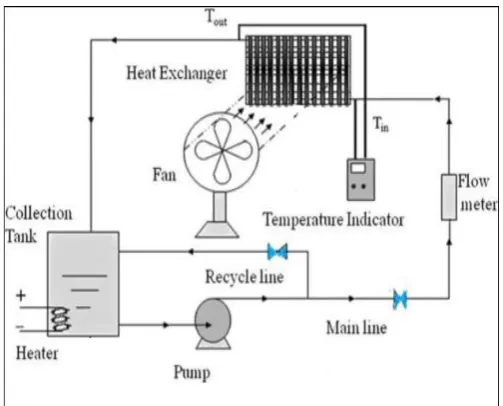
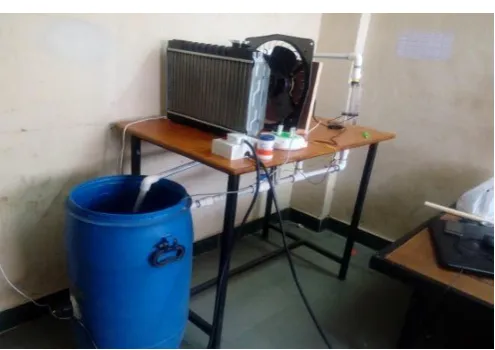
[image:2.595.307.559.418.621.2]The experimental set up consists of following specifications: Reservoir tank (40-50 Lit), electrical heater (2000 W), pump (0.5 hp), flow meter (0-25lpm),tubes, valves, forced fan (1500 rpm), digital thermocouples type K type for temperature measurement, heat exchanger (Car radiator) made of aluminium alloy having 22 tubes equally spaced along entire rectangular area, MgO/water nanofluid prepared with mechanical stirrer by heating and sedimentation for 48 hours.
© 2017, IRJET | Impact Factor value: 5.181 | ISO 9001:2008 Certified Journal | Page 1906 Fig -3.2: Actual Picture of Experimental Set up.
3.1 Details:
Collection tank (reservoir) of 40-50 litres contains a coolant fluid which is heated by electric heater (2 KW) up to a certain suitable temperature allows to pass through a pump (0.5 hP) which provides datum head up to 10-12 m. flow control valve is used to regulate the flow supply and flow meter (0-25 lpm) is used to fix constant flow rate from 5 to 9 lpm. Inlet and outlet temperatures of coolant is noted and simultaneously forced fan i.e. exhaust air fan (1500 rpm) is used to cool down the hot coolant fluid flowing through a radiator tubes. Forced convection fan cools down the temperature of hot coolant and cool fluid again passes to collection tank to complete the cycle. Firstly we used water as a coolant and then different concentrations with volume fractions (0.25,0.50,0.75 & 0.90) are used as as a coolant for cooling of car radiator. The observations are recorded for further calculation of thermal performance.
3.2 Properties of MgO nanoparticles and preparation of nanofluid:
Preparation of MgO/water nanofluid consists of purchasing of MgO nanofluid with high purity about 99 % with a particle size of 40 nm. MgO particles are white in colour having density 3.58 g/cm3. While preparing
this nanofluid we have to slightly lower down the PH value of water then only all particles are dissolved in the water properly. Mass concentration taken for preparation is 2% (m/v) i.e. 2gm of MgO is dissolved in 100 ml of water. Solution is prepared by heating and
[image:3.595.319.555.204.367.2]stirring and after that whole solution is kept for sedimentation for 48 hours. Coolants are taken in different volume fractions and investigate the thermal and physical enhancement of properties of prepared coolant.
Table 3.1: Properties of MgO nanoparticles
Purity [%] 99 Approximate size 40 nm
Color white
Morphology Nearly Spherical True density 3.58 (g/cm3)
Fig -3.3: Preparation of MgO/water nanofluid.
3.3 Properties of radiator material:
Table 3.2: Specifications of radiator
Radiator material (Aluminium alloy 6061),
Density (ρ) 2700 Kg/ m3,
Thermal Conductivity (K) 173 W/m.K , Specific Heat Capacity (Cp) 896 J/kg.K
Length 0.42 m
Width 0.32 m
Diameter of cylinder tube 0.006 m
4. MATHEMATICAL FORMULATION: The thermal and
flow properties of nanofluid are calculated using different available correlations as below:
Thermal conductivity using Timofeeva correlations as below:
wnf K
K 13
Viscosity of nanofluid using Drew and Passman correlations as below:
wnf
© 2017, IRJET | Impact Factor value: 5.181 | ISO 9001:2008 Certified Journal | Page 1907 The density and specific heat using Pak and Cho
correlations as below
w np
nf
(1 )w np
nf
Cp
Cp
Cp
(
1
)
The rate of heat transfer between coolant and airflow in radiator given as follows:
1. For water:
Qw = mw . Cpw . (Tin - Tout) = hw. A. (Tw - Tb)
hw = mw . Cpw .(Tin-Tout)/ A. (Tw - Tb),
convective heat transfer coefficient for water. Nu = hw .d / Kw (Nusselt number)
Re = ρw .V. d/ μw (Reynolds Number)
2. For MgO/water Nanofluid:
Qnf = mnf . Cpnf . (Tin - Tout) = hnf. A. (Tw - Tb)
hnf = mnf . Cpnf . (Tin- Tout)/ A. (Tw - Tb),
convective heat transfer coefficient for nanofluid. Nu = hnf . d /Knf (Nusselt number)
Re = ρnf .V. d/ μnf (Reynolds number)
5. Modelling of Radiator:
Fig.5 a): Modelling of radiator on CATIA V5
5.1 CFD Simulations: CFD simulations are performed on star ccm+ for a specified boundary conditions taken in the experimentation.
Fig.5 b):
Polygon meshed model of radiator
[image:4.595.312.555.61.406.2]5.2 Temperature distributions across the radiator:
[image:4.595.307.559.468.615.2] [image:4.595.37.287.490.657.2]© 2017, IRJET | Impact Factor value: 5.181 | ISO 9001:2008 Certified Journal | Page 1908 Fig. 5.2: b) MgO/ Water (0.25) at 5 lpm
Fig. 5.2: c) MgO/ Water (0.5) at 5 lpm
Fig. 5.2: d) MgO/ Water (0.75) at 5 lpm
[image:5.595.44.549.41.577.2]5.3 CFD plots:
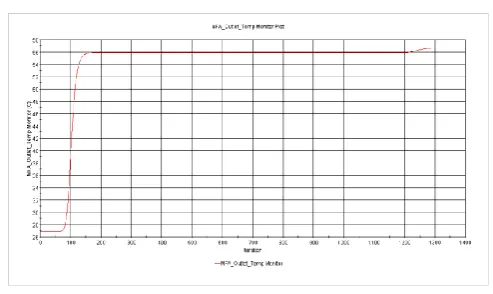
Fig. 5.3: a) Tout plot for water as a coolant
Fig. 5.3b) Tout plot for MgO/water(0.25) as a coolant
Fig. 5.3c) Tout plot for MgO/water(0.5) as a coolant
[image:5.595.37.284.611.758.2]© 2017, IRJET | Impact Factor value: 5.181 | ISO 9001:2008 Certified Journal | Page 1909 6. RESULTS AND DISSUCTIONS:
Table 6.1: Result table for thermal performance enhacement of coolants.
Coolants Q (W) h (W/m2.0C)
Nu Re Error in oulet temp (Tout)
Water 3841.6 1113.6 10.2 34564.1 2.12%
MgO/water(0.25) 6037.4 2073.2 10.9 35275.4 0.78% MgO/water(0.5) 8223.2 3784.6 14.0 35591.6 1.07% MgO/water(0.75) 10648.5 6512.0 18.5 35770.3 3.06% MgO/water(0.9) 11967.8 9714.1 24.2 35844.5 5.35%
Table 6.2: Result table for thermo-physical properties of coolants
.
Coolants ρ (kg/m3)
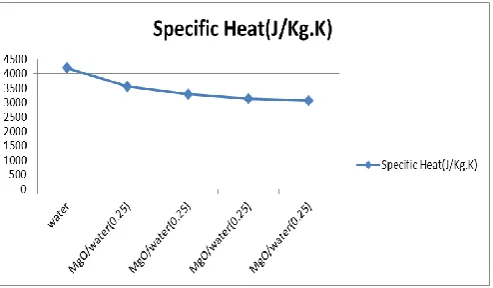
K(W/m.K) μ(N.s/m2) Cp
(J/kg.K) Water 985.2 0.649 0.504
×10-3
4183 MgO/water(0.25) 1633.9 1.1357 0.819
×10-3
3551.42 MgO/water(0.5) 2282.6 1.6225 1.134
×10-3
3278.82 MgO/water(0.75) 2931.3 2.109 1.449
×10-3
3126.87 MgO/water(0.9) 3320.52 2.4013 1.638
×10-3
3064.2
[image:6.595.31.559.37.764.2]6.1 Result Graphs:
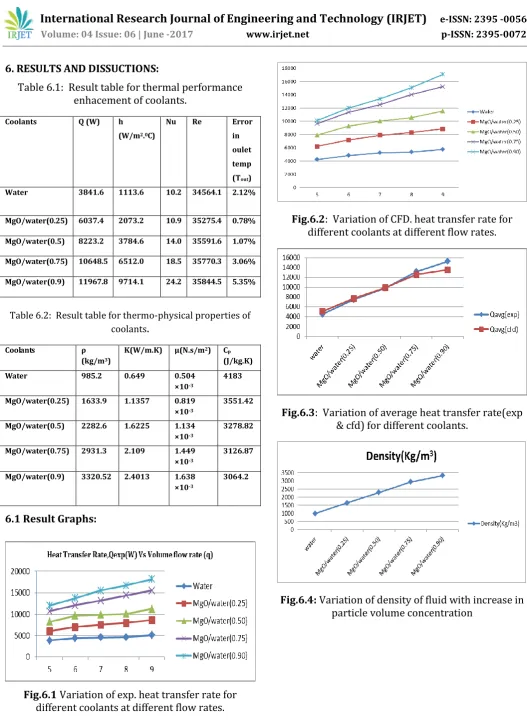
Fig.6.1 Variation of exp. heat transfer rate for different coolants at different flow rates.
[image:6.595.33.321.378.718.2]Fig.6.2: Variation of CFD. heat transfer rate for different coolants at different flow rates.
Fig.6.3: Variation of average heat transfer rate(exp & cfd) for different coolants.
© 2017, IRJET | Impact Factor value: 5.181 | ISO 9001:2008 Certified Journal | Page 1910 Fig.6.5: Variation of thermal conductivity of fluid
with increase in particle volume concentration
Fig.6.6: Variation of dynamic viscosity of fluid with increase in particle volume concentration
Fig. 6.7: Variation of Specific heat of fluid with increase in particle volume concentration
7. CONCLUSIONS:
1. Heat transfer rate is incresed due to the addition of MgO nanoparticles with base fluid as water. The average rate of heat transfer increment for volume fraction(0.25) is 39.48%, for volume fraction(0.50) is 54.12%, for
volume fraction(0.75) is 65.83%, for volume fraction(0.90) is 70.45% respectively. The recorded enhancement range noted (6037-15218 W )
2. Convective heat transfer coefficient is increased due to increase in particle volume concerntration. Average increment is found for volume fractions 0.25, 0.50, 0.75, &0.90 are 49.54%, 70.45%, 84.56%, & 90.14% respectively. The recorded enhancement range noted (2073-16629 W/m2.0C )
3. Reynolds number is increased due to increase in particle volume concentration. Average increment is found for volume fractions 0.25, 0.50, 0.75, &0.90 are 2.01%, 2.88%, 3.37%, & 3.57% respectively. The recorded enhancement range noted (35275-64525 ) 4. Nusselt Number is increased due to increase in
particle volume concerntration. Average increment is found for volume fractions 0.25, 0.50, 0.75, &0.90 are 11.75%, 26.17%, 49.89%, & 63.54% respectively. The recorded enhancement range noted (10-41)
5. Density of coolant fluid is incresed due to increased in particle volume concentration. Average increment is found for volume fractions 0.25, 0.50, 0.75, &0.90 are 39.70%, 56.83%, 66.39%, & 70.32% respectively. The recorded enhancement range noted (1633-3320 Kg/m3 )
6. Thermal conductivity of coolant fluid is incresed due to increase in particle volume concentration. Average increment is found for volume fractions 0.25, 0.50, 0.75, &0.90 are 42.85%, 60%, 69.22%, & 72.97% respectively. The recorded enhancement range noted (1.1-2.4 W/m.K )
7. Dynamic viscosity of coolant fluid is incresed due to increase in particle volume concentration. Average increment is found for volume fractions 0.25, 0.50, 0.75, &0.90 are 38.46%, 55.55%, 65.21%, & 69.23% respectively. The recorded enhancement range noted (0.819 ×10⁻³ -1.638 ×10⁻³ N.s/m2 )
[image:7.595.40.287.487.631.2]© 2017, IRJET | Impact Factor value: 5.181 | ISO 9001:2008 Certified Journal | Page 1911 ACKNOWLEDGEMENT:
I feel immense pleasure in expressing our deepest sense of gratitude to my guide Prof. Ravi H.C. Department of Mechanical Engineering, D.Y.Patil School of Engineering Academy Ambi, Pune. His valuable guidance, constant encouragement and made it to complete this Project. His appreciative suggestion always motivated me for putting most willing efforts on my study during project. My sincerely thanks to Prof. Yogesh Andhale , Head of Mechanical Engineering Department & Prof. Avinash Patil, PG Coordinator for their kind co-operation and guidance in proper direction for completion of this seminar work. Also thankful to Institute principle, Dr. Vilas Nitnaware for providing all the necessary facilities. Last but not the least I would like to thanks all staff of the department who directly or indirectly helped me during working on the project.
REFERENCES:
[1] Xie H, Li Y, Yu W. Intriguingly high convective heat transfer enhancement of nanofluid coolants in laminarflows. PhysLett A 2010;374:2566e8.
[2] Peyghambarzadeh SM, Hashemabadi SH, SeifiJamnani M, Hoseini SM. Improving the cooling performance of automobile radiator with Al2O3/water nanofluid. ApplThermEng 2011;31:1833e8
[3] Naraki M, Peyghambarzadeh SM, Hashemabadi SH, Vermahmoudi Y. Parametric study of overall heat transfer coefficient of CuO/water nanofluids in a car radiator. Int J ThermSci 2013;66:82e90.
[4] Hussein AM, Bakar RA, Kadirgama K, Sharma KV. Heat transfer enhancement using nanofluids in an automotive cooling system. IntCommun Heat Mass Transfer 2014;53:195e202.
[5] Lee S., Choi S., Li S. and Eastman J. Measuring thermal conductivity of fluids containing oxide nanoparticles, Journal of Heat Transfer, Vol. 121, pp.280- 289,1999.
[6] W. Yu, H. Xie, L. Chen, Y. Li, Investigation of thermal conductivity and viscosity of ethylene glycol based ZnO nanofluid, ThermochimicaActa 491 (1–2) (2009) 92– 96.
[7] Nguyen, F. Desgranges, G. Roy, N. Galanis, T. Maré, S. Boucher, H. AngueMintsa, Temperature and particle-size dependent viscosity data for water-based nanofluids— Hysteresis phenomenon, International
Journal of Heat and Fluid Flow 28 (6) (2007) 1492– 1506.
[8] X. Wang, X. Xu, S.U.S. Choi, Thermal conductivity of nanoparticle–fluid mixture, Journal of Thermophysics and Heat Transfer 13 (4) (1999) 474–480.
[9] D.K. Das, Specific heat measurement of three nanofluids and development of new correlations, ASME J. Heat Transf. 131 (7) (2009) 071601–071607. [10] Elias MM, Mahbubul IM, Saidur R, Sohel MR, Shahrul IM, Khaleduzzaman SS, etal. Experimental investigation on the thermo-physical properties of Al2O3 nanoparticles suspended in car radiator coolant. Int Commun Heat Mass Transfer 2014;54:48e53. [11] Masuda, H., Ebata, A., Teramae K., and Hishinuma, N., "Alteration of Thermal Conductivity and Viscosity of Liquid by Dispersing Ultra-fine Particles (Dispersion of yA1203_ Si02 _ and Ti02 Ultra-fine Particles)," Netsu Bussei(Japan),.Vol. 4, No. 4, pp. 227-233,1993.
[12] S. Lee, S.U. Choi, S. Li, J. Eastman, Measuring thermal conductivity offluids containing oxide nanoparticles, Journal of Heat Transfer 121 (2) (1999) 280–289.
[13] X. Wang, X. Xu & S.U.S. Choi, Thermal conductivity of nanoparticles–fluid mixture ,J. Thermophys. Heat Transfer, vol. 13, no. 4, pp. 474– 480,1999.
[14] Sundar & K.V. Sharma 2008, Int. J. Nanopart, Vol. 1, no.1, pp. 66,2008.
[15] Vahid Delavari,Saeed Hashemabadi, CFD simulation of heat transfer enhancement of Al2O3/water and Al2O3/ethylene glycol nanofluids in a car radiator.
[16] Thirumala Reddy, K sandhya Rani ,Performance Improvement of an Automobile Radiator using CFD Analysis.
BIOGRAPHIES:
Mr. Sumit G. Wani, PG student, Dept of
Mechanical Engineering, Dr. D. Y. Patil School of