ISSN: 1992-8645 www.jatit.org E-ISSN: 1817-3195
GELISP: A FRAMEWORK TO REPRESENT MUSICAL
CONSTRAINT SATISFACTION PROBLEMS AND SEARCH
STRATEGIES
1MAURICIO TORO, 2CAMILO RUEDA, 3CARLOS AGÓN, 4GÉRARD ASSAYAG
1
Asstt Prof., Department of Informatics and Systems, UNIVERSIDAD EAFIT, Colombia
2
Prof., Department of Computer Science, PONTIFICIA UNIVERSIDAD JAVERIANA CALI, Colombia
3
Prof., Music Modeling Team, IRCAM, UMR 9912 CNRS, France
4
Dr., Music Modeling Team, IRCAM, UMR 9912 CNRS, France
E-mail: [email protected], [email protected], [email protected], [email protected],
ABSTRACT
In this article we present Gelisp, a new library to represent musical Constraint Satisfaction Problems and search strategies intuitively. Gelisp has two interfaces, a command-line one for Common Lisp and a graphical one for OpenMusic. Using Gelisp, we solved a problem of automatic music generation proposed by composer Michael Jarrell and we found solutions for the All-interval series.
Keywords: Constraint satisfaction problems, openmusic, automatic music generation, search strategies, visual programming.
1.
INTRODUCTIONA Constraint Satisfaction Problem (CSP) is a
formalism to represent combinatorial problems. To solve a CSP we need to find objects that satisfy a number of constraints (i.e., criteria over those variables). CSPs provide a declarative way to represent combinatorial problems, specifying cons-traints instead of a sequence of steps to find the solution (as used in imperative programming). Additionally, it is possible to specify strategies to choo-se between branches during search. CSPs in computer music can be used to solve harmonic, rhythmic or melodic problems. In addition, they can be used for automatic generation of musical structures satisfying a set of rules. For instance, we can find solutions for the All-interval series [6], where we need to find a sequence of 12 different pitches with 12 different intervals.
In order to solve a CSP, we can use constraint programming languages such as Prolog or Mozart-Oz [30]. In order to solve a CSP, those languages use a Constraint Solving Library (CSL) such as Gecode [12]. CLSs are usually written in C++.
1.1 The problem
Using traditional CSL’s or programming languages to solve CSPs is time-demanding and it is intended for specialized users because they usually require
deep knowledge on C++ or logic programming. This makes these tools often unpractical to specify musical CSPs. Furthermore, these tools do not provide a representation for musical data structures.
1.2 Our solution
Gelisp1 is a wrapper for Gecode to Common Lisp.
Gelisp was originally developed by Rueda in 2006
and we modified it to work with current version of Gecode. Furthermore, we added support to model CSPs and search strategies graphically on
OpenMusic (OM) [1]. In addition, Gelisp can take
advantage of the musical data structures and functions defined for OM.
The novelty of Gelisp is to provide a graphical representation for search strategies (e.g., Depth First Search) and global constraints (e.g., “all the intervals of a sequence must be different”), based on an efficient CSL.
1.2 Related work
Several graphical CSLs for OM have been developed in the last decade. Situation [10] generates music based on constraints, OmRc [11] finds structures corresponding to rhythmical constraints, OmClouds [29] finds approximated solutions to a CSP, and OMBacktrack
ISSN: 1992-8645 www.jatit.org E-ISSN: 1817-3195
(http://www.ircam.fr/equipes/repmus/) is a wrapper for the CSL Screamer [13] (a CSL written on Lisp). A graphical CSL to solve musical CSPs should be able to setup search strategies in a graphical way, post multiple kinds of constraints graphically without declaring explicitly loops and recursion, and solve the problem using state-of-art algorithms.
Unfortunately, OmRC and OmSituation are designed to solve specific problems. OmBacktrack is no longer available for current versions of OM. Finally, OmClouds does not guarantee a solution satisfying all the constraints (i.e., a complete solution).
2.
GECODEGecode is a Constraint Solving Library (CSL) written in C++. Gecode provides a propagator for each type of constraint. Propagators translate a constraint into basic constraints supplying the same information. Basic (finite domain) constraints have the form x∈[a..b]. For instance, in a store (i.e., a set with all the constraints asserted) containing and , a propagator for the constraint would add constraints and .
As described in the above example, the action of propagators ends up narrowing down the set of possible values for each variable. This, however, does not guarantee that it will eventually be inferred a single value for each variable. Gecode thus include search engines. The purpose of a search engine is to choose additional basic constraints to add into the store until all variables have reduced their domain to a single value. Using them we can find one, many, or all the solutions for a CSP.
Gecode works on different operating systems and it will be used as the CSL for Mozart-Oz, therefore it is very likely to be maintained for a long time. Furthermore, it provides an extensible API, allowing the user to create new propagators and user-defined search engines. For instance, we can extend Gecode to reason about trees and graphs, which are useful in musical CSPs.
3.
GELISPGelisp provides an interface for Common Lisp and
another for OM. In Gelisp, sequences of variables are represented by lists, as opposed to Gecode, where they are represented by arrays. This makes the power of list processing (provided by Lisp and OM) available for Gelisp users.
3.1 Interface for Common Lisp
To solve a problem using this interface, we need to write a script. A script is a function to define the problem variables and their domains (the possible values that a variable can take), post constraints over the variables, and setup a search strategy.
This interface allows the user to call most of Gecode propagators for both, Finite Domain (FD) and Finite Set (FS) constraints. Basic FD constraints deal with expressions of the form x∈R, where R is a range or a set of ranges of integers. On the other hand, FS constraints deal with expressions among sets of FD variables. In what follows, we present some propagators that Gelisp provides for FD and FS.
Gelisp provides FD propagators for defining
domains (e.g., Domain(X)=[2,5]), equalities and inequalities (e.g., X+Y<Z), cardinality (e.g., 1 occurs two times in [XYZ]), boolean constraints, regular expression constraints and the all-distinct constraint. The all-distinct constraint makes the elements of a sequence pairwise different. On the other hand, for FS we provide constraints for defining domains (e.g., V∈{1,2,3}) and set relations (e.g., X∈A∪B).
In addition, Gelisp includes two search engines, Depth Search First (DSF) and Branch-and-bound (BAB). The DFS engine works by choosing some variable, then a value for that variable, if this does not succeed (a constraint does not hold) then ses another value. If the value succeed, then choo-ses another variable, then a value for it, etc.
The BAB engine works in a similar way, but solutions are computed in such a way that each subsequent solution increases or decreases the value of some user specified FD variable. Both engines can be used for both FS and FD. In addition, we can define search heuristics for value (i.e., the order to assign a value to a variable) and variable order (i.e., the order to choose a variable). These heuristics are parameters for the search engines.
3.2 Graphical Interface for OpenMusic
Instead of writing a script, in the graphical interface we represent a program with a special patch, called
CSP patch. A patch is a visual algorithm, in which
boxes represent functional calls, and connections are functional compositions. Inside a CSP patch, we can place special boxes to define a constraint in the CSP, variable and value heuristics, the variable to be optimized during the search, and a time limit in the search.
ISSN: 1992-8645 www.jatit.org E-ISSN: 1817-3195
constraints (e.g., “all the intervals from a sequence must be different”).
Using the graphical interface we can express a variety of problems declaratively with global constraints. Global constraints have parameters. For instance, the graphical box to find the intervals of a list has a parameter to choose among absolute, non-absolute, or modulo n intervals (calculated as ). Additionally, it has a parameter to post an
all-distinct constraint over the intervals.
Moreover, the output of a CSP patch can be connected to a box to find one solution or a box to find n the solutions
4.
CASE STUDIESIn this section, we describe both, an intuitive and formal definition of two CSPs and we explain how to solve them with Gelisp. Formally, a CSP is triple <X,D,C>, where X is a set of variables, D is the domain for each variable, and C is a set of constraints (read as conjunction) over the variables.
4.1 All-interval series
In this problem, we need to find a sequence of 12 different pitches with 12 different intervals (fig. 1). This problem can be generalized to find n different pitches with n different intervals equivalent under inversion 2. For instance, a value of n=24 represents
the all-interval series for microtones.
[image:3.612.328.517.245.423.2]
Figure 1: An all-interval serie for n=12
Therefore, a solution to this CSP is a sequence of n pairwise different variables with domain [1..n], where all modulo n intervals of the sequence are pairwise different. We give bellow a formalization of this problem
Variables: V1...Vn
Domains: [1..n] ... [1..n]
Constraints: • alldiff(V)
• alldiff ((Vi+1 – Vi)%n, i <= n-1)
There is not a constraint over the interval ) because that interval is always six, according to the literature. Furthermore, it is enough to calculate the
2
For instance, an interval C-E is equivalent to E-C.
series where because the other ones can be obtained from that one using transposition. In addition, we know that if is an all-interval serie, is also one. For those reasons, we include these two constraints to avoid symmetrical solutions:
• C3 V0 = 0
• C4 V0 < Vn
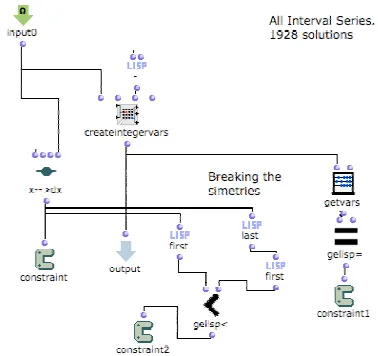
We represent graphically this CSP (fig. 2) with a box to create n all-different variables with domain [1..n], an box for with an all-different parameter ,
an equality box for , and an inequality box for .
Figure 2: All-interval Series CSP on OM
4.2 Jarrell's CSP
Composer Michael Jarrell proposed an idea for automatic music generation [4]. The goal is to generate a sequence of n notes. There is a fix number of occurrences ... for each sequences of intervals (called motives) ... over the sequence of non-absolute intervals of the output sequence. In addition, each note of the output sequence belongs to a Chord Ch. Moreover, the first and the last note of the output sequence are fixed. We give bellow a formalization of this problem
Inputs:
• Motives [...], Limits and , Occurrences [...], Chord Ch
Variables: ...
Domains: [0..127] ... [0..127]
ISSN: 1992-8645 www.jatit.org E-ISSN: 1817-3195
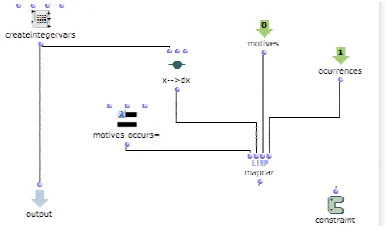
We represent graphically (Fig.3) the constraint . We use the x→dx and motives-occurs= boxes to fix the number of occurrences of each motive over the intervals of the output sequence.
[image:4.612.98.292.244.358.2]
Figure 3: Constraint for Jarrell’s CSP on OM
Jarrell also proposes in [4] to consider absolute intervals and octaviation for the chords, the limits and the motives. For instance, using absolute intervals, an interval is equal to and using octaviation, a pitch G4 is equivalent to G1,G2,G5, etc. Finally, he also proposes to have specific motives and chords for each segment of the output sequence, according to a user-defined segmentation. For simplicity, we do not present those constraints in this paper. However, a complete model of this problem can be found at
Gelisp website.
REFERENCES:
[1] C. Agón, G. Assayag, O. Delerue, and C. Rueda. Objects, Time and Constraints in OpenMusic. In Proceedings of the International Computer Music Conference
(ICMC), Ann Arbor, Michigan, October 1998.
[2] A. Allombert, M. Desainte-Catherine, and M. Toro. Modeling temporal constrains for a system of interactive score. In G. Assayag and C. Truchet, editors, Constraint Programming
in Music, chapter 1, pages 1–23. Wiley, 2011.
[3] J. Aranda, G. Assayag, C. Olarte, J. A. Pérez, C. Rueda, M. Toro, and F. D. Valencia. An overview of FORCES: an INRIA project on declarative formalisms for emergent systems. In P. M. Hill and D. S. Warren, editors, Logic Programming, 25th International Conference,
ICLP 2009, Pasadena, CA, USA, July 14-17,
2009. Proceedings, volume 5649 of Lecture
Notes in Computer Science, pages 509–513.
Springer, 2009.
[4] F. Courtot and M. Jarrell. L’utilisation de la
CAO dans Congruences. Cahiers
d’exploitation Ircam, 1990.
[5] F. Fages and J. Martin. From rules to constraint programs with the rules2cp modelling language. 13th Worshop on Constraint Solving and Constraint Logic Programming, CSCLP’08, 2008.
[6] R. Morris and D. Starr. The structure of the all-interval series. Journal of Music Theory, 2(13), 1974.
[7] C. Olarte, C. Rueda, G. Sarria, M. Toro, and F. Valencia. Concurrent Constraints Models of Music Interaction. In G. Assayag and C. Truchet, editors, Constraint Programming
in Music, chapter 6, pages 133–153. Wiley,
Hoboken, NJ, USA., 2011.
[8] A. Philippou and M. Toro. Process Ordering in a Process Calculus for Spatially-Explicit Ecological Models. In Proceedings of
MOKMASD’13, LNCS 8368, pages 345–361.
Springer, 2013.
[9] A. Philippou, M. Toro, and M. Antonaki. Simulation and Verification for a Process Calculus for Spatially-Explicit Ecological Models. Scientific Annals of Computer Science, 23(1):119–167, 2013.
[10] C. Rueda, M. Lindberg, M. Laurson, G. Block, and G. Assayag. Integrating constraint programming in visual musical composition languages. In ECAI 98 Workshop on
Constraints for Artistic Applications, Brighton,
1998.
[11] O. Sandred. Searching for a rhythmical language. In PRISMA 01 Review.
EuresisEdizioni, Milano, 2003.
[12] C. Schulte and P. J. Stuckey. Efficient constraint propagation engines. CoRR, abs/cs/0611009, 2006.
[13] J. M. Siskind and D. A. Mcallester. Nondeterministic lisp as a substrate for constraint logic programming. In proceedings
of AAAI-93, pages 133–138. AAAI Press,
1993.
[14] M. Toro. Probabilistic Extension to the Factor Oracle Model for Music Improvisation. Master’s thesis, Pontificia Universidad Javeriana Cali, Colombia, 2009.
ISSN: 1992-8645 www.jatit.org E-ISSN: 1817-3195
tools for probabilistic ntcc. Technical report, Pontificia Universidad Javeriana, May 2009. [16] M. Toro. Structured interactive musical scores.
In M. V. Hermenegildo and T. Schaub, editors,
Technical Communications of the 26th
International Conference on Logic
Programming, ICLP 2010, July 16-19, 2010,
Edinburgh, Scotland, UK, volume 7 of LIPIcs,
pages 300–302. Schloss Dagstuhl - Leibniz-Zentrum fuer Informatik, 2010.
[17] M. Toro. Structured Interactive Scores: From a simple structural description of a multimedia scenario to a real-time capable implementation
with formal semantics . PhD thesis, Univeristé
de Bordeaux 1, France, 2012.
[18] M. Toro. Structured interactive music scores.
CoRR, abs/1508.05559, 2015.
[19] M. Toro. Probabilistic Extension to the Concurrent Constraint Factor Oracle Model for Music Improvisation. ArXiv e-prints, Feb. 2016.
[20] M. Toro and M. Desainte-Catherine. Concurrent constraint conditional branching interactive scores. In Proc. of SMC ’10, Barcelona, Spain, 2010.
[21] M. Toro, M. Desainte-Catherine, and P. Baltazar. A model for interactive scores with temporal constraints and conditional branching.
In Proc. of Journées d’Informatique Musical
(JIM) ’10, May 2010.
[22] M. Toro, M. Desainte-Catherine, and J. Castet. An extension of interactive scores for multimedia scenarios with temporal relations for micro and macro controls. In Proc. of
Sound and Music Computing (SMC) ’12,
Copenhagen, Denmark, July 2012.
[23] M. Toro, M. Desainte-Catherine, and C. Rueda. Formal semantics for interactive music scores: a framework to design, specify properties and execute interactive scenarios.
Journal of Mathematics and Music, 8(1):93–
112, 2014.
[24] M. Toro, A. Philippou, S. Arboleda, C. Vélez, and M. Puerta. Mean-field semantics for a Process Calculus for Spatially-Explicit Ecological Models. Technical report, Department of Informatics and Systems, Universidad Eafit, 2015. Available at
http://blogs.eafit.edu.co/giditic-software/2015/10/01/mean-field/.X
[25] M. Toro, A. Philippou, C. Kassara, and S. Sfenthourakis. Synchronous parallel composition in a process calculus for ecological models. In G. Ciobanu and D. Méry, editors, Proceedings of the 11th International
Colloquium on Theoretical Aspects of
Computing - ICTAC 2014, Bucharest,
Romania, September 17-19, volume 8687 of
Lecture Notes in Computer Science, pages
424–441. Springer, 2014.
[26] M.Toro, C.Rueda, C.Agón, and G.Assayag. Ntccrt: A concurrent constraint framework for soft real-time music interaction. Journal of
Theoretical & Applied Information
Technology, 82(1), 2015.
[27] M. Toro-Bermúdez. ntccrt: A ntcc generic real-time interpreter. more information available at https://sourceforge.net/projects/ntccrt . Internet, 2008.
[28] M. Toro-Bermúdez. Towards non-threaded concurrent constraint programming for implementing multimedia interaction systems, July 2008.
[29] C. Truchet, G. Assayag, and P. Codognet. Omclouds, a heuristic solver for musical constraints. In MIC03, Metaheuristics
International Conference, Kyoto, 2003.
[30] P. Van Roy and S. Haridi. Concepts,
Techniques, and Models of Computer