ISSN: 1992-8645 www.jatit.org E-ISSN: 1817-3195
FACEBOOK’S PUBLIC SOCIAL INTERACTION
UTILIZATION TO ASSIST RECOMMENDATION ACROSS
SYSTEM DOMAIN
1MUHAMMAD MURAD KHAN, 1IMRAN GHANI*, 2SEUNG RYUL JEONG,
1
ROLIANA IBRAHIM , 1KASHIF NASEER QURESHI
1
Computing Faculty, Universiti Teknologi Malaysia, Malaysia
2
School of MIS, Kookmin University, Seoul, South Korea
E-mail: [email protected], [email protected], [email protected], [email protected] *Corresponding author: Imran Ghani ([email protected])
ABSTRACT
Social media is most prominent internet transition for this decade and Facebook holds its largest share. Facebook has been utilized by researchers from different perspectives e.g. opinion mining, user mood swing pattern, influential person identification etc. whereas recently Facebook’s social interactions were used for recommendation purposes. Although social interactions assisted recommendation, these interactions forced algorithm to work inside Facebook’s ecosystem i.e. recommending items existing inside Facebook to Facebook users and these interactions were private in nature, requiring explicit permission from user before algorithm execution. This study utilize Facebook’s public social interactions to recommend items across system domain i.e. recommending items to users existing outside Facebook. For this purpose we propose an algorithm that first identify items on Facebook’s public pages, gather social interactions related to them, generate a rank list and finally recommend it to external users. As an experimental case study, “whatmobile.pk” Facebook’s public social page was scanned for items and respective social interactions. These items were then compared with “fan” attribute of items existing on GSMARENA.com website in order to show rank similarity. 299 total items were found common between Facebook’s public page and GSMARENA website. Items were ranked according to social interactions and “fans” quantity. Then a positive spearman correlation of 0.547 was found which was improved to 0.660 by excluding 22 mobile phones.
Keywords: Facebook, Recommendation, Cross Domain, Rank Similarity, Public Social Interactions
1. INTRODUCTION
Internet has made this world a global village [1] and it’s growth rate is expected to be 50,000 gigabytes per second by 2018 [2]. With such growth rate, it is becoming difficult for users to approach items of interest hence causing information overload problem [3]. Special software systems designed to address this problem are known as recommender systems. Recommender systems recommend items to users based on their history such as music, movies, research papers etc.
Although recommender systems rely on users history for recommendation but if it encounters a new user who has no history, or user with insufficient history, recommender system face cold start problem [4]. Cold start problem has been
approached by many researchers from different perspectives, however, recently cross domain recommendation has been used to address respective problem. Cross domain recommender systems attempt to assist recommendation in target domain by utilizing knowledge available in auxiliary domain.
ISSN: 1992-8645 www.jatit.org E-ISSN: 1817-3195
however, target user was bound to exist inside Facebook ecosystem.
This study attempts to utilize social interactions available on Facebook’s public page and generate recommendations for users residing outside Facebook ecosystem. In this paper, section 2 gives a brief overview of related studies and problem background, section 3 explains proposed algorithm and section 4 describes experimentation and results. Finally conclusion of study is presented along with future work.
2. RESEARCH BACKGROUND
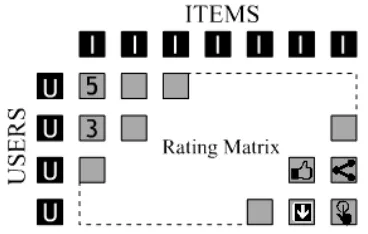
[image:2.612.105.289.361.478.2]Recommender systems (RS) are softwares designed for specific purpose i.e. to recommend most related items to its users [7]. These softwares utilize user’s usage history to identify user’s taste. Mostly in RS, usage history is maintained in form of rating matrix between users and items as shown in figure 1.
Figure 1: User’s interactions for items in rating matrix
Rating matrix objective is to store users interactions against an item where these interactions can be explicit (numerical ratings) or implicit (like, share, click, download) in nature as shown in figure 1. Rating matrix can be identified as heart of recommender systems research because majority of recommender systems research focuses on predicting ratings for empty interactions between users and items.
Recommender systems research is dominated by collaborative and content based recommendation however recently cross domain approach has been utilized for recommendation problem [7].
2.1 Cross domain recommendation (CDR)
Cross domain recommendation attempts to benefit recommendation in target domain by leveraging knowledge available in auxiliary
domain. [8] and [9] explains different types of domain whereas [10] describes different recommendation scenarios between users and items of participating domains
2.2 Facebook usage in CDR
With the largest number of users, Facebook can be identified as world’s biggest service to host social interactions, in social media category [11]. Recently two studies [5] and [6] utilize social interactions on Facebook to recommend movies and music to Facebook users. Although, they illustrated improvement in recommendation prediction based on social interactions. Their recommendations were confined to Facebook users only and both addressed “category domain” cross domain recommendation problem.
2.3 Recommendation across system domain
This study attempts to recommend items to users residing outside Facebook. In order to do so, Facebook public social interactions were utilized which were available on Facebook’s public pages.
Similar attempt was made by [12] where transferred knowledge related to movies from Wikipedia website to movie lens dataset. Also researchers in [13] transfer knowledge related to music from musicload website to compare with gameload dataset. Both studies assigned numerical weights to interactions such as article editing on wikipedia and music played , downloaded on musicload website, in order to generate average ratings between items and users of respective systems.
In this paper we are assigning weights to social interaction available on Facebook in order to generate a rating matrix.
3. PROPOSED ALGORITHM
In order to transfer Facebook social interactions i.e. likes, comments and shares [14] to users residing outside, they are required to be formulized. Formulization of Facebook public social interactions was proposed by [15] where they focused on Facebook’s public page social interactions. This study utilizes [15] formulas to transfer respective social interactions into rating matrix.
ISSN: 1992-8645 www.jatit.org E-ISSN: 1817-3195
3.1 Interaction extraction
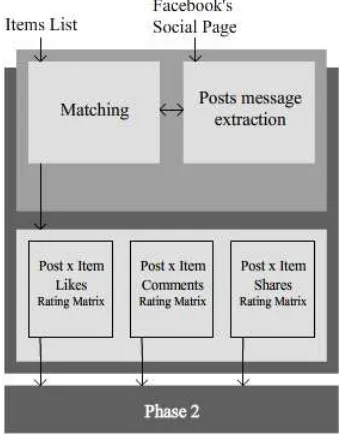
To begin, algorithm needs a list of items as input because these items are required to be ranked based on Facebook social interactions. Each item from list is matched with posts on Facebook public page and quantity of corresponding social interactions are stored, along with users who provided these interactions.
As a result rating matrices are generated between users and items (posts) where corresponding interactions are binary representation
[image:3.612.315.522.74.288.2]of likes, comments and shares as shown in figure 2.
Figure 2: Phase 1: Interaction Extraction
3.2 Rank list generation
[image:3.612.109.281.258.476.2]First phase generate three rating matrices having likes, comments and shares as social interactions. These interactions are binary in nature and exist between corresponding users and items. This phase assigns appropriate weight to all three rating matrices and merge into one final rating matrix. Likes interactions were assigned weight of 4.5, shares 5 and comments 2.5 for experimental case study is discussed in this paper. Figure 3 shows steps involved in this phase.
Figure 3: Phase 2: Rank List Generation
Once appropriate weights are assigned, all rating matrices are merged into a master rating matrix which is further used to generate rank list of items.
3.3 Comparison
Master rating matrix is used to generate item rank list which is further compared with target item rank list. Spearman correlation [16] is used as evaluation matrix, where it shows ranking similarity between two ranked lists. When two lists have same item ranking, its spearman correlation value is 1. When items are ranked exact opposite, its correlation value is -1 . Correlation value becomes 0 where there is no similarity to be found between both rank lists.
Experimental scenario discussed in this paper compares “whatmobile.pk” [17] Facebook’s public social page interactions with GSMARENA [18] website “fans” attribute.
4. EXPERIMENTATION AND RESULTS
GSMARENA website is related to mobiles where users can become “fan” of a mobile. Similarly “whatmobile.pk” Facebook’s social page posts about different mobiles and users provide interactions for respective post. Majority of users of “whatmobile.pk” social page are from Pakistan as objective of this social page is to update about price of mobile phones is Pakistan.
ISSN: 1992-8645 www.jatit.org E-ISSN: 1817-3195
each mobile, social interactions were generated. Similarly each mobile found at Facebook social page was searched at GSMARENA website and corresponding fans of each mobile were retrieved.
[image:4.612.320.517.77.253.2]Figure 4 shows relative share of each band whereas figure 5 shows logarithmic sum of Facebook social interactions and fans found at GSMARENA website for respective brands. Both sums are found close to each other for mentioned brands whereas miner difference exist for three brands.
Figure 4: Mobile Brand Distribution
All mobiles were ranked with respect to logarithm score of Facebook social interactions and logarithm score of GSMARENA fans in order to find spearman rank correlation for 299 mobiles.
A positive correlation of 0.547 was found for 299 mobiles retrieved from Facebook and GSMARENA website, which was further improved to 0.660 by excluding 22 mobile phones. These mobile phones were found ranked at a greater distance.
[image:4.612.108.256.245.405.2]Figure 6 show scatter plot of mobile phones with respect to Facebook and GSMARENA rank list where red dots show mobile ranked oppositely.
Figure 5: Logarithmic Score For Facebook Social Interactions And GSMARENA Fans
Figure 6: Mobile Phones Scattered With Respect To Facebook (Y-Axis) And GSMARENA(X-Axis) Rank List
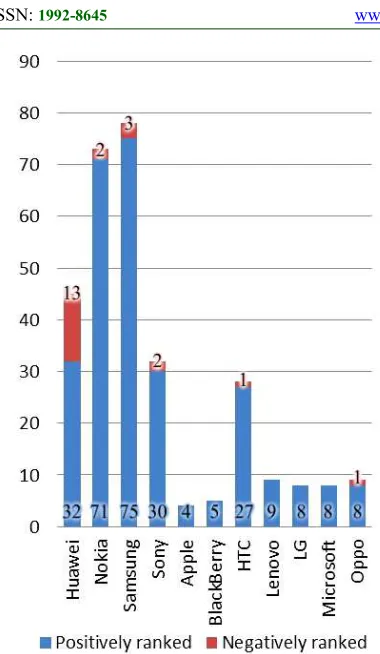
It was observed that some mobile phones gathered relatively high social interactions on Facebook as compared to “fans” on GSMARENA website. One of the reasons found was that these brands spent more on advertisement as compared to others in Pakistan. This resulted in increased interest of Facebook users for respective brands.
[image:4.612.313.520.293.519.2]ISSN: 1992-8645 www.jatit.org E-ISSN: 1817-3195
Figure 7: Brands With Greater Rank Difference Between Facebook And GSMARENA
5. CONCLUSION AND FUTUREWORK
This paper illustrates importance of
Facebook’s public social interactions and their use in item ranking which can further be used for recommendation. Facebook’s social pages host social interactions related to diverse set of entities e.g. politicians, television shows, music, movies, places, mobiles etc. which can be considered as items and proposed algorithm can be used to rank these items. Proposed algorithm used “whatmobile.pk” Facebook’s page posts in order to generate a ranked list of items. This ranked list was found in positive correlation with GSMARENA website hence showing encouraging utilization of Facebook public social interactions.
This study also highlighted demographic based influence on item ranking which leads to future work of this study. In future we plan to identify mobile social pages of majority of countries in order to identify mobile ranking relative to geographical location.
ACKNOWLEDGEMENT
Authors of this study appreciate and acknowledge research grant support Vot 4S113,
by Ministry of Science, Technology and
Innovation (MOSTI), Malaysia.
REFRENCES:
[1] McLuhan, Marshall, and Bruce R. Powers. The global village: Transformations in world life and media in the 21st century. Oxford University Press, USA, 1989.
[2] Walker, Ben. "Every Day Big Data Statistics – 2.5 Quintillion Bytes of Data Created Daily." VCloudNews. April 5, 2015. Accessed March 8, 2016. http://www.vcloudnews.com/every- day-big-data-statistics-2-5-quintillion-bytes-of-data-created-daily/.
[3] Borchers, Al, Jon Herlocker, Joseph Konstan, and J. Reidl. "Ganging up on information overload." Computer 31, no. 4 (1998): 106-108. [4] Zhang, Dan, and Luo Si. "Multiple instance
transfer learning." In Data Mining Workshops, 2009. ICDMW'09. IEEE International Conference on, pp. 406-411. IEEE, 2009. [5] Shapira, Bracha, Lior Rokach, and Shirley
Freilikhman. "Facebook single and cross domain data for recommendation systems." User Modeling and User-Adapted Interaction 23, no. 2-3 (2013): 211-247.
[6] Tiroshi, Amit, and Tsvi Kuflik. "Domain ranking for cross domain collaborative filtering." In User Modeling, Adaptation, and Personalization, pp. 328-333. Springer Berlin Heidelberg, 2012.
[7] Ricci, Francesco, Lior Rokach, and Bracha Shapira. Introduction to recommender systems handbook. Springer US, 2011.
[8] Ricci, Francesco, Lior Rokach, and Bracha Shapira. Introduction to recommender systems handbook (2nd edition). Springer US, 2015. [9] Li, Bin. "Cross-domain collaborative filtering: A
brief survey." In Tools with Artificial Intelligence (ICTAI), 2011 23rd IEEE International Conference on, pp. 1085-1086. IEEE, 2011.
ISSN: 1992-8645 www.jatit.org E-ISSN: 1817-3195
[11] Jin, Chang-Hyun. "The role of Facebook users’ self-systems in generating social relationships and social capital effects." New Media & Society 17, no. 4 (2015): 501-519.
[12]Xu, Qian, E. Xiang, and Qiang Yang. "Social-behavior transfer learning for recommendation systems." In Proc. of Workshop on Social Web Mining. 2011.
[13] Moreno, Orly, Bracha Shapira, Lior Rokach, and Guy Shani. "Talmud: transfer learning for multiple domains." In Proceedings of the 21st ACM international conference on Information and knowledge management, pp. 425-434. ACM, 2012.
[14] Juan, Yun-Fang, and Ming Hua. "Contextually Relevant Affinity Prediction in a Social Networking System." U.S. Patent Application 12/978,265, filed June 28, 2012.
[15] Muhammad Muad Khan, Imran Ghani, Roliana Binti Ibrahim, Seung Ryul Jeong, Do Young Kwon “Facebook social interactions transformation to assist recommendation over spars data” In proceedings of the 7th International Conference on Internet (ICONI) pp,pp 109-114, 2015.
[16]Myers, Leann, and Maria J. Sirois. "Spearman correlation coefficients, differences between." Wiley StatsRef: Statistics Reference Online (2006).
[17]WhatMobile.pk Facebook’s Public Page. Accessed March 10, 2016. https://www.facebook.com/WhatMobile.com.pk [18]GSMARENA Website. Accessed March 10,