ISSN: 1992-8645 www.jatit.org E-ISSN: 1817-3195
A MODEL FOR MEASURING ARTICLES
KNOWLEDGEABILITY LEVELS
1AHMAD ABEDAL-HAYY AL-DALA’IEN, 2MOAMIN A. MAHMOUD,
2MOHD SHARIFUDDIN AHMAD
1
College of Graduate Studies, Universiti Tenaga Nasional
2College of Information Technology, Universiti Tenaga Nasional
E-mail:[email protected], [email protected], [email protected]
ABSTRACT
Universities have traditionally provide teaching, research and consultancy supports in the development and advancement of various industries. Such supports are manifested in the tacit knowledge of academic staff with which they accomplish teaching, research, and consulting activities. Articles are the major explicit knowledge resources that improve the tacit knowledge levels of academic staff in order to enhance the performance of teaching, research, and consulting activities. The main challenge that faces academic staff is the difficulty of sharing accurate or valuable articles based on the working contexts due to the large number of articles published in various sources. Consequently, the main aim of this paper is to evaluate the knowledgeability level of articles based on several measurement variables. We identify and analyze the measurement methods and variables using two main data collection methods which are literature review and interview with experts in knowledge management field. We formulate the proposed model in this paper based on several components (i.e. variables, attributes, and formulas). The results show that the proposed model is useful in distinguishing the knowledgeability levels of articles.
Keywords: Knowledge Accuracy, Knowledgeability, Knowledge Management, Explicit Knowledge,
Knowledge Measurement.
1. INTRODUCTION
Tiwana [1] and Shankar et al. [2] defined knowledge as exploited information and data to
implement various working activities in
organizations. However, accurate knowledge
potentially improves the outcomes accuracy of working tasks. Knowledge is one of the most
important factors of businesses successful
implementations [3]. Thus, weakness of knowledge could lead to errors in businesses activities which could increase costs of services and products. Management of knowledge resources potentially improves business competitive advantages over other organizations via increasing performance [4].
Therefore, organizations should focus on
developing their workers skills using various knowledge resources such as training courses and working guidelines.
There are two main types of knowledge depending on the knowledge documentation style [5, 6]; (1) explicit knowledge which is documented as written forms like articles and books, and (2) tacit knowledge which is stored in people brains i.e. skills behaviors. Organizations aim to enhance
their workers’ tacit knowledge in order to improve performance, i.e. services quality and fast delivery services [7]. Explicit knowledge is considered as the main source of tacit knowledge development [8]. Explicit knowledge is formulated based on many directions such as expert people visions, historical experiments of a business, and research findings that depend on real and usable methodologies.
ISSN: 1992-8645 www.jatit.org E-ISSN: 1817-3195
of knowledge is known as knowledge
measurement.
Explicit knowledge measurement is defined as the processes of evaluating knowledge resources authenticity, knowledge contents accuracy, and knowledge compatibility with working aspects. The main aim of explicit knowledge measurement is to provide useful written knowledge for employees based on their working activities. The main objective of this paper is to develop a model to measure articles knowledgeability levels in order to increase the usefulness of knowledge sharing in universities based on academic staff working tasks such as teaching and research tasks. We define knowledgeability as the scholastic value of an article.
2. RELATED WORKS
This section presents the related works of this research such as knowledge management and measurement processes.
2.1 Overview of Knowledge Management
Researchers produced several definitions of KM based on the theoretical and applicable processes of knowledge management. However there is no standard definition for KM. Earl [9] and Manovas [10] defined KM as a series of processes that collect, manage, design and share knowledge efficiently to maximize performance outcomes of organizations activities. Walters et al. [11] mentioned that KM is the necessary activities such as knowledge acquiring, creating, designing and sharing to maximize the competitive advantages of organizations through useful value chain of knowledge. On the other hand, Kongpichayanond [12] and Massa and Testa [13] defined KM as a sequence processes of knowledge collection, creation, capturing, retrieving, designing and sharing to support applicable activities of organizations.
Debowski [5], Jennex and Olfman [14] mentioned that KM is the processes of managing tacit and explicit knowledge in organizations to maximize profits of businesses. Thus, KM should provide accurate conversion of explicit knowledge to tacit knowledge and vice versa. James [15] defined KM as “the identification, acquisition, utilization, support, maintenance and disposal of knowledge assets for the purpose of adding value and benefiting all stakeholders”. Gonzalez and
Sabherwal [16] mentioned that knowledge
management is the processes of capturing,
managing and sharing knowledge to maximize organizations outcomes and reduce the expense of wasted resources.
2.2 Knowledge Management Processes
Researchers have developed several frameworks to cover the phases and processes of KM. However, there is no standard KM framework to be adopted by organizations in different sectors. This section discusses the possibility of proposing a suitable KM phases and processes to manage tacit and explicit knowledge in universities as a research scope of this study. The main objective of KM processes is to share the right knowledge to the right person at the right time [17, 18]. Thus, explicit knowledge represents accurate knowledge that is compatible with an organization’s strategies and develop employees’ skills and expertise to maximize the
organization’s competitiveness over other
organizations. The following points are considered as the most efficient KM phases and process that ensure the main objective of KM in higher educational organizations [10; 11; 13; 14].
• Knowledge Sharing Phase: There are two main
processes of this phase; (i) pull processes to determine current statuses of tacit knowledge such as skills and expertise levels needs using
knowledge measurement methods and
determine the employees’ needs of explicit knowledge to develop their tacit knowledge using suitable search criteria using suitable search engines, and (ii) push processes to retrieve the explicit knowledge from knowledge base based on the pull processes determinants.
• Knowledge Identification: This phase manages
and identifies suitable explicit knowledge based on determination of pull processes in knowledge sharing phase.
• Knowledge Collection: This phase focuses on
collecting efficient and accurate knowledge from knowledge bases. There are two main styles to collect explicit knowledge; (i) select explicit knowledge from internal knowledge bases, and, (ii) select explicit knowledge from external sources such as internet or other organizations knowledge bases.
• Knowledge Retrieval: This phase retrieves and
ISSN: 1992-8645 www.jatit.org E-ISSN: 1817-3195 and store it in knowledge base, (iii) check the
integration between tacit knowledge, explicit knowledge and organization strategies, and (iv) update tacit and explicit knowledge maps based on employees feedbacks.
2.3 Knowledge Management Success Factors
The successes of KM implementations are influenced by various factors that affect the achievement of organizational objectives of KM. Yaghoubi and Maleki [19] surveyed 75 Iranian employees in financial company to determine the most important success factors of KM. The researchers found that organizational culture, KM architecture, systematic infrastructures, systematic KM and strategies are the most important success factors of KM implementations. On the other hand, Mathi [20] found that the most important factors that affect KM success implementations in
universities are organizational culture,
organizational KM, IT infrastructures and
knowledge measurements. The same factors of Mathi [20] adopted by Abdullah and Sinha [21], Monavvarian and Khamda [22], and Lehner & Haas [23]. Moreover, Zheng [24], mentioned that
organizational culture, organizational
infrastructures, KM structure, and knowledge evaluation are necessary factors to ensure efficient KM implementations.
Organizational culture is important to ensure employees ability and awareness. Responsibility to roles and feedback of employees improve the accuracy of knowledge sharing and measurement. Knowledge measurement is another important factor in KM implementation to evaluate the tacit and explicit knowledge use in organizations. On the other hand, organizational infrastructure and KM factors are necessary to simplify KM structure and provide focused and valuable knowledge at real time. Moreover, the KM implementations should deal with organization strategies to provide managers with visions and plans to maximize the performance of organization services and activities which lead to profits.
2.4 Knowledge Measurement
The measurement of knowledge resources is a vehicle for organizations’ effectiveness and competitiveness. The successful evaluation of knowledge resources enables a firm to become
innovative, harmonize its efforts better,
commercialize new products quickly, foresee
surprises, and become more responsive to market change [7, 36].
Huang et al. [25] mentioned that the quality of explicit knowledge can be evaluated by many factors that reflect the knowledge essentiality, usage, and performance. Thus, the knowledge sources need to include many characteristics to provide these factors efficiently. The knowledge quality is the characteristic that presents the knowledge validity [8, 26]. According AACSB [27], the knowledge sources’ properties plays the main role of quality. There are many factors that determine the knowledge sources’ quality [8, 25, 27]. The three main factors of knowledge quality which are:
1. Knowledge essentiality: the knowledge needs
to be related with organizations topics of activities, contains reliable and trust information in order to ensure the efficiency of knowledge implementations.
2. Context of knowledge: the knowledge needs to
be new enough to meet the current working tasks, complete and related contents, and linked with proposed tasks.
3. Knowledge performance: the contents need to
be clear and in simple format.
On the other side, Al-Oqaily et al. [3], Robert [28], Wu [29], Redman [30], and Huang [25] explained that, the explicit knowledgeability level can be measured through many methods. The methods are as follows:
• Intuitive: In this method, the explicit knowledge
contents can be evaluated by the employees' themselves through many approaches such as evaluation ranking of the explicit knowledge, e.g., 1-10 rank. The employees evaluate the knowledge based on the benefits gained from the contents in their working tasks.
• Systematic: This method is applied by
knowledge administrators in order to ensure that the explicit contents are compatible with activities and strategies of the organizations. Thus, explicit knowledge is collected according to the organizations visions of working aims and outcomes.
• Empirical: This method evaluates the
ISSN: 1992-8645 www.jatit.org E-ISSN: 1817-3195 According to Al-Oqaily et al. [3, 7, 8] and Olsen
[31], there are three main successful
implementations for explicit knowledge
measurement; (1) knowledge acquisition to collect the explicit knowledge based on the real need of working environment, (2) knowledge conversion to design and retrieve the knowledge usefully based on structure and clear format, and (3) knowledge sharing with employees in the context of working environment in real time. Olsen [31] mentioned that, the most successful factors of these processes is the knowledge content preparation and collection; the collected knowledge should agree with organizations strategies of activities and the users’ skills in working environment. Gold et al. [32] focused on knowledge acquisition as the
successful foundation of knowledge
implementations. Gold et al. [32] and Lee & Kang [33] mentioned that, the knowledge measurement factors such as contextual, essentiality, and performance are important to convert useful explicit knowledge based on the employees’ need of knowledge. Karaszewski [34], Gold et al. [32] explained that the knowledge measurement factor plays important roles in the value of the shared knowledge.
Al-Oqaily et al [7], Yaghoubi and Maleki [19], Mathi [20] and Zheng et al. [24] agreed that the knowledge measurement or evaluation is an important factor in knowledge management and processes in addition to other factors such as
employee culture, systematical process,
organizational management, and infrastructure. The systematical processes are important to be adopted to evaluate and organize knowledge that efficiently support the infrastructure. However, employees need to have the ability to use the knowledge in their jobs to maximize the performance of their tasks. The measurement factors handle the tacit and explicit measurement of knowledge; the explicit knowledge measures based on its quality and accuracy to support the employees’ tasks and maximize the value of organizations’ businesses. Thus, the explicit knowledge should be evaluated using methods that ensure contents validity depending on organizational environment.
2.5 Past Studies of Knowledge Measurement
The evaluation of tacit knowledge is important to measure the explicit knowledge effects on the development of individuals’ skills and expertise. Thus, the accuracy of tacit knowledge can be measured through the updates of tacit knowledge. Redman [30], Chilton and Bloodgood [35]
mentioned that the accuracy of explicit knowledge is measured through the extent of actual enrichment that is enhanced by tacit knowledge. Thus, real experiments of tacit knowledge after gaining explicit knowledge is considered as an efficient
measurement method of the documented
knowledge accuracy. Employees’ supervisors are the most relevant persons to determine the increase in employees’ tasks outcomes via observing and assessing employees’ skills. On the other hand, Wu [29] argued that explicit knowledge accuracy could be formulated according to organizations working strategies to ensure business outcomes based on organizations missions and visions. Moreover, OCED [26] and AACSB [27] discussed the role of employees in evaluating the benefit of the gained explicit knowledge. Employees could evaluate explicit knowledge accuracy through several methods such as knowledge ranking or feedbacks using surveys. However, the ranking method is systematically efficient due to short response time of evaluation. OCED [26], AACSB [27], and Huang et al. [25] mentioned that explicit sources characteristics such as publication age and sources indexing are important variables to reflect the accuracy of explicit contents.
The above studies theoretically discuss the variables of accuracy measurement of explicit knowledge. Al-Oqaily et al. [3, 8] discuss the
practical approach of explicit knowledge
measurement through two main variables that summarize the theoretical vision of other researchers; (1) manager ranking: managers rank explicit knowledge accuracy based on the compatibility between the explicit contents and organizations strategies, and (2) employees
ranking: employees could evaluate explicit
knowledge accuracy based on the gained benefits
after sharing explicit contents with other
employees.
ISSN: 1992-8645 www.jatit.org E-ISSN: 1817-3195
3. RESEARCH METHODS
The construction of the proposed methods is based on the feedback from experts in Jordanian universities. The experts are chosen based on their working experiences and the position held in
[image:5.612.87.517.206.319.2]Jordanian universities and who frequently access knowledge resources. The interview is conducted to identify the measurement variables of articles knowledgeability levels as main resources of explicit knowledge in universities. Table 1 show the panel’s profiles.
Table 1: Profiles Of Expert Panel
Name Current Position Years of Experience
Dr. Bassam A. Y. Alqaralleh Dean, Faculty of Information Technology in
Al-Hussein Bin Talal University in Jordan
22 Years
Dr. Ahmad B. A. Hassanat Assistant Professor, Information
Technology Dept., Mutah University, Jordan
19 years
Dr. Mouhammd Al-kasassbeh Head, Information Technology Dept., Mutah
University, Jordan.
16 years
Moha’med O. Al-Jaafreh Head, Software Engineering, Al-Hussein
Bin Talal University
15 years
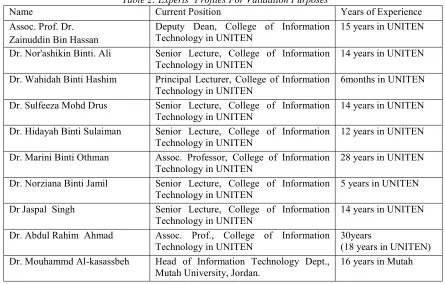
Quantitative data using questionnaire is collected from 20 academicians in Malaysian universities in order to analyze the most suitable attributes, i.e. evaluation scales of the measurement variables. Quantitative data using questionnaire is collected from 10 experts in Malaysian and Jordanian
universities in order to confirm the usefulness validity of the proposed model components. The profiles of the experts for validation purposes are show in Table 2.
Table 2: Experts’ Profiles For Validation Purposes
Name Current Position Years of Experience
Assoc. Prof. Dr. Zainuddin Bin Hassan
Deputy Dean, College of Information Technology in UNITEN
15 years in UNITEN
Dr. Nor'ashikin Binti. Ali Senior Lecture, College of Information
Technology in UNITEN
14 years in UNITEN
Dr. Wahidah Binti Hashim Principal Lecturer, College of Information
Technology in UNITEN
6months in UNITEN
Dr. Sulfeeza Mohd Drus Senior Lecture, College of Information
Technology in UNITEN
14 years in UNITEN
Dr. Hidayah Binti Sulaiman Senior Lecture, College of Information
Technology in UNITEN
12 years in UNITEN
Dr. Marini Binti Othman Assoc. Professor, College of Information
Technology in UNITEN
28 years in UNITEN
Dr. Norziana Binti Jamil Senior Lecture, College of Information
Technology in UNITEN
5 years in UNITEN
Dr Jaspal Singh Senior Lecture, College of Information
Technology in UNITEN
14 years in UNITEN
Dr. Abdul Rahim Ahmad Assoc. Prof., College of Information
Technology in UNITEN
30years
(18 years in UNITEN)
Dr. Mouhammd Al-kasassbeh Head of Information Technology Dept.,
Mutah University, Jordan.
[image:5.612.81.526.426.710.2]ISSN: 1992-8645 www.jatit.org E-ISSN: 1817-3195
4. THE DEVELOPMENT OF THE
PROPOSED MODEL
This section presents the measurement variables, attribute, formulas, and process of proposed measurement model of articles knowledgeability levels.
4.1 Measurement Variables
Articles are the main explicit knowledge sources in working environment of universities. The experts
mention that the measurement of articles
knowledgeability levels is necessary to reduce academicians’ effort and time to identify and retrieve useful articles that satisfy their needs of knowledge. However, there is a large number of articles that are published through various sources such as internet which increase the difficulty of identifying and retrieving the exact articles. The expert panel argue that the knowledgeability level of articles can be classified as high, medium, and
low knowledgeability level using several
measurement variables which are as follows:
• Academic Evaluation: Academicians evaluate
articles knowledgeability level based on the gained benefits of articles according to working context.
• Journal Indexing: the indexing of articles
indicates the contents knowledgeability of these articles.
• Article age: an article age represents the
contents knowledgeability based on current working environment. Old articles may have
accurate knowledge but not applicable
according to current working environment.
• Number of citation of an article: The number
of citation represents the importance of articles contents. Researchers are aware of using accurate contents of articles in their citations.
• Number of publications of an author: Authors
who publish frequently in journals are considered as professionals or experts in their field. Thus, researchers provide related and
accurate knowledge based on his/her
experience.
4.2 Scales of Measurement Variables
The main aim of the proposed measurement
variables is to compare between articles
knowledgeability levels based on its
knowledgeability evaluation. We propose five main
measurement variables to evaluate the
knowledgably level of articles; (1) academic
evaluations (2) the indexing of an article, (3) The age of an article , (4) number of citations of an article, (5) number of publication of an author. In order to identify the evaluation attributes of each variable, we conduct a questionnaire survey on 20 academicians in Sultan Idris University in Malaysia. The participants’ responses are illustrated as follows:
• All measurement variables are scaled based on
5 ranking scale. These scales represent the evaluation attributes of each variable.
• Academic ranking is scaled from one to five
points i.e. the lowest evaluation rank is one. Table 3 illustrates the proposed ranking attributes of lecturers evaluation variables
Table 3: Attributes Of Lecturers Evaluation Variables
Scale Points
1 1
2 2
3 3
4 4
5 5
• Indexing of articles is classified into 5 ranking
scale; (1) internet articles, (2) Scopus articles, (3) ISI articles (Q3 and Q4), (4) ISI articles Q2, and (5) ISI articles Q1. Internet articles are considered as the lowest knowledgeability level sources. Table 4 illustrates the attributes of indexing ranking.
Table 4: Attributes Of Journals Indexing
Rank Points
Internet article 1
Scopus 2
ISI 3
ISI Q2 4
ISI Q1 5
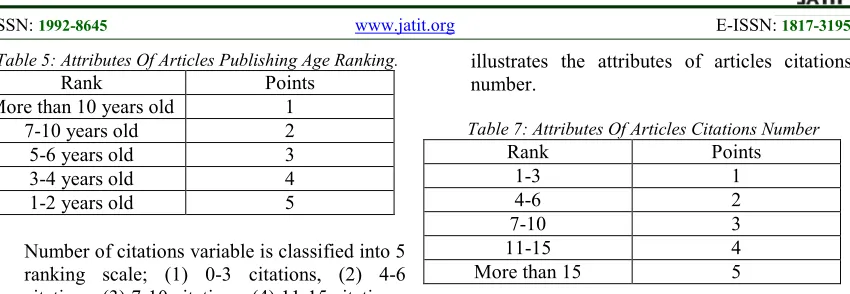
• Article age variable is classified into 5 ranking
ISSN: 1992-8645 www.jatit.org E-ISSN: 1817-3195
Table 5: Attributes Of Articles Publishing Age Ranking.
Rank Points
More than 10 years old 1
7-10 years old 2
5-6 years old 3
3-4 years old 4
1-2 years old 5
• Number of citations variable is classified into 5
[image:7.612.82.296.294.378.2]ranking scale; (1) 0-3 citations, (2) 4-6 citations, (3) 7-10 citations, (4) 11-15 citations, and (5) more than 15 citations. Articles that are cited 0-3 times in other sources considered as the lowest knowledgeability level. Table 6 illustrates the attributes of number of citations variable.
Table 6: Attributes Of Articles Citations Number
Rank Points
0-3 1
4-6 2
7-10 3
11-15 4
More than 15 5
• Number of publication variable is classified
into 5 ranking scale; (1) 1-3 publications, (2) 4-6 publications, (3) 7-10 publications, (4) 11-15
publications, and (5) more than 15
publications. Articles that belong to an author that provided 1-3 publications are considered as the lowest knowledgeability level. Table 7
illustrates the attributes of articles citations number.
Table 7: Attributes Of Articles Citations Number
Rank Points
1-3 1
4-6 2
7-10 3
11-15 4
More than 15 5
4.1 Proposed Model Processes
According to the measurement variables and scales that are explained in the previous section, the overall evaluation of an article is calculated by taking the average point scored by all variables. For example, if the point of academicians for an article is 4, the publishing age is 2008 (2 points), the number of citation is 10 (3 points), the indexing is ISI (3 points), the number of publications is 7 (3 points), then the article’s evaluation average is = 3/5 i.e. ((4+2+3+3+3)/5)/5.
Based on the evaluation average of each article, we can compare between articles knowledgeability level in order to rank all articles based on three main classes; (1) top 25% of the articles considered as high knowledgeability articles, (2) moderate 50% of the articles considered as medium
knowledgeability, (3) lowest 25% articles
ISSN: 1992-8645 www.jatit.org E-ISSN: 1817-3195
Figure 1: The Proposed Model
To clarify the process of the proposed model, let us assume that we have 100 articles stored in the articles repository:
1. Each article is evaluated based on 5
measurement factors; academic’ ranking, number of citation, article age, indexing, and number of publications. Each factor is already assigned to specific attribute value based on the above table ranks.
2. The average of the article is calculated based
on the attributes value of the factors.
3. All 100 articles is evaluated based on step 2.
4. Top 25% of the articles (25 articles) are
considered as strong knowledgably articles.
5. Moderate 50% of the articles (50 articles) are
considered as medium knowledgably articles.
6. Lowest 25% of the articles (25 articles) are
considered as low knowledgably articles. Thus, academicians are recommended to adopt the most knowledgeability articles to support their tacit knowledge within the context of their working environment.
5. VALIDATION OF PROPOSED MODEL
According to NQC (2009), one of the most
review method. It depends on discussing a model details with experts within the same field of a research or a model scope, and update the model based on experts’ feedbacks and recommendations. Thus, we use the summative experts’ panel feedbacks to ensure the validity of the propped model. We discuss the details of the proposed model with experts in ICT field. The expert panel consists of 10 experts from Universiti Tenaga Nasional in Malaysia and Mutah University in Jordan.
The interview highlighted three main questions which are; (1) Are the factors that used in the
proposed model adequate to measure the
knowledgeability levels of articles? (2) Are the scales ranking of the factors useful to evaluate the knowledgeability levels of articles? (3) Are the articles classifications, i.e. high, medium, or low based on the knowledgeability level evaluation acceptable?
ISSN: 1992-8645 www.jatit.org E-ISSN: 1817-3195 experts are also agreeable that the classification of
the total articles knowledgeability levels is acceptable.
Based on the responses of the expert panel, the proposed model is valid for the purpose of knowledgeability evaluation of articles as explicit
knowledge sources thus confirming the
achievements of the research objectives.
6. LIMITATION
The developed model only measures the explicit
knowledge (articles) based on universities
environment. There are many organizations can gain benefits from the measurement processes of explicit knowledge such as financial and health organizations. However, the model (variables and process) may not be applicable for other organizations.
7. CONCLUSION
This paper discusses the development and validation processes of the proposed measurement model of articles knowledgeability level in universities. The knowledgeability level of articles are measured using five main factors; academic factor, article age, indexing, number of citation, number of publications. Each factor measures articles knowledgeability based on evaluation scales. The overall evaluation score of each articles is computed by taking the average score of evaluation. The evaluation scores of articles are compared with each other to classify the articles knowledgeability as high, medium, or low level. As for validation, selected experts have confirmed the validity of the proposed model and the processes.
In our future work, some improvement will be conducted on the proposed model such as adopting more measurement variables to increase the measurement performance and applying the proposed model using automated agent or any other tools.
REFERENCES
[1] Tiwana, A. (2002). The Knowledge
Management Toolkit: Orchestrating IT.
Strategy, and Knowledge Platforms. Pearson Education India.
[2] Shankar, R., Singh, M. D., Gupta, A., &
Narain, R. (2003). Strategic planning for knowledge management implementation in engineering firms. Work Study, 52(4), 190– 200.
[3] Oqaily, A. L. I., Hassan, Z. B.,
Al-Dala'ien, A. A. H., & Rashid, A. M. (2015b).
Develop Practical Methods of Knowledge
Measurement in Universities.Journal of
Theoretical & Applied Information
Technology,73(2).
[4] Yip, M. W., Lau, D. H. C., & Songip, A. R. (2010). Influence of soft elements on KM implementation in Malaysian higher learning
institutions. Journal of Knowledge
Management Practice, 11(3), 1-9.
[5] Debowski, S 2006, Knowledge Management,
John Wiley & Sons, Milton, Queensland, Australia.
[6] Adolph, B. (2005, June). Learning how to do
things differently: Challenges in sharing tacit
knowledge for agricultural and rural
development (with examples from India and
Namibia). In Symposium on Learning
Alliances for scaling up innovative
approaches in the water and sanitation sector, 7-9 June 2005, Delft, the Netherlands (pp. 1-10). IRC International Water and Sanitation Centre.
[7] Al-Oqaily, A. T., Hassan, Z. B., Rashid, A.
M., & Al-sulami, Z. A. (2014). Success Factors of Knowledge Management in Universities (A Case Study: Jordanian Private
Universities). Middle-East Journal of
Scientific Research,22(7), 994-1002.
[8] Al-Oqaily, A. L. I., Hassan, Z. B., Ali, N. A.,
& Al-Sulami, Z. A. (2015a). Proposed Models
of Adaptive Knowledge Aggregator.Journal
of Theoretical & Applied Information
Technology,72(1).
[9] Earl, M, “Knowledge management strategies:
toward a taxonomy”, Journal of Management Information Systems, Vol. 18, No. 1, 2001, pp. 215-34.
[10] Manovas, M 2004, 'Investigating the
relationship between knowledge management capability and knowledge transfer success',
Master ofScience thesis, Concordia
University.
[11] Walters, D, Halliday, M & Glaser, S 2002,
'Creating value in the "new economy", Management Decision, vol. 40, no. 7/8, p. 775-81.
[12] Kongpichayanond, P. 2009, 'Knowledge
management for sustained competitive
advantage in mergers and acquisitions', Advances in Developing Human Resources, vol. 11, no. 3, pp. 375-87.
[13] Massa, S & Testa, S 2009, 'A knowledge
ISSN: 1992-8645 www.jatit.org E-ISSN: 1817-3195 food sector', European Management Journal,
vol. 27, no. 2, pp. 129-41.
[14] Jennex, M.E., & Olfman, L. (2006). A model
of knowledge management success.
International Journal of Knowledge
Management, 2(3), 51-68.
[15] James, P 2005, 'Knowledge Asset
Management: The Strategic Management and Knowledge Management Nexus', DBA thesis, Southern Cross University.
[16] Becerra-Fernandez, I, Gonzalez, AJ &
Sabherwal, R 2004, Knowledge management: Challenges, Solutions, and Technologies, Upper Saddle River, N.J.: Pearson/Prentice Hall.
[17] Van der Spek, R & Spijkervet, A 1997,
'Knowledge management: dealing
intelligently with knowledge', in J Liebowitz & L Wilcox (eds), Knowledge Management and Its Integrative Elements, CRC Press, Boca Raton, pp. 31-59.
[18] O’Leary D.E., Enterprise knowledge
management, IEEE Computer, March 1998, pp. 54–61.
[19] Yaghoubi, N. M., &Maleki, N. (2012).Critical
Success Factors of Knowledge Management.
[20] Mathi, K. (2004). Key success factors for
knowledge management. University of
Applied Sciences, Offenburg, thesis, Master of Business Administration in International Business Management and Consulting.
[21] Abdullah, D. H. & Sinha, RR (2009),
Knowledge management and intellectual capital emerging perspectives (Eds.),“Critical factors for KM implementation: An L&T, E&C division case study”(pp. 53-71).
Institute of management technology,
Ghaziabad..
[22] Monavvarian, A., & Khamda, Z. (2010).
Towards successful knowledge management: people development approach. Business Strategy Series, 11(1), 20-42.
[23] Lehner, F., & Haas, N. (2010).Knowledge
management success factors–proposal of an empirical research. Electronic Journal of Knowledge Management, 8(1), 79-90.
[24] Zheng, W., Yang, B., & McLean, G. N.
(2010).Linking organizational culture,
structure, strategy, and organizational
effectiveness: Mediating role of knowledge management. Journal of Business Research, 63(7), 763-771.
[25] Huang.K, Y. Lee, & R.Wang. 1999. “Quality
information and knowledge”, Upper Saddle River, N.J.: Prentice Hall.
[26] OECD. 2013. “NEW SOURCES OF
GROWTH: KNOWLEDGE-BASED
CAPITAL – KEY ANALYSES AND POLICY CONCLUSIONS”, SYNTHESIS REPORT.
[27] AACSB. 2012. “Impact of Research Task
Force”, Final Report of the AACSB
International. South Harbour Island
Boulevard.USA, 2012.
[28] Robert. S. 2013. “PARAMETRIC EXPLICIT
KNOWLEDGE MAPPING IN A
LEARNING ENVIRONMENT”.
Management and learning international
conference 2013. Zadar, Croatia.
[29] Wu .S. 2103. “A model for assessing the
quality of Gene Ontology”. iConference 2013
Proceedings (pp.953-956).
doi:10.9776/13492.
[30] Redman.T. 2005. “Measuring data accuracy:
A framework and review” , in Wang, R. Y., Pierce, E. M., Madnick, S. E. and Fisher, C. W. (eds.) Information quality. New York: M. E.Sharpe, pp. 21-36.
[31] Olsen, K. (2012).Information technology,
knowledge management and competitiveness: an empirical study in the South African hospitality context(Doctoral dissertation).
[32] Gold, A.H., Malhotra, A. and Segars, A.H.
(2001), ‘‘Knowledge management: an
organizational capabilities perspective’’,
Journal of Management Information Systems, Vol. 18 No. 1, pp. 185-214.
[33] Lee KC, Lee S & Kang IW. (2005). KMPI:
Measuring Knowledge Management
Performance. Information Management,
42(2005):469-482.
[34] Karaszewski R. (2008). The Influence of KM
on Global Corporations‟ Competitiveness.
Journal of Knowledge Management,
12(3):63-70.
[35] Chilton, M.A. and Bloodgood, J.M. (2010),
‘‘Measuring the dimensions of tacit and explicit knowledge: enhancing knowledge
management’’, in Jennex, M. (Ed.),
Ubiquitous Developments in Knowledge Management: Integrations and Trends, IGI Global, Hershey, PA.
[36] Al-dala’ien A, Mahmoud M A. Ahmad MSA,