ISSN: 1992-8645 www.jatit.org E-ISSN: 1817-3195
THE STATE OF VIRTUAL COMMUNITY COHESION: THE
VERTICAL DIMENSION
1
NOR IADAH YUSOP, 2ZAHURIN MAT AJI, 2ZULKHAIRI MD. DAHALIN, 2MOHD
KHAIRUDIN KASIRAN, 2HUDA IBRAHIM
1
Senior Lecturer, School of Computing, Universiti Utara Malaysia
2
Senior Lecturer, School of Computing, Universiti Utara Malaysia
3
Professor, School of Computing, Universiti Utara Malaysia
4
Senior Lecturer, School of Computing, Universiti Utara Malaysia
5
Assoc. Prof., School of Computing, Universiti Utara Malaysia
E-mail: [email protected], [email protected], [email protected], [email protected],
5
ABSTRACT
This paper presents findings on a study on virtual community cohesion with the aim to determine the state of cohesion between the administrators and members of virtual community (i.e. vertical dimension). A vertical virtual community cohesion instrument from a previous study was adopted. It measures cohesion based on two constructs namely the Trust in administrators and Political participation. A survey was conducted involving 235 users of the social media. Descriptive data analysis was carried out on the respondents’ demography and perceptions with regards to the state of cohesion of the virtual community they were involved with. The overall mean scores of both constructs were found to fall into the low cohesion category, and this indicates that the state of vertical community cohesion is low. This reflects the non-political purpose of users of the social media in engaging in virtual community. However, more studies need to be carried out to confirm this. Nevertheless, both dimensions were found to be significantly influencing virtual community cohesion.
Keywords: Virtual Community, Community Cohesion, Trust in Public Figures, Political Participation, Vertical Dimension.
1. INTRODUCTION
Building community cohesion (or
interchangeably used with social cohesion) is about building better relationships between people from different backgrounds including those from new and settled communities. This is true for both physical and virtual community. National unity is very much related and contributed to social cohesion. Social cohesion can simply be referred to as a concept that relates to how well people and communities get on together for the benefit of all [1]. It is a popular concept that is used to describe the strength of human relationships and the stability of a more differentiated society. Social cohesion is sometimes used casually as a label for social success or stable race relations.
A number of studies have found that social cohesion is important for well-being and prosperity of society [2, 3, 4, 5, 6]. In addition, [7] did state, “a
country’s social cohesion is essential for generating the confidence and patience.” This is crucial to gain citizens’ trust on the government particularly when reforms are implemented.
The advancement of the Internet technology allows a new communication medium becomes possible resulting in the emergent of virtual communities. The term “virtual community” and “online community” are sometimes being used interchangeably. Virtual community represents “a group of people who share characteristics and interact in essence or effect only” [8]. Through interaction and participation, the users of such community platform will establish either a formal relationship (such as civic and political) or informal
relationships. These could be feasible by
ISSN: 1992-8645 www.jatit.org E-ISSN: 1817-3195 circles. This is particularly obvious in virtual or
online community where the “friendships” can easily be extended to include friends of friends.
It is reported that, in Malaysia alone, there is a significant increment in the number of Internet users from 17.7 millions in June 2012 to more than 20.14 millions by end of December 2013 [9]. By the end of 2012, the number of Facebook users is nearly 13.6 millions. This represent more than 67.5% of Malaysia Internet users, and this number is expected to grow further. This is an indication that virtual community is very vital in many people’s lives and has become a necessity in some sense.
The impacts of such medium are similar to the impacts of the telephone, radio, and television when they were once in ubiquity. Those who earn a living via the social network sites can not make without it. Similarly, the benefits of virtual community can be further exploited if it could be used as a platform to nurture or inculcate community cohesion. This is supported by [10] who suggest that one of the main questions in virtual community research is on the
role of virtual community in increasing
cohesiveness among the community. This will contribute to the work that investigates the relationship between virtual community and other information disciplines [11]. Furthermore, as a to date mechanism to establish relationships among members, virtual community can be regarded as a system that can assist in transforming the community. In particular, the outcome of this study can provide some input on what are pertinent to virtual community cohesion, and thus social cohesion.
2. VIRTUAL COMMUNITY COHESION
Community cohesion is generally perceived as a positive term, about belonging to a community, about having life opportunities [12] or about having a common cause for actions [1]. With that, community cohesion can simply be understood to be made up of a number of key elements – positive relationships, similar life opportunities, civic engagement and participation, and common vision and values. However, cohesion issues do not just revolve around those facets. With regards to the physical community, the issue of race, faith and poverty are also important in determining the cohesiveness of a society [13]. These provide indications that the definition of social cohesion is contextualized and thus no single definition could describe it all. However, this study adopts the definition by [14] that state “social cohesion is a
state of affairs concerning both the vertical and the horizontal interactions among members of a society, as characterized by a set of attitudes and norms that include trust, a sense of belonging, and the willingness to participate and help, as well as their behavioral manifestations”.
Chan et al. ([14]) consider the notions of
“constituents” and “conditions” in defining
cohesion. Whilst constituents refer to what are required or must be there for social cohesion to form or exist, conditions refer to the necessary conditions for social cohesion building or that promote social cohesion. This is represented in a two-by-two (2X2) social cohesion measurement framework. The framework of [14] was developed to measure social cohesion for traditional community. A corresponding cohesion model for virtual community was developed and tested by [15, 16] based on the framework of [14] to assure its applicability in the context of virtual community. The first part of the measurement framework looks into the cohesion that exists in the society. Such cohesion occurs in two dimensions:
1) horizontal dimensions: This dimension focuses
on the cohesion within and among members of the society. The relationships among different individuals and groups within society are considered.
2) vertical dimensions: This dimension focuses on
the cohesion between the members of the society and the state (or rulers), including the relevant institutions. The relationships between the government and society and state and citizen cohesions are deliberated.
The other part of the framework focus on what constitute cohesion in an individual member of the society and how cohesion is being manifested. The former is referred to as subjective component, and the latter is objective component. These are examined from both dimensions – horizontal and vertical.
Chan et al. ([14]) framework suggests that in
determining (measuring) social cohesion of a community, one must consider not only the relationships among individuals in the society but also the relationship between state and civil society. The latter relationship will be the focus of this paper. This is to reflect the importance of state’s or
the government’s involvement in ensuring
ISSN: 1992-8645 www.jatit.org E-ISSN: 1817-3195 authorized personnel because to the knowledge of
the authors, there is no formal structure of governance defined for virtual community. Alike [14], [15, 16] also suggest that virtual community cohesion should be measured by examining the relationships between administrators and members.
3. VERTICAL DIMENSION OF VIRTUAL
COMMUNITY COHESION MEASURES
The vertical dimension focuses on the cohesion measures between administrators and members of virtual community. This is determined by using the
virtual community cohesion (VCC) model
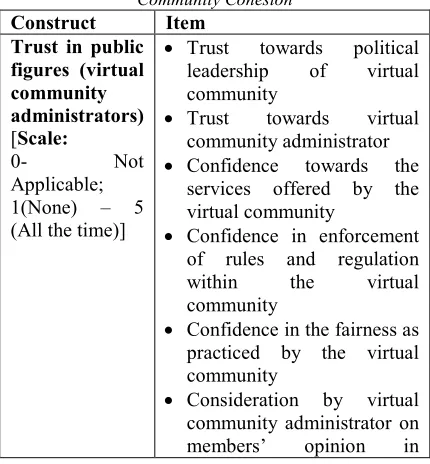
[image:3.612.87.302.501.733.2]developed by [16]. The VCC model was developed based on [14]. The dimension consists of two components namely the Trust in public figures and Political participation. The first component is a subjective component that represents the members’ state of mind, attitude or opinion of an individual member. It measures the trust of the members towards the administrator of the virtual community they participated, and is determined based on the members’ involvement in decision-making and the accountability of the administrator. On the other hand, the second component, which is the Political participation, is an objective component that represents the behavior manifested in response to subjective feelings. It measures the involvement of the members in political activities as part of engagement in public realms and uses political interest as an indicator [17]. Table 1 shows the corresponding items for each of the mentioned components.
Table 1: Items of the Vertical Dimension of Virtual Community Cohesion
Construct Item
Trust in public figures (virtual community administrators) [Scale:
0- Not
Applicable;
1(None) – 5
(All the time)]
• Trust towards political
leadership of virtual
community
• Trust towards virtual
community administrator
• Confidence towards the
services offered by the virtual community
• Confidence in enforcement
of rules and regulation
within the virtual
community
• Confidence in the fairness as
practiced by the virtual community
• Consideration by virtual
community administrator on
members’ opinion in
decision making process
• Confidence in the
accountability of the virtual community administrator Political
participation [Scale:
0- Not
Applicable; 1 (Not active) - 5(Very active)]
• Political view via social
media
• Members’ activeness in
political activity
• The influence of political
situation in virtual
community on members.
4. RESEARCH METHODOLOGY
The instrument used to measure the vertical dimension of the virtual community cohesion was based on a 5-point Likert scale to capture the responses of the respondents. The measurement scale used was determined based on the nature of the questions asked. For the items corresponding to the Trust in Public Figures (Virtual Community Administrators), the scale ranges between 1 (none) and 5 (all the time), while for the Political Participation are 1 (not active) and 5 (very active). For both scales, the scores of 4 and 5 indicate a high category of agreement towards the item, and scores of 2 and 3 indicate a low category of agreement. Score of 1 indicates that the respondent has no idea about the item and 0 indicates that the item does not applicable to the respondents.
Whilst construct validity was based on the framework developed by [14], face and content validity was used to validate the instrument. The instrument was reviewed by two experts, one in the field of unity and the other in the field of social
cohesion, both from two renowned local
ISSN: 1992-8645 www.jatit.org E-ISSN: 1817-3195 A survey was administered where questionnaires
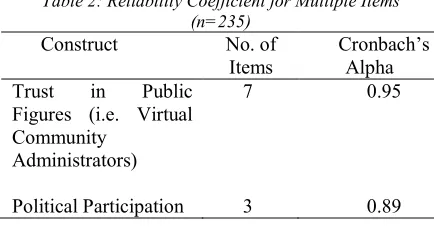
were given to a sample of respondents. The sample size was determined following the suggestion by [18] of which, for a feasible size ranging from 100 to 200 for very large or unknown population. An indication of the population size of social media in Malaysia according to [9] is the number of Facebook users of 13.6 million. It was also stated by [19] that sample sizes larger than 30 and less than 500 are appropriate. Following these recommendations and using the probabilistic sampling approach, questionnaires were distributed through online surveys to reach to the wider virtual community population and hardcopies were distributed by enumerators to increase the response rate. From both techniques, 235 responses were received. Data entry was done on the responses using SPSS version 19.0 as the software to perform the statistical analysis. The overall mean score calculated from the total mean scores of the two constructs was used to represent the vertical virtual community cohesion measure. Reliability tests were conducted for each of the construct to check for internal consistency of responses. Table 2 shows the reliability coefficient (Cronbach’s Alpha) for multiple items used in the study. According to [20], a Cronbach’s alpha value above 0.60 is considered acceptable. This indicates that the measurement constructs are reliable with acceptable internal consistency. In order to gauge the state of cohesion between the administrators and members of virtual community, descriptive analyses in the form of percentages, mean and cross tabulations were employed. Exploratory analyses in the form of
correlation and multiple regressions were
[image:4.612.84.301.530.653.2]performed to determine the influence on both constructs onto the virtual community cohesion.
Table 2: Reliability Coefficient for Multiple Items (n=235)
Construct No. of
Items
Cronbach’s Alpha
Trust in Public
Figures (i.e. Virtual Community
Administrators)
Political Participation
7
3
0.95
0.89
5. FINDINGS AND DISCUSSION
A total of 235 people responded to the survey with age range from 16 to 62 years old. The average age of the respondents is 25.64 years, which represents young respondents. Female respondents
made up 68.1% of the total. As for their qualifications, it is dominated by those with Bachelor degree (46.4%). Race shows the majority of the respondents are Malays (82.6%). Looking into the experience of using social media, majority (65.1%) of the respondents has been using it for more than four years. This indicates that the questionnaire has been answered by experienced users in social media and should be capable of giving meaningful feedbacks. Facebook appears to be the most popular (97.0%) and dominant type (72.8%) of social media used among respondents. Slightly more than 78.0% of the respondents indicated that they use social media mainly to socialize. Others use it for Education (58.3%), Hobby (50.6%), Religion (43.0%), Games (31.1%), Business (27.2%), and Politic (21.7%). This implies that the social media is used mainly for social purposes and getting knowledge for one’s own benefits, and less for business and politics.
The findings on the vertical dimension of the virtual community cohesion will be described based on the identified components namely (i) Trust in virtual community administrators, and (ii) Political participation.
5.1. Trust In Virtual Community
Administrators
ISSN: 1992-8645 www.jatit.org E-ISSN: 1817-3195 the virtual community administrator in taking the
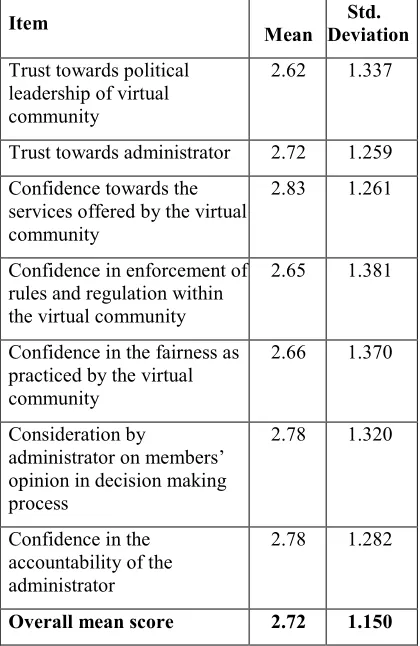
[image:5.612.90.300.259.582.2]members’ opinion during decision making process”, the respondents perceived that their opinions are less considered (mean score 2.78) with 52.1% of them implied so. The pattern for the item “Confidence in the accountability of the virtual community administrator” is similar with the previous item where majority of the respondents (52.5%) have low level of confidence with mean score of 2.78. The details of the score for all the items of the construct are illustrated in Table 3 and Table 4.
Table 3: Mean score of items for Trusts in Virtual Community Administrators
Item
Mean
Std. Deviation
Trust towards political leadership of virtual community
2.62 1.337
Trust towards administrator 2.72 1.259
Confidence towards the services offered by the virtual community
2.83 1.261
Confidence in enforcement of rules and regulation within the virtual community
2.65 1.381
Confidence in the fairness as practiced by the virtual community
2.66 1.370
Consideration by
administrator on members’ opinion in decision making process
2.78 1.320
Confidence in the accountability of the administrator
2.78 1.282
Overall mean score 2.72 1.150
In addition, as shown in Table 4, majority of the respondents’ responses falls under the low category of trusts for each item in this construct with an average of 52.2%. Comparing the percentage of each item for both categories, all items have higher percentages on the low category of trust towards the administrators of virtual community. This implies that the respondents may not pay attention on the presence and roles of the administrators when they are engaging themselves in virtual community. It was also found that the overall finding on “Trust in
virtual community administrators” construct is coherent with the findings of [21, 22, 23]) even though those studies were conducted on traditional community. These are indicated by the mean scores of all the items in the construct of all studies.
Table 4: Category of Trusts in Virtual Community Administrators
Low category
(%)
High category
(%) Trust towards political
leadership of virtual community
55.7 24.2
Trust towards administrator 59.7 25.2
Confidence towards the services offered by the virtual community
52.5 32.0
Confidence in enforcement of rules and regulation within the virtual community
44.2 32.7
Confidence in the fairness as practiced by the virtual community
48.9 30.1
Consideration by
administrator on members’ opinion in decision making process
52.1 31.0
Confidence in the accountability of the administrator
52.5 31.5
Average 52.2 29.5
5.2. Political Participation
[image:5.612.314.523.597.715.2]The construct for political participation aims to measure the involvement of members on specific issues and political culture within the virtual community. For this purpose, three items were being used to solicit the respondents’ views as shown in Table 5 and Table 6.
Table 5: Mean score of items for Political Participation
Mean
Std. Deviation Political view via social
media
2.87 1.516
Members’ activeness in political activity
2.70 1.496
The influence of political
situation in virtual
community on members
2.46 1.509
ISSN: 1992-8645 www.jatit.org E-ISSN: 1817-3195
Table 6: Category of activeness in Political Participation
Low category
(%)
High category
(%) Political view via social
media
40.6 38.4
Members’ activeness in political activity
42.9 33.8
The influence of political
situation in virtual
community on members
44.8 26.5
Average 42.8 32.9
The item “Political view via social media” seeks to determine the activeness of the members in expressing their political view via social media. It was found that the members showed a low level of activeness with the mean score of 2.87, and 40.6% of the respondents indicated so. For the next item, “Members’ activeness in political activity”, the mean score is 2.70 with majority of the respondents (42.9%) suggested low level of activeness. As for the last item, “The influence of political situation in virtual community on members”, the findings show that members are relatively less influenced by the political situation in the virtual community they participated with the mean score of 2.46. The percentage of responses that lead to this score is 44.8%. Of all items for the Political participation construct, political view via social media appears to have the highest mean score of 2.87. The overall mean score is 2.67, which indicates a low level of activeness in political participation among members of the virtual community. Similar to the previous construct, the standard deviation of this construct is also relatively high. This indicates varied responses for each item in the construct.
Based on the tables, the overall mean score of the “Trust in Virtual Community Administrators” construct is 2.72, which indicate low level of trust by the respondents with the highest being “Confidence towards service offered by their own virtual community” with mean score of 2.83, and the lowest is Trust towards political leadership of virtual community with mean score of 2.62. The standard deviation of the construct is relatively high which indicates that there is lack of uniformity in the responses for each item in the construct.
In addition, as shown in Table 6, a comparison on the category of activeness in political participation can be made for each item based on the percentages of responses. Though the percentages in general were less than 50.0% for all items in this construct, they are higher as compared
to the high category. With this, it can be assumed that the respondents were less active in political participation. This is in line with the traditional community cohesion that was examined amongst the German [22]. However, this contradicts with the findings on traditional community cohesion as found by [14].
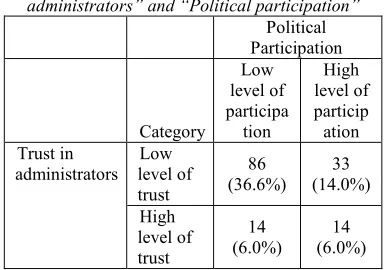
Table 7 shows a cross tabulation between the
constructs “Trust in virtual community
[image:6.612.321.516.291.426.2]administrators” and “Political participation”. The findings show that 86 or 36.6% of total responses indicate both low level of trust towards virtual community administrators and low level of participation in political activity, and as a dimension, it implies low cohesion.
Table 7: Cross tabulation between “Trust in administrators” and “Political participation”
Political Participation
Category
Low level of participa tion
High level of particip
ation Trust in
administrators Low level of trust
86 (36.6%)
33 (14.0%)
High level of trust
14 (6.0%)
14 (6.0%)
In order to perform further analyses, the dataset was tested and found to be not normally distributed. Hence, elimination of outliers was done until the data achieved normality, of which 31 cases were dropped bringing the number to 204. To determine whether there is significant relationship between the vertical dimension constructs with the virtual community cohesion as a whole, correlation analysis was carried out. Table 8 presents the results of the correlation analysis.
Table 8: Correlation analysis of vertical dimension constructs with overall cohesion
Trust In Admin
Political Participat ion Overall
Cohesion
Pearson Correlati
on Sig.
(2-tailed) N
0.675**
0.000
192
0.653**
0.000
192
ISSN: 1992-8645 www.jatit.org E-ISSN: 1817-3195 participation”, were significantly related to the
overall virtual community cohesion. Additionally, the correlation coefficient r shows that both relationships are strong and in positive directions.
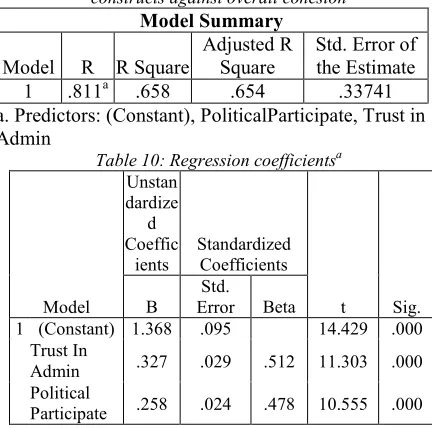
In order to determine the effect of the vertical dimension constructs on the virtual community cohesion, a regression analysis was carried out. Multiple linear regressions were done and the results of are presented in Table 9 and Table 10.
Table 9: Regression Analysis on vertical dimension constructs against overall cohesion
Model Summary
Model R R Square
Adjusted R Square
Std. Error of the Estimate
1 .811a .658 .654 .33741
[image:7.612.85.301.226.440.2]a. Predictors: (Constant), PoliticalParticipate, Trust in Admin
Table 10: Regression coefficientsa
Model
Unstan dardize d Coeffic
ients
Standardized Coefficients
t Sig. B
Std. Error Beta
1 (Constant) 1.368 .095 14.429 .000 Trust In
Admin .327 .029 .512 11.303 .000 Political
Participate .258 .024 .478 10.555 .000
a. Dependent Variable: OverallCohesion
The result shows a significant relationship between both constructs and virtual community cohesion at p < 0.01. Regression coefficient R of 0.811 indicates that both constructs are strong predictors of virtual community cohesion which accounts for 65.8% of the variability. Table 10 shows the positive values of the beta coefficients of both independent variables. This shows that of the two variables, the “Trust in administrators” with value of 0.512 has a better influence on virtual community cohesion compared to “Political participation” (0.478). This means that both constructs of the vertical dimension have strong effect on virtual community cohesion with trust in administrator having more influence on cohesion compared to political participation.
6. CONCLUSION AND
RECOMMENDATION
This study attempts to gauge the perception of users on the cohesion between administrators and members of the virtual community that they
participated. Findings from this study show that both components of the vertical virtual community cohesion dimensions can be categorized as low. With respect to the respondents’ trusts towards the administrators of virtual community that they participated, the results suggest that such trust is not substantial when engaging themselves in virtual community. As a component that represents the respondents’ state of mind, such attitude implies that they may be not aware of the presence of the administrators or perhaps being neutral about it. With regards to low political participation found among the respondents, this may suggest that most of the respondents use virtual community mainly to socialize rather than to engage in political pursuit even though the platform allows freedom of expression. The lack of trusts towards the public figures could potentially lead to the low participation in political activity and thus lack of cohesion from the vertical dimension. However, more studies need to be carried out to examine the effect of trusts in administrators on political participation. As opposed to looking into virtual community users as a whole, another aspect that could lead to better indication on cohesion of virtual community is by examining users of specific virtual community group. Despite the low perceptions of trusts in administrators and political participation among respondents, they both
significantly influenced virtual community
cohesion. This suggests that both dimensions are important in determining virtual community cohesion. Nevertheless, unity and cohesion should not be compromised at the expense of freedom of expression. Community cohesion should take precedence over promoting distrust and political partisan if a country wants to move forward and prosper.
REFRENCES:
[1] I. Turok, A. Kearns, D. Fitch, J. Flint, C. McKenzie, and J. Abbotts, “State of the English Cities Report - Social Cohesion: Department for Communities and Local Government”, 2006. [2] R.D. Putnam, “Bowling Alone: The Collapse
and Revival of American Community”, New
York: Simon & Schuster, 2000.
[3] J.M.M. Ritzen, W. Easterly, and M.J. Woolcock, “On "Good" Politicians and "Bad" Policies: Social Cohesion, Institutions, And
Growth”, World Bank Publications, Vol 2448,
2000.
[4] S. Ruiter, “Association in context and
ISSN: 1992-8645 www.jatit.org E-ISSN: 1817-3195
consequences of voluntary association
involvement”, [Sl: sn], 2008.
[5] J. Stiglitz, A. Sen and J.P. Fitoussi, “The Measurement of Economic Performance and Social Progress Revisited. Reflections and
Overview”, Commission on the Measurement of
Economic Performance and Social Progress, Paris. 2009.
[6] R.G. Wilkinson and M.G. Marmot. “Social
Determinants of Health: The Solid Facts”, World Health Organization, 2003 (Eds.). [7] W. Easterly, J. Ritzen, and M. Woolcock,
“Social Cohesion, Institutions, and Growth: Center for Global Development”, 2006.
[8] W. Hill, L. Stead, M. Rosenstein, and G. Furnas. “Recommending and Evaluating Choices in a
Virtual Community of Use”, Computer Human
Interaction. 1996, pp. 194-201.
[9] “Internet World Stats: Usage and Population
Statistics 2015”,. Retrieved from http://www.internetworldstats.com/stats3.htm#a sia.
[10] S. Gupta and H.W. Kim, “Virtual Community: Concepts, Implications, and Future Research
Directions, Paper presented at the Tenth
Americas Conference on Information Systems, New York, 2004.
[11] F.S.L. Lee, D. Vogel, and M. Limayem, “Virtual Community Informatics : What We
Know and What We Need To Know”, Paper
presented at the 35th Hawaii International Conference on System Sciences (HICSS-35'02), IEEE Computer Society, Big Island, Hawaii. Vol. 00, 2000, pp. 1-10.
[12] R. Quigley and L. Thornley. “Literature
Review on Community Cohesion and
Community Severance: Definitions and
Indicators for Transport Planning and
Monitoring”, Wellington: Quigley and Watts
Ltd., 2011. Retrieved from http://www.nzta.govt.nz/resources/community-
cohesion-and-community- severance/docs/community-cohesion-and-community-severance.pdf
[13] S. Muers, “What is Community Cohesion, and
Why Is It Important?”, The Guardian: Housing
Network Blog. 2011.
[14] J. Chan, H.P. To and E. Chan, “Reconsidering Social Cohesion: Developing a Definition and Analytical Framework for Empirical Research”, Social Indicators Research, Vol. 75, 2006. pp. 273-302.
[15] M.D. Zulkhairi, Y. Nor Iadah, I. Huda, M.A. Zahurin and K. Mohd Khairudin, “A Construct on Fostering Unity through Virtual Community
Cohesion. In: Proceedings of the 7th
Knowledge Management International Conference (KMICe 2014), 12-15 Aug 2014, Langkawi, pp. 548-553.
[16] M.D. Zulkhairi, Y. Nor Iadah, M.A. Zahurin, I. Huda and K. Mohd Khairudin, “Measuring
Virtual Community Cohesion”, In: Proceedings
of the 7th Knowledge Management International Conference (KMICe 2014), 12-15 Aug 2014, Langkawi, pp. 819-824.
[17] R. Berger-Schmitt, "Social Cohesion as an Aspect of the Quality of Societies: Concept and Measurement", ZUMA. 2000.
[18] J.F. Hair, R. Anderson, R. Tatham, and W. Black, "Multivariate Data Analysis", Prentice-Hall, Inc.: Upper Saddle River, NJ, USA., 1995. [19] U. Sekaran, "Research Methods for Business: A Skill Building Approach", 4th Ed. JohnWiley & Sons, Inc: NY, USA, 2003.
[20] J.F. Hair, W. Black, B. Babin, R. Anderson, and R. Tatham. "Multivariate Data Analysis", Prentice Hall, Inc.: Upper Saddle River, NJ, USA., 2006.
[21] J. Chan and E. Chan, "Charting the State of social Cohesion in Hong Kong", The China Quarterly, 2006.pp. 635-658.
[22] B. Stiftung, "Cohesion Radar: Measuring Cohesiveness. Social Cohesion in Germany–A Preliminary Review", 2012.