S T U D Y P R O T O C O L
Open Access
Effectiveness of a transdiagnostic
individually tailored Internet-based and
mobile-supported intervention for the
indicated prevention of depression and
anxiety (ICare Prevent) in Dutch college
students: study protocol for a randomised
controlled trial
Felix Bolinski
1,2*, Annet Kleiboer
1,2, Eirini Karyotaki
1,2, Judith E. Bosmans
3, Anna-Carlotta Zarski
4, Kiona K. Weisel
4,
David D. Ebert
4, Corinna Jacobi
5, Pim Cuijpers
1,2and Heleen Riper
1,2Abstract
Background:Depression and anxiety are common and co-morbid disorders that affect a significant proportion of
students. Innovative prevention strategies targeting both conditions are needed to reduce their health burden and costs. ICare Prevent is such an innovative strategy and contains a transdiagnostic individually tailored Internet-based and mobile-supported intervention. It addresses common risk factors of depression and anxiety as part of a large EU-funded multi-country project* (ICare). Little is known about the clinical and cost-effectiveness of this type of intervention compared to care as usual (CAU) for college students. We hypothesize that ICare Prevent will be more (cost-)effective than CAU in the reduction of symptoms of depression and anxiety.
Methods:A three-arm, parallel, randomized controlled superiority trial will be conducted comparing a guided and an unguided version of ICare Prevent with a control group receiving CAU. The trial will be open-label but outcome assessors will be blinded. A total of 252 college students (age≥16 years) with subclinical symptoms of depression defined as a score≥16 on the Center for Epidemiological Studies Depression Scale (CES-D), and/or anxiety, defined as a score≥5 on the Generalized Anxiety Disorder scale (GAD-7), will be included. Those meeting diagnostic criteria for a depressive or anxiety disorder will be excluded. The primary outcome is change in disorder specific symptom severity from baseline to post-intervention. Secondary endpoints include self-reported depression and anxiety symptoms as well as time to onset of a mood or anxiety disorder until 12-month follow-up. Societal costs and quality of life will be assessed to estimate the intervention’s cost-effectiveness compared to CAU.
(Continued on next page)
* Correspondence:[email protected]
1Department of Clinical, Neuro-, and Developmental Psychology, Vrije
Universiteit Amsterdam, Van der Boechorststraat 1, BT 1081 Amsterdam, The Netherlands
2Amsterdam Public Health research institute, Faculty of Behavioral and
Movement Sciences, Vrije Universiteit Amsterdam, Amsterdam, The Netherlands
Full list of author information is available at the end of the article
(Continued from previous page)
Discussion:Transdiagnostic individually tailored Internet-based prevention could be a (cost-)effective approach to tackle the disease burden of depression and anxiety among college students.
Trial registration:Dutch trial register,NTR 6562. Registered on 6 July 2017.
Keywords:Depression, Anxiety, Prevention, Internet-based intervention, Cognitive behavioral therapy, Students, Randomized controlled trial,
Background
Depression and anxiety are highly prevalent and debilitating conditions that are associated with considerable economic costs [1–5]. Both disorders have their peak onset in early adulthood, including college years [6, 7]. College students often experience a variety of stressors (e.g. gaining personal and financial independence), which have the potential to trigger or exacerbate symptoms of mental health conditions [8,9]. Correspondingly, > 20% of all college students suffer from a mental condition, ranking anxiety and depression on top [10–12].
Depression and anxiety during college years have several negative consequences for students and society. For ex-ample, a younger age of onset of depression and anxiety has been linked to a more severe and chronic disease tra-jectory, as well as a higher risk for developing co-morbid psychiatric disorders in adulthood [8,13, 14]. Moreover, it is clear that anxiety and depression negatively influence academic performance and increase the possibility of col-lege dropout [15,16]. On a societal level, college students’ untreated depression and anxiety may have significant im-plications for human capital, specifically when their future employment and income is considered [17,18].
Preventing the development of these mental health conditions in college students is thus of great importance. Hence, recommendations have been made to implement university-based early detection and prevention programs [19]. These can be distinguished as universal (targeting a population as a whole), selective (providing an intervention to individuals with a specific risk profile), and indicated (tar-geted to those who already experience elevated symptoms below clinical thresholds) ([20]; p. 20–21). According to previous research, face-to-face college-based universal prevention programs show small to moderate effects in reducing depression or anxiety severity [21]. Yet, data on selective and indicated university-based prevention ap-proaches are scarce, though their application may be par-ticularly effective because they are targeted at those who need help the most ([22], p. 499). Specifically, indicated pre-vention has been described as the preferred approach based on its potential for detecting and efficiently helping those who have a high risk of developing depression [23].
Internet-based interventions have the potential to fill the gap between the limited university healthcare facilities and the treatment demand [24–26]. In contrast to
face-to-face psychotherapy, this approach depends less on therap-ist availability, offers low-threshold access, and the possi-bility to use the intervention at any time and place. Moreover, it provides a high degree of anonymity and thus tackles the issue of stigma associated with mental health problems, which negatively affects college students’ help-seeking behavior [17, 18]. In clinical populations, the effectiveness of such Internet-based interventions for anx-iety and depression has already been established [27,28], especially if they are provided with some form of thera-peutic guidance [29]. With regard to prevention of depres-sion or anxiety, the evidence regarding the effectiveness of Internet-based interventions is inconclusive. Recent trials comparing indicated prevention programs to controls have shown mixed effects, varying from no differences be-tween the conditions to moderate effects on reduction of incidence rates in favor of the Internet-based preventive program [24–26,30,31].
However, to the best of our knowledge, no randomized controlled trial on the effects of online indicated prevention of depression and anxiety has been conducted in a pure col-lege student population. Moreover, past research has largely focused on disorder-specific interventions for the online treatment and prevention of these conditions. Adding trans-diagnostic components may address their co-morbidity bet-ter, as well as common underlying factors, such as general negative affect and disturbed information processing [32]. Recent meta-analytic evidence on Internet-based interven-tions has shown that transdiagnostic approaches have no differential effect for anxiety when compared to disorder specific approaches, but they do perform significantly better in the reduction of depressive symptoms [33].
investment (e.g. time and costs of eCoach) as com-pared to no human support for Internet-based pre-vention of anxiety and depression among students is lacking. Examining further the cost effectiveness of guided and unguided Internet-based indicated preven-tion in a student populapreven-tion is essential.
Trial objectives
We designed a randomized controlled trial to evaluate the (cost-)effectiveness of a transdiagnostic individually tailored online intervention compared with care as usual (CAU) in reducing symptoms and preventing the onset of a full episode of depression and anxiety in college stu-dents. We hypothesize that participants in the two active intervention groups will experience larger symptom re-duction of depression and anxiety than those in the con-trol group. Moreover, we hypothesize that the lesser use of personnel (i.e. eCoaches) in the unguided condition will be reflected in a more favorable cost-effectiveness ratio for this group compared to the guided condition.
This study is part of a large European Horizon 2020 re-search project (ICare) and will be conducted with similar study designs, procedures, inclusion and exclusion criteria, and primary outcome measures among the general popu-lation in Germany, Switzerland, and Spain. The study protocol of the other ICare Prevent trials will be pub-lished elsewhere (Weisel, Zarski, Berger, Krieger, Schaub, Moser, et al.: Efficacy and cost-effectiveness of guided and unguided internet-based mobile-supported indicated pre-vention of depression and anxiety (ICare Prevent): A multi-country three-armed randomized controlled trial., unpublished). Within the large ICare project, several Internet-based interventions will be used for different mental health conditions. The overall aim is to increase access and uptake of such interventions by overcoming current barriers to implementation and establishing a comprehensive model of mental health promotion in Europe. With the goal of improving quality of healthcare, effectiveness, and acceptance of this kind of intervention, the ICare project addresses core goals of EU health policy.
Methods/Design
The study is a three-arm, parallel, randomized controlled superiority trial, with an economic evaluation alongside, for college students with subclinical symptoms of de-pression and/or anxiety. An unguided and a guided ver-sion of ICare Prevent will be compared to CAU in a Dutch university setting. Next to screening for eligibility, self-report measures and clinical interviews will be administered at baseline, mid-intervention, and post inter-vention, as well as at six-month and 12-month follow-ups. The ethics committee of the VU medical center has ap-proved the study (number NL60705.029.17). A populated SPIRIT checklist and figure have been submitted as
additional files to this publication (see Additional file1for SPIRIT checklist and SPIRIT figure (Additional file2).
Participants
Students will be recruited and provided with contact de-tails through e.g. a website (https://icare-online.eu/nl/), social media (e.g. Facebook), and information material distributed on campus at Dutch universities. They are eligible if they: (1) are aged≥16 years; (2) experience at least mild self-reported symptoms of depression, defined as a score≥16 on the Center for Epidemiological Studies Depression scale (CES-D; [41]), and/or anxiety, defined as a score≥5 on the seven-item version of the General-ized Anxiety Disorder scale (GAD-7; [42]); (3) do not meet diagnostic criteria for a mood or anxiety disorder based on the Mini International Neuropsychiatric Inter-view (M.I.N.I.; [43]) at screening. Exclusion criteria are: (1) being on a waitlist for, currently receiving, or having received psychotherapy over the past six months for any mental health condition; (2) meeting diagnostic criteria for a lifetime bipolar disorder (M.I.N.I.) or having re-ceived a diagnosis of a psychiatric disorder; (3) being at moderate to severe risk for suicide (M.I.N.I.); (4) being in remission of a major depressive disorder (MDD) epi-sode, defined as an MDD diagnosis in the previous six months and experiencing at least one cardinal symptom (e.g. persistent and pervasive low mood, loss of interest or pleasure in usual activities) during the previous three weeks (M.I.N.I.); (5) self-reported inability to read or write Dutch; (6) no informed consent; (7) no access to a computer or the Internet; or (8) participating in similar studies at time of inclusion.
Study procedures
asking an experienced psychotherapist. Eligible participants will receive a confirmation by email and access to the base-line self-report questionnaires on the onbase-line platform. Once completed, they will be randomized to one of the two inter-vention conditions or the control group.
Non-eligible participants will be advised to consult their general practitioner or a (student) psychologist if they think they need help for their complaints. Those with moderate to severe suicide risk will also be advised to con-tact their general practitioner. In addition, they will be in-formed about the national suicide helpline (113online; [46]). The research team will contact those participants again one week later and ask whether they sought help.
Randomization, treatment allocation, and blinding
The allocation scheme will be derived by computer using a random number generator at a 1:1:1 ratio. Participants
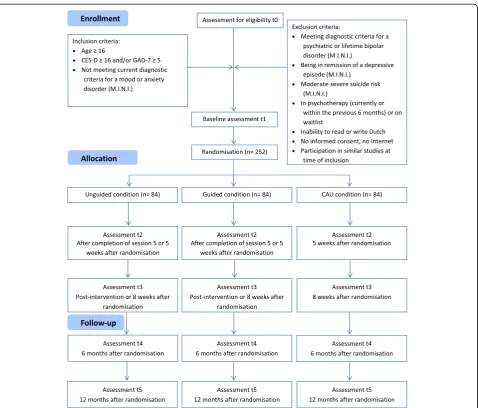
will be randomized at an individual level by an inde-pendent institute (University of Münster, Germany) and randomization will be stratified by type of subclinical symptoms (depression or anxiety). Due to the nature of the study it is not possible to blind either participants or coaches, as they will be notified to which of the three conditions they have been assigned to. However, raters who perform the clinical interviews to assess outcomes will be blinded. In order to ensure that blinding was suc-cessful, participants will be informed about the import-ance not to indicate their allocation status at the beginning of the telephone interviews. Moreover, raters will be asked to guess the allocation status of each par-ticipant after the second interview at post intervention. The results will then be compared to what would have been expected by chance. The flowchart of the trial is shown in Fig.1.
[image:4.595.60.539.305.713.2]Online intervention platform
The technology platform used to deliver the ICare Prevent intervention is provided by Minddistrict. This company is full partner of the ICare project consortium and responsible for the provision and maintenance of the platform. Its content management system is used to upload the inter-ventions, add new participants and eCoaches, as well as questionnaires. Access to the platform is provided by means of email and personalized password combination. It is currently used both in clinical research and in routine practice to provide guided and unguided self-help interven-tions for a variety of mental health condiinterven-tions. The platform conforms to all required quality standards and operates ac-cording to the ISO 27000 and NEN 7510 norms. All data are securely stored on ISO 27000 certified servers and transmitted using HTTPS with SSL certificates (AES-256 and SHA-1, 2048-bit RSA). Unauthorized access to the platform is therefore not possible. A data management and safety plan has been developed as part of the larger ICare project.
Intervention
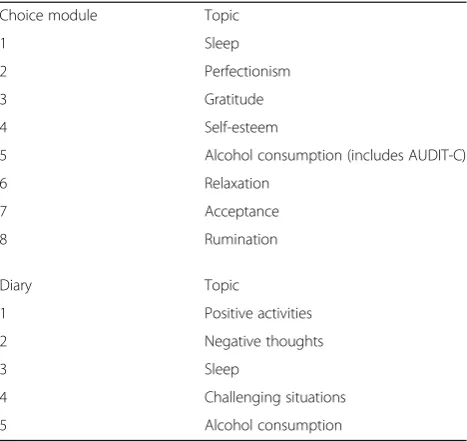
ICare Prevent is an Internet-based intervention with mobile-support by means of an application (app). It uses both transdiagnostic and individually tailored components that are based on previously developed Internet-based modules, all using evidence-based CBT principles [47– 51]. ICare Prevent consists of seven main sessions and one booster session. Participants are advised to complete one main session per week. The intervention contains text, exercises, images, explanatory videos, as well as audio files and downloadable information. Testimonials are used to illustrate (homework) exercises. The main sessions fol-low the same basic structure. First, the content of the current session is explained, followed by a review of the homework exercises from the previous session. In accord-ance with the individually tailored approach of the inter-vention, participants can choose content depending on their predominant complaints, i.e. depression or anxiety. For example, in the fifth session, participants can either practice problem-solving or exposure techniques. The content per session is summarized in Table1. Throughout sessions 2–7, participants can choose to complete one of eight choice modules following the main intervention content. In accordance with the transdiagnostic approach of the intervention, these modules aim at increasing resili-ence and tackle problems common to both depression and anxiety. In addition, five diaries with different content, such as positive activities and sleep, are accessible through the online platform and the app. An overview of all choice modules and diaries is given in Table2.
The intervention can be used on (laptop) computers, mo-bile phones, and tablets. The momo-bile app can be used op-tionally. It provides access to the diaries and allows
[image:5.595.305.537.105.303.2]participants to activate push notifications. These short mes-sages contain small exercises, such as short relaxation tech-niques, as well as motivational texts. The intervention uses a responsive web design in order to tailor content to partic-ipants’needs, based on the choices they make. An optional read-aloud function is included. The expected time to complete each session is approximately 60 min. The two intervention conditions only differ in the support partici-pants receive. In the guided condition, trained eCoaches (clinical psychology master students) spend approximately 20 min, but no more than 30 min per session on sending individual manualized feedback on the exercises through the intervention platform. In addition, they will send
Table 1Overview of topics covered by the intervention per session
Session Topic
1 Introduction, technical aspects, goal-setting, and behavioral activation in the context of basic psychological needs and important personal values
2 Identifying problems and tackling them through behavioral activation
3 Psychoeducation on depression and anxiety
4 Cognitive restructuring and challenging negative thoughts 5 Identifying the most prominent complaints and accordingly
follow either:
a) problem-solving strategies for more prominent depressive complaintsb) exposure strategies for more prominent anxiety complaints
6 Deepening the training on the route chosen in session 5 7 Making a plan for the future
8 Booster session (four weeks after session 7)
Table 2Overview of topics covered by the choice modules and diaries
Choice module Topic
1 Sleep
2 Perfectionism
3 Gratitude
4 Self-esteem
5 Alcohol consumption (includes AUDIT-C)
6 Relaxation
7 Acceptance
8 Rumination
Diary Topic
1 Positive activities
2 Negative thoughts
3 Sleep
4 Challenging situations
[image:5.595.305.539.511.732.2]reminders for module completion in order to increase ad-herence. The eCoaches will be supervised by the members of the research team. Participants in the unguided condi-tion receive only automatic motivacondi-tional messages that aim to increase adherence by positively reinforcing participants for completing intervention modules and reminding them in case of a delay in completion.
Care as usual (CAU)
Participants in all three conditions may use CAU services. We monitor healthcare services used, as well as other means to alleviate symptoms (e.g. as talking with relatives and friends), by means of a self-report questionnaire, the Client Service Receipt Inventory (CSRI; [52]). In the Netherlands, CAU for subclinical symptoms of depression and/or anxiety can include visits to the general practitioner, making use of support staff trained in the provision of help for mild psychological symptoms, or (student) psychologists according to Dutch guidelines [53,54]. Alternatives include homeopaths, alternative medicine providers, or self-medication. Participants in the control group will receive access to ICare Prevent one year after trial inclusion.
Measures
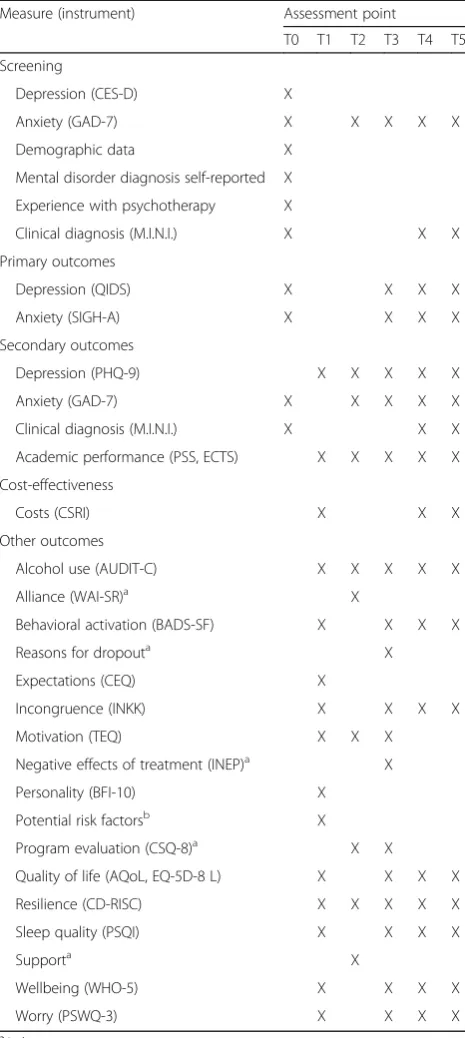
Following screening and baseline (all groups), assess-ment points for the intervention groups include five weeks after randomization or directly after session 5 (whichever happens first) and eight weeks after randomization or post intervention (whichever hap-pens first). Assessment points for the control group include five and eight weeks after randomization. Follow-up measures for all three groups consist of six and 12 months after randomization. Assessments include self-report questionnaires on the intervention platform and diagnostic interviews administered over the telephone. An overview of all measures taken by assessment point is given in Table 3.
Screening
Depression
The CES-D [41] will be used as a screening instru-ment. It has been shown to be reliable and valid in studies across different populations, including stu-dents [55, 56].
Anxiety
The GAD-7 [42] will be used both as screening as well as outcome measure. It has been tested in students as well as different age groups and showed excellent reli-ability and validity [57,58].
Demographic data, self-reported mental disorder diagnosis, and experience with psychotherapy
[image:6.595.305.538.110.630.2]In addition to demographic data, such as age, partici-pants indicate if they have ever received a diagnosis of
Table 3Overview of instruments with associated assessment points
Measure (instrument) Assessment point
T0 T1 T2 T3 T4 T5
Screening
Depression (CES-D) X
Anxiety (GAD-7) X X X X X
Demographic data X
Mental disorder diagnosis self-reported X Experience with psychotherapy X
Clinical diagnosis (M.I.N.I.) X X X
Primary outcomes
Depression (QIDS) X X X X
Anxiety (SIGH-A) X X X X
Secondary outcomes
Depression (PHQ-9) X X X X X
Anxiety (GAD-7) X X X X X
Clinical diagnosis (M.I.N.I.) X X X
Academic performance (PSS, ECTS) X X X X X
Cost-effectiveness
Costs (CSRI) X X X
Other outcomes
Alcohol use (AUDIT-C) X X X X X
Alliance (WAI-SR)a X
Behavioral activation (BADS-SF) X X X X
Reasons for dropouta X
Expectations (CEQ) X
Incongruence (INKK) X X X X
Motivation (TEQ) X X X
Negative effects of treatment (INEP)a X
Personality (BFI-10) X
Potential risk factorsb X
Program evaluation (CSQ-8)a X X
Quality of life (AQoL, EQ-5D-8 L) X X X X
Resilience (CD-RISC) X X X X X
Sleep quality (PSQI) X X X X
Supporta X
Wellbeing (WHO-5) X X X X
Worry (PSWQ-3) X X X X
a
Only in intervention groups b
Optional
T0screening,T1baseline,T2after completion of session 5 or 5 weeks after randomization,T3post intervention,T46-month follow-up,T5
any, and, if so, which, mental health disorder and whether they have ever utilized psychological treatment for any mental health condition.
Diagnostic interview
The M.I.N.I. [43] will be administered by telephone to es-tablish DSM-V diagnoses of mood and anxiety disorders, bipolar disorder, psychosis, and the risk for suicide during screening. The reliability and validity of the M.I.N.I. has been established among several populations [59,60].
Primary outcome
The primary outcome is change in disorder-specific symp-tom severity from baseline to post intervention. For de-pression, this will be assessed using the QIDS-CR [44]. This interview has been used in different settings and has good psychometric properties [44, 61]. The SIGH-A [45] will be used for the assessment of anxiety. Its reliability and validity has been found to be good [45].
Secondary outcomes
Secondary outcomes include self-reported reduction in depressive and anxiety symptoms from baseline to post intervention. In addition to screening, the GAD-7 will be used to measure anxiety symptoms throughout the trial. The nine-item Patient Health Questionnaire (PHQ-9; [62]) will be used to assess depressive symptoms. Research on the PHQ-9 has generally shown good psychometric properties among all age groups [62–64]. Moreover, the time to onset of a mood or anxiety disorder within the 12-month follow-up period will be assessed by the M.I.N.I. Finally, academic performance will be measured by the Presenteeism Scale for Students (PSS; [65]). It is a valid and reliable measure that will be used to assess presentee-ism in the student population [65]. In addition, students will be asked to provide the number of points they ac-quired on the European Credit Transfer System (ECTS) during the semester.
Costs
The CSRI [52] will be used to track societal costs. It has been adapted to the specifics of the Dutch college stu-dent context, measuring costs associated with healthcare use. In addition, it assesses absenteeism and presentee-ism in college as well as in student jobs. For the latter, the Dutch minimum wage will be taken as an estimate of students’income.
Other outcomes, moderators, and mediators
Alcohol use
Alcohol use will be monitored by the three consumption questions of the brief Alcohol Use Disorders Identifica-tion Test (AUDIT-C; [66]). The AUDIT-C has shown good psychometric properties in college students [67].
Moreover, it has been used both as a screening as well as outcome instrument [68,69].
Alliance (only intervention arms)
An adapted version of the self-rated Working Alliance Inventory (WAI-SR; [70]) will be administered to the active intervention groups. Questions relating to the bond with the coach will be asked only in the guided condition. The original form of the WAI-SR has shown good psychometric properties [70, 71].
Behavioral activation
The short form of the Behavioral Activation for Depres-sion Scale (BADS-SF; [72, 73]) assesses activation and engagement in pleasant activities. The reliability and val-idity of the questionnaire has been established in a col-lege student sample [74].
Dropout
Participants will be asked whether and why they have prematurely stopped using the intervention.
Expectations (only intervention arms)
The Credibility/Expectancy Questionnaire (CEQ; [75]) will be used to assess participants’ expectations of the intervention. Its reliability and validity has been estab-lished and the questionnaire has been used in college student samples [75,76].
Incongruence
ICare Prevent aims at reducing the gap between motiv-ational goals and their actual execution. The short ver-sion of the incongruence questionnaire (INKK; [77]) measures the extent to which this is achieved.
Motivation
The Treatment Entry Questionnaire (TEQ; [78]) will be used to assess motivation to participate in the study. Re-search has indicated good psychometric properties for the TEQ in a Dutch psychiatric sample [79].
Negative effects of the intervention (only in intervention arms)
The Inventory for the Assessment of Negative Effects of Psychotherapy (INEP; [80]) measures possible negative aspects of using the intervention.
Personality
Potential risk factors
Participants can choose if they want to answer a battery of potential risk factors for mental wellbeing that have been suggested by the literature, such as smoking, body image, and childhood abuse.
Program evaluation (only in intervention arms)
The eight-item Client Satisfaction Questionnaire has been adapted to this online context (CSQ-8; [83, 84]). It assesses participants’ satisfaction with the intervention. The psychometric properties of the Dutch version have been found to be good [85].
Quality of life
In addition to the Assessment of Quality of Life ques-tionnaire (AQoL-8D; [86,87]), the EuroQol (EQ-5D-5 L; [88]) will be administered. This enables the calculation of quality-adjusted life-years (QALYs) and converting health states into utility scores using the Dutch EQ-5D-5 L tariff [89]. Both instruments have established psy-chometric properties [86,90].
Resilience
The ten-item version of the Connor-Davidson Resilience Scale (CD-RISC; [91]) measures how good individuals can work under pressure or how strong they think they are. The CD-RISC has been used in college samples and its reliability and validity has been well established in dif-ferent populations [92–94].
Sleep quality
One item on sleep quality from the Pittsburgh Sleep Quality Index (PSQI; [95]) will be administered. The PSQI has been used extensively in college samples [96, 97].
Support (only in guided intervention arm)
Seven items have been developed by the research team to assess the relationship between participants and their eCoach (e.g. “I think my eCoach appreciates me less if I use ICare Prevent less often than expected”), as well as how they would rate the eCoach’s competency (e.g. “I think my eCoach is very competent”).
Wellbeing
Wellbeing will be measured by the five-item version of the World Health Organization Ten Well-Being Index (WHO-5; [98]). Good psychometric properties of this in-strument have been established in a college and Dutch population [99,100].
Worry
The ultra-brief version of the Penn State Worry Ques-tionnaire (PSWQ-3; [101]) has good psychometric
properties and will be administered to examine excessive worrying [101,102].
Sample size calculation
The primary endpoint is change in disorder specific symptom severity from baseline to post intervention. Based on the evidence from a meta-analysis by Cuijpers et al. [103] on the effectiveness of psychotherapies for subclinical symptoms of depression, as well as a random-ized controlled trial on the effectiveness of an Internet-based intervention for subclinical depression ([24–26], the expected effect size isd= 0.35. Due to a lack of infor-mation on effect sizes for subclinical symptoms of anx-iety,d= 0.25 is used as a conservative estimation for both conditions. A study comparing the effectiveness of Internet-based psychotherapy with different levels of sup-port found effect sizes in a similar range [39]. The sample size calculation is based on a repeated measure ANOVA and follows the recommendations given in Muller [104] and Muller et al. [105]. Thus, based on a global signifi-cance level α= 0.05 and powerβ= 0.95, 252 participants (84 per study arm) will be needed for an effect of 0.25 to be significant.
Statistical analysis
All analyses for the primary and secondary outcomes will be based on multilevel mixed model regression ana-lyses for continuous outcomes in order to assess change over time. Time will be used as a predictor variable and baseline measures will be included as covariates. Linear models will be used for normally distributed data and negative binomial models for left-skewed data. All ana-lyses will be performed on an intention-to-treat (ITT) sample. Per-protocol analyses including only participants who conformed to their group allocation will be per-formed in addition. Missing data will be handled using either multiple regression imputation techniques if ap-propriate or full information maximum likelihood esti-mation [106]. The secondary outcome, time to mental health disorder onset during 12 months follow-up in all conditions, measured by the M.I.N.I., will also be com-pared using survival curve analysis. The curves will be compared using cox proportional hazard regression ana-lysis using baseline symptom severity as a covariate. Hazard ratios will be calculated as measure of the effect size of group differences. Within secondary analyses, in-teractions with predictors will be added to the model in order to identify risk and protective factors.
Cost-effectiveness
by Van Buuren et al. [107] will be used to impute missing cost and effect data. Incremental cost-effectiveness ratios (ICERs) will be calculated by dividing the pairwise differ-ences in the mean societal costs between the groups by the pairwise differences in mean effects between the groups. Bivariate regression models will be used to esti-mate cost and effect differences while adjusting for con-founding if necessary. Statistical uncertainty will be estimated using bias-corrected accelerated bootstrapping with 5000 replications. Uncertainty surrounding the ICERs will be presented in cost-effectiveness planes and acceptability curves [108].
Discussion
The high prevalence and burden of depression and anx-iety, both on an individual and societal level, warrant ef-fective and low-threshold prevention strategies. Students are considered an at-risk group for developing these con-ditions due to their age of onset and the challenges that this population faces [6]. So far, research on the effective-ness of Internet-based prevention in college students is largely limited to the field of eating disorders and sub-stance use [109,110]. However, scientific evidence on the value of, in particular, transdiagnostic individually tailored interventions for the indicated prevention of depression and anxiety among college students is scarce.
Based on these considerations, we have developed the ICare Prevent intervention. Originally conceived for the indicated prevention in the general population in Germany, we have adapted it to a Dutch college student context. To do that, we have started with a literal trans-lation from German into Dutch. In addition, focus groups have been conducted with students to map out core features that are attractive to them. As a result, the intervention has been shortened considerably while leav-ing the psychotherapeutic components intact. This was assured by the supervision of a licensed psychotherapist. Moreover, problem descriptions and the testimonials have been changed to represent the diverse student population and their experiences related to study stress, balancing work and studies, as well as dealing with fam-ily members, partners, and friends.
Strengths and limitations
To our knowledge, this is the first trial that investigates the (cost-)effectiveness of a transdiagnostic individually tailored Internet-based intervention for the prevention of depres-sion and anxiety in a college student population. Data on both symptom reduction as well as the time to onset of a mood or anxiety disorder will be measured. Although some research suggests that Internet-based interventions have the potential to be cost-effective compared to no treatment, no data are available for preventive transdiagnostic indi-vidually tailored Internet-based interventions for college
students. Specifically, the added (economic) value of sup-port by means of an eCoach needs to be closely monitored in the context of this low-intensity intervention.
Some possible limitations of the present trial should be noted. First, the sample size of this trial conducted among Dutch college students is insufficient for dir-ectly comparing the guided and unguided treatment arm as well as analyzing the time to a mental health disorder onset. Similarly, analyses of moderators and mediators will be underpowered and may therefore provide only limited insights. To counter this issue, data from all participating trials in the ICare project will be pooled in order to achieve enough statistical power. Second, an evaluation of societal costs might be difficult due to the fact that most students are sel-dom in full-time employment. The detrimental effect of depression and anxiety on absenteeism and pres-enteeism in the context of employment is therefore difficult to quantify. In order to increase the validity of the results, we have adapted the cost-effectiveness questionnaire (CSRI; [52]) to fit the specifics of a stu-dent population by focusing on absenteeism and pres-enteeism in student jobs, as well as in lectures. Finally, previous research has shown that adherence to Internet interventions is a point of concern, espe-cially in unguided formats [111, 112]. A series of automatic motivational messages and reminders will be used in order to increase adherence in the un-guided study arm and we will closely observe factors related to dropout. This will be beneficial in designing future interventions and improving uptake of inter-vention content.
Trial status
Recruitment started in July 2017. Follow-up assessments for the last participant are expected to be completed by 31 August 2019.
Additional files
Additional file 1:A populated SPIRIT checklist. (PDF 95 kb)
Additional file 2:SPIRIT figure. (PDF 28 kb)
Abbreviations
Psychotherapie]; INKK: Incongruence Questionnaire–Short Form [Inkonkruenzfragebogen - Kurzform]; ISO: International Organization for Standardization; ITT: Intention-to-treat; M.I.N.I.: Mini International Neuropsychiatric Interview; MDD: Major depressive episode; NEN: Dutch norm [NEderlandse Norm]; PHQ-9: Patient Health Questionnaire–9 item version; PSQI: Pittsburgh Sleep Quality Index; PSS: Presenteeism Scale for Students; PSWQ-3: Penn State Worry Questionnaire–3 item version; QALY: Quality-adjusted life years; QIDS-CR: Quick Inventory for Depression Scale
–Clinician Rated; RSA: Asymmetric Encryption Algorithm; SHA-1: Secure Hash Algorithm 1; SIGH-A: Structured Interview Guide for the Hamilton Anxiety Rating Scale; SSL: Secure sockets layer; TEQ: Treatment Expectancy
Questionnaire; WAI-SR: Working Alliance Inventory–Self-rated; WHO-5: World Health Organization Ten Well-being Index–5 item version
Acknowledgements
The authors greatly thank Marleen Swenne for her help in translating the intervention and adapting it to a Dutch student context.
Funding
This trial is funded as part of the larger project (ICare) by the European Commission Horizon 2020 Research and Innovation Action.
Availability of data and materials Not applicable.
Authors’contributions
DDE designed the study. DDE, FB, EK, AK, HR, PC, ACZ, KKW, and CJ contributed significantly to the design. JEB set up the cost-effectiveness analysis. FB wrote the manuscript. All authors contributed feedback, read, and approved the final manuscript.
Ethics approval and consent to participate
This study and its protocol has received ethics approval from the medical ethics committee of VU Amsterdam Medical Centre (VUmc, registration NL60705.029.17). All participants have to provide written informed consent in order to be included in the study.
Consent for publication Not applicable.
Competing interests
Annet Kleiboer is an editor forTrials.
Publisher’s Note
Springer Nature remains neutral with regard to jurisdictional claims in published maps and institutional affiliations.
Author details
1Department of Clinical, Neuro-, and Developmental Psychology, Vrije
Universiteit Amsterdam, Van der Boechorststraat 1, BT 1081 Amsterdam, The Netherlands.2Amsterdam Public Health research institute, Faculty of
Behavioral and Movement Sciences, Vrije Universiteit Amsterdam, Amsterdam, The Netherlands.3Department of Health Sciences, Faculty of
Earth & Life Sciences, Vrije Universiteit Amsterdam, Amsterdam, The Netherlands.4Department of Clinical Psychology and Psychotherapy,
Friedrich-Alexander-Universität Erlangen-Nürnberg, Erlangen, Germany.
5Department of Clinical Psychology & Psychotherapy, Technische Universität
Dresden, Dresden, Germany.
Received: 11 December 2017 Accepted: 12 January 2018
References
1. Cummings CM, Caporino NE, Kendall PC. Comorbidity of anxiety and depression in children and adolescents: 20 years after. Psychol Bull. 2014; 140(3):816–45.https://doi.org/10.1037/a0034733
2. Kessler RC. The costs of depression. Psychiatr Clin North Am. 2012;35(1):1–14.
https://doi.org/10.1016/j.psc.2011.11.005
3. Kessler RC, Akiskal HS, Ames M, Birnbaum H, Greenberg P, Hirschfeld RM, et al. Prevalence and effects of mood disorders on work performance in a
nationally representative sample of U.S. workers. Am J Psychiatry. 2006; 163(9):1561–8.https://doi.org/10.1176/ajp.2006.163.9.1561
4. Olfson M, Gameroff MJ. Generalized anxiety disorder, somatic pain and health care costs. Gen Hosp Psychiatry. 2007;29(4):310–6.https://doi.org/10. 1016/j.genhosppsych.2007.04.004
5. Whiteford HA, Degenhardt L, Rehm J, Baxter AJ, Ferrari AJ, Erskine HE, et al. Global burden of disease attributable to mental and substance use disorders: findings from the Global Burden of Disease Study 2010. Lancet. 2013;382(9904):1575–86.https://doi.org/10.1016/s0140-6736(13)61611-6 6. Kessler RC, Berglund P, Demler O, Jin R, Merikangas KR, Walters EE. Lifetime
prevalence and age-of-onset distributions of DSM-IV disorders in the National Comorbidity Survey Replication. Arch Gen Psychiatry. 2005;62(6): 593–602.https://doi.org/10.1001/archpsyc.62.6.593
7. Zisook S, Lesser I, Stewart JW, Wisniewski SR, Balasubramani G, Fava M, et al. Effect of age at onset on the course of major depressive disorder. Am J Psychiatry. 2007;164(10):1539–46.
8. Pedrelli P, Nyer M, Yeung A, Zulauf C, Wilens T. College students: mental health problems and treatment considerations. Acad Psychiatry. 2015;39(5): 503–11.https://doi.org/10.1007/s40596-014-0205-9
9. Thurber CA, Walton EA. Homesickness and adjustment in university students. J Am Coll Heal. 2012;60(5):415–9.https://doi.org/10.1080/07448481.2012.673520
10. American College Health Association. American College Health Association -National College Health Assessment II: Reference Group Executive Summary Spring 2015. 2015. Retrieved from Hanover, MD.
11. Auerbach RP, Alonso J, Axinn WG, Cuijpers P, Ebert DD, Green JG, et al. Mental disorders among college students in the World Health Organization World Mental Health Surveys. Psychol Med. 2016;46(14):2955–70.https://doi. org/10.1017/s0033291716001665
12. Ibrahim AK, Kelly SJ, Adams CE, Glazebrook C. A systematic review of studies of depression prevalence in university students. J Psychiatr Res. 2013;47(3):391–400.https://doi.org/10.1016/j.jpsychires.2012.11.015
13. McGorry PD, Purcell R, Goldstone S, Amminger GP. Age of onset and timing of treatment for mental and substance use disorders: implications for preventive intervention strategies and models of care. Curr Opin Psychiatry. 2011;24(4):301–6.https://doi.org/10.1097/YCO.0b013e3283477a09
14. Ramsawh HJ, Weisberg RB, Dyck I, Stout R, Keller MB. Age of onset, clinical characteristics, and 15-year course of anxiety disorders in a prospective, longitudinal, observational study. J Affect Disord. 2011;132(1–2):260–4.
https://doi.org/10.1016/j.jad.2011.01.006
15. Bruffaerts R, Mortier P, Kiekens G, Auerbach RP, Cuijpers P, Demyttenaere K, et al. Mental health problems in college freshmen: Prevalence and academic functioning. J Affect Disord. 2018;225(Supplement C):97–103.
https://doi.org/10.1016/j.jad.2017.07.044
16. Hartley MT. Increasing resilience: Strategies for reducing dropout rates for college students with psychiatric disabilities. Am J Psychiatr Rehabil. 2010; 13(4):295–315.
17. Eisenberg D, Downs MF, Golberstein E, Zivin K. Stigma and help seeking for mental health among college students. Med Care Res Rev. 2009;66(5):522–41.
https://doi.org/10.1177/1077558709335173
18. Eisenberg D, Golberstein E, Hunt JB. Mental health and academic success in college. BE J Econ Anal Policy. 2009;9(1):1–35.
19. Mowbray CT, Megivern D, Mandiberg JM, Strauss S, Stein CH, Collins K, et al. Campus mental health services: recommendations for change. Am J Orthop. 2006;76(2):226.
20. Mrazek PJ, Haggerty RJ. Reducing risks for mental disorders: frontiers for preventive intervention research. Washington, DC: The National Academies Press; 1994.
21. Conley CS, Durlak JA, Kirsch AC. A Meta-analysis of universal mental health prevention programs for higher education students. Prev Sci. 2015;16(4): 487–507.https://doi.org/10.1007/s11121-015-0543-1
22. Antony MM, Stein MB. Oxford handbook of anxiety and related disorders. Oxford: Oxford University Press; 2009.
23. Schoevers RA, Smit F, Deeg DJ, Cuijpers P, Dekker J, van Tilburg W, et al. Prevention of late-life depression in primary care: do we know where to begin? Am J Psychiatry. 2006;163(9):1611–21.https://doi.org/10.1176/ajp.2006.163.9.1611
and recommendations for future research. Front Psychiatry. 2017;8:116.
https://doi.org/10.3389/fpsyt.2017.00116
26. Ebert DD, Kählke F, Buntrock C, Berking M, Smit F, Heber E, et al. A health economic outcome evaluation of an internet-based mobile-supported stress management intervention for employees. Scand J Work Environ Health. 2017;https://doi.org/10.5271/sjweh.3691.
27. Königsbauer J, Letsch J, Doebler P, Ebert D, Baumeister H. Internet- and mobile-based depression interventions for people with diagnosed depression: A systematic review and meta-analysis. J Affect Disord. 2017;223: 28–40.https://doi.org/10.1016/j.jad.2017.07.021
28. Olthuis JV, Watt MC, Bailey K, Hayden JA, Stewart SH. Therapist-supported Internet cognitive behavioural therapy for anxiety disorders in adults. Cochrane Library. 2016;3:CD011565.
29. Andersson G. Internet-delivered psychological treatments. Annu Rev Clin Psychol. 2016;12:157–79.https://doi.org/10.1146/annurev-clinpsy-021815-093006
30. Buntrock C, Ebert DD, Lehr D, Smit F, Riper H, Berking M, et al. Effect of a web-based guided self-help intervention for prevention of major depression in adults with subthreshold depression: a randomized clinical trial. JAMA. 2016;315(17):1854–63.https://doi.org/10.1001/jama. 2016.4326
31. Christensen H, Batterham P, Mackinnon A, Griffiths KM, Kalia Hehir K, Kenardy J, et al. Prevention of generalized anxiety disorder using a web intervention, iChill: randomized controlled trial. J Med Internet Res. 2014; 16(9):e199.https://doi.org/10.2196/jmir.3507
32. Garber J, Weersing VR. Comorbidity of anxiety and depression in youth: implications for treatment and prevention. Clin Psychol. 2010;17(4):293–306.
https://doi.org/10.1111/j.1468-2850.2010.01221.x
33. Pasarelu CR, Andersson G, Bergman Nordgren L, Dobrean A. Internet-delivered transdiagnostic and tailored cognitive behavioral therapy for anxiety and depression: a systematic review and meta-analysis of randomized controlled trials. Cogn Behav Ther. 2017;46(1):1–28.https://doi. org/10.1080/16506073.2016.1231219
34. Gerhards SA, de Graaf LE, Jacobs LE, Severens JL, Huibers MJ, Arntz A, et al. Economic evaluation of online computerised cognitive-behavioural therapy without support for depression in primary care: randomised trial. Br J Psychiatry. 2010;196(4):310–8.https://doi.org/10.1192/bjp.bp.109.065748
35. Smit F, Willemse G, Meulenbeek P, Koopmanschap M, van Balkom A, Spinhoven P, et al. Preventing panic disorder: cost-effectiveness analysis alongside a pragmatic randomised trial. Cost Eff Resour Alloc. 2009;7:8.
https://doi.org/10.1186/1478-7547-7-8
36. Warmerdam L, Smit F, van Straten A, Riper H, Cuijpers P. Cost-utility and cost-effectiveness of internet-based treatment for adults with depressive symptoms: randomized trial. J Med Internet Res. 2010;12(5): e53.https://doi.org/10.2196/jmir.1436
37. Buntrock C, Berking M, Smit F, Lehr D, Nobis S, Riper H, et al. Preventing depression in adults with subthreshold depression: health-economic evaluation alongside a pragmatic randomized controlled trial of a web-based intervention. J Med Int Res. 2017;19(1):e5.https://doi.org/10.2196/jmir.6587
38. Berger T, Hämmerli K, Gubser N, Andersson G, Caspar F. Internet-based treatment of depression: a randomized controlled trial comparing guided with unguided self-help. Cogn Behav Ther. 2011;40(4):251–66.
39. Kleiboer A, Donker T, Seekles W, van Straten A, Riper H, Cuijpers P. A randomized controlled trial on the role of support in Internet-based problem solving therapy for depression and anxiety. Behav Res Ther. 2015; 72:63–71.http://dx.doi.org/10.1016/j.brat.2015.06.013
40. Richards D, Richardson T. Computer-based psychological treatments for depression: a systematic review and meta-analysis. Clin Psychol Rev. 2012; 32(4):329–42.https://doi.org/10.1016/j.cpr.2012.02.004
41. Radloff LS. The CES-D scale: A self-report depression scale for research in the general population. Appl Psychol Meas. 1977;1(3):385–401. 42. Spitzer RL, Kroenke K, Williams JB, Lowe B. A brief measure for assessing
generalized anxiety disorder: the GAD-7. Arch Intern Med. 2006;166(10): 1092–7.https://doi.org/10.1001/archinte.166.10.1092
43. Sheehan DV, Lecrubier Y, Sheehan KH, Amorim P, Janavs J, Weiller E, et al. The Mini-International Neuropsychiatric Interview (M.I.N.I.): the development and validation of a structured diagnostic psychiatric interview for DSM-IV and ICD-10. J Clin Psychiatry. 1998;59(Suppl 20): 22–33. quiz 34–57
44. Rush AJ, Trivedi MH, Ibrahim HM, Carmody TJ, Arnow B, Klein DN, et al. The 16-Item Quick Inventory of Depressive Symptomatology (QIDS), clinician rating (QIDS-C), and self-report (QIDS-SR): a psychometric
evaluation in patients with chronic major depression. Biol Psychiatry. 2003;54(5):573–83.
45. Shear MK, Vander Bilt J, Rucci P, Endicott J, Lydiard B, Otto MW, et al. Reliability and validity of a structured interview guide for the Hamilton Anxiety Rating Scale (SIGH-A). Depress Anxiety. 2001;13(4):166–78. 46. Mokkenstorm JK, Eikelenboom M, Huisman A, Wiebenga J, Gilissen R, Kerkhof
A, et al. Evaluation of the 113Online suicide prevention crisis chat service: outcomes, helper behaviors and comparison to telephone hotlines. Suicide Life Threat Behav. 2017;47(3):282–96.https://doi.org/10.1111/sltb.12286
47. Buntrock C, Ebert D, Lehr D, Riper H, Smit F, Cuijpers P, et al. Effectiveness of a web-based cognitive behavioural intervention for subthreshold depression: pragmatic randomised controlled trial. Psychother Psychosom. 2015;84(6):348–58.
48. Ebenfeld L, Kleine Stegemann S, Lehr D, Ebert DD, Jazaieri H, van Ballegooijen W, et al. Efficacy of a hybrid online training for panic symptoms and agoraphobia: study protocol for a randomized controlled trial. Trials. 2014;15:427.https://doi.org/10.1186/1745-6215-15-427
49. Heber E, Ebert DD, Lehr D, Nobis S, Berking M, Riper H. Efficacy and cost-effectiveness of a web-based and mobile stress-management intervention for employees: design of a randomized controlled trial. BMC Public Health. 2013;13:655.https://doi.org/10.1186/1471-2458-13-655
50. Nobis S, Lehr D, Ebert DD, Baumeister H, Snoek F, Riper H, et al. Efficacy of a web-based intervention with mobile phone support in treating depressive symptoms in adults with type 1 and type 2 diabetes: a randomized controlled trial. Diabetes Care. 2015;38(5):776–83.https://doi.org/10.2337/dc14-1728
51. Thiart H, Lehr D, Ebert DD, Sieland B, Berking M, Riper H. Log in and breathe out: efficacy and cost-effectiveness of an online sleep training for teachers affected by work-related strain–study protocol for a randomized controlled trial. Trials. 2013;14:169.https://doi.org/10.1186/1745-6215-14-169
52. Beecham J, Knapp M. Costing psychiatric interventions. In: Thornicroft G, editor. Measuring mental health needs. London: Gaskell; 2001.
53. Spijker J, Bockting C, Meeuwissen J, van Vliet I, Emmelkamp P, Hermens M, et al. Multidisciplinaire richtlijn Depressie (Derde revisie): Richtlijn voor de diagnostiek, behandeling en begeleiding van volwassen patiënten met een depressieve stoornis. [Multidisciplinary guidelines for depression (third revision): Guideline for the diagnosis, treatment and guidance of adult patients with a depressive disorder]. Trimbos Instituut: Utrecht; 2013. 54. Van Balkom A, van Vliet I, Emmelkamp P, Bockting C, Spijker J, Hermens M,
et al. Multidisciplinaire richtlijn Angststoornissen (Derde revisie): Richtlijn voor de diagnostiek, behandeling en begeleiding van volwassen patiënten met een angststoornis. [Multidisciplinary guidelines for anxiety disorders (third revision): Guideline for the diagnosis, treatment and guidance of adult patients with an anxiety disorder]. Trimbos Instituut: Utrecht; 2013. 55. Bouma J, Ranchor AV, Sanderman R, van Sonderen E. Het meten van
symptomen van depressie met de CES-D: Een handleiding. [Measuring symptoms of depression with the CES-D: a manual]. Groningen: Noordelijk Centrum voor Gezondheidsvraagstukken, Rijksuniversiteit Groningen; 1995. 56. Radloff LS. The use of the Center for Epidemiologic Studies Depression
Scale in adolescents and young adults. J Youth Adolesc. 1991;20(2):149–66.
https://doi.org/10.1007/bf01537606
57. Lowe B, Decker O, Muller S, Brahler E, Schellberg D, Herzog W, et al. Validation and standardization of the Generalized Anxiety Disorder Screener (GAD-7) in the general population. Med Care. 2008;46(3):266–74.https://doi. org/10.1097/MLR.0b013e318160d093
58. Monteiro S, Bártolo A, Torres A, Pereira A. (Re)examining the factorial sstructure of the generalized anxiety disorder-7 in a college students sample. Eur Psychiatry. 2017;41(Supplement):S109.https://doi.org/10.1016/j. eurpsy.2017.01.1879
59. Otsubo T, Tanaka K, Koda R, Shinoda J, Sano N, Tanaka S, et al. Reliability and validity of Japanese version of the Mini-International Neuropsychiatric Interview. Psychiatry Clin Neurosci. 2005;59(5):517–26.https://doi.org/10. 1111/j.1440-1819.2005.01408.x
60. Sheehan DV, Sheehan KH, Shytle RD, Janavs J, Bannon Y, Rogers JE, et al. Reliability and validity of the Mini International Neuropsychiatric Interview for Children and Adolescents (MINI-KID). J Clin Psychiatry. 2010;71(3):313–26.
https://doi.org/10.4088/JCP.09m05305whi
62. Kroenke K, Spitzer RL, Williams JBW. The PHQ-9. J Gen Intern Med. 2001; 16(9):606–13.https://doi.org/10.1046/j.1525-1497.2001.016009606.x
63. Gilbody S, Richards D, Brealey S, Hewitt C. Screening for depression in medical settings with the Patient Health Questionnaire (PHQ): a diagnostic meta-analysis. J Gen Intern Med. 2007;22(11):1596–602.https://doi.org/10. 1007/s11606-007-0333-y
64. Martin A, Rief W, Klaiberg A, Braehler E. Validity of the Brief Patient Health Questionnaire Mood Scale (PHQ-9) in the general population. Gen Hosp Psychiatry. 2006;28(1):71–7.https://doi.org/10.1016/j.genhosppsych.2005.07.003
65. Matsushita M, Adachi H, Arakida M, Namura I, Takahashi Y, Miyata M, et al. Presenteeism in college students: reliability and validity of the Presenteeism Scale for Students. Qual Life Res. 2011;20(3):439–46.
https://doi.org/10.1007/s11136-010-9763-9
66. Bush K, Kivlahan DR, McDonell MB, Fihn SD, Bradley KA. The AUDIT alcohol consumption questions (AUDIT-C): an effective brief screening test for problem drinking. Arch Intern Med. 1998;158(16):1789–95.https://doi.org/10. 1001/archinte.158.16.1789
67. Barry AE, Chaney BH, Stellefson ML, Dodd V. Evaluating the psychometric properties of the AUDIT-C among college students. J Subst Use. 2015;20(1): 1–5.https://doi.org/10.3109/14659891.2013.856479
68. Cunningham JA, Wild TC, Cordingley J, Van Mierlo T, Humphreys K. Twelve-month follow-up results from a randomized controlled trial of a brief personalized feedback intervention for problem drinkers. Alcohol Alcohol. 2010;45(3):258–62.https://doi.org/10.1093/alcalc/agq009
69. Demartini KS, Carey KB. Optimizing the use of the AUDIT for alcohol screening in college students. Psychol Assess. 2012;24(4):954–63.https://doi. org/10.1037/a0028519
70. Hatcher RL, Gillaspy JA. Development and validation of a revised short version of the working alliance inventory. Psychother Res. 2006;16(1):12–25.
https://doi.org/10.1080/10503300500352500
71. Munder T, Wilmers F, Leonhart R, Linster HW, Barth J. Working Alliance Inventory-Short Revised (WAI-SR): psychometric properties in outpatients and inpatients. Clin Psychol Psychother. 2010;17(3):231–9.https://doi.org/10.1002/cpp.658
72. Kanter J, Mulick P, Busch A, Berlin K, Martell C. The Behavioral Activation for Depression Scale (BADS): Psychometric Properties and Factor Structure. J Psychopathol Behav Assess. 2007;29:191.
73. Kanter JW, Mulick P, Busch A, Berlin K, Martell C. Behavioral Activation for Depression Scale (BADS) (Long and Short Form). Meas Instrum Datab Soc Sci. 2012;58:113–117.
74. Manos RC, Kanter JW, Luo W. The Behavioral Activation for Depression Scale–Short Form: Development and Validation. Behav Ther. 2011;42(4): 726–39.http://dx.doi.org/10.1016/j.beth.2011.04.004
75. Devilly GJ, Borkovec TD. Psychometric properties of the credibility/ expectancy questionnaire. J Behav Ther Exp Psychiatry. 2000;31(2):73–86.
http://dx.doi.org/10.1016/S0005-7916(00)00012-4
76. Mitchell N, Gordon PK. Attitudes towards computerized CBT for depression amongst a student population. Behav Cogn Psychother. 2007;35(4):421–30.
https://doi.org/10.1017/S1352465807003700
77. Grosse HM. Inkongruenzfragebogen (INK), vol. 17. Bern: Hans Huber; 2014. 78. Ryan RM, Plant RW, O’Malley S. Initial motivations for alcohol treatment:
Relations with patient characteristics, treatment involvement, and dropout. Addict Behav. 1995;20(3):279–97.http://dx.doi.org/10.1016/0306-4603(94)00072-7
79. Jochems EC, Mulder CL, Duivenvoorden HJ, van der Feltz-Cornelis CM, van Dam A. Measures of motivation for psychiatric treatment based on self-determination theory: psychometric properties in Dutch psychiatric outpatients. Assessment. 2014;21(4):494–510.https://doi.org/10.1177/1073191113517928
80. Ladwig I, Rief W, Nestoriuc Y. What are the risks and side effects of psychotherapy?-development of an inventory for the assessment of negative effects of psychotherapy (INEP). Verhaltenstherapie. 2014;24:252–64. 81. Denissen JJA, Geenen R, van Aken MAG, Gosling SD, Potter J. Development
and validation of a Dutch translation of the Big Five Inventory (BFI). J Pers Assess. 2008;90(2):152–7.https://doi.org/10.1080/00223890701845229
82. Gosling SD, Rentfrow PJ, Swann WB. A very brief measure of the Big-Five personality domains. J Res Pers. 2003;37(6):504–28.https://doi.org/10.1016/ S0092-6566(03)00046-1
83. Attkisson CC, Zwick R. The client satisfaction questionnaire. Psychometric properties and correlations with service utilization and psychotherapy outcome. Eval Program Plann. 1982;5(3):233–7.
84. Boß L, Lehr D, Reis D, Vis C, Riper H, Berking M, et al. Reliability and validity of assessing user satisfaction with web-based health interventions. J Med Internet Res. 2016;18(8):e234.https://doi.org/10.2196/jmir.5952
85. de Brey H. A cross-national validation of the client satisfaction questionnaire: the Dutch experience. Eval Program Plann. 1983;6(3–4):395–400.
86. Richardson J, Iezzi A. Psychometric validity and the AQoL-8D multi attribute utility instrument. Melbourne: Centre for Health Economics Monash University; 2011.
87. Richardson J, Iezzi A, Khan MA, Maxwell A. Validity and Reliability of the Assessment of Quality of Life (AQoL)-8D multi-attribute utility instrument. Patient. 2014;7(1):85–96.https://doi.org/10.1007/s40271-013-0036-x
88. Herdman M, Gudex C, Lloyd A, Janssen M, Kind P, Parkin D, et al. Development and preliminary testing of the new five-level version of EQ-5D (EQ-5D-5L). Qual Life Res. 2011;20(10):1727–36.https://doi.org/ 10.1007/s11136-011-9903-x
89. Versteegh MM, Vermeulen KM, Evers SMAA, de Wit GA, Prenger R, Stolk EA. Dutch Tariff for the Five-Level Version of EQ-5D. Value Health. 2016;19(4): 343–52.http://dx.doi.org/10.1016/j.jval.2016.01.003
90. Janssen MF, Pickard AS, Golicki D, Gudex C, Niewada M, Scalone L, et al. Measurement properties of the EQ-5D-5L compared to the EQ-5D-3L across eight patient groups: a multi-country study. Qual Life Res. 2013;22(7):1717–27.
https://doi.org/10.1007/s11136-012-0322-4
91. Connor KM, Davidson JR. Development of a new resilience scale: the Connor-Davidson Resilience Scale (CD-RISC). Depress Anxiety. 2003;18(2):76–82.
https://doi.org/10.1002/da.10113
92. Giesbrecht T, Abidi K, Smeets T, Merckelbach H, van Oorsouw K, Raymaeker L. Adversity does not always lead to psychopathology:cognitive reactivity is related to longitudinal changes in resilience. Neth J Psychol. 2009;65(2):62–8.
https://doi.org/10.1007/bf03080128
93. Hartley MT. Examining the relationships between resilience, mental health, and academic persistence in undergraduate college students. J Am Coll Heal. 2011;59(7):596–604.https://doi.org/10.1080/07448481.2010.515632
94. Markowitz S, Peters ML. Psychometrische evaluatie van de CD-Risc in een Nederlandstalige populatie: een multi- of unifactorieel meetinstrument om veerkracht te meten? Tijdschr Klin Psychol. 2014;44:55–68.
95. Buysse DJ, Reynolds CF 3rd, Monk TH, Berman SR, Kupfer DJ. The Pittsburgh Sleep Quality Index: a new instrument for psychiatric practice and research. Psychiatry Res. 1989;28(2):193–213.
96. Brown FC, Buboltz WC Jr, Soper B. Relationship of sleep hygiene awareness, sleep hygiene practices, and sleep quality in university students. Behav Med. 2002;28(1):33–8.
97. Grandner MA, Kripke DF, Yoon IY, Youngstedt SD. Criterion validity of the Pittsburgh sleep quality index: investigation in a non-clinical sample. Sleep Biol Rhythms. 2006;4(2):129–36.
98. Bech P, Gudex C, Johansen KS. The WHO (Ten) Well-Being Index: validation in diabetes. Psychother Psychosom. 1996;65(4):183–90.
99. de Wit M, Pouwer F, Gemke RJ, Delemarre-van de Waal HA, Snoek FJ. Validation of the WHO-5 Well-Being Index in adolescents with type 1 diabetes. Diabetes Care. 2007;30(8):2003–6.https://doi.org/10.2337/dc07-0447
100. Manos RC, Kanter JW, Luo W. The behavioral activation scale for depression-short form: Development and validation. Behavior Therapy. 2011;42:726–39.
101. Kertz SJ, Lee J, Bjorgvinsson T. Psychometric properties of abbreviated and ultra-brief versions of the Penn State Worry Questionnaire. Psychol Assess. 2014;26(4):1146–54.https://doi.org/10.1037/a0037251
102. van der Heiden C, Muris P, Bos A, van der Molen H, Oostra M. Normative data for the Dutch version of the Penn State Worry Questionnaire. Neth J Psychol. 2009;65(2):69–75.
103. Cuijpers P, Koole SL, van Dijke A, Roca M, Li J, Reynolds CF. Psychotherapy for subclinical depression: meta-analysis. Br J Psychiatry. 2014;205(4):268–74.
https://doi.org/10.1192/bjp.bp.113.138784
104. Muller KE, Stewart PW. Linear model theory. Hoboken: univariate, multivariate, and mixed models: Wiley; 2006.
105. Muller KE, Edwards LJ, Simpson SL, Taylor DJ. Statistical tests with accurate size and power for balanced linear mixed models. Stat Med. 2007;26(19): 3639–60.https://doi.org/10.1002/sim.2827
106. Baayen RH, Davidson DJ, Bates DM. Mixed-effects modeling with crossed random effects for subjects and items. J Mem Lang. 2008;59(4):390–412.
https://doi.org/10.1016/j.jml.2007.12.005
107. Van Buuren S, Boshuizen HC, Knook DL. Multiple imputation of missing blood pressure covariates in survival analysis. Stat Med. 1999;18(6):681–94. 108. Fenwick E, O’Brien BJ, Briggs A. Cost-effectiveness acceptability curves–facts,
fallacies and frequently asked questions. Health Econ. 2004;13(5):405–15.
109. Beintner I, Jacobi C, Taylor CB. Effects of an Internet-based prevention programme for eating disorders in the USA and Germany–a meta-analytic review. Eur Eat Disord Rev. 2012;20(1):1–8.https://doi.org/10.1002/erv.1130
110. Paschall MJ, Antin T, Ringwalt CL, Saltz RF. Evaluation of an internet-based alcohol misuse prevention course for college freshmen: Findings of a randomized multi-campus trial. Am J Prev Med. 2011;41(3):300–8.
https://doi.org/10.1016/j.amepre.2011.03.021
111. Christensen H, Griffiths KM, Farrer L. Adherence in internet interventions for anxiety and depression: systematic review. J Med Internet Res. 2009;11(2):e13.
https://doi.org/10.2196/jmir.1194
112. Karyotaki E, Riper H, Twisk J, Hoogendoorn A, Kleiboer A, Mira A, et al. Efficacy of self-guided internet-based cognitive behavioral therapy in the treatment of depressive symptoms: a meta-analysis of individual participant data. JAMA Psychiatry. 2017;74(4):351–9.https:// doi.org/10.1001/jamapsychiatry.2017.0044
• We accept pre-submission inquiries
• Our selector tool helps you to find the most relevant journal • We provide round the clock customer support
• Convenient online submission • Thorough peer review
• Inclusion in PubMed and all major indexing services • Maximum visibility for your research
Submit your manuscript at www.biomedcentral.com/submit