IMPLEMENTATION OF FUZZY LOGIC CONTROLLER FOR
BUCK-BOOST CONVERTER COMBINING KY AND
SYNCHRONOUS BUCK CONVERTER FOR BATTERY
OPERATED PORTABLE DEVICES
R.ANAND1, I.GNANAMBAL2, N.POORNEMA3
1
Mahendra college of Engineering, Anna University, Salem, India.
2
Government college of Engineering, Salem, India.
3
Paavai Engineering College, Anna University, Namakkal, India. Email :[email protected]
ABSTRACT
KY converter and buck converter, combined into a positive buck–boost converter is a recently proposed system by K. I. Hwuet. Al. This converter produces low output voltage ripple than the conventional DC-DC negative voltage boosting converters. In this manuscript a PI controller and Fuzzy controller is modelled to control the output voltage ripple to reduce the peak overshoot and settling time of the converter. The results of proposed PI and Fuzzy controlled negative output KY boost converter with the digital simulation by Matlab/Simulink shows reduction in voltage ripple for about 5milli Volts for PI controlled system to 2milli Volts by the proposed Fuzzy controlled combined buck and KY converter. Also the peak overshoot of the system and its settling time are reduced to a greater extent with the proposed system. The performance of the converter with traditional Proportional-Integral-Controller (PIC) and Fuzzy controller is compared at different working conditions in the MATLAB/Simulink. Experimental model using field programmable gate array (FPGA)were also done and the simulation results were verified. Keywords: Fuzzy Logic Controller (FCL), Proportional Integral Controller(PIC), Modified KY Buck
Boost Converter, Output voltage ripple, DC-DC Converter
1. INTRODUCTION
In fast progress of communication and computing gadgets DC-DC converters are employed for various devices like amplifiers, personal digital assistant (PDA), MP3 players, blue tooth devices etc., needs a stepped-up voltage from a specific input voltage. The specifications such as output voltage ripple, settling time and load transient response of the converters has to be taken into contemplation. The conventional non-isolated dc-dc boosting converters are supposed to produce more output voltage ripples. For the purpose of ripple reduction traditional controllers are employed. The KY buck-boost converter (KY-BBC) recently introduced by K.I. Hwu and Y.T. Yau works in CCM, keeping the output current non-pulsating hence suppressed voltage stress across the output capacitor [1-3]. The control methodologies for KY converter topologies are studied for future applications. Reasonably better candidate in the family of DC-DC converters, the KY-BBC is considered for this study. It converts the positive DC source voltage into positive DC load voltage with reduced output ripple voltage.
FLC to regulate the output voltage of modified KY-BBC operated in CCM. The main merits of the designed FLC are its stability under the large line and load disturbances. Generally designing such a stable system via traditional controllers requires a precise mathematical model of the system and complex computations. The paper is organized as follows. Initially the circuit modes of operation of the converter are discussed. Then the design procedure of PIC and FLC for the converter is discussed. The simulation results of the KY-BBC using FLC and PIC at the various operating regions are simulated and verified via hardware setup.
2. MODESOFOPERATION
Figure: 1 Topology Of A Two Switch Modified KY Converter
Figure: 2 Mode-1 Operation Of The Converter
In mode-1 switch S1 is turned ON but the switch S2
is turned off and the diode D1 is reverse biased
hence operating as open circuit. Inductor L1 and C1
charges via the input voltage Vin. The inductor is
gets magnetized and the voltage across the inductor is Vin minus Vc1. At the same time inductor L2 gets
charged and the voltage across the inductor is the
ଶ ଶ ௨௧Figure: 3 Mode-2 Operation Of The Converter.
In mode-2 switch S1 is turned OFF but S2 is turned
ON. During this state the energy stored in L1 and C1
is released to C2. Inductor L1 is demagnetized, the
capacitor C1 gets discharged whereas capacitor C2
and C0 gets charged. At the same time the voltage
across L2 is Vc2 minus V0 thereby causing L2 to be
demagnetized. The working mode equations are described as
ଵ ଵ
ଶ ଶ ௨௧
ଶ ଵ
3. PICONTROLLER
An improved closed loop controller namely PI controller is proposed in this paper. In general PI controller has the ability to reject disturbances and can stabilize the process. A PIC provides proficient output voltage regulation and reduced steady state error for the modified KY-BBC. The dc output voltage is sensed and compared with reference output voltage, which gives the error signal. This error signal is processed by the PIC to keep the output voltage constant and reduce the steady state error. Here, the PIC output sets the control signal for the modifiedKY-BBC. The PIC parameters of modifiedKY-BBC model, proportional gain (Kp) and double integral times (Ti)
Figure: 4 Proposed PI Controllers For Modified KY Converter.
4. FUZZYCONTROLLER
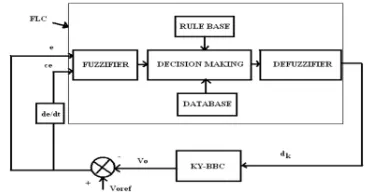
[image:3.595.306.512.362.455.2]Fuzzy logic controller modeled for modified KY buck boost converter is shown in Figure 5. The output voltage of the modified KY buck boost converter is compared with reference voltage by the comparator and the output of converter is error signal which is fed to the Fuzzy controller along with the change in error signal. The output of controller is duty cycle which is fed to PWM block and the PWM output is fed as switching signal to the converter as shown in Figure 5.
Figure: 5 Model Of Fuzzy Logic Controller
The fuzzifier inputs consists of two inputs error (e) and change in error (ce) and these inputs are classified into 5 membership functions namely Negative Big (NB), Negative Small (NS), Zero (ZE), Positive Big (PB) and Positive Small (PS). The input membership function shapes are chosen as “trapmf” membership functions.
Figure 6: Surface View Of The Rules
[image:3.595.97.282.423.521.2]Figure 6 represents the surface view of the rules for the proposed fuzzy logic control. The rules are represented as the combinations of the two inputs error and change in error for a function of output.
Figure 7: Graphical Diagram Of Trapezoidal Membership Functions For Error (e)
[image:3.595.307.510.491.614.2]Figure: 9 Graphical Diagram Of Trapezoidal Membership Functions For Output (O)
Table: 1 Rules of the Fuzzy Logic Controller
E
CE
NB NM NS Z PS PM PB
NB NB NB NB NB NM NS Z
NM NB NM NM NM NS Z PS
NS NB NM NS NS Z PS PM
Z NB NM NS Z PS PM PB
PS NM NS Z PS PS PM PB
PM NS Z PS PM PM PM PB
PB Z PS PM PB PB PB PB
There are two input variables for the fuzzy logic controller namely the error and change in error. The value of error is calculated by comparing the output voltage and reference voltage.
5. SIMULATION RESULTS 5.1 Line Variation
[image:4.595.313.501.208.340.2]Figure 10 represents the line variation response comparing the output of PI and fuzzy for and input variation from 12v to 10v. The simulation response shows that the response time. The converter acts in boost mode as the input is changed from 12v to 10v.
Figure 11: Simulated output voltage response of modified KY converter with PIC/Fuzzy controller.
Figure 11 shows the line variation response comparing the output of PI and fuzzy for the input variation from 12v to 16v. Thus the converter acts in the buck mode. Settling time in buck mode for line variations is.005 seconds i.e 5 milli-seconds for PI controller and 2 milli-seconds for fuzzy controller. Thus the developed fuzzy controller is more efficient than PI controlle
r.
[image:4.595.310.502.501.631.2]5.2 Load Variation
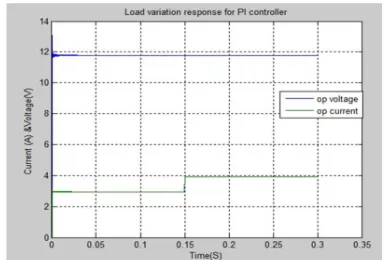
[image:4.595.101.279.545.698.2]Figure: 13 Simulated Output Voltage And Current Response Of Modified Ky Converter With Pic/Fuzzy Controller.
The load variation response for the fuzzy controller shows the output voltage of the converter to be constant at about 12 volts and the change of the load resistance has produced least or no variations approximately. Thus the developed fuzzy controller is very effective to handle the load variation and is a lot better than the PI controller.
5.3 Components Variation
Figure: 14. Simulated Output Voltage And Current Response Of Modified Ky Converter For Capacitor
[image:5.595.99.517.74.287.2]Variation With Pi Controller.
Figure: 15 Simulated Output Voltage And Current Response Of Modified KY Converter For Capacitor
Variation With Fuzzy Controller.
[image:5.595.316.497.421.570.2]Figure 14& 15 shows the response of the PI & fuzzy controller fed modified KY-BBC for the variation of values of capacitor. For instance the capacitor value of the capacitance is varied from 470µF to about 550µF.The converter is stable for variation of the capacitor value and produces a constant output without any deviation
.
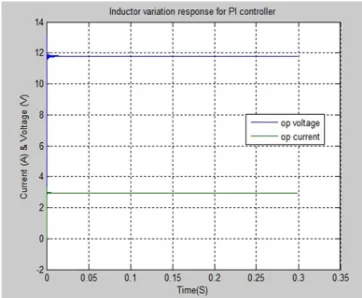
Figure: 16 Simulated Output Voltage And Current Response Of Modified KY Converter For Inductor
[image:5.595.101.280.459.610.2]Figure 17: Simulated Output Voltage And Current Response Of Modified Ky Converter With Fuzzy
Controller.
Figures 16 & 17 represent the simulation response of output voltage of the modified KY-BBC using both the FLC and the PIC for inductor L variation from 14µH to 18µH. It could be observed that the change does not influence the converter performances. Figure shows the response of the PI & fuzzy controller for the variation of values of Inductor which may practically happen due to the high temperature of operation. The developed controllers are very efficient to suppress the fluctuations caused by the variation of the capacitor values and are able to maintain the constant voltage at the output.
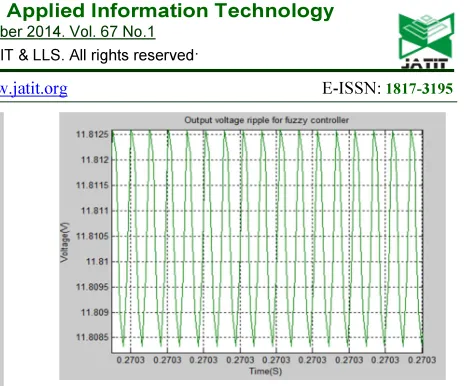
Figure: 19 Simulated Output Voltage Ripple Of Modified Modified Ky Converter With Fuzzy Logic Controller.
Figures show the output voltage ripple for PI and fuzzy controller fed converter. The output ripple voltage is approximately of the order of 6 milli volts for PI controller and 4 milli volts for fuzzy controller.
6. EXPERIMENTALRESULTS
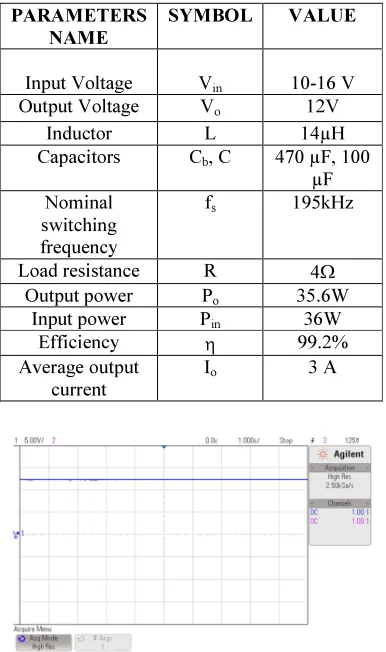
The system performance is validated under five different conditions namely start-up transient, line variation, load variation, and also circuit components variations. The laboratory prototype and MATLAB/SIMULINK simulation models are performed on the modified KY-BBC circuits with specifications listed in Table II. The hardware model of the modified KY-BBC with the implemented FLC/PIC is shown in Figure 18. The details of the power circuits are as follows:
S1 –S2 - IRFP 540 (MOSFET) Db- FR306 (Diodes
)
Cb, C - 470µF/100 µF (Electrolytic and plain polyester type)
L - 14µH/5A (Ferrite Core)
[image:6.595.89.306.108.299.2]Figure:20 Hardware model of the converter with proposed PIC/Fuzzy controller using FPGA. Hardware implementation is done using Xilinx Spartan-3E XC3S100E FPGA. FPGA consists of an on board programmable oscillator with the frequency ranging from 3 to 200 MHz. The board consists of an 8 Bit 4 Channel I2C based Analog to Digital converter for sampling the output voltage from the KY-BBC. The sampling rate equals the switching frequency 195 KHz. On board built in PWM generation logic is present. VHDL programming language is used for configuring the programmable interconnects in the device.
Figure: 21 Experimental output voltage responses of modified KY-BBC using FLC[Ch1:5V/Div-Output
voltage and Ch2:5V/Div- Input voltage].
Figure 22.Experimental output voltage responses of modified KY-BBC using FLC[Ch1:5V/Div-Output
voltage and Ch2:5V/Div- Input voltage].
Figure 21&22 shows the output voltage response from the hardware circuit for the operation in buck and boost mode. Figure 22 shows the input voltage variation from 16v to 12v and the output remains at 12v. The simulation results presented earlier seems to match with the hardware results obtained.
Table: 2 Parameters Of Modified KY BBC
PARAMETERS NAME
SYMBOL VALUE
Input Voltage Vin 10-16 V
Output Voltage Vo 12V
Inductor L 14µH
Capacitors Cb, C 470 µF, 100
µF Nominal
switching frequency
fs 195kHz
Load resistance R 4Ω
Output power Po 35.6W
Input power Pin 36W
Efficiency η 99.2%
Average output current
Io 3 A
Figure 23.Experimental output voltage responses of modified KY-BBC using FLC[Ch1:5V/Div-Output
voltage and Ch2:5V/Div- Input voltage].
Figure 24.Experimental output voltage responses of KY-BBC using FLC[Ch1:5V/Div-Output voltage and
[image:7.595.311.504.223.549.2]Table: 3 Comparision Of Performance Of The Existing And Proposed Controller Output
PARAMETER PIC BASED MODIFIED KY-BBC FLC BASED MODIFIED KY-BBC Output Voltage
ripple 6 millivolts 2 millivolts
Efficiency 93% 99.2%
Settling time 5 milli seconds 2 milli seconds
Table 3 compares the performance parameters of PIC and fuzzy controller for modified KY-BBC. From the table it can be concluded that the performance of the converter is enhanced via the fuzzy logic controller implemented.
7. CONCLUSION
The proposed Fuzzy controller for Synchronous buck boost converter modeled in this article demonstrate reduction in output voltage ripple upto 5 seconds for the PI controller and 2 milli-seconds for the fuzzy controller with the reduction in settling time and reduction in peak overshoot of the output when compared with the existing PI controlled system. The performance exhibited by the proposed system is well suited for communication system and photo-voltaic applications. The performance of this converter can be improved by implementing various optimization techniques.
REFERENCE
[1] K. I. Hwu and Y.T Yau, A KY Boost Converter, IEEE Transactions on Power Electronics, Vol. 25(Issue 11):2699 – 2703, November 2010.
[2] K.I. Hwu, and Y.T Yau, Two Types of KY Buck–Boost Converters, IEEE Transactions on Industrial Electronics, Vol. 56 (Issue 8):2970 – 2980, August 2009.
[3] K. I. Hwu, K. W. Huang and W.C. Tu, Step-up converter combining KY and buck-boost converters, IET Electronics Letters, vol.47,
Electronic. Systems, Vol. 40(Issue 1):259–271,
January 2004.
[5] P. Mattavelli, L. Rossetto and G. Spiazzi, Small signal analysis of DC-DC converter with sliding mode control, IEEE Transaction on Power Electronics, Vol. 12(Issue 1): 96-102, 1997.
[6] P. Comines and N. Munro, PID controllers: recent tuning methods and design to specification, IEEE Proceedings. Control Theory Application, Vol. 149(Issue 1), pp. 46-53, 2002
[7] K.H Cheng, C.F Hsu, C.M Lin, T.T Lee and C. Li, Fuzzy–neural sliding-mode control for DC– DC converters using asymmetric Gaussian membership functions, IEEE Transaction on Industrial Electronics, Vol. 54(Issue 3): 1528– 1536, 2007
[8] M. Rabbani, H.M.M. Maruf, T. Ahmed, M.A. Kabir and U. Mahbub, Fuzzy Logic Driven Adaptive PID Controller for PWM Based Buck Converter, International Conference on Informatics, Electronics & Vision (ICIEV), pp. 958-962, Dhaka, May 2012.
[9] N.F. Nik Ismail, N. Hasim and R. Baharom, A Comparitive study of Propotional Integral Derivative controller and Fuzzy Logic controller on DC/DC Buck Boost converter,
IEEE symposium on Industrial Electronics and Applications (ISIEA), pp 149-154, Langkawi, Sep. 2011.
[10] S. M. Ayob, N.A. Azli and Z. Salam, PWM DC–AC converter regulation using a multi-loop single input fuzzy PI controller, Journal of Power Electronics, Vol. 9(Issue 1):124 -131, 2009.
[11] M.G. Umamaheswari, G.Uma and
K.M.Vijayalakshmi, Design and
implementation of reduced-order sliding mode controller for higher-order power factor correction converters, IET Power Electronics, Vol. 4(Issue 9):984–992, 2011.
[12] K. Ramashkumar and S.
JeevananthanModelling and implementation of fixed switching frequency sliding mode controller for negative output elementary super lift Luo-converter, IET Power Electronics, Vol. 5(Issue 8):1593–1604, 2012