STUDY ON ENGLISH COURSE EDUCATION EVALUATION
BASED ON FUZZY THEORY
1LIN LEI
1Lecturer, Faculty of Foreign Languages, Jiangxi University of Finance and Economics,Jiangxi, China
E-mail: [email protected]
ABSTRACT
Along with the smooth advancement of a new round basic education reform, the profound changes have occurred in English education ideology and teaching modes, which demands the reformation of English course education evaluation system to guarantee the acceleration of the reform. The paper presents a new model for evaluating English course education performance based on the principle of analytic hierarchy process and fuzzy comprehensive evaluation. Firstly an evaluation indicator system of English education performance is designed through analyzing the characteristics of English teachers and students’ behavior. Secondly in constructing the comprehensive evaluation model for English education performance, analytic hierarchy process and fuzzy comprehensive evaluation are combined and two level fuzzy evaluations is adopted to satisfy the dynamics, subjective and transitional characteristics of indicators and improve evaluation accuracy. Thirdly data from of three universities are taken for examples to verify the validity and feasibility of the model and the experimental results show that the model can evaluate English course education performance practically and can help English course education service providers take corresponding concrete measures to enhance its education performance.
Keywords: Education Performance Evaluation (EPE), English Course Teaching Evaluation (ECTE), Two Level Fuzzy Evaluation (TLFE), Analytic Hierarchy Process (AHP)
1. INTRODUCTION
English classroom teaching evaluation takes teaching activity and its effect in the classroom teaching as study object, comprehensively making use of various kinds of methods to collect information, carrying out analysis and processing, so as to obtain objective and true evaluation conclusion reflecting teaching reality. For example, through observing the activities and acts of teachers and students in classroom teaching, in accordance with indicator items as stipulated in evaluation criteria, evaluate grade or mark. The implementation of classroom teaching evaluation can be reference for the evaluated object to design teaching, improve teaching, and be stimulated to carry out creative teaching [1, 2].
Up to now, mathematical models adopted by evaluation of English classroom teaching performance mainly include the following categories. ① Analytic hierarchy process is a good method for quantitative evaluation via quantitative method, having the functions of establishing the ideal weight structure of evaluated object value and analyzing the weight structure of actually-built
value by evaluated object; however, the method has strong limitations and subjectivity, with large personal error, not suitable for complicated system with lots of evaluation indicators[3,4]. ② BP neural network evaluation method makes use of its strong capability in processing nonlinear problems to carry out evaluation of innovation education performance; the method has advantages like self-learning, strong fault tolerance and adaptability; however, the algorithm is easy to be trapped into defects like local minimum, over-learning, strong operation specialization[5,6,7]; ③ Fuzzy comprehensive evaluation is a method carrying out comprehensive evaluation and decision on system through fuzzy set theory, the greatest advantage of which is that it works well on system evaluation of multi-factor and multi-level complicated problems. However, the membership of fuzzy evaluation method as well as the definition and calculation of membership function are too absolute, difficult to reflect the dynamics and intermediate transitivity of evaluation indicators of innovation education performance [8, 9].
ISSN: 1992-8645 www.jatit.org E-ISSN: 1817-3195
process, among which lots of indicators have dynamics, fuzziness, subjectivity and intermediate transitivity, resulting in a difficult application of transitional evaluation method. However, fuzzy evaluation is a method that accurately solves inaccurate and incomplete information, the greatest advantage of which is that the fuzziness and initiative of human thinking can be naturally processed by using it. Hence, this paper will design indicator system of English classroom teaching evaluation and evaluate it with multi-level fuzzy evaluation method, thus making English teachers
and universities convenient to carry out English classroom teaching analysis.
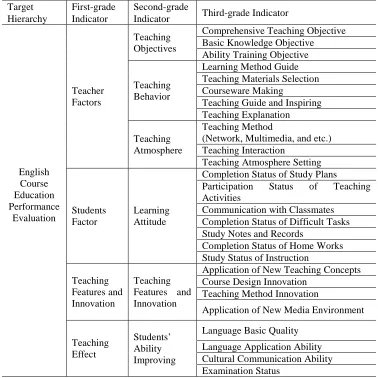
[image:2.612.117.495.254.632.2]In the second section 2, an evaluation indicator system for evaluating English course teaching performance is designed; In the second section 4, the evaluation algorithm for evaluation English course teaching performance is derived which can be divided into four steps; In section 4, the model presented in the paper is realized with the data from three universities; Section 5 gives a conclusion of the whole paper.
Table 1 Indicator System of English Classroom Teaching Performance Evaluation
Target Hierarchy
First-grade Indicator
Second-grade
Indicator Third-grade Indicator
English Course Education Performance
Evaluation
Teacher Factors
Teaching Objectives
Comprehensive Teaching Objective Basic Knowledge Objective Ability Training Objective
Teaching Behavior
Learning Method Guide Teaching Materials Selection Courseware Making
Teaching Guide and Inspiring Teaching Explanation
Teaching Atmosphere
Teaching Method
(Network, Multimedia, and etc.) Teaching Interaction
Teaching Atmosphere Setting
Students Factor
Learning Attitude
Completion Status of Study Plans
Participation Status of Teaching Activities
Communication with Classmates Completion Status of Difficult Tasks Study Notes and Records
Completion Status of Home Works Study Status of Instruction
Teaching Features and Innovation
Teaching Features and Innovation
Application of New Teaching Concepts Course Design Innovation
Teaching Method Innovation
Application of New Media Environment
Teaching Effect
Students’ Ability Improving
Language Basic Quality Language Application Ability Cultural Communication Ability Examination Status
2. EVALUATION INDICATOR SYSTEM
DESIGN
At present, universities all over the world is widely promoting course teaching evaluation; evaluation indicators for English course are improving and perfecting; here taking students’
are not within the scope of teaching quality, but they shall be taken into consideration in the case of specific evaluation. What’s more, evaluators (such as some students) do not pay necessary attention to the teaching evaluation, even just paying lip service. And from technical perspective, it shall be paid high attention whether evaluators (such as some students) are able to correctly understand and master evaluation indicator system as well as evaluation criteria. Therefore, evaluation indicators influencing classroom teaching effects are complicated and variable [8].
This paper, based on the connotation characteristics of English classroom teaching performance evaluation, especially on the basis of expert’s consultations, combined with literatures, establishes a wide and scientific evaluation indicator system of English course education performance evaluation [4-9], which includes 4 hierarchies, 4 categories, 6 second-grade indicators, 26 third-grade indicators; see Table 1 for details.
Table 4 Secondary Evaluation Results
Teacher Factors Students Factor
Teaching Features
and Innovation Teaching Effect Teaching
Objectives
Teaching Behavior
Teaching Atmosphere
Learning Attitude
Teaching Features and Innovation
Students’ Ability Improving JXUFE 4.872 4.272 4.014 4.226 4.364 4.237
SJTU 4.571 4.123. 3.581 4.031 3.786 3.921
NCU 4.651 4.072 3.651 4.135 3.941 4.018
3. DERIVATION OF ALGORITHM
3.1 Steps of Fuzzy Overall Evaluation Method
Fuzzy overall evaluation in this paper is conducted according to the following five steps [9].
(1) Establish Evaluation Element Set. Evaluation element set is an ordinary set constituted by all the elements influencing evaluation object; suppose there are n evaluation indicator elements expressed by
u1,
u2,
u3,
K
,
irrespectively, then the set constituted by these n evaluation elements is called evaluation element set, i.e. U={ u1,u2,u3,…,un }.
(2) Confirm Evaluation Set.Evaluation set is also called judgment set, which is comprised of all the evaluation results of evaluator on evaluation object, is an ordinary set formed by all the possible evaluation results of evaluators on evaluation object. Evaluation results can be divided into m hierarchies according to actual demand of specific cases, which can be expressed by v1, v2, v3, …, vm respectively, then evaluation set can be constituted as V={ v1
,v2,v3, …,vm }.
(3) Confirm the weight of evaluation indicator. The reasonable confirmation of indicator weight embodies the different weight relations among all the evaluation indicators in the system,
increases the comparability among all the evaluation indicators and the effectiveness of evaluation result. AHP is objective with such merits as practicability, conciseness and systematicness. Thus, this paper adopts AHP to confirm the weights of all the evaluation indicators, obtaining the weight wi of each evaluation indicator ui. The set constituted by each weight wi is called weight set W, as shown in formula 1.
0 w 1
w wn} w3, w2, {w1, W
1
i = ≥
=
∑
= i
n
i
K
(1)
There are generally the following steps to confirm indicator weight by AHP. The specific steps to calculate indicator weight by adopting AHP are as follows [9].
ISSN: 1992-8645 www.jatit.org E-ISSN: 1817-3195
hierarchy consist of a pairwise inter-comparison judgment matrix A= (aij).
②Calculate the Weights of All the Indicators. This paper adopts root method to calculate weight; steps are as follows steps. First, calculate the product of each line in comparison matrix; Second, extract nth root of products obtained in step a; Third, Total all the products obtained in step b; Finally, weight wi is obtained through dividing values obtained in step b by values in step c.
③ Consistency Check of Judgment Matrix. While building judgment matrix, due to complexity of objective things, there are always errors in judgment matrix. Generally, there may be no complete consistency in judgment matrix, so consistency check of judgment matrix is required. Quantitative indicator used for measuring judgment matrix is called consistency indicator CI, as shown in formula 2.
1
-n)/n
-max
(
CI
=
λ
(2)In formula 2[8], λmax is the maximum eigenvalue of judgment matrix, n is the number of comparison indicator. λmax is calculated as follows: respectively multiply elements in each line of judgment matrix by vector component of weight W, then add, obtaining Awi; divide Awi respectively by wi, obtaining value Awi/wi.
λmax is the average value of Awi/wi.
[image:4.612.323.509.201.282.2]In order to confirm the allowed range of inconsistency degree, the corresponding average random consistency indicator RI of n can be looked for the following table.
Table 2 Average Random Consistency Indicator
Order 1 2 3 4 5 RI 0 0 0.58 0.90 1.12
At last, judge whether the matrix is consistent through consistency ratio CR, CR=CI/RI. If CR<0.1, the consistency of judgment matrix is acceptable. Whereas, if CR≥0.1, the consistency of judgment matrix is unacceptable; judgment matrix should be properly amended to keep the consistency of judgment matrix to certain extent.
(4) Single-factor Fuzzy Evaluation. Suppose that evaluation object carries out evaluation according to the ith factor in factor set U ui (i=1, 2, 3, …, n), the subordination of which as to the jth factor in evaluation set V vj (j=1,2,3,…
,m) is expressed as rij, formula 3 can be used to show the evaluation result of the ith factor ui.
}
,
3
,
2
,
1
{
R
i=
ri
ri
ri
K
rim
(3)
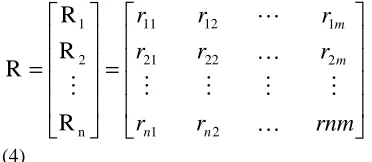
Ri in formula 3 is single-factor evaluation set, so formula 4 can be obtained, i.e. single-factor evaluation set of each factor.
=
=
rnm
r
r
r
r
r
r
r
r
m m n nM
K
M
K
L
M
M
M
2 1 2 22 12 1 21 11 n 2 1R
R
R
R
(4)R in formula 4 is called single-factor evaluation matrix. Rij can be obtained through experts grading method, subordination function method or other managerial mathematical methods.
(5) Build Evaluation Model to Carry out Fuzzy Overall Evaluation. In consideration of difference importance of each factor, i.e. different indicator weights, it is necessary to combine the weight set W and R of all the evaluation indicators, to carry out overall evaluation, building overall evaluation model formula 5
)
,
,
(
1 22 1 2 22 12 1 21 11 m m m n n
b
b
b
rnm
r
r
r
r
r
r
r
r
R
W
B
K
M
K
M
K
L
M
M
o
o
=
=
(5)In formula 5, B is the result set of fuzzy overall evaluation, bj (j=1, 2, 3, …, m) is called fuzzy overall evaluation indicator, which judges the indicator subordination of the jth evaluation element in evaluation set while comprehensively considering the impact of all the indicators on evaluation object.
)
,
2
,
1
(
)
(
b
1j
w
ir
ijj
m
n i
K
=
∧
∨
=
= (6)“∨” in formula 6 represents large-taking symbol, “∧” represents small-taking symbol, the model features the focus on major factors, and that other factors have little impact on results. This operation sometimes makes decision result not easy to be distinguished.
Model 2 M (·, ∨)——Major Factor Highlighting Type, see formula 7.
)
,
2
,
1
(
)
(
b
1j
w
ir
ijj
m
n i
K
=
⋅
∨
=
= (7)“ · ” in formula 7 represents multiplication, the model first multiply species of attribute by single factor subordination, then get a greater one, the feature of which is to highlight major factor and ignore the role of secondary factor.
Model 3 M (∧ , ⊕)——Major Factor Highlighting Type 8.
)
,
2
,
1
(
)
(
b
1j
w
ir
ijj
m
n i
K
=
∧
⊗
=
=∑
(8)“ ⊕ ” in formula 8 is bounded sum,
i.e.
a
⊕
b
=
min(1,
a
+
b)
,⊕
∑
n
1
is to get
a sum of n under the operation of
⊕
,i.e.
∧
=
=∑
(
)
,
1
min
b
1j i ij
n
i
r
w
.Model 4 M (· ,+)——Weighted Average Type, see formula 9
)
,
2
,
1
(
)
(
b
1j
w
ir
ijj
m
n i
K
=
⋅
⊗
=
=∑
(9)The model first multiplies WI by Rij, and then do the sum operation. The model, according to the weight of indicator factor, evenly gives consideration to all the indicator factors, especially applicable to the situation when multiple factors jointly work. Therefore, the competitiveness evaluation of commercial banks in this paper adopts that model for calculation.
3.2 Multi-hierarchy Fuzzy Overall Evaluation
In actual cases, if the evaluation object is multiple factors and the weight distribution among all the factors is relatively balanced, we can adopt multi-hierarchy model for evaluation. Following is the introduction to build third-grade model.
(1) Divide Factor Set. Divide Factor U into several hierarchies U= { u1, u2, u3, …, un }, conditions satisfied formula 10.
i n i j i
u
u
j
i
when
u
u
1,
=∪
=
≠
≠
∩
ϕ
(10)U={ u1, u2, u3, …, un } is called the first factor set.Suppose ui={ ui1, ui2, ui3, …, uik }, i=1,2, …, n is called the second factor set; uij={ uij1, uij2, uij3, …, uijl }, i=1,2, …, n, j= i=1,2, …, k is called the third factor set.
(2) Carry out first-hierarchy fuzzy overall evaluation on uij. Suppose that the weight set of uij={ uij1, uij2, uij3, …, uijl } is wij={ wij1, wij2, wij3, …, wijl }, According to formula 5, overall evaluation is wijοRij=Bij, i=1,2,…, n,j= i=1,2, …, k.
(3) Carry out second-hierarchy fuzzy overall evaluation on ui. Suppose that the weight set of ui={ ui1, ui2, ui3, …, uik } is wi={ wi1, wi2, wi3, …, wik }, according to formula 5, overall evaluation is wiοRi=Bi, i=1,2, …,n。
(4) Carry out third-hierarchy fuzzy overall evaluation on u. Suppose that the weight set of U={ u1, u2, u3, …, un } is W={ w1, w2, w3, …, wn }, according to formula 5, overall evaluation is WοR =B, at last, adopt weighted average method to get evaluation result.
3.3 Confirmation of Subordination Degree
ISSN: 1992-8645 www.jatit.org E-ISSN: 1817-3195
out frequency count on the basis of investigation judgment and obtain the “degree subordinating to certain hierarchy” of the indicator, which is subordination degree.
3.4 Secondary Fuzzy Evaluation
Considering many time fuzzy evaluation in the multistage fuzzy evaluation process, the evaluation error created by the bottom evaluation errors will accumulate step by step, resulting in larger errors in final evaluation. The paper defines and separates the key indicator as first-grade indicator and the key indicator is the indicator that the university need improve, or the performance evaluation need focus on, or which has great influence on the final evaluation. Because English teacher always plays a key role in English course teaching performance evaluation, the paper defines teacher factors as key indicator to be evaluated independently. So the first-grade indicator of the evaluation indicator system in the paper includes teacher factors (including teaching objectives, teaching behavior, teaching atmosphere) and indicators of students factors, teaching features and innovation, teaching effect. Taking advantage of the foregoing preliminarily established evaluation result the paper carries on the secondary fuzzy evaluation and the concrete evaluation indicators in the secondary fuzzy evaluation omitted here.
4. EXPERIMENT CONFIRMATION
Experimental data come from database of 300 English teachers of Jiangxi University of Finance and Economics (referred to as JXUFE), and Southeast Jiaotong University (referred to as SJTU) and Nanchang University (referred to as NCU). Relevant data of 100 English teachers of each university are selected as the basis for data training and experimental verification in the paper, totally 3000 students’ data for study data that come from practical investigation and visit of specific English education institutions and students. In order to make the selected students’ data representatives, 900 students(300 students from each university) with more than 3 years learning experience, 1500 students with 2 years learning experience, 600 learners with less than 2 years learning experience.
Limited to paper space, the evaluation of intermediate results is omitted here, only providing parts of (secondary) evaluation results and final comprehensive evaluation results see table 3 and table 4, and in which the average
evaluation results of the teachers of each university.
Table 3 Final Evaluation Results of Three Universities
JXUFE SJTU NCU Final
Evaluation 4.287 3.869 3.939
5. CONCLUSION
Comprehensive evaluation of English course teaching is an effective method for guaranteeing English teaching quality, lying in the core status of the entire evaluation system of English education. Thus, there is a favorable application prospect for the analysis and competitiveness evaluation of English education based on the principle of fuzzy analysis. This paper, on the basis of the principle of English teachers and students behavior analysis, analyzes and builds comprehensive evaluation system of English education, makes use of multi-hierarchy fuzzy evaluation method to establish comprehensive evaluation model for English education, also carries out case study taking the data of three different universities as an example. Meanwhile, the multi-hierarchy fuzzy evaluation method built in this paper can be reference for the analysis and evaluation of other multi-factor systems.
REFRENCES:
[1] H.J. Zeng and Z.Dekao, “Strategy of Sustainable Development in Project of Modern Distance Education in Rural Elementary and Middle Schools”, Distance
Education in China, Vol. 15, No. 10, October
1996, pp. 47-52.
[2] D. Keengan, “Designing E-Learning Environments for Activity and Instruction”,
Educational Technology, Research and Development, Vol. 52, No. 2, February 2008,
pp. 134-141.
[3] M. Simonson and C. Sehloss, “Theory and Distance Education: A New Discussion”,
American Journal of Education, Vol. 13, No.
1, January 2007, pp. 114-123.
[4] W. Scott and D. Bonham, “Education Research Using Web-based Assessment System”, Journal of Research on Computering in Education, Vol. 33, No. 1,
[5] W. Chunlian and M. Xiufeng, “The Survey of Current Learning Support Service of Web Based on Education of Traditional University”, Open Education Research, Vol.12, No. 2, February 2009, pp. 46-49. [6] P. Bao, “Design on the Evaluation System for
Education”, Chinese Education, Vol.24, No.
9, September 2011, pp. 54-59.
[7] S.Y. Cui and A. F. Xu “An Approach to Evaluating the Education Management Information System with Intuitionistic Fuzzy Information”, International Journal of Advancements in Computing Technology,
Vol.4, No. 4, April 2012, pp. 49-55.
[8] L.J. Song and N. Y. Zhao “A Study on Performance Evaluation Model of Individual Knowledge-sharing”, Journal of Convergence Information Technology, Vol.7,
No. 4, April 2012, pp. 238-245.
[9] H.M. Hui, “Research on the Evaluation Methods on Marine Industrial Core Competence with Intuitionistic Fuzzy Information”, International Journal of Digital Content Technology and its Applications, Vol.6, No. 5, May 2012, pp.