S T U D Y P R O T O C O L
Open Access
Combination therapy of vitamin C and
thiamine for septic shock in a multicentre,
double-blind, randomized, controlled study
(ATESS): study protocol for a randomized
controlled trial
Sung Yeon Hwang
1, Jong Eun Park
1, Ik Joon Jo
1, Seonwoo Kim
2, Sung Phil Chung
3, Taeyoung Kong
3,
Jonghwan Shin
4, Hui Jai Lee
5, Kyoung Min You
5, You Hwan Jo
6, Doyun Kim
6, Gil Joon Suh
7, Taegyun Kim
7,
Won Young Kim
8, Youn-Jung Kim
8, Seung Mok Ryoo
8, Sung-Hyuk Choi
9, Tae Gun Shin
1*and for the Korean
Shock Society (KoSS) Investigators
Abstract
Background:Septic shock is a life-threatening condition with underlying circulatory and cellular/metabolic abnormalities. Vitamin C and thiamine are potential candidates for adjunctive therapy; they are expected to improve outcomes based on recent experimental and clinical research. The aim of the Ascorbic Acid and Thiamine Effect in Septic Shock (ATESS) trial is to evaluate the effects of early combination therapy with intravenous vitamin C and thiamine on recovery from organ failure in patients with septic shock.
Methods:This study is a randomized, double-blind, placebo-controlled, multicentre trial in adult patients with septic shock recruited from six emergency departments in South Korea. Patients will be randomly allocated into the treatment or control group (1:1 ratio), and we will recruit 116 septic shock patients (58 per group). For the treatment group, vitamin C (50 mg/kg) and thiamine (200 mg) will be mixed in 50 ml of 0.9% saline and administered intravenously every 12 h for a total of 48 h. For the placebo group, an identical volume of 0.9% saline will be administered in the same manner. The primary outcome is the delta Sequential Organ Failure Assessment (SOFA) score (ΔSOFA = initial SOFA at enrolment– follow-up SOFA after 72 h).
Discussion:This trial will provide valuable evidence about the effectiveness of vitamin C and thiamine therapy for septic shock. If effective, this therapy might improve survival and become one of the main therapeutic adjuncts for patients with septic shock.
Trial registration:ClinicalTrials.gov,NCT03756220. Registered on 5 December 2018.
Keywords:Sepsis, Septic shock, Thiamine, Vitamin C, Resuscitation
© The Author(s). 2019Open AccessThis article is distributed under the terms of the Creative Commons Attribution 4.0 International License (http://creativecommons.org/licenses/by/4.0/), which permits unrestricted use, distribution, and reproduction in any medium, provided you give appropriate credit to the original author(s) and the source, provide a link to the Creative Commons license, and indicate if changes were made. The Creative Commons Public Domain Dedication waiver (http://creativecommons.org/publicdomain/zero/1.0/) applies to the data made available in this article, unless otherwise stated.
* Correspondence:[email protected];[email protected]
1Department of Emergency Medicine, Samsung Medical Centre, Sungkyunkwan University School of Medicine, 81 Irwon-ro, Gangnam-gu, Seoul 06351, South Korea
Background
Septic shock is a life-threatening disease; it is a subset of sepsis that involves organ dysfunction and profound underlying circulatory and cellular/metabolic abnormal-ities that cause death in more than 40% of patients [1, 2]. Not only does septic shock have high mortality, but the incidence rate is steadily rising due to the aging population and an increased rate of patients with comor-bidities, making it very concerning from a public health perspective [3,4].
Despite current standard treatments, including broad-spectrum antibiotics, source control, fluid re-suscitation, and vasopressors, morbidity and mortality have remained high, and no adjunctive therapies for septic shock have been shown to improve survival [5, 6]. Moreover, although appropriate early resuscitation is applied to patients to improve their haemodynamic state, metabolic and oxidative stress can persist or even worsen at the cellular level, causing further organ dysfunction [1]. Additional interventions to im-prove patient-centred outcomes for septic shock thus need to be researched and developed [7].
Vitamin C and thiamine are soluble vitamins that are essential to human bodies. A deficiency can result in se-vere symptoms, including shock, cardiac failure, and central nervous system disorders [8]. Patients in septic shock show vitamin C and thiamine depletion, which can further aggravate septic shock [9,10].
Vitamin C is a well-known antioxidant that is required as a cofactor/co-substrate for the biosynthesis of colla-gen, neurotransmitters, endogenous catecholamines, vasopressin, and cortisol [11]. Vitamin C enhances the synthesis of endogenous norepinephrine and vasopressin and increases adrenergic sensitivity [8, 12]. In animal and cell-based studies of sepsis, vitamin C acted as an antioxidant defence substance, reducing levels of reactive oxygen species and reactive nitrogen species and im-proving microcirculation by limiting oxidative injury and endothelial barrier disruption [13–17]. Vitamin C also has anti-inflammatory effects and plays a role in enhan-cing immune functions [8,18].
Thiamine is a cofactor that acts on enzymes essential for glucose metabolism, the generation of adenosine tri-phosphate, and the production of nicotinamide adenine dinucleotide phosphate [19]. Thiamine deficiency causes bioenergetic failure, increases oxidative stress and cell injury, and accelerates organ failure, including brain dys-function through neuronal injury [10,20]. Thiamine ad-ministration to assist the metabolisms of patients in septic shock might be reasonable because of its acute consumption in the hypermetabolic state of septic shock and its important roles in cellular metabolism [21]. Thiamine might also reduce the risk of renal oxalate crystallization by preventing the conversion of vitamin C
into oxalate, which is a potential adverse effect of vita-min C advita-ministration [8].
Recently, several preliminary studies about the clinical effects of vitamin C and thiamine have reported their re-sults [22]. A phase I, randomized trial by Fowler et al. [23] included placebo (n= 8), low-dose intravenous vita-min C (50 mg/kg; n= 8), and high-dose vitamin C (200 mg/kg;n= 8); vitamin C reduced the levels of inflamma-tory markers, including C-reactive protein (CRP) and procalcitonin, in a dose-dependent manner in severe sepsis and septic shock. In another small randomized trial by Zabet et al. [24] involving 28 patients in the in-tensive care unit (ICU), the mean dose and duration of norepinephrine administration were significantly lower in the treatment group receiving intravenous vitamin C (100 mg/kg/day) than in the control group. Donnino et al. evaluated the effects of thiamine in a two-centre, ran-domized, double-blind trial in patients (n= 88) with sep-tic shock. In the subgroup with thiamine deficiency (35%), those in the thiamine treatment group had lower lactate levels at 24 h and a decrease in mortality and the rate of renal replacement therapy (RRT) [25, 26]. Woo-lum et al. [27] used propensity matching in patients with septic shock and found that thiamine supplementation increased lactate clearance and decreased 28-day mortal-ity. In a recently published before–after study (n= 94) by Marik et al. [28], combination therapy of vitamin C, thiamine, and steroid dramatically reduced mortality. A similar before–after study by Kim et al. [29] used the protocol from the study by Marik et al. and found a sig-nificant reduction in mortality among patients with se-vere pneumonia. However, these were both single-centre, retrospective observational studies, and debate remains about the effects of vitamin C and thiamine supplementation.
The theoretical and experimental evidence published to date suggests that vitamin C and thiamine supple-mentation can be used as an adjunctive therapy for sep-tic shock [30]. Vitamin C and thiamine have the additional advantages of being inexpensive, widely avail-able, and safe, with adverse effects occurring very rarely [31]. Until recently, however, their potential role has not been rigorously evaluated in a randomized clinical trial. In this trial of the potential advantages of vitamin C and thiamine, we hypothesize that their combined use will reduce organ failure in patients with septic shock.
Objective
shock. We will also evaluate whether this therapy im-proves outcomes, including shock reversal and mortality, in patients with septic shock.
Methods
Study design
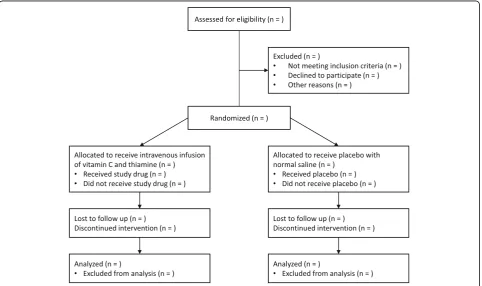
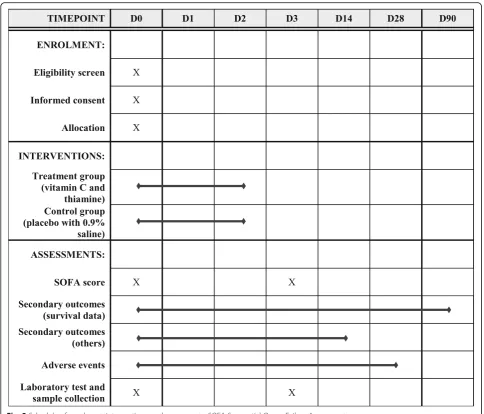
This study is a randomized, double-blind, placebo-controlled, multicentre trial in patients with septic shock. It will be conducted in six emergency departments (EDs) in South Korea. The trial protocol has been approved by the Institutional Review Boards of the individual partici-pating hospitals and the Ministry of Food and Drug Safety in Korea. For all study participants, written informed con-sent will be obtained from either the patient or from the legal representative if the patient lacks capacity. Figures1 and2show the study flow chart and the schedule, respect-ively. A Standard Protocl Items: Recommandations for Clinical Interventional Trials (SPIRIT) checklist is also available (Additional file1).
Eligibility criteria
Adult patients (19–89 years old) who visit an ED directly and are diagnosed with septic shock will be included. Septic shock is defined as sepsis with persisting hypotension requiring vasopressors to maintain a mean arterial pressure (MAP)≥65 mmHg and with a serum lactate level > 2 mmol/L despite adequate volume
resuscitation [2]. Sepsis is diagnosed in patients with suspected infection and organ dysfunction, which is identified as an acute change in the total SOFA score≥2 points due to infection. If the baseline SOFA score is un-known, it will be assumed to be 0.
The following exclusion criteria apply: patients who are transferred from another hospital after vasopressor ad-ministration or mechanical ventilatory support; patients who have set limitations on treatment (e.g. patients with a signed do-not-resuscitate order); patients with an under-lying terminal-stage disease without an active treatment plan and those who are not expected to survive to dis-charge; patients taking at least 1 g/day of vitamin C or re-ceiving intravenous thiamine prior to enrolment; patients experiencing cardiac arrest prior to enrolment or who are expected to die within 24 h despite best possible treat-ment, based on the judgement of medical personnel; preg-nant women; patients with glucose-6-phosphate dehydrogenase deficiency; patients with a history of hyper-sensitivity reactions to the trial drugs; patients with thalas-semia; patients with hyperoxaluria; patients with cystinuria; patients with ongoing gout attacks; patients di-agnosed with oxalate renal stones; patients who meet the inclusion criteria more than 24 h after ED arrival or who are screened more than 24 h after their diagnosis of septic shock; and patients who do not voluntarily consent to par-ticipate in the trial (directly or by legal proxy).
[image:3.595.58.541.430.716.2]Randomization and study medication
The patients will be randomly assigned in a 1:1 ratio to either the treatment group or the placebo group. The randomization sequence will be generated by an inde-pendent biostatistician using a permuted block size of four, stratified by recruitment site. The patients, treating clinicians, and researchers will be blinded to the allo-cated treatment throughout the trial. An identical num-ber of ampoules of treatment drugs or placebo for each patient will be packed in advance. The trial packs, which contain the same number of ampoules of either vitamin C (500 mg/2 ml) and thiamine (50 mg/ 2 ml) or placebo (0.9% saline, 2 ml), were identically manufactured by Jeil Pharmaceutical (Daegu, South Korea). According to the order of allocation, the sequential randomization code for each site will be assigned to trial packs. When a pa-tient in septic shock who meets the study criteria is
identified, written consent will be obtained, and a unique randomization number will be assigned to each newly included participant in the order of enrolment. The treatment drug or placebo in the trial pack with the same number will be administered to the participant.
For the treatment group, vitamin C (50 mg/kg, max-imum single dose 3 g, daily dose 6 g) and thiamine (200 mg) will be mixed in a 50-ml 0.9% saline bag and admin-istered through intravenous infusion over 60 min every 12 h for a total of 48 h. For the placebo group, an identi-cal volume of 0.9% saline from the placebo drug am-poule will be mixed in a 50-ml 0.9% saline bag and administered with the same protocol. Vitamin C and the placebo will be prepared in a sealed, opaque bag using a light-protective infusion set. The researcher may request unblinding of an independent pharmacist in the follow-ing situations: suspected severe adverse effects, includfollow-ing
[image:4.595.56.541.86.500.2]anaphylaxis, in which the researcher determines unblinding to be necessary for the benefit and safety of the patient; and when a patient or legal proxy requires an investigation about suspected damage caused by par-ticipation in the trial. Criteria for trial termination and dropout are as follows: if a patient or legal proxy re-quests termination of the trial or withdraws consent; if a patient is transferred to another hospital within 5 days of admission; if a patient or legal proxy does not follow the instructions of the physician in charge of the trial; if a patient develops a severe disease unrelated to participa-tion in the trial; if the physician in charge of the trial de-termines that participation in the trial is not the best option for a given patient; and if a patient develops se-vere adverse effects due to the test drug including anaphylaxis.
Clinical management
Initial resuscitation and management will be performed according to the latest Surviving Sepsis Campaign guide-lines [32]. Broad-spectrum antibiotics will be adminis-tered as soon as possible, and another general treatment, such as source control, will be performed. Initially, 30 ml/kg of crystalloid fluids will be administered, but the dose may be titrated up or down depending on the pa-tient’s condition. If the patient shows no response to fluids, norepinephrine will be administered to maintain a MAP of at least 65 mmHg. For patients requiring high-dose vasopressors (at least 0.2 μg/kg/min norepineph-rine), additional vasopressin (0.03 U/min) and hydrocor-tisone (200 mg/day: 50 mg every 6 h or 200 mg over a 24-h continuous infusion) will be administered. Hydro-cortisone will be administered until vasopressor therapy is stopped, for up to 7 days. Once a patient reaches and maintains the target MAP for at least 2 h, the dose of norepinephrine will first be reduced (0.1 μg/kg/min per hour) and then stopped completely, and the vasopressin dose will be reduced by 0.01 U per hour. This will be subject to modification based on the attending physi-cian’s judgement and the patient’s status. Intravenous or enteral nutrient supply will be implemented, including the daily required amounts of vitamins to maintain nor-mal nutrition. In cases in which vitamin C or thiamine deficiency is suspected and the attending physician judges it to be clinically necessary, open-label vitamin C (500 mg/day) or thiamine (100 mg/day) will be adminis-tered separately.
Data and laboratory measurements
All data will be anonymized and collected using web-based report forms by investigators or trained research coordinators at each participating hospital who are blinded to the study group assignments. For quality con-trol, data will be centrally reviewed at the coordinating
hospital. Adverse events will be recorded both prospect-ively and by review of clinical charts (urticaria or rash, anaphylaxis, vomiting, diarrhoea, gastrointestinal bleed-ing, symptomatic nephrolithiasis, and others). Survival data will be collected from visiting patients, hospital re-cords, and telephone interviews. Blood samples will be collected at enrolment prior to study drug administra-tion and 72 h after enrolment for use in laboratory tests: complete blood count, creatinine, lactate, CRP, procalci-tonin, vitamin C level, and thiamine level. We plan to collect and store serum samples at the same time. These samples will be stored for future biomarker analysis.
Outcome measure
The primary outcome will be theΔSOFA score, which is a 72-h change in SOFA score that reflects recovery from organ failure (ΔSOFA = initial SOFA at enrolment – follow-up SOFA after 72 h) [28, 33]. If a patient dies in the first 72 h, the previous worst score will be used. Sec-ondary outcomes will be mortality (7-day, 28-day, 90-day, in-hospital, ICU death), time to death, time to shock reversal, vasopressor-free days, dose of vasopres-sor (at 24, 48, and 72 h from enrolment and maximum dose during 72 h), ventilator-free days, ventilator dur-ation, RRT-free days, new use of RRT, new onset or ag-gravation of acute kidney injury (AKI), length of ICU stay, ICU-free days, length of hospital stay, CRP change during the initial 72 h (%), and procalcitonin change dur-ing the initial 72 h (%). For CRP and procalcitonin, if a patient dies within the first 72 h, the last follow-up values will be used. Shock reversal is defined as discon-tinuation of all vasopressors and MAP maintained at 60 mmHg or more for longer than 24 h [34]. For outcome variables showing free days, the time frame will be from enrolment day to day 14. If a patient dies before day 14, the free days after death will be considered 0. The dose of vasopressor is expressed as a norepinephrine equiva-lent dose [35]. AKI is defined as Kidney Disease: Im-proving Global Outcomes (KDIGO) stage 2 or higher, which is new-onset change [36]. For evaluation of the KDIGO stage, baseline creatinine is derived from the lowest value from 1 year to 24 h prior or estimated by a predefined formula (creatinine = 0.74–0.2 (if female) + 0.003 × age) if the former is unavailable [37]. Patients re-ceiving dialysis for chronic end-stage renal failure will be excluded from the analysis.
Statistical analysis
This effect size of a 1.5-point improvement in the 72-h SOFA score is set as a surrogate value for a survival benefit in patients. Assuming that the standard deviation of the ΔSOFA score is the same in both groups, with a statistical significance of 5% and power of 80%, the re-quired participant number per group is 52 patients. As-suming a dropout rate of 10%, we determined that 58 patients will be required in each group (totaln= 116).
Data analyses will be conducted with the intention-to-treat set, the full analysis set, and the per-protocol ana-lysis set, and missing data will not be imputed. For the primary outcome analysis, the ΔSOFA scores will be compared using t tests or the Mann–Whitney test, de-pending on the distribution between the two groups. For secondary outcomes and adverse events, we will use t tests or the Mann–Whitney test for continuous variables and the chi-square test or Fisher’s exact test for categor-ical variables. Linear mixed models and generalized lin-ear mixed models will be used for multivariable analyses of continuous outcomes and categorical outcomes, re-spectively, adjusting for study centre (random effect) and the covariates (fixed effect) of age, sex, infection foci, underlying disease, SOFA score, initial lactase level, and albumin level, if the covariates are unbalanced be-tween the test group and the control group. Survival duration and time to shock reversal will be analysed using the Kaplan–Meier method and compared by the log-rank test. Subgroup analysis will be conducted by predefined groups according to age, sex, infection site, norepinephrine dose at randomization, SOFA score, hy-poalbuminemia, adjunctive steroid use, time from hypotension to trial drug administration, malignancy, vitamin C level, and thiamine level.P< 0.05 will be con-sidered statistically significant and corrected using Bon-ferroni’s method for multiple testing. Statistical analysis will be performed using SAS version 9.4 (SAS Institute, Cary, NC, USA) and STATA version 15.1 (STATA Cor-poration, College Station, TX, USA). A data monitoring committee will be established to review trial data upon recruiting half of the planned patients. This will consist of an independent physician who is experienced with clinical trial implementation and a biostatistician. The committee will evaluate differences in the primary out-come to decide whether the researcher terminates the trial or continues, and will assess adverse events.
Discussion
Treatment of septic shock is challenging, and mortality is high despite maximal intensive care [6]. Moreover, most clinical trial interventions for septic shock have failed to improve outcomes, so the development of ef-fective treatments is important [7]. Vitamin C and thiamine are potential candidates for adjunctive therapy for septic shock. These are safe treatments expected to
improve prognosis based on recent experimental and clinical studies [8]. The key goal of this study is to assess the effects of early combination therapy with intravenous vitamin C and thiamine on recovery from organ failure in patients with septic shock. This trial, along with current ongoing trials [30], will provide important evi-dence about the effectiveness of vitamin C and thiamine supplementation for septic shock when administered early in the ED. If this therapy is shown to be effective, this regimen would be immediately applicable to the management of septic shock and could become one of the main therapeutic adjuncts.
In this trial, we have chosen the ΔSOFA score as the primary endpoint. A relatively large number of patients would be required to evaluate a survival difference. The
ΔSOFA score is well correlated with survival and reflects recovery from organ failure [33, 38, 39]. Therefore, this primary outcome measurement might be a reasonable approach to complement the limitation of a relatively small sample size. In addition, we will measure several important secondary endpoints, including mortality and shock reversal time.
Steroid use can reduce the duration of vasopressor use and enhance recovery from shock, although there is no definite evidence that it improves survival [34]. Steroids can be used with vitamin C for synergistic effects, and other trials have proposed this combination [28,30,40]. In this trial, we will add steroid treatment only for pa-tients requiring a high dose of vasopressor, in accord-ance with the current Surviving Sepsis Campaign guidelines [32]. We will perform subgroup analyses ac-cording to concomitant use of a steroid, which might provide data about potential treatment synergism.
Regarding vitamin C and thiamine use for septic shock patients, the pharmacokinetics, optimal dosage, and dur-ation need to be investigated [22]. In addition to the clinical outcomes, this trial will allow us to evaluate the effects of vitamin C and thiamine supplementation during the initial 48-h period in septic shock, which has higher metabolic de-mands, on blood levels of vitamin C and thiamine.
Trial status
Currently recruiting. Trial start date was 1 December 2018. Anticipated recruitment end date is December 2019.
Additional file
Additional file 1: SPIRIT 2013 checklist: recommended items to address in a clinical trial protocol and related documents. (DOC 125 kb)
Abbreviations
arterial pressure; RRT: Renal replacement therapy; SOFA: Sequential Organ Failure Assessment
Acknowledgements
The authors thank Sunyoung Kim and the clinical research coordinators for their assistance with the trial process.
Authors’contributions
Conceptualization: TGS, SYH, SPC, YHJ, WYK, and SMR. Methodology: SYH, JEP, SK, SPC, YHJ, WYK, SMR, and TGS. Statistical plan: SK. Analysis: SK, TGS, and SYH. Coordination of the study implementation: JEP, TKo, HJL, KMY, DK, TKi, Y-JK, SMR, and S-HC. Investigation: IJJ, SPC, JS, YHJ, GJS, WYK, and S-HC. Data curation: SYH and JEP. Writing—original draft preparation: SYH and TGS. Writing—review and editing: all authors. Project administration: TGS and SYH. Funding acquisition: TGS. All authors read and approved the final manuscript.
Funding
This work was supported by a National Research Foundation of Korea grant funded by the Korean government (No. 2018R1C1B6006821). The government did not have any role in the study design; collection, management, analysis, and interpretation of data; writing of the report; and the decision to submit the report for publication.
Availability of data and materials
The datasets generated and/or analysed during the study will be available from the corresponding author on reasonable request. The findings of this study will be shared through medical literatures and conferences.
Ethics approval and consent to participate
This trial was approved by the Institutional Review Boards of the individual participating hospitals (Samsung Medical Centre, Asan Medical Centre, Gangnam Severance Hospital, Seoul National University Bundang Hospital, Seoul National University Hospital, and Seoul National University Boramae Medical Centre) and by the Ministry of Food and Drug Safety in Korea. Informed consent will be obtained from all study participants. It will be obtained from either the patient or from the legal representative if the patient lacks capacity.
Consent for publication
Not applicable.
Competing interests
The authors declare that they have no competing interests.
Author details
1Department of Emergency Medicine, Samsung Medical Centre, Sungkyunkwan University School of Medicine, 81 Irwon-ro, Gangnam-gu, Seoul 06351, South Korea.2Statistics and Data Centre, Samsung Medical Centre, Seoul, South Korea.3Department of Emergency Medicine, Yonsei University College of Medicine, Seoul, South Korea.4Department of Emergency Medicine, Seoul National University College of Medicine, Seoul Metropolitan Government Seoul National University Boramae Medical Centre, Seoul, South Korea.5Department of Emergency Medicine, Seoul Metropolitan Government Seoul National University Boramae Medical Centre, Seoul, South Korea.6Department of Emergency Medicine, Seoul National University Bundang Hospital, Seongnam, South Korea.7Department of Emergency Medicine, Seoul National University College of Medicine, Seoul, South Korea. 8Department of Emergency Medicine, Asan Medical Centre, University of Ulsan College of Medicine, Seoul, South Korea.9Department of Emergency Medicine, Guro Hospital, Korea University Medical Centre, Seoul, South Korea.
Received: 5 March 2019 Accepted: 27 June 2019
References
1. Gotts JE, Matthay MA. Sepsis: pathophysiology and clinical management. BMJ. 2016;353:i1585.
2. Singer M, Deutschman CS, Seymour CW, Shankar-Hari M, Annane D, Bauer M, et al. The Third International Consensus Definitions for Sepsis and Septic Shock (Sepsis-3). JAMA. 2016;315(8):801–10.
3. Kaukonen K-M, Bailey M, Suzuki S, Pilcher D, Bellomo R. Mortality related to severe sepsis and septic shock among critically ill patients in Australia and New Zealand, 2000-2012. JAMA. 2014;311(13):1308–16.
4. Stoller J, Halpin L, Weis M, Aplin B, Qu W, Georgescu C, et al. Epidemiology of severe sepsis: 2008-2012. J Crit Care. 2016;31(1):58–62.
5. Vincent JL, Pereira AJ, Gleeson J, Backer D. Early management of sepsis. Clin Exp Emerg Med. 2014;1(1):3–7.
6. Seymour CW, Rosengart MR. Septic shock: advances in diagnosis and treatment. JAMA. 2015;314(7):708–17.
7. Perner A, Gordon AC, Angus DC, Lamontagne F, Machado F, Russell JA, et al. The intensive care medicine research agenda on septic shock. Intensive Care Med. 2017;43(9):1294–305.
8. Marik PE. Hydrocortisone, Ascorbic Acid and Thiamine (HAT Therapy) for the treatment of sepsis. Focus on ascorbic acid. Nutrients. 2018;10(11):1762–15. 9. Carr AC, Rosengrave PC, Bayer S, Chambers S, Mehrtens J, Shaw GM.
Hypovitaminosis C and vitamin C deficiency in critically ill patients despite recommended enteral and parenteral intakes. Crit Care. 2017;21(1):300. 10. Donnino MW, Carney E, Cocchi MN, Barbash I, Chase M, Joyce N, et al. Thiamine deficiency in critically ill patients with sepsis. J Crit Care. 2010; 25(4):576–81.
11. Oudemans-van Straaten HM, Spoelstra-de Man AM, de Waard MC. Vitamin C revisited. Crit Care. 2014;18(4):460.
12. Carr AC, Shaw GM, Fowler AA, Natarajan R. Ascorbate-dependent vasopressor synthesis: a rationale for vitamin C administration in severe sepsis and septic shock? Crit Care. 2015;19:418.
13. Zhou G, Kamenos G, Pendem S, Wilson JX, Wu F. Ascorbate protects against vascular leakage in cecal ligation and puncture-induced septic peritonitis. Am J Physiol Regul Integr Comp Physiol. 2012;302(4):R409–16. 14. Wilson JX. Evaluation of vitamin C for adjuvant sepsis therapy. Antioxid
Redox Signal. 2013;19(17):2129–40.
15. Wilson JX. Mechanism of action of vitamin C in sepsis: ascorbate modulates redox signaling in endothelium. Biofactors. 2009;35(1):5–13.
16. Fisher BJ, Kraskauskas D, Martin EJ, Farkas D, Puri P, Massey HD, et al. Attenuation of sepsis-induced organ injury in mice by vitamin C. JPEN J Parenter Enteral Nutr. 2014;38(7):825–39.
17. Kim JY, Lee SM. Effect of ascorbic acid on hepatic vasoregulatory gene expression during polymicrobial sepsis. Life Sci. 2004;75(16):2015–26. 18. Kim SR, Ha YM, Kim YM, Park EJ, Kim JW, Park SW, et al. Ascorbic acid
reduces HMGB1 secretion in lipopolysaccharide-activated RAW 264.7 cells and improves survival rate in septic mice by activation of Nrf2/HO-1 signals. Biochem Pharmacol. 2015;95(4):279–89.
19. Manzetti S, Zhang J, van der Spoel D. Thiamin function, metabolism, uptake, and transport. Biochemistry. 2014;53(5):821–35.
20. Abdou E, Hazell AS. Thiamine deficiency: an update of pathophysiologic mechanisms and future therapeutic considerations. Neurochem Res. 2015; 40(2):353–61.
21. Costa NA, Azevedo PS, Polegato BF, Zornoff LA, Paiva SA, Minicucci MF. Thiamine as a metabolic resuscitator in septic shock: one size does not fit all. J Thorac Dis. 2016;8(6):E471–2.
22. Amrein K, Oudemans-van Straaten HM, Berger MM. Vitamin therapy in critically ill patients: focus on thiamine, vitamin C, and vitamin D. Intensive Care Med. 2018;44(11):1940–4.
23. Fowler AA 3rd, Syed AA, Knowlson S, Sculthorpe R, Farthing D, DeWilde C, et al. Phase I safety trial of intravenous ascorbic acid in patients with severe sepsis. J Transl Med. 2014;12(1):32.
24. Zabet MH, Mohammadi M, Ramezani M, Khalili H. Effect of high-dose ascorbic acid on vasopressor’s requirement in septic shock. J Res Pharm Pract. 2016;5(2):94–100.
25. Moskowitz A, Andersen LW, Cocchi MN, Karlsson M, Patel PV, Donnino MW. Thiamine as a renal protective agent in septic shock. A secondary analysis of a eandomized, double-blind, placebo-controlled trial. Anns Am Thorac Soc. 2017;14(5):737–41.
26. Donnino MW, Andersen LW, Chase M, Berg KM, Tidswell M, Giberson T, et al. Randomized, double-blind, placebo-controlled trial of thiamine as a metabolic resuscitator in septic shock. Crit Care Med. 2016;44(2):360–7. 27. Woolum JA, Abner EL, Kelly A, Thompson Bastin ML, Morris PE, Flannery AH.
Effect of thiamine administration on lactate clearance and mortality in patients with septic shock. Crit Care Med. 2018;46(11):1747–52. 28. Marik PE, Khangoora V, Rivera R, Hooper MH, Catravas J. Hydrocortisone,
29. Kim WY, Jo EJ, Eom JS, Mok J, Kim MH, Kim KU, et al. Combined vitamin C, hydrocortisone, and thiamine therapy for patients with severe pneumonia who were admitted to the intensive care unit: propensity score-based analysis of a before-after cohort study. J Crit Care. 2018;47(C):211–8. 30. Moskowitz A, Andersen LW, Huang DT, Berg KM, Grossestreuer AV, Marik PE,
et al. Ascorbic acid, corticosteroids, and thiamine in sepsis: a review of the biologic rationale and the present state of clinical evaluation. Crit Care. 2018;22(1):283.
31. Marik PE, Khangoora V, Rivera R, Hooper MH, Catravas J. Hydrocortisone, vitamin C and thiamine for the treatment of severe sepsis and septic shock: a retrospective before-after study. Chest. 2016;151(6):1229–38.
32. Rhodes A, Evans LE, Alhazzani W, Levy MM, Antonelli M, Ferrer R, et al. Surviving Sepsis Campaign: International Guidelines for Management of Sepsis and Septic Shock: 2016. Crit Care Med. 2017;45(3):486–552. 33. Ferreira FL, Bota DP, Bross A, Melot C, Vincent JL. Serial evaluation of the
SOFA score to predict outcome in critically ill patients. JAMA. 2001;286(14): 1754–8.
34. Annane D, Renault A, Brun-Buisson C, Megarbane B, Quenot JP, Siami S, et al. Hydrocortisone plus fludrocortisone for adults with septic shock. N Engl J Med. 2018;378(9):809–18.
35. Jentzer JC, Vallabhajosyula S, Khanna AK, Chawla LS, Busse LW, Kashani KB. Management of refractory vasodilatory shock. Chest. 2018;154(2):416–26. 36. Ostermann M, Joannidis M. Acute kidney injury 2016: diagnosis and
diagnostic workup. Crit Care. 2016;20(1):299.
37. Zavada J, Hoste E, Cartin-Ceba R, Calzavacca P, Gajic O, Clermont G, et al. A comparison of three methods to estimate baseline creatinine for RIFLE classification. Nephrol Dial Transplant. 2010;25(12):3911–8.
38. Joo YM, Chae MK, Hwang SY, Jin SC, Lee TR, Cha WC, et al. Impact of timely antibiotic administration on outcomes in patients with severe sepsis and septic shock in the emergency department. Clin Exp Emerg Med. 2014;1(1): 35–40.
39. Jones AE, Trzeciak S, Kline JA. The Sequential Organ Failure Assessment score for predicting outcome in patients with severe sepsis and evidence of hypoperfusion at the time of emergency department presentation. Crit Care Med. 2009;37(5):1649–54.
40. Barabutis N, Khangoora V, Marik PE, Catravas JD. Hydrocortisone and ascorbic acid synergistically prevent and repair lipopolysaccharide-induced pulmonary endothelial barrier dysfunction. Chest. 2017;152(5):954–62.
Publisher’s Note