ISSN: 1992-8645 www.jatit.org E-ISSN: 1817-3195
THE ROLE OF BUILT ENVIRONMENT IN DEVELOPING
SUSTAINABLE HIGH TECH PARKS: ESTABLISHMENT OF
PHYSICAL DEVELOPMENT AND KNOWLEDGE
COMMUNITY NEEDS
MOHD HISYAM RASIDI1, OLORUNTOBA KAYODE2
1
Senior Lecturer ,2Doctoral Candidate, Department of Landscape Architecture, Universiti Teknologi Malaysia,
E-mail: [email protected], [email protected]
ABSTRACT
This paper emphasize the role of built environment in developing sustainable high tech park, the needs of knowledge community and the relationship between the physical development of high tech parks. In addition, it's describes the comparative physical development between Cyberjaya, Malaysia and Tsukuba Science City, Japan. Thus, this study is engender towards identify the significant role of high tech parks in terms of the build environment, physical planning and design strategy in knowledge community planning. The analysis of the case study through physical elements and community participation in Cyberjaya, Malaysia and Tsukuba Science City, Japan indicates how people perceive their living and working environment. This study demonstrates and posits that sustainable environment can be achieve through effective physical planning and design approach in high tech park
development.
Keywords: Built Environment, Knowledge Community, High Tech Parks, Sustainable Planning.
1. Introduction
The word today is moving fast towards the transformation of its regions and cities into knowledge based societies than being characterized by the dawn of the new millennium. The phenomenon of high technology industrial parks (HTPS) which also refers to as “High Tech Parks” is showing an excited vitality all over the world. The number of high technology industrial parks (high tech parks) keeps growing according to International Association of Science Parks [1]. New models are conceived and implemented and more companies find high technology industrial parks as a fertile ground to expand and become more competitive. Moreover, they are important building blocks of the knowledge economy architecture and a convenience place for research and development activities. Based on the industrial revolution, high tech parks were emerged from conventional industrial parks [2]. High tech parks contribute an important role of our modern economic today. The significant functions of high tech parks are not only as a knowledge transfer and incubator activities but also as a place which gives the implication to the
local and regional environment. Recently, the importance of place making has become a main consideration in developing high tech parks. The aim of this study is to define the significance of physical planning and design concept of high tech park. In this paper, we examine physical characters in high tech parks development from theoretical aspects and in the case study of Cyberjaya in Malaysia and Tsukuba Science City in Japan. This paper illustrates the importance of built environment for high tech park development. In addition, we conducted a questionnaire survey which targeted the public opinions on the physical setting in the high tech park.
2. DEFINITION OF HIGH TECH PARKS
ISSN: 1992-8645 www.jatit.org E-ISSN: 1817-3195
closely almost in similar definitions. International Association of Science Parks [8], has classified five famous names which have been used to represent high tech parks; technology parks; science parks; science and technology parks; research parks and technopolis. High tech parks provide for technology transfer with high skill people and have a very strong relationship with the university and research institute. Moreover, these places offer a high quality working and living environment and are well equipped with advance technology facilities to support the research and development (R&D) activities.”Reference, [5]” asserted that, a high tech park, referring to an urban property development which precisely aims to provide an amenable physical place for the commercialization of new ideas and knowledge resulting from R&D activities that occurred within an urban context.
High Tech Parks, Technopolis, Science Cities, Research Parks are common names in a regional innovation strategy that generates sustained and propulsive economic activity through the creation and commercialization of new knowledge [6], [7]. A technopolis is not merely concentration of high technology firms or research and development organizations but also the comprehensive physical development of new technologies, translating the resources output into commercial products or processes and also the careful approach to take a competitive regional growth in terms of economic, social and environmental sustainability. The high tech park’s concept emphasizes the need for a balanced approach to a high technology development. Instead of only focusing on technology, it involves the creation of new settlement, complete with research parks, new universities, technology centers, housing and cultural facilities [8].
3. SUSTAINABLE BUILT ENVIRONMENT AND HIGH TECH PARKS DEVELOPMENT
Sustainability has become an important strategy to be considered in the planning area particularly in high tech parks development. The term of sustainability has been defined as the process of meeting the needs of the present without comprising the ability of the future generations [9]. It focuses on a balance development for future preservation of society/community,
economy/commerce and ecology. “Reference [10]” affirmed that, a high tech park as a place for R&D that exists within the urban environment. The transition from conventional industry into the industrial park concept has significantly changed most of the planning and design ideas; the land use and zoning, scales, locations, site characters and transportation. The transformation has equally changed the physical patterns of the park setting [2]. The trend of society also shifted from informational into knowledge oriented and from manufacturing into service based. A high tech cluster is a combination of R&D, knowledge based economic activities and pleasant surroundings. The ambiance of high tech parks includes picturesque, gardens, open lawns, and stimulating cultural activities in the surrounding area that entertain well educated workers. Hence, The strong links between quality of place and quality of life are widely recognized in the new urbanism era as well as in the high tech park trends. Creating places of high quality environment in the high tech parks always become important agenda [11].
4. PLACE MAKING IN THE HIGH TECH PARK
ISSN: 1992-8645 www.jatit.org E-ISSN: 1817-3195
5. HUMAN AND SOCIAL NEEDS IN THE
HIGH TECH PARKS DEVELOPMENT
The physical development should be developed in accordance with the inhabitants/community needs in the high tech park. As a settlement and working place, the provision of high quality public spaces as a platform for social activities is needed. Public space is an area in a neighborhood that is accessible for active and passive activities that provide other public benefits [12]. Sense of enjoyable environment in the high tech park should offer a variety of social activities. The connection between physical design and community should strive to:
• Encourage physical development links with social activities;
• Develop a clear understanding of public, semi public, and private space and the physical transition between spaces;
• Integrate high tech industrial zone, residential, recreational and mixed use development;
• Provide “eyes on the street and path”;
• Integrate civic buildings such as schools, institutions, libraries, community centre, religion buildings into the community, and give them special prominence.
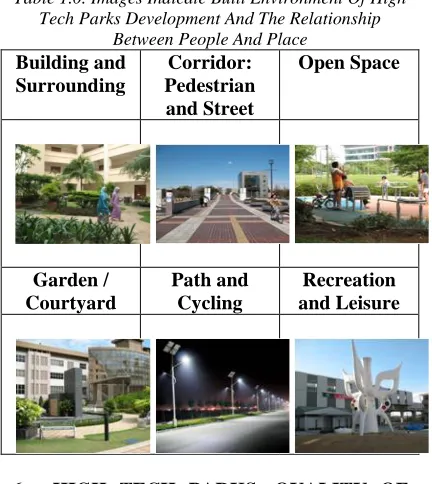
[image:3.612.318.534.100.342.2]These design concepts and innovations have potential social implications in the high tech park development. Building design and site development need to provide pleasant and enjoyable environment that make pedestrian the preferred mode of travel (see table 1.0). Furthermore, the built environment should respect local climate, local culture and lifestyles. Creative and high quality environments should be encouraged in the site development.
Table 1.0. Images Indicate Built Environment Of High Tech Parks Development And The Relationship
Between People And Place
Building and Surrounding
Corridor: Pedestrian and Street
Open Space
Garden / Courtyard
Path and Cycling
Recreation and Leisure
6. HIGH TECH PARKS, QUALITY OF LIFE AND A LEARNING REGION
ISSN: 1992-8645 www.jatit.org E-ISSN: 1817-3195
cluster form and well connected to each other by high quality telecommunication networks. The environment of high tech parks is based on a multi pole system composed of various zonings, building characters, public spaces, communities, landscapes and facilities. Starting from 1980s, economic contribution of high technology parks to the local development began to be noticed. It consists of distinctive high technology industrial zone, education, culture, residential, business, commercial and recreational space.
Sustainability in high tech parks can be described from various angles; the sense of community, characters of the place, the built form, and the environmental management. It was reported that 15% of high tech districts now have residential elements [13]. High tech parks stands as a symbiosis between the universities and the high technology industry.
7. A CASE STUDY OF CYBERJAYA, MALAYSIA
Cyberjaya is the nucleus of the Malaysia Multimedia Super Corridor (MSC-Malaysia). The city is designed to equip businesses and corporations located with the latest Information Communications Technology (ICT). Cyberjaya is located approximately 50 kilometers from Kuala Lumpur, 10 kilometers from Kuala Lumpur International Airport and 5 kilometers from Putrajaya. It aims to be an “intelligent city” engenderd to develop Malaysia’s multimedia industry which complement Putrajaya, a new federal government territory. In 2008, population in Cyberjaya in the day-time consists of 37,000 people and for night-time 13,000 people. Total land development of Cyberjaya is approximately 2890 hectares. Land use planning in Cyberjaya can be divided into seven categories: residential (28.3%), enterprise (13.5%), commercial (4.2%), institutional (10.2%), mixed zone (3.8%), open spaces (5.8%), and infrastructure (34.2%) [3]. The land use distribution indicates two major developments in Cyberjaya consisting of residential zone and enterprise zone [15].There are two main groups living and working in Cyberjaya: students and workers. The population rate in Cyberjaya is increasing from year 2007 (16,400 people) to year 2008 (18,700 people). Currently, there are many projects in Cyberjaya still under construction such as office blocks, entertainments, enterprise and commercial blocks.
The concept of balanced, harmonious relationship between ‘Man and Nature’ can be recognized from Landscape Master Plan pattern of Cyberjaya [15]. Thirty percent of the entire Cyberjaya project is allocated for greenery and open spaces [16]. Thirty percent of each development plot is reserved for green spaces. Green areas in the master plan are classified into five categories: green areas, parks, buffer zones, retention ponds and sewerage systems. Urban blocks and plots at enterprise zone in Cyberjaya provide varieties of open spaces such as green at the perimeter of plots, courtyards, islands, corridors and parking spaces.
7.1 Tsukuba Science City Case Study
Tsukuba Science City is the biggest national project undertaken in 1963 [17]. It has two purposes: to meet the need for high level R&D and improve higher education; and to cope with overcrowded conditions in the Tokyo district. Under the Basic Plan for Science and Technology, Tsukuba Science City is outlined to be the core city to promote science and technology. Tsukuba is expected to serve as "Center City of Excellence" by developing its creative and advanced research activities and by providing information to the world. The Basic Plan for Science and Technology is topromotes an active research exchange and joint study between public research and educational institutes and private research institutes.
7.1.1 Physical Planning and Design Concept
ISSN: 1992-8645 www.jatit.org E-ISSN: 1817-3195 7.1.2 Development of Eco-Life Model City and
the Greenway System
[image:5.612.93.303.383.559.2]Important assets of Tsukuba Science City are the urban city environment as well as the natural and rural environment which includes Mount of Tsukuba, Ushiku Marsh, flatland forests, traditional scenes of villages, and groves around traditional residences. As an attractive city of high quality, Tsukuba preserves the natural and rural environment, make the best use of each regional characteristic, enhance the living environment and beautiful scenery, and afforest unused land. Considering Tsukuba 3E Forum Declaration 2008, developing and promoting innovative technologies towards low carbon, safe and healthy environmental science city, and promoting environmental education become important agenda in Tsukuba model. An environmental technology fostered by research institutes in Tsukuba is expected to be used for the development of the Eco-Life Model City. Advanced urban facilities and public facilities in the Research and Education district describe the importance of living and working environment. Figure 4.0 5km walkway across town center of Tsukuba Science City that link series of green spaces
A pathway system that links buildings or parcels to each other and to their parking areas, transit stops, recreational areas, shops, and public buildings. In Tsukuba City Centre, the master plan includes significant amounts of open space, commercial support, office and mixed residential uses within convenient walking distance. Figure 1.0 shows a schematic pedestrian oriented development based on the Tsukuba Science City. In Tsukuba Science City, wide pedestrians are attached with cycling lanes.
Walking is the most basic movement in the high tech park especially to connect the areas within 500 meters radius. Pedestrians were linked between plots and blocks. The pedestrian networks are attached with cycling lanes of about 2-3 meter wide.
8. BUILT-UP IN HIGH TECH PARKS
[image:5.612.322.530.553.643.2]In the high tech park development, the built area for tenant’s lot is averagely between 30 to 50 percent, but some developers provide up to 40 to 50%. Large proportion of the green spaces provides various amenities, natural zone, and outdoor spaces for activities as well as for future developments. The building height creates sense of human- scale in the high tech park development [12]. For example, an area for 1600m², and the built area is 20-40%, the appropriate of building height is between one to two stories. If the plot size is expanding into 8000m², the built area can be 40-50% and the building height can up to three to five stories. This indicates that, the provision of green areas is around 20-40% and the development provides two stories to five stories of building height which depends on the plot size. Most of the buildings in the high tech parks are not solid buildings. The building massing provides some open spaces such as pocket gardens, courtyards, plazas and green corridors around the perimeter blocks. Generally, a rectangular building is the most building form in high tech parks. Building placement and edge character indicates a clear block patterns, provide active sidewalk and perimeter with green planting (see figure 2.0). Typically, high tech parks characterized by a wide buffer zone.
Figure 2.0 Proportion Of Built Areas And Open Spaces At Tenant's Lot
ISSN: 1992-8645 www.jatit.org E-ISSN: 1817-3195 8.1 Questionnaire in Living Environment
Respondents were asked to choose from a selection of four answers which reflected their opinion on the place they prefer to live in the park or other areas (see figure 3.0). The options offered were divided into four categories: living within the park area, in a small city, in metropolitan area and others. In Cyberjaya, 45.27% respondents choose that they preferred to live in a small city. 30.41% of responses select preferred to live within the park area. On the other hand, to live in a metropolitan (22.88%) or other areas (1.44%) are not so popular rated by the respondents in Cyberjaya. In contrast, respondents in Tsukuba Science City were highly preferred to live in the park area i.e. the respondents percentage is (75%). Other areas are not so significant popular to the respondent such as living in a small city (10%), a metropolitan area (5%) and others (10). Based on this result, the residents in Tsukuba Science City highly preferred to live in the park (75%) compared with responses in Cyberjaya which only 30.41% voted to live in the park.
8.2 Comparative Study Between Cyberjaya And Tsukuba Science City, Favorable Features In The Park
Respondents were asked to select among six categories which reflected their opinions on physical elements that provide a favorable environment to the park (see figure 4.0). The options given were:
i. Building and architecture ii. Working facilities
iii. Landscape, gardens and natural setting
iv. Public transportation system v. Infrastructure and communication vi. Others
[image:6.612.67.558.71.322.2]From the result, , 32% of the respondents in Cyberjaya stated that landscapes, gardens and natural settings provide a favorable environment to the park. Twenty six percent of respondents reported that working facilities contributed in developing a favorable environment of the park, followed by building and architecture (16%), and infrastructure and communication (15%). On the other hand, public transportation (9%) and other factors (2%) as these were not considered as significant elements. Based on respondents’ opinion in Tsukuba Science City, 46% of respondents stated that landscapes, gardens and natural settings provide a favorable environment to the park. Twenty eight percent of respondents reported the working facilities involved in
Figure 3.0 Comparative Result Between Cyberjaya And Tsukuba
Science City Based On The Memorable Features In The Park. Figure 4.0 Comparative Result Between Cyberjaya And Tsukuba
ISSN: 1992-8645 www.jatit.org E-ISSN: 1817-3195
developing favorable environment of the park, subsequently followed by public transportation (11%). Other factors were not considered to be so significant according respondents’ opinion such as building and architecture (5%), infrastructure and communication (5%) and other factors (5%). The results describe in both case studies indicate that landscape and gardens play an important role to provide a favorable environment to the park. The comparative results as shown in ( see figure 5.0) describe that the physical setting in the Tsukuba Science City provides more elements that are creating sense of memorable to the communities and visitors compared with the physical setting in Cyberjaya. The percentage of each element in the Tsukuba Science City is higher than the percentage of each element in Cyberjaya. For instance, the highest element that creates sense of memorable in Tsukuba Science City park in landscape category is(77.5%) whereas the highest element that creates sense of memorable in Cyberjaya buildings category is (66.6%).
8.3 Comparative study between Cyberjaya and Tsukuba Science City (in percentage), Memorable Features in the Park
In addition, this result indicates that, the most significant element that creates sense of memorable in Tsukuba Science City is the parks and landscapes category. While in Cyberjaya, buildings category plays an important element to create sense of memorable.
8.4 Questionnaire on Respondent Opinion on Factors needs to be Improved in the Park
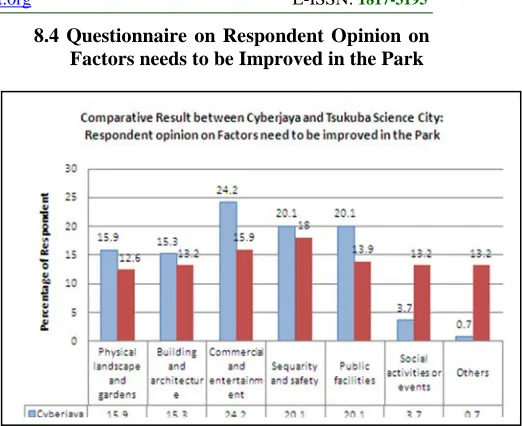
Figure 6.0 indicates the comparative results between Cyberjaya and Tsukuba Science City .This encompass the factors that needed to be improved in the park. In Cyberjaya, the most significant factors needed to be improved are commercial and entertainments (24.2%) followed by security and safety (20.1%) and public facilities (20.1%). The other categories are landscape and gardens (15.9%), and the building and architecture (15.3%). Social activities and other factors are not so significant. However, in Tsukuba Science City the most significant factors that need to be improved is security and safety (18%). Thus, this factor was followed by commercial and entertainment (15.9%). Other factors are averaged such as public facilities (13.9%), landscape and gardens (12.6%), social activities and other aspects (13.2%).
Summarily, physical characters and high quality of place making in the high tech park need to be incorporated significantly into a spatial master planning. The importance of physical characters as well as their built form will improve spaces, activities, movement patterns, and the sense of place which further create an enjoyable experience and livable communities in the park.
66.6 62.6
52.3
50 65.7 60.4 51 47.85
67
61.5
55.4
65 66.36 77.5
71.36 66.6
0 10 20 30 40 50 60 70 80 90 100Buildings
Public spaces
Streets
Pedestri an Public
Parks and… Natural
setting… Activities
Cy erj
Figure 5.0 Comparative Result Between Cyberjaya And Tsukuba Science City Based On The Memorable Features
[image:7.612.307.568.82.295.2]In The Park.
Figure 6.0 Comparative Results Between Cyberjaya And Tsukuba Science City Respondent Opinion Of Factors Need
[image:7.612.113.307.412.547.2]ISSN: 1992-8645 www.jatit.org E-ISSN: 1817-3195 Individual
work place
Small working area
Public area and sharing space
9. DEVELOPMENT OF SOCIAL SPACES
AND WORKING PLACE
ENVIRONMENT IN THE HIGH TECH PARK
Currently, most high tech parks consist of various types of land uses as well as various types of spaces. The provision of public spaces in the high tech park is quite dominant such as in the commercial blocks, central parking spaces, food courts, parks, community centre and street and pedestrian corridors. However, some of these places are not well function due on some problems such as lack of linkages, unattractive environment and activities [19], [20]. Social spaces in the high tech park could play more significant role in develop an attractive and enjoyable environment in the high tech park. The social life occurred at public spaces played a significant in creating vibrant atmosphere and facilitates human interaction [21]. The development of social spaces in the high tech park should get a strong support by the site management. In term of location, there are two types of social spaces: first, inside the tenant lot, and secondly, social space that is located around the whole development. Social spaces are essentially discretionary environments: people have to use them and conceivably could choose to go elsewhere. Man must be offer an attractive and safe environment to get the best result for reasonable development [22]. Work place is one of the important aspects of the physical planning and design development in the high tech park. Workplaces have to provide the best possible working conditions. Smaller functional distances facilitate social interaction [23]. Sharing facilities and public spaces can create opportunities for people to meet each other and exchange information.
10. CONCLUSION
High tech parks are new type of property investment with a different degree of risk from other industrial properties.High tech park physical environment required to be shape to suggest pleasant, comfortable, and a desirable outdoor. Cyberjaya and Tsukuba Science City have demonstrated a concern over sustainable development from their physical characters based on the relationship among the physical elements, landscape and gardens. However, the two Science Cities create a human friendly environment, providing a balance by putting people needs into considerations and ensuring a safety and healthy place to lives and works. Based on the case studies, public activities play an important role to make an active living and working environment in the park. The physical characters and high quality of place making in the high tech park need to be incorporated significantly into a spatial master planning. The physical planning and design should not only cater for high technology industrial activities but the place should be varied in terms of land use and zonings of infrastructural facilities and programs. The new agendas of high tech parks should also determine the uniqueness of the place such as the relation of physical setting to the community, place making and environment, social activities, architectural expression, sustainability, events and special programs, transportation systems, and the location. Interesting and conducive environment should be provide to attract people to live and work in high tech park
REFERENCES
[1] IASP – “International Association of Science
Park”.2007[Online],Available: http://w ww.iaspworld.org [2001]
[2] Frej, A. “Business Park and Industrial Development Handbook, Second Edition”, Urban Land Institute. 2001. [3] Rasidi, M.H and Shinozaki, M. “Physical
Environment and Need of Community in High Tech Park Development”: Case study of Cyberjaya, Malaysia and Tsukuba Science City,
Japan: Journal of Habitat
Engineering”, vol.1, no.1
[image:8.612.83.314.72.217.2]pp249-250. 2009
Figure 7.0 Images For Several Types Of Workplaces: Individual Working Space, Small Working Space And
ISSN: 1992-8645 www.jatit.org E-ISSN: 1817-3195
[4] Carillo, F., “Knowledge Cities;
Approaches, Experiences
and Perspectives”, Elsevier,
Oxford. 2006.
Cyberview Sdn. Bhd., 2008 . Available online: http://www.cyberview.com.my [5] phillips, S., and Yeung, H. “A place for
R&D?, The Singapore Science Park”.
Journal of Urban Studies 40(4). 707-732. 2003
[6] Preer, W .”The Emergence of Technopolis”; Knowledge Intensive
Technologies and Regional. 1992.
[7] Carrillo, F.J. Capital cities: “A taxonomy of capital account for knowledge
cities”.Journal of knowledge Management.vol. 8, no.5. 2004
[8] Tatsuno, S, “The Technopolis Strategy: Japan, High technology and The
Control The Twenty-First
Century”, Englewood Cliffs,
Prentice-Hall, New York. 1986.
[9] United Nations World Commission on Environment and Development “Report to The United Nations Conference on Environment and Development; Rio Declaration on Environment and Development”, Rio de Janeiro. 1992
[10] Zhang.Y, “The science park phenomenon: development, evolution and typology,”
Int.J. Entrepreneurship and Innovation
Management, Vol.5, Nos. 1-2. 2005
[11] Ergazakis, K., Metaxiotis, K. and Psarras, J., “An emerging pattern of successful knowledge Cities’ main
features. In Knowledge Cities:
Approaches, Experience and
Perspectives, Carrillo (edit).
Butterworth Heinemann, Burlington, USA. ISNB – 13:978-0-7506-7941-1, 10:7506- 7941-7. Pp 4-6.2006.
[12] Gehl J, “Three types of outdoor
Activities and quality of out door
space in Gehl (1996). life between
Buildings using public space,”
Arkitektens Forlag, skive, pp 11-40. 2001.
[13] Sanz, L .From “Technology Parks to Learning Villages; A Technology Park
Model for the Globa”l. 2001.
[14] Dearing James., “Growing A Japanese
Science City;Communication in
Scientific Research”, Routledge, London
and New York. Development, Praeger, London. 1995
[15] Federal Department of Town and Country. “Urban Design Guidelines for
The Multimedia Super Corridor”,
Ministry of Housing and Local Government. Kuala Lumpur.2001
[16] Setia Haruman Sdn. Bhd. Laporan Cadangan Pemajuan. “Report on the Progressing Development
of Cyberjaya “, Selangor, Malaysia. 2007 [17] Urban Renaissance Agency, “Tsukuba
Science City Booklet”, Ibaraki. .2005 [18] Tsukuba “Science City Information”
[online]. Available: http://www.info-tsukuba.org/english/
[19] Fadamiro J.A. “Outdoor space and their space Quality”. A Comparative Analysis of three Neighborhood in Lagos, Nigeria.
Journal of urban and environmental research. Vol2, No1 pp. 56-57. 2000 [20] Falade J.B and Oduwaye L.O. Essentials of
Landscape and site planning. Published. by “omega Hi-Tech Limited and Lead Associates”. Palm groove.Lagos ISNB 978-02109946 pp.6, 22.1998
[21] Aurore ,M and Ghozlane, F-Bahi, “Place-Identity in a School Setting: Effects of the Place Image:” Journal of Environment and
Behaviror” 43: 344. 2011 originally
published online 11Aurore Marcouyeux and Ghozlane Fleury-Bahi.2011. http://eab.sagepub.com/content /43/3/344. 2011
[22] Carmona M,T Heath,and Oc,S Tiesdell
Public Place- “Urban Spaces; The
Dimensions of urban design”. Architectural
Press, NY Oxford OX28DP ,ISBN 07506 3, 96 -102. 2003
[23] Shiho Sugihara and Gary W. Evans. “Place Attachment and Social Support at Continuing Care Retirement Communities”. Journal of Environment and Behavior. pp.401.
http://eab.sagepub.com/ . http://eab.sagepub.