INTEGRATION OF MOBILE AND WEB APPLICATION: AN
IMPLEMENTATION OF DIABETIC MANAGEMENT
SYSTEM
1M.A. JABAR, 2M.F. AZMI, 3F. SIDI
1,2
Department of Software Engineering and Information System, Universiti Putra Malaysia
3Department of Computer Science, Universiti Putra Malaysia
E-mail: [email protected] , [email protected] , [email protected]
ABSTRACT
Rapid development and high mobile devices penetration around the globe has impacted wireless and flexibility usage that promotes usability of technology at anytime and anywhere. Wireless technology has turned out to be the major medium in communication. One of the best-known examples of wireless technology is the mobile phone that can help to create solutions faster and easier than earlier days. However, designing and implementing these types of information systems can be highly challenging and difficult as user interaction with such technologies will be continuous and pervasive. Therefore, we propose a solution on how to deliver and share information in an ubiquitous environment. A prototype of diabetes monitoring system that support both mobile and web platform were implemented and evaluated. An evaluation based on expert judgment technique was used to validate the prototype. This study has shown that integration with mobile and web to access information on the internet can be a paradigm to promote ubiquitous information access and sharing.
Keywords: Integration, Mobile, Web Application, Diabetic Management, Ubiquitous
1. INTRODUCTION
Rapid developments in the technologies, the ease of use and the falling cost of mobile devices have contributed to great changes in today's lifestyle. During the past decade, the concept of ubiquitous coverage has expanded in various fields in the society due to the rapid development of wireless mobile and information technologies. A lot of applications which were initially available at a fixed location only have been transformed into ubiquitous applications, to be used wirelessly and flexibly at anytime and anywhere. Mobile wireless technology consist of two aspects which is mobility and computing. Mobile computing can provide user with continuous access to network resources without restriction in term of time and location [1]. Wireless can be describe as a way to transmit any form of data such as text, voice, image or video through radio waves, infrared waves or microwaves [2]. Therefore, mobile technologies are defined as any wireless technologies that facilitate transmission to mobile devices without time and location dependent. [3]. Built on a mobile computing platform, smart phone offer more advanced computing ability and
connectivity than its successor. Such devices has enhanced the functionalities available to the users by integrating multiple numbers of sensors and hardware into a single unit such as global positioning system (GPS), accelerometer sensor and near field communication (NFC). Communication, information search, entertainment and other function that you would able to think of is now available in the palm of your hand.
2. LITERATURE REVIEW
fact finding is the most common task in seeking information followed by casual browsing and information gathering. Communication remains the main function serve by mobile phone. However, Yanqing, only focuses on communication that relies on internet to suit with the context. There are several ways to communicate over the internet. For example, voice services such as Skype and Fring while textual based communication can be a web mail, online communities, push mail or instant messaging. Content object handling can be considered as activities where participants used the internet to manipulate digital content. It can be either capturing a public data such as ring tones, wall papers and add-on applications or sharing it by transferring to others or simply publish it to the public. A study conducted by Tomi in [5] on the impact on information needs and practices for users with constant mobile internet connection, identified five categories for information needs. 33% of the information needs (on-the-move and public transportation) occurs in a context when participant was moving while the remaining 67 % of the information needs took place when participants were in a situation that was relatively static in terms of movement. More interesting, a large quantity of information needs occurred in the home environment (35 %) even with the existence of desktop computer. Most probably its due to proximity and convenience which the mobile is instantly available for fulfilling the information need. It is also supported by Nylander, et al in [6], whereby 51% occurrence of internet access by using mobile phone took place in location where participants had access to computer. Mobile phone is not simply a backup when no computer is available but more as a tool that helps to provide quicker and more convenient service. Therefore, it can be said that mobile devices have become powerful and usable enough to supplant the desktop computer in some situations, even when the computer is available.
Previously, healthcare was focused on diagnosis-based treatment only where patient will approach medical professionals when they are not feeling well. If the healthcare monitoring process shift from clinical-centric to patient centric, it would be great to minimize the resources at hospitals. A comprehensive ubiquitous healthcare solution has been proposed which includes a real time Electrocardiography (ECG) monitoring and analyzing system based on an Android mobile device [7]. Wireless sensor network technology is used to transmit data hence promoting the flexible
monitoring mechanism by replacing complicated wired technology and moving healthcare away from a fixed location setting by utilizing a mobile phone. It also reduces the hassles, queues and crowds in hospital as well as providing more healthcares services and focus to patients who are seriously and urgently in need of such services. An integrated framework has been proposed in [8] to improve diabetes therapy management. Self-monitoring blood glucose (SMBG) measurements are conventionally analyzed by the physician based on the patient's logbook. Sometimes it is hard to perform assessment and decision making due to the data availability. Besides, there are many factors that affect a patient's blood glucose levels and cause unpredictable and potentially dangerous blood glucose level such as illness, physical activity, treatments, physical and psychological stress, drugs and change in the meal plan. The proposed solution consists of patient's personal diabetes management device, Radio-frequency Identification (RFID)-based management application and web portal with glycemic index database which is integrated with each other over the internet. The architecture offers a set of services for monitoring, interconnecting with the glycemic index database and ubiquitous access to the information based on the personal device, web portal and management desktop application. Main contribution of the framework in supporting blood glucose management and insulin therapy is that most of the measurements and interactions with the patient are done at home. It improves the self-monitoring blood glucose process while keep the interaction between nurses and physicians being updated regularly.
levels by recognizing past behavior based on user location and activity. However the proposed system still relies on user input as the mobile phone does not equipped with additional sensors. Food intake and insulin dosage input will be synchronized with the blood glucose meter to obtain the blood glucose levels. From the previous researches, it can be conclude that a better mechanism on logging the blood glucose reading could improve the assessment and decision making on diabetic patient. By utilizing a mobile phone, a flexible monitoring mechanism can be implemented to replace conventional wired technology but without losing its main function as a phone.
3. METHODOLOGY
A prototype application was developed as a part of the outcome of this study. The prototype will be used to validate the solution for the problem, where the patient able to log their blood glucose readings and the doctors are able to read patient's blood glucose logs and receive alert on bad glucose readings. Prototype of the model is evaluated and validated using expert judgment technique. Experts on the domain were selected to test the prototype followed by the evaluation and the validation. The method relies heavily on the experience of the expert knowledge in similar development environments and history of past projects.
For this study, the system is developed as a web-based application where it can be access easily by doctor and patient over the Internet. A web application can be considered as a distributed system, with a client-server or multi-tier architecture with a wide number of users distributed all over the world and accessing it concurrently. It's execution environments composed of different hardware, network connections, operating systems, Web servers and Web browsers [11] Web application also has an extremely heterogeneous nature that depends on the large variety of software components that it usually includes. It also has the ability of generating software components at run time according to user inputs and server status. Therefore, it is important to decide the type of application either stand-alone application or web-based application. Basically, most of medical applications are designed to access the medical documents through Intranet or Internet as it allows data and information to be shared or interactively exchanges through the networks [12]. There are several factors that need to be considered in this system development and web-based application is
chosen as it is more efficient compared to desktop application in term of scalability. Through web-based application, it is easier to expand size of the system especially in adding more client console to access the system in the future. It also has cross-platform capability to run the application.
In contrast to the traditional programming process of applications for desktop computer, programming applications for smartphones requires the usage of dedicated programming languages [13]. Apple developers make use of Objective-C, Google Android-enabled phones support Java, Microsoft's Windows Phone 7 supports C#, and HP's webOS applications are written in Hypertext Markup Language (HTML) 5, CSS and JavaScripts. In this research, Google Android platform is chosen as it is open source and can be integrated with push notification service using Google Cloud to Device Messaging (C2DM). The list of software tools used, include the Eclipse IDE Indigo, Apache Tomcat 7.0, MySQL Community Server 5., Apache Struts 2, Apache Tiles 2, Hibernate, Android Operating System, Google Cloud to Device Messaging (C2DM), jQuery Mobile and Enterprise Architect 7.5
4. DESIGN AND IMPLEMENTATION
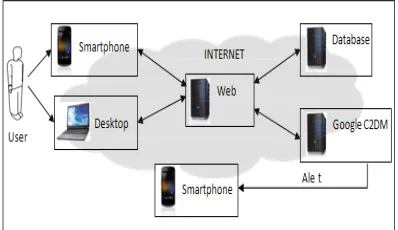
Model that has been proposed in this research is shown in Figure 1. User can have option to access the system using smartphone or desktop. The application will be hosted at the web server which interacts with database server to store and retrieve information and Google Cloud to Device Messaging (C2DM) server. Google C2DM server will send push notification to specified device when triggered by the web server. Physical design of the modules begins by adapting specification from the system requirements. The design process is undertaken by id interaction with sub-systems and their communication.
[image:3.612.316.515.590.705.2]
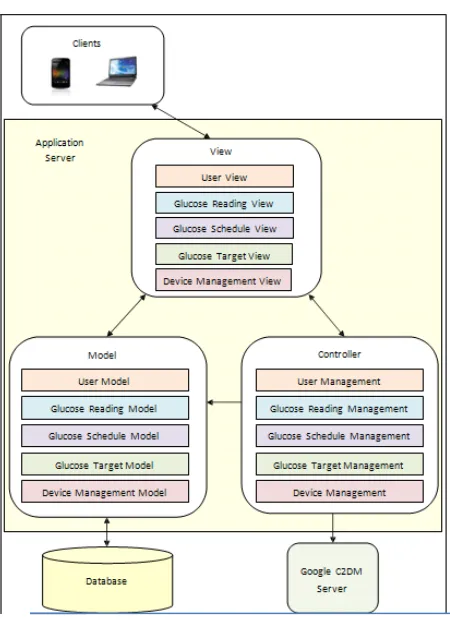
Physical design of the modules begins by adapting specification from the system requirements. The design process is undertaken by identifying the major components, interaction with sub-systems and their communication. The architecture for the system is illustrated in Figure 2.
Figure 2: Proposed System Architecture
Model-View-Controller is often seen in web applications, where the view is the actual Hypertext Markup Language (HTML) page. The controller is the code that gathers dynamic data and generates the content within the HTML. Finally, the model is represented by the actual content, which is often stored in a database or in Extensible Markup Language (XML) nodes, and the business rules that transform that content based on user actions.
Apache Tomcat will serve as Web Server that provide servlet container for the web application to be deployed. MySQL Server will host the database used in this project. Apache Struts 2 will be used as a base framework. Therefore this project is confirmed to meet the MVC Pattern. Apache Tiles 2 has been used to manage the website template. It impose reuse component
and well integrated with Struts 2. Hibernate is used to implement the entity class. It help to manage the automatic creation of entity table of
database.
The model contains the business logic and interact with the persistence storage to store, retrieve and manipulate data. MySQL is chosen as the database for the application with the integration of Hibernate Framework.
The view is responsible for displaying the results back to the user. In Struts the view layer is implemented using JavaServer Pages (JSP) for the desktop client and blend with jQuery Mobile for the mobile client.
The controller handles all the request from the user and selects the appropriate view to return. Whenever the user sends a request for something then it always go through the controller. The controller is responsible for intercepting the requests from view and passes it to the model for the appropriate action. After the action has been taken on the data, the controller is responsible for directing the appropriate view to the user.
For notification alert mechanism, Cloud to Device Messaging service by Google is used to push notifications to mobile devices. It helps to fetch data from the web server to the application on Android device.
5. RESULT AND DISCUSSION
In term of system usability, since current method at Malaysian Government Clinics and Hospitals still using paper based to log the patient's glucose reading, s he agreed t hat the prototype of the system is easy to use.
6. CONTRIBUTION, LIMITATION AND
FUTURE WORK
The main contribution of this research is the proposed model that allows the integration of web application and mobile application by using a single backend server to handle all the logics. It is important to make sure that all data and information that being access is the same for all clients. Integration Google Cloud to Device Messaging (C2DM Service) to provide notification alert can help to reduce cost in information sharing as it can replace SMS notification that usually occur some charges when using the service. The major limitation of this system is on the availability of the smartphone to receive the notification alert. Smartphone need to be connected to the internet to receive the notification else the alert will be kept at Google C2DM server until the phone is available. Therefore, doctor could be late to take quick action. Another action that need to be consider is the patient itself. Patient must log the correct glucose reading to make sure the doctor made a correct decision on the patient's glucose readings. Another action that need to be consider is the patient itself. Patient must log the correct glucose reading to make sure the doctor made a correct decision on the patient's glucose readings
.
REFERENCES
[1] Malladi, R. & Agrawal, D. P. (2002). Current and Future Applications of Mobile and Wireless
Networks. COMMUNICATIONS OF THE ACM
Volume 45. 144-146.
[2] Dubendorf, V. A. (2003). Wireless Data Technologies : Wiley Publications. Eclipse (2012). Eclipse Integrated Development Environment (IDE) [Online]. http://www.eclipse.org/ [Accessed 15 June 2012]
[3] Louise, B. & Anind, D. (2003). Is Context-Aware Computing Taking Control Away from the User? Three Levels of Interactivity Examined. In Proceedings of the Fifth International Conference on Ubiquitous Computing, UbiComp 2003, Seattle, Washington, October 12-15, 2003.
[4] Yanqing, C. & Virpi, R. (2008). How People
Use the Web on Mobile Devices. In
Proceedings of the 17th International World
Wide Web Conference, WWW 2008, Beijing,
China.
[5] Tomi, H. (2009). Information Needs and Practices of Active Mobile Internet Users. In Proceedings of the 6th International Conference on Mobile Technology, Applications, and Systems, Mobility Conference 2009, ACM, Nice, France, September 2-4, 2009.
[6] Nylander, S. , Lundquist, T. & Brännström, A. (2009). At Home and with Computer Access - Why and Where People Use Cell Phones to Access the Internet. In Proceedings of the 27th international conference on Human factors in computing systems, CHI 2009, ACM, Boston, MA, USA, April 4-9, 2009.
[7] Pei-Cheng H. & Wan-Young C. (2011). A Comprehensive Ubiquitous Healthcare Solution on an Android Mobile Device. Sensors (2011) Volume 7. 6799-6815.
[8] Jara A. J., Zamora M. A., Skarmeta A. F. G. (2011). An Internet of things-based personal device for diabetes therapy management in ambient assisted living (AAL). Personal and Ubiquitous Computing (2011) Volume 15, 431– 440.
[9] Mafauzy M. et al, (2011). The Status of Diabetes Control in Malaysia: Results of DiabCare 2008. Medical Journal of Malaysia (2011) Volume 66 No 3, 175-181.
[10]Davy, P. & Yolande, B. (2008). Mobile Phones Assisting With Health Self-Care: A Diabetes Case Study. In Proceedings of the 10th international conference on Human computer interaction with mobile devices and services, MobileHCI 2008, ACM, Amsterdam, Netherlands. September 2-5, 2008.
[11]Di Lucca G. A., Fasolino A. R. (2006). Testing Web-based applications: The state of the art and future trends. Information and Software Technology Journal Volume 48. 1172-1186. [12]Zhang, M.H., W.Y. Lin, S.A. Klein, J.T.
Bacmeister, S. Bony, R.T. Cederwall, A.D. Del Genio, J.J. Hack, N.G. Loeb, U. Lohmann, P. Minnis, I. Musat, R. Pincus, P. Stier, M.J. Suarez, M.J. Webb, J.B. Wu, S.C. Xie, M.-S. Yao, and J.H. Zhang, (2005), Comparing clouds and their seasonal variations in 10 atmospheric general circulation models with satellite
measurements. J. Geophys. Res., 110,
[13]Höpfner, H. et al, (2011). Towards a Target Platform Independent Specification and Generation of Information System Apps. In Proceedings of the 19th ACM SIGSOFT Symposium on the Foundations of Software
Engineering, SIGSOFT 2011, ACM, Szeged,