PERFORMANCE ANALYSIS OF AN ENERGY EFFICIENT
CLUSTERING IN WIRELESS SENSOR NETWORKS
1V.CHANDRASEKARAN, 2Dr.A.SHANMUGAM
1
Research Scholar, Assistant Professor (Senior Grade), Department Of ECE, Velalar College of Engineering and Technology,
Erode - 638 012, Tamil Nadu, India.
2
Principal and Research Supervisor, Bannariamman Institute of Technology Sathyamangalam-638 401, Tamil Nadu, India.
E-mail: [email protected], [email protected]
ABSTRACT
Wireless sensor networks (WSNs) have gained increasing importance in a variety of military and civilian applications. The most important issue faced in all wireless sensor networks is its energy consumption. Innovative techniques that improve energy efficiency to prolong the network lifetime are highly required. Clustering is an effective topology control approach in wireless sensor networks, which can increase network scalability and lifetime. In this paper, we propose a novel energy efficient clustering approach (E2C) for single-hop wireless sensor networks, which better suits the periodical data gathering applications. E2C is a clustering technique in which the network is partitioned into a group of cluster regions with one cluster head in each cluster region.E2C uses a new method of election of cluster heads and clusters formation. The finest value of competition range produces a good distribution of cluster heads. Further in the cluster formation phase, plain nodes join clusters not only taking into account its intra-cluster communication cost, but also considering cluster heads cost of communication to the BS. Simulation results show that E2C prolongs the network lifetime significantly against the other clustering protocols such as LEACH, HEED and EECS.
Keywords: Wireless Sensor Networks, Cluster Region, Cluster heads, Energy Efficiency
1. INTRODUCTION
Recent advances in communication technology have led to the development of intelligent, lightweight, low cost sensor nodes that cooperatively collect data from the place of deployment. A WSN consists of a large number of sensor nodes, which are densely deployed over an unattended area either close to or inside the targets to be observed. These sensor nodes periodically monitor or sense the conditions of the targets, process the data, and transmit the sensed data back to a base station. All of the sensor nodes group together to form a communication network for providing reliable networking service. The grouping among sensor nodes is very important in WSNs for data collected from multiple sensor nodes can offer valuable inference about the environment and the collaboration among sensor nodes can provide trade - offs between communication cost and computation energy.
Since it is likely that the data acquired from one sensor node are highly correlated with the data from its neighbors, data aggregation can reduce the redundant information transmitted in the network. It
is well known that the energy consumed for transferring one bit of data can be used to perform a large number of arithmetic operations in a sensor processor. When the base station is far away, there are significant advantages in using local data aggregation instead of direct communication. Thus, node clustering, which aggregates nodes into groups (clusters), is critical to facilitating practical deployment and operation of WSNs.
In this paper, we argue that a node clustering solution can achieve this objective. We propose a scalable, distributed, and energy-efficient clustering algorithm, Energy-efficient Clustering (E2C). E2C determines suitable cluster sizes considering their distances to the sink. By tuning the probability that a node becomes a CH, E2C effectively controls cluster sizes, which allows an approximately uniform use of the overall energy resources of a WSN. This protocol targets at low signaling overhead and an overall low level of energy consumption.
assumptions and our network model. Section 4 exhibits the details of E2C and Section 5 evaluates the performance of E2C via simulations and compares E2C with some other cluster protocols. Finally, Section 6 concludes the paper and gives the directions of future work.
2. RELATED WORK
Energy-efficient clustering algorithms for wireless sensor networks have been widely addressed in literature. Heinzelman (2000), et al. presented the LEACH (Low Energy Adaptive Clustering Hierarchy) protocol for WSNs of cluster-based architecture, which is a widely known and elegant clustering algorithm, by selecting the CHs in rounds. LEACH is a popular energy efficient adaptive clustering algorithm that forms node clusters based on the received signal strength and uses these local cluster heads as routers to the SINK. Since data transfer to the base station consumes more energy, all the sensor nodes within a cluster take turns with the transmission by rotating the cluster heads. This leads to balanced energy consumption of all nodes, and hence a longer lifetime of the network. A predefined value, P (the desired percentage of cluster heads in the network), is set before starting this algorithm. LEACH works in several rounds where each round has two phases, the setup phase and the steady phase. During the setup phase, each node decides whether or not to become a cluster head. Each node chooses a random number p between 0 and 1, which is the probability to elect itself as a cluster head. If the probability p is less than a threshold T(n) for node n , node n will become a cluster head for the current round r . This T(n) is calculated as follows:
1 ∗ ଵ
, ∈
0,
During the steady phase, the sensor nodes can begin sensing and transmitting data to the cluster heads. The cluster heads also aggregate data from the sensor nodes in their cluster and send data to the base station. After a certain period of time spent on the steady phase, the network goes into another round of selecting the cluster heads. The duration of the steady phase is longer than the duration of the setup phase in order to minimize the overhead. LEACH provides an optimized behavior for
communication in WSNs based on self - organization methods. Mobility is also supported by LEACH, whereas new nodes have to be synchronized to the current round. Node failures may lead to less cluster heads to be elected than desired because the predefined P is a percentage of the total number of sensor nodes.
Considering a single round of LEACH, a stochastic cluster - head selection will not automatically lead to minimum energy consumption during the steady phase for data transfer of a given set of sensor nodes. For example, some of the cluster heads can be located near the edges of the network or some adjacent nodes can become cluster heads. In these cases, some sensor nodes are further away from a cluster head. However, considering two or more rounds, a selection of favorable cluster heads at the current round can result in an unfavorable cluster - heads selection in the later round. Regarding energy consumption, a deterministic cluster - head selection algorithm can outperform a stochastic algorithm. The modification of the threshold equation by the remaining energy may bring up another problem. Since the remaining nodes have a low energy level after a number of rounds, the cluster - head threshold will become too low. Some cluster heads will not have enough energy to transmit data to the base station.
The network cannot work well although there are still nodes available with enough energy to perform this task. The threshold equation can be modified further by including a factor that increases the threshold for any node that has not been a cluster head for a certain number of rounds. The chance of this node becoming a cluster head increases because of the higher threshold.
cluster heads while the secondary parameter is used for breaking ties.
The clustering process at each sensor node requires several rounds. Every round is long enough to receive messages from any neighbor within the cluster range. As in LEACH, an initial percentage of cluster heads in the network, Cprob , is predefined.
The parameter Cprob is only used to limit the initial
cluster – head announcements and has no direct impact on the final cluster structure. In HEED,each sensor node sets the probability CHprob of becoming
a cluster head as follows
∗
௦ௗ௨௫
where E residual is the estimated current residual energy in this sensor node and E max is the maximum energy (corresponding to a fully charged battery), which is typically identical for homogeneous sensor nodes. The CHprob value must
be greater than a minimum threshold p min . A cluster head is either a tentative cluster - head , if its CHprob is < 1, or a final cluster - head , if its CHprob
has reached 1. During each round of HEED, every sensor node that never heard from a cluster head elects itself to become a cluster head with probability CHprob. The newly selected cluster heads
are added to the current set of cluster heads. If a sensor node is selected to become a cluster head, it broadcasts an announcement message as a tentative cluster - head or a final cluster - head . A sensor node hearing the cluster - head list selects the cluster head with the lowest cost from this set of cluster heads. Every node then doubles its CHprob
and goes to the next step. If a node completes the HEED execution without electing itself to become a cluster head or joining a cluster, it announces itself as a final cluster - head . A tentative cluster - head node can become a regular node at a later iteration if it hears from a lower cost cluster head. Note that a node can be selected as a cluster head at consecutive clustering intervals if it has higher residual energy with lower cost. Since a WSN is assumed to be a stationary network, where nodes do not die unexpectedly, the neighbor set of every node does not change very frequently.
Here HEED does not need to do neighbor discovery very often. In addition, distribution of energy consumption of HEED extends the lifetime of all the nodes in the network, thus sustaining stability of the neighbor set. Nodes also automatically update their neighbor sets in multihop
networks by periodically sending and receiving messages. The HEED clustering improves network lifetime over LEACH clustering because LEACH randomly selects cluster heads (and hence cluster sizes), which may result in faster death of some nodes. The final cluster heads selected in HEED are well distributed across the network and the communication cost is minimized.
Another popular Energy Efficient Clustering Scheme (EECS). Ye et al. proposed EECS, a distributed, energy efficient and load balanced clustering algorithm which helps in periodical data gathering applications of WSN. This algorithm elects the cluster head from the sensor nodes who is having more residual energy through local radio communication while achieving well cluster head distribution. During the CH election, some candidate nodes are elected, and they compete among themselves to become a cluster head. EECS algorithm is based upon the features of most popular clustering algorithm LEACH. This algorithm uses single hop communication between the CH and base station. At the time of cluster formation the BS broadcasts a “hello” message to all the nodes at a certain power level. After receiving the “hello” message the nodes can compute the approximate distance to the BS based on the received signal strength.
In cluster head election phase, a node becomes a CANDIDATE node with a probability T. After becoming a candidate, it broadcasts a COMPETE HEAD MSG to all the nodes present within radio range Rcompete. Each candidate node always checks for alternatives who are having more residual energy than itself. Once it finds more powerful node than itself, it quits from the competition without receiving any subsequent COMPETE HEAD MSG. Otherwise the node will be elected as cluster head. In the cluster formation phase each HEAD node broadcasts the HEAD AD MSG across the network. All the plain nodes receive the HEAD AD MSG and decide whether to join that head or not based on distance parameter. Each node selects the CH, which requires minimum communication according to the received signal strength.
The overhead complexity across the network is O(n), where n is the number of nodes. There is at most one cluster head in every Rcompete radio range.
that in this algorithm network lifetime increases by 35% compared to LEACH. This algorithm uses local radio communication for CH selection based on residual energy.
3. NETWORK MODEL
We consider the network model of hundreds of sensor nodes distributed in a large area. For simplifications, it is considered a WSN system in which the data being sensed by sensor nodes is transmitted to a base station, and there is only one base station with sufficient energy near part of the sensor nodes. Because sensor nodes first transmit sensed data to the CHs, so the CH sensor nodes perform data fusion. In addition, sensor nodes are desired to be designed as cheap and high energy-efficient as possible, it is assumed that all sensor nodes and the BS use symmetric radio channel with the same transmission range in the network. They are distributed randomly and densely, and their energy is constrained.
The network architecture considered is the following:
• A fixed base station is located away from the sensor field.
• The sensor nodes are energy constrained with uniform initial energy allocation.
• Each node senses the environment at a fixed rate and always has data to send to the base station.
• The sensor nodes are assumed to be immobile.
• The network is homogeneous, and all the nodes are equivalent, i.e., they have the same computing and communication capacity.
• The network is location unaware, i.e., the physical location of nodes is not known in advance.
• The transmitter can adjust its amplifier
power based on the transmission distance.
Tx Rx
kbits kbits
[image:4.612.99.307.625.719.2]
Figure 1: Radio model
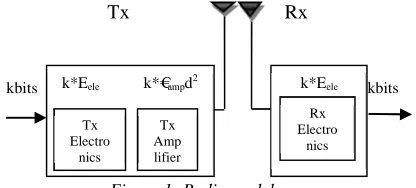
The radio model that is used is the same adopted in LEACH as shown in Figure 1. By using this approach, we assumed the energy loss of d2 due to channel transmission. The node dissipates the energy for the radio transmission of a message of k bits over a distance d is due to running both the transmitter circuitry and the transmitter amplifier is given by:
்௫ , !
∗ " ∗ #௦ଶ, $
∗ " ∗ #ସ, %
Where Eele is the transmitter circuitry dissipation
per bit, which is supposed to be equal to the corresponding receiver circuitry dissipation per bit and Eamp is the transmit amplifier dissipation per bit
per square meter. Depending on the transmission distance both the free space and the multi-path fading channel models are used.
Similarly, the energy ERx (k) dissipated by a node
for the reception of a k-bit message is due to running the receiver circuitry is given by
ோ௫ ∗
Additionally, data aggregation is adopted to save energy. It is assumed that the sensed information is highly correlated, thus the cluster head can always aggregate the data of its members into a single length-fixed packet. And this operation also consumes energy Eaggre(nJ/bit/signal). The energy
required to transmit a message from a source node to a destination node is equal to the energy required to transmit the same message from the destination node back to the source node for a given SNR.
Finally, it is assumed that the communication environment is both contention and error free. Thus there is no need for retransmission. Finally, IEEE 802.11 is the wireless communication standard used in the simulation tests performed. Generally, the selection of this standard enables the high rate transmission over long distances.
4. PROPOSED ENERGY EFFICIENT
CLUSTERING
In this section, we explain our proposed Energy Efficient Clustering (E2C). E2C is a clustering technique, where the network is partitioned into a set of clusters with one cluster head in each cluster. In our clustering technique, the Cluster Head k*Eele k*€ampd2 k*Eele
Tx Electro
nics
Tx Amp lifier
Rx Electro
directly communicate with the Base Station. In the network deployment phase, the BS broadcasts a “hello” message to all the nodes at a certain power level. By this way each node can compute its approximate distance to the BS based on the received signal strength. It helps nodes to select the proper power level when communicating with the BS. In our proposed E2C technique, there are three phases Cluster head election phase, Cluster formation phase and Data transmission phase. In the cluster head election phase, well distributed cluster heads are elected with a little control overhead. In the cluster formation phase, the selected cluster head forms a group. In the data transmission phase, CH aggregates the data from the cluster members and send it to the Base station.
4.1 Cluster Head(CH) Election
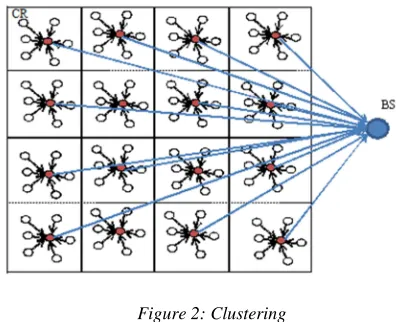
[image:5.612.319.527.67.411.2]In the CH election phase, the network is partitioned into a set of Cluster Regions (CR).
Figure 2: Clustering
In each CR, the nodes participate in CH election called CH Nominee (CHN) are found using a probability scale is assigned to each sensor. According to this value, each sensor decides on becoming a CH Nominee (CHN). Basically, the probability to become a CHN, T, is scaled by the ratio of initial sensor energy level to the average initial energy of the network. For a node i in region R, the resulting probability becomes
∗
&'( )* '+') &'( )*
Computation of Pi is performed only once right after network initialization. At the beginning, each node is elects a random number on [0 1]. If the number is less than Pi, then the sensor node
becomes a CH Nominee (CHN). With this mechanism, approximately a ratio T of all nodes is elected as CHNs.
No
Yes
Yes [image:5.612.94.292.328.489.2]
No
Figure 3: Flowchart For Cluster Head Selection
In our Clustering algorithm, we use the initial energy levels for selecting the CHNs. Since the rate of being selected as a CHN is proportional to the initial energy levels and the CHs are eventually selected among these nominees, the resulting frequency of having the CH-role and the corresponding energy consumption are on the average approximately proportional to the initial energy levels. Therefore, this choice is a reasonable method towards balancing energy consumption levels while preventing additional overhead. Note that node residual energy levels are taken into
START
Sensor Nodes compute the Probability
Node chooses the random number between (0 1)
Is random number < Probability
Node elect as a Cluster Member(CM)
Node elect as a Cluster Head Nominee (CHN)
CHNs broadcasts the CH ADV packet and it’s residual energy
CHN elect as a Cluster Head (CH)
CHN elect as a Cluster Member (CM) Is Res.E of
CHN < Res.E of other CHNs
account during the selection of the actual CHs.
Figure 4: Cluster Region(CR)
After CHNs selected, each CHN in Cluster region CRi transmits a “CH advertisement” packet
and advertises its residual energy level within a neighborhood of radius ri and it is determined by
the Equation
,
(
-
A CHN monitors the advertisements from other CHNs and defers from acting as a CH if a higher energy level is reported by another. Eventually, the candidates with the highest residual energy among their neighboring CHNs become the CHs. If a CHN receives no advertisement packets for a period of Twait, it automatically becomes a CH node. This
mechanism enables the choice of the actual CH nodes to be based on the most recent sensor energy stocks. Additionally, we use d(CHN,BS) to break the tie of Eresidual during the comparisons.
4.2 Cluster Formation
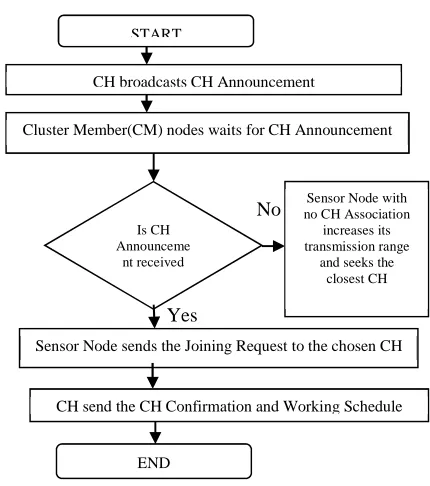
After the CHs are elected, each CH transmits a“CH announcement” packet within an area of transmission radius ri and informs other sensors of
its availability as a CH. This CH-announcement range is a multiple of ri selected to ensure that each
CM receives at least one announcement packet and can associate to a CH. To ensure reception of announcement packets by other nodes, a straightforward method is to send region-wide broadcasts. However, this potentially causes high transmission energy cost; a fine tuned value is required. Thus, a system parameter tuned to achieve high CH-association probability for non-CH nodes
while avoiding an unnecessarily large transmission range.
Each CM nodes may collect announcement packets from multiple CHs and selects the CH that has generated the announcement packet with the
No
Yes
Figure 5: Flowchart for Cluster Formation
highest RSSI as the ideal CH to associate to. Nodes associate to CHs via sending a “CH Joining” request and upon reception of a subsequent “CH confirmation”. At the end of the cluster formation phase, there may still be a few sensors that have not joined any clusters as they may not have received any announcement packets. To recover from such cases, a sensor with no CH-association gradually increases its transmission range and seeks the closest CH to associate.
Synchronization between each phase should be guaranteed so that each node has enough time to complete the procedure or the first phase, we could choose a proper time interval Timer according to the system parameters and wireless channel quality; and in the second phase, each cluster head broadcasts a TDMA schedule within its cluster. Then the members process in the corresponding time slots and turn off the radio in the idle time to save energy further. Additionally, we make BS periodically synchronize the nodes over the network against the time drift.
START
CH broadcasts CH Announcement
Cluster Member(CM) nodes waits for CH Announcement
Is CH Announceme
nt received
Sensor Node with no CH Association increases its transmission range
and seeks the closest CH
Sensor Node sends the Joining Request to the chosen CH
CH send the CH Confirmation and Working Schedule
[image:6.612.320.535.161.404.2]4.3 Data Transmission
Once the clusters are created and the TDMA schedule is fixed, data transmission can begin. Assuming nodes always have data to send, they send it during their allocated transmission time to the cluster head. This transmission uses a minimal amount of energy (chosen based on the received strength of the cluster-head announcement). The radio of each non-cluster-head node can be turned off until the node’s allocated transmission time, thus minimizing energy dissipation in these nodes. The cluster-head node must keep its receiver on to receive all the data from the nodes in the cluster. When all the data has been received, the cluster head node performs signal processing functions to compress the data into a single signal. For example, if the data are audio or seismic signals, the cluster-head node can beam form the individual signals to generate a composite signal. This composite signal is sent to the base station. Since the base station is far away, this is a high-energy transmission.
In the data transmission phase, the consumed energy of cluster head i, E(CHi) is as follows,
assuming the distance between the CH and the base station is greater than the cross over distance do.
./ ∗ ∗ " " 1 ∗ "
" #ସ)
Observing the above formula, energy consumption of E(CHi) is composed of three parts: data receiving,data aggregation and data transmission. In the field, several cluster heads may be near the BS, while some are far away. The energy expended during data transmission for far away cluster heads is significant, especially in large scale networks. Since d(CHi, BS) has been fixed after cluster head election , we should justify the cluster size for each cluster head to balance their load across the network. So after some time the corresponding Cluster head energy to be reduced and to rotate the cluster head selection process.
5. PERFORMANCE ANALYSIS
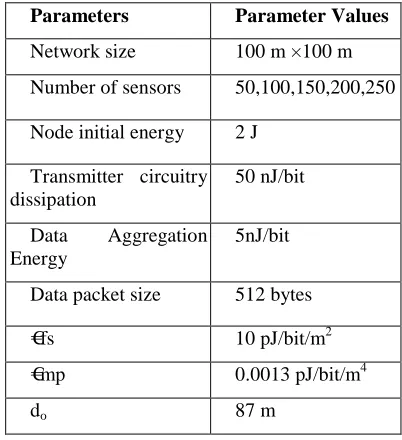
In this section, the performance of the E2C protocol implemented with NS2.In the simulation, we adopt the same MAC protocols in E2C as in LEACH. The parameters of simulations are listed in
[image:7.612.316.517.139.359.2]Table 1, where the parameters of the energy consumption model are the same as LEACH.
Table 1: Parameters Used In The Simulation
Parameters Parameter Values
Network size 100 m ×100 m
Number of sensors 50,100,150,200,250
Node initial energy 2 J
Transmitter circuitry dissipation
50 nJ/bit
Data Aggregation Energy
5nJ/bit
Data packet size 512 bytes
€fs 10 pJ/bit/m2
€mp 0.0013 pJ/bit/m4
do 87 m
5.1 Network Lifetime
Lifetime is the criterion for evaluating the performance of sensorNetworks. In the simulation, we measure the lifetime in terms of the round when the first node dies, because in data gathering applications a certain area cannot be monitored any more once a node dies.
In order to measure the proposed clustering algorithm, we consider two metrics for the performance evaluation. System lifetime (the time of FND (first node dies) and the number of alive nodes are applied, because lengthening the network lifetime is an important issue in clustered WSNs.
• System lifetime (the time of FND) - The definition of system lifetime can be used to determine how alive a system is. We use the most general definition of the lifetime in this paper, the time of FND. Therefore, in order to maximize the system lifetime, we maximize the time of FND in a WSN system.
• The number of alive nodes - The ability of a WSN depends on the set of alive nodes (nodes that have not failed).Therefore, we evaluate the functionality of the WSN system depending on counting the number of alive nodes in the system.
In the Figure 6, we find HEED perform better than LEACH,EECS perform better than HEED and E2C performs the best. The reason for this is that E2C always achieves well distributed cluster heads according to the residual energy; further, we consider balancing the load among the cluster heads
[image:8.612.102.293.167.328.2]with weighted function.
Figure 6: Comparison Of The Network Lifetime For 100m X 100m Network With 100 Nodes.
Comparing with LEACH, HEED and EECS the simulation results show that E2C performs best and prolongs the network lifetime significantly.
5.2 Residual Energy
It is measured as the total amount (in joules) of remaining battery energy at the end of the simulation. When considering the residual energy of each round, E2C performs better than the other clustering algorithms and prolongs the network
[image:8.612.330.508.296.444.2]lifetime significantly.
Figure 7: Comparison Of The Average Residual Energy For 100m X 100m Network With 100 Nodes.
5.3 Packet Delivery Ratio
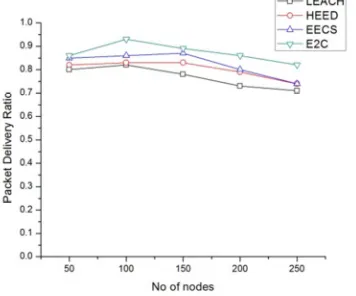
It is defined as the ratio of total number of packets that have reached the destination node and the total number of packets originated at the source node. Figure 8 shows the effect of number of nodes on Packet Delivery Ratio (PDR) of LEACH, HEED, EECS and our proposed E2C.
The PDR for number of nodes from 50 to 250 is found to decrease when the number of nodes increases.
Figure 8: Effect Of Number Of Nodes On Packet Delivery Ratio (PDR)
This is due to higher traffic in the network. The E2C shows 12 - 14 % improvement in PDR over LEACH and HEED.
5.4 Throughput
[image:8.612.104.293.522.670.2]Figure 9: Effect Of Number Of Nodes On Throughput
LEACH shows a large variation in the number of packets delivered, whereas E2C delivers moderately an equal number of packets while increasing the number of nodes. E2C shows the improvement over LEACH, HEED and EECS.
6. CONCLUSION AND FUTURE WORKS
In this paper, a distributed, energy efficient and load balanced clustering scheme applied for periodical data gathering. E2C produces a uniform distribution of cluster heads across the network through localized communication with little overhead. Performance results demonstrate that E2C extends network lifetime and provides equalization of node energy levels. E2C outperforms well-known and popular clustering algorithms LEACH, HEED and EECS in energy conservation and equalization. All of our contributions here are focused on the clustering stage. There is still much space to improve the performance of data transmission. In the large scale sensor networks, multi-hop hierarchical routing is a mainstream technique for energy saving. We will remove the assumption of single-hop and design an energy efficient protocol for both intra-cluster and inter-cluster data transmission in future.
In order to save energy further, multi-hop communication among the cluster heads can be adopted during the inter-cluster communications in the data transmission phase. Notice that we focus on the cluster set-up algorithm but not the data transmission approach in this paper. In future, we will consider the multi-hop hierarchical routing technique in inter-cluster communication.
REFRENCES:
[1] Akyildiz, I. F., Su, W., Sankarasubramaniam, Y. and Cayirci, E., 2002, A Survey on Sensor Networks. IEEE Communications Magazine, August, 102–114.
[2] A. A. Abbasi and M. Younis, “A survey on clustering algorithms for wireless sensor networks,” Computer Commun., vol. 30, pp. 2826–2841, 2007.
[3] Heinzelman, W., Chandrakasan, A. and Balakrishnan, H. (2002). An application-specific protocol architecture for wireless microsensor networks. IEEE Transactions on Wireless Communications, 1(4), 660–669. [4] O. Younis and S. Fahmy, “HEED: a hybrid,
energy-efficient, distributed clustering approach for ad hoc sensor networks,” IEEE Trans. Mobile Comput., vol. 3, no. 4, pp. 366–379, 2004.
[5] P. Krishna , N. H. Vaidya , M. Chatterjee , and D. K. Pradhan , “ A cluster - based approach for routing in dynamic networks ” , Computer Communication Review , vol. 27 , no. 2 , Apr. 1997 , pp. 49 – 64 .
[6] Bandyopadhyay, S.and Coyle, E.,2003.An Energy-Efficient Hierarchical Clustering Algorithm for Wireless Sensor Networks. Proceedings of IEEE INFOCOM’03.
[7] S. Soro and W. B. Heinzelman, “Prolonging the lifetime of wireless sensor networks via unequal clustering,” in IPDPS, 2005.
[8] A. Amis , R. Prakash , T. Vuong , and D. Huynh , “ Max - min d - cluster formation in wireless ad hoc networks ” , in Proceeding of the of IEEE INFOCOM ’ 00 , Tel Aviv, Israel, Mar. 2000 , pp. 32 – 41.
[9] W. Liu and J. Yu, “Energy Efficient Clustering and Rout-ing Scheme for Wireless Sensor Networks,” Proceeding of the IEEE International Conference on Intelligent Com-puting and Intelligent Systems, Shanghai, 20-22 Novem-ber 2009, pp. 612-616.
[10] Brief, R.P., and K.V. Peasnell, 1996. “Clean surplus: A link between accounting and finance”, Garland Publishing, New York. [11] Brown Stephen, Lo Kin, Thomas Lys, 1999.
[12] C. Hao and S. Megerian, “Cluster sizing and head selection for efficient data aggregation and routing in sensor networks,” In Proceedings of the IEEE on Wireless Communications and Networking, vol. 4, pp. 2318–2323, April 2006. [13] Y. Mao, L. Chengfa, C. Guihai, and J. Wu “EECS: An energy efficient clustering scheme in wireless sensor networks”. In Proceedings IPCCC, IEEE 24th International, 535–540. [14] Bandyopadhyay, S.and Coyle, E.(2003).An
Energy-Efficient Hierarchical Clustering Algorithm for Wireless Sensor Networks. Proceedings of IEEE INFOCOM’03.
[15] S. Banerjee and S. Khuller , “ A clustering scheme for hierarchical control in multi – hop wireless networks ” , in Proceeding of IEEE INFOCOM ’ 01 , 2001 , pp. 1028 – 1037. [16] P. Ding , J. Holliday , and A. Celik , “
Distributed energy efficient hierarchical clustering for wireless sensor networks ” , in Proceeding of IEEE International Conference on Distributed Computing in Sensor Systems(DCOSS ’ 05) , Marina Del Rey, CA, June 2005 , pp. 322 – 339
[17] Mao YE, Chengfa LI, Guihai CHEN, and Jie WU, “An Energy Efficient Clustering Schemein Wireless Sensor Networks” , in Ad Hoc & Sensor Wireless Networks, Vol. 3, 2007 pp. 99-119.