Technology (IJRASET)
Novel Technique to Resolve Energy-Hole Problems
in Wireless Sensor Network to Increase Network
Robustness
Upasana Narula1, Vimmi Malhotra2 1
M.Tech (CSE) Student, 2Assistant Professor SUS College of Engineering and Technology, Mohali
Abstract: Wireless sensor network is application built network. Wireless Sensor Network can comprise of multiple sinks that may be either mobile or static. If a system has more than one sink, then it will produce the same query into Wireless Sensor Network. There are major complications in wireless sensor network like battery depletion, deployment, security etc. Battery consumption is a major issue which degrades the performance of the system. In this paper we concentrated on the divide and rule scheme which help to reduce the battery consumption in the network. To overwhelm this difficultly a novel method will be projected. Experimental results show the energy levels of all the regions.
Keywords: Sensor nodes, battery consumption, Divide and Rule scheme, relay nodes.
I. INTRODUCTION
Wireless sensor network (WSN) is a network of small light weight wireless nodes which are highly distributed and deployed in large numbers. Wireless sensor networks monitor the system or environment by measuring physical parameters such as humidity, pressure and temperature [6]. Wireless sensor networks provide an economic approach for the deployment of the control devices and distributed monitors and avoid the expensive wired system. Sensor nodes carry limited power resources that are irreplaceable therefore; there is a need to design an energy efficient technique to increase the life of wireless sensor networks. An inbuilt trade-off mechanism must be done so that an end-user should opt for a prolonging network lifetime at the cost of either lower throughput or higher transmission delay [11].Wireless sensor networks design follow some approaches as energy-aware techniques, processing, multi-hop communication and density control techniques so that lifetime of battery should be extended. But these approaches still need to be improved. Energy depletion or physical destruction of nodes may lead to failures in wireless sensor networks. Building a protocol to deploy sensor nodes in an organized and collaborative way is the most important challenge [1].A Wireless Sensor Network may consists of multiple sinks which may be mobile or static. If a system has more than one sink, it will generate the same query into the WSN. Each sink for such a system will have its own path developed to the source nodethat is somehow not required or there can be a way which avoids this. Some major issues in wireless sensor networks aredeployment of the network, energy consumption, dynamic changes and non attended operation. The major issue is battery consumption which degrades the performance of the system.Sensor nodes can use their limited supply of energy performing computations and transmitting information in a wireless environment but their lifetime is strongly battery dependent and hence energy-conserving forms of communication and computation are essential. To overcome energy consumption problem divide and rule scheme will be used. In this whole area is dividing into inner and outer regions. It is based upon static clustering and minimum distance of cluster head selection. In this paper we will study about divide and rule scheme in detail. In section 2ndliterature survey will be done. In section 3rd we will study about divide and rule scheme. In last section we will focus on proposed technique and conclusion respectively.
II. REVIEW OF LITERATURE
Technology (IJRASET)
routing may cause more nodes deplete their energy while routing as compared to single hop routing.
Basilis Mamalis et.al [5], describe the concept of Clustering and described various design challenges of clustering in Wireless Sensor networks. The paper describes various clustering Protocols including Probabilistic Clustering Approaches and Non-Probabilistic Clustering Approaches. Various Algorithms discussed in these protocols takes periodically re-election of Cluster Heads (rotation of Cluster Head role) among all nodes. Drawback of these algorithms is the time complexity of these algorithms is difficult to keep low as the size of the Wireless sensor Networks becomes larger, the extension in multi-hop communication patterns is unavoidable which increases the routing path.
H. Duboris-Ferries [10] et.al proposed an algorithm based on Voronoi clusters to handle multiple sink nodes. This Voronoi algorithm designates a sink for each cluster to perform data acquisition from sensors in cluster. Each node keeps a record of its closest sink and of the network distance to that sink. When a message arrives from a sink, the recipient checks whether the distance traversed by the packet is less than the current estimate of closet sink distance. If so, the node updates its closest sink and parent entries and resends the message. A node also re-forwards the message if the distance traversed is equal to closest distance and the message came from the closet sink. A drawback of this algorithm is that it does not consider residual energy sensor node.
SudhanshuTyagi et.al [7], have presented the most popular protocol for clustering in WSNs that is Low Energy Adaptive Clustering Hierarchy (LEACH) which is based on adaptive clustering technique. This paper provides the taxonomy of various clustering and routing techniques in WSNs based upon metrics such as power management, energy management, network lifetime, optimal cluster head selection, multihop data transmission etc. LEACH forms clusters based on the received signal strength and use the Cluster Head nodes as routers to the base-station. All the data processing such as data fusion and aggregation are local to the cluster. LEACH forms clusters by using a distributed algorithm, where nodes make autonomous decisions without any centralized control. Initially a node decides to be a Cluster Head with a probability p and broadcasts its decision. A node becomes a Cluster Head for the current rotation round if the number is less than the pre-defined threshold. The limitation of this approach is that since the decision to change the Cluster Head is probabilistic, there is a chance that a node with very low energy gets selected as a Cluster Head. When this node dies, the whole cell becomes dysfunctional. Also, the Cluster Head is assumed to have a long communication range so that the data can reach the base-station from the Cluster Head directly. This is not always a realistic assumption since the Cluster Heads are regular sensors and the base-station is often not directly reachable to all nodes due to signal propagation problems, e.g., due to the presence of obstacles. Consequently, it is not applicable to networks deployed in large regions.
KiranMaraiya et.al [3] studied various cluster head selection algorithm for data aggregation in wireless sensor networks. This paper proposed the algorithm for efficient cluster head selection in which there is no need to select cluster head periodically, which results in lots of energy saving in the wireless sensor network. The limitation of this algorithm is that in this algorithm the base station decides the location of sensor node i.e to which cluster it belongs by first receiving information from sensor node about its current location but if the base station is located far away from the sensor node then energy is wasted in deciding to which cluster the sensor node will be located.
K. Latifet. al [4],have presented routing technique called Divide and Rule which is based upon minimum distance based Cluster Head selection and static clustering. Network area is divided into small regions (clusters).Old fashioned routing techniques such as LEACH, LEACH-C which are not energy efficient as present day clustering techniques such as Divide-and-Rule scheme. The advantage of Divide-and-Rule scheme is that when it is compared with LEACH and LEACH-C the Divide and Rule scheme provides much better results in terms of its stability period, life time of the network, coverage area and throughput. The limitation of this scheme is that during routing each node in Outer Square(Os) region sends its data to Primary level Cluster Heads which then forwards all the aggregated data to the secondary level Cluster Head present in the Middle Square(Ms) region. Secondary level Cluster Heads aggregate all the collected data and further forward it to Base Station which leads to more energy consumption of CH nodes present in the Middle Square and Inner Square(Is) regions which further leads to energy hole and may cause various data routing problems.
Technology (IJRASET)
number of clusters.EbinDeni Raj [12] discussed that cluster head Gateway Switch Routing protocol (CGSR) uses a hierarchical network topology. The nodes are organized into cluster and all the nodes should trust on a cluster head which is elected by any selection algorithm. Some algorithms are discussed that enable to optimize power consumption during the selection of cluster head in wireless sensor network that is LEACH and LEACH with deterministic. There were factors which play an important role in selection of cluster head like power efficient, threshold based, density, load balancing, scalability and distance. Algorithms based on load balancing reduce communication cost to a great extent. Algorithms were discussed which concentrate on the Density and Distance based Cluster Head Energy Efficient scheme for Selection of Cluster Heads in Wireless sensor networks, Consumed Energy as an element for the Cluster Head. The algorithms are evaluated and gave birth to a new algorithm called EDRLEACH.
III. DIVIDE AND RULE SCHEME [4] Divide-and-Rule scheme [4] is based upon
Static clustering and minimum distance based Cluster Head selection. Network area is divided into small regions (clusters). The beauty of this technique is the formation of square and rectangular regions, which divides the network area into small regions, and as a result the communication distance for intra cluster and inter cluster reduces [9].
A. Region formation
1) In first step, network is divided into nequal distant concentric squares. For simplicity, take n= 3here therefore, the network area is divided into three equal distance concentric squares: Inner square(Is), Middlesquare(Ms) and Outer square(Os).
2) Base Station (BS) is located in the centre of network field therefore; its coordinatesare taken as reference point for formation of concentric squares [10].
3) Division of network field into concentricsquares can be obtained from following equations: Coordinates of top right corner of Is, Tr(Is)
Tr(Is) = (Cp(x) + d,Cp(y) + d)(1)
Coordinates of bottom right corner of Is,Br(Is) Br(Is) = (Cp(x) + d,Cp(y) − d) (2)
Coordinates of top left corner of Is, Tl(Is) Tl(Is) = (Cp(x) − d,Cp(y) + d)(3)
Coordinates of bottom left corner of Is, Bl(Is)
Bl(Is) = (Cp(x) − d,Cp(y) − d) (4)
Where, dis the factor of distance from center of network to boundary of Is value of d for Msand Osincreases with a multiple of 2 and 3 respectively. If there arennumber of concentric squares then the coordinates of nthsquare (Sn), can be found from the following equations
Tr(Sn) = (Cp(x) + dn,Cp(y) + dn)(5) Br(S n) = (Cp(x) + dn, Cp(y) − dn)(6) Tl(S n) = (Cp(x) − dn, Cp(y) + dn)(7) Bl(S n) = (Cp(x) − dn, Cp(y) − dn)(8)
In the second step, the area is divided into two concentric squares into equal area quadrilaterals; latter is named as Corner Regions(CR) and Non-Corner Regions(NCR).
To divide area between Is and Ms into four equal area quadrilaterals, top right and bottom right corners of Isare taken as reference points.
Co-ordinates of region NCR2 are taken by adding d in the x-coordinate of top right and bottom right corner of Is. Co-ordinates of region NCR3 are taken by adding d in the y-coordinate of top right and top left corner of Is.
Technology (IJRASET)
Remaining regions are 4 CRs: CR2, CR3, CR4, CR5.Following the same sequence, the area is divided between Ms and Os into 4 equal area quadrilateral regions (NCR6, NCR7, NCR8,NCR9) and corner regions (CR6, CR7, CR8, CR9).
B. Protocol Operation
In setup phase BS divides the network field into small regions, on the bases of their co-ordinates. Is a node sending data directly to BS. In each region one CH is selected per round. CHs of Osregions, select front neighboring CHs of Msregions as their next hop CH. Nodes of CR selects, BS or neighboring CHs as theirCH, based on minimum distance. If a tie occurs, for a node of CR, in selection of CH from its neighboringregions than, it is resolved by selecting the CH with greater residual energy.In steady state phase each node send its data to CH in its allocated time slot. Primary level CHs sendaggregated data to their respective secondary level CHs. Secondary level CHs then, aggregate all collected data and forward it to BS.
IV. PROPOSED METHODOLOGY
The communication between sensor nodes to sink is based upon multi-hop message relay. The batteries of the sensor nodes placed near the sink will exhaust faster as compared to those that are placed far away. This is because nearby sensors are shared by more sensor-to-sink paths, heavier message relay load on them and therefore consume more energy. Energy depletion causes energy holes which degrade the network performance. Researchers have developed many energy models [5] to give proper explanation but these models still need to be improved. Clustering technique in routing protocols plays a key role to hold the stability and lifetime of the network. One of the energy efficient routing protocols for wireless sensor network is Divide and Rule scheme. In existing technique, suppose a corner node which wants to communicate with the sink through intermediate nodes. First of all it send request to its cluster head of nearest cluster. Then this cluster head further forward data to its nearest available region. The inner region nodes near sink are the main nodes which participate in communication with sink and intermediate nodes. Problem arises when battery of the nodes near sink goes down and communication stops. Because sink node can communicate only with the help of region nearby node not directly. The reasonis that nearest sensor nodes are out of range of sink. So battery of inner nodes degrades and communication stops here. To overcome this problem relay nodes will be used instead of sensor nodes.In the proposed work, we will insert N no, relay nodes in Inner and middle region to communication path between outer & middle region nodes and sink node. Routing will be performed with different values of N and will find the optimum number of relay nodes.
V. Experimental Results
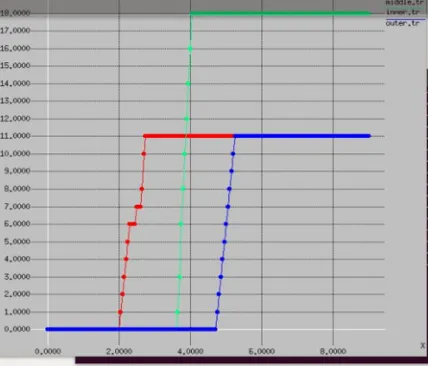
[image:5.612.199.413.506.689.2]The fig.1.1 shows the energy levels of different regions. The energy level of inner region is highest as compared to middle and outer regions. Red line shows middle region energy level. Green line shows inner energy level and blue line shows outer energy levels.
Technology (IJRASET)
VI. CONCLUSIONThe inner region nodes are the main nodes which participate to communicate with sink and intermediate nodes. The problem arises when the battery of nodes near sink goes down and communication stops. Because sink node can communicate only with the help of region nearby node and not communicate directly. The major reason is that nearest sensor nodes are out of range of sink. So battery of inner region nodes degrades and communication stops. To overcome this problem relay nodes will be used instead of sensor nodes. In this paper a novel technique will be proposed to improve the problem of battery consumption.
REFERENCES
[1] A.A. Kharazian, K. Jamshidi and M.R. Khayyambashi, “Adaptive clustering in wireless sensor network: considering nodes with lowest energy”, International Journal of Ad hoc, Sensor & Ubiquitous Computing (IJASUC) Vol.3, No.2, April 2012.
[2] K.Maraiya, K. Kant, N. Gupta, “Application based Study on Wireless Sensor Network” International Journal of Computer Applications (0975 – 8887), Volume 21– No.8, May 2011, 2006.
[3] K. Maraiya, K. Kant, N. Gupta“Efficient Cluster Head Selection Scheme for Data Aggregation in Wireless Sensor Network” International Journal of Computer Applications, Volume 23-No. 9, June 2011.
[4] K. Latif, A.Ahmad, N.Javaid, Z.A. Khan, N. Alrajeh, “Divide and Rule Scheme for Energy Efficient Routing in Wireless Sensor Networks” 2013. [5] B. Mamalis, D. Gavalas, C. Konstantopoulos and G. Pantziou, “Clustering in Wireless Sensor Networks”, 2007.
[6] C.G. Izquierdo, F. Bertiglia, “Traceability of ground based meteorological surface temperature measurements”, 2012.
[7] S. Tyagi, N. Kumar, “A systematic review on clustering and routing techniques based upon LEACH protocol for wireless sensor networks” March 2013. [8] Ewa Hansen,JonasNeander,MikaelNolinandMatsBjorkman“EfficientClusterFormation forSensor Networks”.
IJCSI InternationalJournalof Computer ScienceIssues, volume 8,Issue5, No 2, pp. 1694-0814, Sep. 2011.
[9] G.H. Raghunandan, B.N. Lakshmi, “A Comparative Analysis of Routing Techniques for Wireless Sensor Networks”, Proceedings of the National Conference on Innovations in Emerging Technology, IEEE 2011.
[10] H. Duboris-Ferries and D. Estrin, “Efficient and Practical Query Scoping in Sensor networks,” Tech Rep.2004-39, CENS/UCLA Tech Report, 2004. GA 30332,
Conference on Ambient Systems, Networks and Technologies (ANT), 2013
[11] I.F.Akyildiz,W.Su,Y.Sankarasubramaniam, E.Cayirci. “WirelessSensorNetworks:Asurvey” Broadband and Wireless Networking Laboratory, School of Electrical and Computer Engineering, Georgiainstituteof Technology,Atlanta,GA 30332,USAReceived12December2001; accepted20 December2001.