342
SUPPLIER SELECTION UNDER FUZZY ENVIRONMENT: A HYBRID
MODEL USING KAM IN DEA
ALIREZA FALLAHPOUR
Department of mechanical engineering, Faculty of Engineering, University of Malaya, Kuala Lumpur, Malaysia EZUTAH UDONCY OLUGU
Department of mechanical engineering, Faculty of Engineering, University of Malaya, Kuala Lumpur, Malaysia SITI NURMAYA MUSA
Department of mechanical engineering, Faculty of Engineering, University of Malaya, Kuala Lumpur, Malaysia DARIUSH KHEZRIMOTLAGH
Department of Applied Statistics, Faculty of Economics and Administration, University of Malaya, Malaysia SUJIT SINGH
Department of mechanical engineering, Faculty of Engineering, University of Malaya, Kuala Lumpur, Malaysia ABSTRACT
In today’s competitive world, supplier selection is buzzword issue to business success for industries and firms. Robust methods are required to evaluate and select qualified suppliers. Regarding to the literature, the hybrid Data Envelopment Analysis-Artificial Intelligence (DEA-AI) models are the effective models to assess the suppliers’ performance. This paper proposes an integrating Kourosh and Arash Model (KAM) in DEA and Adaptive Fuzzy Inference System (ANFIS) as a powerful tool in prediction to estimate the supplier efficiency scores. This hybrid model consists of two parts. First part applies KAM to determine a best technical efficiency score for each supplier. Second part utilizes the suppliers’ performance score for training ANFIS to estimate the new suppliers’ performance. The proposed model implemented in a cosmetic industry, too.
Keywords: DEA; KAM; ANFIS; Suppliers’ Efficiency; prediction.
INTRODUCTION
Supply chain management (SCM) is a process of planning, implementing, and controlling the operations of the supply-chain network catering to the requirements of customers (purchasers) as efficiently as possible (Bhattacharya, Geraghty et al. 2010). SCM includes several parts such as Customer Relationship Management, Supplier relationship management, Demand management, Order fulfilment, Manufacturing flow management, Product development and commercialization, supplier selection, robotic automation and so on. In recent decades, the issue of supplier selection has been focused by so many researchers as a part of SCM. Supplier selection is a very complex process with criteria such as quality, cost, delivery and service (Humphreys, Wong et al. 2003, Guneri, Yucel et al. 2009, Omurca 2013). Therefore, various methods have been introduced to improve the supplier selection process such as Multi-Criteria Decision Making (MCDM) techniques, DEA, Mathematical Programming (MP) etc. Since the proposed approaches have some limitation, researchers tried to integrate the methods for improving the process of supplier selection.
343
models of DEA were integrated with Multi-Layer Perceptron (MLP) to predict the suppliers’ performance scores. To validate the model, the result was compared with Decision Tree (DT). Özdemir and Temur (Ozdemir and Temur 2009)applied DEA-ANN for evaluating suppliers and predicting the suppliers’ efficiency scores. They demonstrated that the hybrid model avoids the long time calculation of DEA and calculates the suppliers’ performance precisely even with the small sized data set. Shi et al(Shi, Bian et al. 2010) applied DEA-ANN model for selecting the suitable logistic suppliers. The CCR model was employed for calculating the efficiency and then using Back Propagation ANN was used for estimating the efficiency. The result revealed that the model is able to rank the 22 logistic suppliers and select the best one. Celebi and Bayraktar(Çelebi and Bayraktar 2008) proposed a new approach of combination of DEA and ANN. They tried to cope with the limitation related to the homogeneity and accuracy assumptions of DEA using ANN. Kuo et al(Kuo, Wang et al. 2010) extended the Celebi and Bayraktar paper by adding MCDM technique to the model. The proposed model is called ANN-MADA used for supplier selection. The result represented that the ANN-MADA functions better than ANN-DEA.
Although CCR and BCC have been successfully combined with ANN in supplier selection, these models have some drawbacks. CCR and BCC classified suppliers into two classes which are technically efficient and inefficient. But they assign the same scores to technically efficient suppliers(Khezrimotlagh, Salleh et al. 2013). On the other side, ANN is not very accurate in comparison with other AI-based models such as ANFIS and its deviation is high from the reality while using small sample sized data set. In this paper, to overcome the weaknesses of previous DEA models, KAM as a robust DEA model is used to evaluate the suppliers’ performance more accurate and is integrated with ANFIS as to find a high accuracy predictive structure for the suppliers’ efficiency.
METHODOLOGY
This section contains a brief description of the methods that have been used in the model and the proposed model.
Kourosh and Arash Model (KAM)
Khezrimotlagh et al. (Khezrimotlagh, Salleh et al. 2013) recently proposed a more robust technique based on the additive DEA model. The KAM improves DEA in assessment production, benchmarking and ranking of DMUs. KAM can distinguish between technically efficient DMUs with very small errors (Khezrimotlagh, Salleh et al. 2013). In addition, the efficiency of DMUs with both integer and real values are computed. Equation 1 show KAM Variable Returns to Scale (VRS), where 𝐷𝑀𝑈𝑙(𝑥𝑙, 𝑦𝑙) is under evaluation. Further more information refer to(Khezrimotlagh, Salleh et al. 2013)
𝑚𝑎𝑥 ∑𝑚𝑗=1𝑤𝑙𝑗−𝑠𝑙𝑗−+ ∑𝑝𝑘=1𝑤𝑙𝑘+𝑠𝑙𝑘+, (1)
Subject to
∑𝑛𝑖=1𝜆𝑖𝑥𝑖𝑗+ 𝑠𝑙𝑗+= 𝑥𝑙𝑗+ 𝜀𝑙𝑗−, 𝑓𝑜𝑟 𝑗 = 1,2, … , 𝑚,
∑𝑛𝑖=1𝜆𝑖𝑦𝑖𝑘− 𝑠𝑙𝑘+ = 𝑦𝑙𝑘− 𝜀𝑙𝑘+, 𝑓𝑜𝑟 𝑘 = 1,2, … , 𝑝,
344 𝑦𝑙𝑘+ 𝑠𝑙𝑘+ − 2𝜀𝑙𝑘+ ≥ 0, 𝑓𝑜𝑟 𝑘 = 1,2, … , 𝑝,
∑𝑛𝑖=1𝜆𝑖= 1,
𝜆𝑖≥ 0, 𝑓𝑜𝑟 𝑖 = 1,2, … , 𝑛,
𝑠𝑙𝑗−≥ 0, 𝑓𝑜𝑟 𝑗 = 1,2, … , 𝑚,
𝑠𝑙𝑘+ ≥ 0, 𝑓𝑜𝑟 𝑘 = 1,2, … , 𝑝.
Adaptive Neuro Fuzzy Inference System
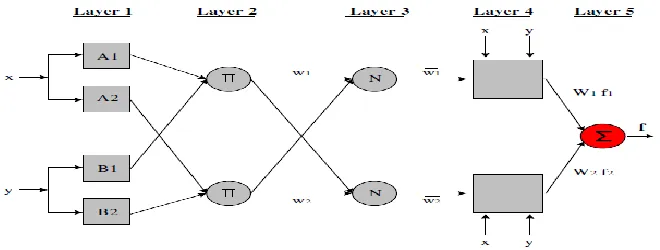
[image:3.612.78.408.274.399.2]ANFIS was first introduced by Jang in 1993. ANFIS contains five layers(Jang 1993) for function approximation (shown figure 1 with two inputs x and y): a fuzzified layer; product layer; normalized layer; defuzzified layer; output layer.
Figure 1: A simple structure of ANFIS.
Layer1. Every node in this layer is an adaptive node with a node function.
𝑂1,𝑖= 𝜇𝐴𝑖(𝑥), 𝑖 = 1,2 (2)
𝑂1,𝑖= 𝜇𝐵𝑖−2(𝑦), 𝑖 = 3,4 (3)
Where x and y are assumed to be the input nodes, A and B are the linguistic labels, 𝜇𝐴𝑖 and 𝜇𝐵𝑖 are the
membership functions for 𝐴𝑖 and 𝐵𝑖 fuzzy sets, respectively, and 𝑂1,𝑖is the output of the node i in the first
layer. In ANFIS, Bell function is usually used as a membership function.
𝜇𝐴(𝑥) =1+{𝑥−𝑐1
𝑎 }2𝑏
(4)
𝑎, 𝑏 and 𝑐 are assumed the premise parameters respectively.
Layer 2. In this layer the firing strength of each rule is determined through multiplication:
𝑂2,𝑖 = 𝑤𝑖 = 𝜇𝐴𝑖(𝑥)𝜇𝐵𝑖(𝑦), 𝑖 = 1,2 (5)
Layer 3: Every node in the third layer, as the normalized layer, computes the ratio of the ith rule’s firing
strengths to the sum of all rules’ firing strengths.
345
𝑂3,𝑖 = 𝑤̅̅̅ =𝑖 𝑤𝑖
𝑤1+𝑤2, 𝑖 = 1,2 (6)
Layer 4: In this layer every node i is adaptive with a node function.
𝑂4,𝑖= 𝑤̅̅̅𝑓𝑖 𝑖= 𝑤̅̅̅ (𝑝𝑖 𝑖𝑥 + 𝑞𝑖y + 𝑟𝑖), 𝑖 = 1,2 (7)
Where𝑤̅̅̅𝑖is the output of layer 3 and linear 𝑝𝑖, 𝑞𝑖 and 𝑟𝑖 are referred to as consequent parameters.
Layer 5. In this layer the overall output of ANFIS is computed as the summation of all incoming signals.
𝑂5,𝑖 = ∑ 𝑤𝑖̅̅̅𝑓𝑖 𝑖 =∑ 𝑤∑ 𝑤𝑖 𝑖𝑓𝑖
𝑖
𝑖 𝑖 = 1,2 (8)
ANFIS uses an integrated learning rule algorithm which applies back propagation algorithm for the parameters in Layer 1 and the least square method is utilized for training parameters(Ho, Lee et al. 2002).
The proposed model
The integrated model contains four sections including data collection, calculating the efficiency using KAM, training ANFIS to find the best structure and testing for validating the trained ANFIS structure. The first step to evaluate the suppliers is determining the selection criteria and measuring them. For determining the importance of each criterion triangular fuzzy number and for converting the fuzzy numbers to the crisp numbers Graded Mean Integration (GMI) representation method(Chen and Hsieh 1999) (equation 9) are used respectively. Table 1 shows the linguistic variables for measuring the attributes.
[image:4.612.65.546.456.527.2]𝜕(𝐴̃) =(𝑎+4𝑏+𝑐)6 (9)
Table 1: The linguistic variables
Output Input
Very low (VL) (0, 1, 3) (7, 9, 10)
Low (L) (1, 3, 5) (5, 7,9)
Medium (M) (3, 5, 7) (3, 5, 7)
High (H) (5, 7,9) (1, 3, 5)
Very high (VH) (7, 9, 10) (0, 1, 3)
KAM as a robust DEA model is employed to calculate the suppliers’ efficiency. This data set is used as a new dataset for ANFIS. In this step, for finding the best structure of ANFIS, the dataset obtained by KAM is separated into two parts for training and testing. In the training part the goal is to find the most appropriate structure of ANFIS for approximating the suppliers’ efficiency and in the testing part, the accuracy of the trained ANFIS structure is validated. Note that Mean Square Error (MSE) and Mean Absolute Error (MAE) are statistic factors to evaluate the training accuracy and testing accuracy of ANFIS in comparison with the real efficiency achieved by KAM.
CASE STUDY
346
[image:5.612.64.550.168.241.2]suppliers’ performance and find the most efficient supplier. In this survey, Quality (Q), Delivery (D) and Service (S) were selected as the outputs and Cost was selected as the input. After determining the criteria the next step is to collect the dataset using table 1 and equation 9. Then, KAM was used for computing the suppliers’ efficiency Table 2 presents the efficiency obtained by KAM.
Table 2: The data set related to the suppliers’ efficiency
Supplier Efficiency Supplier Efficiency Supplier Efficiency Supplier Efficiency
1 0.89565 6 0.88145 11 0.68126 16 0.95478
2 0.76235 7 0.0.932 12 0.79852 17 0.90258
3 0.99369 8 0.81259 13 0.97036 18 0.92999
4 0.96897 9 0.71856 14 0.76987 19 0.99874
5 0.90036 10 0.69741 15 0.66015 20 0.93569
[image:5.612.67.554.350.459.2]To find the best structure, 70 percent of the data set (related to the efficiency) was selected for training of ANFIS. The best structure of ANFIS is shown in table 3. Table 4 presents the estimated efficiency by the ANFIS model and figure 2 depicts the accuracy of the model in comparison with the actual efficiency (including MSE, MAE).
Table 3:The best parameters of the ANFIS algorithm.
Parameters Setting
Epoch 1000
Generate FIS Grid partition
Error Tolerance 0
Optim method Hybrid
MF type for inputs Trimf
MF type for output Linear
Number of MF to each input 3
Table 4: the efficiency computed by the model
Actual ANFIS Actual ANFIS
0.89565 0.82369 0.81259 0.78413
0.76235 0.80024 0.71856 0.72000
0.99369 0.96587 0.69741 0.70938
0.96897 0.99365 0.68126 0.70917
0.90036 0.89741 0.79852 0.81236
0.88145 0.90003 0.97036 1
0.90326 0.90330 0.76987 0.69804
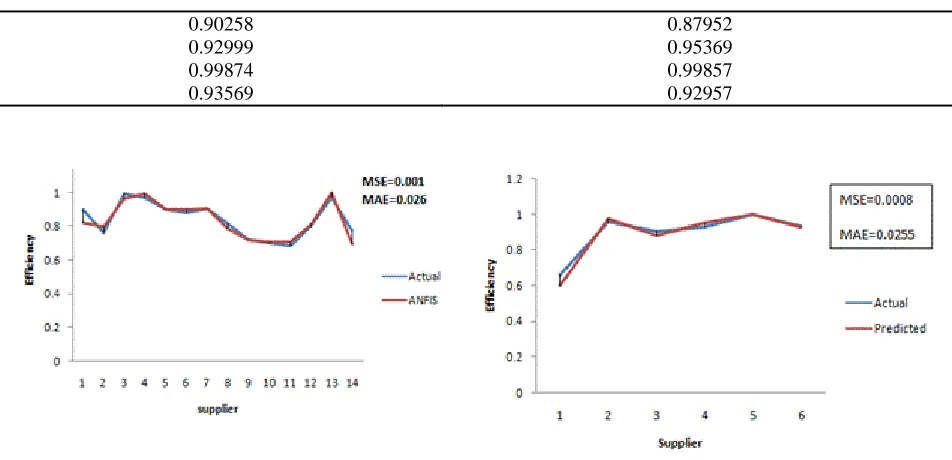
To validate the prediction power of the model, the 30 percent remained of the model was used as a dataset which is out of the training dataset. Table 5 presents the predicted suppliers’ efficiency scores and figure 3 visualizes the precision of the model in prediction.
Table 5: The predicted efficiency
Actual Predicted
0.66015 0.60258
[image:5.612.67.546.501.595.2] [image:5.612.63.550.679.718.2]347
0.90258 0.87952
0.92999 0.95369
0.99874 0.99857
0.93569 0.92957
Figure 2: Evaluating ANFIS-based accuracy Figure 3: Evaluation the predictive power of the model
RESULT AND DISCUSSION
This study has combined the KAM as a robust DEA model to cope with the problems of CCR and BCC with ANFIS as a powerful predictive tool to cope with the drawbacks of ANN for analyzing suppliers’ performance. Result shows that the integrated model is very precise in predicting the suppliers’ efficiency and using this ANFIS-based model the managers of the company can calculate the efficiency with new dataset.
CONCLUSION
This paper has proposed KAM-ANFIS to improve the previous proposed integrated DEA-AI models of supplier selection. Although CCR and BCC are two famous but have some restriction. To determine the efficiency more accurate KAM was used in this paper. Since the process of the supplier efficiency using DEA needs knowledge and time to overcome this problem in the previous papers ANN was used. On the other hand, ANN is low accuracy in training. In order to cope with this problem ANFIS an powerful tool was used. The result of the integrated model reveals that the integrated model can determine the efficiency with high accuracy.
REFERENCES
[1] Bhattacharya, A., J. Geraghty and P. Young (2010). "Supplier selection paradigm: An integrated hierarchical QFD methodology under multiple-criteria environment." Applied Soft Computing 10(4): 1013-1027.
[2] Çelebi, D. and D. Bayraktar (2008). "An integrated neural network and data envelopment analysis for supplier evaluation under incomplete information." Expert Systems with Applications 35(4): 1698-1710.
[image:6.612.67.543.70.300.2]348
[4] Guneri, A. F., A. Yucel and G. Ayyildiz (2009). "An integrated fuzzy-lp approach for a supplier selection problem in supply chain management." Expert Systems with Applications 36(5): 9223-9228.
[5] Ho, S.-Y., K.-C. Lee, S.-S. Chen and S.-J. Ho (2002). "Accurate modeling and prediction of surface roughness by computer vision in turning operations using an adaptive neuro-fuzzy inference system." International Journal of Machine Tools and Manufacture 42(13): 1441-1446.
[6] Humphreys, P., Y. Wong and F. Chan (2003). "Integrating environmental criteria into the supplier selection process." Journal of Materials Processing Technology 138(1): 349-356.
[7] Jang, J.-S. (1993). "ANFIS: adaptive-network-based fuzzy inference system." Systems, Man and Cybernetics, IEEE Transactions on 23(3): 665-685.
[8] Khezrimotlagh, D., S. Salleh and Z. Mohsenpour (2013). "A new method for evaluating decision making units in DEA." Journal of the Operational Research Society.
[9] Khezrimotlagh, D., S. Salleh and Z. Mohsenpour (2013). "A new robust mixed integer-valued model in DEA." Applied Mathematical Modelling 37(24): 9885-9897.
[10]Kuo, R. J., Y. C. Wang and F. C. Tien (2010). "Integration of artificial neural network and MADA methods for green supplier selection." Journal of Cleaner Production 18(12): 1161-1170.
[11]Omurca, S. I. (2013). "An intelligent supplier evaluation, selection and development system." Applied Soft Computing 13(1): 690-697.
[12]Ozdemir, D. and G. T. Temur (2009). "DEA ANN approach in supplier evaluation system." World Academy of Science, Engineering and Technology 54(538): 343-348.
[13]Shi, C.-d., D.-x. Bian and S.-l. Li (2010). Application of BP neural network and DEA in the logistics supplier selection. Computer Engineering and Technology (ICCET), 2010 2nd International Conference on, IEEE. [14]Wu, D. (2009). "Supplier selection: A hybrid model using DEA, decision tree and neural network." Expert