ISSN 2291-8639
Volume 15, Number 1 (2017), 31-45 http://www.etamaths.com
TWIN HYPERCUBE FOR INTUITIONISTIC FUZZY SETS AND THEIR APPLICATION IN MEDICINE
B. DAVVAZ1,∗, E. HASSANI SADRABADI1, JUAN J. NIETO2 AND ANGELA TORRES3
Abstract. In this paper, we present a description of intuitionistic fuzzy sets as vectors in twin hy-percube. Finally we verify an application of intuitionistic fuzzy sets in medicine using twin hypercube for intuitionistic fuzzy sets.
1. Introduction
The concept of intuitionistic fuzzy sets was introduced by Atanassov [1]. The intuitionistic fuzzy sets have some applications in different sciences. In the papers [6,9,12,13] has been developed the concept of applications of intuitionistic fuzzy sets in medical diagnosis using from relation between intuitionistic fuzzy sets and symptoms. Also this paper is a generalization of the paper [11] to intuitionistic fuzzy sets. We present some applications of intuitionistic fuzzy sets in diagnosis. Actually by employing twin hypercube for intuitionistic fuzzy sets we determine the kind of patient.
This paper is organized as follows: In first section we recall basic facts about intuitionistic fuzzy sets. In second section we present twin hypercube. In third section we describe distance and entropy of intuitionistic fuzzy sets and fourth section we present intuitionistic fuzzy segments and intuitionistic fuzzy midpoints. In the final section we study an application of intuitionistic fuzzy sets in medicine.
2. Basic facts about intuitionistic fuzzy sets
After the introduction of fuzzy sets by Zadeh [16], several researches consider some generalization of fuzzy sets. As an important generalization of the notion of fuzzy sets on a non-empty setX,Atanassov introduced in [1,3], the concept of intuitionistic fuzzy sets defined on a non-empty setX as an object having the form
A={hx, µA(x), νA(x)i:x∈X}, (2.1)
where the functions
µA:X→[0,1], νA:X→[0,1],
denote the degree of membership and the degree of non-membership of each elementx∈X to the set Arespectively, and 0≤µA(x) +νA(x)≤1 for all x∈X.IfνA(x) = 1−µA(x) , then A is a classical fuzzy set. Such defined objects are studied by many authors and have many interesting applications not only in mathematics (see [5]).
LetAandB be two intuitionistic fuzzy sets inX.Then, the following expressions are defined in [1,3].
(1) A⊆B if and only ifµA(x)≤µB(x) andνA(x)≥νB(x), (2) A=B if and only ifA⊆B andB⊆A,
(3) AC={hx, νA(x), µA(x)i:x∈X},
(4) A∩B ={hx,min{µA(x), µB(x)},max{νA(x), νB(x)}i:x∈X}, (5) A∪B ={hx,max{µA(x), µB(x)},min{νA(x), νB(x)}i:x∈X}, (6) A={hx, µA(x),1−µA(x)i:x∈X},
(7) ♦A={hx,1−νA(x), νA(x)i:x∈X}.
Received 3rdMay, 2017; accepted 26th June, 2017; published 1stSeptember, 2017. 2010Mathematics Subject Classification. 92C50, 03E72.
Key words and phrases. intuitionistic fuzzy set; Hamming distance; intuitionistic fuzzy midpoint; intuitionistic fuzzy segment; medicine.
c
2017 Authors retain the copyrights of their papers, and all open access articles are distributed under the terms of the Creative Commons Attribution License.
We recall the following two examples from [7].
Example 2.1. Consider the universe X = {10,100,500,1000,1200}. An intutionistic fuzzy set “Large” ofX denoted byL and may be defined by
L ={h10, 0.01, 0.9i, h100, 0.1, 0.88i, h500, 0.4, 0.5i,
h1000, 0.8, 0.1i, h1200, 1, 0i}.
One may define an intuitionistic fuzzy set “Very Large” (denoted byV L) as follows:
µV L(x) = (µL(x))2 and νV L(x) = 1−(1−νL(x))2,
for allx∈X. Thus,
V L ={h10, 0.0001, 0.99i, h100, 0.01, 0.9856i, h500, 0.16, 0.75i,
h1000, 0.64, 0.19i, h1200, 1, 0i}.
Example 2.2. Consider the universe {a1, a2, a3, a4, a5, a6}. Let A andB be two intuitionistic fuzzy
sets ofX given by
A ={ha1, 0.2, 0.6i, ha2, 0.3, 0.7i, ha3, 1, 0i, ha4, 0.8, 0.1i, ha5, 0.5, 0.4i}
and
B ={ha1, 0.4, 0.4i, ha2, 0.5, 0.2i, ha3, 0.6, 0.2, ha4, 0.1, 0.7i, ha5, 0, 1i}.
Then,
Ac ={ha
1, 0.6, 0.2i, ha2, 0.7, 0.3i, ha3, 0, 1i, ha4, 0.1, 0.8i, ha5, 0.4, 0.5i},
A∩B ={ha1, 0.2, 0.6i, ha2, 0.3, 0.7i, ha3, 0.6, 0.2i, ha4, 0.1, 0.7i, ha5, 0, 1i},
A∪B ={ha1, 0.4, 0.4i, ha2, 0.5, 0.2i, ha3, 1, 0i, ha4, 0.8, 0.1i, ha5, 0.5, 0.4i},
A ={ha1, 0.2, 0.8i, ha2, 0.3, 0.7i, ha3, 1, 0i, ha4, 0.8, 0.2i, ha5, 0.5, 0.5i},
♦B ={ha1, 0.6, 0.4i, ha2, 0.8, 0.2i, ha3, 0.8, 0.2i, ha4, 0.3, 0.7i, ha5, 0, 1i}.
For each intuitionistic fuzzy set inX, we call
πA(x) = 1−µA(x)−νA(x),
the intuitionistic index ofxin A. It is a hesitancy degree ofxtoA[2,4].
3. Twin hypercube
Similar to Kosko [10], we introduce a geometrical interpretation of intuitionistic fuzzy sets as vectors in twin hypercube. Indeed, for a given setX={x1, . . . , xn}, an intuitionistic fuzzy setAis determined
just by two mappingsµA:X −→I= [0,1] andνA:X −→I= [0,1], and the valuesµA(x) andνA(x) giving the degree of membership and the degree of non-membership of each element x ∈ X to the intuitionistic fuzzy setA, respectively. Thus, the set of all intutionistic fuzzy sets in X is determined precisely by two unit hypercubes. One of them is the unit hypercube of membership degree and another one is the unit hypercube of non-membership degree.
Any intuitionistic fuzzy setA determines a vector
P ∈In×In
given by
h(µa(x1), . . . , µA(xn),(νA(x1), . . . , νA(xn)i.
Conversely, any vectorQ=h(a1, . . . , an),(b1, . . . , bn)igenerates an intuitionistic fuzzy set A defined
by
µA(xi) =a1 andνA(xi) =b1, fori= 1, . . . , n.
(1) The least cardinality ofA is equal to the so-called sigma-count (cf. [17,18]), and is called the minP
Count(min-sigma-count):
minXCount(A) = n X
i=1
µA(xi).
(2) The biggest cardinality of A, which is possible due to πA, is called the maxP
Count (max-sigma-count), and is equal to
maxXCount(A) = n X
i=1
(µA(xi) +πA(xi)).
Clearly, forAC, we have
minP
Count(Ac) = n X
i=1
νA(xi),
maxPCount(Ac) = n X
i=1
(νA(xi) +πA(xi)).
Now, the cardinality of an intuitionistic fuzzy setAis defined as the interval
Card(A) =|A|=hminXCount(A),maxXCount(A)i.
Therefore, we have
|A|=h n X i=1 µA(xi), n X i=1
(1−νA(xi))i. (3.1)
Theorem 3.1. IfA andB are two intuitionistic fuzzy sets inX, then
|A∪B|=|A|+|B| − |A∩B|. (3.2)
Proof. According to Eq. (3.1), we have
|A∪B| =h n X
i=1
µA∪B(xi),
n X
i=1
(1−νA∪B(xi))
i
=h n X
i=1
max{µA(xi), µB(xi)}, n X
i=1
(1−max{νA(xi), νB(xi)})i
=h n X
i=1
max{µA(xi), µB(xi)}, n X
i=1
min{1−νA(xi),1−νB(xi)}i,
|A∩B| =h n X
i=1
µA∩B(xi),
n X
i=1
(1−νA∩B(xi))
i
=h n X
i=1
min{µA(xi), µB(xi)}, n X
i=1
(1−min{νA(xi), νB(xi)})i
=h n X
i=1
min{µA(xi), µB(xi)}, n X
i=1
max{1−νA(xi),1−νB(xi)} i
.
Therefore, we obtain
|A∪B|+|A∩B| =h n X
i=1
µA(xi) +µB(xi),(1−νA(xi)) + (1−νB(xi))i
=h n X
i=1
µA(xi), n X
i=1
(1−νA(xi)) i
+h n X
i=1
µB(xi), n X
i=1
(1−νB(xi)) i
=|A|+|B|.
4. Distance and entropy of intuitionistic fuzzy sets
The above discussion allows us to consider the following distance between intutionistic fuzzy sets. For two intutionistic fuzzy setsA andB, The Hamming distance [14,15] betweenA andB are given by
d(A, B) = n X
i=1
|µA(xi)−µB(xi)|+|νA(xi)−νB(xi)|+|πA(xi)−πB(xi)|. (4.1)
Each summand in (4) is between 0 and 1. ForA, B, C intuitionistic fuzzy sets, we have:
(1) 0≤d(A, B)≤n,
(2) d(A, B) = 0 if and only ifA=B, (3) d(A, B) =d(B, A),
(4) d(A, B)≤d(A, C) +d(C, B).
A geometric interpretation of intutionistic fuzzy sets is presented in [15]. An intuitionistic fuzzy set is represented by a point in the triangle A0B0D0, where A0(1,0,0), B0(1,0,0) and D0(0,0,1). An intutionistic fuzzy setAin X is mapped into triangleA0B0D0 in that each element of X corresponds to an element ofA0B0D0, as an example, a pointx0 ∈A0B0D0 corresponding tox∈X is marked the values ofµA(x),νA(x) andπA(x).
LetEbe a fuzzy set defined on fuzzy sets. Then,E is an entropy measure if it satisfies the four De Luca and Termini axioms [8].
According to a geometric representation of an intuitionistic fuzzy set [15], we have
E(A) =a
b, (4.2)
whereais the distance (A, Anear) fromAto the nearest pointAnear among A0 andB0, andb is the distance (A, Af ar) from A to the fareast pointAf ar among A0 and B0. The Eq. (4.2) describes the degree of fuzziness for a single point belonging to an intuitionistic fuzzy set. Fornpoints belonging to an intuitionistic fuzzy set we have
E(A) = 1 n
n X
i=1
E(Ai). (4.3)
Theorem 4.1. [15] A generalized entropy measure of an intuitionistic fuzzy setAin X is
E(A) = 1 n
n X
i=1
maxCount(Ai∩Aci) maxCount(Ai∪Ac
i) = 1 n n X i=1 n X j=1
µAi∩Ac
i(xj) +πAi∩Aci(xj)
n X
j=1
µAi∪Ac
i(xj) +πAi∪Aci(xj)
= 1 n n X i=1 n X j=1
min{µAi(xj), νAi(xj)}+ 1−µAi∩Aci −νAi∩Aci
n X
j=1
max{µAi(xj), νAi(xj)}+ 1−µAi∪Aci −νAi∪Aci
= 1 n n X i=1 n X j=1
min{µAi(xj), νAi(xj)}+ 1−2 min{µAi(xj), νAi(xj)}
n X
j=1
max{µAi(xj), νAi(xj)}+ 1−2 max{µAi(xj), νAi(xj)}
= 1 n n X i=1 n X j=1
−min{µAi(xj), νAi(xj)}+ 1
n X
j=1
where Ai denotes the single element intutionistic fuzzy set corresponding to the ith element of the
universeX. In other words, Ai is theithcomponent ofA.
For two intuitionistic fuzzy subsets AandB, it is possible to define a degree of subsethood
S(A, B) = |A∩B|
|A| .
For the midpointM, sinceµM(xj) =νM(xj) = 1
2, we have
E(M) = 1 n n X i=1 n X j=1 1 2 n X j=1 1 2 = 1 n n X i=1 n 2 n 2 = 1 n n X i=1
1 = n n = 1.
Since for any intutionistic fuzzy subset A 6= M, we have E(A) < 1, therefore the midpoint M is maximally intutionistic fuzzy set. Now we present the following definition.
The intuitionistic fuzzy subset C is between intuitionistic fuzzy subsets A and B, if d(A, C) + d(C, B) =d(A, B).
The metric segment betweenAandB is defined as the following:
segment(A, B) ={C:d(A, C) +d(C, B) =d(A, B)},
that is,
n X
i=1
|µA(xi)−µC(xi)|+|µC(xi)−µB(xi)|= n X
i=1
|µA(xi)−µB(xi)|,
n X
i=1
|νA(xi)−νC(xi)|+|νC(xi)−νB(xi)|= n X
i=1
|νA(xi)−νB(xi)|.
Another concept is the idea of equidistant points:
equid(A, B) ={C:d(A, C) =d(C, B)},
that is,
n X
i=1
|µA(xi)−µC(xi)|= n X
i=1
|µC(xi)−µB(xi)|,
n X
i=1
|νA(xi)−νC(xi)|= n X
i=1
|νC(xi)−νB(xi)|.
IfC∈segment(A, B), and it is equidistant toAandB, then
d(A, C) =d(C, B) =1
2d(A, B). Therefore we introduce the set of midpoints betweenAand B:
mid(A, B) ={C:d(A, C) =d(C, B) =1
2d(A, B)}, that is,
n X
i=1
|µA(xi)−µC(xi)|= n X
i=1
|µC(xi)−µB(xi)|=1 2
n X
i=1
|µA(xi)−µB(xi)|,
n X
i=1
|νA(xi)−νC(xi)|= n X
i=1
|νC(xi)−νB(xi)|= 1 2
n X
i=1
|νA(xi)−νB(xi)|.
The canonical midpoint AandB is denoted by
µC(xi) = 1
2(µA(xi) +µB(xi)), νC(xi) = 1
2(νA(xi) +νB(xi)), i= 1,2, . . . , n.
This canonical midpoint is not the unique midpoint and there are more midpoints. Actually we show Cis a midpoint betweenA andB:
n X
i=1
|µA(xi)− 1
2(µA(xi) +µB(xi))|= n X
i=1
1
2|µA(xi)−µB(xi)|,
n X
i=1
|νA(xi)−1
2(νA(xi) +νB(xi))|= n X
i=1
1
2|νA(xi)−νB(xi)|.
Therefored(A, C) =1
2d(A, B) and similarlyd(C, B) = 1
2d(A, B), thend(A, C) =d(C, B) = 1
2d(A, B). If A is a crisp subset of X, that is, A is a vertex of the hypercube, then µA : X → {0,1}, νA:X → {0,1}, therefore
d(A, M) = n X
i=1
|µA(xi)− 1
2|+|νA(xi)− 1
2|+|πA(xi)−(1−µM(xi)−νM(xi))|
= n X i=1 1 2 + 1 2 = n X i=1
1 =n, and
d(A, Ac) = n X
i=1
|µA(xi)−µAc(xi)|+|νA(xi)−νAc(xi)|+|πA(xi)−πAc(xi)|
= n X
i=1
|µA(xi)−νA(xi)|+|νA(xi)−µA(xi)|+|πA(xi)−(1−νA(xi)−µA(xi))|
= n X
i=1
2|µA(xi)−νA(xi)|= n X
i=1
2 = 2n.
Similarlyd(Ac, M) =n, and then
d(A, M) =d(Ac, M) =1 2d(A, A
c).
Hence
n X
i=1
|µA(xi)− 1 2|=
1 2
n X
i=1
|µA(xi)−µAc(xi)|=
n 2,
n X
i=1
|νA(xi)− 1 2|=
1 2
n X
i=1
|νA(xi)−νAc(xi)|=
n 2.
Sinced(A, C) =d(C, B) =1
2d(A, B), it follows thatd(A, C)+d(C, B) = 1
2d(A, B) and somid(A, B)⊂ segment(A, B). Hence, C∈segment(A, B). In the bellow example we describe the definitions
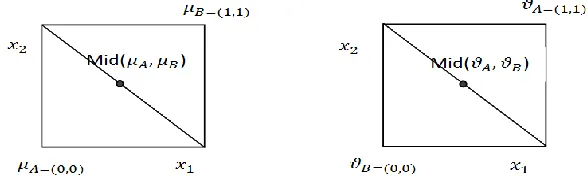
Example 4.1. Let X={x1, x2},µA={0,0}, νA={1,1}, µB={1,1}, νB={0,0}. Then, we have
µA+µB 2 = (
1 2,
1 2),
νA+νB 2 = (
1 2,
1
2)∈mid(A, B).
IfµC= (c1, c2), νC= (c3, c4)is another midpoint betweenA andB then:
d(A, C) =c1+c2+ (1−c3) + (1−c4),
d(A, B) = n X
i=1
|µA(xi)−µB(xi)|+|νA(xi)−νB(xi)|= n X
i=1
(2 + 2) = 4,
d(C, B) = 1−c1+ 1−c2+c3+c4⇒c1+c2= 1, c3+c4= 1.
Therefore
• d(A, C) =1
• d(C, B) =1
2d(A, B)⇒c3+c4= 1,
so
mid(A, B) ={C: (c1, c2),(c3, c4)|c1+c2= 1, c3+c4= 1},
and we have an infinite set of midpoints.
If C ∈ equid(A, B), then c1+c2 = (1−c1) + (1−c2), c3+c4 = (1−c3) + (1−c4). Therefore
c1+c2= 1, c3+c4 = 1. Thenmid(A, B) =equid(A, B). As we can see these sets coincide. Suppose
thatµC = ( 1 2,
1
2), νC= ( 1 2,
1
2). Then, d(A, B) = 2, d(A, C) = 2, d(C, B) = 2. Thus, C∈equid(A, B)
butC /∈segment(A, B), since d(A, C) +d(C, B)6=d(A, B), therefore equid(A, B)*segment(A, B)
Figure 1. Midpoints betweenµA= (0,0), νA= (1,1) andµB= (1,1), νB = (0,0)
Example 4.2. Now consider µA = (0,0), νA = (1,1), µB = (1,0), νB = (0,1), then d(A, B) = 2, C∈mid(A, B) if and only if
• c1+c2= 1−c1+c2= 1⇒c1=
1 2, c2=
1 2,
• 1−c3+ 1−c4=c3+ 1−c4= 1⇒c3=
1 2, c4=
1 2,
somid(A, B) =n(1 2,
1 2),(
1 2,
1 2)
o
. Also,C∈equid(A, B)if and only if
• c1+c2= 1−c1+c2⇒c1=
1 2,
• 1−c3+ 1−c4=c3+ 1−c4⇒c3=
1 2,
thenequid(A, B) =n(1 2, c2),(
1 2, c4)
o
, hencemid(A, B)⊂equid(A, B).
5. Intuitionistic fuzzy segments and intuitionistic fuzzy midpoints
In this section, first we verify the segment between two points in a square and determine the set of midpoints between A and B. Let µA = (a1, a2), νA = (a3, a4), µB = (b1, b2), νB = (b3, b4) be
intuitionistic fuzzy subsets of the setX ={x1, x2}. IfµC = (c1, c2), νC = (c3, c4)∈ segment(A, B),
then:
|a1−c1|+|a2−c2|+|b1−c1|+|b2−c2|=|a1−b1|+|a2−b2|, (5.1) |a3−c3|+|a4−c4|+|b3−c3|+|b4−c4|=|a3−b3|+|a4−b4|. (5.2)
So, we obtain min{ai, bi} ≤ci≤max{ai, bi}, i= 1,2,3,4. If min{ai, bi}> ci, then
• |a1−c1|+|b1−c1|>|b1−a1|, |a2−c2|+|b2−c2|>|b2−a2|, so
|a1−c1|+|a2−c2|+|b1−c1|+|b2−c2|>|b1−a1|+|b2−a2|that is contradiction with5.1,
also
• |a3−c3|+|b3−c3|>|b3−a3|, |a4−c4|+|b4−c4|>|b4−a4|, therefore
|a3−c3|+|a4−c4|+|b3−c3|+|b4−c4|>|b3−a3|+|b4−a4|,this relation is contradiction
with5.2.
Theorem 5.1. The points in the segment betweenAandB is as follows:
segment(A, B) ={(c1, c2),(c3, c4)|min{ai, bi} ≤ci ≤max{ai, bi}, i= 1,2,3,4}.
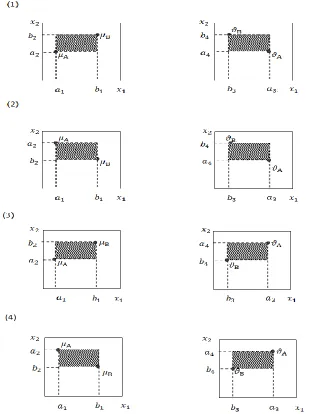
Proof: Suppose thata1≤b1anda3≥b3(ifa1> b1anda3≤b3we interchange the roles ofµA, µB andνA, νB). Now, there are four possibilities, ifµC = (c1, c2), νC= (c3, c4) then:
(1) a1≤b1, a2≤b2, a3≥b3, a4≤b4⇒a1< c1< b1, a2< c2< b2, b3< c3< a3, a4< c4< b4,
(2) a1≤b1, a2> b2, a3≥b3, a4≤b4⇒a1< c1< b1, b2< c2< a2, b3< c3< a3, a4< c4< b4,
(3) a1≤b1, a2≤b2, a3≥b3, a4> b4⇒a1< c1< b1, a2< c2< b2, b3< c3< a3, b4< c4< a4,
(4) a1≤b1, a2> b2, a3≥b3, a4> b4⇒a1< c1< b1, b2< c2< a2, b3< c3< a3, b4< c4< a4.
Suppose that min{ai, bi} ≤ ci ≤ max{ai, bi} and we show C ∈ segment(A, B) that is: d(A, C) + d(C, B) =d(A, B).
Proof: 1. Ifa1≤b1, a2≤b2, a3≥b3, a4≤b4, then
d(A, C) = c1−a1+c2−a2+a3−c3+c4−a4,
d(C, B) = b1−c1+b2−c2+c3−b3+b4−c4,
d(A, C) = b1−a1+b2−a2+a3−b3+b4−a4.
Therefored(A, B) =d(A, C) +d(C, B). Similarly in all of cases 2,3,4,d(A, B) =d(A, C) +d(C, B).
Theorem 5.2. The set of midpoints betweenA andB has the following possibilities:
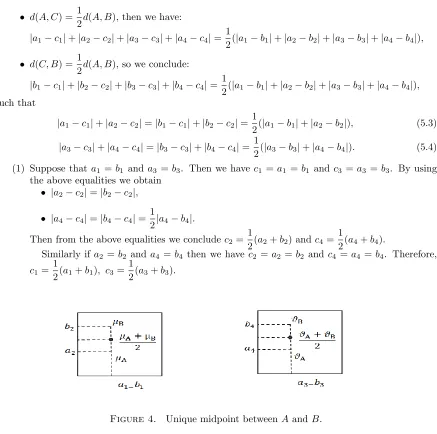
(1) If eithera1=b1,a3=b3 ora2=b2, a4 =b4, then there is a midpoint given bymid(A, B) =
{µA+µB
2 ,
νA+νB 2 }.
(2) If a1 < b1, a2 < b2, a3 > b3 and a4 < b4, then the set of midpoints is as follows. If
µC= (c1, c2),νC = (c3, c4), then:
• c1+c2=
1
2(a1+a2+b1+b2),
• c3+c4=
1
2(a3+a4+b3+b4),
(3) Ifa1< b1, a2> b2, a3> b3, a4> b4, then:
• c1−c2=
1
2(a1−a2+b1−b2),
• c3−c4=
1
2(a3−a4+b3−b4),
(4) Ifa1< b1, a2< b2, a3> b3, a4> b4, then:
• c1+c2=
1
Figure 3. Segment betweenA andB: 1. a1≤b1, a2≤b2, a3 ≥b3, a4≤b4, 2.
a1 ≤b1, a2 > b2, a3 ≥ b3, a4 ≤b4, 3. a1 ≤ b1, a2 ≤b2, a3 ≥b3, a4 > b4, 4.
a1≤b1, a2> b2, a3≥b3, a4> b4.
• c3−c4=
1
2(a3−a4+b3−b4),
(5) Ifa1< b1, a2> b2, a3> b3, a4< b4, then:
• c1−c2=
1
2(a1−a2+b1−b2),
• c3+c4=
1
2(a3+a4+b3+b4),
Proof: IfC∈mid(A, B), thend(A, C) =d(C, B) =1
2d(A, B). So, we have:
• d(A, C) =d(C, B), therefore:
• d(A, C) =1
2d(A, B),then we have:
|a1−c1|+|a2−c2|+|a3−c3|+|a4−c4|=
1
2(|a1−b1|+|a2−b2|+|a3−b3|+|a4−b4|),
• d(C, B) =1
2d(A, B),so we conclude:
|b1−c1|+|b2−c2|+|b3−c3|+|b4−c4|=
1
2(|a1−b1|+|a2−b2|+|a3−b3|+|a4−b4|), such that
|a1−c1|+|a2−c2|=|b1−c1|+|b2−c2|=
1
2(|a1−b1|+|a2−b2|), (5.3)
|a3−c3|+|a4−c4|=|b3−c3|+|b4−c4|=
1
2(|a3−b3|+|a4−b4|). (5.4)
(1) Suppose that a1=b1 anda3 =b3. Then we have c1 =a1 =b1 andc3 =a3 =b3. By using
the above equalities we obtain
• |a2−c2|=|b2−c2|,
• |a4−c4|=|b4−c4|=
1
2|a4−b4|.
Then from the above equalities we concludec2=
1
2(a2+b2) andc4= 1
2(a4+b4).
Similarly if a2=b2 anda4 =b4 then we havec2 =a2 =b2 and c4 =a4=b4. Therefore,
c1=
1
2(a1+b1), c3= 1
2(a3+b3).
Figure 4. Unique midpoint betweenAandB.
(2) Now, suppose thata1< b1, a2< b2, a3> b3, a4< b4. Then, by using5.3we find: • c1−a1+c2−a2=b1−c1+b2−c2,
• c1−a1+c2−a2=
1
2(b1−a1+b2−a2),
• b1−c1+b2−c2=
1
2(b1−a1+b2−a2). So,c1+c2=
1
2(a1+a2+b1+b2), also by5.3we have:
• c3−a3+c4−a4=b3−c3+b4−c4,
• c3−a3+c4−a4=
1
2(a3−b3+b4−a4),
• b3−c3+b4−c4=
1
2(a3−b3+b4−a4).
Therefore, we obtainc3+c4=
1
2(a3+a4+b3+b4).
(3) Ifa1< b1, a2> b2, a3> b3, a4> b4, then by using5.3we obtain: • c1−a1+a2−c2=b1−c1+c2−b2,
• c1−a1+a2−c2=
1
2(b1−a1+a2−b2),
• b1−c1+c2−b2=
1
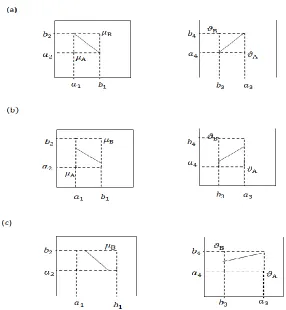
Figure 5. Midpoints between A and B: (a) b1−a1 = b2−a2, b3−a3 = b4−
a4, (b)b1−a1< b2−a2, a3−b3< b4−a4, (c)b1−a1> b2−a2, a3−b3> b4−a4.
Thus,c1−c2=
1
2(a1−a2+b1−b2), also by using the relation 5.4we have:
• c3−a3+a4−c4=b3−c3+c4−b4,
• c3−a3+a4−c4=
1
2(a3−b3+a4−b4),
• b3−c3+c4−b4=
1
2(a3−b3+a4−b4). So, we concludec3−c4=
1
2(a3−a4+b3−b4).
(4) Leta1< b1, a2< b2, a3≥b3, a4> b4. According to the case 2, ifa1< b1, a2< b2, we have
c1+c2=
1
2(a1+a2+b1+b2).
Now, ifa3> b3, a4> b4, we findc3−c4=
1
2(a3−a4+b3−b4).
(5) Leta1< b1, a2> b2, a3> b3, a4< b4. According to the case 3, ifa1< b1, a2> b2, we obtain
c1−c2=
1
2(a1−a2+b1−b2).
Also, ifa3> b3, a4< b4, we havec3+c4=
1
2(a3+a4+b3+b4).
As in the two-dimensional hypercube I2, we find the following result.
Theorem 5.3. The points in the segment between µA = (a1, a2, a3), νA = (a4, a5, a6) and µB = (b1, b2, b3), νB= (b4, b5, b6)are given by
segment(A, B) ={C= (c1, c2, c3), (c4, c5, c6) : min{ai, bi} ≤ci≤max{ai, bi}, i= 1,2,3,4,5,6}.
Example 5.1. Suppose the first variable x1 depends on several blood tests, the second one x2 on
cardiac tests, and the third variablex3 on some non-invasive vascular tests. For example, patient 1
is the point P1 = (0.9,0.2,0.9), (0.1,0.8,0.1) in twin three dimensional hypercube and patient 2 is
P2= (0.7,0.8,0.5),(0.3,0.2,0.5), patient 3 isP3= (0.8,0.2,0.9),(0.2,0.8,0.1), then
segment(P1, P2) ={(c1, c2, c3),(c4, c5, c6) : 0.7≤c1≤0.9, 0.2≤c2≤0.8,
0.5≤c3≤0.9, 0.1≤c4≤0.3, 0.2≤c5≤0.8, 0.1≤c6≤0.5}.
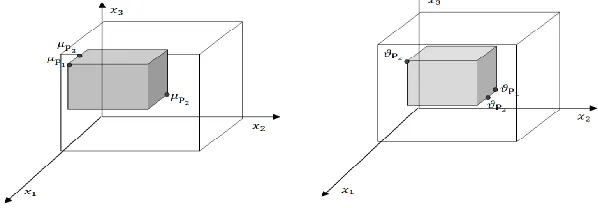
This segment is represented in grey in Figure6. The pointP3 = (0.8,0.2,0.9), (0.2,0.8,0.1) belongs
to the segment between P1, P2. Indeed d(P1, P2) = 2.4, d(P1, P2) = 0.2, d(P3, P2) = 2.2 and then
d(P1, P2) =d(P1, P3) +d(P3, P2).
Figure 6. Segment betweenP1 andP2
Now, consider the intuitionistic fuzzy set µP1 = (0.7,0.8,0.5), νP1 = (0.3,0.2,0.5) and µP2 = (0.9,0.2,0.9), νP2 = (0.1,0.8,0.1). Let P3 = (c1, c2, c3), (c4, c5, c6) be midpoint between µP1, νP1
andµP2, νP2. Then,d(P2, P3) =
1
2d(P1, P2). Therefore,
• c1−0.7 + 0.8−c2+c3−0.5 = 0.6, • 0.3−c4+c5−0.2 + 0.5−c6= 0.6,
alsod(P1, P3) =
1
2d(P1, P2), so
• 0.9−c1+c2−0.2 + 0.9−c3= 0.6, • c4−0.1 + 0.8−c5+c6−0.1 = 0.6,
Therefore we obtain: c1−c2+c3 = 1, c4−c5+c6 = 0 such that c1, c2, c3, c4, c5, c6 have to satisfy
Figure 7. Shows the set of midpoints between µA, νA and µB, νB. Note that P3= (0.8,0.2,0.9),(0.2,0.8,0.1)∈segment(A, B) butP3∈/mid(A, B)
6. An application of intuitionistic fuzzy sets in medicine
We now state a complete description of the medical problem. As in the paper [11], we consider the following intuitionistic fuzzy variables: smoking and alcohol drinking. Let X = {x1, x2}, for a
nonsmoker we consider the degree of membership is 0 and the degree of nonmembership is 1, this point is the ideal situation for your health. Also for example if you smoke six cigarettes per day we say that your degree of a smoker is 0.8, and we suppose the degree of nonmembership is 0.2. If the consumption of cigarettes is 10 or more, the degree of membership is 1 and the degree of nonmembership is 0. Now for other intuitionistic fuzzy variables, if you drink no alcohol, the degree of membership is 0, and the the degree of nonmembership is 1. If you drink more than 75 cc of alcohol per day, the degree of alcoholism is 1 and the degree of non alcoholism is 0, for 25 cc per day, the degree of membership could be 0.4 and the degree of nonmembership is 0.6 and for 50 cc per day the degree of membership is 0.8 and the degree of nonmembership is 0.2.
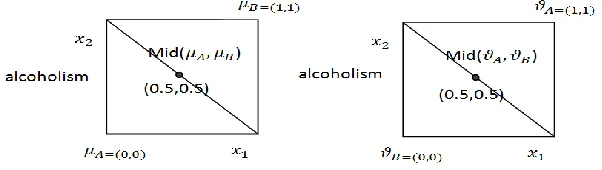
Therefore the intuitionistic fuzzy set µA = (0,0), νA = (1,1) corresponds to a non smoker and teetotaler, also the intuitionistic fuzzy set µB = (1,0), νB = (0,1) showes a heavy smoker but a non teetotaler and the intuitionistic fuzzy set µC = (0.8,1), νC = (0.2,0) represents that person smokes about six cigarettes per day and 75 cc of alcohol per day. According to the above text, µA = (0,0), νA = (1,1) is the ideal situation for your health that is difficult to achieve. Also for µB = (1,1), νB = (0,0) your physician has suggested you to reduce your consumption of cigarettes and alcohol by half, therefore you may achieve a midpoint between intuitionistic fuzzy setµA, νAand
µB, νB. The intuitionistic fuzzy set µM = µA+µB
2 = (0.5,0.5), νM =
νA+νB
2 = (0.5,0.5) is a moderate number that you consume four cigarettes per day and 30 cc alcohol per day.
Figure 8. midpoint between a non smoker and teetotaler µA = (0,0), νA = (1,1) and a heavy smoker and heavy drinker µB= (1,1), νB = (0,0).
andµB= (0.7,0.3), νB = (0.3,0.7) are also valid midpoints. Any intuitionistic fuzzy set withν = 1−µ is on the linea1+a2 = 1, a3+a4= 1. If we calculate the distance of any intuitionistic fuzzy points
that is on the linea1+a2= 1, a3+a4= 1 to pointM = (0.5,0.5), (0.5,0.5), the point that has the
least distance, has better condition.
Figure 9
Example 6.1.Consider the intuitionistic fuzzy setsA= (0.3,0.7),(0.7,0.3), B= (0.4,0.6),(0.6,0.4), C = (0.1,0.9),(0.9,0.1), by above description we find the best point:
The midpoint isM = (0.5,0.5),(0.5,0.5), therefored(A, M) = 0.2 + 0.2 + 0.2 + 0.2 = 0.8, d(B, M) = 0.4, d(C, M) = 1.2, thatC has the most distance andB has the lest distance. Therefore the best point isB and the worst point isC.
Any intuitionistic fuzzy set withν 6= 1−µis not on the linea1+a2= 1, a3+a4= 1. For foundation
the best point, we calculate distance of points to ideal point, that isA= (0,0),(1,1). Any point that it’s distance is the least from ideal point, this point is the best point.
Example 6.2. Consider the intuitionistic fuzzy setsA= (0.3,0.8),(0.5,0.1),B = (0.3,0.8),(0.7,0.2)
andC = (0.3,0.8),(0.6,0.1). For point A the degree of membership of smoking is 0.3 and the degree of nonmembership is 0.5 and the degree of membership of alcoholism is 0.8 and the degree of non-membership is 0.1. We calculate distances A, B, C to ideal point, that is I = (0,0),(1,1), therefore
d(A, I) = 2.5, d(B, I) = 2.2, d(C, I) = 2.4. As we can see the distance ofB to ideal point is minimum and it is the best point, also the distance ofAto point I is maximum, and it is the worst point.
Example 6.3. Suppose that µP1 = (0.1,0.6,0.9), νP1 = (0.9,0.4,0.1), µP2 = (0.4,0.4,0.9), νP2 = (0.6,0.6,0.1),µP3 = (1,0.4,0.5), νP3 = (0,0.6,0.5). Now, we find distances P1, P2, P3 to ideal point.
By consideration µI = (0,0,0), νI = (1,1,1), then d(P1, I) = 2.8, d(P2, I) = 2, d(P3, I) = 2.4.
Therefore the best point isP2 and the worst point isP1.
References
[1] K. Atanassov, Intuitionistic fuzzy sets, Fuzzy Sets Syst. 20 (1986), 87-96. [2] K. Atanassov, More on intuitionistic fuzzy sets, Fuzzy Sets Syst. 33 (1989), 37-46.
[3] K. Atanassov, New operations defined over the intuitionistic fuzzy sets, Fuzzy Sets Syst. 61 (1994), 137-142. [4] K. Atanassov, Operators over interval valued intuitionistic fuzzy sets, Fuzzy Sets Syst. 64 (1994), 159-174. [5] K. Atanassov, Intuitionistic Fuzzy Sets, Theory and Applications, Studies in Fuzziness and Soft Computing, 35
(1999), Physica-Verlag, Heidelberg.
[6] B. Davvaz and E. Hassani Sadrabadi, An application of intuitionistic fuzzy sets in medicine, Int. J. Biomath. 9 (3) (2016), Art. ID 1650037.
[7] B. Davvaz and S.K. Majumder, Atanassov’s intuitionistic fuzzy interior ideals of Γ-semigroups, Sci. Bull., Politeh. Univ. Buchar., Ser. A 73(3) (2011), 45-60.
[8] A. De Luca and S. Termini, A defnition of a non-probabilistic entropy in the setting of fuzzy sets theory, Inform. Control 20 (1972), 301-312.
[9] S.K. De, R. Biswas and A.R. Roy, An application of intuitionistic fuzzy sets in medical diagnosis, Fuzzy Sets Syst. 117 (2001), 209-213.
[10] B. Kosko, Neural Networks and Fuzzy Systems, Prentice-Hall, Englewood Cliffs, 1992.
[11] J.J. Nieto and A. Torres, Midpoints for fuzzy sets and their applications in medicine, Artif. Intell. Med. 27 (2003), 81-101.
[13] E. Szmidt and J. Kacprzyk, Intuitionistic Fuzzy Sets in Some Medical Applications. In: Reusch B. (eds) Compu-tational Intelligence. Theory and Applications. Fuzzy Days 2001. Lecture Notes in Computer Science, vol 2206. Springer, Berlin, Heidelberg (2001).
[14] E. Szmidt and J. Kacprzyk, On distances between intuitionistic fuzzy sets, Fuzzy Sets Syst. 114 (2000), 505-518. [15] E. Szmidt and J. Kacprzyk, Entropy for intuitionistic fuzzy sets, Fuzzy Sets Syst. 118 (2001), 467-477.
[16] L.A. Zadeh, Fuzzy Sets, Infor. Control 8 (1965), 338-353.
[17] L.A. Zadeh, A computational approach to fuzzy quantifers in natural languages, Comput. Math. Appl. 9 (1983), 149-184.
[18] L.A. Zadeh, The role of fuzzy logic in the management of uncertainty in expert systems, Fuzzy Sets Syst. 11 (1983), 199-227.
1
Department of Mathematics, Yazd University, Yazd, Iran
2
Departamento de An´alisis Matem´atico Estadstica y Optimizacion,, Facultad de Matem´aticas, Universi-dad de Santiago de Compostela, 15782 Santiago de Compostela, Spain
3
Departamento de Psiquiatria, Radiologia y Salud P´ublica, Facultad de Medicina, Universidad de Santi-ago de Compostela, 15782 SantiSanti-ago de Compostela, Spain
∗