Technology (IJRASET)
Dispersion Analysis in WDM Systems
Kulwinder Singh1, Maninder Singh2, Vikas Gupta3, Kamaljit Singh Bhatia4
1
Associate Professor, ECE Department, BMSCE, Sri Muktsar Sahib 2
Research Scholar, ECE Department, BMSCE, Sri Muktsar Sahib 3
Research Scholar, ECE Department, IKG Punjab Technical University Jalandhar 4
Assistant Professor, ECE Department, IKG Punjab Technical University, Batala Campus
Abstract: This paper proposes an 8 channel 40 Gb/s wavelength division multiplexing (WDM) system with optimized modulation format. This system is simulated with three dispersion compensation techniques i.e. pre, post and symmetrical compensation. Amongst these different compensation techniques, symmetrical compensation technique achieved best performance in terms of Q-Factor and bit error rate (BER). Also system is analyzed for varying number of channels.
Keywords: Dispersion Compensating Fiber (DCF), DWDM, Q-Factor, BER, Dispersion Compensation Techniques.
I. INTRODUCTION
Performance of optical fiber communication is degraded with dispersion. The dispersion has the effect of pulse broadening and inter symbol interference (ISI). Pulse broadening is increased with increase in distance [1]. The DWDM system is analyzed using three dispersion compensation schemes i.e. pre, post and symmetrical with 25 GHz channel spacing for finding optimum modulation format. The Q value and eye opening in terms of input power and transmission distance are observed for different modulation formats. Symmetrical compensation technique is found to as superior than other techniques. It is also observed that four-wave
mixing (FWM) effect limits the system performance and MDRZ format is best suited for proposed system [2]. DWDM technique is
analyzed with channel spacing less than 0.8 nm using 100 channels at data rate of 20 Gbps data rate. The performance of the system is optimized using Dispersion compensation fiber (DCF) and fiber Bragg grating (FBG) [3]. Discrete multi-tone transmission (DMT) is an emerging technique for increased capacities in future systems. 8 channels with data rate of 56 Gb/s are combined in a 50-GHz channel to design a 400 Gb/s super-channel. To maintain cost efficiency and low power consumption, the system complexity is reduced to minimum [4]. DWDM system in optical fiber communication is investigated with dispersion tolerance and difference dispersion compensation techniques [5]. In DWDM systems optical signals with different wavelength are coupled on a single fiber. This technique can increase system capacity and can properly utilize the bandwidth. However, some factors can limit this capacity and data rates. These factors can be linear or nonlinear. Dispersion comes in the nonlinear factor. Dispersion Compensation Fiber (DCF) and linear loss EDFA compensation have been used in single mode fiber (SMF) channel to ensure the communication quality for the design [6]. The high speed 8-channel bidirectional DWDM-PON access system is proposed. The system is demonstrated using spectrum slicing technology for transmission over 20 km SMF fiber span using dispersion compensating techniques such as fiber Bragg grating (FBG) and dispersion compensating fiber [7].
A. Dispersion Compensation
Although optical networks utilizing optical fiber offers very large bandwidth and fiber capacity but the problem of dispersion still persists. Dispersion is a process by which a pulse is broadened because different modes possess different group velocities in time domain. Dispersion can cause intersymbol interference and also reduces the pulse energy. The major types of dispersion include; modal dispersion, group velocity dispersion (GVD) and polarization mode dispersion (PMD). Modal dispersion occurs mostly in multimode fiber because different modes possess different group velocities GVD occurs because of material and waveguide property of the fiber. PMD occurs because of different group velocities in different polarization states of the mode.
Technology (IJRASET)
with negative dispersion is placed before the standard mode fiber (SMF) to compensate positive dispersion of the SMF. In Post-Compensation technique, the dispersion compensating fiber (DCF) with negative dispersion is placed after the standard mode fiber (SMF) to compensate positive dispersion of the SMF. In Symmetrical Compensation technique, the dispersion compensating fiber (DCF) with negative dispersion is placed before and after the standard mode fiber (SMF) to compensate positive dispersion of the SMF.
B. Simulation Setup
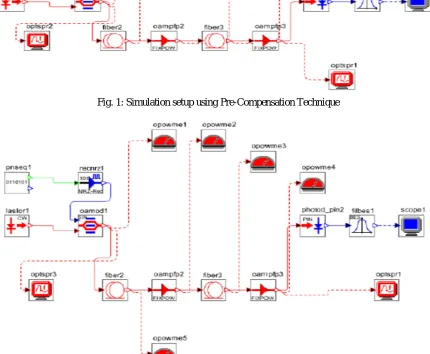
[image:3.612.88.518.342.696.2]The simulation setup of 8 channel 40 Gb/s WDM system is composed of three sections; transmitter, optical fiber and receiver. This system is analyzed by choosing NRZ modulation format. Transmitter section consists of a data source, CW laser source, electrical driver and amplitude modulator. Data rate is selected at 40 Gbps. Here DCF technique is used to compensate the effect of dispersion. Three simulation setups are designed for dispersion compensation includes; pre compensation, post compensation and Symmetric compensation. The standard single mode fiber (SMF) of length 100 km is used for three setups. In pre compensation scheme shown in Fig. 1, DCF having length of 20 km is used before the SMF fiber to compensate the positive dispersion effect.
Fig. 1: Simulation setup using Pre-Compensation Technique
Technology (IJRASET)
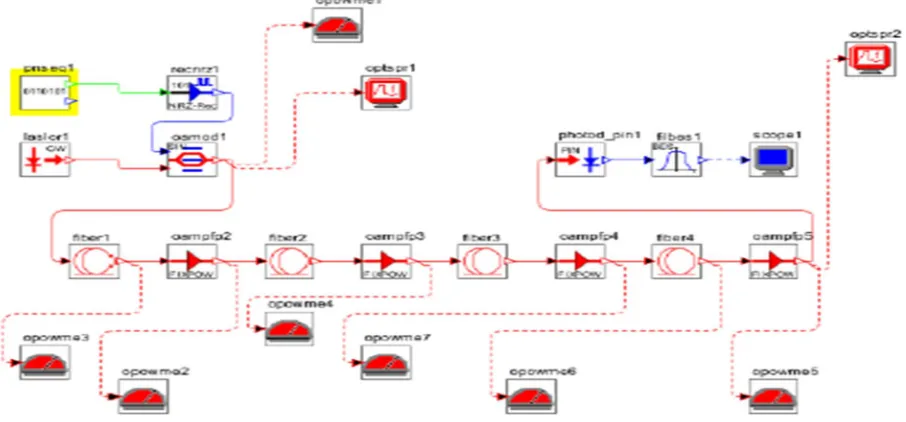
[image:4.612.82.535.117.328.2]In post compensation scheme (Fig. 2), DCF having length of 20 km is used after the SMF fiber to compensate the positive dispersion effect.
Fig. 3: Simulation setup using Symmetrical Compensation Technique
In symmetrical compensation technique (Fig. 3), two DCF fibers each containing length of 20 km are used before and after the SMF fiber to compensate the positive dispersion effect. Lastly in receiver section, the received signal is de-multiplexed, detected by PIN photodiode, passed through Bessel filter and finally received as output.
II. RESULTS & DISCUSSIONS
[image:4.612.159.459.486.697.2]The three different dispersion compensation schemes i.e., pre-compensation, post-compensation and symmetrical-compensation have been simulated and analysed for 40 Gbps long haul system in terms of received maximum Q Factor value and Minimum Bit error rate.
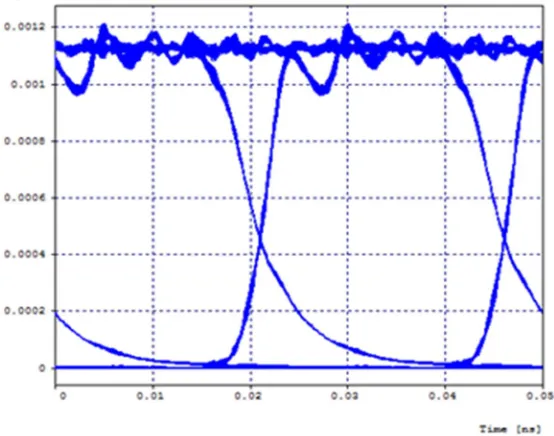
Fig. 4 depicts the eye diagram for pre-compensation technique. From this eye diagram the value of Q-Factor and BER are calculated for this technique.
Technology (IJRASET)
Fig. 5 depicts the eye diagram for post-compensation technique. From this eye diagram the value of Q-Factor and BER are calculated for this technique.
[image:5.612.172.449.110.328.2]Fig. 5: Eye Diagram for Post-Compensation Technique
Fig. 6 depicts the eye diagram for symmetrical compensation technique. From this eye diagram the value of Q-Factor and BER are calculated for this technique.
Fig. 6: Eye Diagram for Symmetrical Compensation Technique
[image:5.612.148.476.387.632.2]Technology (IJRASET)
Fig. 7: Q-Factor versus Channel Number for Different Compensation Techniques
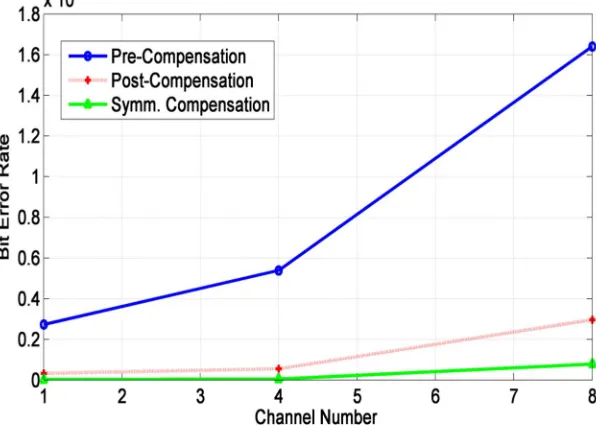
[image:6.612.147.484.70.283.2]Fig. 8 analyzes the BER versus channel number for different compensation techniques. It is depicted that value of symmetrical compensation technique achieved least BER as compared to other techniques. Also BER increase with increase in channel number.
Fig. 8: BER versus Channel Number for Different Compensation Techniques
III. CONCLUSIONS
In this paper an 8 channel 40 Gb/s WDM system is analyzed in terms of Q-factor and BER for three types of dispersion compensation techniques viz. pre-compensation, post-compensation and symmetrical compensation. Simulation results showed that for the proposed system best Q-Factor value (19.99 dB) and least BER value (2.361e-032) are achieved in case of symmetrical compensation technique. The performance of Post-Compensation technique is also better than Pre-Compensation technique. It is also conclude that value of Q-factor is decreased and BER is increased when we increase the number of channels.
REFERENCES
[1] S. Kumar, “Performance analysis of dispersion compensation in long haul optical fiber with DCF,” IOSR Journal of Electronics and Communication Engineering, Vol. 6, No. 6, pp. 19-23, Aug. 2013.
[image:6.612.157.455.353.566.2]Technology (IJRASET)
compensation schemes in the presence of Kerr's effect,” Optik - International Journal for Light and Electron Optics, Vol. 121, No. 8, pp. 739-749, Apr. 2010. [3] S. Rebhi, M. Najjar and R. Houria, “Performance analysis of a 2 Tb/s DWDM system based on narrow channel spacing and multi-diagonal code,” 2016 22nd
Asia-Pacific Conference on Communications (APCC), Yogyakarta, 2016, pp. 148-152.
[4] A. Dochhan, H. Griesser, N. Eiselt, M. Eiselt and J. P. Elbers, “Optimizing Discrete Multi-tone Transmission for 400G Data Center Interconnects,” In proceedings Photonic Networks; ITG-Symposium; Leipzig, Germany, pp. 1-6, 2016,.
[5] A. Dolma and O. Kayaöz, “Investigation of DWDM system and dispersion effect in optical systems,” 24th Signal Processing and Communication Application Conference (SIU), Zonguldak, pp. 1745-1748, 2016.
[6] N. M. Nawawi et al., “Dispersion compensation dense wavelength division multiplexing for nonlinearity analysis at various propagation distance and input power,” International Conference on Computer, Communications, and Control Technology, Kuching, pp. 346-349, 2015.