Technology (IJRASET)
Types of Routing Protocols to maintain Message
Security
Ramanpreet Kaur1, Cherry Goyal2, Harjeet Kaur3, Mandeep Singh4
Computer Science, Baba Farid Group of Institutions, Bathinda
Abstract: Every machine on the Internet has a unique number assigned to it, called an IP address. Without a unique IP address on your machine, you will not be able to communicate with other devices, users, and computers on the Internet. You can look at your IP address as if it were a telephone number, An IP address is a fascinating product of modern computer technology designed to allow one computer (or other digital device) to communicate with another via the Internet. IP addresses allow the location of literally billions of digital devices that are connected to the Internet to be pinpointed and differentiated from other devices. In the same sense that someone needs your mailing address to send you a letter, a remote computer needs your IP address to communicate with your computer.
Keywords: IP, ICMP, MTU, DNS, VOIP
I. INTRODUCTION
A. Internet Protocol (IP)
The Internet Protocol (IP) is a network-layer (Layer 3) protocol that contains addressing information and some control information that enables packets to be routed. IP is documented in RFC 791 and is the primary network-layer protocol in the Internet protocol suite. Along with the Transmission Control Protocol (TCP), IP represents the heart of the Internet protocols. IP has two primary responsibilities: providing connectionless, best-effort delivery of datagram’s through an internetwork; and providing fragmentation and reassembly of datagram’s to support data links with different maximum-transmission unit (MTU) sizes
B. IP addresses can be either static or dynamic
Static IP addresses never change. They serve as a permanent Internet address and provide a simple and reliable way for remote computers to contact you. Static IP addresses reveal such information as the continent, country, region, and city in which a computer is located; the ISP (Internet Service Provider) that services that particular computer; and such technical information as the precise latitude and longitude of the country, as well as the locale, of the computer. Many websites provide IP address look-up services to their visitors, free of charge. If you're curious about your own IP address, you can locate these websites by performing a Google search.
Dynamic IP addresses are temporary and are assigned each time a computer accesses the Internet. They are, in effect, borrowed from a pool of IP addresses that are shared among various computers. Since a limited number of static IP addresses are available, many ISPs reserve a portion of their assigned addresses for sharing among their subscribers in this way. This lowers costs and allows them to service far more subscribers than they otherwise could.
Static IP addresses are generally preferable for such uses as VOIP (Voice over Internet Protocol), online gaming, or any other purpose where users need to make it easy for other computers to locate and connect to them. Easy access can also be facilitated when using a dynamic IP address through the use of a dynamic DNS service, which enables other computers to find you even though you may be using a temporary, one-time IP address. This often entails an extra charge, however, so check with your ISP.
C. How many IP addresses do we use ?
Typically, a residential Internet connection is assigned one unique address and uses a block of private addresses to number each computer, printer, video game console, or smartphone connected to it. But while this address is assigned to the connection we use, the services and peers we communicate with on the Internet also have addresses. There are approximately 3.7 billion addresses available for ordinary Internet connections, and about 1.6 billion people used the Internet. So, very roughly, each user requires a little over two unique addresses
D. IP address classes
Technology (IJRASET)
Figure 2 below.If you look at the table you may notice something strange. The range of IP address from Class A to Class B skips the 127.0.0.0-127.255.255.255 range. That is because this range is reserved for the special addresses called Loopback addresses The rest of classes are allocated to companies and organizations based upon the amount of IP addresses that they may need. Listed below are descriptions of the IP classes and the organizations that will typically receive that type of allocation.
E. Internet control protocol
Addition to IP, which is used for data transfer. Internet has several control protocols used in it. Work layer, including ICMP, ARP, and RARP
1) Internet Control Message Protocol (ICMP): The internet control message protocol is mechanisms used by hosts and routers to send notification of datagram problems back to the sender.
IP is essentially an unreliable and connectionless protocol. It is having no mechanism to detect any type of errors in the network. So ICMP used with IP to make internet aware if something wrong occurs in the network.
The IP protocol also lacks a mechanism for hosts and management queries. A host sometimes need to determine if a router or another host is alive .And sometimes a network administrator needs information from another host or router.
The ICMP has been designed to compensate for the above two deficiencies. It is a companion to the IP protocol.
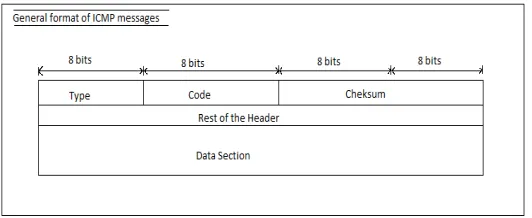
2) Message format: ICMP message have a 8-byte header and variable size data-section.
General format of header is different for each message type, first 4 bytes are common to all. In fig. The first field, ICMP type, defines the type of the messages. The code field specifies the reason for the particular message type. The last common field is checksum field. The rest of the header is specific for each messages type.
The data section in error messages carries information for finding the original packets that had the error. In query messages, the data section carries extra information based on type of query.
a) Types Of Messages: ICMP divided into two categories:
Error Reporting: Error reporting messages report problems that a router or a host (destination) May encounter when it processes an IP packet.
ICMP does not correct errors -simply report the errors. ICMP uses the source IP address to send the error messages to the source (originator) of the datagram.
Five types of errors are handled:
i) Destination Unreachable: This message is sent by intermediate router of the path to the source host, when router is unable to deliver the datagram.
ii) Source quench: The source quench message is designed to add a kind of flow control to the IP. When a host discard the datagram due to congestion, it send source quench message to the sender of datagram. This message has two purposes. First, it informs the source datagram is discarded. Second, it warns the source there is congestion somewhere in the path and that source should slow down the sending process
iii) Time exceeded: This message is generated when not all fragments that make up the message arrive at destination host in proper time
iv) Parameter problem: If the destination host gets a missing value in any field of the datagram, it discards the datagram and sends a parameter problem message back to source.
Technology (IJRASET)
that datagram forward to correct router. It sends a redirection message to the host so that it correct the mistake.
In fig. Host A wants to send a datagram to host B router2 is the most efficient choice, but host did not choose R2.datagram goes to R1.R1 receives that datagram and forward to R2,at same time its sends a redirection message to host A.
b) Query Message: The query message occurs in pairs, help the host to get specific information from a router or another host.
i) Echo Request and reply: Users used this pair of message to identify network problems. The combination of echo-reply and echo-request message determines whether two system communicate with each other.
ii) Time stamp request and reply: This message is used to determine the arrival time and departure time of the reply are recorded.
iii) Address mask request and reply: It is used to get the format of IP address. The result of this communication is that source host knows which part of IP address is used as network, host, and subnet.
II. ADDRESS RESOLUTION PROTOCOL
ARS is usedto find the physical address of the receiver that’s knows its logical address.to send datagram packets sender needs the physical address of the receiver. The Host send a ARP query packet. The packet includes physical and IP address of the sender and IP address of the receiver .because of sender does not knows the physical address of receiver, the query is broadcast over the network.
Every host on net receives and process it but only true recipient recognizes its IP address and sends back ARP response packet. The response packet contains receipting IP and physical address. Packet is unicast to inquirer by using physical address received in query packet.
III. REVERSE ADDRESS RESOLUTION PROTOCOL
RARP finds the logical address for machines that only knows its physical address. Each host assigned more than one logical address, which are unique
ARP solves the problem of finding of Ethernet address corresponding to the given IP address.
Sometimes reverse problem occur, machine knows physical address but will be its corresponding IP address? For this problem solution id RARP.
Routing Protocols
Routing protocol updates are exchanged by routers to learn about paths to other logical networks. Each routing protocol offers features that can make it desirable as part of an internetwork design.
IV. CONCLUSION
The implementation of small, mobile, low-cost, energy conscious devices has created unique challenges for today s designers. The drive for a miniaturization and inexpensive fabrication calls for an unprecedented high level of integration and system heterogeneity. Limiting battery lifetimes make energy efficiency a most critical design metric and the real time nature of applications impose strict performance constraintsGeneral distributed systems mostly rely on a client/server communication model. A client will make a request for a service; the network will communicate the request to the server and the subsequent reply from the server back to the client
REFERENCES
[1] S. M. Metev and V. P. Veiko, Laser Assisted Microtechnology, 2nd ed., R. M. Osgood, Jr., Ed. Berlin, Germany: Springer-Verlag, 1998.
Technology (IJRASET)
Springer, 1989, vol. 61.[3] S. Zhang, C. Zhu, J. K. O. Sin, and P. K. T. Mok, “A novel ultrathin elevated channel low-temperature poly-Si TFT,” IEEE Electron Device Lett., vol. 20, pp. 569–571, Nov. 1999.
[4] M. Wegmuller, J. P. von der Weid, P. Oberson, and N. Gisin, “High resolution fiber distributed measurements with coherent OFDR,” in Proc. ECOC’00, 2000, paper 11.3.4, p. 109.
[5] R. E. Sorace, V. S. Reinhardt, and S. A. Vaughn, “High-speed digital-to-RF converter,” U.S. Patent 5 668 842, Sept. 16, 1997. [6] (2002) The IEEE website. [Online]. Available: http://www.ieee.org/
[7] M. Shell. (2002) IEEEtran homepage on CTAN. [Online]. Available: http://www.ctan.org/tex-archive/macros/latex/contrib/supported/IEEEtran/ [8] FLEXChip Signal Processor (MC68175/D), Motorola, 1996.
[9] “PDCA12-70 data sheet,” Opto Speed SA, Mezzovico, Switzerland.
[10] A. Karnik, “Performance of TCP congestion control with rate feedback: TCP/ABR and rate adaptive TCP/IP,” M. Eng. thesis, Indian Institute of Science, Bangalore, India, Jan. 1999.
[11] J. Padhye, V. Firoiu, and D. Towsley, “A stochastic model of TCP Reno congestion avoidance and control,” Univ. of Massachusetts, Amherst, MA, CMPSCI Tech. Rep. 99-02, 1999.