Nature Inspired Computation Techniques and Its
Applications in Soft Computing: Survey
K. Himabindu1, S. Jyothi2 1, 2
Department of Computer Science, Sri Padmavati Mahila Visvavidyalayam (Women’s University), Tirupati, INDIA;
Abstract: Soft Computing is efficient to solve system solutions based on technique in the area of computation. Soft computing is designed to develop intelligence computation techniques to provide solutions to real world problems. These techniques are inspired by nature such as Artificial Neural computation, Evolutionary Algorithms, Swarm Intelligence, Artificial Immune Systems based algorithms gained much attention and shown success. In this a few algorithms have proved to be very efficient and become more popular tools for solving real world optimization problems. This paper presents the working procedures and provides list of applications by using nature inspired algorithms. The desirable advantages of the intelligent computational algorithms and initial success in many domains have encouraged researchers to work towards the advancements of these techniques.
Keywords: Soft Computing, Natural Inspired computation techniques, Evolutionary Computation, Swarm intelligence, artificial neural networks, artificial immune system, Applications.
I. INTRODUCTION
Soft computing(SC) techniques are the combination of Swarm intelligence, artificial immune system based algorithms, Evolutionary Computation (EC) techniques and Artificial Neural computation. Nature proved to be one of the greatest sources of inspiration for these intelligent algorithms. In this paper deals Soft Computing techniques inspired by nature. These techniques make use of the skills of intelligent agent by simulating insect behavior suitable for the required problem.
Natural computing [1] also called natural computation, is a terminology introduced to encompass three classes of methods:
1) those that take inspiration from nature for the development of novel problem-solving techniques;
2) those that are based on the use of computers to synthesize natural phenomena; and
3) those that employ natural materials to compute. The main fields of nature inspired models of research that compose many techniques like artificial neural networks, evolutionary algorithms, swarm intelligence, artificial immune systems among others. These computational paradigms studied by natural computing are abstracted from natural phenomena as diverse as functioning of the brain, flock of birds behavior, and the immune system. Dually, one can view processes occurring in nature as information processing. Such processes include self-assembly and developmental processes.
II. NATURE INSPIRED COMPUTATION MODELS
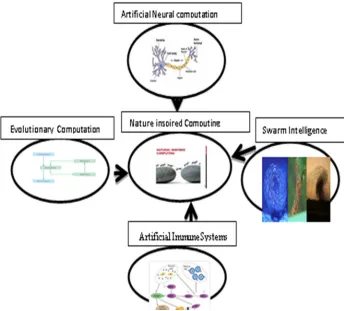
Nature is a large part of science, it solve problems in an efficient and effective manner. This may be achieved by transferring knowledge from natural systems to computational systems. Nature inspired computing techniques such as Artificial Neural Computation, Evolutionary Algorithms, Swarm Intelligence, and Artificial Immune System have helped in solving complex problems and provide optimum solution.
Fig 1: Nature Inspired Computation Techniques
A. Artificial Neural Computation
The comparison of computing machines and human nervous system is presents the Neural computation. This field aims both to understand how the brain of living organisms works (brain theory or computational neuroscience), and to design efficient algorithms based on the principles of how the human brain processes information (Artificial Neural Networks, ANN ). Many terms used to describe neural networks are synonymous to common statistical terminology [4].
B. Neural Network Models
1) The Perceptron
2) Multilayered feed forward ANN models
3) Recurrent ANN models
4) Radial basis function ANN Models
C. Neural Network Applications
Today, neural networks are used to solve a wide variety of problems. These applications fall into one of the following categories [5]:
1) Fraud Detection [6]
2) Pattern Recognition using Neural Networks[7]
3) Neural Networks for Classification[8]
4) Medical Diagnosis[9]
D. Evolutionary Computation
Fig. 2: Process of Evolutionary Computation
1) Genetic Algorithms: Genetic Algorithms (GAs) are heuristic search based optimization technique based on the evolutionary principles of natural selection and genetics. As such type of an intelligent exploitation of a random search used to solve optimization problems. The basic techniques of the GAs select individuals at random are designed to simulate processes in natural systems necessary for evolution.
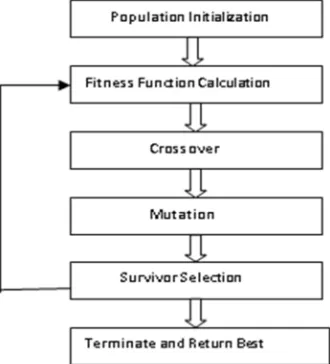
Fig. 3: Procedure of Genetic Algorithm
General Procedure for Implementing GA
a) Initialize the population (usually randomized binary strings) b) Calculate the fitness for each individual in the population
c) Reproduce selected individuals to form new population
d) Perform crossover and mutation (or other operations)
e) Loop to step 2 until some condition is met
f) Applications:
i) Economic Evolution[12]
ii) Agriculture [13] iii) Image Processing [14]
iv) Vehicle routing problems[15]
v) DNA Analysis [16]
[image:4.612.223.388.322.504.2]real-valued vector. Evolutionary programming is same as evolutionary strategies without use of recombination for the representation of real valued vector [17] .
a) Applications:
i) Traffic routing and planning[18
ii) Pharmaceutical design[19
iii) Cancer detection[20][21] iv) Military planning[22]
v) System identification[23]
vi) Power engineering [24]
3) Evolution Strategies: In evolutionary strategies fixed-length real-valued vector is used for that representation. Works with vectors of real numbers as representations of solutions, and typically uses self-adaptive mutation rates, as well as recombination. Evolution Strategies reproduction operators are two types that is Gaussian mutation and Intermediate recombination. In Gaussian mutation a random value from a Gaussian distribution is added to each element of an individual’s vector to create a new offspring and in Intermediate recombination which the vectors of two parents are mingle element by element, to form up a new offspring. These type of operators replicate the behavioral as opposed to structural interpretation of the representation [25].
4) Genetic programming: The difference between genetic programming and genetic algorithm is genetic programming represented as a tree structure of actions and values, usually a nested data structure and genetic algorithm represented as a list of actions and their values, often a string. Genetic programming, the result function have more flexible, but often grow in complexity because of it have a variable length and it rarely provide invalid states. But in Genetic algorithms, the result function has bounded complexity because of it have a fixed length and it produces invalid states [26].
a) Applications:
i) traffic routing and planning[27]
ii) pharmaceutical design[28]
iii) cancer detection[29] iv) military planning[30]
v) system identification[31]
E. Swarm Intelligence
The study of computational systems inspired by the collective behavior that is call it as Swarm intelligence and also one of the important concept in artificial intelligence. Collective Intelligence is coordination of large numbers of homogeneous agents in the environment. flocks of birds, Schools of fish and colonies of ants are the instances of Swarm Intelligence. This type of intelligence is self-organizing, decentralized, and distributed throughout an environment[32]. In nature such type of systems are used to solve problems like, prey evading or effective foraging for food and colony re-location[33].
Fig.4: Categorization of Swarm Intelligence
like food and safety. Principle of diverse, response resources should not be concentrated in narrow region. Principle of stability and adaptability Swarms are expected to adapt environmental fluctuations without rapidly changing modes since mode changing costs energy. Roots in models of social insects behavior is [34][35].
1) Foraging behavior
2) Division of labor and task allocation
3) Cemetery organization
4) Nest building
5) Collaborative transportProperties of collective intelligence systems
6) Distributed computation
7) Direct and indirect interactions
8) Agents equipped with simple computational capabilities
9) Robustness
10) Adaptiveness
a) Ant Colony Optimization: Ant Colony Optimization (ACO) is a model for designing metaheuristic algorithms and solving hard combinatorial optimization problems inspired by the indirect communication of real ants. And ACO initially proposed by Colorni, Dorigo and Maniezzo. In ACO algorithms, ants construct candidate solutions to the problem being tackled, making decisions that are stochastically biased by numerical information based on (artificial) pheromone trails and available heuristic information. The pheromone trails are updated during algorithm execution to bias the ants search toward promising decisions previously found[36][37]. Notable examples of ant behaviors:
Fig 5: (a) Foraging (b)Division of labour (c) Collective transport(d) Cluster formation
Foraging: In foraging Individual ants deposits a chemical on the ground which increases the probability that other ants will follow the same path. Biologists have shown that many colony-level behaviors observed in social insects can be explained via rather simple models in which only stigmergic communication is present. Different phases of the behavior of ant colonies have inspired different types of ant colony algorithms. Division of labor, brood sorting, and cooperative transport are the best examples of foraging. Division of labour: Division of labor is an important and widespread feature of life in ant colonies. Social insects are all categorized into two types i.e., fundamental type of division of labor & reproductive division of labor [38]. There are different kinds of division of labor i.e., reproductive, castes, tasks accomplished in the colony.
Collective transport : Collective behavior takes many forms, such as emergence, self–organization, super organism, quorum sensing, artificial intelligence and dynamic networks.
Cluster formation: Clustering problems that is mainly inspired by the behavior of ant colonies and this behavior based upon the brood sorting. In Brood sorting mainly ant colonies sort their brood in the process of smallest items in the middle and largest items in the periphery. The best example of brood sorting is collective structure formation by social insects. By the behavior of ant colonies that cluster their corpses and sort their larvae. Larval sorting and corpse cleaning by ant was first modeled by Deneu bourg et al. for accomplishing certain tasks. The ant colony clustering algorithm is used to develop cluster benchmark problems [39][40].
b) Applications
i) Routing[41]
i) Traveling salesman[42]
ii) Tele communication[43]
iii) Discounted cash flows in project scheduling [44]
iv) Classification[45]
v) Protein folding [46 ][ 47 ][ 48].
[image:6.612.100.505.330.405.2]successfully applied to solve a wide range of optimization problems such as continuous nonlinear and discrete optimization problems [49]. PSO was developed from swarm intelligence and this is based on the behavior of birds and fish. While searching for food the birds get scattered or they go together in search of food while searching for food source from one place to another, there is always a bird that can smell the best food source easily and go in search of that source i.e., the bird is perceptible of the food source and supply the information to all other birds. Birds have good communication, co operation and positive thinkers. The particle without quality and volume will serve as individuals and their behaviors are controlled by each particle to show their complexity. The Anatomy of particle : A particle (individual) is composed of three vectors that is x-vector, vector and v-vector. The x-vector notify the current position or location of the particle in the search space, The p-vector records the location of the best solution found so far by the particle and the v-p-vector gives the direction for which particle will travel at if it is undisturbed.
Two fitness values are
i) The x-fitness records the fitness of the x-vector, and ii) The p-fitness records the fitness of the p-vector.
There are 4 types of PSO based on 1 and 2 .
iii) Full Model ((1, 2 > 0)
iv)Cognition Only ((1 > 0 and (2 = 0), v) Social Only ((1 = 0 and (2 > 0) vi)Selfless ((1 = 0, (2 > 0, and g i)
Where 1, 2 are learning rates leading the cognition and social components and Where g indicates the index of the particle with the best p-fitness[50].
Applications
vii) Face detection[51]
viii)Heart beat classification [52] ix) Object detection[53]
x) Image Classification[54]
xi) Railway vehicle design [55]
d) Cuckoo Search: Cuckoo search (CS) is developed in 2009 by Xin-She Yang and Suash Deb. CS is one of the nature-inspired metaheuristic algorithm. For describing the standard Cuckoo Search, we use the following three idealized rules:–
i) Each Cuckoo lays one egg and dumps its one egg in a randomly chosen nest
ii) The chosen and best nests with high quality of eggs will carry over to the next generation.
iii) The number of available hosts nests is fixed and the egg laid by a cuckoo is discovered by the host bird with a probability (0,1).[56][57].
Applications
iv) Automatic detection of diabetes[58]
v) Breast Cancer Classification in Mammogram Image[59]
vi) Capacity of wind power plants [60]
vii) Wireless sensor networks[61].
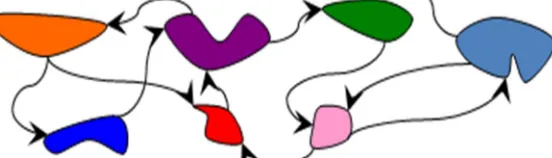
[image:7.612.170.446.633.712.2]e) Biogeography Based Optimization: Biogeography presents the study of biological organisms in geographical distribution. The idea of this optimization developed from the way of how species are distributed in various graphical areas. Mathematical equations that govern the distribution of organisms were first discovered and developed during the 2008. Species like fish, birds and animals migrate between islands through wind, flying, flotsam, swimming as shown in below fig.6.
Biogeography-based optimization (BBO) is a recently developed heuristic algorithm and population based evolutionary algorithm which has shown impressive performance on many well known benchmarks. For an optimization problem with a certain number of candidate solutions are used. But one good solution is analogous to a habitat with a high Habitat Suitability Index (HSI). This HSI corresponds to a geographical area that is well suited for hosting biological species in biogeography. In optimization problems, HSI corresponds to a measure of the goodness of a BBO solution, which is also called fitness[62][63]. There are two types of fitness functions are there that is high fitness solutions and low fitness solutions. High fitness solutions match with the large number of species, and low fitness solutions match with the a small number of species. High fitness solutions are share their features with other solutions, and low fitness solutions are accept shared features from other solutions. This approach to solve general optimization problems is called biogeography-based optimization (BBO). The algorithm of BBO consists of two main stages i.e., migration (information sharing) and mutation[64].
Migration: Migration is a probabilistic operator that may cause to improve a candidate solution. Each solution in migration are used to probabilistically share features between solutions. For each solution yk, the immigration rate ʎk is used to probabilistically decide whether it is immigrate or not. If we select the immigration, then we select the emigrating solution yj ,the probabilistic emigration rate is mj [65]. Migration is represented by
( ) ← ( ) --- (1)
where s represents solution feature, equivalent to a gene in GAs. Here, immigration rate ʎand emigration rate μ of each habitat are
based on a particular migration model. In the early stages of introducing BBO, Dan Simon proposed four different types of migration process, these types can be sorted as :
i) Partial Migration Based BBO “PMBBBO”
ii) Single Migration Based BBO“SMB-BBO”
iii) Simplified Partial Migration Based BBO“SPMB-BBO”
iv) Simplified Single Migration Based BBO“SSMB-BBO”
Mutation: Mutation is a probabilistic operator and that randomly modifies a solution feature. The purpose of mutation is to increase diversity between the population. For low fitness solutions, mutation provides them a chance of improving the quality of solutions, and for high fitness solutions, mutation is improve them even more than they already have.
Applications
v) Image Classification
vi) Emotion and stress recognition from speech signal vii) Object detection
f) Artificial Bee Colony: Artificial Bee Colony algorithm proposed by Karboga. It is an optimization algorithm and this algorithm totally based on a particular intelligent foraging behavior of honeybee swarms. ABC algorithm is efficiently solved engineering problems with high dimensionality. In ABC algorithm, the artificial bees colony swarm consists of three groups of bees that is employed bees, onlookers and scouts.
i) Employed Bees: Employed bees go to their food source and come back to hive and dance on this area. The employed bee whose food source has been abandoned becomes a scout and starts to search for finding a new food source .
ii) Onlookers: Onlookers choose a food source within the neighborhood of the food sources and also selected by themselves. By using probability based selection process onlookers are placed on the food sources.
iii) Scouts: The employed bee whose food source has been exhausted by the bees becomes a scout and its is searching the environment surrounding the nest for new food sources. The scouts are categorize by low search costs and a low average in food source quality. If a solution express a food source is not improved by a predetermined number of trials, then that food source is uncontrolled and the employed bee is converted to a scout [66][67][68]. The behavioral characteristics of honey bees : Foraging behaviours, Marriage behaviours, Queen bee concept.
Applications
i) Bioinformatics [69]
ii) solve complex transportation problem [70]
iii) Accident Diagnosis[71]
iv) Constrained Problem Optimization [72]
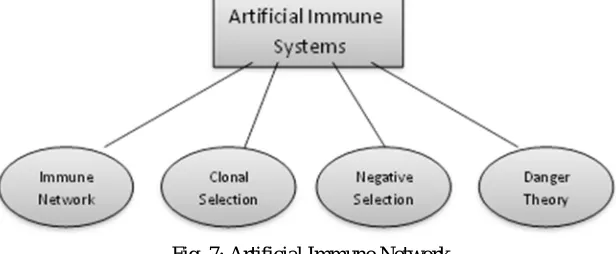
Nature gives protective measure to each species called immune system. Artificial Immune System (AIS) is a bio inspired model and rule based machine learning systems inspired by principles of immune system, which is used for solving different problems like genetic algorithms, neural networks and swarm intelligence in the area of information security. The computer immunology describes in two ways that is intrusion detection method and distributable change detection algorithm[73]. Artificial Immune System inspired from human immune system .The most significant feature of AIS is self and non self discrimination. These techniques used for anomaly detection in intrusion detection systems. Human immune system protects the human body from the foreign pathogens like AIS used a multilayered protection structure for protecting the computer networks from the attacks. Modern Artificial Immune systems are inspired by three sub components: Clonal selection, immune network, negative selection and Danger theory.
[image:9.612.151.459.253.380.2]1) Immune Network: The immune Network theory has been proposed by Jerne (1974). It was defined as complex network of paratopes that used to recognize set of idiotopes and also as well as these idiotopes used to recognize paratopes. For the process of recognizing signals Antigen-sensitive lymphocytes can respond either positively or negatively. A positive response gives the result into cell activation, cell proliferation and antibody secretion and negative response would result into suppression and tolerance [74]. Artificial immune Network as shown in figure 7.
Fig. 7: Artificial Immune Network
2) Clonal Selection: The principles are repertoire diversity, genetic variation and natural selection. The role of repertoire diversity is can be maintains if immune system produces more antibodies than what effectively used in binding with an antigen. Because of whenever the immune system responded majority of antibodies did not play any active role. And Natural variation is produced by the variable gene regions , the responsibility of these is production of highly diverse population of antibodies and selection occurs [75].
3) Negative Selection: The motive of negative selection is to provide tolerance for self cells. While the immune system’s identify the unknown antigens when not reacting to the self cells. And also it deals with the immune system's ability to detect unknown antigens while not reacting to the self cells. When the generation of T-cells, receptors are made through a pseudo-random genetic rearrangement process. Then after it undertake a censoring process in the thymus, called the negative selection [76].
Applications
a) Fault diagnosis[77]
b) Computer Security[78]
c) Robotics[79]
d) pattern recognition [80]
III. CONCLUSIONS
In this paper nature-inspired computation techniques and its applications are discussed. Typical illustrations are addressed for Artificial Neural computation, Evolutionary Algorithms, Swarm Intelligence, Artificial Immune Systems based algorithms and their applications.
REFERENCES [1]. G.Rozenberg, T.Back, J.Kok (2012), "Handbook of Natural Computing", Springer Verlag.
[2]. Shilpi Gupta, Shweta Bhardwaj, Parul Kalra Bhatia (2011), "A Reminiscent Study Of Nature Inspired Computation", International Journal of Advances in Engineering & Technology, May ISSN: 2231-1963.
[3]. Leandro Nunes de Castro (2006) "Fundamentals of natural computing: an overview", Science Direct, 1571-0645/$ Elsevier. doi:10.1016/j.plrev.2006.10.002. [4]. Peter Tino, Lubica Benuskova and Alessandro Sperduti "Artificial Neural Network Models".
[6]. Raghavendra Patidar, Lokesh Sharma(2011)," Credit Card Fraud Detection Using Neural Network", NCAI2011, 13-14 May 2011, Jaipur, India International Journal of Soft Computing and Engineering (IJSCE) ISSN: 2231-2307, Volume-1.
[7]. Santaji Ghorpade , Jayshree Ghorpade and Shamla Mant ," PATTERN RECOGNITION USING NEURAL NETWORKS ",International Journal of Computer Science & Information Technology (IJCSIT), Vol 2, No 6, December 2010 DOI : 10.5121/ijcsit.2010.2609.
[8]. David Reby , Sovan Lek , Ioannis Dimopoulos et.al.,(1997) , "Artificial neural networks as a classification method in the behavioural sciences ",40, 35-43. [9]. Filippo Amato, Eladia María Peña-Méndez, Petr Va?hara et.al.,(2013) "Artificial neural networks in medical diagnosis", Journal of Applied Biomedicine,
Vol11, Issue 2,pages 47-58.
[10]. Talib S. Hussain "An Introduction to Evolutionary Computation".
[11]. Rajkumari Bidya lakshmidevi "Survey on evolutionary compuatation techniques and its application in different fields". [12]. Thomas Riechmann, "Genetic Algorithm Learning and Economic Evolution".
[13]. Angela Ribeiro , Juan Ranz , Xavier P. Burgos-Artizzu et.al.(2011), "An Image Segmentation Based on a Genetic Algorithm for Determining Soil Coverage by Crop Residues", 6480-6492; doi:10.3390/s110606480, sensors ISSN 1424-8220
[14]. Komal R. Hole , Prof. Vijay S. Gulhane et.al., (2013) "Application of Genetic Algorithm for Image Enhancement and Segmentation", International Journal of Advanced Research in Computer Engineering & Technology, Vol 2, Issue 4, ISSN: 2278 - 1323.
[15]. Abdul Kadar Muhammad Masum, Mohammad Shahjalal and Md. Faisal Faruque et.al., (2011) "Solving the Vehicle Routing Problem using Genetic Algorithm", International Journal of Advanced Computer Science and Applications, Vol. 2, No. 7.
[16]. Rebecca parsons, Mark E. Johnson (1995), "DNA Sequence Assembly and Genetic Algorithms New Results and Puzzling Insights", ISMB-95 . [17]. Gary B. Fogel, David Fogel, Lawrence Fogel (2011), "Evolutionary programming", Scholarpedia, 6(4):1818.
[18]. Javier J. Sánchez Medina, Manuel J. Galán Moreno and Enrique Rubio Royo (2008) "Evolutionary Computation Applied to Urban Traffic Optimization", Innovation Center for Information Society (CICEI), Advances in Evolutionary Algorithms, ISBN 978-953-7619-11-4, pp. 468.
[19]. B.S. Duncan and A.J. Olson (1996) "Applications of evolutionary programming for the prediction of protein-protein interactions," Evolutionary Programming V, L.J. Fogel, P.J. Angeline and T. Baeck (eds.), MIT Press, Cambridge, pp. 411-417.
[20]. D.B. Fogel, E.C. Wasson, E.M. Boughton, and V.W. Porto (1997) "A step toward computer-assisted mammography using evolutionary programming and neural networks," Cancer Letters, Vol. 119, pp. 93-97.
[21]. D.B. Fogel, E.C. Wasson, E.M. Boughton and V.W. Porto (1998) "Evolving artificial neural networks for screening features from mammograms," Artificial Intelligence in Medicine, Vol. 14, pp. 317-326.
[22]. D.B. Fogel, L.J. Fogel, and W. Atmar (1993) "Evolutionary programming for ASAT battle management," Proc. 27th Asilomar Conf. on Signals, Systems, and Comptuers, A. Singh (ed.), IEEE Computer Society Press, Los Alamitos, CA, pp. 617-621.
[23]. D.B. Fogel (1990) "System identification through simulated evolution," Master's thesis, UC San Diego.
[24]. L.L. Lai and J.T. Ma (1996) "Application of evolutionary programming to transient and subtransient parameter estimation," IEEE Trans. Energy Convers., Vol. 11, pp. 523-529.
[25]. Hans-Georg Beyer And Hans-Paul Schwefel (2002), "Evolution strategies A comprehensive introduction", Natural Computing 1: 3-52.
[26]. T. Venkat Narayana Rao and Srikanth Madiraju (2010), "Genetic Algorithms and Programming-An Evolutionary Methodology ",Advanced Computing: An International Journal (ACIJ ), Vol.1, No.1, November, DOI : 10.5121/acij.2010.1102 11 .
[27]. Partha Chakroborty ,"Optimal Routing and Scheduling in Transportation: Using Genetic Algorithm to Solve Difficult Optimization Problems".
[28]. Langdon. WB and Buxton.BF (2003),"The Application of Genetic Programming for Drug Discovery in the Pharmaceutical Industry". EPSRC RAIS Secondment with GlaxoSmithKline.
[29]. William P. Worzel, Jianjun Yu and Arpit A. Almal, et.al., (2009) "Applications of Genetic Programming in Cancer Research", Int J Biochem Cell Biol. Feb; 41(2): 405-413. doi: 10.1016/j.biocel.2008.09.025.
[30]. Schlabach JL, Hayes CC and Goldberg DE., "FOX-GA: a genetic algorithm for generating and analyzing battlefield courses of action". [31]. H.Iba, T.Sato and H.DeGaris "System identification approach to genetic programming".
[32]. Yichen Hu "Swarm intelligence".
[33]. Andrea Roli "Swarm Intelligence: A brief introduction".
[34]. Bonabeau, E., Dorigo and M. and Theraulaz, G(1999) "Swarm Intelligence from Natural to Artificial System", Oxford University Press, pp.1-24. [35]. Alan Reynolds and Eric Bonabeau "Swarm Intelligence David Corne".
[36]. James J. Cochran (2010), "A Concise Overview Of Applications Of Ant Colony Optimization", Wiley Encyclopedia of Operations Research and Management Science.
[37]. Dorigo, Ant colony optimization web page, http://iridia.ulb.ac.be/mdorigo/ACO/ACO.html
[38]. Marco Dorigo, Eric Bonabeau and Guy Theraulaz (2000) "Ant algorithms and stigmergy " Future Generation Computer Systems 16 851-871, 0167-739X/00/$, PII: S0167-739X(00)00042-X.
[39]. Wei Gao (2016) "Improved Ant Colony Clustering Algorithm and Its Performance Study", Computational Intelligence and Neuroscience, Article ID 4835932, 14 pages http://dx.doi.org/10.1155/2016/4835932.
[40]. Luca Maria Gambardella, Fabio de Luigi "Ant Colony Optimization Vittorio Maniezzo".
[41]. Nishitha Taraka and Amarnath Emani (2014),"Routing in Ad Hoc Networks Using Ant Colony Optimization", Fifth International Conference on Intelligent Systems, Modelling and Simulation, 2166-0662/14,IEEE DOI 10.1109/ISMS.2014.100.
[42]. Ivan Brezina Jr. Zuzana ?i?ková (2011), "Solving the Travelling Salesman Problem Using the Ant Colony Optimization", Management Information Systems, Vol. 6, No. 4, pp. 010-014, UDC 005.658.6.
[43]. R. Schoonderwoerd, O. E. Holland and J. L. Bruten et.al.,(1997), "Ant-based load balancing in telecommunications networks adaptive behavior", 5(2):169-207. [44]. W. N. Chen, J. ZHANG and H. Chung (2010), "Optimizing Discounted Cash Flows in Project Scheduling--An Ant Colony Optimization Approach", IEEE
Transactions on Systems, Man, and Cybernetics--Part C: Applications and Reviews Vol.40 No.5 pp.64-77.
[46]. X. M. Hu, J. ZHANG?J. Xiao and Y. Li (2008), "Protein Folding in Hydrophobic-Polar Lattice Model: A Flexible Ant- Colony Optimization Approach ", Protein and Peptide Letters, Volume 15, Number 5, Pp. 469-477.
[47]. Shmygelska, R. A. Hernández and H. H. Hoos (2002), "An ant colony algorithm for the 2D HP protein folding problem," Proceedings of the 3rd International Workshop on Ant Algorithms/ANTS, Lecture Notes in Computer Science, vol.2463, pp.40-52.
[48]. M. Nardelli; L. Tedesco; A. Bechini (2013). "Cross-lattice behavior of general ACO folding for proteins in the HP model". Proc. of ACM SAC 2013: 1320-1327. doi:10.1145/2480362.2480611.
[49]. Mahamed G. H. Omran (2005), "Particle Swarm Optimization Methods for Pattern Recognition and Image Processing", University of Pretoria etd - Omran. [50]. Kennedy J. (1997), "The Particle Swarm: Social Adaptation of Knowledge", Proceedings of the International Conference on Evolutionary Computation, pp.
303-308, IEEE Press.
[51]. Rabab M. Ramadan and Rehab F. Abdel - Kader (2009) "Face Recognition Using Particle Swarm Optimization-Based Selected Features", International Journal of Signal Processing, Image Processing and Pattern Recognition Vol. 2, No. 2.
[52]. Ali Khazaee,(2013)" Heart Beat Classification Using Particle Swarm Optimization ",I.J. Intelligent Systems and Applications, 06, 25-33, DOI: 10.5815/ijisa.2013.06.03.
[53]. Hugo A. Perlin, Heitor S. Lopes and Tânia Mezzadri Centeno "Particle Swarm Optimization for Object Recognition in Computer Vision", DOI: 10.1007/978-3-540-69052-8_2.
[54]. Mohamad Omran, Ayed A. Salman and Andriesp.Engel (2004) "Image Classification using Particle Swarm Optimization",DOI: 10.1142/9789812561794_0019.
[55]. Qing Wu, Colin Cole and Tim Mc Sweeney ,"Applications of particle swarm optimization in the railway domain", ISSN: 2324-8378 (Print) 2324-8386 (Online).
[56]. Venkata Vijaya Geeta. Pentapalli and Ravi Kiran Varma (2016), "Cuckoo Search Optimization and its Applications: A Review", ISSN (Online) 2278-1021 ISSN (Print) 2319 5940, Vol. 5, Issue 11.
[57]. Iztok FisterJr. , Xin-She Yang, Dušan Fister, Iztok Fister(2013), "Cuckoo Search: A Brief Literature Review",Volume 516 of the series Studies in Computational Intelligence, pp 49-62.
[58]. Giveki, D., H. Salimi, G. Bahmanyar, and Y. Khademian. (2012), "Automatic detection of diabetes diagnosis using feature weighted support vector machines based on mutual information and modified cuckoo search". Available at arXiv preprint arXiv:1201.2173.
[59]. M. N. Sudha and S. Selvarajan (2016), "Feature Selection Based on Enhanced Cuckoo Search for Breast Cancer Classification in Mammogram Image", Circuits and Systems, 7, 327-338 Published Online http://dx.doi.org/10.4236/cs.2016.74028
[60]. Hakimi Gilani, S., Vafrakhth, H.(2012), "Determine the capacity of wind power plants by Cuckoo optimization algorithm", the second Conference on Renewable Energy and Distributed Generation Iran, Tehran University.
[61]. Manian Dhivya , Murugesan Sundarambal , Loganathan Nithissh Anand (2011), "Energy Efficient Computation of Data Fusion in Wireless Sensor Networks Using Cuckoo Based Particle Approach", Int. J. Communications, Network and System Sciences, , 4, 249-255 doi:10.4236/ijcns.2011.44030 Published Online. [62]. Bhuvnesh Khokhar, K. P. Singh Parmar ,SurenderDahiya (2012),"Application of Biogeography-based Optimization for Economic Dispatch Problems",
International Journal of Computer Applications (0975 - 888) Volume 47- No.13.
[63]. Du, D., Simon and D., Ergezer, M.,(2009), "Biogeography-based optimization combined with evolutionary strategy and immigration refusal". Proceedings of the IEEE Conference on Systems, Man, and Cybernetics, San Antonio, Texas, pp. 10231028.
[64]. Wee Loon Lim, Antoni Wibowo, Mohammad Ishak Desa, and Habibollah Haron (2016) "A Biogeography-Based Optimization Algorithm Hybridized with Tabu Search for the Quadratic Assignment Problem", Computational Intelligence and Neuroscience, Article ID 5803893, 12 pages http://dx.doi.org/10.1155/2016/5803893.
[65]. Haiping Ma and Dan Simon b (2011) "Analysis of migration models of biogeography-based optimization using Markov theory",Engineering Applications of Artificial Intelligence 24, 1052-1060.
[66]. Adil Baykasoùlu, Lale Özbak?r and P?nar Tapkan (2007), "Artificial Bee Colony Algorithm and Its Application to Generalized Assignment Problem",ISBN 978-3-902613-09-7, pp. 532, Itech Education and Publishing, Vienna, Austria.
[67]. D.Karaboga (2005) "An idea based on honey bee swarm for numerical optimization" TR-06.
[68]. D.Karaboga, B. Basturk (2007) "On the performance of artificial bee colony (ABC) algorithm" Applied Soft Computing, 687-697, Elsevier B.V. doi:10.1016/j.asoc.2007.05.007.
[69]. Asaju La'aro Bolaji, Ahamad Tajudin Khader, Mohammed Azmi Al-Betar Et.Al.,(2013) "Artificial Bee Colony Algorithm, Its Variants And Applications: A Survey ",Journal Of Theoretical And Applied Information Technology 20th. Vol. 47 No.2 © 2005 - 2013 Jatit & Lls.
[70]. D. Teodorovic and M. Dell' orco (2005), "Bee Colony Optimization - A Cooperative learning approach to Complex Transportation Problems," In Proceedings of the 16th Mini-EURO Conference on Advanced OR and AI Methods in Transportation (2005), pp. 51-60.
[71]. M. S. Oliveira, R. Schirru and J. A. C. C. de Medeiros1(2009), "On the Performance of an Artificial Bee Colony Optimization Alogithm Applied to the Accident Diagnosis in a PWR Nuclear Pwer Plant," In Proceedings of International Nuclear Atlantic Conference - INAC Brazil, pp. 1-11, 27.
[72]. N. Stanarevic, M. Tuba, and N. Bacanin (2011), "Modified Artificial Bee Colony algorithm for Constrained Problems Optimization," International Journal of Mathematical Models and Methods in applied Sciences, vol. 5, pp.644-651.
[73]. Kathir.Viswalingam and Ayyappan(2014), "A Study and Survey of Artificial Immune Systems", International Journal of Innovative Research in Computer and Communication Engineering, ISSN(Online): 2320-9801 ISSN (Print): 2320-9798, Vol. 2, Issue 12.
[74]. J.R. Al-Enezi, M.F. Abbod and S. Alsharhan (2010) "Artificial Immune Systems 118 Artificial Immune Systems - Models, Algorithms And Applications", Ijrras 3 (2) .
[75]. Aickelin, Uwe and Dasgupta, D. (2005) Artificial immune systems. In: Introductory Tutorials in Optimisation, Decision Support and Search Methodology "Access from the University of Nottingham repository:
[76]. Jungwon Kim and Peter Bentley, "Negative Selection and Niching by an Artificial Immune System for Network Intrusion Detection".
[78]. Lincy Elizebeth Jim and Mark A. Gregory (2016), "A Review of Artificial Immune System Based Security Frameworks for MANET", Communications, Network and System Sciences, 9, 1-18.
[79]. An Artificial Behavioral Immune System for cognitive robotics".