5
X
October 2017
Performance Analysis of Various Routing Protocols
in Wireless Sensor Network
Shailesh K. Sarvan1, Manu Sood2
1, 2
Department of Computer Science, Himachal Pradesh University, Shimla, India
Abstract: Wireless Sensor Network (WSN) consists ofnumerous sensors that are connected to form a network and these sensors shares the information gathered through the wireless links. The data from one sensor node is forwarded through multiple nodes to the destination. Wireless Sensor Network demands limited communication, computation and energy resources. IEEE 802.15.4 standard and ZIGBEEprovide low power consumption and also the low cost communication which is suitable for the wireless sensor networks. There are various routing protocols that are suitable for WSN and these protocols have to work efficiently considering power and resource limitations of sensor network. AODV, DYMO and LEACH are the 3 different routing protocols that have been discussed in this paper. We also compared these protocols on the basis of parameters like Average Throughput, Average Packet Delivery Ratio, Average End to End Delay and Average Energy Consumption. We have used NS2 Network Simulator for simulation of these protocols depending upon various scenarios.
Keywords: WSN, Routing, AODV, DYMO, LEACH.
I. INTRODUCTION
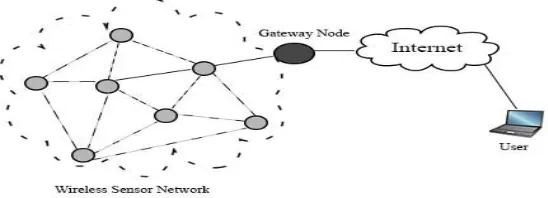
[image:2.612.162.436.432.531.2]Wireless Sensor Network is a network of multiple sensors connected to form a single network which can be connected to internet using gateways. Sensors are simple nodes which are capable of collecting data, processing it and sharing it with other devices. A sensor node measures ambient conditions from environment and transforms it into electrical signals and sends these signals through radio transceivers to gateway node. This gateway node is responsible for sending the collected data to other devices over the internet [1].
Fig. 1 A Wireless Sensor Network
Applications of Wireless Sensor Network:
1) Sensor nodes can monitor heat and pressure of certain region. 2) Real time traffic information.
3) Air pollution monitoring.
4) Surveillance system for security purpose. 5) Industrial monitoring.
6) Health monitoring.
in which AODV, DYMO and LEACH protocols are discussed. Objectives of this study arelisted in Section III. In Section IV, provide information of the performance metrics which are used to compare these routing protocols. Simulator which we used and the simulation setup are described in Section V. In Section VI, we will discuss the results obtained from the simulations. Finally, Section VII concludes our paper.
II. ROUTING PROTOCOLS
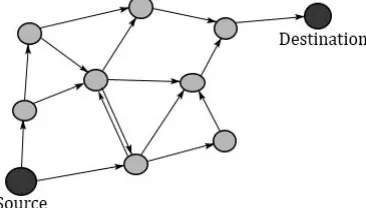
[image:3.612.202.423.183.343.2]A routing protocol specifies how sensor nodes communicate with each other. A routing algorithm determines the specific choice of route through which data transmission takes place between source and destination.
Fig.2 Routing in WSN
Types of Routing Protocols [3]
1) Proactive Routing Protocol: In Proactive Routing Protocol node maintains one or more tables representing the entire topology of the network. Routes are always available. This leads to low latency and high overhead.
2) Reactive Routing Protocol: In Reactive Routing Protocol the node initiate route discovery process until a route to destination is required. This leads to high latency and low overhead.
3) Hybrid Routing Protocol: This Protocol uses the feature of Proactive and Reactive Protocols and tries to exploit their strengths.
A. AODV (Ad-hoc On-demand Distance Vector)
AODV is an on demand i.e. reactive protocol. It allows nodes to transmit data through their neighbors to destination node with which they cannot directly communicate. Routes are created on demand and are maintained as long as they are required by the sources [4]. Network remains silent until connection is established. Nodes that demand for the connection to be established broadcast their request for connection. Other AODV nodes maintain the record of node that requests connection and keeps on forwarding the message of route request (RREQ). This creates a temporary route back to the requesting node as shown in Fig. 3. The node that holds a route to a destination node sends backward message (RREP) through the temporary routes to the requesting node as shown in Fig. 4. Now, if there are various routes from source node to destination node then the source node selects that route which requires least number of hops to the destination node. And if the node link fails then the whole process of route finding is repeated.
[image:3.612.222.405.605.709.2]Fig. 4 Route Reply (RREP) after route discovery
Route table is maintained by every node with one entry per destination. AODV uses sequence number for loop free routing and route maintenance [5]. Timers are used to delete expired routes in routing table.
B. DYMO (Dynamic MANET On-demand) Routing Protocol
The Dynamic MANET On-demand (DYMO) routing protocol is the successor to the AODV protocol. It is an enhancement of AODV and is easier to implement. DYMO is a hybrid routing protocol i.e. it is both proactive and reactive protocol.
Just like in AODV, when a source needs to send the data packet it broadcast route request RREQ to its neighbors to discover the route to the destination [6]. If route is not obtained within the RREQ waiting period, then it may again try to discover route through another RREQ data packet. DYMO uses exponential backoff mechanism to reduce congestion in the network due to repeated attempts for route discovery. Data packets that are waiting to be routed are buffered and it may have either negative or positive impact on the performance of the system. If the maximum number of route discovery attempts is reached and destination is still not discovered then all the data packets in the buffer are dropped and Destination Unreachable ICMP message is delivered to the source. If the route is discovered but after sometime the link to the destination node breaks. Then, the Route Error RERR packet is issued which notifies the DYMO router that certain route is no longer available.
C. LEACH (Low Energy Adaptive Clustering Hierarchy)
[image:4.612.211.406.460.593.2]LEACH protocol is a hierarchical routing protocol. The main aim of hierarchical routing protocol is to increase the node’s lifespan by reducing the energy consumption of the nodes.
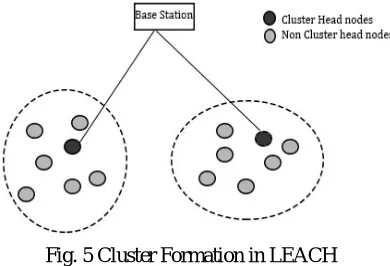
Fig. 5 Cluster Formation in LEACH
The nodes form a cluster, and each cluster has its Cluster Head [7]. The job of cluster head is to collect data from their surrounding nodes and transmit it to the base station. Since the a lot of energy is consumed while transmitting data to base station, the LEACH uses Stochastic Threshold Algorithm [8] to randomly selects the few sensor nodes as cluster head and rotates this role to evenly distribute the energy load among the sensors of the network.
The LEACH network has 2 phases [9]
1) The Set-Up Phase:The phase in which the cluster heads are chosen.
2) The Steady-State Phase:The phase in which the cluster heads are maintained and data is transmitted between the nodes.
III. OBJECTIVES The main objective for this research is as follows
1) To compare the 3 key routing algorithms of WSN based oncertain parameters.
2) To find out which of the three protocolsperform better in different scenario.
VII. PERFORMANCE METRICS
Throughput:Throughput of a network is the average rate of successful message delivery over a communication channel. Throughput (T) = (No. of bytes) * 8 / (Finish Time – Start Time) bps
Packet Delivery Ratio: It is the ratio between the total number of packets received and the total number of packet sent. Packet Delivery Ratio (PDR) = (No. of packets received / No. of packets sent) * 100
End to End Delay: It refers to the time taken for a packet to be transmitted across a network from source to destination. End to End Delay (D) = Total time taken by a packet from Source to Destination.
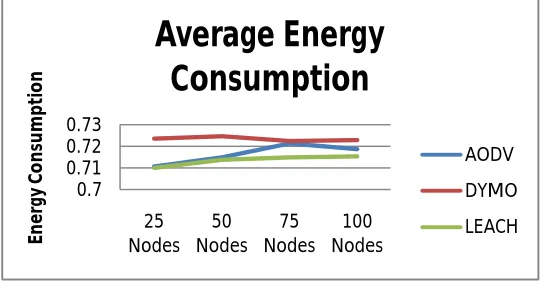
Energy Consumption: It indicates average amount of energy spent in each node for individual task. Average Energy Consumption (E) = (TE + RE + IE) / No. of Nodes
Where,
TE = Total energy consumed for transmission of packets RE = Total energy consumed for reception of packets IE = Energy consumed when nodes are in idle state.
V. SIMULATION A. About Simulator
We have used NS2 Network Simulator for the simulations of routing algorithms in wireless sensor network. NS2 is an open source network simulator tool that runs on Linux. It supports multiple protocols and capability of graphically detailing network traffic [10]. NS2 also supports various algorithms in routing and queuing. Complex scenarios can easily be tested in NS2 simulator. NS2 is a package of tools that simulates behavior of networks such as creating network topologies, log events that happen under any loads, analyze the events and understands the network.
B. Simulation Parameters
Simulations were performed using NS2 Network Simulator. Simulation scenario varies from 25 nodes to 100 nodes in a rectangular area of 500m x 500m. In Table I, we have summarized different parameters used for our simulations.
TABLE I
Parameters Used In Simulation
Parameter Value
Protocols Studied AODV, DYMO, LEACH
Channel Type Wireless Channel
Antenna Type Omni Directional Antenna
Propagation Model Two Ray Ground
Simulation Time 30 sec
Terrain Area 500m x 500m
Traffic Type UDP(CBR)
No. of Nodes 25, 50, 75, 100
VI. RESULTS AND DISCUSSIONS A. Throughput
Fig. 6Throughput vs. Number of Nodes
B. Packet Delivery Ratio
[image:6.612.159.454.288.433.2]Based on Fig. 7, packet delivery ratio of AODV and LEACH decreases with increase in the number of nodes. In case of DYMO,packet delivery ratio first increases then decreases and again increases. Hence, we say that in case of DYMO number of nodes does not determine the packet delivery ratio.
Fig. 7Packet Delivery Ratio vs. Number of Nodes
C. End to End Delay
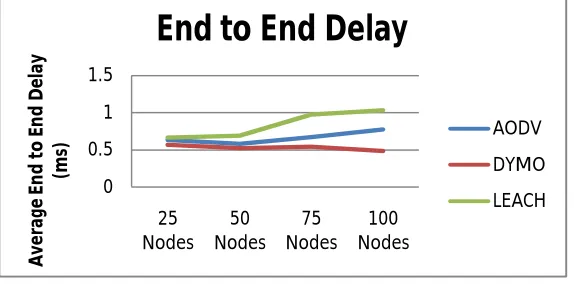
In Fig. 8, we observed that in LEACH due to cluster head selection the delay increases with the number of nodes. However, DYMO shows least delay as compared to AODV and LEACH because of exponential backoff mechanism which reduces congestion in the network.
Fig. 8 End to End Delay vs. Number of Nodes
D. Average Energy Consumption
Hierarchical Protocols are specially designed for efficient energy consumption, whereas reactive and hybrid protocols are not much energy efficient. Fig. 9 shows that LEACH which is hierarchical protocol consumes least energy as compared to AODV and DYMO. However AODV is comparatively more energy efficient than DYMO.
0 0.5 1 1.5 2 25 Nodes 50 Nodes 75 Nodes 100 Nodes T h ro u gh p u t
Throughput
AODV DYMO LEACH 0 20 40 60 8025 Nodes 50 Nodes 75 Nodes 100
Nodes P ac ke t D e liv e ry R at io %
Packet Delivery Ratio
AODV DYMO LEACH 0 0.5 1 1.5 25 Nodes 50 Nodes 75 Nodes 100 Nodes A ve ra ge E n d t o E n d D e la y (m s)
End to End Delay
AODV
DYMO
[image:6.612.164.451.515.657.2]Fig. 9 Average Energy Consumption vs. Number of Nodes
VII. CONCLUSION
In this work, we studied 3 protocols (AODV, DYMO and LEACH) that provide routing solution to the Wireless Sensor Network. These routing algorithms were compared using parameters such as Throughput, Packet Delivery Ratio, End to End Delay and Average Energy Consumption. With the simulations and results we obtained, we conclude that LEACH protocol is more energy efficient as compared to AODV and DYMO. But in case of other parameters DYMO performs better than AODV and LEACH.
REFERENCES
[1] Sharma, Gaurav, SumanBala, and Anil K. Verma. "Comparison of flooding and directed diffusion for wireless sensor network." India Conference (INDICON), 2009 Annual IEEE.IEEE, 2009.
[2] Felsche, Matthias, Alexander Huhn, and Horst Schwetlick. "Routing protocols for 6LoWPAN." International Conference on IT Revolutions. Springer, Berlin, Heidelberg, 2011.
[3] Routing in Ad Hoc Wireless Networks. http://folk.uio.no/kenneho/studies/essay/node11.html.
[4] Kansal, Parul, DeepaliKansal, and ArunBalodi. "Compression of various routing protocol in wireless sensor network." International Journal of Computer Applications 5.11 (2010): 0975-8887.
[5] Farooq, Hasan, and Low Tang Jung. "Performance analysis of AODV routing protocol for wireless sensor network based smart metering." IOP Conference Series: Earth and Environmental Science. Vol. 16.No. 1.IOP Publishing, 2013.
[6] Raghuvanshi, A. S., and S. Tiwari. "DYMO as routing protocol for IEEE-802.15. 4 enabled wireless sensor networks." Wireless Communication and Sensor Networks (WCSN), 2010 Sixth International Conference on. IEEE, 2010.
[7] Handy, M. J., Marc Haase, and Dirk Timmermann. "Low energy adaptive clustering hierarchy with deterministic cluster-head selection." Mobile and Wireless Communications Network, 2002.4th International Workshop on.IEEE, 2002.
[8] Gawade, Rohit D., and Sanjay L. Nalbalwar. "A centralized energy efficient distance based routing protocol for wireless sensor networks." Journal of Sensors 2016 (2016).
[9] Gill, ReenkamalKaur, PriyaChawla, and Monika Sachdeva. "Study of LEACH routing protocol for Wireless Sensor Networks." International Conference on Communication, Computing and Systems (ICCCS–2014). 2014.
[10] Network Simulator 2: a Simulation Tool for Linux. http://www.linuxjournal.com/article/5929