Computational analysis of intensive and
extensive properties of Nano fluids
Rakesh Kumar1 Mehak Hans2 Rockey Tyagi3 Department of Materials Science and Nano Technology
Deen Bandhu Chhotu Ram University of Science and Technology Sonepat, Haryana
Abstract: A colloidal mixture of Nano-sized (<100 nm) particles in a base fluid called Nano-fluid, which is the new era of heat exchange fluid for different high temperature exchange applications where transport attributes are considerably higher than those of the base fluid. In the present study, the impacts because of volume fraction on thermo-physical properties (Thermal conductivity, Density, Specific Heat and Heat Capacity) for CuO,Al2O3,TiO2,Fe3O4 with water and ethylene glycol based Nanofluids are tentatively explored. The present work concentrates on thermal conductivity and heat Capacity of Nano fluids using computational analysis. Results demonstrate that thermal conductivity increments with volume fraction for different Nano fluids with different percentage-of-increment
Keywords: Specific Heat, Thermal Conductivity, Heat Capacity, Density,
I. INTRODUCTION
Auto radiator is a basic bit of the engine cooling system. Due to confined space at the front of the engine, the degree of the radiator is constrained and can't be fundamentally stretched. Thusly, it is essential to grow the high temperature trade capacities of working fluids, for instance, water and ethylene glycol in radiators because of their low thermal conductivity. A late headway in Nanotechnology has been the presentation of Nano-fluids, i.e. colloidal suspensions of nanometer-sized strong particles rather than regular working liquids. Nanofluids are another class of liquids designed by Choi (1995)[1] scattering nanometer-sized materials (nanoparticles) in base liquids.Nanofluids are Nanoscale colloidal suspensions containing condensed Nano materials. They are two-stage frameworks with one two-stage (solid phase) in an alternate (fluid phase). Due to their phenomenal
Thermal execution, Nano- liquids have pulled in consideration as another era having diverse application in the field of Heat Exchangers, in Chemical Plants and in Auto-Cooling . Defense and Aerospace applications .The paper assesses different parameters of Heat exchange and relations between them.
A. Literature Review
Lee et al. (1999)[2] created model for measuring the thermal conductivity of liquids containing metals or metal oxides of conductivity higher than base liquids. Wang et al. (1999)[3] led probes the liquids having nanoparticles mixture and found that thermal conductivities of nanoparticle–fluid mixtures expand with respect to those of the base liquids. Li and Peterson (2006) investigate the nanofluids by differing the temperature of the liquid and additionally the volume fraction has been changed, and found that there is a viable increment in the thermal conductivity of the nanofluids. Xuan and Li (2003)[4] investigated experimentally heat transfer performance of Cu/water Nano fluid with concentration of 2% under turbulent flow conditions in a tube and observed more than 39% enhancement in the Nusselt number compared with pure water. Liu et al. (2006) and Murshed et al. (2005)[5] demonstrated the thermal conductivity improvement of Cuo Nano fluid and Titanium dioxide nanofluids respectively. Ollivier et al.[6] (2006) investigated the utilization of Nano fluids as a jacket water coolant in a gas spark ignition engine. They numerically simulated the unsteady heat exchange through the chamber and inside the coolant stream and reported that in light of higher thermal diffusivity of nanofluids, the thermal signal variations for knock detection expanded by 15% over the anticipated utilizing immaculate water. Nguyen et al. (2007) [7] used Al2O3/water Nano-fluid in an electronic cooling system and found a
maximum of 40% Enhancement in convective heat transfer coefficient at an added particle concentration of 6.8 vol%. Gherasim et al.(2011)[8] displayed numerical recreations for an outspread stream cooling framework with an Al2O3/water Nano-fluid stream. The
of a square molded micro-channel heat exchanger (MCHE). Their results exhibited that Al2O3 and Ag nanoparticles have the most
noteworthy heat exchange coefficient and least Pressure drop among all nanoparticles tried, separately. They inferred that the profits of nanofluids, for example, upgrade in heat exchange coefficient are prevailing over the weaknesses, for example, increment in Pressure Drop. Peyghambarzadeh et al. (2011)[10] examined tentatively the convective high temperature exchange improvement of water and Ethylene Glycol based nanofluids.. The results demonstrate that the high temperature exchange improves around 40% compared with the base liquids in the best conditions. Shafahi et al.(2012) [11] utilized a two-dimensional investigation to study the heat exchange of a barrel shaped high temperature funnel using Al2O3,CuO and Tio2 nanofluids. Their results affirmed that the heat
exchange of a heat pipe is enhanced and thermal resistance across the heat pipe are reduced and maximum capillary heat transfer of the heat pipe is observed when nanofluids are utilized as the working fluid. The so improved properties of base fluids with nanoparticles dispersed in them need to be explored.
Table1. Thermo Physical Properties of various Nanoparticles in oxide Form
Particles Specific
Heat (J/kg K)
Density( Kg/m3)
Thermal Conductivity (W/mK)
Diameter
Al2O3 880 3700 46 20nm
CuO 540 6510 18 20nm TiO2 710 3840 11.7 10nm
Fe3O4 670 5180 80.4 36nm
Table2. Thermo Physical properties of base Fluids
Base Fluids
Specific Heat (J/kg K)
Density (Kg/m3)
Thermal Conductivity (W/mK)
Diameter (nm)
Water 4197 971 0.669 0.384 Ethylene
Glycol
2608.3 1081.4 0.261 0.415
II. METHODOLOGY
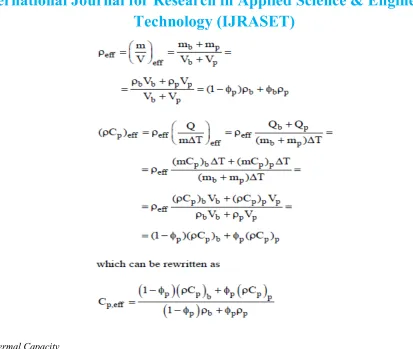
In order to examine the heat exchange of nanofluids and use them in practical applications, it is essential first to study their thermo-physical properties such as density, specific heat and thermal conductivity.
A. Specific Heat and Density
B. Thermal Capacity
It is the product of the density of nanofluids and the specific heat of nanofluids. It is a measurable physical quantity equal to the ratio of the heat added to (or subtracted from) an object to the resulting temperature change. Heat capacity is an extensive property of matter, meaning it is proportional to the size of the system.
Q = ρnf X Cpnf
C. Thermal Conductivity
The Thermal conductivity (knf) for Nano-fluid have been evaluated focused around two semi-empirical mathematical statements exhibited by Corcione [14](2011) on the premise of a wide experimental data of trial information accessible in the writing as taking after comparisons:
III. RESULTS
[image:4.612.92.505.53.402.2]0.00 0.01 0.02 0.03 0.04 960 980 1000 1020 1040 1060 1080 1100 1120 1140 1160 1180 1200 1220 1240 1260 1280 1300 1320 D en s ity ( K g/m 3) Volume fraction Al2O3/Water CuO/water TiO2/water Fe3O4/Water Al2O3/EG CuO/EG TiO2/EG Fe3O4/EG
The density of Nano-fluids for volume fraction from 1% to 4% increases with water and ethylene glycol as base fluid.[15] Fig2. Specific Heat of Nano fluid with Base Fluid as water and ethylene Glycol
0.00 0.01 0.02 0.03 0.04 2200 2400 2600 2800 3000 3200 3400 3600 3800 4000 4200 S p e c ifi c h e a t (J /K g K ) volume fraction Al2O3/Water CuO/Water TiO2/water Fe3O4/Water Al2O3/EG CuO/EG TiO2/EG Fe#O4/EG
0.00 0.01 0.02 0.03 0.04 4015000 4020000 4025000 4030000 4035000 4040000 4045000 4050000 4055000 4060000 4065000 4070000 4075000 4080000 Th e rm a l c a p a c it y volume fraction Al2O3/water CuO/water TiO2/water Fe3O4/water
Fig4. Thermal Capacity of Nano fluids with Ethylene Glycol as base fluid
0.00 0.01 0.02 0.03 0.04
2816000 2818000 2820000 2822000 2824000 2826000 2828000 2830000 2832000 2834000 2836000 2838000 2840000 2842000 2844000 2846000 2848000 2850000 T he rm al C apa c it y Volume fraction Al2O3/EG CuO/EG TiO2/EG Fe3O4/EG
0.005 0.010 0.015 0.020 0.025 0.030 0.035 0.040 0.0 0.2 0.4 0.6 0.8 1.0 1.2 1.4 1.6 1.8 2.0 2.2 Keff/Kbf C D E Al2O3/Water CuO/Water TiO2/Water Fe3O4/Water Volume fraction K e ff /K b
Fig6. Keff/Kb for different nanofluids with Ethylene Glycol as base fluid at 343K.
0.005 0.010 0.015 0.020 0.025 0.030 0.035 0.040
0 2 4 6 8 10 12 14 Keff/Kb C D E Al2O3/EG CuO/EG TiO2/EG Fe3O4/EG Volume fraction K e ff /K b
There is an increment in the effective thermal conductivity of the nanofluids as compared to the base fluids. (Ethylene Glycol and Water).The increment in the thermal conductivity is more in the ethylene Glycol as base fluid as compared to the water as base fluid[11,19-21]
In the present study, the effective thermal conductivity, Density, Specific Heat and Thermal Capacity of CuO/Al2O3/TiO2/Fe3O4:Water/Ethylene Glycol based nanofluids with particle volume fraction were investigated at temperature
343K. The results show that the relative thermal conductivity of Nano fluid increases with particle volume fraction and . In contrast, the density of nanofluids significantly increases with particle volume fraction. The effect of temperature on the enhanced thermal conductivity of nanofluids is important for theoretical understanding and needs to be considered for further development. Finally, it is inferred from this study that the thermo-physical properties should be considered as important parameters with the use of nanofluids for high-temperature applications.
Nomenclature
ρnf= density of Nano fluid
ρp= density of particles (Kg/m3)
Cp= specific heat of Nano particles
Cp nf =specific heat of Nanofluids (J/KgK)
Mb= mass of base fluids
Mp= mass of Particles (Kg)
Vb=volume of Base fluids
Vp=volume of Particles (m3)
Q = Thermal Capacity (J) Re= Reynolds Number Pr= Pradantl Number
Kb =Thermal Conductivity of Base fluid T=Temperature (K)
Keff= Effective thermal Conductivity
REFERENCES
[1] Choi S. U. S., Eastman J. A., Enhancing Thermal Conductivity of Fluids with Nanoparticles, ASME International Mechanical Engineering Congress & Exposition, USA, (1995).
[2] Lee S, Choi SUS, Li S, Eastman JA et al (1999) Measuring thermal conductivity of fluids containing oxide nanoparticles. Trans Am Soc Mech Eng 121:280– 289
[3] Wang X, Xu X, Choi SUS (1999) Thermal conductivity of nanoparticle–fluid mixture. Thermophys Heat Transf 13:474–480 [4] Xuan Y, Li Q (2003) Investigation on convective heat transfer and flow features of nanofluids. Int J Heat Transfer 125:151–155 [5] Murshed SMS, Leong KC, Yang C (2005) Enhanced thermal conductivity of TiO2–water based nanofluids. Int J Therm Sci44:367–373
[6] E. Ollivier, J. Bellettre, M. Tazerout and G. C. Roy, “De- tection of Knock Occurrence in a Gas SI Engine from a Heat Transfer Analysis,” Energy Conversion and Man- agement, Vol. 47, No. 7-8, (2006), pp. 879-893.
[7] Nguyen C.T., Roy G., Gauthier C., Galanis N., Heat transfer enhancement using Al2O3-water nanofluid for an electronic liquid cooling system, Applied Thermal Engineering, Vol. 27, Iss. 8-9, (2007), pp. 1501-1506
[8] Gherasim I., Roy G., Nguyen C.T., Vo-Ngoc D., Heat transfer enhancement and pumping power in confined radial flows using nanoparticle suspensions (nanofluids), International Journal of Thermal Sciences, Vol. 50, No. 3, (2011), pp. 369-377.
[9] Mohammed H.A., Bhaskaran G., Shuaib N.H., Saidur R., Influence of nanofluids on parallel flow square microchannel heat exchanger performance, International Communications in Heat and Mass Transfer, Vol.38, No. 1, (2011), pp. 1-9.
[10] Peyghambarzadeh S.M., Hashemabadi S.H., Hose-ini S.M., Seifi Jamnani M., Experimental study of heat transfer enhancement using water/ethylene glycol based nanofluids as a new coolant for car radiators, International Communications in Heat and Mass Transfer, Vol. 38, Iss. 9, (2011), pp. 1283-1290.
[11] Shafahi M., Bianco V., Vafai K., Manca O., An investigation of the thermal performance of cylindrical heat pipes using nanofluids, International Journal of Heat and Mass Transfer, Vol. 53, Iss. 1-3,( 2012) , pp. 376-383.
[12] B.C. Pak, Y.I. Cho, Hydrodynamic and heat transfer study of dispersed fluids with submicron metallic oxide particles, Exp. Heat Transf. 11 (1998) 151-170. [13] Y. Xuan, W. Roetzel, (2000). Conceptions for heat transfer correlation of nanofluids, International Journal of Heat and Mass Transfer, 43 (2000), 3701-3707. [14] M. Corcione, “Empirical Correlating Equations for Pre- dicting the Effective Thermal Conductivity and Dynamic Viscosity of Nanofluids,” Energy Conversion
and Man- agement, Vol. 52, No. 1,2011,pp.789-793.
[15] R. S. Vajjha, D. K. Das density measurement of different nano fluids and their comparision with theoretical Petroleum Science and Technology 01/2009; 27:612-624; DOI: 10.1080/10916460701857714
[16] Mahesh Juneja D. Gangacharyulu Experimental Analysis on Influence of Temperature and Volume Fraction of Nanofluids on Thermophysical Properties (IJETCAS) 5(3), June-August, 2013
[19] Navid Bozorgan, Komalangan Krishnakumar, Nariman Bozorgan The Performance Evaluation of Overall Heat Transfer and Pumping Power of γ-Al2O3/water Nanofluid as Coolant in Automotive Diesel Engine Radiator ANALELE UNIVERSITĂłII “EFTIMIE MURGU” RESIłA ANUL XX, NR. 1, 2013, ISSN 1453 – 7397
[20] Navid Bozorgan, Komalangan Krishnakumar Nariman Bozorgan Numerical Study on Application of CuO-Water Nanofluid in Automotive Diesel Engine Radiator Modern Mechanical Engineering, 2012, 2, 130-136