5
IV
April 2017
Technology (IJRASET)
Implementation of FBMC with Parallel Algorithms
for High Performance Spectrum Sensing and
Transmitting
Arun. V1,Jayanthi. N21
PG Scholar, 2AP, Department of Electronics & Communication Engineering Mahendra Engineering College, TN, India
Abstract : In recent years, filter bank multicarrier (FBMC) has recaptured widespread interests for its possible applications in cognitive radio and dynamic spectrum access. A distinctive feature for cognitive radio is its adaptivity to environment. When environment changes, a cognitive radio will change its parameters to optimize the transmission and receiving. Thus it is desirable to design a unified structure and algorithm for FBMC that needs little change for different parameters.In this paper, we propose a unified structure and parallel algorithms to implement the FBMC. The FBMC system and parallel algorithms are constructed based on the normalized prototype filter. The coefficients of the normalized prototype filter can be pre-computed and stored. The proposed parallel algorithms have the same structure for various choices of time duration, subcarrier spacing and bandwidth. Combined with known parallel algorithms for the fast Fourier transform (FFT), the proposed algorithms fully parallelize the computations for the transmitter and receiver, which can run much faster than conventional serial algorithms as modern processors usually have massive parallel capability.
Keyword: FBMC,OQAM,FFT,WLAN,OFDM.
I. INTRODUCTION
Orthogonal frequency division multiplexing (OFDM) has been probably the most successful multi-carrier modulation (MCM) scheme for the wired or wireless communication in the past two decades and it is employed in the standard of today’s 4G network. Meanwhile, OFDM still plays an important role in many current applications such as asymmetric digital subscriber line (ADSL), digital video broadcasting (DVB) and wireless local area networks (WLANs). However, with the increasing number of users and devices, the need for energy efficiency and sophisticated spectrum utilization at low costs drawbacks of OFDM become apparent such as the cyclic prefix (CP) leading to a decrease in the system efficiency. Consequently, other MCM methods have been proposed and evaluated recently and latest research indicates a great potential for these methods which may have a big influence on next generation communication systems and may replace the conventional OFDM.
One important, new emerging MCM method is the filter bank based multicarrier FBMC) transmission, which introduces filter banks to the OFDM system and discards the CP. In this sense, the FBMC is an evolution of OFDM. The employed filter bank will import extract flexibility to the system to cope with some drawbacks of OFDM.
Intuitively, the filter bank can be designed with different properties to satisfy the communication requirements. For example, for the OFDM system, CP is used to eliminate inter symbol interference (ISI). In order to remove this interference completely, the length of CP must be no shorter than the length of the impulse response of the corresponding channel. However, this CP-redundancy decreases both spectral and power efficiency. For the FBMC, instead of CP, filter banks can be designed and applied to reduce the out-of-band power leakage and increase the spectral efficiency with a cost of computational complexity. In the past research activities, most comparisons of bit error rate (BER) between these two systems are based on simulations. However, the analytical bit error probability (BEP) expressions of them have not been derived and evaluated yet. In this contribution, we first derive the analytical BEP expressions for both OFDM and FBMC under the additive white Gaussian noise (AWGN) channel. Then, by combining these analytical expressions with the characteristic of the Rayleigh channel, the close-form BEP expressions under Rayleigh Channel are also able to be obtained.
II. OFDM VS FBMC
A. Evolution of FBMC Techniques
Technology (IJRASET)
in the 1960s, who presented the conditions required for signalling a parallel set of Pulse amplitude modulated (PAM) symbol sequences through a bank of overlapping vestigial side band (VSB) modulated filters[4]. Saltzberg extended the idea and showed how the Chang’s method could be modified for transmission of Quadrature amplitude modulated (QAM) symbols[1]. In 1980s, Hiroshaki progressed more on FBMC and proposed an efficient polyphase implementation for the Saltzberg method[5]. The method proposed by Saltzberg is referred to as OFDM based on offset QAM or OFDM-OQAM. This method is also referred to as staggered modulated multitone (SMT).
In the 1990s, the advancements in digital subcarrier line (DSL) technology led to more work on two classes of FBMC communication systems, namely filtered multitone (FMT) and discrete wavelet multitone (DWMT) modulation[6]. More recently, in [7] it has been shown that DWMT is essentially using cosine modulated filter banks. Therefore, DWMT was renamed to cosine modulated multitone (CMT).
Filtered Multitone (FMT) is another multicarrier communication scheme which has been proposed for DSL applications .In FMT, the adjacent subcarriers do not overlap as they are separated by guard bands. Hence, FMT is less bandwidth efficient than the FBMC methods proposed by Chang and Saltzberg.
B. Comparison of FMT, OFDM-OQAM and CMT
In OFDM-OQAM, each subcarrier band is double sideband modulated and carries a sequence of QAM symbols. Whereas, in CMT, subcarrier modulation is vestigial sideband which carries a sequence of PAM symbols. Therefore, assuming identical symbol duration and number of subcarriers, the CMT signal occupies half the bandwidth of OFDM-OQAM, hence providing only half of its data rate.
C. Complexity and Compatibility of OFDM-FBMC
FBMC systems are complex when compared to OFDM. The increase in complexity is due to the exchange of the IFFT/FFT by the filter banks. The number of real multiplications per modulation symbol as meausre are used to compare OFDM and FBMC. With OFDM, when applying the Split-Radix algorithm we have, With FBMC, the number of real multiplications per complex symbol can be calculated approximately for the synthesis(SFB) and analysis filter bank(AFB) as follows :
D. Compatibility
Since OFDM and FBMC are multicarrier techniques based on the FFT operation, a high degree of compatibility can be obtained if the frequency pattern is the same for both approaches , particularly at initialization. They have a common core, and software defined transmitters and receivers can be efficiently implemented. However, due to the presence of the cyclic prefix in OFDM, the streaming of the signals is different.
E. Why FBMC, when OFDM is a Proven and Widely Deployed Multicarrier Modulation Technique?
[image:3.612.199.400.589.679.2]Esentially, filter banks offfer more degrees of freedom which can be exploited to mitigate certain issues associated with OFDM. For instance, OFDM sufers from poor spectral selectivity since the frequency response of adjacent subchannels overlap significantly with each other.
Fig 1: Spectra of OFDM and FBMC sub channels
Technology (IJRASET)
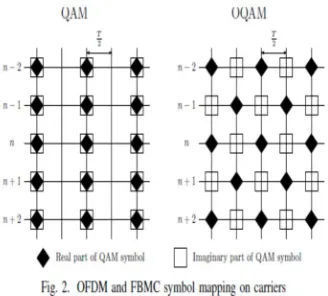
[image:4.612.226.390.357.505.2]The concept of transmultiplexer leads to the development of FBMC system. The transmultiplexer can be considered as a system that converts from time division multiplexed (TDM) version of a signal to a frequency division multiplexed (FDM) version, and back. Figure 2 shows the FBMC- OQAM system. The main processing blocks in this direct form representation of FBMC-OQAM system are OQAM pre-processing, synthesis filter bank, analysis filter bank, and OQAM post-processing.
G. OQAM Pre/Post Processing
In the OQAM preprocessing, the first operation is a simple complex-to-real conversion, where the real and imaginary parts of the QAM complex-valued symbol ck, 1 where k = 0, 1, . . ., M-1 are separated and time staggered by half the symbol period. The complex-to-real conversion increases the sample rate by a factor of 2. The next operation is the multiplication by θk,n sequence where θk,n =j(k+n) . Since the adjacent values in a single subchannel and in the adjacent subchannels are multiplied with powers of
j (by θk,n), they will be orthogonal to each other. So, adjacent subchannel interference free transmission can be ensured. In the OQAM-post processing, the first operation is the multiplication by θk,n* sequence and is followed by the operation of separating the real part. The second operation is real- to complex conversion, in which two successive real-valued symbols (with one multiplied by
j) form a complex-valued symbol c̃ k,n. The real-to-complex conversion decreases the sample rate by a factor 2.
H. Synthesis and Analysis Filter Banks
As shown in the Figure 2, OQAM modulated symbols are transmitted to M upsamplers with upsampling factor M/2.Then they are passed to the synthesis filterbank and combined for transmission. After passing through the channel C (z), the received signal is filtered using analysis filter bank and then downsampled by a factor of M/2.All the subchannel filters in synthesis filter bank Gk(z) are formed by the exponential modulation of a single realvalued linear phase FIR prototype filter G0 (z) with impulse response p(m). The kth synthesis filter is defined by,
III. UNIFIED PARALLEL ALGORITHM FOR THE TRANSMITTER
To reduce transmitter complexity, people usually compute the samples of (6) and then use a digital to analog converter (DAC) to convert the digital signal into analog signal. How to generate the discrete time signal is a major part of the transmitter design. In this section, we consider parallel algorithms for discrete time implementation of FBMC at the transmitter. To simplify the notations, we only consider general FBMC systems. Note that for general FBMC, Extension to OFDM/OQAM is straightforward. Let W be the bandwidth for transmission. To simplify the DAC and analog filtering, we can choose N and F
such that and null some subcarriers to keep the used bandwidth not exceeding W. The sampling rate is usually chosen as α NF,
where is the over- sampling factor. Thus the sampling period is . To simplify the notations, we denote Note that ® can be any positive number not smaller than 1, but we require to be an integer number.
IV. SIMULATION RESULTS
Technology (IJRASET)
channel, Pedestrian B channel are those 3 channels considered. The received signal at the receiver is equalized using Frequency Domain MMSE one-tap equalizer. Channel state information is estimated using pilots (BTPA transmission). The equalized signals are passed to the analysis filterbank and then OQAM demodulated to reconstruct the transmitted symbols. BER performance of this FBMC-OQAM in AWGN channel, Vehicular A channel and Pedestrian B channel are analyzed.
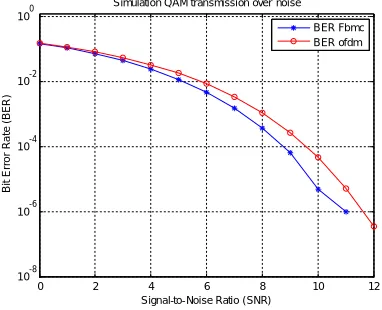
[image:5.612.206.397.227.382.2]BER performance of FBMC-OQAM system with and without Frequency Domain MMSE one-tap equalization in vehicular A and pedestrian B channel are shown in Figure 5 and Figure 6 respectively. It can be seen that the proposed equalization in FBMC-OQAM system gives very good BER performance for the system in Frequency selective channels also. Without equalizer the entire received bits are erroneous and are not recoverable. By the use of the proposed equalizer, BER can be reduced significantly. The system with only AWGN channel has a BER rate of about 10-5 at an SNR of 16 dB. With Frequency domain MMSE one tap equalizer, BER of the system is 0.5x10⁻⁵ at 16 Db SNR in Vehicular A channel and 0.5x10⁻⁵ at 20 dB SNR in Pedestrian B channel.
Fig 3: BER comparison of OFDM and FBMC
BER performance of FBMC-OQAM system with and without Frequency Domain MMSE one-tap equalization in vehicular A and pedestrian B channel are shown in Figure 5 and Figure 6 respectively. It can be seen that the proposed equalization in FBMC-OQAM system gives very good BER performance for the system in Frequency selective channels also. Without equalizer the entire received bits are erroneous and are not recoverable. By the use of the proposed equalizer, BER can be reduced significantly. The system with only AWGN channel has a BER rate of about 10-5 at an SNR of 16 dB. With Frequency domain MMSE one tap equalizer, BER of the system is 0.5x10⁻⁵ at 16 dB SNR in Vehicular A channel and 0.5x10⁻⁵ at 20 dB SNR in Pedestrian B channel.
V. CONCLUSION
Multicarrier modulation (MCM) techniques have gained a lot of attraction in the modern communication world. In this paper a Filter Bank based Multi Carrier system with Offset Quadrature Amplitude Modulation (FBMC-OQAM system) is developed using exponential modulation of a single prototype filter. BER performance of the FBMCOQAM system in AWGN channel and in Vehicular A and Pedestrian B channel with and without equalizer were studied. In fading channels, BER performance can be significantly improved by using the proposed Frequency domain MMSE one-tap equalizer.
REFERENCES
[1] Sahin, I. Guvenc, and H. Arslan, “A survey on multicarrier communications: Prototype filters, lattice structures, and implementation aspects,” Communications Surveys Tutorials, IEEE, vol. 16, no. 3, pp. 1312–1338, Third 2014.
[2] Q. He, C. Schmitz, and A. Schmeink, “BEP of fourier transform and discrete wavelet transform based OFDM,” in Wireless Communication Systems (ISWCS 2013), Proceedings of the Tenth International Symposium on, Aug 2013, pp. 1–5.
[3] F. Schaich, “Filterbank based multi carrier transmission (fbmc); evolving ofdm: Fbmc in the context of wimax,” in Wireless Conference (EW), 2010 European, April 2010, pp. 1051–1058.
[4] M. Bellanger, FBMC physical layer: a primer, PHYDYAS, Jan 2010.
[5] M. Tanda and T. Fusco, Data-aided synchronization and initialization (single antenna), PHYDYAS, July 2008.
[6] M. Bellanger, “Physical layer for future broadband radio systems,” in Radio and Wireless Symposium (RWS), 2010 IEEE, Jan 2010, pp. 436– 439.
0 2 4 6 8 10 12
10-8 10-6 10-4 10-2 100
Signal-to-Noise Ratio (SNR)
B it E rr o r R a te ( B E R)
Simulation QAM transmission over noise