5
IV
April 2017
Technology (IJRASET)
Visual Cryptography for Light Encryption Scheme
Using LED Based On Halftoning Algorithm
S. Vijay Gokul1, G. Subashri Meenakshi2, S. Mangaiyarkarasi3 1,2,3
Department of ECE, Mepco Schlenk Engineering College, Sivakasi, Tamilnadu
Abstract-Visible Light is regarded as a reliable mode of communication in comparison with Radio Frequency communication. It has a great scope in 5G networks. But this visible light communication is prone to security issues like eavesdropping due to its visual nature. This paper deals with the light encryption scheme using Light Emitting Diode.
Keywords: Security, Visual Cryptography, Otsu, Halftone, Lifi
I. INTRODUCTION
As the technology rules the world currently, security plays a very vital role in data transfer. This can be provided by means of Network security. Cryptography is a study of mathematical technique that relates the aspects of security issues like Data confidentiality, Data Integrity and Data Availability which is referred to as CIA triangle.
Visual Cryptography is a new technique of providing information security using simple user algorithms. Complex, computationally intensive algorithm is not used in this technique as used in the traditional cryptographic techniques. As images are more attractive than text, they are more prone to hacking nowadays. The security should be provided for Visible Light Communication of image transmission. As far as now the security for image transmission in VLC was provided by an Otsu algorithm which has enhanced Bit Error Rate but has a limitation on computational time and image sharing scheme. This can be overcome by an Image security algorithm called halftone algorithm. The proposed idea will overcome the limitations that were mentioned above.
Figure1 represents the light encryption system using laptops. The VLC signal from a LED can be received by a light encrypting device like mobile or laptops, which could be any device that has a optical receiver such as photodiode or an camera image sensor, and also having a visible LED for optical transmitter. After the visible light signal from LED is received by the light encrypted device, the image data can be encrypted by applying halftone algorithm followed by an XOR cipher. This ensures double encrypted security for the data to be sent. The above implementation could be made possible for the future VLC medium.
Fig.1.Proposed Light Encryption Scheme. For the practical implementation it requires three components. They are
A. Power supply section
B. Transmitter section
C. Receiver section
II. RELATED WORKS
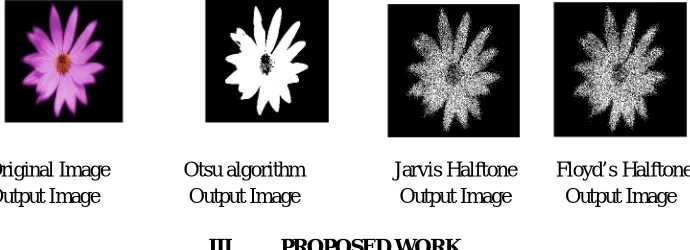
original image [2].Halftone is a reprographic technique in which simulation is done through dots and spacing [4]. This differs from continuous tone imagery which has a wide range of colors; this technique reduces visual reproduction by producing image through dots in one color. Halftone algorithm is found to be secured as it involves image sharing technique. Halftone algorithm can be made possible by means of error diffusion filters. With the work done on Jarvis, Floyd’s error diffusion algorithms, the parameters were analyzed [6]. The output images of various image security algorithms are:
Original Image Otsu algorithm Jarvis Halftone Floyd’s Halftone Output Image Output Image Output Image Output Image
III. PROPOSED WORK
Based on the works done in the security algorithm there were issues like computational complexity, PSNR calculation and time consumption. These issues can be overcome by the proposed visual cryptographic algorithm [5] which is based on dividing the black and white pixels by which the image sharing is done.
A. Software Algorithm
This algorithm is based on the binary image separation that includes two shares namely black pixel and white pixels [9]. This scheme is based on k out of n scheme where n is the total number of shares produced and k is the number of images to be stacked together so as to get back the final image. This work is done on Matlab platform.
1) The input image variable is initialized.
2) Two share variables are declared and are initialized to zero.
3) The black and white pixels are processed separately.
4) The share matrices are declared. Based on the random number generated, the values of pixels vary. If the random number is 0 then it remains as such, else the value gets swapped [2].
5) The similar procedure is repeated for black pixel.
6) Individual shares are produced.
7) The above algorithm could produce two shares.
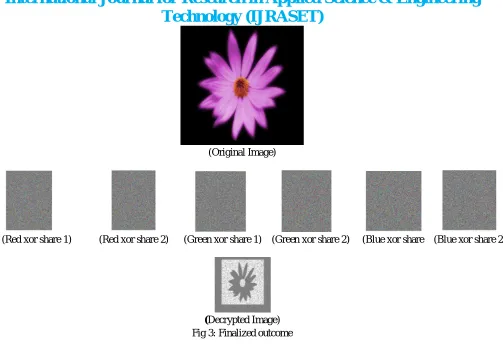
8) Six shares can be produced as in Figure 2 are bit-ORed so that the shares get combined together.
9) Then an encryption algorithm is used which is XOR operation. This provides a double security to the data being sent.
[image:3.612.139.484.163.288.2]10) The (2, 6) scheme is used to retrieve back the original image.
Technology (IJRASET)
(Original Image)
(Red xor share 1) (Red xor share 2) (Green xor share 1) (Green xor share 2) (Blue xor share (Blue xor share 2)
[image:4.612.64.567.51.395.2](Decrypted Image) Fig 3: Finalized outcome
B. Hardware Implementation
Data transfer over long distances is done usually in serial form. Data from a transmitting system is converted into a stream of serial bits, and is transferred on a single line to a receiving system at a time. Serial to parallel conversion is used to retrieve the data at the receiving end. The speed of data transmission in measured in baud rate. This is done by means of RS232 cables that can serially transmit data from one system to another [7]. Here LED acts as a source for Visible Light Communication.
IV. BLOCK DESCRIPTION
Hardware Circuit used for visible light communication consists of three blocks. They are
Fig 4: Block diagram of the transmitter and receiver section
A. Power Supply Block
Both the transmitter and the receiver section will be operated in 5V DC supply.
1) Computer with MATLAB software
2) Max 232 IC
3) Switching circuit
4) LED diode
The transmitter section starts with the data being received serially from the MATLAB through RS232 cable to the hardware. This data is received by the MAX232 IC which is a serial IC. The data is then sent to the LED source [8] which is the main component in the Visual communication. The LED source is used in serially communicates with the receiver end in the presence of light. With the presence of the LED source using the supply, there is a data being transmitted serially.
C. Receiver Block
The receiver section consists of a photodiode which is used as the receiver. The data that was serially transmitted by the LED is received by the photodiode. This data is sent to the MAX232 IC for conversion of TTL logic. This is then sent via a serial cable to the PC or any other device to get back the output (i.e.,) the data or image that was transmitted.
V. WORKING PRINCIPLE
[image:5.612.78.534.357.512.2]Serial communication is done for transmission of data. The MAX232 IC is used that converts the signals from RS232 logical input into TTL logic that is being used to drive the data through the LED diode. Based on the voltage being sent to the other side the output received is judged. As the photodiode has the ability to receive the data through the light source, the data is received through it and is sent to MAX232 to send the data serially. Serial cable is used on the both the ends to transmit and receive data in the devices.
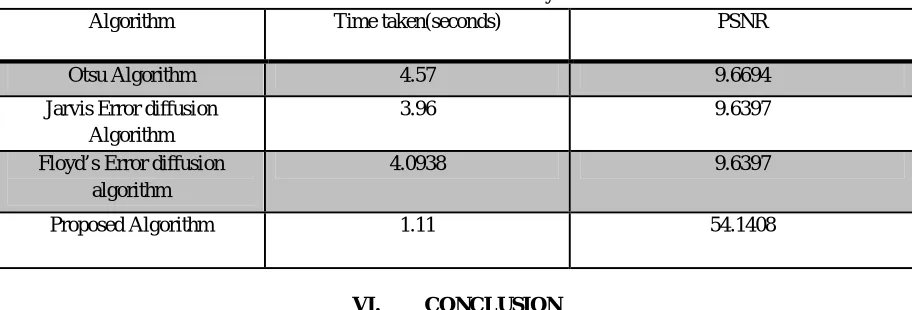
Table I Performance Analysis
Algorithm Time taken(seconds) PSNR
Otsu Algorithm 4.57 9.6694 Jarvis Error diffusion
Algorithm
3.96 9.6397
Floyd’s Error diffusion algorithm
4.0938 9.6397
Proposed Algorithm 1.11 54.1408
VI. CONCLUSION
Reliable communication could be provided by visual cryptographic technique and has a greater usage in case of 5G technology. With the implementation of halftone secured data communication may be made possible through this. The proposed algorithm has better PSNR and computational time on comparison with the existing algorithms. Its future applications include the data transmission with the help of li-fi technology, where visible light communication plays a vital role. The drawback of this technique is that this data transfer can be done only in the presence of a visible light source.
VII. ACKNOWLEDGEMENT
It’s a pleasure working on the project named “Visual Cryptography for Light Encryption Scheme Using LED Based on Halftoning algorithm”. We thank our Project in- charge Mr. S.Vijay Gokul who supported us and provided us with his precious time and guidance. We thank whole of the E.C.E department for their appreciation and kind support. We would like to thank concealed reviewers for their valuable comments.
REFERENCES
[1] Yang Liu, Kevin Liang, Hung-Yu Chen’Liang-Yu Wei, Chin-Wei Hsu, Chi-Wai Chow, Senior Member, IEEE, Chien-Hung Yeh, “Light Encryption Scheme Using Light-Emitting Diode and Camera Image Sensor”, IEEE journal on photonics, Volume 8, Number 1, February 2016.
Technology (IJRASET)
Volume: 02 Issue: 05, Aug-2015.
[4] Mrs. G.Shoba, Ms. K. Anitha, Ms. S. Banupriya, Ms. D. Lalitha, “Sharing Color Images Using Extended Visual Cryptography (EVC) With Expansionless Shares”, International Journal of Advanced Research in Computer Science and Software Engineering, Volume 5, Issue 1, January 2015.
[5] Wangarce G.,R. Zhongnin,”Halftone visual cryptography by iterative half toning”, Proceedings of 2010 IEEE International Conference on Acoustics Speech and Signal Processing, March 2010.
[6] H.-C. Wu, H.-C. Wang, R.-W. Yu, “Color visual cryptography scheme using meaningful shares,” IEEE Eighth Int'l Conf. on Intelligent Systems Design and Applications (ISDA'08), vol.3, 2008.
[7] Liju Sajan, Lince Mathew, Abraham Thomas, Sarun Sathyan, Bibin Baby, “Wireless data transfer using visible light communication”, IJRET: International Journal of Research in Engineering and Technology, Volume: 04 Special Issue: 03, Apr-2015.
[8] Komine and M. Nakagawa, “Fundamental analysis for visible light communication system using LED lights,” IEEE Trans. On consumer electronics, vol. 50, 2004.