Technology (IJRASET)
A Study of Data Mining Tools in Knowledge
Discovery Process
Pallavi Wankhade1, Prof.R.R. Shelke2
ME First Yr. (CSE) , Assistant Professor Computer Science & Engg, Department H.V.P.M’s COET, Amravati
Abstract--Data mining, the extraction of hidden predictive information from large databases, is a powerful new technology with great potential to help companies focus on the most important information in their data warehouses. It uses machine learning, statistical and visualization techniques to discovery and present knowledge in a form which is easily comprehensible to humans. Various popular data mining tools are available today. Data mining tools predict future trends and behaviors, allowing
businesses to make proactive, knowledge-driven decisions. Data mining tools can answer business questions that traditionally were too time consuming to resolve. They scour databases for hidden patterns, finding predictive information that experts may miss because it lies outside their expectations. This paper presents an overview of the data mining tools like Weka, Tanagra, Rapid Miner, Orange.
Index Terms:-Data mining, Rapid Miner, Tool, WEKA.
I. INTRODUCTION
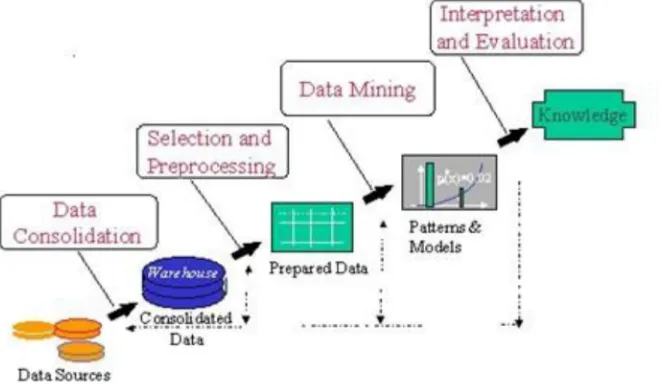
[image:2.612.146.476.450.642.2]Data Mining, also popularly known as Knowledge Discovery in Databases (KDD), refers to the nontrivial extraction of implicit, previously unknown and potentially useful information from data in databases. While data mining and knowledge discovery in databases (or KDD) are frequently treated as synonyms, data mining is actually part of the knowledge discovery process. The following figure (Figure 1) shows data mining as a step in an iterative knowledge discovery process. In its simplest form, data mining automates the detection of relevant patterns in a database, using defined approaches and algorithms to look into current and historical data that can then be analyzed to predict future trends. Because data mining tools predict future trends and behaviors by reading through databases for hidden patterns, they allow organizations to make proactive, knowledge-driven decisions and answer questions that were previously too time-consuming to resolve.
Figure 1: Data mining is the core of Knowledge discovery process.
the marketplace, each with their own strengths and weaknesses. Internal auditors need to be aware of the different kinds of data mining tools available and recommend the purchase of a tool that matches the organization's current detective needs. This paper presents an overview of the data mining tools available today. For example- weak, Tangara, RapidMiner, Orange.
II. CATEGORIES OF DATA MINING TOOLS
Most data mining tools can be classified into one of three categories: traditional data mining tools, dashboards, and text-mining tools. Below is a description of each.
A. Traditional Data Mining Tools
Traditional data mining programs help companies establish data patterns and trends by using a number of complex algorithms and techniques. Some of these tools are installed on the desktop to monitor the data and highlight trends and others capture information residing outside a database. The majority are available in both Windows and UNIX versions, although some specialize in one operating system only. In addition, while some may concentrate on one database type, most will be able to handle any data using online analytical processing or a similar technology.
B. Dashboards
Installed in computers to monitor information in a database, dashboards reflect data changes and updates onscreen — often in the form of a chart or table — enabling the user to see how the business is performing. Historical data also can be referenced, enabling the user to see where things have changed (e.g., increase in sales from the same period last year). This functionality makes dashboards easy to use and particularly appealing to managers who wish to have an overview of the company's performance.
C. Text-Mining Tools
The third type of data mining tool sometimes is called a text-mining tool because of its ability to mine data from different kinds of text — from Microsoft Word and Acrobat PDF documents to simple text files, for example. These tools scan content and convert the selected data into a format that is compatible with the tool's database, thus providing users with an easy and convenient way of accessing data without the need to open different applications. Scanned content can be unstructured (i.e., information is scattered almost randomly across the document, including e-mails, Internet pages, audio and video data) or structured (i.e., the data's form and purpose is known, such as content found in a database). Capturing these inputs can provide organizations with a wealth of information that can be mined to discover trends, concepts, and attitudes. When evaluating data mining strategies, companies may decide to acquire several tools for specific purposes, rather than purchasing one tool that meets all needs. Although acquiring several tools is not a mainstream approach, a company may choose to do so if, for example, it installs a dashboard to keep managers informed on business matters, a full data-mining suite to capture and build data for its marketing and sales arms, and an interrogation tool so auditors can identify fraud activity.
III. WEKA TOOL
WEKA, formally called Waikato Environment for Knowledge Learning, is a computer program that was developed at the University of Waikato in New Zealand for the purpose of identifying information from raw data gathered from agricultural domains. WEKA supports many different standard data mining tasks such as data preprocessing, classification, clustering, regression, visualization and feature selection. The basic premise of the application is to utilize a computer application that can be trained to perform machine learning capabilities and derive useful information in the form of trends and patterns.
Technology (IJRASET)
Figure 2: WEKA GUI chooser
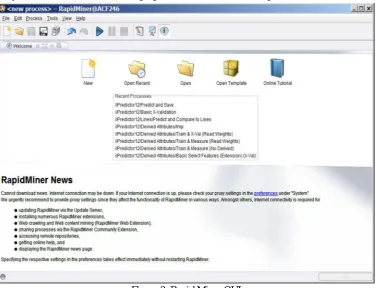
IV. RAPIDMINER TOOL
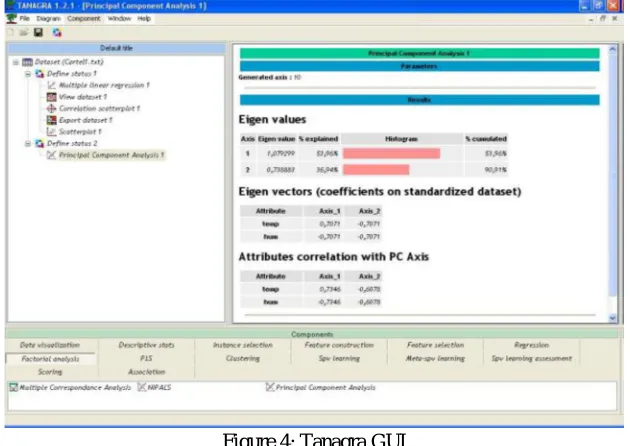
[image:4.612.120.496.414.702.2]TANAGRA is a free DATA MINING software for academic and research purposes. It proposes several data mining methods from exploratory data analysis, statistical learning, machine learning and databases area. This project is the successor of SIPINA which implements various supervised learning algorithms, especially an interactive and visual construction of decision trees. TANAGRA is more powerful, it contains some supervised learning but also other paradigms such as clustering, factorial analysis, parametric and nonparametric statistics, association rule, feature selection and construction algorithms. TANAGRA is an "open source project" as every researcher can access to the source code, and add his own algorithms, as far as he agrees and conforms to the software distribution license.
Figure 4: Tanagra GUI
VI. DBMINER TOOL
DBMiner,a data mining system for interactive mining of multiple-level knowledge in large relational databases, has been developed based on our years-of-research. The system implements a wide spectrum of data mining functions, including generalization, characterization, discrimination, association, classification, and prediction. By incorporation of several interesting data mining techniques, including attribute-oriented induction, progressive deepening for mining multiple-level rules, and meta-rule guided knowledge mining, the system provides a user-friendly, interactive data mining environment with good performance.
VII. WITNESS MINER TOOL
Technology (IJRASET)
[image:6.612.149.464.424.667.2]
Figure 5: Witness Miner GUI
VIII. ORANGE TOOL
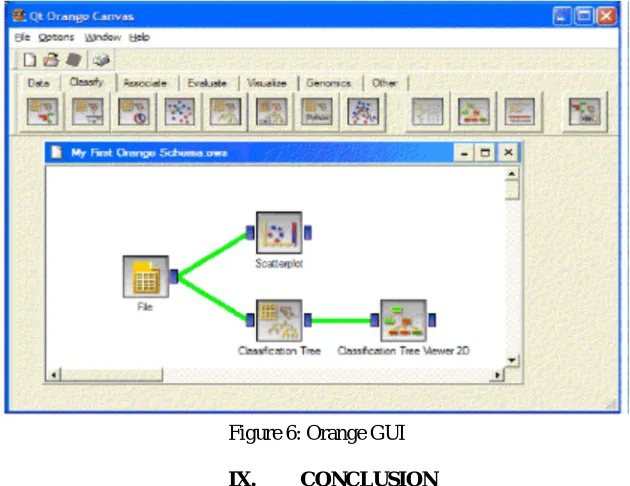
Orange is a powerful free and open source component-based data mining and machine learning software suite.It contains complete set of components for data preprocessing, feature scoring and filtering, modeling, model evaluation, and exploration techniques. It is based on C++ components, that are accessed either directly (not very common), through Python scripts (easier and better), or through GUI objects called Orange Widgets.Orange is distributed free under GPL and can be downloaded from the download page. Orange is a component-based framework, which means you can use existing components and build your own ones. You can even prototype your own components in Python, and use it in place of some standard C-based Orange component.Orange is supported on various versions of Linux,Apple’s ,Mac OS X and Microsoft Windows.
Figure 6: Orange GUI
IX. CONCLUSION
X. ACKNOWLEDGEMENT
First of all we would especially like to express sincere gratitude to our parents. It gives us great pleasure and satisfaction in presenting the paper on “A STUDY OF DATA MINING TOOLS IN KNOWLEDGE DISCOVERY PROCESS” Before we get into the depth of the things, we show our sincere gratitude towards respected teachers, guide, colleagues and all who have directly or indirectly helped us in the completion of this paper successfully
REFERENCES
[1] J. Han and M. Kamber. Data Mining: Concepts and Techniques. Morgan Kaufmann, 2000.
[2] G. Piatetsky-Shapiro, U. M. Fayyad, and P. Smyth. From data mining to knowledge discovery: An overview. In U.M. Fayyad, et al. (eds.), Advances in Knowledge Discovery and Data Mining, 1-35. AAAI/MIT Press, 1996.