International Journal of Emerging Technology and Advanced Engineering
Website: www.ijetae.com (ISSN 2250-2459,ISO 9001:2008 Certified Journal, Volume 5, Issue 6, June 2015)
Soft Computing Approach for Optimization of FACTS Devices
to Regulate Transmission Power Losses
Nilesh Borkar
1, B. Anjanee Kumar
2 1Dept. of Electrical, RITEE, Chhattisgarh, India
2Assistant Professor, Electrical Dept., RITEE, Chhattisgarh, India
Abstract—Losses in power transmission square measure vital in absence of dominant devices. significant power consumption happens owing to significant load on lines and production of power doesn't meet the need. specialise in reducing power wastage, management devices square measure used with reactive impedances and thyristor switches to compensate inductive, resistive and electrical phenomenon losses in transmission. FACTS devices enhance power flow transfer capability and continuous management over voltage profile with improvement in system damping to attenuate losses on a parallel note. during this analysis heuristic approach is tested to optimize FACTS devices that may any enhance the dominant action of device. TCSC is chosen as management device and Genetic formula, Particle Swarm improvement and Differential Evolution square measure heuristic approach that may be tested. Results and simulations validate the prevalence in performance of GA with TCSC over standard TCSC.
Keywords-- TCSC, Power Loss, Genetic Algorithm, Heuristic Approach
I. INTRODUCTION
Transmission of power ranges from meters to kilometres. The long is that the transmission line; higher would be the losses in transmission [3] [4] [6]. Researches demonstrate that three factors square measure major in domain of technical losses i.e. resistance, inductance and capacitance. The mounted losses square measure subjected to quality of fabric and environmental conditions, therefore square measure out of scope of this paper.
The line are often studied with the 3 constants: R (Resistance), L (Inductance) and C (Capacitance) [7]. These factors square measure distributed in an exceedingly line uniformly across whole length. The inductance and also the resistance square measure the 2 factors that kind series electric resistance. The capacitance that exist between the conductors for one section line or from the conductor to neutral for the 3 section line forms a shunt path across the length of the road [8]. so the results of capacitance introduce complications within the line calculations. Overhead lines square measure classified on the idea of the presence of capacitance in an exceedingly line.
Insufficient reactive power handiness or non-optimized reactive power flow might lead an influence system to insecure operation beneath heavily loaded conditions [1] [2]. By reallocating reactive power generations within the system by adjusting electrical device faucets, generator voltages and switchable volt-ampere sources, the matter are often solved to a way extent. Power generated in power stations suffer giant and complicated networks like overhead lines, transformers, cables and alternative instrumentality and reaches at the top users. it's undeniable fact that the one unit of electrical energy generated by power plant doesn't match with the units distributed to the shoppers. However, some proportion of the units is lost within the distribution network.
(1)
FACTS technologies provide competitive solutions to today‟s power systems in terms of exaggerated power flow transfer capability, enhancing continuous management over the voltage profile, up system damping, minimizing losses, etc. FACTS technology consists of high power physical science based mostly instrumentation with its time period operational management [9]. There ar 2 teams of FACTS controllers supported completely different technical approaches, each leading to controllers ready to solve transmission issues.
International Journal of Emerging Technology and Advanced Engineering
Website: www.ijetae.com (ISSN 2250-2459,ISO 9001:2008 Certified Journal, Volume 5, Issue 6, June 2015)
Even supposing these ways are unorthodox with stripped-down mathematical basis and convergence guarantee, they need tried their effectiveness and optimization methods thence widening the realm of implementation.
II. PROBLEM DEFINITION AND LITERATURE SURVEY
Naturally the ability flow pattern may be influenced by changes of the impedances within the network. equally series compensation could also be used as a method for adapting the load ability of bound essential lines that may risk to be operative with large angle separation or amplitude deviations throughout contingencies. This successively initiates lead-lag drawback in controllers on that the researchers targeted their work. varied algorithms tend to over-write the matter domain either by improvement or multi-objective formation.
Design of associate degree optimum controller needs improvement performance measures that area unit usually non-commensurable and competitive with one another. style of such a controller is so a particle swarm improvement (PSO) drawback. The authors during this paper investigates the comparison of application of PSO primarily based improvement technique and Differential Evolution (DE) for the planning of a Thyristor Controlled Series Compensator (TCSC)-based supplementary damping controller [10].
Rajendra Prasad Narne [11] presents the modelling and simulation of one machine infinite bus (SMIB) system with an influence system stabilizer (PSS), and TCSC primarily based controllers. completely different controller structures specifically Lead-Lag (LL) and a proportional-integral (PI) for TCSC Controller were projected and comprehensive assessment effects of the tuned TCSC Controller on the take a look at grid were dole out. Simulations were dole out in numerous loading conditions below a symmetrical three-phase contact fault happens at generator terminals. Galam Ravi [12] in his work project investigated the employment of TCSC to maximise total transfer capability usually outlined because the most power transfer group action between a selected power-seller and a power-buyer during a network. For this purpose, they propose one among the organic process improvement Techniques, specifically Differential Evolution (DE) to pick the optimum location and also the optimum parameter setting of TCSC that minimize the active power loss within the power network, and compare its performances with Genetic algorithmic rule (GA).
A Genetic-based damping controller for a thyristor-Controlled Series capacitance (GCSC) is given within the paper oj M. A. Abido. the planning drawback of TCSC primarily based stabilizer is developed as associate degree improvement drawback wherever the genetic algorithmic rule (GA) is applied to look for the optimum setting of the stabilizer parameter. Minimizing the important a part of the system eigen value related to low frequency oscillation mode was projected because the objective perform of the planning drawback. The projected controller was examined on a weak connected grid with completely different disturbances and loading conditions. Eigenvalue analysis and nonlinear simulation results show the effectiveness of the projected GCSC primarily based stabilizer and its ability to produce economical damping of low frequency oscillations [13].
Ali Yazdekhasti presents parameters setting by improvement algorithmic rule of Particle Swarm improvement (PSO) for modeling Thyristor Controlled Series capacitance (TCSC) in grid. this is often done by minimizing a time-domain primarily based objective perform of PSO. The results obtained from simulations in MATLAB/SIMULINK verified the effectiveness of projected modeling and rising grid stability [14] [44].
III. THYRISTOR CONTROLLED SERIES COMPENSATOR
TCSC is supplied with the electrical condenser bank, followed and shunted by a Thyristor Controlled Reactor (TCR) that gives a sleek variable series electrical phenomenon electrical phenomenon. it's one-port circuit coupled asynchronous with the transmission line; it exercises natural commutation; with switch frequency is low; it conjointly implements insignificant energy storage and don't have even a single DC-port. With the insertion of a electrical phenomenon electrical phenomenon asynchronous of line, inherent inductive electrical phenomenon would lower the whole effective ohmic resistance of the road and so nearly decrements its length. As a result, each the voltage stability and angular stability gets improved. Moreover, in distinction to capacitors that square measure switched by circuit breakers, TCSC are additional economical as a result of the thyristors that provides versatile adjustment, and additional subtle management theories may be effortlessly applied.
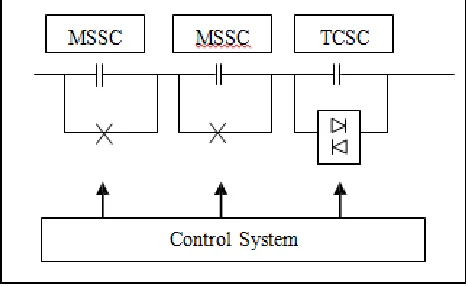
Figure 1 shows the simple diagram of TCSC. This structure could be modeled as
𝑋=𝑋0+Δ𝑋 (2)
International Journal of Emerging Technology and Advanced Engineering
[image:3.612.333.564.370.650.2]Website: www.ijetae.com (ISSN 2250-2459,ISO 9001:2008 Certified Journal, Volume 5, Issue 6, June 2015)
Figure 1: Simple Diagram of TCSC
The management offered by TCSC is associate „impedance‟ sort management, i.e. the inserted voltage is proportional to line current. this kind of management is mostly best fitted to the applications in power flow issues, wherever a well-defined point in time distinction exists between the ends of the line to be stipendiary and controlled. The idea of managementled series compensation will be used for a good vary of objectives within the facility control technology. Naturally the facility flow pattern will be influenced by changes of the impedances within the network. equally series compensation could also be used as a method for adapting the load ability of bound essential lines that will risk to be in operation with overlarge angle separation or amplitude deviations throughout contingencies.
[image:3.612.52.286.520.663.2]Inserting a TCSC could alleviate such limitations thereby increasing the transfer capability of the transmission. it's seemingly that installations of governable series compensation can embrace each fastened and automatically switched modules (MSSC) and thyristor controlled modules (TCSC) during a kind of mixtures.
Figure 2: Outline of CSC with MSSC and TCSC
IV. HEURISTIC APPROACHES FOR TCSC
Genetic Algorithm
International Journal of Emerging Technology and Advanced Engineering
Website: www.ijetae.com (ISSN 2250-2459,ISO 9001:2008 Certified Journal, Volume 5, Issue 6, June 2015)
A fitness or objective operate is employed to replicate the goodness of every member of the population. Given a random initial population, GA functions in definite pattern of cycles known as as generations, as follows:
Every member of the population is examined employing a fitness operate.
The population undergoes replica during a variety of iterations. One or additional parent people ar chosen stochastically, however strings that possess higher fitness values have higher likelihood of conducive Associate in Nursing offspring.
Genetic operators, for instance mutation and crossover, square measure applied to folks to provide offspring.
The offspring individuals are then introduced into the population and the process is repeated.
Particle Swarm Optimization
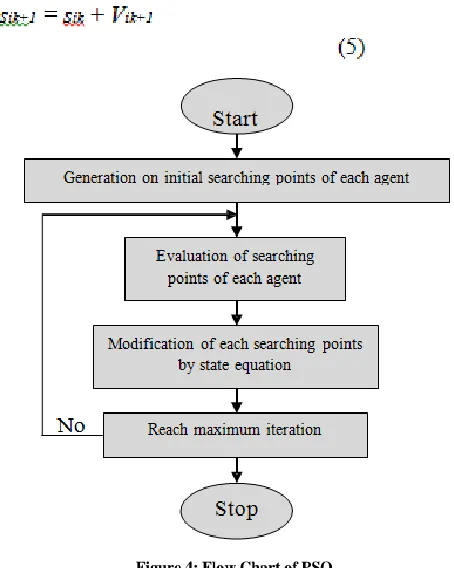
Working Behavior of Particle Swarm Optimization: Each particle tries to modify its position using the following information:
The current positions,
The current velocities,
The distance between the current position and pbest,
The distance between the current position and the gbest.
The adjustment of the particle‟s position can be mathematically modeled according the following equation:
Where,
vik : velocity of agent i at iteration k, w:
weighting function, cj : weighting factor,
rand: uniformly distributed random number between 0 and 1,
sik : current position of agent i at iteration k,
pbesti : pbest of agent i,
gbest: gbest of the group.
The following weighting function is usually applied in above equation
Where,
wMax= initial weight, wMin = final weight,
[image:4.612.327.554.203.487.2]maxIter = maximum iteration number, iter = current iteration number.
Figure 4: Flow Chart of PSO
Differential Evolution
Differential Evolution is that the optimization technique smitten by the distinction in pairs of object vectors sampled haphazardly to formulate mutation method. First State creates contemporary people and choose three people in random to optimize one individual. a brand new vector is formed by adding a weighted (mutation factor) distinction of 2 individual to the opposite. Crossover isn't obligatory step of First State as compared to GA. The people area unit processed for analysis of fitness for brand spanking new people (better than recent individuals). the method is dead until most generations or convergence is reached.
V. RESULTS AND SIMULATIONS
With No Thyristor Controlled Series Compensator: POWER LOSS = 144.6958 MW
International Journal of Emerging Technology and Advanced Engineering
Website: www.ijetae.com (ISSN 2250-2459,ISO 9001:2008 Certified Journal, Volume 5, Issue 6, June 2015)
With Thyristor Controlled Series Compensator positioned By PSO @ BUSES 13, 3 & 21: POWER LOSS = 129.4213 MW
With Thyristor Controlled Series Compensator positioned By DE @ BUSES 13, 3 & 21: POWER LOSS = 129.4213 MW
VI. CONCLUSION
In the context of our analysis for the diminution of Transmission Power Losses by the applying of FACTS devices, a comparison is formed within the 3 algorithms that were wont to optimize with FACTS devices. The Differential Evolution, Particle Swarm optimization and Genetic algorithmic rule were tested with the FACTS devices exploitation the MATLAB model. The simulation results indicate the superior performance of FACTS with these 3 algorithms. a discount in mainframe time and Transmission Power Losses is reported once BSS methodology is used along side optimization algorithmic rule in comparison against the NR methodology. The tests were performed taking STATCOM because the FACTS device. The PSO and Differential Evolution algorithms have equal power losses that's slightly but Genetic algorithmic rule and far higher than the road while not STATCOM device. additional the share reduction in mainframe time exploitation DE (BSS method) will increase with the rise in size of power grid.
REFERENCES
[1] P.K. Roy , S.P. Ghoshal , S.S. Thakur, “Optimal VAR Control for
Improvements in Voltage Profiles and for Real Power Loss Minimization using Biogeography Based Optimization”, Electrical Power and Energy Systems, Vol. 43, No.1, pp. 830–838, December 2012.
[2] Abbas Rabiee, Maziar Vanouni, Mostafa Parniani, “Optimal
Reactive Power Dispatch for Improving Voltage Stability Margin Using a Local Voltage Stability Index”, Energy Conversion and Management, Vol. 59, pp. 66-73, July 2012
[3] Gomez Exposito, A., et al. "Fair allocation of transmission
power losses."Power Systems, IEEE Transactions on 15.1 (2000): 184-188.
[4] Chao, Hung-Po, and Stephen Peck, "A market mechanism for
electric power transmission." Journal of regulatory economics 10.1 (1996): 25-59.
[5] http://electrical-engineering-portal.com/total-
losses-in-power-distribution-and-transmission-lines-1
[6] Sipila, Kari, et al. "Estimation of capacity and required transmission power of WCDMA downlink based on a downlink pole equation" Vehicular Technology Conference Proceedings, 2000,
VTC 2000-Spring Tokyo, 2000 IEEE 51st, Vol. 2,IEEE, 2000
[7] Scardelletti, Maximilian C., George E. Ponchak, and Thomas M.
Weller, "Miniaturized Wilkinson power dividers utilizing capacitive loading" Microwave and Wireless Components Letters, IEEE 12.1 (2002): 6-8
[8] Karthaus, Udo, and Martin Fischer. "Fully integrated passive UHF
RFID transponder IC with 16.7-μW minimum RF input power" Solid-State Circuits, IEEE Journal of 38.10 (2003): 1602-1608
[9] Chandrasekar, K., and N. V. Ramana. "Performance comparison of
DE, PSO and GA approaches in Transmission Power Loss minimization using FACTS Devices" International Journal of Computer Applications 33 (2011)
[10] A. K. Baliarsingh, D. P. Dash, N. R. Samal, S. Panda, “Design of TCSC-Based Controller Using Particle Swarm Optimization Algorithm” IOSR Journal of Engineering. Apr. 2012, Vol. 2(4) pp: 810-813
[11] Rajendra prasad Narne, P.C.Panda, Jose. P. Therattil, “Transient
Stability Enhancement of SMIB System using PSS and TCSC-Based Controllers” IEEE PEDS 2011, Singapore, 5 - 8 December 2011
[12] Galam Ravi, Prof P.Umapathi Reddy, “Optimal Placement of
Thyristor Controlled Series Capacitor for Loss Minimization in a Power System”. Galam Ravi, Prof P.Umapathi Reddy / International Journal of Engineering Research and Applications (IJERA) ISSN: 2248-9622. Vol. 3, Issue 2, March -April 2013, pp.1841-1846
[13] M. A. Abido, “Genetic-Based Tcsc Damping Controller Design For Power System Stability Enhancement” Paper BPT99-228-44 accepted for presentation at the IEEE Power Tech'99 Conference, Budapest, Hungary, Aug 29 - Sep 2, 1999.
[14] Ali Yazdekhasti and Iman Sadeghkhani, “Optimal Tuning of TCSC
Controller Using Particle Swarm Optimization” A. Yazdkhasti, et al., AEES, Vol. 1, No. 1, pp. 24-29, March 2012
BIODATA
Author: Nilesh Borkar received his BE (Electronics & Telecommunication) degree from Pandit Ravi Shankar Shukla University Raipur in 2008. He is currently an M.E. student in the Electrical Engineering specialization in power electronics from Chhattisgarh Swami Vivekananda Technical University Bhilai. His Research interests are power electronics, power quality and power system.