International Journal of Emerging Technology and Advanced Engineering
Website: www.ijetae.com (ISSN 2250-2459,ISO 9001:2008 Certified Journal, Volume 4, Issue 2, February 2014)
538
A Novel Method for Data Hiding In Encrypted Image And
Video
A. Kaja Moideen
1, K. R. Siva Bharathi
21PG Scholar, 2Assistant Professor, Dept. of ECE, Sri Krishna College of Engineering and Technology, Coimbatore.
Abstract- Now a days the data security and data integrity are the two challenging areas for research. This work describes the concept of separable reversible data hiding technique that is related with internet security. When it is desired to send the confidential/important/secure data over an insecure and bandwidth-constrained channel it is customary to encrypt the cover data and then embed the confidential/important/ secure data into that cover data. With an encrypted image/video containing additional data, if a receiver has the data-hiding key alone, he can extract the additional data but the image/video content is unknown to him. If the receiver has the encryption key, he can decrypt to obtain only an image/video similar to the original one, but the additional data cannot be obtained. If the receiver has both the data-hiding key and the encryption key, he can extract both the additional data and recover the original image/video without any error by exploiting the spatial correlation in natural image.
Keywords— Image/video encryption, image/video
recovery, reversible data hiding
I. INTRODUCTION
The amount of digital images/video has increased rapidly on the Internet. Image/video security becomes increasingly important for many applications, e.g., secure transmission of image and video , military and medical applications. For example, speed and secure transmission is vital in the medical world. Nowadays, the transmission of image/videos is a daily routine and it is necessary to find an efficient way to transmit them over networks. The protection of this multimedia data can be done with encryption or data hiding algorithms.
In the current trends of the world, the technologies have developed so much that most of the individuals prefer using the internet as the primary medium to transfer data from one end to another.
There are many possible ways to transfer information using the internet: via emails, chats, etc. The data transmission is made very simple, speed and accurate using the internet. However, one of the main problems with transmitting data over the internet is the security threat it poses i.e. the personal or confidential information can be stolen or hacked in many ways. Therefore it is very important to take data security into consideration, as it is one of the most important factors that need attention during the process of data transmission. Data security basically means protection of data and providing high security to prevent data modification from unauthorized users or hackers. Data security has gained more attention in the recent period of time due to the massive increase in data transfer rate over the internet.
International Journal of Emerging Technology and Advanced Engineering
Website: www.ijetae.com (ISSN 2250-2459,ISO 9001:2008 Certified Journal, Volume 4, Issue 2, February 2014)
[image:2.612.82.537.111.365.2]539
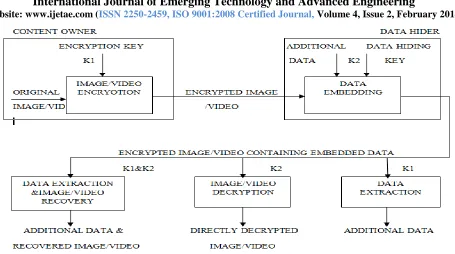
Fig. 1 Sketch of separable reversible data hiding in encrypted image.
The watermark embedding protocol is based on public key cryptography and has little overhead in terms of the total data communicated between the buyer and the seller.Video encryption and video watermarking can be combined together to protect both the confidentiality and the ownership/identification [7].
T. Bianchi provided a general framework extending an idea put forward and derived precise conditions that permit to process the underlying signal by operating directly on the composite words thus achieving a significant gain from a computational complexity perspective[8]. M.Cancellaro have presented a joint watermarking and encryption method, based on a layered scheme and on a key dependent transform domain [2]. The proposed method grants the authenticity of the transmitted data. In [9], the signs of host DCT coefficients was encrypted by content owner and each content-user uses a different key to decrypt only a subset of the coefficients, so that a series of different fingerprints are generated for the users. In the joint scheme mechanism, only a partial encryption is involved, leading to a loss of partial information . Furthermore, the separation of original cover image/video and hidden data from a watermarked version is not considered. In [10] and [11], each sample of a cover signal is encrypted by a public-key mechanism and a homomorphic property of encryption is exploited to embed some additional data into the encrypted mage/video.The amount of data in the encrypted signal is significantly expanded and the computation complexity is high. Also, the data hiding is not reversible.
This work proposes a separable reversible data hiding scheme for encrypted image, that is made up of image encryption, data hiding and data-extraction/image-recovery phases. The data of original cover are entirely encrypted, and the additional message is hidden by modifying a part of encrypted image. At receiver side, with the aid of spatial correlation in natural image, the hidden data are successfully extracted while the original image is correctly recovered.
II.IMPLEMENTATION MODULE
A.Image Encryption
International Journal of Emerging Technology and Advanced Engineering
Website: www.ijetae.com (ISSN 2250-2459,ISO 9001:2008 Certified Journal, Volume 4, Issue 2, February 2014)
540
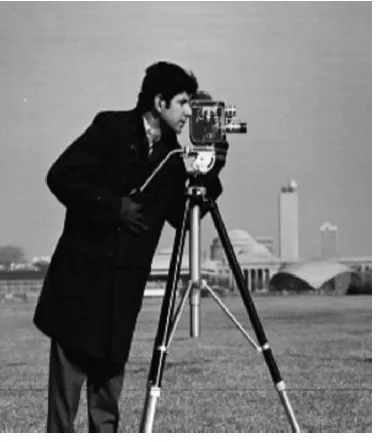
Fig. 2 shows an example of image encryption mechanism. Digital images, accounting for 70% of the information transmission on the internet, is an important parts of network exchanges. However, the image information is different from text message and has larger amount of data and stronger correlation between pixels.
Assume the original image with a size of N1 * N2 is in uncompressed format and each pixel with gray value falling into [0, 255] is represented by 8 bits. Denote the bits of a pixel as bi ,j ,0 , bi , j ,1,…, bi ,j ,7 where ( i, j ) indicate the pixel position and the gray value as P i ,j .
bi ,j ,k =[ pi ,j/2k ] mod 2 , k = 0,1,….7 (1)
and
pi ,j = ∑ . 2k (2) In encryption phase, the exclusive-or results of the original bits and pseudo-random bits are Calculated
= (3) Where ri,j,k are to determined by an encryption key. Then, Bi,j,k are orderly concatenated as the encrypted data.
Different types of secure stream cipher methods are used to ensure that anyone without the encryption key, cannot obtain any information about original content from the encrypted data.
B.Data Embedding
In the data embedding phase, few parameters are embedded into a small number of encrypted pixels, and LSB of the other encrypted pixels are compressed to create a space for accommodating the additional data and the original data at the positions occupied by the parameters. The information is as follows According to a data-hiding key, the data-hider randomly selects Np encrypted pixels that will be used to carry the parameters for data hiding. Here, Np is a positive integer and is of smaller in number. for example, Np=20. The other (N-Np) encrypted pixels are permuted and divided into a number of groups, each of which contains L pixels.For each pixel-group, collect the M least significant bits of the L pixels, and denote them as B(k,1) ,B(k,2) …… B(k,M*L) where k is a group index within [1,(N-Np)/L] and M is a positive integer which is less than 5.
[image:3.612.77.265.440.661.2]International Journal of Emerging Technology and Advanced Engineering
Website: www.ijetae.com (ISSN 2250-2459,ISO 9001:2008 Certified Journal, Volume 4, Issue 2, February 2014)
541
The data-hider also generates a matrix G , which is composed of two parts. The right part is pseudo-random binary matrix derived from the data-hiding key and the left part is the identity matrix . For each group that is product with the G matrix to form a matrix of size (M * L-S). Which has a sparse bits of size S, in which the data is hidden and arrange the pixels into the original form and repermutated to form a original image.
C. Data Extraction & Image Recovery: Image Decryption:
When having an encrypted image containing embedded data, a receiver initially generates ri,j,k based on the encryption key, and calculates the exclusive-or of the ri,j,k and the received data to decrypt the image. The decrypted bits is denoted as . Clearly, the original five most significant bits (MSB) are obtained correctly. For a certain pixel, if the hidden bit in the block including the pixel is zero and the pixel belongs to S1, or the hidden bit is 1 and the pixel belongs to S0, hiding the data does not affect any encrypted bits of the pixel. So, the three LSB that is decrypted must be same as the original LSB, Which implies that the decrypted gray value of the pixel is similar. On the other hand, if the pixel belongs to S0 then the embedded bit in the pixel’s block is 0 , or the embedded bit is 1 and the pixel belongs to S1 , the decrypted LSB.
=
=
=
=
k = 0,1,2.
(4)This means that the three decrypted LSB must be different from the original LSB and in this case:
= 1 (5)
Data Extraction:
If the receiver has both the data-hiding, then it is possible to extract the embedded data According to the data-hiding key, the values of L,M and S, the original LSB of the Np selected encrypted pixels, and the (N-Np) * S/L - Np additional bits can be extracted from the encrypted image containing embedded data. By putting the LSB of the Np into their original positions, the encrypted hidden data of the Np selected pixels are recovered, and their original gray values can be decrypted correctly using the encryption keys.
[image:4.612.139.494.468.688.2]
(a) (b)
International Journal of Emerging Technology and Advanced Engineering
Website: www.ijetae.com (ISSN 2250-2459,ISO 9001:2008 Certified Journal, Volume 4, Issue 2, February 2014)
542
III. EXPERIMENTAL RESULTS
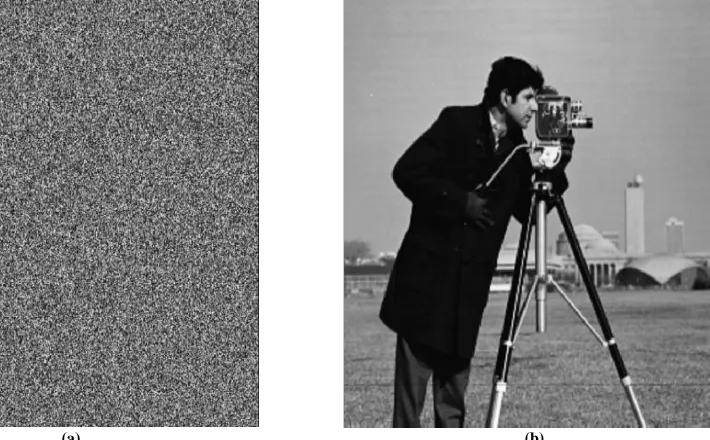
The test image Camera man sized 512x512 shown in Fig. 2(a) was used as the original image in the experiment. After image encryption, the eight encrypted bits of each pixel are converted into a gray value to generate an encrypted image shown in Fig. 2(b). Then, we let M = 3, L = 128 and S = 2 to embed 4.4 x 10³additional bits into the encrypted image. The encrypted image containing the embedded data is shown in Fig. 3(a), and the embedding rate R is 0.017 bit per pixel (bpp). With an encrypted image containing embedded data, by using the data-hiding key we could extract the additional data. If we directly decrypt the encrypted image containing embedded data using the encryption key, the PSNR value of the decrypted image was 39.0 dB, which equals to the theoretical value 39.1 dB calculated. The directly decrypted image is given as Fig. 3(b). By using both the data-hiding and the encryption keys, the hidden data could be successfully extracted and the original image could be perfectly recovered from the encrypted image containing embedded data.
IV. CONCLUSION
In this paper, a novel scheme for separable reversible data hiding in encrypted image/video is proposed, which consists of image encryption, data embedding and data-extraction/image-recovery phases. Initialy, the content owner encrypts the original uncompressed image using an encryption key. Data-hider does not know the original content, Although he can compress the least significant bits of the encrypted image using a data-hiding key to create a sparse space to accommodate the additional data. With an encrypted image containing hidden data, the receiver may retreive the additional data using only the data-hiding key, or to obtain an image that is similar to the original one using only the encryption key. If the receiver has both of the keys, then he can extract the hidden data and recover the original content without any error by exploiting the spatial correlation in natural image.
REFERENCES
[1 ] J. Tian, “Reversible data embedding using a difference expansion,”IEEE Trans. Circuits Syst. Video Technol., vol. 13, pp. 890–896,Aug. 2003.
[2 ] M. Cancellaro, F. Battisti, M. Carli, G. Boato, F. G. B. Natale, and A. Neri, “A commutative digital image watermarking and encryption method in the tree structured Haar transform domain,” Signal Processing:Image Commun., vol. 26, no. 1, pp. 1–12, 2011. [3 ] M. U. Celik, G. Sharma, A. M. Tekalp, and E. Saber, “Lossless
generalized-LSB data embedding,” IEEE Trans. Image Process., vol. 14, no.2, pp. 253–266, Feb. 2005.
[4 ] M. Deng, T. Bianchi, A. Piva, and B. Preneel, “An efficient buyer-seller watermarking protocol based on composite signal representation,” in Proc. 11th ACM Workshop Multimedia and Security, 2009, pp. 9–18.
[5 ] M. Kuribayashi and H. Tanaka, “Fingerprinting protocol for images based on additive homomorphic property,” IEEE Trans. Image Process., vol. 14, no. 12, pp. 2129–2139, Dec.2005.
[6 ] N. Memon and P. W. Wong, “A buyer-seller watermarking protocol,”IEEE Trans. Image Process., vol. 10, no. 4, pp. 643–649, Apr. 2001.
[7 ] S. Lian, Z. Liu, Z. Ren, and H. Wang, “Commutative encryption and watermarking in video compression,” IEEE Trans. Circuits Syst. VideoTechnol., vol. 17, pp. 774–778, Jun. 2007.
[8 ] T. Bianchi, A. Piva, and M. Barni, “Composite signal representation for fast and storageefficient processing of encrypted signals,” IEEE Trans.Inform. Forensics Security, vol. 5, no. 1, pp. 180–187, Feb. 2010.
[9 ] W. Hong, T.-S. Chen, Y.-P.Chang, and C.-W. Shiu, “A high capacity reversible data hiding scheme using orthogonal projection and prediction error modification,” Signal Process., vol. 90, pp. 2911–2922, 2010.
[10 ]W. Liu, W. Zeng, L. Dong, and Q. Yao, “Efficient compression of encrypted gray scale images,” IEEE Trans. Image Process., vol. 19, no. 4, pp. 1097–1102, Apr. 2010.
[11 ]X. Zhang, “Reversible data hiding in encrypted image,” IEEE Signal Process. Lett., vol. 18, no. 4, pp. 255–258, Apr. 2011.