International Journal of Emerging Technology and Advanced Engineering
Website: www.ijetae.com (ISSN 2250-2459, ISO 9001:2008 Certified Journal, Volume 7, Issue 4, April 2017)
71
Performance of AODV and RIP in Wireless Sensors Networks
AbuBakr Obaid
1, Dr. Ghassan M T Abdalla
2, Prof. Sami M Sharif
31
Alneelain University, Sudan, University of Omdurman Ahlia, Sudan
2 University of Khartoum, Sudan, University of Tabuk, KSA 3University of Khartoum, Sudan
Abstract— Wireless Sensor Network WSN is a network that consists of a number of sensors nodes, each node is a combination of a sensor, microcontroller, memory unit and transceiver module. WSN have many useful applications such as remote monitoring, medicine, military and in chemical processing. The power consumption is a great challenge in WSN, which can be reduced by using enhanced and effective routing protocols. In this paper, we have studied the performance of two routing protocols AODV and RIP using INET 3.2 simulator under OMMNeT 4.6, based on five network metric measurements: Expected Transmission Rate ETX, packet error rate, End-to-End delay, number of packets sent and number of packets received. AODV has higher ETX and higher packet error rate, with higher End-to-End delay, but the number of packets received by RIP protocol is higher than AODV protocol.
Keywords— RIP, AODV, INET 3.2, and WSN.
I. INTRODUCTION
Wireless Sensor Network (WSN) is a network that consists of a number of sensors nodes scattered over a landscape to monitor a certain phenomena to study. The user can access the WSN via internet for remote access.
The sensor node is a combination of a number of devices such as (sensor, microcontroller, memory unit, power unit and transceiver module), the main weakness of this node is the power consumption which affect the lifetime of the network, many research have been carried to prolong the network lifetime by reducing the power consumption of the node by operating the sensor in many modes such as transmitting, receiving and idle. When a sensor in transmitting mode it means that sensor is transmitting information to other nodes, in receiving mode it receives data from other nodes, in idle mode means that sensor not transmitting and receiving [1].
The main power consumption is consumed when the sensor transmitting and receiving information to and from others. In order to reduce this power the packet to be sent over the network is divided into small packets and using a number of hops to relay these packets to the destination. Thus routing protocol is a great challenging in WSN. Many researchers have been carried to enhance routing protocols.
Generally, routing protocols in WSN is categorized into two classes: network structure and protocol based on operation. There are many types of network structure protocol such as: flat network routing, hierarchal network routing and location based routing, in addition to that protocols based on operation are divided into many types such as negotiation based routing, multipath based routing, query-based routing, QoS – based routing and coherent based routing [2 ].
In designing a routing protocol there are a number of challenging to be considered to achieve a reliable routing protocol such as node deployment, energy consumption, data reporting method, node/link heterogeneity, fault tolerance, scalability, network dynamics, transmission media, connectivity , coverage, data aggregation and quality of service[3].
In this paper we have studied the performance of Ad-hoc On-Demand Distance Vector AODV protocol and Routing Information Protocol (RIP) these protocols are extensively used on ad-hoc networks, which are similar to WSN and have nearly the same weakness such as power consumptions. AODV is a distance vector protocol, in DV protocol each node recognizes how to access other nodes through its neighbors by looking to its routing table to determine the next hop to access the destination not considering the speed of the link. RIP is a link state protocol that routes towards the destination through mostly fast links not considering the number of hops, but in distance vector protocols the number of hops are widely considered.
The remainder of the paper is organized as follows: section II we have studied the related work. In Section III we have explained the factors to evaluate network efficiency. In Section IV we have setup the parameters for the simulator. In section V we have discussed the result and analysis. In Section VI is the conclusion for the paper.
II. RELATED WORK
A. Ad-hoc On- Demand Distance Vector (AODV)
International Journal of Emerging Technology and Advanced Engineering
Website: www.ijetae.com (ISSN 2250-2459, ISO 9001:2008 Certified Journal, Volume 7, Issue 4, April 2017)
72
The protocol is used when the route to the destination is unknown. In this protocol each node sends a Hello message to show it is a life. Initially, the source node broadcast Route REQuest RREQ packet to all neighbors nodes, when the intermediate node receives RREQ packet, it replies with Route REPly packet, if the node is a destination node. Otherwise, the node rebroadcast RREQ packet until it reaches its destination, in this manner a node may receive a multiple copies of RREQ packet, which will be discards except one RREQ packet. Finally, the RREQ arrives to the destination node it will reply with RREP packet to the source, each intermediate nodes between the source and the destination stores the route that was created by RREQ packet from the source to be used by RREP packet sent from the destination node. When the source receives the RREP packet it starts to send the data over the established route.
Each node maintains the route by storing the route number on routing table and set a counter for this route, if this route is not used for a specific period of time it announces that this route is not valid to be used. If the link is broken between the source and destination, the Route Error RERR is sent from the destination. The source will establish a new route [4].
Kassim et al. [5] Evaluate and compare two routing protocols, Ad Hoc on Demand Distance Vector (AODV) and Temporary Ordered Routing Algorithm (TORA) the comparison is based on Quality of Service (QoS) factors throughput and delay. The network simulated is a mesh network with a single source. The network is consisting of 30 nodes. The paper shown that AODV has higher throughput than TOR, when the number of nodes are increased, while AODV and TOR have the same average throughput. The significant difference appeared when the number of node is 25 nodes. In comparing delay between AODV and TORA, TORA has better delay than AODV in all scenarios.
Dwivedi et al. [6] investigated four routing protocols AODV, DSDV, TORA and LEACH shown that AODV has the highest packet delivery ratio, lowest routing overhead and maximum throughput over the others. The paper studied the average End-to-End delay and found that the minimum average End-to-End delay was obtained by AODV.
B. Routing Information Protocol (RIP)
Meena et al. [7] Investigated RIP based on different network parameters such as average delay, energy consumption, average Jitter, throughput, first message received, last message received and total message received.
The number of nodes on the network are 100 nodes all these parameters were investigating four routing protocols DSR, DYMO, OLSR and RIP.
The paper shown that when using VBR and CBR traffic mode to measure the average delay, OLSR has the minimum average delay routing protocol followed by RIP, DYMO and DSR.
The maximum energy consumption was obtained by OLSR routing protocol when using CBR traffic mode followed by DSR, DYMO and RIP, while using VBR traffic mode OLSR has the maximum energy consumption too followed by RIP, DSR and DYMO.
The maximum throughput was obtained by DSR when using CBR traffic mode followed by DYMO, OLSR and RIP, while using VBR traffic mode OLSR given a maximum value of throughput followed by DYMO, OLSR and RIP. The maximum number of the first message received was obtained by OLSR followed by RIP DYMO and DSR using CBR and VBR traffic mode. However, the maximum number of last message received by DSR followed by DYMO, OLSR and RIP using CBR traffic mode. While using VBR traffic mode RIP was the maximum number of last message received followed by DSR, DYMO and OLSR. In measuring the total number of messages received DSR was shown the maximum number of messages received followed by DYMO, OLSR and RIP using CBR traffic mode, while when using VBR traffic mode DSR and DYMO have the maximum number of messages received followed by RIP and OLSR.
The paper also measures End-To-End Delay using CBR and VBR traffic mode and the result that RIP had the minimum value of End To End delay followed by OLSR, DSR and DYMO.
Sahabul et al. [8] studied the performance of three routing protocols IARP, RIP and STAR based of different network metrics such as node energy consumption, average energy consumed in transmit receive and idle mode, and the number of update packet sent. The paper shown that RIP has the minimum energy consumption in receive and transmit modes followed by STAR and RIP, while in idle mode IARP has the minimum energy consumption followed by STAR and RIP.
III. FACTORS TO EVALUATE NETWORK PERFROMANCE
In valuating network efficiency for AODV and RIP there are many factors used. In this paper the following measurements:-
International Journal of Emerging Technology and Advanced Engineering
Website: www.ijetae.com (ISSN 2250-2459, ISO 9001:2008 Certified Journal, Volume 7, Issue 4, April 2017)
73
The ETX of a path is the total number of packets transmitted (including retransmitted packets required to deliver a packet to it’s a destination. For a given network paths with minimum ETX have the highest throughputs [9].
Packet Error Rate (PER): PER is calculated from bit error rate (BER) and the collision time [10]. The BER is simply defines as a ratio of errors to the total number of bits, with the strong signal the BER is very small.
End-To-End delay: Is defined as the time it takes to deliver a packet from the transmitter to the receiver. It consists of two parts. The first one is a fixed part and the second is a variable part. The fixed part consists of many components such as coding delay, packtization delay, and propagation delay. The variable part is the sum of all the queuing delays generated by the router to route the packets via it output port [11].
Number of packets sent: defined as the total number generated by the source to be sent over the network. Number of packets received: defined as the total number of packets received by the destination.
IV. SIMULATION PARAMETERS SETUP
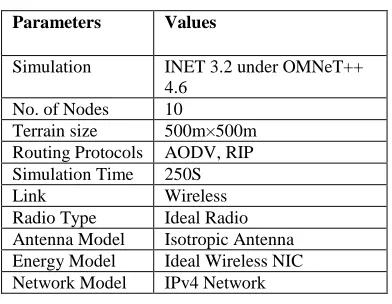
The networks to be simulated are consisting of one transmitter hostA and one receiver hostB between them scattered a number of sensor nods randomly. In order to send a packet from hostA to hostB it routes through these nodes. The numbers of nodes are 10 in both networks; the parameters for the network and values are in Table 1.
TABLEI
SIMULATIONPARAMETERSSETUP
Parameters Values
Simulation INET 3.2 under OMNeT++ 4.6
No. of Nodes 10
Terrain size 500m×500m Routing Protocols AODV, RIP Simulation Time 250S Link Wireless Radio Type Ideal Radio Antenna Model Isotropic Antenna Energy Model Ideal Wireless NIC Network Model IPv4 Network
V. RESULTS ANSANALYSIS
[image:3.612.322.565.115.292.2]When running the simulator for both AODV and RIP protocols the networks the outputs for ETX transmission, packet error rate, End-to-End delay, number of packets sent and number of packets received.
Fig. 1 the ETX for AODV and RIP protocols
The ETX transmission count is the number of packets transmitted and retransmitted packet required to deliver a packet to the destination, in the network there are many paths from the transmitter to receiver. As it observed from Fig. 1 that all paths with RIP protocol have minimum ETX, which indicate that RIP has a maximum throughput over AODV, but AODV has a high overhead packets to decide their routes to the next hop, this process is repeated in each hop, while the RIP protocol recognizes the best route as it in the source (link state protocol). For this reason RIP does not require much control packets to deliver packets to the destination, while the AODV needs.
[image:3.612.71.267.486.638.2]The packet error rate is calculated from bit error rate and collision time. The bit error rate is sensitive to signal received at the receiver, as the signal attenuated the bit error rate is increased. WSN uses batteries to operate, which is depleted as packet transmitted over the network increased.
[image:3.612.325.563.515.663.2]International Journal of Emerging Technology and Advanced Engineering
Website: www.ijetae.com (ISSN 2250-2459, ISO 9001:2008 Certified Journal, Volume 7, Issue 4, April 2017)
74
[image:4.612.323.565.195.342.2]From Fig. 2 we observed that ETX is increased in AODV since it needs to select the route at each hop, thus a lot of energy is consumed in overhead packet to route the data packets to the destination which affect the signal strength in each hop, which is obviously increase the packet error rate in AODV protocol as appeared in Fig. 2 from this figure we notice that the packet error rate for RIP protocol is low because in RIP the ETX is also low, since less overhead packet are required to deliver the data packets to the destination.
Fig. 3 End-To-End delay for AODV
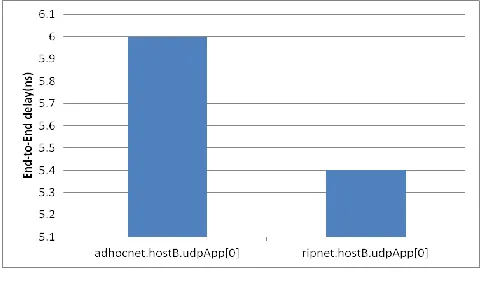
[image:4.612.48.290.255.397.2]In comparing the End-To-End delay between AODV and RIP protocol, we observe that RIP has low End-To-End delay than AODV has as in Fig. 3; from the definition of End-To-End delay is a summation of many factors such as coding delay, packetization delay, propagation delay and the queuing time. Since AODV has high ETX which indicates that many packets transmitted over the network which requires long time to each packet to wait in a node queue to be transmitted to the receiver which results in increasing End-To-End delay in AODV protocol. In contrast to RIP protocol which has low ETX means that End-To-End delay is also low due to the low number to be queued in each node.
Fig. 4 Number of packets sent for AODV and RIP
The simulator run for both protocols AODV and RIP, the numbers of packets generated are 4921 and 5047 for AODV and RIP respectively. These packets are generated by the source hostA in both networks AODV and RIP as in Fig. 4.
Fig. 5 Number of packets received for AODV and RIP
Fig. 5 show that RIP protocol has higher received packet over AODV protocol, which result in that RIP has maximum throughput over AODV, since both have the approximately the same transmitted packets. As RIP has low ETX values, low packet error rate, low End-To-End delay over AODV result in that RIP has maximum throughput.
VI. CONCLUSION
The result obtained is acceptable since RIP is better than AODV; because of RIP is a link state protocol, while AODV is a vector distance protocol. The result is investigated by using a new network metric ETX, when the value of ETX decreased the throughput is increased. Others factors are also considered such as packet error rate, End-To-End delay which are low in RIP over AODV resulting in RIP with maximum throughput.
REFERENCES
[1] Jennifer Yick, Biswanath Mukherjee, Dipak Ghosal, 2008,‖ Wireless sensor network survey‖, Elsevier.
[2] Jamal N. Al-Karaki, Ahmed E. Kama,‖ Routing Techniques in Wireless Sensor Networks: A Survey‖, 1998
[3] Ian D. Chakeres, Elizabeth M. Belding-Royer,‖ AODV Routing Protocol Implementation Design‖,.
[image:4.612.48.291.565.703.2]International Journal of Emerging Technology and Advanced Engineering
Website: www.ijetae.com (ISSN 2250-2459, ISO 9001:2008 Certified Journal, Volume 7, Issue 4, April 2017)
75
[5] A.K. Dwivedi, Sunita Kushwaha, O. P. Vyas, 2009‖ Performance of Routing Protocols for Mobile Adhoc and Wireless Sensor Networks: A Comparative Study‖ International Journal of Recent Trends in Engineering, Vol 2, No. 4,
[6] Meena Kaushal and Prateek Singh, 2013.‖Performance Analysis of DSR, DYMO, OLSR and RIP Protocols of Manet using CBR and VBR Transmission Traffic Mode‖,International Journal of Current Engineering and Technology.
[7] Sahabul Alam, Debashis De and Anindita Ray, 2015‖ Analysis of Energy Consumption for IARP, RIP and STAR Routing Protocols in Wireless Sensor NETWORK‖, Second International Conference on Advances in Computing and Communication Engineering.
[8] Douglas S. J. De Couto, 2004 ―High-Throughput Routing for Multi-Hop Wireless Networks‖.
[9] Soo Young et al.,‖ Packet Error Rate Analysis of IEEE 802.15.4 under IEEE 802.11b Interference‖,