Lightweight attributebased encryption
supporting access policy update for cloud
assisted IoT
Belguith, S, Kaaniche, N and Russello, G
http://dx.doi.org/10.5220/0006854603010312
Title
Lightweight attributebased encryption supporting access policy update for
cloud assisted IoT
Authors
Belguith, S, Kaaniche, N and Russello, G
Type
Conference or Workshop Item
URL
This version is available at: http://usir.salford.ac.uk/id/eprint/50015/
Published Date
2018
USIR is a digital collection of the research output of the University of Salford. Where copyright
permits, full text material held in the repository is made freely available online and can be read,
downloaded and copied for noncommercial private study or research purposes. Please check the
manuscript for any further copyright restrictions.
Update for Cloud Assisted IoT
Sana Belguith
1, Nesrine Kaaniche
2and Giovanni Russello
11Cyber Security Foundry, University of Auckland, New Zealand 2SAMOVAR, CNRS, Telecom SudParis, University Paris-Saclay, Paris, France
Keywords: Constant-size Attribute based Encryption, Access Policy Update, Cloud Assisted IoT, Confidentiality, Access Control.
Abstract: Cloud-assisted IoT applications are gaining an expanding interest, such that IoT devices are deployed in dif-ferent distributed environments to collect and outsource sensed data to remote servers for further processing and sharing among users. On the one hand, in several applications, collected data are extremely sensitive and need to be protected before outsourcing. Generally, encryption techniques are applied at the data producer side to protect data from adversaries as well as curious cloud provider. On the other hand, sharing data among users requires fine grained access control mechanisms. To ensure both requirements, Attribute Based Encryp-tion (ABE) has been widely applied to ensure encrypted access control to outsourced data. Although, ABE ensures fine grained access control and data confidentiality, updates of used access policies after encryption and outsourcing of data remains an open challenge. In this paper, we design PU-ABE, a new variant of key policy attribute based encryption supporting efficient access policy update that captures attributes addition and revocation to access policies. PU-ABE contributions are multifold. First, access policies involved in the encryption can be updated without requiring sharing secret keys between the cloud server and the data ow-ners neither re-encrypting data. Second, PU-ABE ensures privacy preserving and fine grained access control to outsourced data. Third, ciphertexts received by the end-user are constant sized and independent from the number of attributes used in the access policy which affords low communication and storage costs.
1 INTRODUCTION
Nowadays, IoT applications are widely used in dif-ferent fields such as smart cities, e-health, intelligent transport systems, to name a few (Farhan et al., 2018; Atwady and Hammoudeh, 2017; Coates et al., 2017; Belguith et al., 2018). Due to their limited storage and computation capacities, IoT devices are usually assisted with cloud services to store and process ge-nerated data (Kaaniche and Laurent, 2017b; Belguith et al., 2015). IoT devices produce huge amounts of data which need to be securely collected and shared among different users (Bacis et al., 2016a; Bacis et al., 2016b). Consequently, encryption and access control mechanisms are important to protect data from unaut-horised access (Belguith et al., 2016).
Attribute based encryption (ABE) ensures encryp-ted access control to outsourced data while limiting privacy leakage of data producers and users (Kaani-che and Laurent, 2017a). ABE consists of encipher-ing data with respect to an access policy over a set of attributes where users who have the matching
attribu-tes can recover data. Nowadays, with the emergence of applications adapted to distributed and dynamic en-vironments, several settings require adding new users, strengthening access patterns and/or removing current users from systems. A naive solution is to re-encrypt the whole data contents using new access policy by the data owner and re-outsource them to the cloud server. However, this solution is extremely expen-sive in computation and communications costs as it should be re-executed at every time a user is added or removed. Proxy re-encryption techniques are used to update users in outsourced systems. These mecha-nisms allow a server to re-encrypt stored data without accessing their content using a re-encryption key (Li-ang et al., 2015; Ge et al., 2018). Attribute-based Proxy Re-encryption (AB-PRE) systems have been applied for access policy update. In AB-PRE, when the data owner decides to update access policies of some ciphertexts, she uses her private key to genera-ted a re-encryption key for each ciphertext to be chan-ged from an old access policy to a new one. After-wards, all the generated re-encryption keys are
uplo-Belguith, S., Kaaniche, N. and Russello, G.
Lightweight Attribute-based Encryption Supporting Access Policy Update for Cloud Assisted IoT. DOI: 10.5220/0006854601350146
aded to a proxy server to update the ciphertext using the received keys. Although AB-PRE schemes allow re-encryption without decrypting ciphertext or acces-sing the plaintexts, it requires that the data owner ge-nerates valid re-encryption keys. When the number of ciphertext rises, it becomes inefficient for a data ow-ner to geow-nerate all the re-encryption keys and upload them to the proxy. Furthermore, this may also be un-feasible for limited bandwidths. Therefore, attribute-based proxy re-encryption schemes may not be effi-cient when updating a huge the number of ciphertexts. Key Policy Attribute Based Encryption (KP-ABE) is widely applied to secure data in several distribu-ted systems such as Publish and Subscribe systems (Pub/Sub) (Ion et al., 2012; Esposito and Ciampi, 2015), pay-TV systems (Ogawa et al., 2017), vehicu-lar networks (Nkenyereye et al., 2016), ..., where rules on who may read a document must be specified but it is unable to specify policies on a per-message ba-sis. Obviously, these dynamic environments usually require efficiently adding new users and/or revoking existent users. That is, KP-ABE consists in labeling user’s key by an access structure that specifies which type of ciphertext the key can decrypt, while cipher-text are labeled by a set of attributes. Thus, KP-ABE are adapted to distributed and decentralized environ-ments. Instead, Ciphertext Policy Attribute Based En-cryption (CP-ABE) schemes consists in associating an access structure to the ciphertext while assigning a set of credentials to deciphering users. CP-ABE schemes supporting policy update have been recently explored by Jiang et al. (Jiang et al., 2016; Jiang et al., 2017). Indeed, the authors proposed a CP-ABE scheme where new attributes can be added or current attributes can be removed efficiently without sharing re-encryption keys.
This motivates us to introduce the first KP-ABE scheme supporting adding and/or removing attributes from the access policy without sharing keys with the cloud server.
Contributions – In this paper, we propose Policy Update Attribute Based Encryption (PU-ABE), a novel key policy attribute based encryption scheme which supports access policy update. This proposed scheme is suitable for bandwidth-limited applications as the size of the ciphertext received by end-users does not depend on the number of attributes involved in the access policy. In PU-ABE, the encrypting entity generates a ciphertext involving encrypted data together with some extra components used for supporting the access policy update feature. The ciphertext is forwarded to the cloud server that can update the access policy upon demand. Indeed, the cloud server does not need to be trusted. That is, it
stores and shares ciphertexts among authorised users and also executes access policy update algorithm as requested. While executing these functionalities, the remote server is unable of decrypting any ciphertexts neither accessing any secret keys. For supporting the policy update feature, PU-ABE provides two functions. The first function permits to add new attributes to the access policy used to encrypt data. The second function ensures revoking attributes from the access policy used in the encryption phase. To prove the security of our proposed constructions, we present an updated security model to capture security requirements related to policy updates.
Paper Organisation – The remainder of this work is as follows: Section 2 highlights security considerati-ons and design goals. Then, Section 3 reviews related work and section 4 describes the system and security models. Section 5 presents the mathematical back-ground. In Section 6, an overview of PU-ABE is in-troduced and the detailed construction are presented. Section 7 presents a rigorous security discussion. Fi-nally, a theoretical analysis of computational perfor-mances is presented in Section 8, before concluding in Section 9.
2 PU-ABE FRAMEWORK
In this section, we first present the network model, detailing the involved entities and their interactions in Section 2.1. Then, we detail the security requirements that the proposed system should fulfill in Section 2.2.
2.1 Architecture
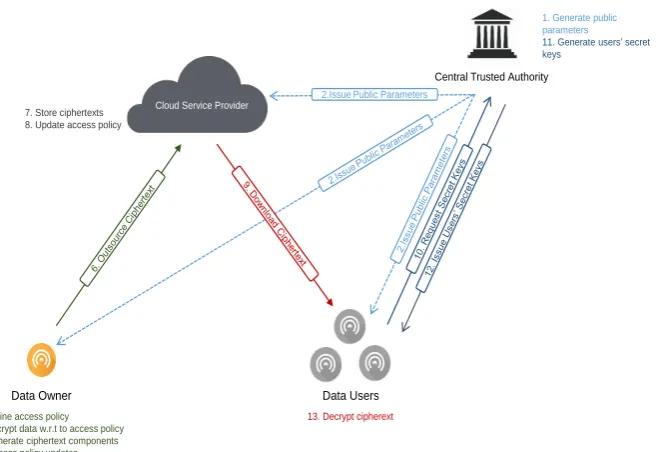
As depicted by Figure 1, our PU-ABE framework considers a cloud service provider that stores data ge-nerated by data owners and share them among aut-horised users. Four different entities are defined as follows:
• The Central Trusted Authority (CTA), known by the Attribute authority, is responsible for gene-rating the global public parameters and issuing users’ secret keys. CTA is considered as a trus-ted entity in our model.
• The data owner (O) is the data producer. She de-fines access rights and encrypts data with respect to them before outsourcing to the cloud. In ad-dition, the data owner generates extra ciphertext components used by the update algorithm.
• The data users (U) requests access to outsourced data. She decrypts the received data using his access rights. A user may be malicious if she tries to access data without authorisation.
2.2 Security Requirements
To design an efficient attribute based encryption scheme supporting efficient access policy update, the following requirements need to be achieved:
• access policy update – our PU-ABE scheme should ensure adding new attributes and/or remo-ving attributes from the access policy.
• flexible access control –our proposal should en-sure flexible security policies among dynamic groups of users, w.r.t. forward secrecy and bac-kward secrecy.
– backward secrecy means that a new added user to a group is unable to decrypt information cre-ated prior to their introduction.
– forward secrecy means that a compromise of the secret key does not affect the secrecy of fu-ture encrypted data.
• data confidentiality – our PU-ABE scheme has to protect the secrecy of outsourced and encryp-ted data contents against curious users and curious cloud service provider.
• low computation overhead and storage cost –
the proposed algorithms should have low proces-sing complexity and acceptable storage cost to be adapted to resource-constrained devices and dis-tributed environments.
3 ATTRIBUTE BASED
ENCRYPTION SCHEMES
Attribute-based Encryption (ABE) has been designed to ensure encrypted flexible access control for out-sourced data (Sahai and Waters, 2005). Unlike tradi-tional public key encryption schemes, ABE consists in encrypting data for many users. Therefore, decryp-ting entities’ private keys and encrypted data are la-beled with a set of attributes or a structure over attri-butes. A user is able to decrypt a ciphertext if there
is a match between her private key and the cipher-text (Bethencourt et al., 2007). Attribute based en-cryption schemes are classified into two categories, namely: Key-Policy ABE (KP-ABE) and Ciphertext-Policy ABE (CP-ABE) (Goyal et al., 2006). In KP-ABE, ciphertexts are labeled with a set of attributes while users’ private keys are associated with an access policy which can be any monotonic structure. The user is able to decrypt the ciphertext if her access po-licy is satisfied by the attributes embedded in the cip-hertext. KP-ABE schemes have been widely applied to secure data in distributed systems such as Internet of Things, publish and subscribe systems, intelligent transport systems, etc. (Yao et al., 2015).
Although ABE schemes ensure flexible access control to encrypted data, the communication and computation overhead as well as the bandwidth con-sumption increase exponentially with the number of attributes required in the access policies. To save the storage cost of ciphertext and processing overhead of encryption, attribute based encryption schemes with constant ciphertext size have been introduced (Her-ranz et al., 2010; Ge et al., 2012; Attrapadung et al., 2012; Wang and Luo, 2012). In these schemes, the size of the generated ciphertext does not depend on the number of attributes used on the threshold access policies, which presents an interesting feature mainly for resource-constrained devices. Herranz et al. (Her-ranz et al., 2010) have proposed the first constant size threshold ciphertext-policy attribute based encryption scheme. Indeed, the ciphertext size is constant and does not depend on the number of attributes invol-ved in the threshold access policies. Afterwards, se-veral CP-ABE schemes with constant cipheretxt size have been proposed (Ge et al., 2012; Belguith et al., 2017; Li et al., 2017). Due to the construction of CP-ABE schemes, monotone access policies based sche-mes can not be extended to ensure a constant cipher-text size. For instance, these schemes consist in only using threshold or conjunctive access policies which do not provide the desired expressiveness.
Several expressive Key policy attribute based en-cryption schemes with constant ciphertext size have been designed (Attrapadung et al., 2012; Wang and Luo, 2012; Emura et al., 2009). Wang et al. (Wang and Luo, 2012) have proposed a KP-ABE scheme with constant ciphertext size. This scheme relies on a monotone access policy to express the users’ attri-butes.
Central Trusted Authority
Cloud Service Provider
2.Issue Public Parameters
Data Users Data Owner
3. Define access policy 4. Encrypt data w.r.t to access policy 5. Generate ciphertext components for access policy updates
7. Store ciphertexts 8. Update access policy
13. Decrypt cipherext
1. Generate public parameters
[image:5.595.141.472.91.317.2]11. Generate users’ secret keys
Figure 1: PU-ABE involved entities and their interaction.
access policies should be updated to support these changes. Recently, the first CP-ABE with policy up-date has been proposed by Jiang et al. (Jiang et al., 2016; Jiang et al., 2017). The authors introduced a new variant of CP-ABE supporting access policy update that captures the functionalities of attribute addition and revocation from access policies. They provide two CP-ABE schemes supporting AND-gate access policies with constant-size ciphertexts. In key policy attribute based encryption schemes, policy up-date is still not supported. This motivates us to ad-dress the problem of constructing the first key policy attribute based encryption scheme with policy update.
4 MODEL DESCRIPTION
In this section, we first present the system model of our PU-ABE scheme (subsection 4.1). Then, we de-tail our security model (subsection 4.2).
4.1 System Model
Our policy-update key-policy attribute based encryp-tion scheme consists of five randomized algorithms:
setup,encrypt,update,keygenanddecrypt, defined
as follows:
setup(ξ)→(pp,msk)– thesetupalgorithm is
per-formed by a central trusted authority, known by the attribute authority. It takes as input a security para-meterξand outputs the public parametersppand the secret master keymsk.
encrypt(pp,
S
,M)→CT – the encryptionalgo-rithm is performed by an enciphering entity
E
. It ta-kes as inputs the public parameterspp, the set of the encryption attributesS
and the messageM. This al-gorithm outputs the encrypted message, referred to asCT.
update(pp,CT,ind,
U)
→CT0– the update algo-rithm is executed by a cloud server. It takes as inputs the public parameters pp, a ciphertext CT that con-tains the set of enciphering attributesS
={ai}i=1..msuch that |
S
|=m, an operation indicator indwhere ind = addor ind= revokeand a set of attributesU
with
U
∩S
=/0ifind=addorU
⊂S
ifind=revoke. It outputs a new ciphertextCT0for the new encrypting set of attributesS
0such asS
0=S
∪U
orS
0=S
\U
w.r.t.indvalue.keygen(pp,msk,Ψ)→sk– this randomized algo-rithm is executed by the attribute authority to derive the secret keys of a decrypting entity
D
. Given the pu-blic parameterspp, an access policyΨof the userD
and the secret master keymsk. The algorithm outputs the user’s secret keyskw.r.t.Ψ.decrypt(pp,sk,CT0) → M – the decryption algorithm is executed by the decrypting entity
D
. It takes as inputs the public parameters pp, the user’s secret keysk and the ciphertextCT0. The algorithm returns the message M ifD
has correctly obtained the secret key related to the required set of attributes for deciphering the encrypted message. Otherwise, the algorithm outputs a reject symbol⊥.that for all security parameter ξ, all attribute uni-verse descriptions U, all (pp,msk)∈ setup(ξ), all (S,
U
)⊆U(i.e;Uis the attribute universe), allsk∈keygen(pp,msk,Ψ), all M ∈M (i.e; Mis the mes-sage universe), all Ψ∈
G
(G
is the access policy space), allCT ∈encrypt(pp,S
,M), and all CT0 ∈(pp,CT,ind,
U)
if the decrypting user has correctlyobtained the secret keysk related to theΨ required access policy
S
0 for deciphering the encrypted mes-sage, thederypt(pp,sk,CT0)outputsM.4.2 Security Model
For designing a secure policy-update attribute based encryption scheme, we consider the case of malicious adversaries with respect to the indistinguishability property. The indistinguishability property means that if an adversary has some information about the plaintext, he should not learn about the ciphertext. This security notion requires the computational impossibility to distinguish between two messages chosen by the adversary with a probability greater than a half.
To design the most suitable security model consi-dering the confidentiality requirement, we adopt an updated security model to capture security re-quirements related to policy updates (Jiang et al., 2017). PU-ABE is said to be indistinguishable against non-adaptive chosen ciphertext attacks if there is no probabilistic polynomial time (PPT) adversary that can win the Expcon f security game
with non-negligible advantage. The Expcon f game
is formally defined, between an adversary
A
and a challengerC
as follows:INITIALISATION –
A
selects a set of encryption attributesS
∗(i.e;S
∗ corresponds to the set of attri-butes specified for the encryption) to be used for en-crypting the challenge ciphertext, as a set of attributesS
∗={ai}i=1..mwhere|S
∗|=m.A
sendsS
∗toC
. SETUP– the challengerC
runs thesetup(ξ) algo-rithm, sends the public parametersppto the adversaryA
and keeps secret the master keymsk.QUERYPHASE 1 – the adversary
A
queries, for each sessioni, an access policyΨA,i. The challengerC
answers by running thekeygen(pp,msk,ΨA,i)al-gorithm and sends the resulting secret keyskA,ito the
adversary
A
. Note that the access policyΨA,i doesnot satisfy the encryption attribute set
S
∗.CHALLENGE PHASE – during the challenge
phase,
A
picks two equal length cleartextsM0∗ andM1∗ as well as an attribute set U∗ with |U∗| =t
U∗∩
S
∗=/0ifind=addorU∗⊂S
∗ifind=revoke.The challenger
C
chooses a random bitbfrom{0,1}with
S
0∗=
S
∗\U
∗for ind= addorS
0∗=
S
∗∩U
∗forind=revokeand computes the challenge encryp-ted message CTb∗=encrypt(pp,
S
∗,Mb∗). It gives CTb∗ to the adversary ifU
=/0, otherwiseCTb0∗=update(pp,CTb∗,ind,
U
∗).QUERYPHASE2 – in this phase, the adversary
A
can query a polynomially bounded number of queries as in QUERY PHASE 1, except thatA
cannot query secret keys related to a set of attributesS
∗.GUESS –
A
tries to guess which message Mi, wherei∈ {0,1} corresponds to the enciphered dataCTb∗. Thus,
A
outputs a bit b0 of b and wins thegame ifb=b0. The advantage of the adversary
A
in the above game is defined as AdvA[ExpCon f(1ξ)] =|Pr[b=b0]−12|.
5 MATHEMATICAL
BACKGROUND
In this section, we first introduce the access structure in section 5.1. Then, in section 5.2, we present the bilinear maps. Finally, we introduce some security assumptions.
5.1 Access Policies
Access policies can be represented as a boolean functions of attributes or a Linear Secret Sharing Scheme (LSSS) matrix.
Access Structure –Let
P
={P
1,···,P
n}be a set ofparties. A collection A⊆2{P1,···,Pn} is monotone if
∀B,CifB∈AandB⊆CthenC∈A.
An access structure is a collection A of non-empty subsets of {
P
1,···,P
n}, such as A⊆2{P1,···,Pn}\/0.Note that any access structure can be converted into a boolean function. Boolean functions can be defined as an access tree, where the leaves present the attributes while the intermediate and the root nodes are the logical operators AND(∧)and OR(∨).
Linear Secret Sharing Schemes (LSSS) – Let
P
be a set of parties,Abel×nmatrix, andρ:{1,2,···,l} →P
be a function that maps a row to a party for labeling. A secret sharing scheme for access structure Ψover a set of partiesP
is a linear secret sharing scheme (LSSS) inZpand is represented by(A,ρ)if it consistsof two efficient algorithms:
• Share((A,ρ),s): The share algorithm takes as in-put s∈Zp which is to be shared. It randomly
s,β2,···,βk)T. It outputsM.βas the vectors ofl
shares. The shareλi=<Ai,βT>belongs to party
ρ(i), whereAiis thei−thof A.
• Recon((A,ρ),
S
): The reconstruction algorithmtakes as input an access set
S
∈ A. Let I ={i|ρ(i)∈
S
}. It outputs a set of constants{µi}i∈Isuch that∑i∈Iµi·λi=β1=s.
5.2 Bilinear Maps
LetG1,G2andGT be three multiplicative groups of
a finite field having the same order p. An admissi-ble asymmetric pairing function ˆefromG1×G2 in
GT has to be bilinear, non degenerate and efficiently
computable.
5.3 The General Diffie-Hellman
Exponent Assumption
In our PU-ABE construction, we make use of the generalisation of the Diffie-Hellman exponent as-sumption, formally defined by Boneh et al. in (Boneh et al., 2005). The authors have introduced a class of assumptions that appeared with the use of pairing-based schemes namely Decisional DiffieHellman assumption (DDH), Bilinear Diffie-Hellman (BDH), and q-Bilinear Diffie Hellman Exponent (qBDHE) assumptions, detailed hereafter.
LetB= (p,G1,G2,G,eˆ:G1×G2→G)be a bilinear map group such that G1=G2=G. Let g0 be a generator of G and set g =eˆ(g0,g0)∈G. Let s andnbe positive integers andP,Q∈Fp[X1,···,Xn]s be two s-tuples of n-variate polynomials over Fp
where P = (p1,···,ps) and Q = (q1,···,qs) and
p1=q1=1. For any functionh:Fp→Ωand any
vector (x1,···,xn) ∈ Fnp, h(P(x1,···,xn)) stands for (h(p1(x1,···,xn)),···,h(ps(x1,···,xn))) ∈
Ωs and h(Q(x
1,···,xn)) stands for
(h(q1(x1,···,xn)),···,h(qs(x1,···,xn))) ∈ Ωs. Let f ∈Fp[X1,···,Xn], it is said that f depends on
(P,Q), which we denote by f ∈P,Q, when there is a linear decomposition
f =
∑
1≤i,j≤s
ai,j·pi·pj+
∑
1≤i≤s
bi·qI, ai,j,bi∈Zp
Let P,Q be as above and f ∈Fp[X1,···,Xn]. The
(P,Q,f)-General Diffie- Hellman Exponent problems are defined as follows.
Definition 1: (P,Q,f)-GDHE. Given a tuple
H(x1,···,xn) = (gP0(x1,···,xn),gQ(x1,···,xn))∈ Gs1×Gs, computegf(x1,···,xn).
Definition 2: (P,Q,f)-GDDHE. Given
H(x1,···,xn) ∈ Gs1×Gs, compute gf(x1,···,xn) as above, decide whetherT=gf(x1,···,xn).
We refer to (Boneh et al., 2005) for a proof that
(P,Q,f)-GDHEand(P,Q,f)-GDDHEhave generic security when f ∈/<P,Q>.
6 A NOVEL KEY POLICY
ATTRIBUTE BASED
ENCRYPTION SUPPORTING
POLICY UPDATE
In this section, we first give an overview of our propo-sed constant size PU-ABE scheme (subsection 6.1). Then, we detail the scheme construction.
6.1 Overview
In this paper, we develop a novel key-policy attribute based encryption scheme that supports access policy update. Our contribution extends Wang et al.’s key policy attribute based encryption scheme (Wang and Luo, 2012) to support adding new attributes or revo-king others from the encryption access policy. In-deed, the cloud server is able to change a ciphertext encrypted with respect to an access policy
S
to a cip-hertext encrypted with respect to a new access policyS
0such thatS
0corresponds toS
∪U
in case of attri-butes’ addition andS
\U
in case of attributes’ revo-cation. This update does not need any re-encryption key neither the data owner to be online. It is only ba-sed on some extra ciphertext components as detailed in Section 6.2) which are used by the cloud server in the update algorithm. Indeed, while encrypting data contents,E
generates additional elements in the cip-hertext which point out attributes that can be added or removed later. When an access policy update is required, the cloud server uses the ciphertext’s com-ponents to generate a new ciphertext suitable for the new access policy then forwards it to the decrypting entity.6.2 Concrete Construction
Our PU-ABE construction, supporting both attribu-tes’ addition and revocation, is based on five algo-rithms defined as follows:
pairing ˆe:G1×G2→GT. It also randomly
se-lects two generatorsg∈G1 andh∈G2 as well as a secret random valueα∈Z∗
p. In addition, the
attribute authority setsv=eˆ(g,h),{hαi}i=1···kand
{ui=gαi}i=1···kwherek=|U|is the cardinal of
the attributes universesU. Finally, it chooses a cryptographic hash function
H
:{0,1}∗⇒Z∗pand outputs the public parametersppas follows:pp = (G1,G2,GT,v=eˆ(g,h),h,{hαi}i=1···k,
{ui=gαi}i=1···k)
The master secret key is defined asmsk= (g,α).
• encrypt – let
S
be the set of the encryption attributesS
={ai}mi=1. This algorithm, executed by the encrypting entityE
takes an extra input which is a maximum revocation numberr≤m. The data owner choosess∈Z∗pand computes the
ciphertextCT as follows:
E0=hs·∏ai∈S(α+H(ai))
E1=E0α,···,Ek−m=Ekα−m−1
C1=u−1s=,···,Cr+1=u−r+s1
CM=M·eˆ(g,h)s
• update – the update algorithm first checks the operation indicator ind. Then, if ind = add,
it proceeds as (i), otherwise if ind = revoke it
executes (ii):
(i) – given a ciphertextCT encrypted w.r.t. a set of attributes
S
andU
={a01,···,a0t}a new set of
attributes where
U
∩S
=/0, the server has to addelements of
U
to the set of encrypting attributesS
of the ciphertextCT. To do so, it proceeds as follows:LetF(x)be the polynomial inxdefined asF(x) =
∏ai∈U(x+H(ai)) =ftxt+ft−1xt−1+···+f0 Then, the algorithm computes E0
0 =E0F(α) =
∏t
i=0Eifi. The new ciphertext is then defined
as CT0 = (E0
0,C1,CM) w.r.t.
S
0, the new set of encrypting attributes defined asS
0=S
∪U
.(ii) – given a ciphertextCT encrypted w.r.t. a set of attributes
S
and a revocation attribute setU
={a01,···,a0t} ⊆
S
wheret≤r, the server updatesthe ciphertextCT as follows:
Let F(x) be the polynomial in x as F(x) =
1
∏ai∈UH(ai)∏ai∈U(x+
H
(ai)) = ftxt+ft−1xt−1+···+f0
Then, the algorithm computesCT0as follows:
E0
0=E
1 ∏ai∈U H(ai)
0 =hs·∏ai∈S\U(α+H(ai))F(α)
C0
1=∏tt+=11Cifi−1 =g−αs∑ t+1
i=1αi−1fi−1=u−sF(α)
1
C0
M=CMeˆ(∏ti=1Ci−fi,h) =Meˆ(g,h)s∑ t i=0fiαi
=MvsF(α)
• keygen – it computes the private key associated to an access structureΨ w.r.t. an LSSS scheme
(A,ρ)such thatAis the correspondingl×n
ma-trix. First, thekeygenalgorithm generates shares of 1 relying on theLSSSschema w.r.t. (A,ρ), as detailed in section 5. Namely, it chooses a column vectorβ= (β1,β2,···,βn)T, whileβ1=s=1 and
β2,···,βn∈Zp. Then for eachi=1 tol, it
calcu-latesλi=<Ai,βT >, and setsskas follows:
sk = {Di,(Ki,j)nj=0}li=0
= {gα+Hλ(iρ(i)),(hλiαj)n j=0}li=0
• decrypt – the cipherext CT0 is encrypted
un-der the set of attributes
S
0 =S
∪U
={at+m i=1}. The decrypting entityD
having a secret keysk(A,ρ) first sets I = i|ρ(i) ∈
S
0, and calcu-lates the reconstruction of constants µi∈I =Recon((A,ρ),
S
). The decryption keycorrespon-ding to the LSSS scheme w.r.t. (A,ρ) is parsed
assk={Di,(Ki,j)nj=0}li=0. Then,
D
computes the polynomial on the variableαwith degreem+t−1 as follows:Pi,A(α)=
λi
α(j=
∏
1,j6=i(α+H
(aj))−j=∏
1,j6=iH
(aj)))D
calculates hPi,A(α) according to his secret key component (Ki,j)nj=0. Afterwards, she computesYiwhich can be retrieved based on two cases w.r.t. theindoperator value, such that:
– Case 1: if attributes have been added to the access policy:
Yi = (eˆ(C1,hPi,A(α))·eˆ(Di,C2))
1 ∏j=1,j6=iH(ai))
= eˆ(g,h)sλi
Finally,
D
computes Y =∏i∈IYiµi =eˆ(g,h)sand retrievesM=CM/Y. Note that if no chan-ges have been made to the access policy and the corresponding ciphertext, the decryption pro-cess followsCase 1.
– Case 2: if attributes have been revoked from the access policy:
Yi = (eˆ(C0
1,hPi,A(α))·e(Di,E00))
1 ∏j=1,j6=iH(ai))
Finally,
D
computes Y =∏i∈IYiµi =eˆ(g,h)sand retrievesM=CM0 /Y.
7 SECURITY ANALYSIS
In this section, we first prove the correctness of our PU-ABE construction, with respect to the data de-cryption algorithms proposed in the previous con-struction, in section 7.1. Then, we prove the security of our proposal, with respect to the indistinguishabi-lity property in Section 7.2.
7.1 Correctness
In the following, we prove the correctness of the PU-ABE proposed construction w.r.t. the attributes’ ad-dition and revocation. A decrypting entity
D
who possesses a set of attributes expressed with respect to an access structureΨ, satisfyingS
0first setsPi,A(α)=
λi
α(∏j=1,j6=i(α+
H
(aj))−∏j=1,j6=iH
(aj))). Then,D
uses his secret keys to computeYi with respect to the two following cases:• Case 1: ifind= addand
S
0=S
∪U
, thenYi is computed as:Yi = [e(Cˆ 10,hPi,A(α))·e(Dˆ i,E00)] 1
∏j=1,j6=iH(a j))
= [e(gˆ −αs,hPi,A(α))·e(gˆ α+Hλ(ρ(i i)),EF(α)
0 )]
1
∏j=1,j6=iH(a j))
= [e(gˆ −αs,hPi,A(α))
·e(gˆ α+Hλ(ρ(i i)),hs·∏a j∈A(α+H(aj))F(α))]
1
∏j=1,j6=iH(a j))
= [e(gˆ ,h)−αsPi,A(α)
·e(gˆ ,h)sλiF(α)·∏j=1,j6=i(α+H(aj)))]∏j=1,j6=1iH(a j))
= [e(gˆ ,h)−sλi(∏j=1,j6=i(α+H(aj))e(gˆ ,h)sλi∏j=1,j6=iH(aj)
·e(gˆ ,h)sλiF(α)·∏j=1,j6=i(α+H(aj))]∏j=1,j6=1iH(a j)
= [e(gˆ ,h)sλi∏j=1,j6=iH(aj)]∏j=1,j6=1iH(a j)
= e(gˆ ,h)sλi
Afterwards, the decrypting entity
D
computes:Y =
∏
i∈I
Yµi
i
=
∏
i∈Ieˆ
(g,h)sλiµi
= eˆ(g,h)s∑i∈Iλiµi
= eˆ(g,h)s
Recall that the constants mui∈I are
the reconstruction of the LSSS matrix
µi∈I = Recon((A,ρ),A). Therefore, the user
retrievesY using the following equation
<λ,µ>=
∑
i∈I
λiµi=
∑
i∈I
β1=
∑
i∈I
1=1
Finally,
D
retrievesMsuch as:M=CM
Y =
CM
ˆ
e(g,h)s =
Meˆ(g,h)s
ˆ
e(g,h)s
• Case 2:ifind=revokeand
S
0=S
\U
,Yiiscom-puted as follows:
Yi = [eˆ(C01,hPi,A(α))·eˆ(Di,E00)]
1
∏j=1,j6=iH(a j))
= [eˆ(u−sF(α)
1 ,hPi,A(α))·eˆ(g λi
α+H(ρ(j)),
hs·∏a j∈A\U(α+H(aj))F(α) )]
1
∏j=1,j6=iH(a j))
= [eˆ(g,h)−sλiF(α)(∏j=1,j=6 i(α+H(ai))−∏j=1,j6=iH(ai)))·
ˆ
e(g,h)sλi·∏j=1,j6=i(α+H(aj))F(α))]∏j=1,j6=1iH(a j)) = [eˆ(g,h)−sλiF(α)(∏j=1,j6=i(α+H(ai))
·eˆ(g,h)sλiF(α)∏j=1,j6=iH(ai)))
·eˆ(g,h)sλiF(α)·∏j=1,j6=i(α+H(aj)))]∏j=1,j6=1iH(a j))
= eˆ(g,h)sλiF(α))
∏j=1,j6=iH(ai) ∏j=1,j6=iH(a j) = eˆ(g,h)sF(α)λi
Afterwards, the decrypting entity computes:
Y =
∏
i∈I
Yµi
i
=
∏
i∈I
ˆ
e(g,h)sF(α)λiµi
= eˆ(g,h)sF(α)∑i∈Iλiµi
= eˆ(g,h)sF(α)
Finally,
D
retrievesMsuch as:M=C0M
Y =
C0
M
ˆ
e(g,h)sF(α) =
Meˆ(g,h)sF(α)
ˆ
e(g,h)sF(α)
7.2 Confidentiality
Proof. To decrypt a ciphertext CT’ associated with an updated access policy
S
0,A
must recover ˆe(g,h)s, incase of attributes’ addition and ˆe(g,h)s∑ti=0fiαi, in case of attributes’ revocation, where the secret sharing key
sis embedded in the ciphertext. For this purpose,
A
has to retrieve the corresponding ˜CM and the related private key.
To prove that our scheme is secure against selective non-adaptive chosen ciphertext attacks, we first consider that
A
is running the Expcon fexperiment with an entity
B
. This latter is running the ExpB. Wang et al. security game (Wang and Luo, 2012), withC
. The objective of this proof is to show that the advantage ofA
to win theGS−CPA(1κ)security game is equivalent to the advantage ofExpB
to win the Wang et al. security game (Wang and Luo, 2012). Hereafter,
A
andB
proceed as follows:INITIALISATION– in this phase, the adversary
A
gives the algorithmC
a challenge set of attributesS
∗.SETUP – the challenger
C
runs thesetup(ξ) algorithm, sends the public parameters
pp= (G1,G2,GT,v=eˆ(g,h),gα,h,hα,···,hαk,{ui=
gαi}i=1···k) to
B
and keeps secretmsk. Consequently,B
sendspptoA
.QUERYPHASE 1 –
B
sets an empty tableT and repeatedly queries an access policyΨA,i, for eachses-sion i. That is,
B
usesC
to derive and send the queried secret keys toA
. The challengerC
ans-wers by running thekeygen(pp,msk,ΨA,i)algorithm.The challenger
C
generates shares of 1 relying on the LSSS schema w.r.t. (A,ρ). It chooses a co-lumn vectorβ= (β1,β2,···,βn)T, whileβ1=s=1 and β2,···,βn∈Zp. Then for each i=1 to l, itcalculates λi =<Ai,βT >, and sets sk as skA,i =
{gα+Hλ(iρ(i)),(hλiαj)n j=0}li=0.
Note that the access policyΨA,i does not satisfy
the encryption attribute set
S
∗. The private keysskA,i={g
λi
α+H(ρ(i)),(hλiαj)n
j=0}li=0are returned to
B
. Subsequently,B
sets a new entry with the private key and returnsskA,i={gλi
α+H(ρ(i)),(hλiαj)n
j=0}li=0to
A
.CHALLENGE PHASE – during the challenge
phase,
A
picks two equal length cleartextsM0∗ andM1∗ as well as an attribute set U∗ with |U∗| =t
U∗∩
S
∗=/0ifind=addorU∗⊂S
∗ifind=revoke. Subsequently,B
selectsS
B such thatS
B ⊆S
0∗, such asS
0∗=
S
∗\U
∗forind=addorS
0∗=
S
∗∩U
∗forind=revoke.
Afterwards,
B
sends the access structureS
B and thetwo equal length messages M0 andM1, defined by
A
to the challengerC
. The challengerC
chooses a random bit b from {0,1} withS
0B =S
B \U
∗for ind = add or
S
0B =S
B∩U
∗ for ind = revoke and computes the challenge encrypted messageCTb∗=encrypt(pp,
S
0B,Mb∗).
E0=hs·∏ai∈S0B(α+H(ai))
E1=E0α,···,Ep−m=Ep−m−1
C1=u−1s=,···,Cr+1=u−r+s1
CM=M·vs=M·eˆ(g,h)s
The challenger
C
gives CTb∗ to the adversary ifU
=/0, otherwiseCT0∗b =update(pp,CTb∗,ind,
U
∗).QUERYPHASE2 – in this phase, the adversary
A
can query a polynomially bounded number of queries as in QUERY PHASE 1, except that
A
cannot query secret keys related to a set of attributesS
∗.Hereafter, two cases are considered w.r.t. theind
operator value, randomly selected by
C
in order to encrypt the challenging message such that:• Case 1– the first case corresponds to attributes’ addition, such that
C
setsS
0B =S
B∪U
∗ and outputs an encrypted messageCT0b, as defined in
section 6.2. In this case, we first show that how a challenge ciphertext should be produced. In fact, given a ciphertextCT encrypted w.r.t. a set of at-tributes
S
B andU
∗={a01,···,at0}a new set of
at-tributes where
U
∩S
=/0,C
has to add elementsof
U
∗to the set of encrypting attributesS
B of the ciphertextCT0b. To do so, it proceeds as follows:
LetF(x)be the polynomial inxdefined asF(x) =
∏ai∈U∗(x+
H
(a0i)) = ftxt+ft−1xt−1+···+ f0 Then, the algorithm computes E0∗0=E∗F(α)0 =
∏t
i=0Eifi. The new ciphertext is then defined as CT0b= (E0∗0,C1,CM)w.r.t.
S
0, the new set of en-crypting attributes defined asS
0B=S
B∪U
∗.• Case 2– the second case corresponds to attribu-tes’ revocation, such that
C
definesS
0B=S
B\U
∗ and outputs an encrypted messageCT0b, as
de-tailed in section 6.2. That is, given a ciphertext
CT encrypted w.r.t. a set of attributes
S
0B and a revocation attribute setU
∗={a01,···,at0} ⊆
S
0B where t ≤r, the server updates the ciphertextCT0
bas follows: LetF(x)be the polynomial inx
asF(x) =∏ 1
a0i∈U∗H(a0i)∏a0i∈U(x+H(a
0
i)) =ftxt+ ft−1xt−1+···+f0. Similarly, the new ciphertext is then defined asCT0b= (E0∗0,C0∗1,C0∗M)w.r.t.
S
0, the new set of encrypting attributes defined asWithout loss of generality, the distribution of the received challenge ciphertext does not depend on the attributes’ addition and revocation. More precisely, the distribution of the challenge enciphered message is quite similar in both cases. Thus, the resistance of PU-ABE scheme against CPA, follows (Wang and Luo, 2012) construction, w.r.t. to
B
, that is proven secure under the GDDHE assumption. Thus, the view ofB
is indistinguishable from the view ofA
, considering a randomly selected enciphered message w.r.t.S
0B referring to the updated access policy.As such, we prove that our PU-ABE construction is secure against selective non-adaptive chosen cip-hertexts attacks in the standard model, under the GD-DHE assumption, with respect toExpcon fsecurity
ex-periment.
8 PERFORMANCES ANALYSIS
In this section, we present the computation and the storage complexities of our proposed PU-ABE scheme. In our analysis, we are interested in the com-putations performed to execute theencrypt, update
and thedecryptalgorithms as well as the size of the
generated encrypted message and the size of the se-cret keys as introduced in Table 1.
8.1 Storage Complexities
Emura et al. (Emura et al., 2009) introduced a KP-ABE scheme requiring only 2 keys per user indepen-dent of the users’ attributes. In addition, this scheme generates a ciphertext composed only of 3 elements. Herranz et al. (Herranz et al., 2010) have proposed the first CP-ABE scheme generating a ciphertext whose size does not depend on the number of attributes used in the threshold access policy. In this scheme, the de-crypting entity needsk+nsecret keys’ wherekis the
cardinal of the attributes universes andnis the num-ber of the users’ attributes.
In (Ge et al., 2012), the authors proposes a CP-ABE scheme with constant ciphertext size. However, this schemes requires the use of 3k−2+nsecret keys.
Similarly, the authors in (Wang and Luo, 2012) pro-posed a KP-ABE scheme which produces only 3 ele-ments in the ciphertext. The users’ secret keys are equal tok(n+1). This size of secret keys is due to the use ofLSSSmonotone access policies which ma-kes the scheme more expressive than the aforementi-oned schemes.
Although, the above schemes ensure low storage and communication costs, they do not support access
policy updates. Indeed, if the access rights change with the addition or the revocation of some attributes, outsourceddata need to be re-encrypted.
Jiang et al. (Jiang et al., 2017), have proposed a threshold CP-ABE scheme supporting access po-licy update. The authors proposed two different con-struction. The first construction ensures the addition of attributes to the access policy. This incurs the gene-ration of a ciphertext whose size is equal to 3+k−m
to be forwarded to the cloud server however the final user only receives 3 elements of the ciphertext no mat-ter how many attributes are used in the access policy. The second construction provides the ability to revoke attributes from the access policy. Therefore, the gene-rated access policy depends on the maximum number of attributes in an attribute revocation list. Like the first construction, the user only needs three elements to decrypt data. Both the proposed construction re-quiren+1 secret keys for every user.
In our PU-ABE scheme, we apply a compact po-licy update technique to ensure adding and/or remo-ving attributes from access policies in KP-ABE sche-mes. Therefore, the proposed construction genera-tes a ciphertext size equal to 3+k+r−m. Users receives a constant ciphertext size independent from the number of attributes involved in the access po-licy and from the applied update procedures. PU-ABE relies in using monotone access policies, then the users secret keys are equal ton+kelements. The-refore, the proposed PU-ABE scheme ensures expres-siveness and policy updates while introducing compa-rative storage with similar ABE schemes.
8.2 Computation Complexities
The proposed schemes in (Emura et al., 2009), (Her-ranz et al., 2010) and (Wang and Luo, 2012) introduce an encryption algorithm which requires two exponen-tiations in G1 and one exponentiation in G. Ge et al.’s scheme (Ge et al., 2012) introduces an encryp-tion algorithm requiring 5 exponentiaencryp-tions inG1and one exponentiation inG.
In Emura et al.’ scheme (Emura et al., 2009), the de-crypting entity needs to perform two pairing operati-ons and 3 exponentiatioperati-ons inG1. Herranz et al. (Her-ranz et al., 2010) decryption algorithm requiresn+1
exponentiations inG1, 5 pairing functions and one ex-ponentiation inG. In (Ge et al., 2012) scheme, the users executes 4 pairing operations and 2(k−n) ex-ponentiations inG1. Wang et al. proposed a KP-ABE scheme (Wang and Luo, 2012) where the decryption algorithm performs n+1 exponentiations inG, one
Table 1: Features and Functionality Comparison of Attribute Based Encryption Schemes.
Scheme Policy Update Access Policy Type Key size Ciphertext size Encryption Cost Update Cost Decryption Cost
(Emura et al., 2009) 7 AND-Gates CP-ABE 2 3 2E1+E – 2τp+3E1
(Herranz et al., 2010) 7 Monotone KP-ABE k+n 3 2E1+E – (n+1)E1+5τp+E
(Ge et al., 2012) 7 Threshold CP-ABE 3k−2+n 4 5E1+E – 4τp+2E1(k−n)
(Wang and Luo, 2012) 7 Monotone KP-ABE k(n+1) 3 2E1+E – (n+1)E+E1+2τp
(Jiang et al., 2017) X Threshold CP-ABE n+1 3+k−m/ 3 (k−m+2)E1+E tE1 nE1+2τp
X Threshold CP-ABE n+1 r+3 / 3 (r+2)E1+E (2t+2)E1+τp nE1+2τp
PU-ABE X Monotone KP-ABE (n+1)k 3+k−m+r/3 (k−m+2+r)E1+E tE1/(2t+2)E1+τp 2τp+E1+ (n+1)E We denote byE1the exponentiation cost inG1,Ethe exponentiation cost inGandτPthe computation cost of a
pairing function ˆe. nis the number of attributes of a user. kis the cardinal of the universe of attributesU. mis the number of attributes used in an access policy for encryption.tis the number of attributes (t=|
U
|) added or removed from an access policy andris the maximum number of attributes supported by the revocation list.policies update. Jiang et al.’s scheme is the first CP-ABE scheme supporting policy updates. In this scheme, the encryption algorithm related to the at-tributes addition construction requirek−m+2
ex-ponentiations inG1 and only one exponentiation in
G. In addition, the attribute revocation encryption algorithms requiresr+2 exponentiations inG1 and only one exponentiation in G. This proposal con-sists in executing an update algorithm by the cloud server to update the used access policy used in the encryption. Therefore, it requirest exponentiations inG1to add attributes and 2t+2 exponentiations in
G1and one pairing operation to revoke attributes. In (Jiang et al., 2017), the decryption algorithm incurs 2τp+nE1overhead.
PU-ABE scheme requires the execution of(k−
m+2+r)exponentiations inG1and only one expo-nentiation inG. The proposed scheme requires the execution of two update functions to add attributes or revoke attributes from the access policy. To add new attributes, it requirest exponentiations in G1 while revoking t attributes needs to an overhead equal to
(2t+2)E1+τp, wheret is the number of attributes
to be added or removed. Our PU-ABE scheme requi-res 2τp+E1+ (n+1)Eas a decryption overhead due to the use of monotone access policies.
Above all, our proposed PU-ABE scheme psents quite similar to the computation costs of the re-lated attribute based encryption schemes while provi-ding more practical features mainly related to expres-siveness and policy update.
9 CONCLUSIONS
Attribute based encryption is often used to ensure en-crypted access control to outsourced data for multi-user settings. That is, in several applications, multi-users are removed and/or added, thus, it require an efficient update of users’ access rights.
In this paper, we propose PU-ABE, a novel key policy attribute based encryption technique, with
short size ciphertexts that supports access policy up-date. Indeed, a cloud server can add and/or remove attributes from the encryption access policy without requiring data re-encryption. The proposed PU-ABE scheme is proved to be secure against chosen cipher-texts attacks in the standard model. Finally, a detailed performances analysis showed that PU-ABE cipher-texts are short-sized and independent from the num-ber of attributes used in the access policy which af-fords low communication and storage costs, compa-red to most-closely related schemes.
ACKNOWLEDGEMENTS
This research is supported by STRATUS (Security Technologies Returning Accountability, Trust and User-Centric Services in the Cloud), a project funded by the Ministry of Business, Innovation and Employ-ment (MBIE), New Zealand.
REFERENCES
Attrapadung, N., Herranz, J., Laguillaumie, F., Libert, B., De Panafieu, E., and R`afols, C. (2012). Attribute-based encryption schemes with constant-size cipher-texts.Theoretical Computer Science, 422:15–38. Atwady, Y. and Hammoudeh, M. (2017). A survey on
au-thentication techniques for the internet of things. In
Proceedings of the International Conference on Fu-ture Networks and Distributed Systems, page 8. ACM. Bacis, E., De Capitani di Vimercati, S., Foresti, S., Pa-raboschi, S., Rosa, M., and Samarati, P. (2016a). Mix&slice: Efficient access revocation in the cloud. In
Proceedings of the 2016 ACM SIGSAC Conference on Computer and Communications Security, pages 217– 228. ACM.
Belguith, S., Jemai, A., and Attia, R. (2015). Enhancing data security in cloud computing using a lightweight cryptographic algorithm. InICAS 2015 : The Eleventh International Conference on Autonomic and Autono-mous Systems, pages 98–103. IARIA.
Belguith, S., Kaaniche, N., Jemai, A., Laurent, M., and Attia, R. (2016). Pabac: a privacy preserving attri-bute based framework for fine grained access control in clouds. In13th IEEE International Conference on Security and Cryptography(Secrypt).
Belguith, S., Kaaniche, N., Laurent, M., Jemai, A., and At-tia, R. (2017). Constant-size threshold attribute ba-sed signcryption for cloud applications. InSECRYPT 2017: 14th International Conference on Security and Cryptography, volume 6, pages 212–225.
Belguith, S., Kaaniche, N., Laurent, M., Jemai, A., and
Attia, R. (2018). Phoabe: Securely outsourcing
multi-authority attribute based encryption with policy hidden for cloud assisted iot. Computer Networks, 133:141–156.
Bethencourt, J., Sahai, A., and Waters, B. (2007). Ciphertext-policy attribute-based encryption. InIEEE Symposium on Security and Privacy.
Boneh, D., Boyen, X., and Goh, E.-J. (2005). Hierarchical identity based encryption with constant size cipher-text. InAnnual International Conference on the The-ory and Applications of Cryptographic Techniques, pages 440–456. Springer.
Coates, A., Hammoudeh, M., and Holmes, K. G. (2017). In-ternet of things for buildings monitoring: Experiences and challenges. InProceedings of the International Conference on Future Networks and Distributed Sys-tems, page 38. ACM.
Emura, K., Miyaji, A., Nomura, A., Omote, K., and Soshi, M. (2009). A ciphertext-policy attribute-based encryption scheme with constant ciphertext length. InInternational Conference on Information Security Practice and Experience, pages 13–23. Springer. Esposito, C. and Ciampi, M. (2015). On security in
pu-blish/subscribe services: a survey. IEEE Communica-tions Surveys & Tutorials, 17(2):966–997.
Farhan, M., Jabbar, S., Aslam, M., Hammoudeh, M., Ahmad, M., Khalid, S., Khan, M., and Han, K.
(2018). Iot-based students interaction framework
using attention-scoring assessment in elearning. Fu-ture Generation Computer Systems, 79:909–919. Ge, A., Zhang, R., Chen, C., Ma, C., and Zhang, Z. (2012).
Threshold ciphertext policy attribute-based encryption with constant size ciphertexts. InAustralasian Con-ference on Information Security and Privacy, pages 336–349. Springer.
Ge, C., Susilo, W., Fang, L., Wang, J., and Shi, Y. (2018). A cca-secure key-policy attribute-based proxy re-encryption in the adaptive corruption model for
dropbox data sharing system. Designs, Codes and
Cryptography, pages 1–17.
Goyal, V., Pandey, O., Sahai, A., and Waters, B. (2006). Attribute-based encryption for fine-grained access
control of encrypted data. InThe 13th ACM
confe-rence on Computer and communications security.
Herranz, J., Laguillaumie, F., and R`afols, C. (2010). Con-stant size ciphertexts in threshold attribute-based
en-cryption. In International Workshop on Public Key
Cryptography, pages 19–34. Springer.
Ion, M., Russello, G., and Crispo, B. (2012). Design and implementation of a confidentiality and access cont-rol solution for publish/subscribe systems. Computer networks, 56(7):2014–2037.
Jiang, Y., Susilo, W., Mu, Y., and Guo, F. (2016). Ciphertext-policy attribute based encryption suppor-ting access policy update. InInternational Conference on Provable Security, pages 39–60. Springer. Jiang, Y., Susilo, W., Mu, Y., and Guo, F. (2017).
Ciphertext-policy attribute-based encryption suppor-ting access policy update and its extension with pre-served attributes.International Journal of Information Security, pages 1–16.
Kaaniche, N. and Laurent, M. (2017a). Attribute based en-cryption for multi-level access control policies. In SE-CRYPT 2017: 14th International Conference on Secu-rity and Cryptography, volume 6, pages 67–78. Scite-press.
Kaaniche, N. and Laurent, M. (2017b). Data security and privacy preservation in cloud storage environments
based on cryptographic mechanisms.Computer
Com-munications, 111:120–141.
Li, J., Sha, F., Zhang, Y., Huang, X., and Shen, J. (2017). Verifiable outsourced decryption of attribute-based encryption with constant ciphertext length. Security and Communication Networks, 2017.
Liang, K., Au, M. H., Liu, J. K., Susilo, W., Wong, D. S., Yang, G., Yu, Y., and Yang, A. (2015). A secure and efficient ciphertext-policy attribute-based proxy re-encryption for cloud data sharing. Future Gene-ration Computer Systems, 52:95–108.
Nkenyereye, L., Park, Y., and Rhee, K. H. (2016). A secure billing protocol over attribute-based
encryp-tion in vehicular cloud computing. EURASIP
Jour-nal on Wireless Communications and Networking, 2016(1):196.
Ogawa, K., Tamura, S., and Hanaoka, G. (2017). Key mana-gement for versatile pay-tv services. InInternational Workshop on Security and Trust Management, pages 3–18. Springer.
Sahai, A. and Waters, B. (2005). Fuzzy identity-based
en-cryption. InEUROCRYPT 2005.
Wang, C.-J. and Luo, J.-F. (2012). A key-policy attribute-based encryption scheme with constant size
cipher-text. In Computational Intelligence and Security
(CIS), 2012 Eighth International Conference on, pa-ges 447–451. IEEE.
Yao, X., Chen, Z., and Tian, Y. (2015). A lightweight attribute-based encryption scheme for the internet
of things. Future Generation Computer Systems,