BIROn - Birkbeck Institutional Research Online
Rossi, Federica and Caloffi, A. and Russo, M. (2013) Networked by
design: can policy constraints support the development of capabilities for
collaborative innovation? Working Paper. Birkbeck College, University of
London, London, UK.
Downloaded from:
Usage Guidelines:
Please refer to usage guidelines at or alternatively
Working Papers in Management
Birkbeck, Department of Management BWPMA 1305
Networked by design:
Can policy constraints support the
development of capabilities for
collaborative innovation?
Federica Rossi
Department of Management
Birkbeck, University of London
Annalisa Caloffi
Department of Economics and Business
University of Padova
Margherita Russo
Department of Economics
University of Modena and Reggio Emilia
July 2013
ISSN 2052 – 0581
Networked by design:
Can policy constraints support the development of capabilities for
collaborative innovation?
Federica Rossi*, Annalisa Caloffi**, Margherita Russo*** Abstract
While there has been some recent interest in the behavioural effects of policies in support of innovation networks, this research field is still relatively new. In particular, an important but under-researched question for policy design is “what kind of networks” should be supported, if the objective of the policy is not just to fund successful innovation projects, but also to stimulate behavioural changes in the participants, such as increasing their ability to engage in collaborative innovation. By studying the case of the innovation policy programmes implemented by the regional government of Tuscany, in Italy, between 2002 and 2008, we assess whether the imposition of constraints on the design of innovation networks has enhanced the participants’ collaborative innovation capabilities, and we draw some general implications for policy.
Keywords: Behavioural additionality, collaborative innovation, innovation networks, innovation policy, policy constraints
JEL classification: L21, L24, O25, O31, O32
Acknowledgements: We are grateful to the participants to the workshop “Complexity in the Real World: from Policy Intelligence to Intelligent Policy” (ECCS’12, Brussels) for their comments on an early version of this paper. We also thank Luca Andriani for his helpful comments on a more recent version.
* Department of Management, School of Business, Economics and Informatics, Birkbeck, University of London, Malet Street, London WC1E 7HX, UK; tel. 0044 207 0790685; email: [email protected]
(corresponding author)
** Department of Economics and Business, Universita’ di Padova, email: [email protected]
1. Introduction
Firms’ ability to access knowledge through interactions with external organizations, including universities and other firms, is increasingly recognized as an important determinant of innovation capabilities (Cohen, Nelson and Walsh, 2002; Arundel and Geuna, 2004; Laursen and Salter, 2004). In management theory, it has been suggested that, as technologies become more complex and economic environments more uncertain, firms increasingly rely upon external sources of knowledge to support their technological development (Arora and Gambardella, 1990; Powell, Koput and Smith-Doerr, 1996). It has been observed that innovation activities have become more open and distributed, involving R&D collaborations, integration of different knowledge modules, transaction of intellectual property (Von Hippel, 1988; Chesbrough, 2003). Studies of both organizations and individuals have emphasized the role of interactions among heterogeneous actors as key sources of innovation (Fonseca, 2002; Nooteboom, 2004). The complexity-inspired approach of Lane and Maxfield (1997) has highlighted the elements of such interactions that are associated with greater likelihood to generate innovations (“generative potential”, in these authors’ terminology) and to foster long-lasting relationships that give rise to innovation cascades.
The stated objectives of policies supporting the setup of innovation networks are usually to realize joint R&D, technological development or technology transfer projects or even, sometimes, networking per se (with a view to create a “critical mass” of experts or users in a certain discipline or technological area, as in the networks of excellence funded in the EU FPs 6 and 7). At the same time, policy interventions that provide resources for the setup of networks among different organizations may also contribute to improving the participants’ ability to perform collaborative innovation, by allowing them to gain experience in networking with external partners and in collaborating with them on a specific activity. While achieving such “behavioural” effects is not generally considered the main objective of these policies, they could constitute important outcomes, since they have the potential to generate long-lasting beneficial changes in the participants’ competences and abilities (Clarysse et al, 2009; Duso et al, 2010).
The analysis of the learning effects of policy interventions in support of innovation networks fits, indeed, with the recent debate on the investigation of policies’ “behavioural additionality” effects. The concept of behavioural additionality was introduced by Buisseret, Cameron and Georghiou (1995) with regard to the effect of a policy intervention on a firm’s (or another organization’s) way of undertaking R&D, in opposition to the established concept of output additionality, which simply captured a policy’s effect on the amount of R&D that an organization engaged in. Over time, the concept has been expanded and refined, for example by Georghiou (1998) who added the idea that these changes should be permanent in character and should allow for a more efficient innovation performance (see Gok and Edler, 2012, for a review of studies on the concept of behavioural additionality). Within the broad realm of behavioural additionality, more specific concepts have also been introduced to capture particular kinds of behavioural changes induced by policy interventions, such as “network additionality”, intended as the ability of public funding instruments to increase networking and co-operation to a greater extent than would be present without such funding (Hyvarinen and Rautiainen, 2007), and “cognitive capacity additionality” to capture the increase in an organization’s capabilities to engage in successful innovation (Bach and Matt, 2002, 2005).
to fund “successful” innovation projects, but also to increase the participants’ ability to engage in collaborative innovation. Should policies simply provide funding to innovation networks on the basis of an assessment of the project they intend to realize, or should they promote the setup of networks with specific features, in order to increase the agents innovative potential through networking?
Many of the policies that we observe in practice require the participants to comply with a number of “relational” features that are seen as conducive to successful collaborative innovation. For instance, most of the policies targeting SMEs try to encourage their collaboration with academia or other research centres. For this reason, the presence of a minimum number of small firms and universities is often required. However, the implications in terms of policy design may not be so straightforward. In fact, imposing specific requirements on networks “by design” may be counterproductive, encouraging participants to comply with rules that may not meet their specific needs and, ultimately, may decrease their opportunities for learning and networking.
In this study, we analyse a specific policy in order to investigate whether imposing constraints on the design of innovation networks can improve the participants’ ability to engage in collaborative innovation. We use a rich dataset on all the organizations participating in a set of regional policy programmes implemented in the Italian region of Tuscany between 2002 and 2008. Some of these programmes imposed certain compulsory requirements on the composition of the innovation networks to be funded (specifically in terms of the size of the partnerships and of the types of organizations that they should include), while other programmes did not impose any constraints thereby leaving the participants’ free to organize their partnerships according to their needs. In comparing the two different groups of programmes, we will try to analyse the effects of policy constraints upon the ability to engage in subsequent collaborative innovation.
The paper is organized as follows. In the next section, we discuss the rationale underpinning the imposition of policy constraints in the formation of innovation networks. In section 3, we present our data. In section 4, we present our empirical analysis, and in section 5 we conclude.
Our objective is to assess whether the requirement that networks comply with certain structural constraints enhances the innovative capabilities of the organizations involved in such networks. We do so by studying the case of the regional innovation policy programmes implemented by Tuscany’s regional government between 2002 and 2008.
In these policy interventions, two key types of constraints were imposed: heterogeneity constraints, when a minimum degree of variety in the composition of the partnership was made compulsory (in particular, the specific nature of the organizations that should have been involved in the partnership was specified); and minimum size constraints, when a minimum number of partners (larger than that mandated by the heterogeneity constraint) was required. These constraints were in line with the policymaker’s main objectives in facilitating the formation of partnerships, which were: (i) to promote the realization of successful innovation processes and (ii) to support learning processes on the part of the participants and in particular on the part of SMEs. In fact, in the policymakers’ intentions, the heterogeneity constraints were instrumental in creating connections between organizations that would not have otherwise collaborated and in promoting the diffusion of knowledge and technology to those organizations that were considered as weaker elements in the regional innovation system: by requiring that networks involved both knowledge-intensive organizations (universities, KIBS, public and private research centres) and partners that were less knowledge-intensive and less accustomed to engaging in collaborative innovation (micro enterprises and SMEs), the policymaker was hoping to foster the transfer of advanced technologies and organizational knowledge from the former to the latter. The minimum size constraints were expected to induce those organizations that were already collaborating with others (that is, organizations that were already part of established networks) to open up their partnerships to new organizations, preventing them from locking into stable and closed communities.
and which may even have an adverse impact on it. Another example is that the minimum size constraint may require the involvement of a large number of partners that create congestion and hamper communication, thus reducing performance.
On the other hand, constraints may be instrumental in enhancing the participants’ ability to engage in further collaborative innovation. By participating in relatively large and heterogeneous networks, organizations may become acquainted with a variety of partners (who can provide them with further networking opportunities) and they may gain experience in engaging in and managing relationships with agents characterized by different competencies, cognitive frames and modes of operation. These processes may increase the participants’ likelihood to engage in subsequent collaborations, and to form heterogeneous and large collaborations. In the next section of the paper we analyse whether policy constraints have had an impact on the participants’ collaborative innovation capabilities by focusing precisely on these aspects – the ability to form new networks and the ability to form more heterogeneous and larger networks – as evidenced by the participants’ involvement in subsequent policy-supported innovation networks.
3. The regional policy programmes
3.1. Programmes and participants
The empirical analysis focuses on a set of recent policies supporting networks of innovators implemented by the regional government of Tuscany. This regional government has been one of the most active promoters of innovation network policies in Italy, with a succession of tenders supported by European Regional Development funds (ERDF) since the early 2000s (Russo and Rossi, 2009; Bellandi and Caloffi, 2010). In particular, in the programming period 2000-2006 it promoted nine consecutive waves of four policy programmes aimed at supporting innovative projects carried out by networks of organizations1. These policy initiatives were addressed to a regional economic context characterized by the prevalence of
1 We consider the following policy programmes: the Regional Programme of Innovative Action (RPIA)
SMEs with little R&D activity, often operating in sectors affected by harsh international competition. In order to promote the upgrading of these firms’ innovation skills and the adoption and marketing of the main outputs of the innovative projects within the regional context, the regional government supported the development of non-transitory forms of collaboration among micro enterprises, SMEs, large firms, universities, research centres, business services providers and other organizations such as innovation centres acting as intermediaries.
Overall, the nine waves were assigned almost € 37 million, representing around 40% of the total funds spent on innovation policies in that programming period. Half of these funds were assigned to waves funded at 100% (non-repayable subsidies), while the rest was administered through co-funding (with shares of non-repayable subsidies ranging from 75% to 85% of admissible costs). Through the nine waves, 168 projects were funded, and carried out in the years 2002-2008.
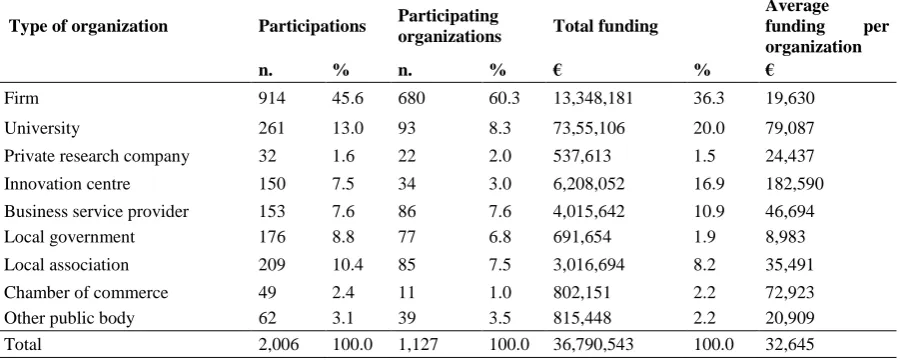
In our analysis we shall consider only the funded projects2. The total amount of different organizations involved in the nine waves was 1,1273, a subset of which (348) had taken part in more than one project. Since many waves allowed multiple participations (each organization could participate in more than one project), the number of participations amounted to 2,0064.
Table 1 shows the numbers and shares of participations and organizations involved in the programmes, classified into nine categories according to their nature: firms, business service providers (generally private companies); private research companies; local (business) associations; universities (and other public research providers); innovation centres (generally publicly funded or funded via public-private partnerships); chambers of commerce; local governments; and other public bodies.
2 See Russo and Rossi (2009) for a comparative analysis of funded and not funded project applications
submitted to the RPIA_ITT programme.
3 The data refer to definitive projects, drafted in the format scheduled in the funding specifications. Our analysis
includes all the subcontractors that have been explicitely identified in the application forms.
4 On average, the funds and the number of participants per project range from slighty less than 27 thousand
Firms5 represented 45,6% of overall participations, and a larger share of participating organizations, but they had the smallest ratios of participations per capita (number of participations divided by the number of organizations).
[image:10.595.70.529.280.460.2]The last column of table 1 shows the average funding per type of funded organization, taking into account that not all of them were permitted to receive funding (large companies and organizations based outside the region could enter the projects only with their own resources). Innovation centres on average received more funds than all other types of participants, followed by universities and chamber of commerce.
Table 1. Participants, agents and funding by type of organization
Type of organization Participations Participating
organizations Total funding
Average funding per organization
n. % n. % € % €
Firm 914 45.6 680 60.3 13,348,181 36.3 19,630
University 261 13.0 93 8.3 73,55,106 20.0 79,087
Private research company 32 1.6 22 2.0 537,613 1.5 24,437
Innovation centre 150 7.5 34 3.0 6,208,052 16.9 182,590
Business service provider 153 7.6 86 7.6 4,015,642 10.9 46,694
Local government 176 8.8 77 6.8 691,654 1.9 8,983
Local association 209 10.4 85 7.5 3,016,694 8.2 35,491
Chamber of commerce 49 2.4 11 1.0 802,151 2.2 72,923
Other public body 62 3.1 39 3.5 815,448 2.2 20,909
Total 2,006 100.0 1,127 100.0 36,790,543 100.0 32,645
In terms of economic activity (based on Nace Rev. 1.1 codes) and size6, the largest share of participating enterprises were manufacturing companies (68%): of these, 21.8% were micro and small firms in the traditional industries of the region (marble production and carving, textiles, mechanics, jewellery. The remaining ones were micro firms in the service sector (Nace Rev. 1.1:72): these were an active group, with 1.8 projects each on average.
The various programmes addressed a set of technology/industry targets. A large share of funds was devoted to ICT and multimedia (48.2%), with the objective to widen their adoption in traditional industries and SMEs. Projects in opto-electronics, an important competence network in the region, received 16.4% of funds. The third targeted area, projects in mechanics, received 7.5% of funds. The remaining technological fields included organic
5 Overall, 680 enterprises were involved in one or more of the policy programmes. They are about 1% of the
enterprises active in the region in 2001.
6 Enterprises are grouped by size into four classes: micro-sized firms (less than 10 employees); small firms
chemistry (5%), biotech (4%), and others (new materials, nanotechnologies and a combination of the previously mentioned technologies).
The regional policymakers were very active in providing learning opportunities for the participants. In all the observed programmes, and particularly until 2006, participants were frequently invited to present their progress in programme meetings, which often included - in addition to project participants and the programme managers - external experts discussing particular features of the programmes or presenting best practices.
Besides monitoring the projects’ progress, and teaching the policy participants how to manage the different aspects of the projects (from administrative procedures to external communication and dissemination), these meetings served to strengthen networking. In fact, the meetings (approximately one every four months) were used to exchange information on the innovative skills possessed by the various participants, the technologies developed and used in the projects, the sector of application of such technologies. The participation of all project partners – and not just the leading partner – was highly recommended. Moreover, in order to maximize the diffusion of information, the regional administration funded the publication of the final project reports, to be distributed to participants in the various programmes and in public events.
The programme meetings were intended to facilitate the recombination of skills and knowledge possessed by the regional agents and thus facilitate the initiation of further innovation processes.
3.2. Policy constraints
2004_171E, targeting environmental protection technologies), in 2005 (2005_171); the SPD line 172 – ‘programme 1.7.2’ – issued in 2002 (2002_172). In the vision of policymakers, all these programmes should have led to the development and strengthening of innovation clusters made of SMEs and large companies working together with innovation service providers, universities and other agents supporting innovation. Strongly inspired by the regional innovation system framework – which was dominant in the European innovation strategies of the time – the regional policymaker considered the emergence of such clusters as the first step towards the formation of an innovation system in Tuscany.
The second period started in 2006, and ended with the last intervention implemented in 2008. It included two programmes, divided into three waves: the Regional Programme of the Innovative Action issued in 2006 (2006_VIN), and the waves 2007 and 2008 of the programme 171 (2007_171 and 2008_171). The policymaker’s goal was to consolidate the networks formed in the previous period. Interestingly, these interventions had not been planned at the beginning of the programming period: the regional administration was able to procure additional funds that enabled it to implement a further RPIA and two more waves of the SPD line supporting innovation networks (programme 1.7.1).
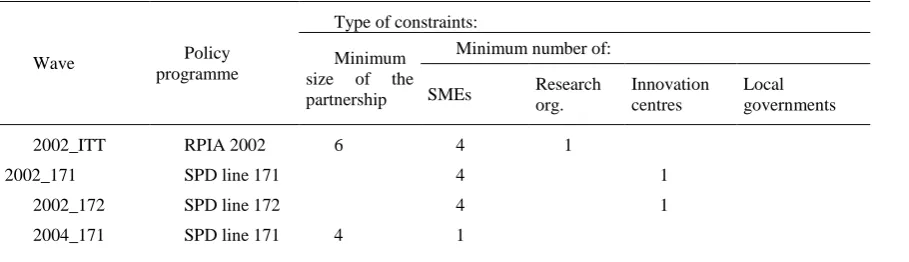
[image:12.595.59.514.638.769.2]Out of the six waves launched in the first period (2002-2005), five were characterized by the imposition of several constraints which were not present in any of the waves in the second period (2006-2008). Table 2 below shows the types of constraint characterizing the different waves: whether the programme demanded a certain composition of the partnership in terms of types of organizations involved (henceforth “heterogeneity constraint”), and whether the programme demanded a minimum number of partners, greater than that implied by the heterogeneity constraint (henceforth “minimum size constraint”). Some of these programmes also required organizations to participate in no more than one or two different projects, a constraint (not shown in Table 2) whose effects we do not investigate in this study.
Table 2. Types of constraints in the different waves
Wave Policy
programme
Type of constraints: Minimum
size of the partnership
Minimum number of:
SMEs Research
org.
Innovation centres
Local governments
2002_ITT RPIA 2002 6 4 1
2002_171 SPD line 171 4 1
2002_172 SPD line 172 4 1
2004_171E SPD line 171
2005_171 SPD line 171 10 5 1 1
2006_VIN RPIA 2006
2007_171 SPD line 171
2008_171 SPD line 171
Note to table 2: The first column displays the nine waves considered. The Regional Programmes of Innovative Action are identified with the following labels: 2002_ITT (Regional Programme of Innovative Action issued in 2002, whose acronym was ITT – Tuscany Technological Innovation) and 2006_VIN (acronym: Virtual Innovation Networks and Cooperative Integration, issued in 2006). The different calls of the two lines 1.7.1 and 1.7.2 included in the Single Programming Document are identified with the name of the line and of the reference year, as identified by the administrative documents we have analysed.
4. Empirical analysis
4.1. Descriptive analysis
The presence of a set policy-imposed constraints allows us to test whether the constraints had some impact on the participants’ learning processes, influencing the development of their ability to engage in collaborative innovation. Our dataset has two major limitations:. First, it does not allow us to extend the analysis to behavioural effects going beyond the period of implementation of the policy interventions themselves, in order to investigate whether and how the participants’ collaborative innovation skills have improved. Second, we do not have a control group of organizations that were not involved in the policy intervention, which could provide the basis for a counterfactual analysis. Because of the lack of data on the behaviour of participants after the end of the policy programmes, we focus on the characteristics of their participation in policy programmes in the second period (2006-2008) as evidence of their development of collaborative innovation skills. To compensate for the lack of an external control group, our empirical strategy involves distinguishing the effects of participation in programmes with and without policy constraints in the first period on the organizations’ behaviour in the second period: since most programme in the first period did
impose constraints, we have developed measures capturing the intensity, rather than just the presence, of constraints, as will be described in greater detail in the next section
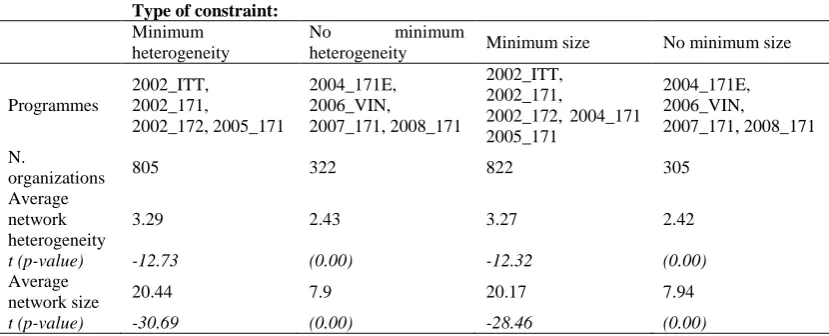
and in what follows used as a synonym of waves) which imposed a minimum size constraint resulted in larger project networks. We also observe whether there were any significant cross-cutting effect between the constraints and the relevant variables (e.g., whether the presence of a heterogeneity constraint had an effect on the networks’ average size, and whether the presence of a minimum size constraint had an effect on the networks’ average heterogeneity). We measure the heterogeneity of each project network in terms of the diversity of the types of participants: the index we use is the reciprocal of the Herfindahl index computed on the shares of participants belonging to each of nine categories (as listed in Table 1). The size of a network is measured by the number of participating organizations.
Table 3. Relationship between policy constraints and the key dimensions they were designed to impact
Type of constraint:
Minimum heterogeneity
No minimum
heterogeneity Minimum size No minimum size
Programmes 2002_ITT, 2002_171, 2002_172, 2005_171 2004_171E, 2006_VIN, 2007_171, 2008_171 2002_ITT, 2002_171,
2002_172, 2004_171 2005_171
2004_171E, 2006_VIN, 2007_171, 2008_171 N.
organizations 805 322 822 305
Average network heterogeneity
3.29 2.43 3.27 2.42
t (p-value) -12.73 (0.00) -12.32 (0.00)
Average
network size 20.44 7.9 20.17 7.94
t (p-value) -30.69 (0.00) -28.46 (0.00)
Table 3 shows that networks were on average more heterogeneous in programmes where a heterogeneity constraint was present than in programmes where such constraint was absent; and that networks were on average larger in programmes with minimum size constraints than in programmes without this constraint. At the same time, significant cross-cutting effects were also present: that is, networks were on average larger in programmes where a heterogeneity constraint was present than in programmes where such constraint was absent, and networks were on average more heterogeneous in programmes with minimum size constraints than in programmes without this constraint.
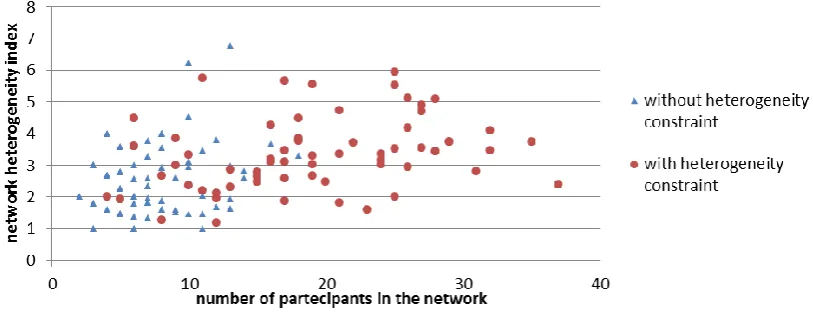
the size and heterogeneity of networks were, on average, greater when constraints were present. In programmes without constraints, network size was generally smaller (consistently with the lack of a minimum size constraint) and, although network heterogeneity was on average lower, its variability was greater.
Figure 1. Size and heterogeneity of project networks, grouped according to presence or absence of
constraints
Obviously, these comparisons do not tell us what are the effect of constraints. In fact, the features of networks in each programme may be influenced by many other elements besides policy constraints (the amount of funds available, the technology area the policy was designed to implement, the duration of the programme, and so on). Moreover, this approach does not allow us to distinguish between the effects of each constraint. In fact, while the constraints were strongly overlapping (programmes which imposed minimum heterogeneity also necessarily imposed a minimum size of the network) they had different intensity in different programmes (the minimum number of partners required ranged between 4 in programme 2004_171 and 10 in programme 2005_171, while the minimum heterogeneity required was lowest in programme 2004_171 and highest in programme 2002_171). The relationship between the intensity of the constraints in these five programmes was only loosely positive: the programmes that imposed a highest minimum size were not necessarily the programmes that imposed the highest heterogeneity, and vice versa programmes with low minimum size requirements may have had more strict heterogeneity constraints.
In what follows, we try to explore the effects of policy constraints on the behaviour of each organization rather than on the behaviour of networks of organizations. Therefore, we focus on the average heterogeneity and average size of all the networks an organization was involved in. For each organization, we average the heterogeneity indexes and the size of all the networks in which it took part, in either the first or the second period. The impact of constraints is also measured at the level of each organization: we compute the minimum heterogeneity requirements and the minimum size requirements of all the networks an organization participated in, and we average these across all such networks (only for projects funded within programmes where such constraints were present).
To assess the impact of policy constraints on the organizations’ development of collaborative innovation capabilities, we run two different sets of models.
First, we consider the 856 organizations that participated in programmes in the first period, and we assess whether policy constraints influenced the likelihood to participate also in the second period (Model 1). The dependent variable (T_20068) takes value 1 if the organization has participated in at least one project in the second period, and zero otherwise. Our hypothesis is that the policy constraints are likely to impact the actual heterogeneity and size of the networks the organization participated in during the first period, and these in turn are likely to affect the probability of its participation in the second period. To test this hypothesis we run a two-step instrumental variables probit regression (ivprobit) where the average heterogeneity and average size of networks in the first period (avghet_20025 and
avgsize_20025) are instrumented by the variables representing the average minimum heterogeneity (avgminhet) and the average minimum size (avgminsize) of the projects the organization participated in, as mandated by the policy constraints. We also include some variables capturing the organization’s pre-existing capabilities for collaborative innovation (the number of projects the organization participated in during the first period,
Nprojects20025, and the average funding per project the organization was able to procure,
avgfunding_20025), and we control for the organization’s type (out of nine possible
categories, as indicated in Table 1; Chambers of Commerce is the reference category) and technological specialization (share of projects in each technology area).
characteristics of an organization’s networks in the second period that capture the organization’s ability to engage in collaborative innovation: the number of projects,
Nprojects20068 (Model 2), the average heterogeneity of projects, avghet_20068 (Model 3), and the average size of projects, avgsize_20068 (Model 4). Because of the different types of dependent variables, Model 2 is estimated with a Poisson model while Models 3 and 4 use OLS. Due to some missing data, the models are run on 460 observations.
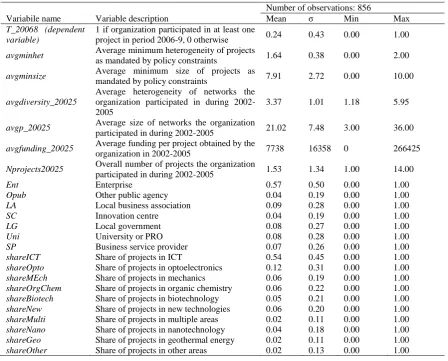
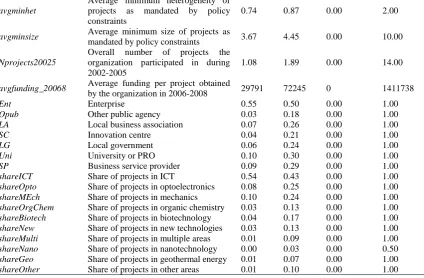
[image:17.595.66.515.254.615.2]Tables 4 and 5 report the main descriptive statistics on the variables used in the models.
Table 4. Variables used in Model 1
Number of observations: 856
Variabile name Variable description Mean σ Min Max
T_20068 (dependent variable)
1 if organization participated in at least one
project in period 2006-9, 0 otherwise 0.24 0.43 0.00 1.00
avgminhet Average minimum heterogeneity of projects
as mandated by policy constraints 1.64 0.38 0.00 2.00
avgminsize Average minimum size of projects as
mandated by policy constraints 7.91 2.72 0.00 10.00
avgdiversity_20025
Average heterogeneity of networks the organization participated in during 2002-2005
3.37 1.01 1.18 5.95
avgp_20025 Average size of networks the organization
participated in during 2002-2005 21.02 7.48 3.00 36.00
avgfunding_20025 Average funding per project obtained by the
organization in 2002-2005 7738 16358 0 266425
Nprojects20025 Overall number of projects the organization
participated in during 2002-2005 1.53 1.34 1.00 14.00
Ent Enterprise 0.57 0.50 0.00 1.00
Opub Other public agency 0.04 0.19 0.00 1.00
LA Local business association 0.09 0.28 0.00 1.00
SC Innovation centre 0.04 0.19 0.00 1.00
LG Local government 0.08 0.27 0.00 1.00
Uni University or PRO 0.08 0.28 0.00 1.00
SP Business service provider 0.07 0.26 0.00 1.00
shareICT Share of projects in ICT 0.54 0.45 0.00 1.00
shareOpto Share of projects in optoelectronics 0.12 0.31 0.00 1.00
shareMEch Share of projects in mechanics 0.06 0.19 0.00 1.00
shareOrgChem Share of projects in organic chemistry 0.06 0.22 0.00 1.00
shareBiotech Share of projects in biotechnology 0.05 0.21 0.00 1.00
shareNew Share of projects in new technologies 0.06 0.20 0.00 1.00
shareMulti Share of projects in multiple areas 0.02 0.11 0.00 1.00
shareNano Share of projects in nanotechnology 0.04 0.18 0.00 1.00
shareGeo Share of projects in geothermal energy 0.02 0.11 0.00 1.00
[image:17.595.76.518.655.775.2]shareOther Share of projects in other areas 0.02 0.13 0.00 1.00
Table 5. Variables used in Models 2, 3, 4
Number of observations: 460
Variabile name Variable description Mean σ Min Max
Nprojects20068 (dependent variable in Model 2)
Number of projects the organization
participated in 2006-2008 1.46 0.94 1.00 8.00
avghet_20068 (dependent variable in Model 3)
Average minimum heterogeneity of projects as mandated by policy constraints
2.65 1.10 1.00 6.76
avgsize_20068 (dependent variable in Model 4)
Average size of networks the
organization participated in during 2006-2008
avgminhet
Average minimum heterogeneity of projects as mandated by policy constraints
0.74 0.87 0.00 2.00
avgminsize Average minimum size of projects as
mandated by policy constraints 3.67 4.45 0.00 10.00
Nprojects20025
Overall number of projects the organization participated in during 2002-2005
1.08 1.89 0.00 14.00
avgfunding_20068 Average funding per project obtained
by the organization in 2006-2008 29791 72245 0 1411738
Ent Enterprise 0.55 0.50 0.00 1.00
Opub Other public agency 0.03 0.18 0.00 1.00
LA Local business association 0.07 0.26 0.00 1.00
SC Innovation centre 0.04 0.21 0.00 1.00
LG Local government 0.06 0.24 0.00 1.00
Uni University or PRO 0.10 0.30 0.00 1.00
SP Business service provider 0.09 0.29 0.00 1.00
shareICT Share of projects in ICT 0.54 0.43 0.00 1.00
shareOpto Share of projects in optoelectronics 0.08 0.25 0.00 1.00
shareMEch Share of projects in mechanics 0.10 0.24 0.00 1.00
shareOrgChem Share of projects in organic chemistry 0.03 0.13 0.00 1.00
shareBiotech Share of projects in biotechnology 0.04 0.17 0.00 1.00
shareNew Share of projects in new technologies 0.03 0.13 0.00 1.00
shareMulti Share of projects in multiple areas 0.01 0.09 0.00 1.00
shareNano Share of projects in nanotechnology 0.00 0.03 0.00 0.50
shareGeo Share of projects in geothermal energy 0.01 0.07 0.00 1.00
shareOther Share of projects in other areas 0.01 0.10 0.00 1.00
4.3. Empirical results
Table 6 reports the results of Model 1. The first-stage regressions on the variables
avghet_20025 and avgsize_20025 show that policy constraints significantly influence the heterogeneity and size of the networks each organization participates in: the variable
avgminsize has a positive and significant coefficient in both cases, indicating that participating in networks that, on average, have higher minimum size requirements leads organizations to form larger and more heterogeneous networks. Instead, the variable
[image:18.595.84.509.77.355.2]avgminhet has a significant but negative coefficient in both cases, indicating that participating in networks that, on average, have higher minimum heterogeneity requirements leads organizations to form smaller and less heterogeneous networks. This is a counterintuitive result that we discuss in greater detail later.
Table 6. Estimates for Model 1
First stage First stage Main equation
Dependent
Variable avghet_20025 avgsize_20025 T_20068
Coefficient (SE) Significance level Coefficient (SE) Significance level Coefficient (SE) Significance level
avghet_20025 -1.931
(1.809)
avgsize_20025 0.352
(0.276)
avgminhet -0.886 *** -3.838 ***
[image:18.595.72.541.650.771.2]avgminsize 0.257 *** 1.567 ***
(0.019) (0.133)
avgfunding_20025 0.000 0.000 ** 0.000 *
(0.000) (0.000) (0.000)
Nprojects20025 -0.001 -0.248 0.552 ***
(0.022) (0.153) (0.111)
Ent -0.424 ** 1.929 * -2.076
(0.163) (1.137) (1.447)
Opub 0.262 3.150 ** -0.985
(0.208) (1.450) (0.909)
LA -0.094 2.905 ** -1.690
(0.181) (1.262) (1.183)
SC 0.112 5.323 *** -1.799
(0.217) (1.510) (1.511)
LG -0.217 4.083 ** -2.751
(0.184) (1.282) (1.687)
Uni -0.079 2.640 * -1.323
(0.183) (1.274) (1.122)
SP 0.295 0.964 0.293
(0.185) (1.288) (0.758)
shareICT 0.519 ** 4.608 ** -5.657 ***
(0.273) (1.901) (1.165)
shareOpto 0.059 3.924 ** -6.328 ***
(0.280) (1.950) (1.506)
shareMEch 1.076 *** 0.704 -2.710
(0.301) (2.096) (2.058)
shareOrgChem 0.322 -5.446 ** -2.985
(0.302) (2.100) (2.520)
shareBiotech 1.414 *** 1.596 -2.792
(0.296) (2.060) (2.287)
shareNew 0.726 ** -0.710 -3.395 *
(0.298) (2.077) (1.849)
shareMulti 2.169 *** -1.714 -0.057
(0.356) (2.479) (4.508)
shareNano 0.488 5.013 ** -8.298 ***
(0.307) (2.134) (1.748)
shareGeo 0.817 ** -7.760 *** 0.606
(0.386) (2.690) (4.377)
shareOther 0.045 -5.594 ** -2.852
(0.341) (2.376) (1.945)
constant 2.485 *** 10.623 *** 3.779 **
(0.328) (2.280) (1.741)
N. obs. 856 N. obs. 856 N. obs. 856
F 29.46 F 38.67 Chi2 77.81
Prob > F 0.000 Prob > F 0.000 Prob > Chi2 0.000
R-squared 0.425 R-squared 0.493 R-squared
Adj R-squared 0.411 Adj R-squared 0.48
*** p<0.01, ** p<0.05, * p<0.1; Wald test of exogeneity: chi2(2) = 5.59 Prob > chi2 = 0.0612
Firms are involved in less heterogeneous networks (the Ent variable in the first column has a significantly negative coefficient), while several technological areas are positively associated with heterogeneity (ICT, mechanics, biotech, new technologies, geothermal energy, multiple technologies). Organizations that capture larger funds, on average, are involved in larger networks (this can be seen from the significantly positive coefficient of the variable
participates in (ICT, optoelectronics and nanotechnology are associated with larger networks, organic chemistry, geothermal energy and other technologies are associated with smaller networks).
Concerning the main equation, neither greater heterogeneity nor greater size are associated with greater likelihood to participate in projects in the second period. Instead, subsequent participation is more likely if organizations have obtained more funds (variable
avgfunding_20025) and have participated in more projects in the first period (variable
Nprojects20025), variables that can indicate the presence of strong pre-existing collaborative innovation capabilities – that is, these were organizations that were already able to network successfully in order to procure public funds. The participation in a large number of projects in the first period may have further increased their collaborative innovation capabilities by providing them with more contacts and greater reputation as successful collaboration partners, as well as, possibly, better ability to write up project proposals. Therefore, while policy constraints appear to have influenced the heterogeneity and size of the funded networks, participating in more heterogeneous and larger networks did not in itself promote further successful participation; rather, it was pre-existing capabilities that influenced the likelihood to successfully bid for later programmes.
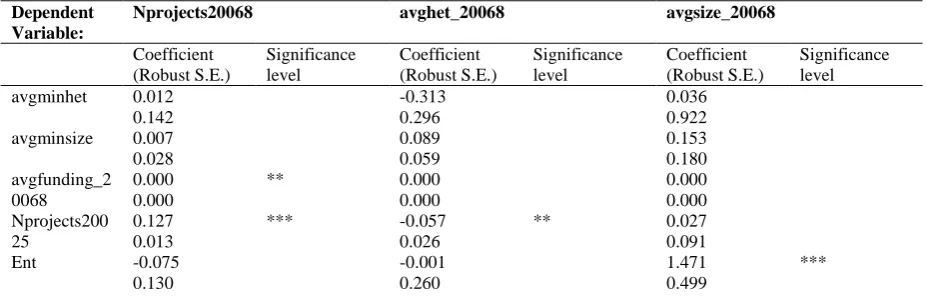
The results of Models 2, 3 and 4 are reported in Table 7. Here, we consider the set of 476 organizations that participated in the second period (2006-2008) and we examine whether having participated in projects in the first period that were characterized by the presence of policy constraints influenced several characteristics of an organization’s networks in the second period: the number of projects it participated in, Nprojects20068 (Model 2), the average heterogeneity of its project networks, avghet_20068 (Model 3), and the average size of its project networks, avgsize_20068 (Model 4). Due to some missing data on the networks’ composition (16 observations are missing), the models are run on 460 observations.
The results of Model 2 suggest that having participated in projects with minimum heterogeneity and size constraints did not influence the number of projects that the organization participated in during the second period: in fact, the coefficients of the variables
avgminhet and avgminsize are not significant. Rather, pre-exisiting collaborative innovation capabilities (as proxied by the variable Nprojects20025) significantly and positively influenced the number of projects an organization participates in. Therefore, having participated in more projects in the first period increased not only the likelihood to participate in projects in the second period (as shown by Model 1) but also the number of projects an organization participated in. Local governments and local business associations participated in fewer projects in the second period than other types of organizations. Organizations specializing in optoelectronics participated in more projects, and those specializing in biotech participated in fewer projects.
Model 3 suggest that having participated in projects with minimum heterogeneity and/or minimum size constraints did not influence the average heterogeneity of projects in the second period. Having participated in a greater number of projects in the first period had a significantly negative effect on the heterogeneity of networks in the second period: That is, more experienced organizations ended up joining or forming less heterogeneous networks. This may suggest that organizations may not consider heterogeneity per se as a valuable attribute of project networks, but rather only value when it is indeed necessary for the project’s success: this is supported by the fact that in the programmes implemented in the second period, where no constraints were imposed, the networks’ composition was more variable (as shown in Figure 1).
centres, local governments, universities and private business service providers are more likely to form heterogeneous networks: this is not surprising, as most of these organizations (in particular, local business associations, innovation centres and local government) consider building bridges with and across the local business community as one of their primary missions. Organizations specializing in biotech and new technologies are associated with more heterogeneous networks, while optoelectronics, organic chemistry, multiple technologies and the general “other technology areas” category are associated with less heterogeneous ones, following a similar pattern to that found in the first period (as shown in Model 1).
[image:22.595.71.535.617.768.2]Model 4 suggests that having participated in programmes with heterogeneity and size constraints in the first period did not influence the size of an organization’s project networks in the second period. Firms and organizations specialized in certain technology areas (optoelectronics, mechanics and biotechnology) were involved in larger networks, while organizations specializing in organic chemistry, geothermal energy, multiple technologies and other technologies participated in smaller networks. This pattern also shows some consistency with the pattern found in the first period (as shown in Model 1). From the previous Figure 1, we know that project networks in the second period were on average much smaller than in the first period, indicating that the minimum size constraints had indeed been effective in forcing organizations to form larger partnerships than they would have formed otherwise.
Table 7. Estimates for Models 3, 4 and 5
Dependent Variable:
Nprojects20068 avghet_20068 avgsize_20068
Coefficient (Robust S.E.)
Significance level
Coefficient (Robust S.E.)
Significance level
Coefficient (Robust S.E.)
Significance level
avgminhet 0.012 -0.313 0.036
0.142 0.296 0.922
avgminsize 0.007 0.089 0.153
0.028 0.059 0.180
avgfunding_2 0068
0.000 ** 0.000 0.000
0.000 0.000 0.000
Nprojects200 25
0.127 *** -0.057 ** 0.027
0.013 0.026 0.091
Ent -0.075 -0.001 1.471 ***
Opub -0.153 0.736 0.323
0.159 0.456 1.041
LA -0.336 ** 0.925 *** 0.355
0.155 0.300 0.733
SC 0.096 0.723 ** 0.567
0.166 0.314 1.090
LG -0.300 * 1.431 *** 1.018
0.158 0.330 0.629
Uni 0.027 0.805 ** 0.869
0.143 0.299 0.637
SP 0.196 0.541 * 0.622
0.148 0.317 0.650
shareICT -0.044 -0.183 0.105
0.062 0.147 0.482
shareOpto 0.288 *** -0.589 *** 1.797 ***
0.094 0.148 0.545
shareMEch -0.043 0.100 2.425 ***
0.075 0.195 0.856
shareOrgChe m
-0.009 -0.654 *** -2.297 **
0.160 0.251 0.972
shareBiotech -0.240 *** 0.437 ** 4.230 ***
0.084 0.208 0.843
shareNew -0.241 1.279 *** -0.719
0.146 0.347 0.822
shareMulti -0.078 -1.620 *** -2.453 *
0.215 0.402 1.280
shareNano -0.766 1.014 6.989
0.729 1.146 5.056
shareGeo 0.549 -0.235 -4.459 ***
0.352 0.372 1.087
shareOther 0.223 -0.513 ** -2.833 ***
0.176 0.256 0.857
constant 0.230 * 2.411 *** 7.083 ***
0.136 0.283 0.613
N. obs. 460 N. obs. 460 N. obs. 460
chi2 94.98 F 7.878 F 5.601
Prob >Chi2 0.00 Prob >F 0.00 Prob >F 0.00
R-squared 0.077 R-squared 0.263 R-squared 0.203
*** p<0.01, ** p<0.05, * p<0.1
5. Conclusions
heterogeneous than those in programmes without such constraints. However, the networks formed in programmes without constraints exhibited greater variability in terms of heterogeneity, suggesting that the imposition of constraints reduced the variability in the compositions of the partnerships.
When (as we did in section 4.2) we separate the effects of minimum size and minimum heterogeneity constraints, and we take into account the fact that the constraints had different degrees of intensity (and the intensity of the two constraints was only loosely correlated) we find that the two constraints have had different impacts.
The statistical models computed on different subsamples share a number of common findings.
First of all, the network dimensions that are influenced by the policy constraints – heterogeneity and size – did not impact the organization’s likelihood to participate in projects in the second period nor the number of projects the organization participated in during the second period.
Secondly, the variables proxying the acquisition of collaborative innovation capabilities were often influenced by the presence of characteristics indicating pre-existing collaborative innovation capabilities (such as the ability to procure more funds per project and the ability to submit more successful project applications). This suggests that, as could be expected, the organizations that already had strong capabilities to engage in collaborative innovation were better able to exploit the opportunities offered by these programmes. Having participated in more projects may have, in itself, promoted further collaborations by allowing organizations to get acquainted with a larger number of partners and to increase their reputation of “successful” collaborators.
These findings suggest several concluding remarks with respect to the effectiveness of constraints in supporting learning processes on the part of organizations involved in policy initiatives.
subsequent programmes or in the formation of more diverse or larger networks in the second period, these contacts may provide useful in other contexts and at future points in time. Instead, a more restrictive constraint like the minimum heterogeneity constraint appears to have had more controversial effects. Having participated in programmes with tighter heterogeneity constraints led organizations to form less heterogeneous and smaller networks. The argument here is that very specific constraints were interpreted by participants as being akin to “guidelines” that should be followed in order to bid successfully; hence, in programmes with strict heterogeneity constraints the compositions of projects networks were more similar to each other, and reflected quite closely the minimum composition required by the policymaker. Paradoxically, imposing more heterogeneity “by design” led participants to form less heterogeneous and smaller networks as they simply followed the indications provided. Instead, looser (or even absent) heterogeneity constraints led participants to include the variety of organizations that they actually needed to realize their projects, producing greater variability in network composition and, on average, greater heterogeneity.
The problem with the ex ante definition of very specific heterogeneity constraints is that, while there is a general consensus on the benefits of heterogeneous networks, the nature of the agents that may best contribute to the partnership very much depends on the content of the project that the network intends to realize. Hence, the definition of specific constraints may force participants to include organizations whose involvement is not needed for the purposes of the project, creating unnecessary complications. Furthermore, rigid rules may even discourage participants from experimenting with more varied approaches.
References
Ahuja, G. (2000). Collaboration networks, structural holes, and innovation: A longitudinal study, Administrative Science Quarterly, 45: 425–455.
Arora, A. and Gambardella, A. (1990). The changing technology of technological change: general and abstract knowledge and the division of innovative labour, Research Policy, 23: 523-532.
Arundel, A., Geuna, A. (2004). Proximity and the use of public science by innovative European Firms, Economics of Innovation and New Technology, 13(6): 559-580.
Autio, E., Kanninen, S., Gustaffson, R. (2008). First- and second-order additionality and learning outcomes in collaborative R&D programs, Research Policy, 37(1): 59-76. Bach, L., Matt, M. (2002) Rationale for Science & Technology Policy, in: Georghiou, L.,
Rigby, J., Cameron, H. (Eds.), Assessing the Socio-Economic Impacts of the Framework Programme (ASIF). Report to European Commission DG Research, pp. 93-145.
Bach, L., Matt, M. (2005) From Economic Foundations to S&T Policy Tools: a Comparative Analysis of the Dominant Paradigms, in: Llerena, P., Matt, M. (Eds.), Innovation Policy in a Knowledge-Based Economy: Theory and Practice. Springer,Berlin Heidelberg. Bachler, J.; Brown, R. (2004) Innovation and regional development: Transition towards a
knowledge-based economy, OECD Conference, Florencem, 25-26 November
Bellandi, M. and Caloffi A. (2010). An analysis of regional policies promoting networks for innovation, in European Planning Studies, 18(1): 67-82.
Branstetter, L., Sakakibara, M. (2002). When do research consortia work well and why? Evidence from Japanese panel data. American Economic Review, 92: 143–159.
Buisseret, T.J., Cameron, H.M. and Georghiou, L. (1995). What Difference Does It Make - Additionality in The Public Support Of R&D In Large Firms. International Journal of Technology Management 10: 587-600.
Caloffi, A., Russo, M., Rossi, F. (2012) What networks to support innovation? Paper presented at the DRUID conference “Innovation and competitiveness: Dynamics of organizations, industries, systems and regions”, Copenhagen, June 19-21.
Caloghirou, Y., Vonortas, N.S., Ioannides, S. (2004). European collaboration in research and innovation. Business strategy and public policy. Cheltenham: Edward Elgar.
Chávez, S.M. (2011). Behavioural additionality in the context of regional innovation policy in Spain. Innovation: Management, Poliy & Practice, 13(1): 95-110.
Chesbrough, H. (2003) The Era of Open Innovation, MIT Sloane Management Review, 44(3): 35-41.
Clarysse, B., Wright, M., Mustar, P. (2009). Behavioural additionality of R&D subsidies: A learning perspective. Research Policy, 38(10): 1517-1533.
Cohen, W. Nelson, R., and Walsh, J. (2002). Links and Impacts: The Influence of Public Research on Industrial R&D. Management Science, 48(1), 1-23.
Cunningham, P., Ramlogan, R. (2012) The effects of innovation network policies, Manchester Institute of Innovation Research, Manchester Business School, University of Manchester.
Duso. T., Pennings, E., Seldeslachts, J. (2010). Learning dynamics in research alliances: A panel data analysis. Research Policy, 39(6): 776–789.
European Commission (2003) A European initiative for growth. Investing in networks and knowledge for growth and employment, COM(2003)579, Bruxelles, EC.
Fier, A., Aschhoff, B. and Löhlein, H. (2006). Behavioural additionality of public R&D funding in Germany, in Government R&D funding and company behaviour. Measuring behavioural additionality, Paris: OECD Publishing.
Georghiou, L. (1998) Issues in the Evaluation of Innovation and Technology Policy. Evaluation 4, 37-51.
Gök, A., Edler, J. (2012) The Use of Behavioural Additionality Evaluation in Innovation Policy-Making. Research Evaluation, forthcoming. doi: 10.1093/reseval/rvs015.
Hughes, A. (2006) University-industry linkages and UK science and innovation policy, Centre for Business Research, University Of Cambridge, Working Paper No. 326.
Hyvarinen, J., Rautiainen, A.M. (2007) Measuring additionally and systemic impacts of public research and development funding - The case of TEKES, Finland. Research Evaluation 16, 205-215.
Lane, D.A. and R. Maxfield (1997). Foresight Complexity and Strategy, in: W.B. Arthur, S. Durlauf and D.A. Lane (eds.), The economy as an evolving complex system II. Redwood City, CA: Addison Wesley.
Laursen, K., Salter, A. (2004). Searching low and high: what types of firms use universities as a source of innovation? Research Policy, 33: 1201–1215.
Mytelka, L., Smith, K., 2002. Policy learning and innovation theory: an interactive and co-evolving process. Research Policy, 31: 1467-79
Nauwelaers, C., Wintjes, R. (2008) Innovation Policy in Europe, Cheltenham: Edward Elgar. Nooteboom, B. (2004) Inter-firm collaboration, learning and networks. An integrated
approach, London and New York: Routledge.
Organization for Economic Cooperation and Development (1997) National Innovation Systems, Paris, OECD.
Powell W. W., Koput K. W., and Smith-Doerr L. (1996). Interorganizational Collaboration and the Locus of Innovation: Networks of Learning in Biotechnology, Administrative Science Quarterly, 41(1): 116-145.
Tindemans, P. (2009). Post-war research, education and innovation policy-making in Europe, in Delanghe, H., Muldur, U., Soete, L. (Eds.) European Science and Technology Policy: Towards Integration or Fragmentation?, Cheltenham, Edward Elgar.