BIROn - Birkbeck Institutional Research Online
Brown, Paul and Fenner, Trevor (2017) The size of a graph is reconstructible
from any n - 2 cards. Discrete Mathematics 341 (1), pp. 165-174. ISSN
0012-365X.
Downloaded from:
Usage Guidelines:
The size of a graph is reconstructible from any
n
−
2 cards
Paul Brown
∗and Trevor Fenner
†Department of Computer Science and Information Systems
Birkbeck College, University of London, United Kingdom
September 6, 2017
Abstract
Let G and H be graphs of order n. The number of common cards of G and H is the maximum number of disjoint pairs (v, w), where v and w are vertices of G and H, respectively, such thatG−v ∼= H−w. We prove that if the number of common cards of G and H is at least n−2 then G and H must have the same number of edges when
n≥29. This is the first improvement on the 25-year-old result of Myrvold that if Gand
H have at least n−1 common cards then they have the same number of edges. It also improves on the result of Woodall and others that the numbers of edges ofGandHdiffer by at most 1 when they haven−2 common cards.
Keywords: Graph reconstruction, vertex-deleted subgraphs, common cards, size reconstruction
1
IntroductionIn this paper all graphs are finite, undirected and contain no loops or multiple edges. Any graph-theoretic terminology and notation not explicitly explained can be found in Bondy and Murty’s text [1].
LetGbe a graph of ordern, and let v ∈V(G). The vertex-deleted subgraphorcardG−v ofG is obtained fromGby deletingv together with all edges of Gincident to v. The multi-set of all n unlabelled cards ofG is called thedeckof G, which we denote byD(G). TheReconstruction Conjecture, first proposed by Kelly and Ulam in 1941 [5, 6, 13], asserts that, whenn >2, two graphs G and H are isomorphic if and only if D(G) = D(H). However, despite the efforts of many graph theorists, the status of the sufficiency of the condition remains unresolved.
One approach to tackling this problem has been to consider the number of common cards between pairs of graphs. Acommon card of, orbetween, two graphsGandH is any card in the multi-set intersection D(G)∩ D(H). The number of common cards of G and H, denoted by b(G, H), is the cardinality of this multi-set intersection. It follows that there exist labellings v1, v2, . . . , vnofV(G) andw1, w2, . . . , wnofV(H) such thatG−vj is isomorphic toH−wj for
all j, 1 ≤ j ≤ b(G, H). The Reconstruction Conjecture can then be reformulated as follows:
b(G, H) < n unless G and H are isomorphic when n > 2. Examples of families of pairs of non-isomorphic graphs that have a large number of common cards relative to n can be found in [2] and [4].
It is also of interest to obtain bounds on b(G, H) when G and H differ on certain graph parameters. A graph parameter θ is reconstructible from a subset S of the deck D(G) if θ(H) = θ(G) for every graph H for which D(H) contains S. For example, it was shown by Bowler et al [3] that b(G, H) ≤ n
2 + 1 when G is connected and H is disconnected, i.e.,
connectedness is reconstructible from anyn2+ 2 cards. Other authors have considered pairs for which the sizes, i.e., the numbers of edges, of G and H differ. However, despite the fact that it is easy to show thatb(G, H)< nin this case [8], obtaining stronger bounds has proved difficult. Myrvold [9] showed that b(G, H)≤ n−2 for such pairs when n ≥7. More recently, Woodall [14] generalised results of Kocay, Ramachandran, Monikandan and Balakumar [7] [11] [10] to obtain a number of relationships betweenb(G, H) and |E(G)| − |E(H)|
.
A consequence of one of Woodall’s results is that if|E(G)|−|E(H)|
≥2 thenb(G, H)≤n−3
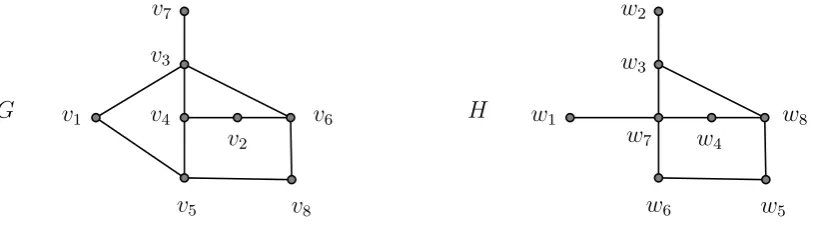
when n is sufficiently large. However, he stated that it was currently unknown whether, for n sufficiently large,|E(G)|=|E(H)| when b(G, H) =n−2. In this paper we prove that this is indeed the case whenn ≥29, i.e., the size of a graph is reconstructible from anyn−2 cards in its deck forn≥29. We note that this lower bound on nis almost certainly too high. However, for the pair of graphs of order 8 in Figure 1, b(G, H) = 6 and|E(G)| =|E(H)|+ 1. Indeed, this pair, together with their complements, are the only two pairs of non-isomorphic graphs of order 8 that have 6 common cards [12]. It is easy to check thatG−vj ∼=H−wj for 1≤j ≤6.
G v4
v2
v6
v3
v7
v1
v5 v8
H
w7 w4
w8
w3
w2
w1
[image:3.595.82.489.386.499.2]w6 w5
Figure 1: A pair of graphs of order 8 with different sizes having 6 common cards.
Using similar methods to those employed in this paper, we are hopeful that it can be shown that the size of a graph is reconstructible from any set of β cards in its deck for β less than n−2. Indeed, it likely that this result holds for significantly smaller values of β, since, as was stated in [2], there is currently no known pair G and H for which |E(G)| 6= |E(H)| and b(G, H)> 23n, when n ≥22. Indeed, a stronger version of the Reconstruction Conjecture was proposed in that paper, namely that 2n
3 is, in fact, an upper bound on b(G, H) for large n
when Gand H are not isomorphic.
2
Notation and preliminary resultsLetGbe a graph and let v be a vertex of G. Theneighbourhood of v inG is the subset NG(v)
of V(G) consisting of all vertices of G adjacent to v, and its degree in G, denoted by dG(v),
is the cardinality of this set, i.e., dG(v) = |NG(v)|. We denote the minimum and maximum
We define Dα(G) ={v ∈ V(G) |dG(v) = α} and dα(G) = |Dα(G)|, i.e., dα(G) is the number
of vertices of G of degree α. For any S ⊆ V(G), we further define Dα(S) = S ∩Dα(G) and
dα(S) = |Dα(S)|. So dα(NG(v)) is the number of neighbours of v of degree α in G. We note
that dα(G) = 0 when α < δ(G) or α >∆(G), and that P
i
di(S) =|S|, so P
i
di(G) = n.
We denote the complement of G by G, and note that dG(v) = n−1−dG(v) for all v; thus
Di(G) = Dn−1−i(G) for all i. Since δ(G) = n − 1 − ∆(G), it follows that Dδ(G)(G) =
Dn−1−∆(G)(G) =D∆(G)(G). Clearly, for anyv ∈V(G) and w∈V(H), we haveG−v ∼=H−w
if and only ifG−v ∼=H−w. This implies that b(G, H) = b(G, H).
Finally, we define
Eαβ(G) ={e∈E(G)|e =uv, where dG(u) = α and dG(v) =β, or vice versa}, (1)
and eαβ(G) = |Eαβ(G)|. We note that eαβ(G)≤min{αdα(G), βdβ(G)}.
Lemma 2.1. LetG be a graph and let S⊆V(G). Then, for all α,
αdα(G) ≥ X
u∈S
dα(NG(u)), (2)
X
u∈S
dα(NG(u)) ≥ (α+ 1 +|S| −n)dα(G)−dα(S). (3)
Proof Let T = {(u, v) ∈ S ×Dα(G) | uv ∈ E(G)}. For each v ∈ Dα(G), there are precisely
|NG(v)∩S| elements inT. On the other hand, for each u∈ S, there are precisely dα(NG(u))
elements in T. Thus P v∈Dα(G)
|NG(v)∩S|=|T|= P u∈S
dα(NG(u)).
Since |NG(v)∩S| ≤ |NG(v)|=α for every vertex v ∈Dα(G), it is clear that P
v∈Dα(G)
|NG(v)∩S| ≤ αdα(G), yielding (2). Now, each vertex in Dα(G)\Dα(S) is adjacent
to at least α−(n−1− |S|) vertices of S and each vertex in Dα(S) is adjacent to at least
α−(n− |S|) vertices of S, so it follows that
X
v∈Dα(G)
|NG(v)∩S| ≥ (α+ 1 +|S| −n)(dα(G)−dα(S)) + (α+|S| −n)dα(S)
= (α+ 1 +|S| −n)dα(G)−dα(S),
yielding (3). 2
Lemma 2.2. LetG be a graph and let v ∈V(G). If dG(v) = α, then
dα(G−v) =dα(G) +dα+1(NG(v))−dα(NG(v))−1 (4)
and, fori6=α,
di(G−v) =di(G) +di+1(NG(v))−di(NG(v)). (5)
Proof These follow immediately sincedG−v(u) =dG(u)−1 foru∈NG(v), anddG−v(u) = dG(u)
for u∈V(G−v)\NG(v). 2
Lemma 2.3. (Handshaking) Let Gbe a graph. Then P v∈V(G)
Lemma 2.4. Let G be a graph and let Λα(G) = Eαα(G)∪Eαα+1(G)∪Eα+1α+1(G). Then
Λδ(G)−1(G−v)⊆Λδ(G)(G) for allv ∈V(G).
Proof Let δ=δ(G). Clearly, Eδ−1δ−1(G) =Eδ−1δ(G) =Eδ−1δ+1(G) = ∅. So, if
xy∈Eδ−1δ−1(G−v)∪Eδ−1δ(G−v)∪Eδδ(G−v), then xy∈Eδδ(G)∪Eδδ+1(G)∪Eδ+1δ+1(G).
2
Lemma 2.5. LetG be a graph. Suppose that eαα+1(G) = 0. Then
{v ∈V(G)|eαα+1(G−v)≥1}
≤(α+ 1)dα+1(G) + (α+ 2)eαα+2(G). (6)
Proof Let v ∈ V(G). Suppose there exists xy ∈ Eαα+1(G −v), where dG−v(x) = α and
dG−v(y) =α+ 1. Then, eitherv ∈NG(x) and dG(x) = α+ 1, orv ∈NG(y)\NG(x),dG(x) = α
and dG(y) =α+ 2. The result now follows since there are at most (α+ 1)dα+1(G) vertices of
G that have a neighbour x of degree α+ 1, and at most (α+ 2)eαα+2(G) vertices of G that
have a neighbour y of degreeα+ 2 that is adjacent to a vertex xof degree α. 2
3
General resultsFrom now on, we assume that G and H are non-isomorphic graphs of order n. We define δ= min{δ(G), δ(H)} and ∆ = max{∆(G), ∆(H)}.
We label the vertices of G and H so that G − vj ∼= H − wj for j = 1, 2, . . . , b(G, H),
where dG(v1) ≤ dG(v2). . . ≤ dG(vb(G, H)). We define A(G) = {vj | 1 ≤ j ≤ b(G, H)} and
A(H) = {wj | 1≤ j ≤ b(G, H)}. In addition, we define A(G) = V(G)\ A(G), and A(H) =
V(H)\ A(H). Clearly, |A(G)|=|A(H)|=b(G, H), and |A(G)|=|A(H)|=n−b(G, H).
For all of the results in this section, we shall assume that |E(G)|=|E(H)|+ 1, without stating this explicitly. The justification for this assumption will become apparent in Section 4.
Lemma 3.1. Letvj ∈ A(G). Then dG(vj) = dH(wj) + 1.
Proof This follows since |E(G)| −dG(vj) =|E(G−vj)|=|E(H−wj)|=|E(H)| −dH(wj). 2
Corollary 3.2. dH(w1)≤dH(w2). . .≤dH(wb(G, H)). 2
Corollary 3.3. The following relationships between A(G) andA(H) follow immediately.
(a) di+1(A(G)) =di(A(H)) for all i.
(b) di+1(G) =di(A(H)) +di+1(A(G)) for alli.
(c) di(H) =di+1(A(G)) +di(A(H)) for alli.
(d) dδ(A(G)) = d∆(A(H)) = 0, dδ(G) = dδ(A(G)) andd∆(H) = d∆(A(H)).
(e) dδ(G)≤n−b(G, H).
2
Lemma 3.4.
X
y∈A(H)
dH(y)− X
x∈A(G)
dG(x) =b(G, H)−2. (7)
Proof Since |A(H)|=b(G, H), it follows from Lemmas 2.3 and 3.1 that
2|E(G)|= X
vj∈A(G)
dG(vj) + X
x∈A(G)
dG(x) =b(G, H) + X
wj∈A(H)
dH(wj) + X
x∈A(G)
Similarly, since |E(G)|=|E(H)|+ 1, it follows from Lemma 2.3 that
2|E(G)|= 2|E(H)|+ 2 = X
wj∈A(H)
dH(wj) + X
y∈A(H)
dH(y) + 2.
The above two equations immediately yield (7). 2 Lemma 3.5. Letψ =dδ(H)−dδ(G). Then, for all vj ∈ A(G) and wj ∈ A(H):
(a) dδ(NG(vj)) =dδ(NH(wj));
(b) if dG(vj) =δ+ 1, or equivalentlydH(wj) =δ, thendδ+1(NG(vj))−dδ+1(NH(wj)) =ψ−1;
(c) if dG(vj)≥δ+ 2, or equivalentlydH(wj)≥δ+ 1, thendδ+1(NG(vj))−dδ+1(NH(wj)) =ψ.
Proof (a) Since dδ−1(G) =dδ−1(H) = 0, it follows from (5) that dδ(NG(vj)) = dδ−1(G−vj) =
dδ−1(H−wj) =dδ(NH(wj)).
(b) By putting i = δ in (5) for vj ∈ Dδ+1(A(G)), and α = δ in (4) for wj ∈ Dδ(A(H)), we
obtain
dδ(G−vj) = dδ(G) +dδ+1(NG(vj))−dδ(NG(vj)), (8)
dδ(H−wj) = dδ(H) +dδ+1(NH(wj))−dδ(NH(wj))−1. (9)
Since G−vj ∼= H−wj, on using part (a) and the definition of ψ, the result follows from (8)
and (9).
(c) Sincedδ(A(G)) = 0 by Corollary 3.3(d), this result follows similarly by puttingi=δ in (5)
for vj ∈ A(G)\Dδ+1(A(G)) andwj ∈ A(H)\Dδ(A(H)). 2
Corollary 3.6. Let b=b(G, H). Then
δdδ(G) ≥ (δ+b−n)dδ(H), (10)
δdδ(H) ≥ (δ+ 1 +b−n)dδ(G). (11)
Proof Using inequality (2) withα=δ and S =A(G), and then inequality (3) withα=δ and S =A(H), it follows from Lemma 3.5(a) that
δdδ(G)≥ X
vj∈A(G)
dδ(NG(vj)) = X
wj∈A(H)
dδ(NH(wj))≥(δ+ 1 +b−n)dδ(H)−dδ(A(H)).
This implies inequality (10). Inequality (11) follows similarly, noting that dδ(A(G)) = 0 by
Corollary 3.3(d). 2 Corollary 3.7. Let ψ =dδ(H)−dδ(G) and let b=b(G, H). Then
(δ+ 1)dδ+1(G) ≥
X
wj∈A(H)
dδ+1(NH(wj)) +ψb−dδ+1(A(G)), (12)
(δ+ 1)dδ+1(H) ≥
X
vj∈A(G)
dδ+1(NG(vj))−ψb+dδ+1(A(G)). (13)
Proof By Corollary 3.3(d), dG(vj)≥δ+ 1 for allvj ∈ A(G). So, since|A(G)|=b, on summing
dδ+1(NG(vj)) for all vj ∈ A(G) using Lemma 3.5(b) and (c), it follows that
X
vj∈A(G)
dδ+1(NG(vj)) = X
wj∈A(H)
dδ+1(NH(wj)) +ψb−dδ+1(A(G)).
Lemma 3.8. Letψ =dδ(H)−dδ(G). Suppose that ψ ≥1. Then
b(G, H)≤j(δ+2)(ψ+δn+2+ψ)k ≤j(δ+2)(δ+3n+1)k.
Proof Let b=b(G, H). By Corollary 3.3(a) and (d),
dδ+1(A(G)) =dδ(A(H))≤dδ(H) =dδ(G) +ψ =dδ(A(G)) +ψ.
Hence
dδ+1(G)≤dδ+1(A(G)) +dδ(A(G)) +ψ ≤ |A(G)|+ψ = (n−b) +ψ.
So, sinceψb≤(δ+2)dδ+1(G) by (12), it follows thatψb≤(δ+2)(n−b+ψ). Thus (ψ+δ+2)b≤
(δ+ 2)(n+ψ), yielding the first inequality. The second inequality follows since n ≥δ+ 2, as otherwise G∼=H∼=Kn. 2
Corollary 3.9. Suppose that dδ(H)> dδ(G).
(a) If δ = 0, then b(G, H)≤2
3(n+ 1)
, and b(G, H)≤n−3 whenn ≥9.
(b) If δ = 1 then b(G, H)≤3
4(n+ 1)
, and b(G, H)≤n−3 whenn ≥12.
(c) If δ ≤6 thenb(G, H)≤8
9(n+ 1)
, and b(G, H)≤n−3 whenn ≥27.
2
Lemma 3.10. Letψ =dδ(H)−dδ(G). Suppose that ψ ≤ −1 and dδ(A(H)) = 0. Then
b(G, H)≤j(δ+1)(δ+1n+−δ+3ψ −ψ)k ≤j(δ+1)(δ+2n+δ+4)k.
Proof Let b =b(G, H). If dδ+1(A(H)) = 0, then −ψb ≤(δ+ 1)dδ+1(A(H))≤ (δ+ 1)(n−b)
by (13); thus b ≤ j(δδ+1+1)−ψnk ≤ j(δ+1)(δ+1n+−δ+3ψ −ψ)k. So suppose that dδ+1(A(H)) ≥ 1. Hence
dH(w1) = δ + 1, and thus dG(v1) = δ + 2 by Lemma 3.1. Therefore, by Lemma 3.5(c),
dδ+1(NG(v1))−dδ+1(NH(w1)) =ψ. On puttingα=δ+1 =dH(w1) in (4) andi=δ+1 6=dG(v1)
in (5), it follows that
dδ+1(G) = dδ+1(H) +dδ+2(NH(w1))−dδ+2(NG(v1)) +ψ−1≥dδ+1(H)−(δ+ 3−ψ), (14)
asdδ+2(NG(v1))≤dG(v1) = δ+ 2. Since dδ+1(G) =dδ+1(A(G)) by Corollary 3.3(b), it follows
from (14) that
n−b =|A(G)| ≥dδ+1(A(G)) =dδ+1(G)≥dδ+1(H)−(δ+ 3−ψ). (15)
From (13), we see that (δ+ 1)dδ+1(H) ≥ −ψb. Combining this with (15) then gives n−b ≥
−δψb+1 −(δ+ 3−ψ). Thus (δ+ 1−ψ)b ≤(δ+ 1)(n+δ+ 3−ψ), yielding the first inequality. The second inequality follows immediately as n+δ+ 3 > δ+ 1. 2 Corollary 3.11. Suppose that dδ(G)> dδ(H) and dδ(A(H)) = 0.
(a) If δ = 0 then b(G, H)≤1
2(n+ 4)
, and b(G, H)≤n−3 whenn ≥9.
(b) If δ = 1 then b(G, H)≤2
3(n+ 5)
, and b(G, H)≤n−3 whenn ≥17.
2
4
The case when b(G, H) =n−2We now prove the main result of this paper: if n ≥ 29 and b(G, H) ≥ n−2, then |E(G)| = |E(H)|. We first state the results of Myrvold and Woodall. The first theorem is a restatement of Theorem 2.3 in [9]. The second follows from Theorem 1.3(b) in [14] (this result was also proved for n≥9 by Kocay, Ramachandran, Monikandan and Balakumar [7] [11] [10]).
Theorem 4.1. LetG and H be graphs of order n, where n ≥7 and b(G, H) ≥n−1. Then
|E(G)|=|E(H)|. 2
Theorem 4.2. LetG and H be graphs of order n, where n ≥10 andb(G, H) = n−2. Then
|E(G)| − |E(H)|
≤1. 2
We assume from now on that|E(G)|=|E(H)|+ 1and b(G, H) =n−2. We shall show that n≤28 under these assumptions. Our main result will then follow from Theorems 4.1 and 4.2. We let A(G) = {x1, x2} and A(H) = {y1, y2}, where we assume that dG(x1) ≤ dG(x2) and
dH(y1)≤dH(y2), without loss of generality. We recall from Lemma 3.1 thatdG(vj) = dH(wj)+1
for all j.
Since H−wj ∼=G−vj for all j, we may assume that A(H) = A(H) and A(G) = A(G). So
A(H) = {y1, y2} and A(G) = {x1, x2}, where we note that dH(y2) ≤ dH(y1) and dG(x2) ≤
dG(x1). Furthermore, since |E(H)| = |E(G)| + 1, we make frequent use of the following
complementarity principle:
For any result for G and H, we may deduce a corresponding result for H and G by replacing all occurrences of G, H, δ, ∆, x1, x2, y1 and y2 by H, G, n−1−∆, n−1−δ, y2, y1, x2 and
x1, respectively.
Lemma 4.3. dH(y1) +dH(y2)−dG(x1)−dG(x2) =n−4.
Proof This follows immediately from Lemma 3.4. 2
We first show that δ≥2 under our assumptions.
Lemma 4.4. Suppose that n≥9. Then 1≤δ≤∆≤n−2.
Proof Suppose that δ = 0. If d0(H) > d0(G) then b(G, H) ≤ n −3 by Corollary 3.9(a),
which is impossible. Hence d0(H) ≤ d0(G). Now, if dH(w1) = δ = 0, then Lemma 3.5(b)
implies that d1(NG(v1)) = d0(H)−d0(G)−1 < 0, which is impossible. Thus d0(A(H)) = 0.
It now follows from Corollary 3.11(a) that b(G, H) ≤ n−3 when d0(G) > d0(H). Therefore
d0(G) =d0(H). Hence G∼=G1∪K1 and H ∼=H1∪K1, whereG1 and H1 are non-isomorphic
graphs of ordern−1. Nowd0(A(G)) = 0 by Corollary 3.3(d). Since we also haved0(A(H)) = 0,
clearly b(G1, H1) =b(G, H) = n−2. So |E(G1)|=|E(H1)| by Theorem 4.1. However, since
|E(G1)| = |E(G)| = |E(H)|+ 1 = |E(H1)|+ 1, this is impossible. Therefore δ ≥ 1. By the
complementarity principle, it immediately follows thatn−1−∆≥1, and thus ∆≤n−2. 2
We recall the definition of Eαβ(G) from (1), and that eαβ(G) =|Eαβ(G)|. These will be used
frequently in several of the remaining proofs.
Lemma 4.5. Suppose that n≥16 and δ= 1. Then d1(H)≤d1(G) andd1(A(H)) = 0.
Proof Ifd1(H)> d1(G), thenb(G, H)≤n−3 by Corollary 3.9(b), which is impossible. Hence
Since d1(G) = d1(A(G)) by Corollary 3.3(d), we have
1≤d1(A(H))≤d1(H)≤d1(G) = d1(A(G))≤2. (16)
SodG(x1) = 1 anddH(w1) = 1, and thus dG(v1) = 2 by Lemma 3.1. Hence, by Lemma 3.5(b),
d2(NG(v1)) + (d1(G)−d1(H)) + 1 =d2(NH(w1))≤dH(w1) = 1.
This implies that d2(NG(v1)) = 0, d1(G) = d1(H) and d2(NH(w1)) = 1. Therefore, let
NH(w1) = {t} and NH(t) = {w1, t0}, and thus e11(H) = 0 as d1(H) ≤ 2 by (16). In
ad-dition, it follows from Corollary 3.3(b) and (16) that
d2(G) =d1(A(H)) +d2(A(G))≤d1(A(G)) +d2(A(G))≤2. (17)
Hence e22(G) = 0 as d2(NG(v1)) = 0.
Case (a): e12(G) = 0.
LetS={vj ∈ A(G)|e12(G−vj)≥1}. From (6) with α= 1, we have|S| ≤2d2(G) + 3e13(G).
Hence |S| ≤10, since d2(G)≤2 by (17) and e13(G)≤d1(G)≤2 by (16). Now letT ={wj ∈
A(H)|e12(H−wj)≥1}. Since w1t ∈E12(H), clearlyA(H)\ {w1, t, t0} ⊆T, so |T| ≥n−5.
Since |T|=|S|, this implies thatn≤15, which is impossible.
Case (b): e12(G)≥1.
Without loss of generality, we assume that d2(NG(x1)) = 1. Now, since e11(H) = 0, it follows
that d1(NH(wj)) = 0 if dH(wj) = 1. So, by Lemmas 3.1 and 3.5(a), d1(NG(vj)) = 0 if
dG(vj) = 2. Sinced2(NG(x1)) = 1, this implies thatE12(G) ={x1x2}, and thusD1(G) ={x1}.
Therefore, D1(H) = {w1} by (16) and D2(G) = {v1, x2} by (17). Moreover, d1(NG(vj)) = 0
for all j, so it follows from Lemma 3.5(a) that t is either y1 or y2. By Lemma 4.3, dH(y1) +
dH(y2) = n − 1. Now dH(t) = 2 and dH(y1) ≤ dH(y2), so t must be y1, and therefore
dH(y1) = 2 and dH(y2) =n−3. Clearly, y1 is the unique leaf of H−w1; so G−v1 also has
a unique leaf, namely x1. Now v1x2 6∈ E(G) since e22(G) = 0. So D2(NG−v1(x1)) = {x2},
and hence d2(NH−w1(y1)) = 1. Thus dH(t
0) = 2, so t0 is not y
2. It therefore follows that,
without loss of generality, we may assume that t0 isw2, i.e.,NH(y1) ={w1, w2}. Furthermore,
since dH(y2) = n−3, we have NH(y2) = V(H)\ {w1, y1, y2} and NH(w2) = {y1, y2}. This
implies that y2 is the unique vertex at distance 2 from the unique leaf y1 of H −w1. Now
w1y1 ∈E11(H−w2), and thus e11(G−v2)≥1. So, since D1(G) ={x1}, E12(G) ={x1x2} and
e22(G) = 0, clearly v2x2 ∈ E(G). This implies that v2 is the unique vertex at distance 2 from
the unique leaf x1 of G−v1. However, dG(v2) = 3 by Lemma 3.1, so dG−v1(v2) ≤ 3. This is
impossible as dH−w1(y2) =n−3≥13. Therefore d1(A(H)) = 0. 2
Corollary 4.6. Suppose that n≥16 and ∆ =n−2. Thend1(G)≤d1(H) andd1(A(G)) = 0.
Proof This follows immediately by the complementarity principle. 2 Lemma 4.7. Suppose that n≥17. Then 2≤δ≤∆≤n−3.
Proof By Lemma 4.4, it follows that 1≤δ≤∆≤n−2. We now assume that δ= 1 and show that this leads to a contradiction.
By Lemma 4.5, d1(H) ≤ d1(G) and d1(A(H)) = 0, so d1(H) = d1(A(H)). Now, if d1(G) >
d1(H) then b(G, H)≤n−3 by Corollary 3.11(b), which is impossible; hence d1(G) = d1(H).
So, by Corollary 3.3(d),
ThereforedG(x1) =dH(y1) = 1 asδ= 1; moreover,dG(x2) = 1 if and only ifdH(y2) = 1. Hence
dH(y2) = n−4 +dG(x2) by Lemma 4.3, and it follows that dG(x2) = 2 and dH(y2) = n−2, as
∆≤n−2. Thus ∆ =n−2, and hence min(δ(H), δ(G)) = 1. By Corollary 4.6,d1(A(G)) = 0.
So d1(G) = 0 as dG(x1) = n−2 and dG(x2) = n−3. However, since dH(y2) = 1, we have
d1(H) > d1(G). By applying Corollary 3.11(b) to the pair H and G, we see that b(H, G) ≤
n−3, which is impossible sinceb(H, G) = b(G, H). Thereforeδ≥2. By the complementarity principle, it follows that n−1−∆≥2, and hence ∆≤n−3. 2 Lemma 4.8. Suppose that n≥17. Then dH(y1)≥δ+ 1 andDδ(H) =Dδ(A(H)).
Proof By Lemmas 4.3 and 4.7, dH(y1) ≥ (n−4)−(n−3) + 2δ = 2δ−1 ≥ δ+ 1. Since
dH(y2)≥dH(y1), it immediately follows thatDδ(H) =Dδ(A(H)). 2
We note that Lemma 4.8 implies that ifδ(H) =δ then dH(w1) =δ.
Theorem 4.9. Let G and H be graphs of order n, where n ≥ 27. Suppose that |E(G)| = |E(H)|+ 1 and b(G, H) =n−2. Then dδ(G) = dδ(H) and d∆(G) = d∆(H).
Proof We first note that 2 ≤δ≤∆≤n−3 by Lemma 4.7, and dδ(G)≤2 by Corollary 3.3(e).
We show that both of the casesdδ(H)> dδ(G) anddδ(G)> dδ(H) lead to contradictions, from
which it will follow that dδ(G) = dδ(H). By applying the complementarity principle, it will
then follow thatd∆(G) = dn−1−∆(G) =dn−1−∆(H) = d∆(H).
Suppose first thatdδ(H)> dδ(G). Then, by (10),δdδ(G)≥(δ−2)dδ(H)≥(δ−2)(dδ(G) + 1),
soδ ≤2 + 2dδ(G)≤6. This contradicts Corollary 3.9(c).
Suppose instead that dδ(G) > dδ(H), so dδ(H)≤1. Then, by (11), δdδ(H)≥(δ−1)dδ(G)≥
(δ−1)(dδ(H) + 1), so δ ≤1 +dδ(H) ≤2. It immediately follows that δ = 2, d2(H) = 1 and
d2(G) = 2. Therefore D2(G) = {x1, x2} by Corollary 3.3(d), and D2(H) = {w1} by Lemma
4.8. SodG(v1) = 3 by Lemma 3.1, and thus D3(G) = {v1} by Corollary 3.3(b).
By Lemma 3.5(a), d2(NG(vj)) = d2(NH(wj)) for all j. Since D2(H) = {w1}, it follows that
d2(NG(v1)) = 0, and thuse23(G) = 0; moreover,d2(NG(vj))≤1 for allj. Now, if x1x2 6∈E(G),
there would be four distinct vertices vj ∈ A(G) such that d2(NG(vj)) = 1 and, therefore, four
corresponding vertices wj ∈ A(H) such that d2(NH(wj)) = 1. This is clearly impossible as
d2(H) = 1; hence x1x2 must be in E(G). In addition, since d2(NG(v1)) = 0, it follows that
x1x2 ∈ E22(G−v1) and therefore e22(H −w1) ≥ 1. As D2(H) = {w1}, this implies that
NH(w1) = {t, t0}, where dH(t) = dH(t0) = 3 and tt0 ∈E(H).
LetS ={vj ∈ A(G)|e23(G−vj)≥1}. Sincee23(G) = 0, we have |S| ≤ 3d3(G) + 4e24(G) by
(6). Now e24(G) ≤2, as D2(G) = {x1, x2} and x1x2 ∈ E(G). Hence |S| ≤ 11, asd3(G) = 1.
Now let T = {wj ∈ A(H) | e23(H −wj) ≥ 1}. As both w1t and w1t0 are in E23(H), clearly
A(H)\(NH(t)∪NH(t0)) ⊆ T; so |T| ≥ n−7. Since |S| = |T|, this implies that n ≤ 18,
contradicting the hypothesis. 2 Corollary 4.10. Suppose that n ≥27. Then δ(G) =δ(H) = δ and ∆(G) = ∆(H) = ∆. 2 Lemma 4.11. Suppose that n≥27. Then
2≤δ=dG(x1)≤dG(x2)< dH(y1)≤dH(y2) = ∆≤n−3. (18)
Proof Since dδ(G) = dδ(A(G)) and d∆(H) = d∆(A(H)) by Corollary 3.3(d), it follows from
Corollary 4.10 that dG(x1) =δ and dH(y2) = ∆. So dH(y1)−dG(x2) =n−4−∆ +δ≥ 1 by
Corollary 4.12. Suppose that n ≥27. Then dH(w1) = δ, dG(v1) =δ+ 1, dG(vn−2) = ∆ and
dH(wn−2) = ∆−1. 2
For vertices s∈V(G) andt ∈V(H), we define NGA(s) =NG(s)∩ A(G) and NHA(t) =NH(t)∩
A(H), respectively.
Lemma 4.13. Suppose that n ≥ 27 and dδ(G) = dδ(H) = 1. Then Dδ(G) = {x1} and
Dδ(H) ={w1}. In addition, either eδδ+1(G)≥1 or eδ+1δ+1(G)≥1.
Proof Since dδ(G) = dδ(H) = 1, it follows that Dδ(G) = Dδ(A(G)) = {x1} by Lemma 4.11,
andDδ(H) =Dδ(A(H)) = {w1}by Corollary 4.12. This implies thatdδ+1(G)≤2 by Corollary
3.3(b).
Suppose now thateδδ+1(G) =eδ+1δ+1(G) = 0. Then, since eδδ(G) = 0, it follows from Lemma
2.4 thateδ−1δ(G−vj) =eδδ(G−vj) = 0 for all vj. Now dδ+1(NH(w1))≥ 1 by Lemma 3.5(b),
soeδδ+1(H)≥1, and thus there existst∈Dδ+1(NH(w1)). Furthermore, since eδ−1δ(H−wj) =
eδδ(H−wj) = 0 for all wj, it is easy to see that NHA(t) = {w1}. Since δ ≥ 2 by (18), this
implies thatδ = 2 andNH(t) = {w1, y1, y2}.
Let S = {vj | e23(G−vj) ≥ 1}. Since e23(G) = 0, we have |S| ≤ 3d3(G) + 4e24(G) by (6).
Hence |S| ≤ 14, as d3(G) ≤ 2 and d2(G) = 1. Now let T = {wj | e23(H −wj) ≥ 1}. As
w1t ∈E23(H), clearlyA(H)\(NHA(w1)∪NHA(t))⊆T, so|T| ≥n−5. As|S|=|T|, this implies
that n≤19, which is impossible. Therefore, either eδδ+1(G)≥1 or eδ+1δ+1(G)≥1. 2
Corollary 4.14. Suppose that n ≥27 anddδ(G) =dδ(H) = 1. Then Dδ+1(G) ={v1, x2}.
Proof By Lemma 4.13 and Corollary 3.3(a), Dδ(G) = {x1} and dδ+1(A(G)) =dδ(A(H)) = 1.
So Dδ+1(A(G)) = {v1} and thus Dδ+1(G) ⊆ {v1, x2}. Suppose that dG(x2) ≥ δ+ 2. Then
eδ+1δ+1(G) = 0, so eδδ+1(G) ≥ 1 by Lemma 4.13. This implies that Dδ(NG(v1)) = {x1}, and
thus dδ(NH(w1)) = 1 by Lemma 3.5(a). This is impossible since Dδ(H) = {w1} by Lemma
4.13. Hence dG(x2) = δ+ 1. 2
Lemma 4.15. Suppose that n≥27. Then n−4≤2(∆−δ)≤n−2.
Proof By Lemma 4.11, dG(x1) = δ and dH(y2) = ∆. Now, if dG(x2) > dG(x1) then dδ(H) =
dδ(G) = 1 by Theorem 4.9 and Corollary 3.3(d); so dG(x2) = δ+ 1 by Corollary 4.14. Hence
dG(x2)∈ {δ, δ+ 1}. It immediately follows from the complementarity principle that dH(y1)∈
{n−1−∆, n−∆}, and thus dH(y1)∈ {∆,∆−1}. Since (∆−δ) +dH(y1)−dG(x2) = n−4
by Lemma 4.3, the result now follows easily. 2 Lemma 4.16. Suppose that n ≥ 27, dδ+1(G) = 2 and δ ≥ dδ(H) + 6. Then dδ+1(H) =
dδ+1(A(H)) = 2.
Proof If dH(y1) ≤ δ+ 1 then dH(y1) = δ + 1 and dG(x1) = dG(x2) = δ by (18). However,
this would imply thatdH(y2) = n−5 +δ by Lemma 4.3, which is impossible since δ ≥6. So
dH(y1)≥δ+ 2, and thereforedδ+1(H) = dδ+1(A(H)). We now show thatdδ+1(H) = 2.
Suppose first that dδ+1(H)≤1. Then, by (13) and Theorem 4.9,
δ+ 1≥ X
vj∈A(G)
dδ+1(NG(vj)) +dδ+1(A(G)). (19)
Putting α = δ + 1 and S = A(G) in inequality (3), we see that the right hand side of (3) reduces to δdδ+1(G)− dδ+1(A(G)). Combining inequalities (3) and (19) then implies that
So suppose instead that dδ+1(H)≥3. By (12), Theorem 4.9 and Corollary 3.3(a),
2(δ+ 1) ≥ X
wj∈A(H)
dδ+1(NH(wj))−dδ(A(H)). (20)
Using inequality (3) for H with α = δ+ 1 and S = A(H), together with inequality (20), it follows that
2(δ+ 1) ≥δdδ+1(H)−dδ+1(A(H))−dδ(A(H))≥3(δ−1)−dδ(H).
Again, this contradicts the assumption that δ≥dδ(H) + 6. Therefore dδ+1(H) = 2. 2
We note that 1 ≤ dδ(G) ≤ 2 by Theorem 4.9 and Corollary 3.3(e). To complete the proof
of the upper bound on n, we find upper bounds on δ when dδ(G) = 1 and when dδ(G) = 2.
The complementarity principle then gives corresponding lower bounds on ∆. These bounds, together with Lemma 4.15, will then yield the required upper bound onn.
We define Λα(G) = Eαα(G)∪Eαα+1(G)∪Eα+1α+1(G), as in Lemma 2.4, and let λα(G) =
|Λα(G)|.
Lemma 4.17. Suppose that n≥27 and dδ(G) = dδ(H) = 1. Then δ ≤6.
Proof We assume that δ≥7 and obtain a contradiction.
Clearly, eδδ(G) = eδδ(H) = 0. Also, by Lemma 4.13 and Corollary 4.14, Dδ(G) = {x1},
Dδ(H) = {w1} and Dδ+1(G) ={v1, x2}. Therefore, since δ ≥ 7, it follows from Lemma 4.16
that Dδ+1(H) = Dδ+1(A(H)) = {w2, w3}, and hence Dδ+2(G) = Dδ+2(A(G)) = {v2, v3} by
Corollary 3.3(a). We summarise the degrees of the vertices of G and H in Table 1.
v1 v2 v3 v4, . . . , vn−2 x1 x2
δ+ 1 δ+ 2 δ+ 2 ≥δ+ 3 δ δ+ 1
w1 w2 w3, w4, . . . , wn−2 y1 y2
[image:12.595.153.448.422.478.2]δ δ+ 1 δ+ 1 ≥δ+ 2 ≥δ+ 2 ≥δ+ 2
Table 1: The degrees of the vertices of Gand H in Lemma 4.17.
We note thatDδ+1(NG(v1))⊆ {x2}and Dδ(NH(w1)) =∅. So, by Lemma 3.5(a),dδ(NG(v1)) =
0, which implies that v1x1 6∈E(G).
Case (a): v1x2 ∈E(G).
In this case, Dδ+1(NG(v1)) = {x2}. So it follows from Lemma 3.5(b) that dδ+1(NH(w1)) =
dδ+1(NG(v1)) + 1 = 2. Therefore Dδ+1(NH(w1)) = {w2, w3}, so Eδδ+1(H) = {w1w2, w1w3}.
We recall from Lemma 2.4 that, Λδ−1(G−vj)⊆Λδ(G) for allvj. So Λδ−1(G−vj)⊆ {v1x2, x1x2}
for all vj, since v1x1 6∈E(G).
Now let S ={vj ∈ A(G) | λδ−1(G−vj)≥ 1}. Clearly, S ⊆ NG(x2), so |S| ≤δ+ 1. Now let
T ={wj ∈ A(H)|λδ−1(H−wj)≥1}. Since Eδδ+1(H) ={w1w2, w1w3}, it is easy to see that
(NHA(w2)∪NHA(w3))\ {w1} ⊆ T, so |T| ≥ 2(δ−1)− |NHA(w2)∩NHA(w3)| −1. We shall show
that NHA(w2)∩NHA(w3) = {w1}, hence |T| ≥2δ−4. As |S| =|T|, it will immediately follow
that δ≤5, contradicting our assumption that δ ≥7.
Suppose first that x1x2 6∈E(G). Then Λδ−1(G−vj)⊆ {v1x2} for all vj, so λδ−1(H−wj)≤1
for all wj. Clearly, if there exists wk ∈ (NHA(w2)∩NHA(w3))\ {w1}, then {w1w2, w1w3} ⊆
Suppose, on the other hand, thatx1x2 ∈E(G). ThenEδδ(G−v1) ={x1x2}sincev1x2 ∈E(G),
by hypothesis, andv1x1 6∈E(G). Soeδδ(H−w1) = 1, which implies thatw2w3 ∈Eδ+1δ+1(H).
Thus, if there existswk∈(NHA(w2)∩NHA(w3))\{w1}, then{w1w2, w1w3, w2w3} ⊆Λδ−1(H−wk).
However, this is impossible since Λδ−1(G−vj)⊆ {v1x2, x1x2}for all vj, so it again follows that
NHA(w2)∩NHA(w3) = {w1}.
Case (b): v1x2 6∈E(G).
In this case, Dδ+1(NG(v1)) = ∅. Thus dδ+1(NH(w1)) = 1 by Lemma 3.5(b). Therefore, since
Dδ+1(H) = {w2, w3}, without loss of generality we may assume thatDδ+1(NH(w1)) ={w2}, so
Eδδ+1(H) ={w1w2}. This implies that dδ(NH(w3)) = 0, so dδ(NG(v3)) = 0 by Lemma 3.5(a).
Hence v3x1 6∈E(G).
Now eδ+1δ+1(G) = 0 asv1x2 6∈E(G), so it follows from Lemma 4.13 that eδδ+1(G)≥1. Hence
x1x2 ∈ E(G) as v1x1 6∈ E(G). In addition, by Lemma 3.5(a), dδ(NG(v2)) = dδ(NH(w2)) = 1,
sov2x1 ∈E(G). Noweδ−1δ(H−w2) = 0, so eδ−1δ(G−v2) = 0, and therefore v2x2 6∈E(G). It
follows that x1x2 ∈ Eδ−1δ+1(G−v2), so eδ−1δ+1(H−w2) ≥ 1. This implies that there exists
t ∈ Dδ+2(NH(w1)∩NH(w2)), so w1w2tw1 is a cycle in H. Since δ ≥ 3, there must also exist
wk ∈NHA(t)\ {w1, w2}. It follows thatw1w2tw1 is a cycle in H−wk, each vertex of which has
degree at mostδ+1. SinceG−vk ∼=H−wk, there must exist such a cycle inG−vk. Clearly, the
vertices of this latter cycle are contained in {v1, v2, v3, x1, x2}. Since G contains none of the
edgesv1x1, v1x2, v2x2 orv3x1, it is straightforward to check that the only possible such cycle is
v1v2v3v1. Hence dδ+1(NG(v3))≥ 1. Necessarily, dδ+1(NH(w3)) ≤1, so it follows from Lemma
3.5(c) that dδ+1(NG(v3)) = dδ+1(NH(w3)) = 1, and thus v3x2 6∈ E(G) and w2w3 ∈ E(H).
However, this implies thatEδδ(G−v3) =∅, which is impossible since w1w2 ∈Eδδ(H−w3). 2
Lemma 4.18. Suppose that n≥27 and dδ(G) = dδ(H) = 2. Then δ ≤7.
Proof We assume that δ≥8 and obtain a contradiction.
Since dδ(G) = dδ(H) = 2, it easy to see, using Corollary 3.3(d) and (18) that Dδ(G) =
Dδ(A(G)) ={x1, x2}andDδ(H) = Dδ(A(H)) ={w1, w2}. So, by Corollary 3.3(a),Dδ+1(G) =
{v1, v2}. Therefore, since δ ≥ 8, it follows from Lemma 4.16 that Dδ+1(H) = Dδ+1(A(H)) =
{w3, w4}, and hence Dδ+2(G) = Dδ+2(A(G)) = {v3, v4} by Corollary 3.3(a). We summarise
the degrees of the vertices of G and H in Table 2.
v1 v2 v3 v4 v5, . . . , vn−2 x1 x2
δ+ 1 δ+ 1 δ+ 2 δ+ 2 ≥δ+ 3 δ δ
w1 w2 w3 w4 w5, . . . , wn−2 y1 y2
[image:13.595.137.459.533.589.2]δ δ δ+ 1 δ+ 1 ≥δ+ 2 ≥δ+ 2 ≥δ+ 2
Table 2: The degrees of the vertices of Gand H in Lemma 4.18.
Now dδ(NG(vj)) =dδ(NH(wj)) for all j, by Lemma 3.5(a). In addition, by Lemma 3.5(b),
dδ+1(NH(w1)) =dδ+1(NG(v1)) + 1 and dδ+1(NH(w2)) = dδ+1(NG(v2)) + 1. (21)
We may therefore assume, without loss of generality, that w1w3 ∈E(H), so dδ(NH(w3))≥ 1.
If dδ(NH(w3)) = 1 then w2w3 6∈ E(H), so (21) implies that Dδ+1(NH(w2)) = {w4} and
dδ+1(NG(v2)) = 0. Thus
Case (a): w1w2 6∈E(H), so eδδ(H) = 0.
In this case, dδ(NG(v1)) = dδ(NH(w1)) = 0 and dδ(NG(v2)) = dδ(NH(w2)) = 0. Therefore
eδδ+1(G) = 0.
(a)(i): x1x2 6∈E(G), so eδδ(G) = 0.
Now eδδ(G− v1) = 0 as eδδ+1(G) = 0, so eδδ(H −w1) = 0. It immediately follows that
w2w3 6∈E(H), and thusdδ(NH(w3)) = 1. Therefore eδ+1δ+1(G) = 0 by (22), and thusλδ(G) =
0. Hence λδ−1(G−vj) = 0 for all vj by Lemma 2.4. Now, since δ ≥ 3, there exists some
wk ∈ NHA(w3)\ {w1}. However, it is easy to see that w1w3 ∈ Λδ−1(H−wk) for any such wk,
which is impossible since λδ−1(G−vk) = 0.
(a)(ii): x1x2 ∈E(G), so eδδ(G) = 1.
By the hypothesis of case (a), eδ−1δ−1(H − w3) = 0, so eδ−1δ−1(G − v3) = 0, and hence
dδ(NG(v3))≤ 1. Therefore dδ(NH(w3)) = 1, as w1w3 ∈ E(H) and dδ(NH(w3)) = dδ(NG(v3)).
SoDδ+1(NH(w2)) = {w4}andeδ+1δ+1(G) = 0, by (22). It immediately follows thatdδ+1(NG(v1)) =
0, so dδ+1(NH(w1)) = 1 by (21). Hence w1w4 6∈ E(H), and thus eδδ(H −w1) = 0. However,
this is impossible since dδ(NG(v1)) = 0, which implies thatx1x2 ∈Eδδ(G−v1).
Case (b): w1w2 ∈E(H), so eδδ(H) = 1.
In this case, dδ(NG(v1)) = dδ(NH(w1)) = 1 and similarly dδ(NG(v2)) = dδ(NH(w2)) = 1.
Thereforeeδδ+1(G) = 2.
(b)(i): x1x2 6∈E(G), so eδδ(G) = 0.
Now eδ−1δ−1(G−vj) = 0 for all vj, so eδ−1δ−1(H−wj) = 0 and thus dδ(NH(wj)) ≤ 1 for all
wj. Hencedδ(NH(w3)) = 1, soDδ+1(NH(w2)) = {w4} by (22). ThereforeDδ(NH(w4)) = {w2},
which implies thatDδ+1(NH(w1)) = {w3}.
LetS={vj ∈ A(G)|λδ−1(G−vj)≥2}. Sinceeδδ(G) = 0 anddδ(NG(v1)) =dδ(NG(v2)) = 1, it
is easy to see thatS =NGA(v1)∩NGA(v2), so|S| ≤δ. Now letT ={wj ∈ A(H)|λδ−1(H−wj)≥
2}. Since {w1w2, w1w3, w2w4} ⊆ E(H), it is clear that (NHA(w3)∪NHA(w4))\ {w1, w2} ⊆ T,
so|T| ≥2(δ−1)− |NA
H(w3)∩NHA(w4)| −2.
Suppose there exists wk ∈NHA(w3)∩NHA(w4). Now wk is not w1 orw2, since dδ+1(NH(w1)) =
dδ+1(NH(w2)) = 1. So {w1w2, w1w3, w2w4} ⊆ Λδ−1(H−wk). However, since eδδ(G) = 0 by
hypothesis (b)(i) and eδ+1δ+1(G) = 0 by (22), it follows that λδ(G) = eδδ+1(G) = 2. Since
λδ−1(G−vj)≤λδ(G) for allvj by Lemma 2.4, this contradicts the fact that λδ−1(H−wk)≥3.
HenceNHA(w3)∩NHA(w4) = ∅, and therefore|T| ≥2δ−4. As |S|=|T|, this implies thatδ ≤4,
contradicting our assumption thatδ ≥8.
(b)(ii): x1x2 ∈E(G), so eδδ(G) = 1.
Sincedδ(NG(v1)) = 1, we haveeδ−1δ(G−v1)≥1, so eδ−1δ(H−w1)≥1, which implies that w3
orw4 is inNH(w1)∩NH(w2). It follows thatw1w2w3w1 orw1w2w4w1 is a cycle in H. Without
loss of generality, we assume that w1w2w4w1 is a cycle in H.
For any graph F, let C(F) be the set of cycles of length three in F in which each vertex on the cycle has degree at most δ. Now δ ≥ 4, so dH(w4) ≥ 5, and thus there must exist some
wk ∈NHA(w4)\{w1, w2}. Hencew1w2w4w1 ∈C(H−wk), and thereforeC(G−vk)6=∅. Clearly,
the vertices of any cycle in C(G−vk) must be contained in {v1, v2, x1, x2}. However, since
dδ(NG(v1)) = dδ(NG(v2)) = 1, no cycle in C(G−vk) can contain the edge x1x2. It therefore
follows that vk ∈ NG(v1)∩NG(v2), and that C(G−vk) contains precisely one cycle, namely
It follows that v1v2 ∈ E(G), hence dδ+1(NG(v1)) = dδ+1(NG(v2)) = 1. So dδ+1(NH(w1)) =
dδ+1(NH(w2)) = 2 by (21), and thus {w3, w4} ⊆ NH(w1)∩NH(w2). Now dδ+1(NG(vk)) = 2,
so dδ+1(NH(wk)) = 2 by Lemma 3.5(c), and hence wk ∈ NH(w3)∩NH(w4). However, this
implies that both w1w2w3w1 and w1w2w4w1 are cycles in C(H−wk), contradicting the fact
that |C(G−vk)|= 1. 2
Combining the above results leads us to our main theorem.
Theorem 4.19. LetGandH be graphs of ordern, wheren≥29 and b(G, H)≥n−2. Then |E(G)|=|E(H)|.
Proof Suppose that |E(G)| 6= |E(H)|. By Theorems 4.1 and 4.2, it is sufficient to consider the case when b(G, H) = n −2 and |E(G)| = |E(H)|+ 1, and show that this leads to a contradiction. In this case, 1 ≤ dδ(H) = dδ(G) ≤ 2 by Theorem 4.9 and Corollary 3.3(e).
Thereforeδ≤7, by Lemmas 4.17 and 4.18. It now follows from the complementarity principle that n−1−∆≤7, and thus n−15≤∆−δ. So, since 2(∆−δ)≤n−2 by Lemma 4.15, we haven ≤28. This contradicts the premise that n≥29, so |E(G)|=|E(H)|. 2
Acknowledgements
We are very grateful to both referees for their many suggestions, which helped us substantially improve the accuracy and readability of the paper.
References
[1] J.A. Bondy and U.S.R Murty, Graph Theory, Graduate Texts in Mathematics, Springer, Berlin, 2008.
[2] A. Bowler, P. Brown and T. Fenner, “Families of pairs of graphs with a large number of common cards”, Journal of Graph Theory Vol 63 (2010), 146-163.
[3] A. Bowler, P. Brown, T. Fenner and W. Myrvold, “Recognising connectedness from vertex-deleted subgraphs”, Journal of Graph Theory Vol 67 (2011), 285-299.
[4] P. Brown and T. Fenner, “A new approach to graph reconstruction using supercards”, Journal of Combinatorics, to appear.
[5] P.J. Kelly, On Isometric Transformations, PhD Thesis, University of Wisconsin, 1942.
[6] P.J. Kelly, “A congruence theorem for trees”, Pacific Journal of Maths, Vol 7 (1957), 961-968.
[7] W. Kocay, “On reconstructing graphs fromn−2 cards”, Journal of Combinatorial Math-ematics and Combinatorial Computing, Vol 80 (2012), 5-10.
[8] J. Lauri and R. Scapellato, Topics in Graph Automorphisms and Reconstruction, LMS Student Texts 54, Cambridge University Press, 2003.
[9] W. Myrvold, “The degree sequence is reconstructible from n−1 cards”, Discrete Mathe-matics, Vol 102 (1992), 187-196.
[11] S. Ramachandran and S. Monikandan, “Pairs of graphs having n−2 cards in common”, Ars Combinatoria, Vol 112 (2013), 213–223.
[12] D. Rivshin and S. P. Radziszowski, “The vertex and edge graph reconstruction numbers of small graphs”, Australasian Journal of Combinatorics Vol 45 (2009), 175-188.
[13] S. M. Ulam, A Collection of Mathematical Problems, Wiley, New York, 1960.