© Associated Asia Research Foundation (AARF)
A Monthly Double-Blind Peer Reviewed Refereed Open Access International e-Journal - Included in the International Serial Directories. Page | 190
A GENERIC ANALYSIS OF THE ROLE OF NGOS & ITS
PRACTICES TOWARDS RENDERING SERVICES ESSENTIAL
FOR THE ECONOMIC DEVELOPMENT OF INDIA
Prof. H.R. Ananth,
HEAD- Training & Placements, HOD-MBA,
Sri Venkateshwara College of Engineering, Vidyanagar, Bangalore, India PhD. Scholar at RAYALASEEMA UNIVERISTY, KURNOOL, AP – PP MAN 705
ABSTRACT
The government is basically power oriented. So it has a tendency to try to control and dictate.
Similarly business sector tries to maximize profit employing fair and foul means. In such
situation the civil society sector has to try to restrain both government and business sector
taking the side of the people in order to protect people's rights and interests. The civil society
includes class organizations, educational organizations, non-profit non-government
organization (NGOs) and press. If the civil society is strong the government will try to
become more democratic and people's welfare oriented. Similarly the business sector will
also become more responsible and sensitive. Therefore civil society including NGOs is
inseparable component of the democratic society. The main mission of the civil society
including NGOs should be to provide service to the most venerable section of the society to
make them empowered, capable and organized, so that they become able to defend their right
and to enhance their quality of life and living standard. They are required to go where the
government is not adequately reaching and the areas where the government has not paid
adequate attention. Their objective is not to substitute the government but to show the
example of service to draw attention of the responsible agencies and to help the local people
to be self-reliant.
This study intends to study about the major services offered by the Indian NGOs, to identify
International Research Journal of Management and Commerce
ISSN: (2348-9766) Impact Factor- 5.564, Volume 5, Issue 2, February 2018
Website- www.aarf.asia, Email : [email protected] , [email protected]
© Associated Asia Research Foundation (AARF)
A Monthly Double-Blind Peer Reviewed Refereed Open Access International e-Journal - Included in the International Serial Directories. Page | 191
the Barriers to Growth & Functioning of NGOs & the factors supplementing the growth of
NGOs & to identify the influence of services offered by the NGOs on the growth & economy
of India.
Keywords: Growth & economy, Services, Civil Society
NGOs in India – An Introduction
In India NGOs have been explained in many ways& being finally a destination,
internationally acclaimed as start point. A wide variety of forms of organizations most of it
encompass NGOs as international institutes. NGOs always look after the well-being of the
poor, chases action to ease agony, endows the basic community services looks after the
environment which take on the public expansion. These NGOs are associated with many
charitable activities which are broadly consistent, advanced towards private interest promote
the public goodness, rather than labour unions/ business associations.
NGOs based on their terms one described by themselves. NGOs in India are described in
many ways; grass root level community upliftment, self-help, credit societies and so on.
Self-description is only sufficient to describe its classification and whether each sub categories
qualifies as and NGO, public interest credit societies and so on. Grass rood level
organizations may not be able to demonstrate with ordinary people. It is also to be checked
whether it is feasible or not, will set objective or not. NGOs go with a profit of people, grass
roots, or mass based.
From other parts of civil society efforts are being made to stipulate or distinguish NGO with
meaning criteria. Or find difference between one NGO and other if not quickly they run in to
trouble. NGOs are not membership based whereas GROS (grass root organizations) and
CBOS (Community based organizations).
To distribute help in financial means, to grass route level based community India. NGOs are
treated as organizations that are created to provide work. NGO sector of a civil society are
imposed by precise boundaries and world be difficult to conclude at a consistent and
© Associated Asia Research Foundation (AARF)
A Monthly Double-Blind Peer Reviewed Refereed Open Access International e-Journal - Included in the International Serial Directories. Page | 192
rough and ready practical definition exists. Public interest groups chichi are not people
movement, in common parlances across India are termed as NGOs.
Definition of NGO
NGOs are defined in their own ways as the analysis of pheromone of NGOs is surprisingly
difficult from large formal agencies to small informal groups. The NGOs range from different
diverse groups. Across different societies NGOs work in different ways as they have many
aims to be attained and that is why they have different shapes. Society is served by different
things by these NGOs when it comes to generating of funds. NGOs work in different ways.
Sometimes NGOs generate money thru their hard work by government regarding working
process complex debates are generated as there is no boundary or unclear regarding their
profits, aims and achievements. NGOs can be formal or informal. Small or big, flexible or
bureaucratic, some NGOs depend on local mobilized resources as some NGOs are extremely
funded. Southern NGOs are less developed and northern NGOs are widely developed. There
are notable difference between southern NGOs and northern NGOs. Both development
grounds and geographical territory is revealed in North NGOs and south NGOs and has
become very tedious to understand between the two. To survive and live respectful life,
NGOs are termed as 3rd Sector which has come in to existence, due to poor work management by the government for the disadvantageous sector which needs immediate help
to survive. Many NGOs work outside boundary of community which are termed as grass root
NGOs and also show case NGOs which are formed only for personal gains.
Historical Background of NGO
To make NGOs effective one of the international donor communities in late 1980s wanted to
give fresh solution to old development problems which were characterized by developmental
ineffective projects, not sufficient government aids for the public service delivery. To
liberalize economies NGOs gave subsequent effort to state the apart of structural adjusted
policies. International donor community was successful during the post-cold war era in
bringing developmental outcomes between market governments, third sector which
advocated the concept of good governance and to reduce poverty and gender discrimination
© Associated Asia Research Foundation (AARF)
A Monthly Double-Blind Peer Reviewed Refereed Open Access International e-Journal - Included in the International Serial Directories. Page | 193
more and more efforts were also made.
NGOs had partly lied up to the expectations as it was gauged unrealistically and in spite of
more efforts in 1980s NGOs had to face back lash.
Concept of NGO
Created by permissible persons and innate an NGO is a legitimately constituted organization
which works on its own from any government. To refer the entities which has no position in
the government where the expression used on the whole by the governments
Without getting any support from the government these NGOs which are people based so
called NGOs will work which are related to political or social purposed to serve some sort of
purpose. Projects which are mainly concerned with projects that are related to advocacy
NGOs or development, the classification was done by World Bank on NGOs,which has
ethically related with promotion or a cause.
Services offered by NGOs in India
Services in Agriculture sector
o Transfer modern agriculture techniques and technology to draw maximum
benefits
o Increase production and productivity
o Diversification of agriculture land into cash crops
Rural Industry
o Identification of situation based vocation which create mass employment
opportunities
o Link with microfinance to become self-reliant
o Recognition and promotion of rural industries for self-reliant and futuristic
enterprises at gross root level
o Exposure of various segments of rural society to innovative ideas
o Create an economic infrastructure by developing vocational trainings
Women Empowerment
o SHG formation
© Associated Asia Research Foundation (AARF)
A Monthly Double-Blind Peer Reviewed Refereed Open Access International e-Journal - Included in the International Serial Directories. Page | 194
exposure visits
o Linkages with different income generation activities
o To provide opportunity and forum forawareness, confidence and
self-empowerment
o Development of activity hub
Rural Infrastructure
o Maximum harvesting of rain water
o Increase of ground water level
o Sanitation blocks in villages for individuals Providing of drinking water
facilities
o Low cost houses for poor families
Education
o Establishment of one model school in each block
o Establishment of E-Learning units in schools
o Promotion of sports and culture programs
o Computer education in senior secondary and secondary schools of the district.
o Help to child with special need and other poor students.
Health
o To provide healthy and hygienic condition to rural community
o To organize ailment specific health camp
o To organize surgical camp
Objectives of the study
To identify the major services offered by the Indian NGOs.
To identify the Barriers to Growth & Functioning of NGOs& the factors
supplementing the growth of NGOs.
© Associated Asia Research Foundation (AARF)
A Monthly Double-Blind Peer Reviewed Refereed Open Access International e-Journal - Included in the International Serial Directories. Page | 195 Table1: Barriers to Growth & Functioning of NGOs
Employee Turnover
Lack of Potential
Staff
Semi-Skilled
Staff
Absenteeism Lack of HR
Practices
Lack Service
driven people
Poor Salary
3.74 3.42 3.53 3.31 3.41 3.42 3.47
Graph 1: Barriers to Growth & Functioning of NGOs
Analysis:
From the above table & graph, it can be seen that the employee turnover has got the
mean score of 3.74, lack of potential staff has got the mean score of 3.42,
Semi-Skilled Staff has got the mean score of 3.53, Absenteeism has got the mean score of
3.31, Lack of HR Practices has got the mean score of 3.41, Lack Service driven
people has got the mean score of 3.42, Poor Salary 3.47.
Interpretation:
It can be seen that the employee turnover has got the highest mean score of 3.72 as
compared to the other barriers of growth & functioning of NGOs.
3.74
3.42
3.53
3.31
3.41 3.42
3.47
Employee Turnover
Lack of Potential Staff
Semi-Skilled Staff
Absenteeism Lack of HR
Practices
Lack Service driven people
Poor Salary
Mean
Sc
or
e
Barriers
© Associated Asia Research Foundation (AARF)
A Monthly Double-Blind Peer Reviewed Refereed Open Access International e-Journal - Included in the International Serial Directories. Page | 196 Table2: Factors supplementing growth of NGO's
Self-Motivated Team Quality of Work Team
Strong Leadership
Press and Media Support
4.35 4.25 4.17 3.78
Graph 2: Factors supplementing growth of NGO's
Analysis:
From the above table & graph, it can be seen that the Self-Motivated Team has got the
mean score of 4.35, Quality of Work Team has got the mean score of 4.25, Strong
Leadership has got the mean score of 4.17, Press and Media Support has got the mean
score of 3.78.
Interpretation:
It can be seen that the Self-Motivated Team has got the mean score of 4.35 as
compared to the other Factors supplementing growth of NGO's.
4.35
4.25
4.17
3.78
Self-Motivated Team Quality of Work Team Strong Leadership Press and Media Support
Mean
Sc
or
e
Supplementing Factors
© Associated Asia Research Foundation (AARF)
A Monthly Double-Blind Peer Reviewed Refereed Open Access International e-Journal - Included in the International Serial Directories. Page | 197 Hypotheses
H1: There is no significant association between the Rehabilitation service offered by the
NGOs and their contribution to the growth and economy
H2: There is no significant association between the Counselling service offered by the NGOs
and their contribution to the growth and economy
H3: There is no significant association between the Socialization services offered by the
NGOs and their contribution to the growth and economy
H4: There is no significant association between the Medical services offered by the NGOs
and their contribution to the growth and economy
H5: There is no significant association between the Education services offered by the NGOs
and their contribution to the growth and economy
H6: There is no significant association between the Employment services offered by the
NGOs and their contribution to the growth and economy
Research Methodology
This research is a descriptive research which is aimed at finding out some of the major
services offered by the NGOs in India and its contribution towards the Indian economy &
development.
Sources of data collection: Primary Data:
Primary data refers to the collection of first-hand information. This study uses survey method
for collecting data from the respondents. Questionnaire will be used as a survey instrument
for collecting data from the employees associated with an NGO.
Secondary Data:
The Secondary data refers to the information which already exists. Secondary data will be
collected from various publications, Government reports, websites, journals,Newspapers,
© Associated Asia Research Foundation (AARF)
A Monthly Double-Blind Peer Reviewed Refereed Open Access International e-Journal - Included in the International Serial Directories. Page | 198 Sampling method:
The process of selecting a portion of the population to represent the entire population is
known as sampling. A sample is a subset of a population selected to participate in the study,
it is a fraction of the whole. The data were proposed to be collected using convenient
sampling.
Results & Discussions
Rehabilitation Services
H0: There is no significant association between the Rehabilitation service offered by the
NGOs and their contribution to the growth and economy
H1: There is a significant association between the Rehabilitation service offered by the
[image:9.595.89.505.394.710.2]NGOs and their contribution to the growth and economy
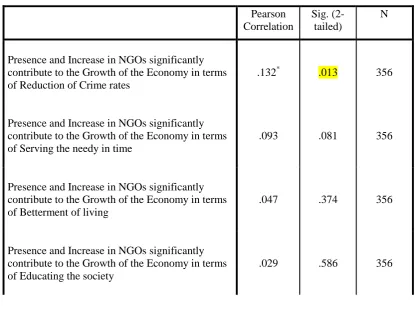
Table 3: Correlation between the Rehabilitation service offered by the NGOs and their contribution to the growth and economy
Correlations
Pearson Correlation
Sig. (2-tailed)
N
Presence and Increase in NGOs significantly contribute to the Growth of the Economy in terms of Reduction of Crime rates
.132* .013 356
Presence and Increase in NGOs significantly contribute to the Growth of the Economy in terms of Serving the needy in time
.093 .081 356
Presence and Increase in NGOs significantly contribute to the Growth of the Economy in terms of Betterment of living
.047 .374 356
Presence and Increase in NGOs significantly contribute to the Growth of the Economy in terms of Educating the society
© Associated Asia Research Foundation (AARF)
A Monthly Double-Blind Peer Reviewed Refereed Open Access International e-Journal - Included in the International Serial Directories. Page | 199 Presence and Increase in NGOs significantly
contribute to the Growth of the Economy in terms of Reduction of poverty
.065 .221 356
*. Correlation is significant at the 0.05 level (2-tailed).
Inference
From the above table, it can be found that at 95% significance level (p-value < 0.05), there is
a positive correlation between the Rehabilitation service offered by the NGOs and their
contribution to the growth and economy in terms of reduction in the crime rates. Therefore,
the Rehabilitation services offered by the NGOs mainly work towards reduction in the crime
rates as compared to any other factors contributing to the growth and economy. Hence H0 is
rejected.
Counselling Services
H0: There is no significant association between the Counselling service offered by the NGOs
and their contribution to the growth and economy
H1: There is a significant association between the Counselling service offered by the NGOs
[image:10.595.75.516.461.721.2]and their contribution to the growth and economy
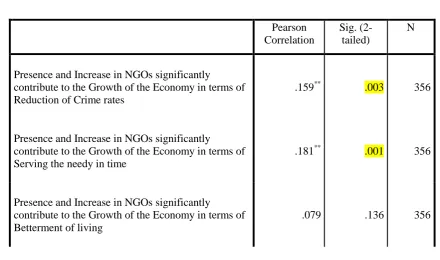
Table 4:Correlation between the Rehabilitation service offered by the NGOs and their contribution to the growth and economy
Correlations
Pearson Correlation
Sig. (2-tailed)
N
Presence and Increase in NGOs significantly
contribute to the Growth of the Economy in terms of Reduction of Crime rates
.159** .003 356
Presence and Increase in NGOs significantly
contribute to the Growth of the Economy in terms of Serving the needy in time
.181** .001 356
Presence and Increase in NGOs significantly
contribute to the Growth of the Economy in terms of Betterment of living
© Associated Asia Research Foundation (AARF)
A Monthly Double-Blind Peer Reviewed Refereed Open Access International e-Journal - Included in the International Serial Directories. Page | 200 Presence and Increase in NGOs significantly
contribute to the Growth of the Economy in terms of Educating the society
.161** .002 356
Presence and Increase in NGOs significantly
contribute to the Growth of the Economy in terms of Reduction of poverty
.156** .003 356
Rate the Counselling service 1 356
**. Correlation is significant at the 0.01 level (2-tailed).
Inference
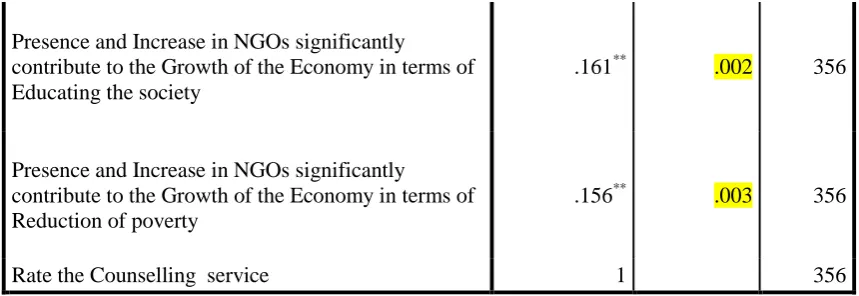
From the above table, it can be found that at 99% significance level (p-value < 0.01), there is
a positive correlation between the Counselling service offered by the NGOs and their
contribution to the growth and economy in terms of reduction in the crime rates, serving the
needy in time, educating the society & reduction of poverty. Hence H0 is rejected.
Socialization Services
H0: There is no significant association between the Socialization services offered by the
NGOs and their contribution to the growth and economy
H1: There is a significant association between the Socialization services offered by the NGOs
and their contribution to the growth and economy
Table 5:Correlation between the Socialization services offered by the NGOs and their contribution to the growth and economy
Correlations
Pearson Correlation
Sig. (2-tailed)
N
Presence and Increase in NGOs significantly contribute to the Growth of the Economy in terms of Reduction of Crime rates
.146** .006 356
Presence and Increase in NGOs significantly contribute to the Growth of the Economy in terms of Serving the needy in time
[image:11.595.83.513.35.183.2]© Associated Asia Research Foundation (AARF)
A Monthly Double-Blind Peer Reviewed Refereed Open Access International e-Journal - Included in the International Serial Directories. Page | 201
Presence and Increase in NGOs significantly contribute to
the Growth of the Economy in terms of Betterment of living .189
**
.000 356
Presence and Increase in NGOs significantly contribute to the Growth of the Economy in terms of Educating the society
.236** .000 356
Presence and Increase in NGOs significantly contribute to
the Growth of the Economy in terms of Reduction of poverty .238
**
.000 356
Rate the Socialization service 1 356
**. Correlation is significant at the 0.01 level (2-tailed).
Inference
From the above table, it can be found that at 99% significance level (p-value < 0.01), there is
a positive correlation between the Socialization services offered by the NGOs and their
contribution to the growth and economy in terms of reduction in the crime rates, serving the
needy in time, betterment of living, educating the society & reduction of poverty.
Socialization services offered by the NGOs seem to be a very significant service as it
contributes to almost all the factors of growth & economy. Hence H0 is rejected.
Medical Services
H0: There is no significant association between the Medical services offered by the NGOs
and their contribution to the growth and economy
H1: There is a significant association between the Medical services offered by the NGOs and
their contribution to the growth and economy
Table 6:Correlation between the Medical services offered by the NGOs and their contribution to the growth and economy
Correlations
Rate the Medical Facilities service
Pearson Correlation
Sig. (2-tailed)
N Presence and Increase in NGOs significantly
contribute to the Growth of the Economy in terms of Reduction of Crime rates
.061 .252 356
Presence and Increase in NGOs significantly
contribute to the Growth of the Economy in terms of Serving the needy in time
[image:12.595.75.523.584.729.2]© Associated Asia Research Foundation (AARF)
A Monthly Double-Blind Peer Reviewed Refereed Open Access International e-Journal - Included in the International Serial Directories. Page | 202 Presence and Increase in NGOs significantly
contribute to the Growth of the Economy in terms of Betterment of living
.149** .005 356
Presence and Increase in NGOs significantly
contribute to the Growth of the Economy in terms of Educating the society
.141** .008 356
Presence and Increase in NGOs significantly
contribute to the Growth of the Economy in terms of Reduction of poverty
.111* .036 356
Rate the Medical Facilities service 1 356
**. Correlation is significant at the 0.01 level (2-tailed). *. Correlation is significant at the 0.05 level (2-tailed). Inference
From the above table, it can be found that at 99% significance level (p-value < 0.01), there is
a positive correlation between the Medical services offered by the NGOs and their
contribution to the growth and economy in terms of serving the needy in time, betterment of
living, & educating the society. And at 95% significance level (p-value < 0.05), there is a
positive correlation between the medical services offered by the NGOs and their contribution
to the growth and economy in terms of reduction of poverty. Hence H0 is rejected.
Education Services
H0: There is no significant association between the Education services offered by the NGOs
and their contribution to the growth and economy
H1: There is a significant association between the Education services offered by the NGOs
and their contribution to the growth and economy
Table 7:Correlation between the Education services offered by the NGOs and their contribution to the growth and economy
Correlations
Pearson Correlation
Sig. (2-tailed)
N
Presence and Increase in NGOs significantly contribute to the
[image:13.595.77.518.34.224.2]© Associated Asia Research Foundation (AARF)
A Monthly Double-Blind Peer Reviewed Refereed Open Access International e-Journal - Included in the International Serial Directories. Page | 203 Presence and Increase in NGOs significantly contribute to the
Growth of the Economy in terms of Serving the needy in time .202
**
.000 356
Presence and Increase in NGOs significantly contribute to the
Growth of the Economy in terms of Betterment of living .212
**
.000 356
Presence and Increase in NGOs significantly contribute to the
Growth of the Economy in terms of Educating the society .259
**
.000 356
Presence and Increase in NGOs significantly contribute to the
Growth of the Economy in terms of Reduction of poverty .162
**
.002 356
Rate the Education service 1 356
**. Correlation is significant at the 0.01 level (2-tailed).
Inference
From the above table, it can be found that at 99% significance level (p-value < 0.01), there is
a positive correlation between the Education services offered by the NGOs and their
contribution to the growth and economy in terms of serving the needy in time, betterment of
living, educating the society & reduction of poverty. Hence H0 is rejected.
Employment Services
H0: There is no significant association between the Employment services offered by the
NGOs and their contribution to the growth and economy
H1: There is a significant association between the Employment services offered by the NGOs
and their contribution to the growth and economy
Table 8:Correlation between the Employment services offered by the NGOs and their contribution to the growth and economy
Correlations
Pearson Correlation
Sig. (2-tailed)
N
Presence and Increase in NGOs significantly contribute to the
Growth of the Economy in terms of Reduction of Crime rates .107
*
.044 356
Presence and Increase in NGOs significantly contribute to the
Growth of the Economy in terms of Serving the needy in time .168
**
[image:14.595.60.536.33.254.2]© Associated Asia Research Foundation (AARF)
A Monthly Double-Blind Peer Reviewed Refereed Open Access International e-Journal - Included in the International Serial Directories. Page | 204
Presence and Increase in NGOs significantly contribute to the
Growth of the Economy in terms of Betterment of living .082 .124 356
Presence and Increase in NGOs significantly contribute to the
Growth of the Economy in terms of Educating the society .194
**
.000 356
Presence and Increase in NGOs significantly contribute to the
Growth of the Economy in terms of Reduction of poverty .173
**
.001 356
Rate the Employment Opportunities service 1 356
**. Correlation is significant at the 0.01 level (2-tailed). *. Correlation is significant at the 0.05 level (2-tailed).
Inference
From the above table, it can be found that at 99% significance level (p-value < 0.01), there is
a positive correlation between the Employment services offered by the NGOs and their
contribution to the growth and economy in terms of serving the needy in time, educating the
society & reduction of poverty. And at 95% significance level (p-value < 0.05), there is a
positive correlation between the Employment services offered by the NGOs and their
contribution to the growth and economy in terms of reduction of crime rates. Hence H0 is
rejected.
Conclusion
The widespread belief that NGOs are more successful in reaching the poor in poverty
reduction also resulted in rapid growth of funding for NGOs by government and external
donors. As far as the government funding is concerned, there are over 200 government
schemes initiated by the central and state governments through which NGOs can have direct
access to resources for rural development (Reddy and Rajasekhar 1996).
In recent times, many Non-Governmental organisations have been concentrating
social mobilization on contemporary issues of importance such as women empowerment,
human rights, and implementation of various central and state government development
programmes. The NGOs in India have contributed handsomely towards social mobilization
and social activism through their intensive campaigns, people’s mobilization programmes
and effective networks.The NGO as a social force facilitates collective action and people
© Associated Asia Research Foundation (AARF)
A Monthly Double-Blind Peer Reviewed Refereed Open Access International e-Journal - Included in the International Serial Directories. Page | 205
various people-oriented as well as people-centred strategies, and these organizations build
rapport with the people and mobilize them. The NGOs play in making the people
environmentally aware and sensitive to take part in the development process (Biswambhar
Panda et.al -2003).
Before the restoration of democracy, NGOs were not allowed to be registered and
operate.After reestablishment of democracy NGOs, could play an effective role in many
people oriented programs such as health, family planning, environment and non -formal
education. Since democracy provided an opportunity to NGOs, it could be said that the
existences of NGOs is intimately linked with democracy in Nepal. At present NGOs are
playing a very important role to provide health services to the population in rural areas.
Similarly it has done remarkable work in the field of literacy, family planning, population,
environmental conservation and development of non-formal education.
Non-governmental organizations (NGOs) have played a significant role in the last few
decades in not only helping bridge this gap, but also by creating low cost replicable models of
care. NGOs are active in a wide array of areas such as child mental health, schizophrenia and
psychotic conditions, drug and alcohol abuse, dementia etc. Their activities have included
treatment, rehabilitation, community care, research, training and capacity building, awareness
and lobbying.
There is a need to more effectively include NGOs in all aspects of health research in
order to maximize the potential benefits of research. NGOs, moreover, can and should play
an instrumental role in coalitions for global health research, such as the CGHRC. With a
renewed sense of purpose and a common goal, NGOs and their partners intend to make
strong and lasting inroads into reducing the disease burden of the world's most affected
populations through effective research action.
References:
o Anand, V.K. (2001), “Avenue for Sustainable Empowerment of Rural Women”,
Social Welfare, Vol.48, No.4, July, Pp.24-26
o Deepti, Agarwar. (2001). “Empowerment of Rural Women in India” , Social Welfare,
© Associated Asia Research Foundation (AARF)
A Monthly Double-Blind Peer Reviewed Refereed Open Access International e-Journal - Included in the International Serial Directories. Page | 206 o Rao, Vasudeva D. and A.P. Rao. (2000) “Swaskti Bank – Of the community,By the
Community, For the Community”, SocialWelfare, August,Pp.3-8
o Sinha, Kalpana (ed). (2000 Empowerment of Women in south Asia,AMDISA and
SAARC. Hyderabad.
o Vijaya Kumar, S. 2002. Devadasis – Social Problems in India – Series 1,National
Commission for Women, Hyderabad: Councilfor Social Development (memio)
o Laxmi R. Kulshrestha , et.al. 2002. “ NGO in micro finance Partners in Rural
Development” Kuruksheta, February issues.
o Binay Kumar Sahay, 2002 “Empowering Community for Sustainable Livelihood
throughJankar System” Kuruksheta, Februaryissues.
o Kurukshetra, November 2004 “Rajive Gandhi National Drinking Water Mission
Committed to providing Safe Drinking Water”.
o AdityaKeshari Mishra, 2004. “Social Capital- alternative model for viable
development.” Kurukshetra, Novermber 2004
o Butler P: Health research for development: the continuing challenge. A discussion
paper. International Conference on Health Research for Development, Bangkok. 10–
13 October 2000, [http://www.conference2000.ch//pdf/discussionpaper.pdf]
o UNDP: Human Development Report 2002: Deepening Democracy in a Fragmented
World. New York. 2002
o Brundtland GH: Address at the First Steering Committee Meeting. International
Conference on Health Research for Development: Geneva. April 30, 1999,
[http://www.who.int/director-general/speeches/1999/english/19990430_ichrd.html]
o Labonte R, Spiegel J: Setting global health priorities for funding Canadian
researchers: A discussion paper prepared for the Institute on Population and Public
Health. 2001, Saskatchewan: SPHERU, [http://www.cghcr.ca/documts.htm#1]
o Labonte R, Spiegel J: Setting global health priorities. Brit Med J. 2003, 326: 722-3.
o Commission on Health Research and Development: Health Research: Essential Link
to Equity for Development Commission on Health Research for Development. 1990,