GE-International Journal of Engineering Research
Vol. 4, Issue 8, August 2016 IF- 4.721 ISSN: (2321-1717) © Associated Asia Research Foundation (AARF) Publication
Website: www.aarf.asiaEmail : [email protected] , [email protected]
DESIGN, DEVELOPMENT AND PERFORMANCE EVALUATION OF
PORTABLE ONION DICING TOOL
S. Bhuvaneswari,1 R. Udhayakumar2, R. Kailappan3 and G. Senthil kumaran1 ICAR-Indian Institute of Horticultural Research, Bengaluru- India
1
Division of Post Harvest Technology, ICAR-IIHR, Bengaluru. 2
Department of Agriculture and Animal Husbandry,Gandhigram Rural Institute, Gandhigram, Tamilnadu.
3
Professor(Retd), Department of Agricultural and Food Processing, Agrl. Engg college and Res. Institute, TNAU, Coimbatore.
ABSTRACT
Onion (Allium cepa L.) is an edible bulb. Onion is also widely used in soups, pickles
and cooked vegetable dishes, sauces Peeling, Cutting, Slicing and Chopping are considered
as major unit operations involved in onion processing. At present cutting of onion in mass
for various receipies is done by hand using knives in small restaurants and street vendors
which is laborious, time consuming and causing much strain to hands and eye. In order to
reduce the drudgery, a hand-operated onion dicing tool working on the principle of levers
was designed and developed. The tool consisted of cutting blade, punching frame, outlet
container for collecting diced onion. The onion dicing tool is capable of making 9 dices each
having size 8x8 mm. The cutting efficiency of dicing tool was found to be 97.23%. The cost
of the dicing tool was worked out to Rs. 5000/- with an average capacity of 60kg/h. More
over this onion dicing tool will prevent the drudgery of cutting onion in large quantities.
Key words: Onion dicing, tool, cutting, efficiency, capacity, time saving. Introduction
Onion (Allium cepa L.) is an edible bulb. While it is a vegetable at heart, it also acts as
major ingredient. The colour varies from white to red to purple, the shape from spherical to
almost conical, and the diameter at the largest point from 10mm to 8cm or more. Onion is the
fourth most important commercial vegetable crop in India covering an area of 10.52 lakh
hactares which is 11.4 % of total vegetable area. The production of onion in the country is
168.13 lakh tonnes accounting for 10.4% of the total vegetable production
(Anonymous,2010). India is the second largest onion growing country in the world. Indian
onions are famous for their pungency and are available round the year. Onion is basically
used for flavouring in cooking. It is used as a vegetable, or as a spice to bring out the flavour
of other dishes without overpowering them. It often accompanies meat - especially mince and
meat dishes such as shepherd’s pie and meat loaf which would be insipid without it. Onion is
also widely used in soups, pickles and cooked vegetable dishes, sauces, hearty casseroles,
bean and lentil dishes (www. agricultural products india.com,2015).
Peeling, Cutting, Slicing and Chopping are considered as major unit operations
involved in onion processing. At present cutting of onion is done by hand using knives in
small restaurants and street fast food vendors for the preparation of various snack foods using
onion. The sharpness of the blade plays a major role in peeling and cutting. Cutting of the produce
with dull blades and knives causes bruising and damage to more tissue layer than intended. The
sharpness of the knife blade affects the product storage life ( Bolin and Huxsoll,1991 ).
The cutting of onion by hand is laborious, time consuming and causing much strain
to hands and eye. The power operated onion slicer which are available at present will not
serve the purpose of mobile street fast food vendors as they cannot get power supply
wherever they go. Hence, a manually operated onion dicing tool onion dicing has been
developed which will cater to the need of mobile street fast food vendors. The features and
performance of onion dicing tool is explained in this research paper
Materials and methods
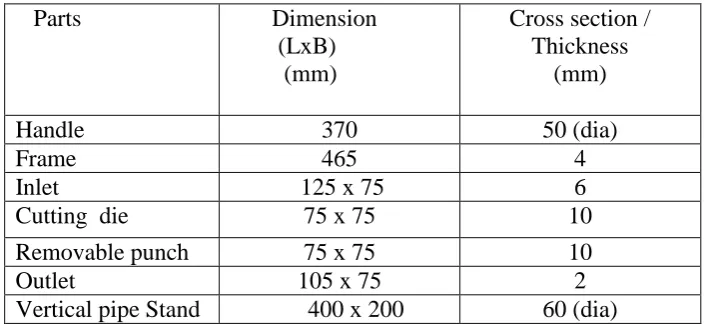
The design specification of hand operated onion dicing tool is given in Table 1. The
dicing tool consists of two components namely a removable cutting grid of size 75x75 mm
with slots of 8x8 mm size. Cutting of vegetables by using grid type cutting surface was
developed and tested by Tony Thomas et al. (2014). A removable punch size 75x75 mm is
provided with 8 mm thick protruding pegs to move into the slot during cutting. The unit is
component of the tool which works on the principle of lever mechanism and is used for
transmitting the force required for cutting the fruit (Ambrish Ganachari et.al. 2008) is made
up of mild steel shaft of 50mm diameter with adjustable length of 370-470 mm. The shaft is
placed at a height of 465 mm from the bottom of the stand. The tool is provided with an inlet
of 125 x 75 mm size on the side. The outlet has a detachable container of 105 x 75 mm size
and kept below the cutting surface. The cutting die and punch are fixed in detachable form
for cleaning as and when required. The polar and equilateral diameters of the onion used to
determine the cutting surface of onion dicing tool. Out of total quantity of onion taken, peel
accounted for 20%. The peeled onion was used for testing the dicing tool.
The detailed specifications of the developed hand operated onion dicing tool is given in
Table :1. The capacity of the hand operated onion dicing tool was found to be 60kg/h for the
onion having polar diameter (60-65 mm) and equilateral diameter (50-55 mm). The tool was
capable of making 9 onion dices each having size of 8x8 mm. The onion after peeling was
subjected to dicing. Out of total quantity of onion taken, peel accounted for 20%. The peeled
[image:4.595.104.458.213.378.2]onion was used for testing the dicing tool.
Table: 1. Design specifications of the developed hand operated onion dicing tool
Parts Dimension
(LxB) (mm)
Cross section / Thickness
(mm)
Handle 370 50 (dia)
Frame 465 4
Inlet 125 x 75 6
Cutting die 75 x 75 10
Removable punch 75 x 75 10
Outlet 105 x 75 2
Vertical pipe Stand 400 x 200 60 (dia)
Results and discussions
Performance Evaluation of the Tool
A portable onion dicing tool working on lever principle was evaluated for its comparative
performance over conventional method by using plain sharp knife was done by engaging 50
and 28 years old women and 25 years old man. The performance of the developed onion
dicing tool was evaluated based on its capacity, cutting efficiency, percent whole onion dices
recovery, percent un diced onion (shreds) recovery. The economics of the developed tool was
estimated by considering the cost of the raw materials, overhead charges and labour charges
by using onion dicing tool and by conventional cutting method. The cost of operation was
calculated by estimating the fixed cost and variable cost for onion dicing using tool in
By dicing tool By plain sharp knife Fig.2 Comparitive Performance evaluation of onion dicing tool
The mean cutting efficiency of the dicing tool was found to be 97.23 per cent having
an average cut piece weight of 64g with the cut pieces of size 8 mm (approx). The diced
onion was 97% and un diced onion was 2.5% (Fig.2). The developed tool could be easily
operated even by women aged 50 years with dicing rate of 60kg/h compared to women aged
28 years 65kg/h and men aged 25 years 70kg/h. The cutting efficiency was higher than
conventional method of cutting by hand using knife Moreover the operation of the tool is so
simple and could be easily operated by middle aged women without any drudgery to the
hands. The visual observation as well as the operators opinion about using dicing tool was
that it did not give much strain to the eyes and hands during continuous onion dicing
operation.
A hand operated tool for onion dicing was designed and developed. The developed
onion dicing tool had a capacity of 60 kg/h. The efficiency of cutting of the tool was
97.23%. The cost of the tool was Rs. 5000/-. The cost saving in operation over conventional
methods was 44% and time saving in operation over conventional method was 71%. This
portable manual operated dicing tool will be convenient and beneficial for small restaurants
and street food vendors.
REFERENCES
1.Anonymous, 2012. How does cutting, slicing and chopping affect fresh vegetables. In: the world’s healthiest foods. July 15-21(www.whfoods.com/genpage.phpt name=George&dbid=345 accessed on 12.9.13) .
3. Bolin H.R and C.C Huxsoll.1991. Control of minimally processed carrot (Daucus carota) surface discolouration caused by abrasive peeling. Journal of Food Science, 56: pp. 416-418.
4. http://www.agriculturalproductsindia.com/vegetables/vegetables-onions.html accessed on 20.10.2015